
If you run an electronics business targeting the Japanese market, you will most likely hear the term “TELEC certification” as long as your products have wireless functions such as Bluetooth and WiFi. Many people are confused when they first encounter it: Is it mandatory? What is the difference from the commonly mentioned PSE certification? If I use a wireless module that already has a certificate, does the whole device not need to apply for it? Will it cost a lot of money and take a long time?
This article will start with the most basic judgment, break down the entire process from preparation to obtaining the certificate step by step, and also tell you how to avoid pitfalls and how to judge whether product changes require retesting. Even if you are a complete beginner who has never been exposed to it, you will be able to make most judgments independently after reading it and avoid many detours.
First, Understand the Basics: Does Your Product Need TELEC Certification?
This is the starting point of all questions, and also the place where cognitive misunderstandings are most likely to occur. Let’s start with the most basic definition.
What is TELEC Certification?
Simply put, TELEC certification is a mandatory market access permit for radio transmitting equipment in Japan, based on Japan’s . Its core purpose is to prevent various wireless signals from interfering with each other — for example, your home WiFi cannot interfere with your neighbor’s Bluetooth headset, and walkie-talkies cannot interfere with airport communication systems.
Many people think TELEC is a Japanese government department, but it is not. The body responsible for formulating rules and supervising the entire system is the Ministry of Internal Affairs and Communications of Japan (abbreviated as MIC), while TELEC (Telecommunication Engineering Center) is one of the private certification bodies authorized by MIC. In addition to TELEC, MIC-authorized institutions such as JQA and TÜV can also issue certificates with the same effect, so you don’t have to stick to TELEC only.
Products that pass the certification can be affixed with the Giteki Mark (full name: “Technical Conformity Certification Mark”, which is the official mark for radio compliance in Japan), which is a necessary credential for products to be legally sold in Japan and clear customs smoothly.
Don’t Confuse Them: TELEC, PSE, and JATE Regulate Different Things
Many beginners confuse these three certifications, but in fact, they regulate completely different dimensions and cannot replace each other:
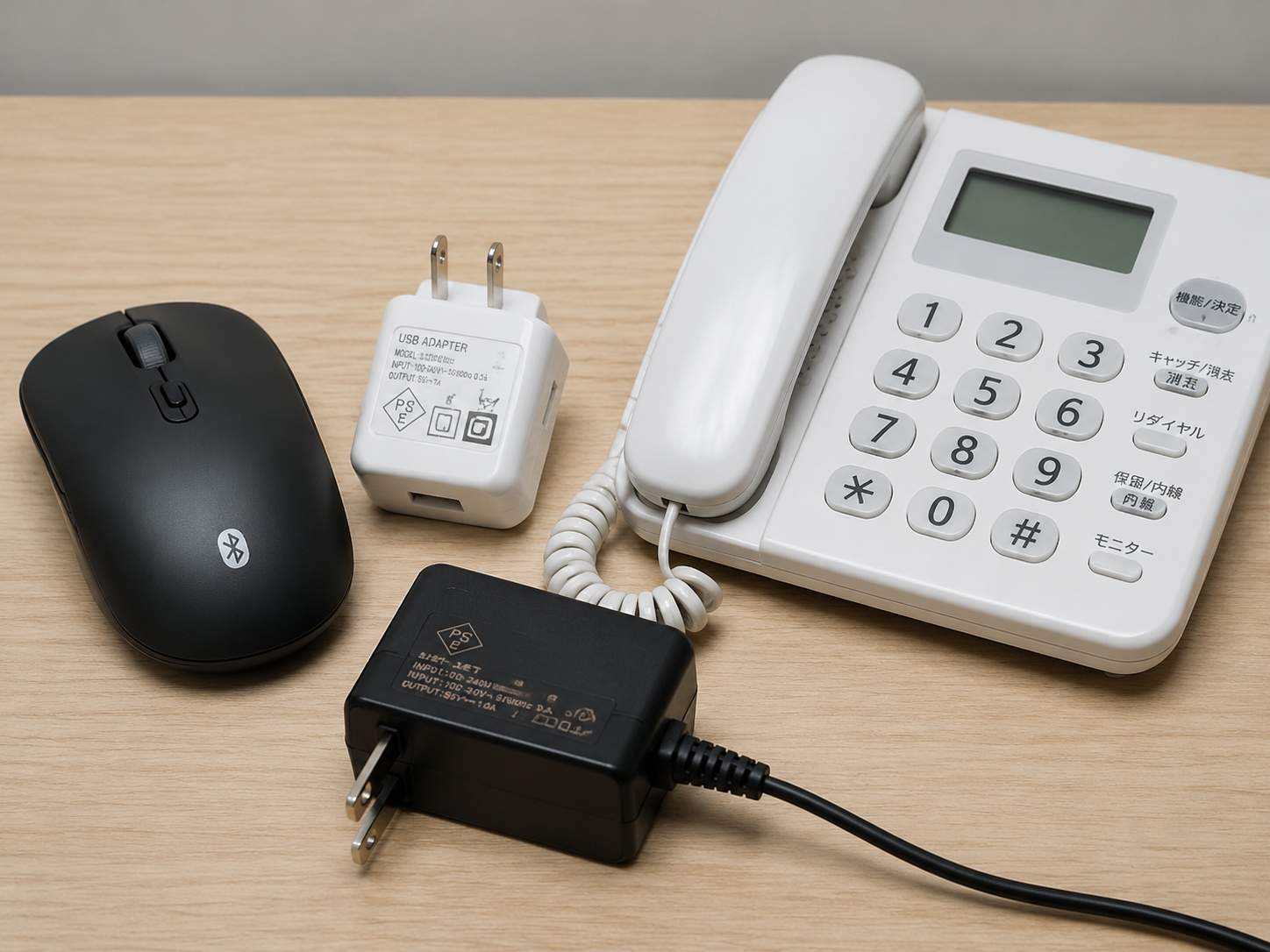
| Certification Type | Core Regulation Direction | Legal Basis | Examples of Applicable Products |
| TELEC | Radio transmission parameters (frequency, power, interference level, etc.) | Bluetooth mice, WiFi routers, walkie-talkies | |
| PSE | Electrical safety (preventing electric shock, fire, etc.) | Power adapters, chargers, plug-in electrical appliances and other regulated electrical products | |
| JATE | Telecommunications network access compatibility | Landline phones connected to telephone lines, communication equipment accessing operator networks |
For example: a smart power strip with WiFi needs PSE certification to ensure electrical safety because it is plugged in; and because it has WiFi transmission function, it needs TELEC certification to ensure wireless signal compliance. Both certificates are required, as they regulate different matters.
In addition, it should be clear that MIC is the regulatory authority and TELEC is the certification body. They are not two independent certifications, but have different division of labor.
Quick Judgment: Does Your Product Need to Apply?
As long as three conditions are met at the same time, TELEC certification is required:
1. Planned to be sold or used for a long time in Japan: If you only bring prototypes to Japan for temporary exhibitions, there are special temporary import or test certification channels, and you do not need to apply for formal certification for mass production.
2. With active radio transmission function: Not all electrical products need it, only those that actively transmit radio signals outward — for example, ordinary wired keyboards do not need it, but Bluetooth keyboards do; pure-reception radios do not need it, but walkie-talkies that can transmit signals do.
3. Not on the official exemption list of the Ministry of Internal Affairs and Communications of Japan: Some very short-range micro-power devices may be exempted, but you must check the official MIC list, and cannot judge based on the experience that “low power means no need to apply”.
Common Mandatory, Exempt, and Boundary Scenarios
To make it easier for you to understand, we have sorted out several common situations:
• Typical products that require certification: Devices with Bluetooth/WiFi/Zigbee/LoRa/4G/5G functions, walkie-talkies, wireless microphones, active RFID readers, wireless remote controls (such as remote control toys, garage door remote controls).
• Typical exemption situations: Pure-reception devices without transmission, very short-range micro-power devices announced by MIC (subject to the official list).
• Boundary scenarios: Overseas merchants bringing prototypes to Japan for exhibitions can go through test certification or temporary import procedures, and do not need to apply for type certification for mass production, but these prototypes cannot be used for batch sales.
What If You’re Not Sure? Two Formal Channels to Help You Judge
If you are still not sure whether your product needs to apply, you can confirm through two formal channels:
1. Check the list published by the Ministry of Internal Affairs and Communications of Japan to verify whether the product falls within the scope requiring certification or exemption.
2. Find a laboratory with MIC authorization qualification to do a free pre-evaluation. As long as you provide complete product wireless parameters, you can usually get an initial judgment quickly. The specific cycle depends on the completeness of the materials and the scheduling of the institution, so you don’t have to struggle with Japanese official documents by yourself.
Choose the Right Path Before Applying: Cut Detours by Half
After confirming that you need to apply, don’t rush to send samples. Choosing the right certification type and application channel can save you a lot of time and money.
Two Certification Types: Don’t Choose the Wrong One
TELEC certification is divided into two types, with completely different applicable scenarios. If you choose the wrong one, it will either be unusable or a waste of money:
| Certification Type | Applicable Scenarios | Coverage | Validity Period |
| Type Certification | General models for mass production and sales | Covers all mass-produced products of the same model | No fixed validity period, the industry generally refers to 5 years; standard updates or product changes will cause invalidation |
| Test Certification | Single/small-batch prototypes, custom equipment, exhibition samples | Only valid for the single or small-batch products submitted for inspection | Only corresponds to the submitted batch, cannot be used for mass production and sales |
There is a simple mnemonic to remember: Choose type certification for mass production sales, choose test certification for prototypes, custom products, and exhibitions.
Using a Certified Wireless Module? It Can Be Simplified but Not Exempted
Many people ask: The Bluetooth module I use already has a TELEC certificate, so does the whole device not need to apply? The answer is: testing can be simplified, but it cannot be exempted.
Simplification has strict prerequisites, which must be met at the same time:
• The wireless module itself has obtained type certification from an MIC-authorized institution;
• The finished product does not change any transmission parameters of the module;
• Use the antenna and installation method specified by the module manufacturer;
• The shielding structure of the finished product is consistent with the reference design of the module manufacturer.
If these conditions are met, there is no need to retest the core RF parameters of the module, and only the compliance confirmation of the finished product is required, which can save part of the testing fee and time.
However, if there is any of the following changes, the simplified process cannot be used, and full testing is required: changing the antenna, adjusting the transmission power, modifying the RF circuit, updating the transmission logic in the firmware, or changing the shielding structure.
It must be noted here: Module certification ≠ whole device exemption from certification. It only reduces test items, and the whole device still needs to obtain its own TELEC certificate to be sold legally.
How Do Overseas Users Apply? Choose the Most Suitable One from Three Channels
For overseas merchants or developers, there are three main channels to apply for TELEC certification:
1. Entrust an MIC-recognized third-party laboratory/agent: This is the most commonly used method. You don’t need to make a special trip to Japan. The agent will provide local Japanese contact service (one of the necessary conditions for application) and help you with testing and review throughout the process, which is suitable for most overseas small and medium-sized sellers.
2. Entrust a local Japanese certification body: Such as JATE, JQA and other local authorized institutions in Japan, suitable for merchants who have Japanese communication skills and have contacts in Japan.
3. Submit to an MIC-authorized institution by yourself: You need to have fluent Japanese communication skills and a fixed local Japanese contact person responsible for regulatory matters, which is suitable for entities with corresponding resources.
For the vast majority of overseas small and medium-sized sellers, prioritizing a third-party agent with formal MIC qualifications is the most cost-effective way. The time and communication costs saved are far higher than the service fee.
Can Multiple Models Be Applied for Together? It Depends on Whether the Wireless Part Is the Same
If you have multiple product models and want to apply together to reduce costs, the core judgment criterion is: whether the core wireless design is completely consistent.
If multiple models share the same RF chip, the same RF circuit, and the same antenna solution, and only differ in appearance color and non-RF functions (such as the noise reduction function of headphones, the backlight function of keyboards), they can be applied for together.
If the RF parameters, usage scenarios, or transmission methods are different, they cannot be combined.
It should also be reminded that combined application can reduce the average cost per model, but it will not significantly shorten the overall cycle, because the review process still has to go through normally, except that there is no need to repeat the wireless part test.
Prepare These in Advance: Avoid Repeated Corrections and Rework
When many people apply for certification, the total cycle is dragged out not because the test fails, but because the materials or prototypes do not meet the requirements and are repeatedly corrected. Preparing in advance can reduce rework by at least half.
List of Required Materials
The materials required for application can be divided into three categories. Sorting them out in advance can save a lot of trouble:
1. Basic product materials: Product manual in English or Japanese, wireless parameter table (frequency band, transmission power, modulation method, number of channels, etc. must be clearly stated), list of models applying for certification.
2. Technical materials: Circuit block diagram or schematic diagram (the wireless link part should be highlighted), antenna specification sheet (including antenna type, gain, installation position, whether it is replaceable, etc.), whole device photos (the appearance, interfaces, internal layout, and antenna position must be clearly photographed).
3. Compliance materials: Product label design draft (space must be reserved for the Giteki Mark and certification number), applicant’s qualification documents (such as business license), and if a certified wireless module is used, the module’s certification certificate must also be provided.
Prototype Preparation Requirements
The state of the prototype directly affects the test results, so it must be prepared according to the requirements:
• Quantity: Normally 2-3 units, which is adjusted according to the product category and number of frequency bands. For example, multi-band devices may need to provide one more unit.
• State: It must be the final version close to mass production, and there must be no temporary flying leads, debug mode, or temporary antennas, otherwise the test results will be invalid.
• Accessories: All accessories such as original antennas, power supplies, and connecting cables must be included, consistent with the final sales configuration.
• Firmware requirements: Lock the firmware version submitted for inspection, and there must be no hidden functions that can switch to non-compliant frequency bands (such as enabling frequency bands not allowed in Japan through engineering mode).
The Most Common Pitfall: Inconsistent Materials
One of the high-frequency reasons for corrections is inconsistent materials, which can be completely avoided in advance. Be sure to check these points before submission:
1. The model, frequency band, and power on the manual, label, parameter table, and test prototype are completely consistent — for example, if the manual says Bluetooth 5.3 and the parameter table says 5.2, you will definitely be required to make corrections.
2. The descriptions of the wireless part in the circuit block diagram, physical photos, and antenna specification sheet can confirm each other — for example, if the antenna is on the left side of the motherboard in the block diagram but on the right side in the physical photo, it will be questioned.
3. Overseas entities should confirm the complete information of the Japanese contact person in advance, which is a necessary condition for the application. Don’t wait until the review to supplement it.
Full Process Breakdown: 6 Steps from Pre-Evaluation to Obtaining the Certificate
After preparing the materials and prototypes, you can enter the formal application process. The entire process can be divided into 6 steps, each with checkpoints to pay attention to. Follow them and you won’t go wrong.
Step 1: Pre-Evaluation and Plan Confirmation
Before the official start, first send the product’s wireless parameters and basic information to the laboratory. The laboratory will help you verify: what standards apply, which certification type to apply for, whether the simplified process can be used, and which items need to be tested.
After that, the laboratory will issue a formal evaluation plan, which will clarify the test items, cycle, and total cost.
Checkpoint: Be sure to check whether the plan clearly states all costs, whether it applies to the simplified rules you expect, and whether there are vague charging items.
Step 2: Contract Signing and Sample Submission
After confirming that the evaluation plan is correct, you can sign the entrustment contract, pay the first installment, and then send the finalized prototypes and full set of materials to the laboratory.
Checkpoint: The contract should list all costs, and also clearly state the charging rules for retesting and corrections — for example, how much it costs for one retest, whether there is an extra charge for material corrections, to avoid disputes later.
Step 3: Pre-Test and Formal Test
This is the core link of the entire process. The test does not need to be sent to Japan, and can be completed in an MIC-recognized laboratory with testing qualifications for the corresponding category — there are also many qualified institutions in China, and the specific product categories they can undertake depend on their authorization coverage.
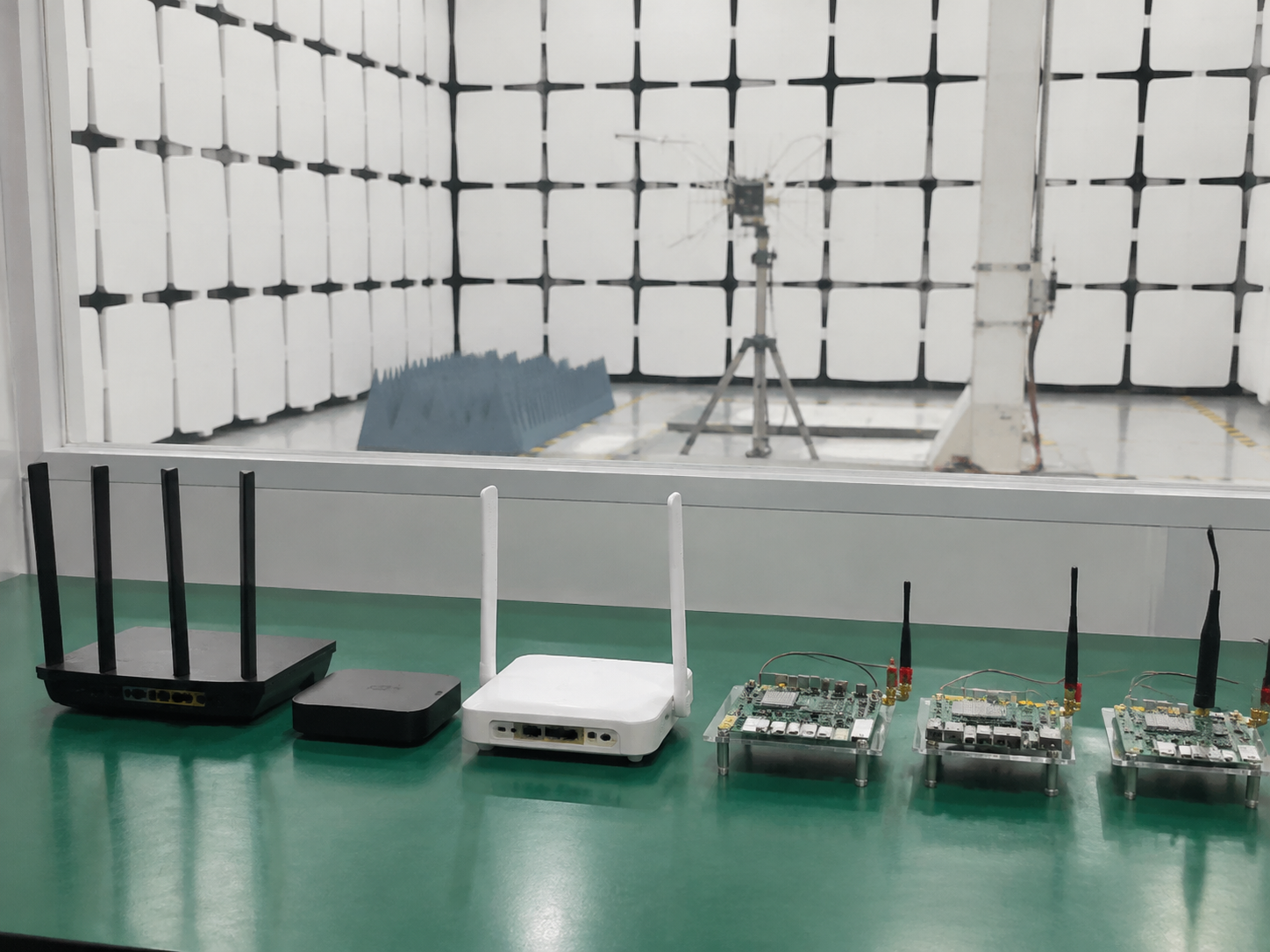
We strongly recommend doing a pre-test first: before the formal test, first investigate common problems such as power, spurious interference, and frequency offset, and rectify them in advance, which can greatly reduce the probability of failing the formal test. Although the pre-test may cost a little more money, it saves much more time and money than rectifying and retesting after failing the formal test.
The core items of the formal test are actually not difficult to understand. In plain language, there are four:
• Transmission frequency: Check whether the device works within the legal frequency band allowed in Japan, and cannot run to the wrong frequency band.
• Transmission power: Check whether the signal strength exceeds the upper limit specified in Japan, to avoid excessive power interfering with other devices.
• Occupied bandwidth: Check whether the device’s signal occupies the bandwidth of other legal frequency bands, and cannot “cross the boundary”.
• Spurious interference: Check whether the device emits extra interference signals in addition to the normal working signal.
If the test fails, the laboratory will issue specific rectification suggestions, and you can send samples for retesting after the rectification is completed.
Checkpoint: Before the formal test, be sure to check the consistency of the prototype and materials again, and don’t send the wrong version of the prototype.
Step 4: Material Submission and Japanese Side Review
After the test is passed, the laboratory will sort out the test report and full set of application materials, and submit them to the MIC-authorized certification body in Japan.
The focus of the Japanese side’s review is: whether the test report meets the requirements, whether the materials are complete, and whether all parameters are consistent before and after.
The common reasons for corrections are still those: missing materials, contradictory parameters, inconsistent model descriptions.
Checkpoint: Before submission, be sure to ask the laboratory to do a pre-review of the materials, and try to solve the problems before submission — a single correction generally extends the cycle by 1-2 weeks, which is very delaying.
Step 5: Obtaining the Certificate and Information Verification
After the review is passed, the certification body will issue a type certification certificate or test certification notice.
Don’t rush to use the certificate after you get it. Be sure to check the following information first: whether the product model is correct, whether the applicant’s information is wrong, whether the covered frequency bands and power are consistent with your product, and whether there are special applicable conditions.
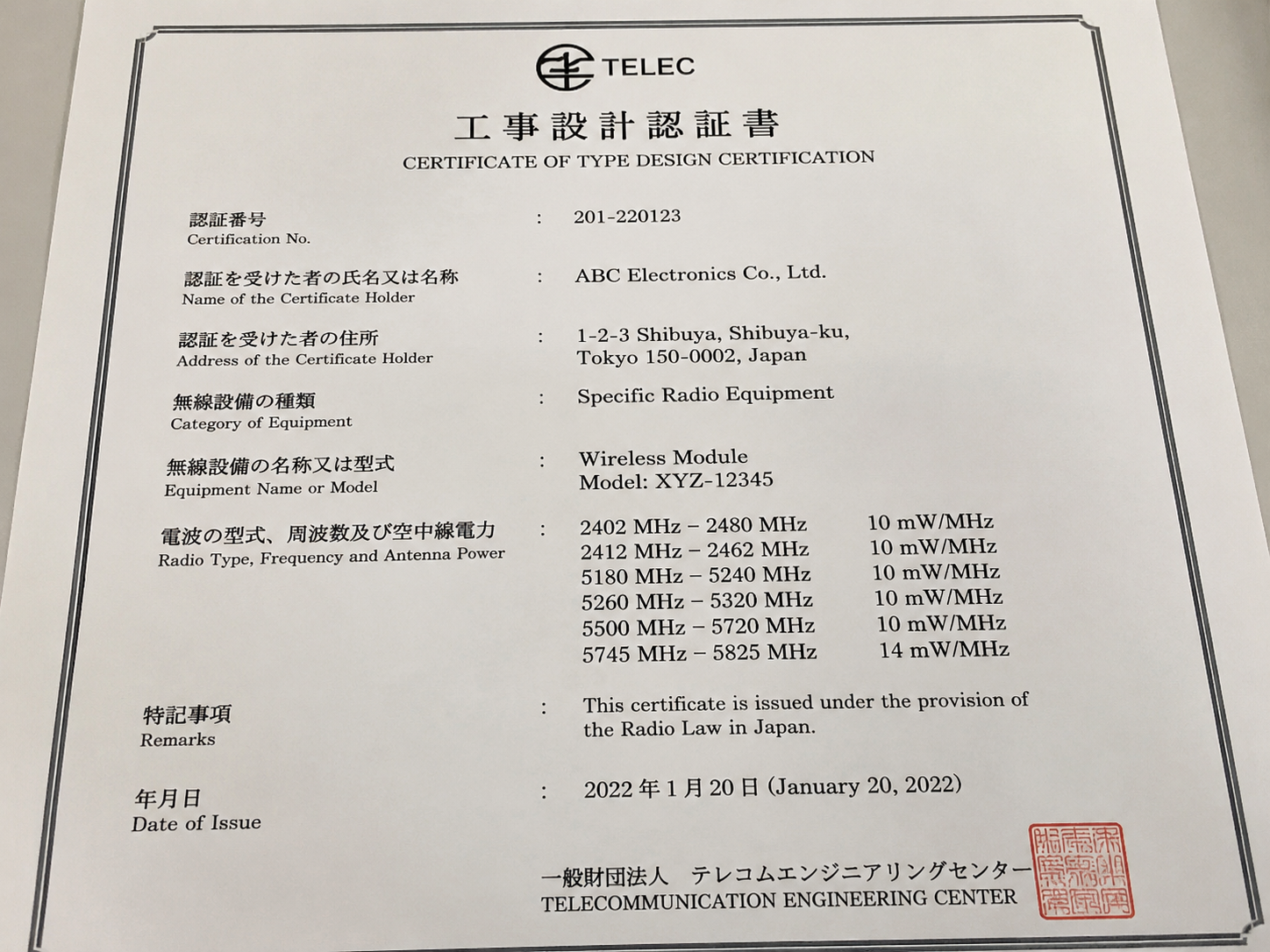
If you want to verify the authenticity of the certificate, you can enter the certificate number on the official website of the certification body or the official query system of the Ministry of Internal Affairs and Communications of Japan.
Checkpoint: All information on the certificate must be completely consistent with the information on the product nameplate and sales page, otherwise the goods may be detained during customs clearance, and e-commerce platforms may also remove your products from the shelves.
Step 6: Post-Marketing Maintenance and Change Management
Many people think that everything is fine after getting the certificate, but that’s not the case. The maintenance of the certification is also very important:
• Material retention: Certificates, test reports, and related technical documents must be retained for more than 1 year after the product is discontinued, so that they can be produced in case of random inspection by regulatory authorities.
• Validity maintenance: If relevant Japanese standards are updated, or your product is modified, you need to re-evaluate whether the certificate is still valid.
• Consistency requirements: Mass-produced products must be completely consistent with the RF part of the submitted prototype, and the transmission parameters cannot be modified without permission — for example, secretly increasing the power for better signal is a violation of the and will be punished.
Be Clear: Time, Cost, and Common Traps
Many people are most concerned about “how long it takes” and “how much it costs”, as well as how to avoid being scammed. We will explain it all at once.
Certification Cycle: Normally 4-8 Weeks, These Situations Will Extend It
Under normal circumstances, it takes 4-8 weeks from formal testing to obtaining the certificate, provided that the test is passed once and the materials are complete without corrections.
The following factors will extend the cycle:
• Failure to pass the test requires rectification and retesting;
• Multiple corrections of materials;
• The product is a complex device with multiple frequency bands and high power (such as 5G routers);
• Combined application of multiple models.
If your time is tight, formal laboratories can provide 2-3 weeks of expedited service, which requires an additional expedited fee, but all compliance review links will not be skipped, so it is impossible to “get an official certificate in 1 week”. Be sure to be vigilant when encountering claims of super fast certificate issuance.
Cost Composition and Reference Range
The cost of TELEC certification mainly consists of three parts: testing fee, certificate fee from the certification body, and agency/service fee (if you entrust an agent, including the cost of the Japanese contact person).
There are many factors that affect the cost: the number of wireless frequency bands (the more, the more expensive), transmission power (the higher, the more expensive), whether a certified module is used (using one can save part of the testing fee), whether expedited service is needed, and whether rectification is required.
Here is a general industry reference range: the overall cost of single-band low-power devices (such as Bluetooth mice) is about several thousand to 10,000 RMB; the cost of multi-band, high-power or cellular communication devices (such as 4G cameras) will be higher. The specific cost should be subject to the formal evaluation plan of the laboratory, because each product is different.
Three Common Traps of Low-Price/Super-Fast Certification
When overseas users look for partners, they are very likely to encounter these traps, which must be avoided:
1. Low-price drainage, price increase later: First quote a price far below the market price to attract you to cooperate, and then keep increasing the price in the name of “additional test items”, “rectification fee”, “material supplement fee”, etc., and the final total cost is even higher than that of formal institutions.
2. Claiming to get the certificate in 1 week, but actually it’s a fake certificate: They say they can get the certificate in 1 week or even a few days, but what they actually give is just a test report issued by the third party itself, not an official certificate authorized by MIC, which is not recognized at all during customs clearance.
3. Falsely claiming that CE/FCC can be directly converted to TELEC: Saying that having CE or FCC certification can be directly converted to TELEC without testing is completely a lie.
The way to avoid pitfalls is also very simple: first, verify the MIC official authorization qualification of the laboratory or agent; second, confirm that the certificate can be queried on the official website of MIC or the certification body; third, all costs must be listed in the contract, and there must be no vague charging items.
Already Have CE/FCC Certification? Cannot Be Directly Converted, But Can Be Referenced
Many people ask: I already have CE or FCC wireless certification, can I reuse it?
The answer is: It cannot be directly substituted. Japan has its own independent frequency planning, power limits, and testing standards. For example, some frequency bands are allowed by CE but prohibited in Japan, so it is definitely not possible to directly convert to TELEC certification.
However, if the test methods and applicable frequency bands of some test items are completely consistent, the previous test data can be submitted to the certification body as a reference, and whether it can be recognized is ultimately determined by the certification body’s review. So don’t trust the publicity of “FCC/CE to TELEC guaranteed pass”, it’s all unreliable.
Advanced Judgment: Do Product Changes Require Retesting? What Are the Common Misconceptions?
After getting the certificate, the product will inevitably have iterative updates. At this time, how to judge whether to re-do the certification? What are the common cognitive misconceptions? We have sorted out the content that needs to be mastered at the semi-proficient stage.
Do Product Changes Require Retesting? It Depends on Whether the RF Part Is Touched
The core principle of judgment is: whether the change affects the wireless transmission parameters.
If it is only the following changes, no retesting is required, and no certificate change is needed:
• Only change the appearance such as shell color and silk screen;
• Only modify the circuit of the non-RF part (such as changing the charging circuit, changing the backlight circuit);
• Only update firmware that does not involve transmission parameters (such as changing the UI interface, adding non-wireless functions).
If there is any of the following changes, re-evaluation is required, and retesting or certificate change may be needed:
• Changing the antenna or changing the installation position of the antenna;
• Adjusting transmission power and working frequency band;
• Replacing the RF chip or RF front-end circuit;
• Changing the shielding structure of the product;
• Updating firmware involving RF parameters (such as changing the modulation method, optimizing the transmission logic).
If you are not sure, the safest way is to find a laboratory to do a change evaluation in advance. Spending a small amount of money can avoid subsequent compliance risks.
Four Most Common Cognitive Misconceptions
We have sorted out the four most common cognitive misconceptions that beginners are prone to fall into, to see if you have fallen for them:
1. Misconception 1: All electrical products need TELEC: Wrong, only products with active radio transmission function need it, pure wired and pure reception products do not.
2. Misconception 2: TELEC is a Japanese government department/the only certification body: Wrong, TELEC is one of the private certification bodies authorized by MIC, and certificates from many other authorized bodies are also valid.
3. Misconception 3: Module certification = whole device exemption from testing: Wrong, the test can only be simplified if the module’s usage conditions are met, and the whole device still needs to get its own certificate.
4. Misconception 4: It’s okay to mass produce first and then make up the certificate: The risk is extremely high. Selling without a certificate may result in customs detention of goods, removal from e-commerce platforms, and fines. The rework cost is much higher than the cost of applying for certification in advance.
Compliance Boundaries for Customs Clearance and Sales
Finally, let’s emphasize the compliance requirements for customs clearance and sales, which many people stumble on:
• In accordance with the compliance requirements of the corresponding product category, mark the Giteki Mark and certification number on designated carriers such as the product body, nameplate, or minimum sales package. The size and style of the mark must comply with the relevant regulations of the Ministry of Internal Affairs and Communications of Japan.
• The model, wireless parameters, and certification number on the product nameplate, sales page, and manual must be completely consistent with the certificate, and there must be no discrepancies.
• If the requirements are not met, the light consequence is that the goods are detained by customs and removed from e-commerce platforms, and the serious consequence is that fines are imposed, and even entry into the Japanese market is prohibited.
Ready-to-Use Self-Check List: Check Before Applying to Avoid Omissions
For your quick verification, we have prepared a pre-application self-check list. You can check off items one by one to avoid omissions:
□ Whether TELEC Certification Is Required
• The product has active radio transmission function
• Planned to be sold or used for a long time in Japan
• Not within the official exemption scope of the Ministry of Internal Affairs and Communications of Japan
□ Certification Type and Path Selection
• Mass-produced general models: choose type certification
• Single/small-batch prototypes/custom equipment: choose test certification
• Using certified modules and meeting conditions: can apply for simplified process
• Overseas small and medium-sized sellers: prioritize third-party agents with MIC qualifications
□ Material and Prototype Preparation Check
• The model, frequency band, and power of all materials are completely consistent
• The prototype is the final version close to mass production, with all supporting accessories included
• The submitted firmware version has been locked, and there is no hidden function of non-compliant frequency bands
□ Preliminary Estimation of Time and Cost
• Single-band low-power devices: reserve 4-6 weeks, low budget
• Multi-band/high-power/complex devices: reserve more than 6-8 weeks, high budget
• Extra time and cost for rectification and corrections have been reserved
□ Partner Pitfall Avoidance Check
• The laboratory/agent has MIC official recognition qualification
• The quotation includes all costs, no hidden consumption
• The certificate can be queried on the official website of MIC or the certification body
• Can provide local Japanese contact service (applicable to overseas entities)
In general, the core of the entire TELEC certification process always revolves around two principles: first, the product’s RF parameters are consistent with the submitted prototype; second, the information of all materials, labels, and certificates is completely matched. If you are still unsure about the compliance requirements of your product, the safest way is to find a laboratory with MIC authorization qualification to do a pre-evaluation, clarify the direction in advance, and avoid detours.