
If you sell charging products and want to enter the Indonesian market, you have most likely heard of SNI certification. Some say all plug-in products require it, some say CE can replace it, and others say low-power products don’t need it at all — it’s hard to distinguish fact from fiction. If you run afoul of the rules, at best your goods will be detained at customs and you’ll face fines; at worst, you’ll face regulatory enforcement, recalls, seizures, penalties, or sales restrictions imposed by e-commerce platforms under their own rules. This article explains the scope of application, judgment methods, standard rules, and pitfall avoidance points of SNI certification from the perspective of charging products, so you can go from beginner to being able to make independent preliminary judgments, without being led astray by vague claims.
First, Understand the Basic Logic of SNI
First, clarify the core underlying logic, so that subsequent judgments will not be confused.
SNI itself is a product technical requirement standard formulated by the Indonesian government, equivalent to Indonesia’s “national standard”, covering product safety, performance and other requirements for all industries. SNI certification is a qualification certificate issued by an officially recognized body after assessing that a product complies with the corresponding SNI standard. The most important premise to emphasize here is: not all SNI standards are mandatory — only products included in the mandatory certification regulations by Indonesian competent authorities must hold SNI certification for import and sale. Products not in the catalog can be certified voluntarily, but it is not a mandatory requirement.
For products subject to mandatory SNI, they must first meet the corresponding certification and competent authority requirements, and simultaneously complete other applicable compliance requirements such as import, labeling, and registration before they can be legally imported and sold. In other words, the SNI certificate is an important part of the compliance chain, but it does not mean that all market access conditions have been met. Usually, you need to verify along this chain: first clarify the product definition, then check the corresponding mandatory regulations, find the SNI standards cited in the regulations, complete the certification, and implement import, labeling, registration and other applicable requirements.
For merchants selling products such as chargers, charging cables, and power strips, SNI is a key focus — because charging products are directly related to electrical safety, they are a key regulated category in Indonesia’s consumer electronics sector. If a product is covered by mandatory regulations but does not meet the requirements, you may face regulatory enforcement, recalls, seizures, penalties, or sales restriction measures taken by platforms under their rules. The specific handling depends on the product, competent authority and platform rules, and it cannot be generalized that all local e-commerce platforms will directly remove the product.
Many people are confused about the division of responsibilities of Indonesian departments managing SNI; in fact, it is very clear to remember by role:
• BSN (National Standardization Agency of Indonesia): Manages the SNI standard system itself, as well as the rules for the use of the SNI mark;
• Category competent authorities: Responsible for issuing the catalog and implementation rules for products that require mandatory SNI, such as the competent authority for electronic and electrical products;
• KAN (National Accreditation Committee): Equivalent to an institution that issues “qualification licenses” to certification bodies and testing laboratories, and its accreditation scope must correspond to specific product categories and certification schemes;
• LSPro (Officially Authorized Certification Body): The institution actually responsible for product testing and assessment, and for issuing SNI certificates;
• Importer/Manufacturer: Is the first responsible party for compliance, and must confirm the validity of certification on its own, and cannot rely solely on verbal statements from suppliers or third parties.
People who are new to SNI are most likely to fall into four pitfalls, which are clarified all at once here:
First, not all charging products require SNI certification, only those in the mandatory catalog must have it;
Second, overseas certifications cannot replace SNI. SNI is Indonesia’s independent certification system, and there is no mutual recognition with CE, FCC, CB, or CCC. Even if you have a bunch of other certifications, you still need to complete SNI certification when entering Indonesia;
Third, it is not necessarily mandatory just because a product is connected to mains electricity (wall power). Mandatory status depends on the product definition, rated parameters, HS code in the regulations and current competent authority regulations, and cannot be judged solely by whether the product plugs into the wall. Whether a wireless charging pad is within the mandatory scope must also be confirmed item by item based on whether it includes an external adapter, rated input parameters, product definition, HS code and current competent authority regulations, and cannot be judged solely by the name “wireless charging pad”;
Fourth, low power does not automatically grant exemption. Mandatory status depends on the product’s classification in the catalog, and has no direct relationship with power level. You cannot say “mine is only 5W so I don’t need to do it”.
How to Determine Whether a Charging Product Requires SNI?
After understanding the basic logic, the core question is: does my product need SNI certification? First, we will explain the core basis for judgment, then divide charging products into three categories, so you can first classify your own product. But note that the classification below is a judgment framework, not a fixed conclusion for all products. When there is no corresponding regulation number, annex and applicable boundary, it can only be marked as “pending official confirmation”.
Core Basis for Judgment
To determine whether a product requires mandatory certification, the core depends on six aspects: current mandatory certification regulations, clear product definition, rated parameters, product structure, HS code, and import and sales scenarios. For a single charging product, the information to be verified includes: product boundary (whether it is an independent charger or an accessory), input voltage, output power or capacity, whether it is sold independently, whether it has communication functions, and whether it is for civil or industrial use.
It is important to mention the HS code here: it is only a reference for preliminary screening during customs declaration. Under the same HS code, some products may require certification while others do not. You absolutely cannot draw a conclusion solely based on the HS code.
Category 1: Products Clearly Requiring Mandatory Certification
The regulatory basis for this type of product is very clear: it is the current mandatory certification regulations and their annexes issued by the category competent authority. A product is a mandatory certified product only if it is within the product scope clearly covered by the current mandatory regulations of the competent authority, and its product definition, rated parameters and HS code all comply.
Charging products cannot be judged solely by names such as “charger”, “power strip” or “power cord”. Civilian wall-plug or desktop chargers, Indonesian standard plugs, power strips with USB interfaces, mains power extension cords, etc., all require separate verification of their specific product definitions, structures, rated parameters and applicable regulations. For 100-240V wall-plug USB-C chargers, mandatory status cannot be confirmed solely by voltage and interface; it must be verified against specific models and regulation annexes.
These products usually also need to be judged in combination with the sales method, target users, whether they are sold independently, and whether there are special exemption circumstances. Of course, there are exceptions. For example, temporarily imported samples do not require certification if they meet the exemption rules, but this must be verified separately with the competent authority or customs, and you cannot assume exemption on your own.
Category 2: Products Pending Verification
For this type of product, you cannot directly say it must be done, nor can you directly say it must not be done. It needs to be confirmed in combination with the latest regulations and product conditions. Common pending verification categories in charging products include: pure low-voltage charging cables, wireless charging pads without adapters, power banks, car chargers, and multi-port fast charging docks.
When verifying, it is necessary to look at multiple dimensions: whether it is included in the latest mandatory catalog, whether the product structure meets the regulatory definition, whether the rated voltage and power fall within the specified range, whether the HS code matches, and whether the sales scenario will trigger mandatory requirements.
For example, whether passive USB-C cables are subject to mandatory SNI requires verification of the cable’s rated voltage, structure, purpose, HS code and current mandatory regulations. Before obtaining written confirmation from the competent authority or a KAN-accredited LSPro, it should not be stated that “there is no clear mandatory basis for the time being”.
Another example: for a smart USB-C charger with Bluetooth function, in addition to checking SNI requirements, it is also necessary to confirm whether it is a telecommunications or wireless device that requires certification in accordance with the current rules of the Indonesian communications competent authority, and cannot only look at safety standards.
If you are unsure, you can consult an authorized LSPro, a local Indonesian importer, or check the public documents of the competent authority for confirmation. When consulting, you should require the other party to explain the applicable regulations, product boundaries and judgment basis, rather than just giving verbal conclusions such as “probably not required”.
Category 3: Scenarios Where Separate SNI Judgment Is Not Required
There is another category of products that are not suitable for direct judgment as independently sold consumer electronics products, mainly in three situations.
The first is charging equipment in professional fields, such as industrial, medical, and aviation chargers. These products may be regulated by their respective professional regulations, so you need to find the corresponding competent authority to confirm the requirements, and cannot directly apply the mandatory catalog for consumer electronics.
The second is built-in charging modules that are not sold independently, such as USB-C charging modules installed in laptops. For such modules, you should first confirm the mandatory regulations and certification schemes applicable to the complete machine. If the competent authority or LSPro requires component certificates, test reports, or requires components to be included in the scope of the complete machine certificate, corresponding materials still need to be provided, and it cannot be generally concluded that no separate assessment is required.
The third is accessories only used for export processing. Products that are only for export and not circulated in the Indonesian market may not be subject to domestic sales requirements under conditions such as compliance with competent authority regulations, customs supervision, and export purpose certification; this should be verified on a case-by-case basis, and export purpose shall not be regarded as automatic exemption.
For example, for a built-in USB-C charging board in a laptop, as long as it complies with regulations together with the complete machine and is not sold separately, it cannot be simply understood as “automatically not requiring SNI”. Instead, it is necessary to confirm what compliance materials the module needs to provide based on the complete machine certification scheme and LSPro requirements.
Compliance Boundaries for Different Sales Scenarios
In addition to the product itself, sales scenarios will also affect compliance requirements, and several common boundaries need to be clarified:
• Offline physical stores and local Indonesian e-commerce platforms: Products within the mandatory catalog must meet the corresponding certification, labeling, import and sales requirements. Whether the platform restricts listing depends on platform rules and regulatory conditions;
• Personal use / temporarily imported samples: Exemption conditions, allowed quantities, and declaration requirements must be verified with customs or the competent authority in advance, and such exempt products must never be sold. Once sold, they may no longer meet the exemption conditions;
• Set sales: Whether the charger in a set can be covered by the complete machine certificate depends on the applicable mandatory regulations, certification scheme and product scope listed in the certificate. If the charger is an independently mandatorily regulated product, or the certificate does not cover the model, factory and parameters, it is usually necessary to complete the corresponding conformity assessment separately;
• Product revision: If parameters, interfaces, structure, key components or production factory change, it may affect the original certification coverage. You must let LSPro evaluate in advance, and cannot directly use the original certificate after the change.
Common SNI Standards and Parallel Requirements
After confirming that a product requires SNI, many people will ask: which standard should be used? Do all USB-C chargers use the same standard? Here we will first clarify the applicable rules of standards, and then list several standard series that may be involved in charging products.
Core Principles of Standard Application
First, remember two core principles:
First, there is no universal unified SNI standard. Which version and which standard to use specifically depends entirely on which one is cited in the mandatory regulations, and whether the product definition, structure and rated parameters match. It is not that the newer the better, nor can you just find any related standard.
Second, the existence of a standard does not mean that the product is subject to mandatory certification. Products not included in mandatory regulations do not automatically require certification just because a certain SNI standard exists.
Therefore, you cannot forcefully apply a certain type of standard or exclude a certain type of standard just because the product has a USB output. You must first match the product’s category definition. For example, for a power strip with USB, in addition to the USB power module, you also need to consider the requirements corresponding to the plug, socket, switch, cable and overall structure, and cannot only treat it as a “charger” category.
Common Safety Standards for Charging Products
The following are only examples of standard series that may be involved, and cannot replace regulation matching. The specific standard must be determined in accordance with the SNI version, product definition, structure and rated parameters cited in the mandatory regulations of the competent authority.
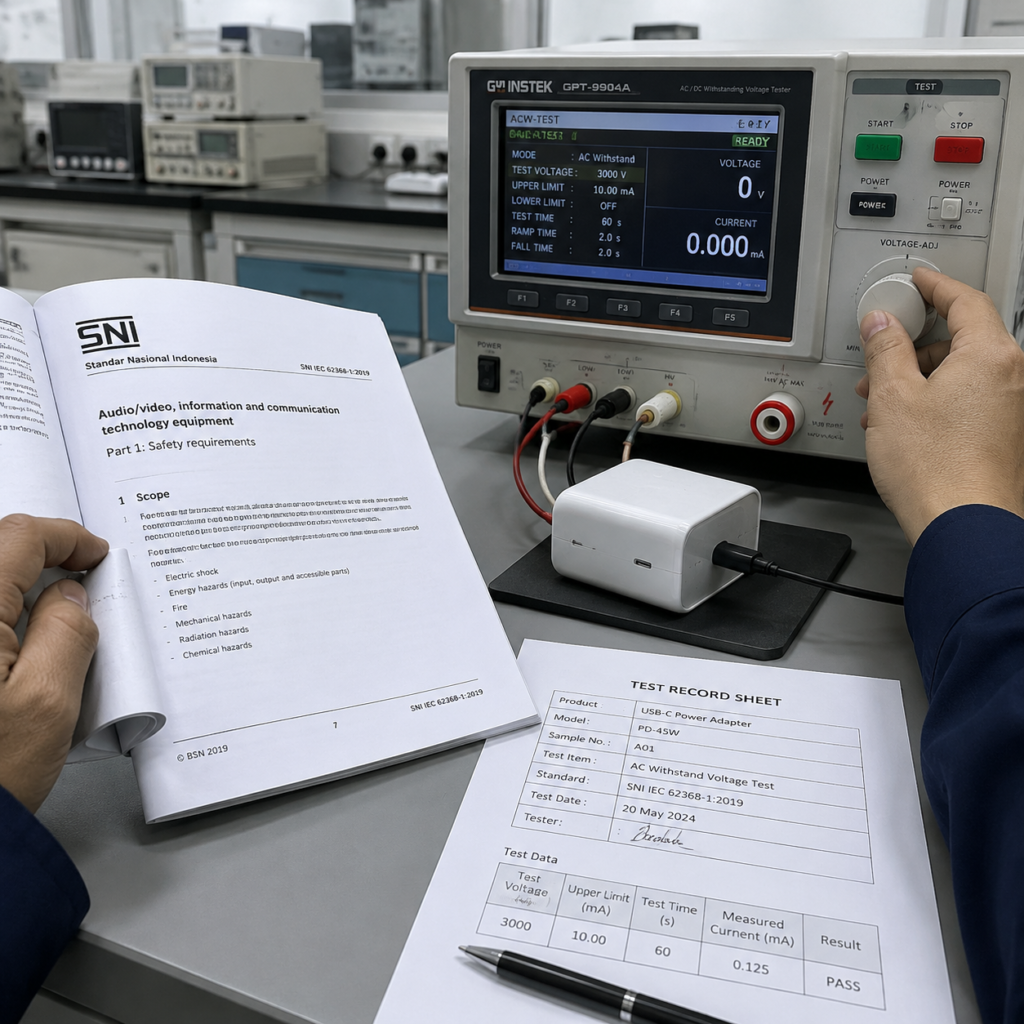
• Charger/power adapter category: Some power supply units or adapters for audio-visual, information technology and communication technology equipment may apply SNI IEC 62368-1. Independent chargers do not automatically apply this standard; it shall be subject to current mandatory regulations and their cited versions, product definition and rated parameters;
• Plug/socket/USB power strip category: The plug-in parts of household and similar use plugs, sockets and some power strips may apply SNI IEC 60884-1. For power strips with USB, additional or alternative standards must also be determined based on their power module, structure, rated parameters and mandatory regulations;
• Cable category: 60227 and 60245 are cable standard series with different insulating materials and structures, which must be matched according to specific sections and rated voltages. Whether USB cables are subject to mandatory SNI should be verified item by item for their structure, rated parameters, purpose, HS code and current mandatory catalog, and it cannot be directly asserted that there is no mandatory safety standard.
Standard Versions and Update Rules
Regarding standard versions and updates, three points should also be noted:
First, the valid version must be the version officially issued by BSN and cited in mandatory regulations. Even if BSN releases a new version, as long as the regulation has not cited it, you cannot judge the applicable version solely by the word “latest”;
Second, there is no unified transition period after standard updates. It shall be subject to the official documents of the competent authority or the issuing body, and you cannot guess how long it is on your own;
Third, for new technology products, such as GaN chargers and fast charging products supporting USB PD/PPS, you must first confirm whether they are covered by existing standards and whether there are additional requirements, and cannot take it for granted to apply old standards.
Other Parallel Compliance Requirements
In addition to SNI safety certification, some charging products also need to meet other parallel compliance requirements:
• Electromagnetic Compatibility (EMC): Simply put, it is the requirement that the product will not interfere with other devices nor be interfered with by other devices when operating. Switching power supply chargers may need to meet relevant requirements, depending on the provisions of applicable regulations;
• Energy efficiency requirements: Energy efficiency limits or energy efficiency labels only apply when the energy competent authority issues and implements them for the corresponding product category. External power adapters cannot be deemed to require Indonesian energy efficiency labels solely based on product attributes; current regulations should be verified;
• Communication certification: If the product contains Bluetooth, Wi-Fi or other radio transmission/telecommunications functions that operate in Indonesia, it is necessary to confirm whether it is a device requiring certification in accordance with the current rules of the communications competent authority, and apply for corresponding device certification. Whether certification is required also depends on radio transmission, frequency band and device classification; products that only have wireless charging function and do not contain radio communication functions usually do not trigger this type of communication certification due to wireless charging itself.
Four-Step Judgment Method: Quickly Confirm Whether a Product Requires SNI
After talking about so many classifications and rules, some people may still feel confused. Here we have sorted out a four-step judgment method. Following it, you can make a preliminary judgment on whether your product requires SNI, and know how to handle it when in doubt.
Step 1: Organize Core Product Information
First, organize all the core information of the product, don’t miss any items:
• Product type: Is it a charger, adapter, cable, plug, or a built-in accessory of the complete machine? Does it have communication functions such as Bluetooth and Wi-Fi?
• Key parameters: input voltage, output power/capacity, interface type, structural form (wall plug/desktop, wired/wireless);
• Sales information: whether it is independently retailed, sales channels, import methods, whether target users are ordinary consumers or industrial customers.
The more complete the information, the more accurate the subsequent judgment.
Step 2: Verify Official Mandatory Regulations
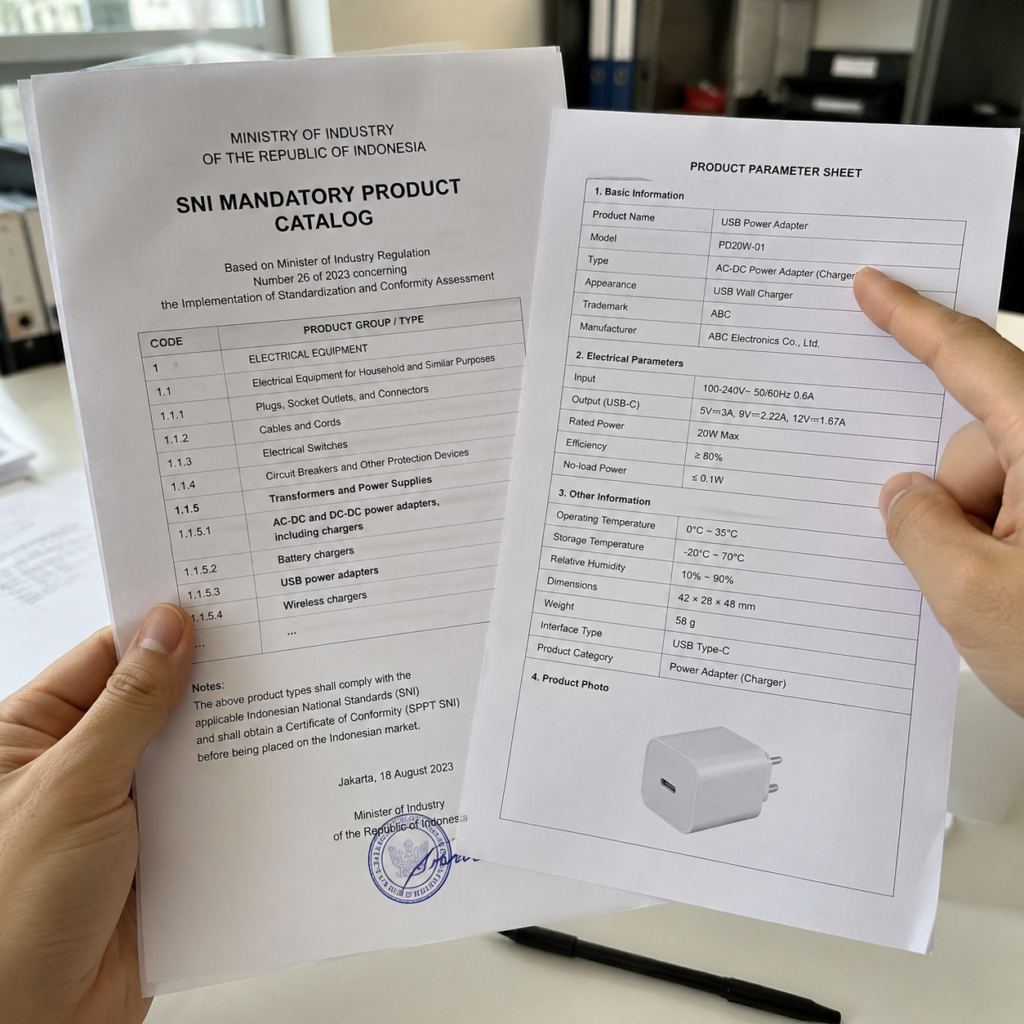
Only trust authoritative sources: that is, the latest mandatory certification regulations and their annexes issued by the category competent authority, and the standards and related catalogs officially published by BSN. Other hearsay does not count.
When verifying, you cannot only look at one dimension. You need to compare the product name, HS code, technical parameter boundaries, product definition, structure and purpose together — for example, you cannot say it is required just by looking at the word “charger”, you also need to check the input voltage, product structure, whether it is for civil use, and whether it is sold independently.
Special reminder: Absolutely do not judge solely based on e-commerce platform labels, supplier verbal statements, or HS code alone. These are all unreliable.
Step 3: Match Applicable Boundary Conditions
Match boundaries based on the verification results:
• If the product fully meets the definition of the mandatory catalog, and is for civil use and sold independently, it most likely requires certification;
• If no clear mandatory basis can be found, or the product is a low-voltage product, built-in module, set accessory, etc., further verification is required;
• If it is a special scenario (temporarily imported samples, industrial equipment, export-only processing accessories), verify the corresponding exemption rules to see if it can be exempted, but you cannot determine exemption on your own.
Step 4: Standardized Handling When in Doubt
If you are still unsure, don’t guess blindly, handle it according to the standardized process:
First prepare the necessary materials, including product specifications, nameplate photos, appearance drawings, structure descriptions, HS code and sales form description;
Then consult through formal channels, such as local cooperative importers in Indonesia, or formal LSPro with KAN accreditation and matching accreditation scope. When consulting, be sure to ask the other party to clearly give the applicable regulations, standards and boundaries, and do not accept unfounded vague statements such as “probably not required” or “almost”.
SNI Compliance Identification and Pitfall Avoidance Guide
Even if you have figured out your own product, there are still many fake SNI pitfalls in the market. Whether you are doing certification yourself or verifying a supplier’s certificate, you must learn to identify them to avoid pitfalls.
Key Points for Mark and Certificate Verification
Formal SNI marks and certificates need to be verified in combination with corresponding regulations and certification schemes:
• Mark requirements: The carrier, position, size of the SNI mark, and whether a QR code or Indonesian language information is required, shall be implemented in accordance with current SNI mark usage regulations, product mandatory regulations and the requirements stated in the certificate. Verification shall be based on the corresponding regulations and the mark scheme approved by LSPro, and cannot be judged solely by the condition of “printed on the product body” or “printed on the packaging”;
• Core certificate information: A formal SNI certificate will clearly list the certificate holder, production factory, covered product models, rated parameters, applicable SNI standards, and current status of the certificate;
• Validity period and inquiry: First verify whether the LSPro on the certificate is accredited by KAN and has the corresponding scope, then cross-verify the certificate number, model, factory, standard and status through the official inquiry channel of the LSPro, available BSN databases and the competent authority system. The authenticity of the certificate cannot be determined solely based on the records of a single database.
Typical Characteristics of Common Fake SNI
Be alert when encountering these four situations, as they are most likely fake SNI:
First, there is a problem with the mark — either there is no corresponding valid certificate at all, or the printing is rough, or the marking method is inconsistent with applicable regulations, certification schemes and certificate requirements;
Second, information mismatch — the model, parameters, and production factory on the certificate do not match the actual product. For example, the certificate is for a 5V2A charger, but the actual product sold is a 65W fast charger;
Third, invalid qualification — either the certificate has expired, or the issuing body is not accredited by KAN for the corresponding scope, or the certificate exceeds the accreditation scope of the body. The accreditation status, certification scope, product category and applicable certification scheme of the LSPro at KAN should be verified; if the body is not accredited for the corresponding scope, the certificate cannot prove that the product meets mandatory SNI requirements;
Fourth, out-of-scope claims — for example, the certificate only covers two certain models, but the merchant claims that the entire series of products has SNI certification.
Common Advanced Misconceptions
There are several advanced misconceptions that many merchants who have been in the business for a while also fall into:
• Thinking that OEM/white-label products do not require certification: Wrong. As long as they are in the mandatory catalog, whether it is a private brand or an OEM white-label product, they must be compliant, which has nothing to do with the size of the brand;
• Thinking that USB-C products uniformly use one standard: Wrong. Different power, protocols, and input structures may lead to different applicable standards and requirements, which cannot be generalized;
• Thinking that one certificate is valid for the entire series: Wrong. The SNI certificate only covers the models, parameters and production factories clearly listed on it. If you change the model or factory, the original certificate may not cover it.
Product Change Assessment Rules
Many merchants do not know whether they need to re-certify when modifying products. Remember a unified principle: any change should be reported to or confirmed by LSPro in accordance with the corresponding certification scheme. LSPro will decide whether to conduct supplementary testing, revise the certificate or re-certify based on whether the change affects safety, key components, model, factory, certificate holder, label or certification scope. Without confirmation, the original certificate cannot be used to cover the modified product.
The handling methods for different change types can refer to the following table:
| Change Type | Common Scenarios | Conventional Handling Method |
| Minor appearance change | Silk screen adjustment, shell color replacement | Report to or confirm with LSPro, which will judge whether it affects the certificate, mark and label based on the certification scheme, and revise the certificate or supplement materials if necessary |
| Key safety component change | Replacement of plugs, power cords, safety chips, insulating materials | Apply for change assessment, which may require supplementary testing, certificate revision or re-certification |
| Core function change | Output power increase, new interface added, new fast charging protocol added | Assessed by LSPro based on certification scope and certification scheme, which may require supplementary testing, certificate revision or re-certification |
| Subject change | Replacement of production factory, change of certificate holder | Apply for change assessment according to the certification scheme, which may involve certificate revision, factory assessment or re-certification |
At this point, you should have a complete understanding of the applicable rules of Indonesian SNI certification for charging products. You can clarify the relationship between SNI standards, mandatory regulations and certification, and know the division of responsibilities of each participant; you can make a preliminary judgment on the mandatory attribute of charging products based on product definition, rated parameters, structure, purpose, HS code and sales scenarios, and will no longer draw conclusions solely based on “whether it is connected to mains electricity” or “how high the power is”; you know the SNI standard series that may be involved in charging products, and understand that the application of standards is subject to regulatory citations; you can use the four-step judgment method to initially check whether your product requires SNI, and also know what formal channels to turn to when in doubt; you can verify the core information of SNI marks and certificates, and recognize the four common types of fake SNI; when a product is revised, you can also judge whether supplementary testing, certificate revision or re-certification is required by reporting the change to the original LSPro and assessing it based on the applicable certification scheme; you also understand the compliance boundaries of different sales scenarios, and can avoid common pitfalls such as set sales and personal import.
Of course, SNI regulations and catalogs are updated from time to time, and the final compliance judgment shall still be subject to the latest official documents, applicable certification schemes and written opinions of formal institutions. However, with these methods, you will no longer be misled by vague information and can make most basic judgments on your own.