
If you do overseas business with products like chargers, USB-C power supplies, and charging cables, you’ve most likely heard the saying that “CB reports can save certification costs.” But when you actually get started, many people get confused: What exactly is a CB report? Can you sell directly to the whole world with it? Why are you required to conduct supplementary testing even after submitting a conversion application?
In this article, we start from the most basic concepts, and thoroughly explain the applicable boundaries, pre-verification, full process steps, requirements of popular markets, cost estimation, and pitfall avoidance methods for CB report conversion. Even if you are a novice who has never been exposed to certification before, you can judge by yourself whether your product is eligible for CB conversion, and roughly how much money and time it will cost.
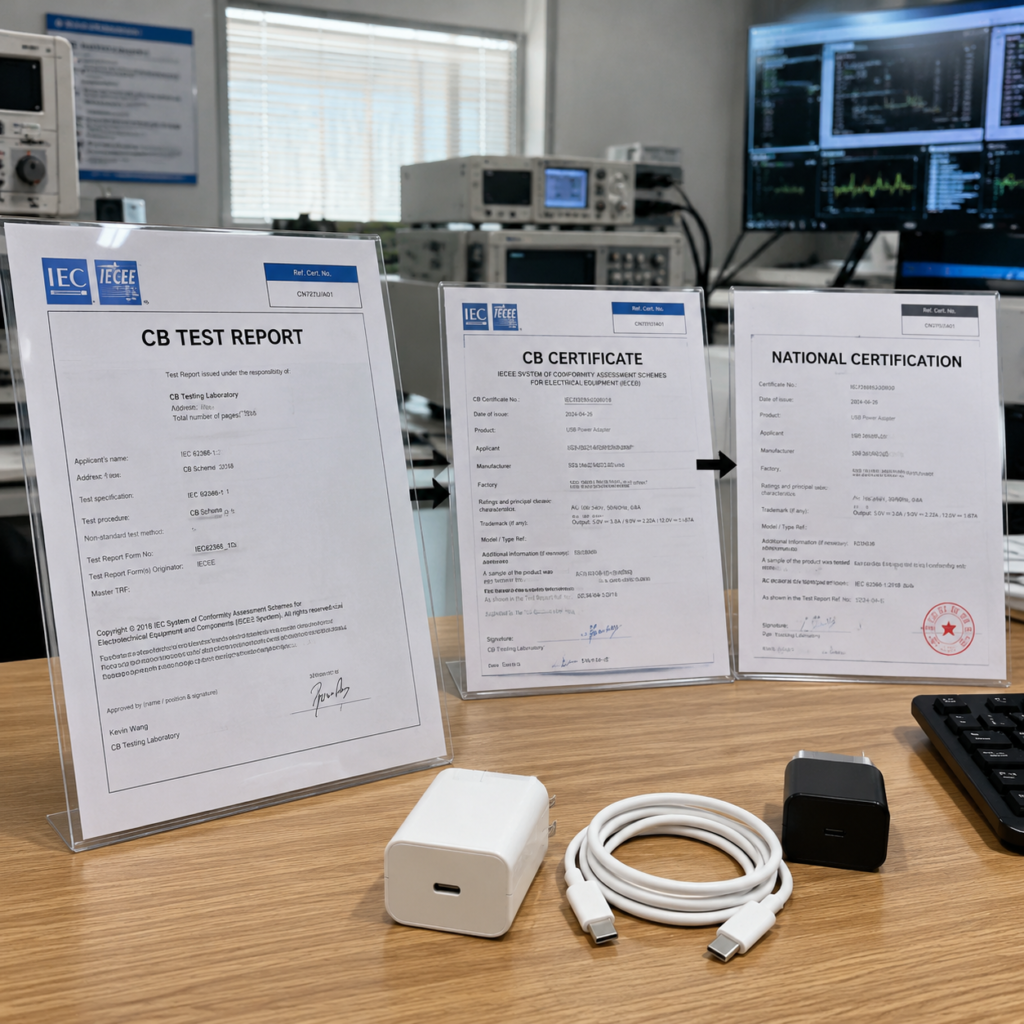
Must-Know for Beginners: Core Logic and Boundaries of CB Report Conversion
You can understand the CB scheme as a set of international safety conformity assessment and certificate mutual recognition arrangements: IECEE carries out product safety testing and certificate mutual recognition based on IEC standards and relevant national differences. Accredited testing laboratories in each country (referred to as CBTL) complete testing in accordance with applicable standards and issue a CB Test Report, which records the product’s test data, structural design, and key component information; the corresponding conformity certificate is the CB Certificate, issued by the National Certification Body (referred to as NCB).
Whether the target country or specific certification body accepts CB reports, and to what extent, still depends on local regulations, product categories, standard versions, and their own certification procedures. Conversion usually requires both the report and the certificate, neither is dispensable. Only documents issued by IECEE-accredited CBTLs and NCBs are valid under the CB scheme, and relevant qualifications can be queried in the official IECEE database.
Which Charging Products Are Eligible for CB Report Conversion
CB does not automatically cover all products under the commodity name “charger”. Many wall-plug power adapters, information technology equipment power supplies, and some USB-C power supplies can apply for CB according to applicable IEC product safety standards, but you must first confirm the product category, rated parameters, intended use, and the standard on which the CB report is based.
Common safety standards for chargers may include IEC 62368-1, IEC 61558 series, IEC 60335 series, or other product-specific standards, which cannot be judged solely by the product name. Car chargers, charging docks, battery-powered devices, and complete products with charging ports may also be subject to different standards due to different specific structures and uses, and require separate assessment.
Cables and connectors usually need to be assessed in accordance with corresponding cable or component standards, and may also be assessed together with the complete product. Active USB-C charging cables with E-Marker chips, charging docks, and multi-port fast charging power supplies must confirm applicable standards in combination with specific circuits, intended use, rated parameters, and the CBTL’s accreditation scope; it cannot be generally concluded that they can or cannot be converted separately.
Ordinary passive charging cables also cannot be directly excluded from the assessment scope just because they “have no chip”. They may be assessed in accordance with corresponding component or cable requirements, or may be assessed as part of a complete product. Plug accessories without circuits should also be judged based on their intended use, applicable standards, and supporting product conditions, and a unified conclusion cannot be simply applied.
Value and Applicable Boundaries of CB Report Conversion
The plain logic of CB report conversion is to take a set of safety test documents completed in accordance with IEC standards, and apply for locally recognized market access documents from the target country or certification body, to avoid repeating all safety tests from scratch.
CB reports may reduce duplicate items in the target country’s safety tests, but the actual savings ratio and cycle must be assessed and quoted by the target body on a case-by-case basis according to standard versions, national differences, product consistency, and factory inspection requirements, and cannot be calculated using a fixed ratio or unified cycle.
Here, you must firmly remember the applicable boundary: Ordinary IECEE CB safety reports mainly cover product safety, and are not equivalent to EMC, energy efficiency, environmental protection, or wireless compliance certificates. These requirements usually need to be assessed separately in accordance with target market regulations, and test reports, calculations, supplier declarations, or other technical evidence must be provided. IECEE also has other conformity assessment activities, but they are not the same as the content of ordinary CB safety reports themselves.
4 Common Cognitive Misconceptions for Novices
The first common misconception is thinking that “with a CB report, you can sell globally”. In fact, CB is only a technical basis under the international safety testing and certificate mutual recognition framework, not a globally unified market access certificate — you must convert it into a local certification recognized by the target country, or complete the filing and self-declaration required by the local authority, before you can legally launch the product.
The second misconception is that “all charging products are eligible for CB report conversion”. In fact, you must first confirm the product category, applicable standards, and the coverage scope of the CB report. Passive charging cables, car chargers, charging docks, or complete products with batteries cannot be judged solely by the commodity name.
The third misconception is that “conversion requires no further testing at all”. Conversion may only reduce part of the safety tests or document review; the target country’s national differences, plug requirements, and other regulatory requirements may still require supplementary assessment or testing.
The fourth misconception is that “CB can replace all certifications”. We emphasize again: ordinary CB safety reports cannot replace compliance requirements such as EMC, energy efficiency, environmental protection, and wireless; these items must be handled separately in accordance with the rules of the target market.
Pre-Judgment: 10-Minute Self-Check of Conversion Feasibility
After understanding the basic concepts, don’t rush to find a body to submit an application — spending 10 minutes doing a feasibility self-check can help you save thousands or even tens of thousands of yuan in wasted money, and will not delay your launch time.
Step 1: Verify the Validity of the CB Report
First, confirm whether your CB report is valid. First, check the issuing qualification: the CBTL and NCB on the report must be queryable in the official IECEE database; “fake CB reports” issued by unknown small institutions are useless.
Second, check the standard version: for example, the common safety standard for chargers is IEC 62368-1. IEC 60950-1 has been replaced by IEC 62368-1 in many markets, but whether old version reports can continue to be used for specific products or conversion must still be confirmed according to the target country’s current regulations, standard transition arrangements, and certification body policies, and cannot be directly deemed invalid globally.
Third, check the completeness of the report: you should verify whether the CB report contains complete test results, product descriptions and key component information, applicable national differences, and conformity conclusions, and confirm that it meets the document requirements of the CB certificate and the target body. Not every report must include difference test pages for all countries; if the report does not state the differences for a target country, supplementary assessment or testing may be required later.
Finally, don’t forget that conversion usually requires submitting both the CB report and the corresponding CB certificate at the same time; neither is dispensable.
Step 2: Check the Consistency Between the Product and the Report
Many people fall into pitfalls at this step: thinking that “close enough is fine”, but in fact, the product’s structure, parameters, and key components must all be consistent with the coverage scope of the report.
First is the model series: you should verify whether the target model is clearly listed in the CB certificate, report, or its allowed model series. The report sometimes covers multiple models through structurally identical model variants, component replacement lists, or condition descriptions, so it cannot be judged solely by whether the model characters are exactly the same. Conversely, even if the model name is the same, as long as the internal structure or rated parameters change, it may not be within the coverage scope.
Then are key components: transformers, safety capacitors, and optocouplers in charging heads, as well as terminals, insulation layers, and E-Marker chips in charging cables, usually need to be checked against the key component information in the report. You should focus on checking whether the report allows alternative models or equivalent parts, and confirm that the actually used components comply with the list, replacement rules, and conditions in the report, rather than simply requiring that the brand and model must be exactly the same.
Then are electrical parameters: the range of input and output voltage, power, USB-C PD, or other fast charging protocols must all be within the coverage scope of the report. For example, if the report only covers 20W single-port PD, but the actual product sold is a 65W dual-port GaN charger, the original report cannot be used directly.
Here is a special reminder for products of the same series: many people think that chargers of the same series can share one CB report, but in fact, products with different power levels and different numbers of ports still need to be assessed to see if they fall within the model range allowed by the report, and sharing cannot be assumed by default.
Step 3: Confirm the Mutual Recognition Basis of the Target Country
First, you must confirm whether the target market and specific certification body participate in relevant CB mutual recognition arrangements, or whether they accept the CB report in their national procedures. The fact that a target country is a member of the IECEE scheme does not mean that it unconditionally accepts all product categories, all standard versions, or all certification procedures; non-member countries or their certification bodies may also accept CB reports according to their national regulations or body procedures.
Second, you must confirm that the target country accepts CB conversion applications for your type of product — not all bodies open the same mutual recognition procedures to all products.
There are two other easily overlooked points: First, you must confirm the requirements of both the selling country and the actual importing country at the same time. For example, if your goods enter from Singapore and are sold to Malaysia, the requirements of the two countries may be different, and both must be confirmed. Second, you must comply with the access rules of e-commerce platforms and retailers. Whether U.S. regulations mandate third-party safety certification depends on the specific product and applicable regulations; some platforms, retailers, or customers may require NRTL marks such as UL and ETL, which shall be subject to the current written requirements of the target site and procurement channel.
Step 4: Identify Gaps in Non-Safety Requirements
Since ordinary CB safety reports mainly deal with product safety, these items must be sorted out separately: for example, electromagnetic compatibility (EMC), energy efficiency/standby power consumption, and wireless function certification, which require testing or preparation of other compliance evidence in accordance with target market rules; local plug specifications, label language, and qualifications of importers/local representatives also need to be prepared separately; environmental protection requirements such as RoHS and recycling labeling regulations must also comply with local rules.
3 Core Judgment Criteria
After completing the above checks, you can use three core criteria to quickly judge whether conversion is possible:
First, the CB report and certificate are authentic and valid, and the standard version meets the requirements of the target country or target body;
Second, the product category, model, structure, parameters, and key components are within the coverage scope of the CB report;
Third, the target market or specific certification body accepts this CB report and allows applications in accordance with local procedures.
Only when all three aspects are met is it suitable to continue submitting a conversion application.
General Full Process: 6 Steps of CB Report Conversion
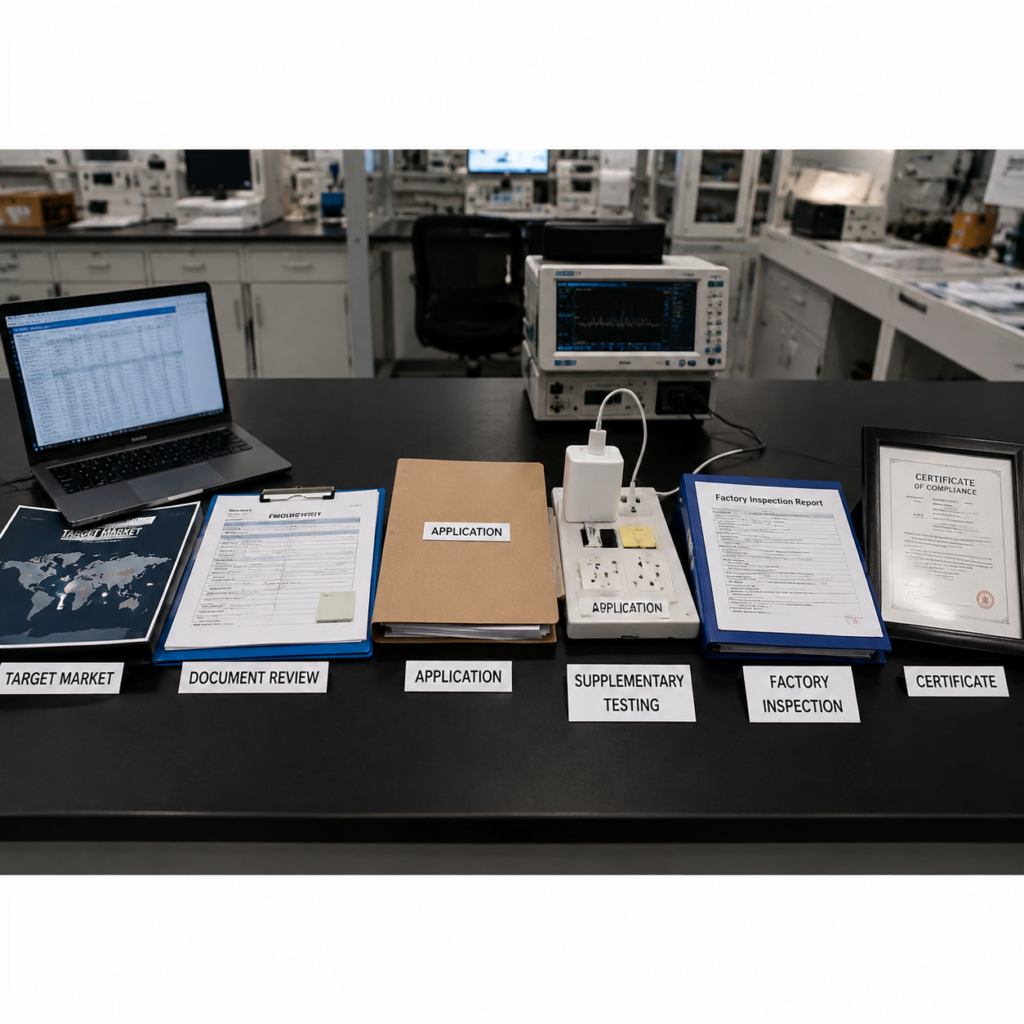
After confirming feasibility, let’s look at the general full process of CB report conversion, which has a total of six steps. There are slight differences in different countries, but the core logic is the same.
Step 1: Clarify the Target Market and Certification Type
First, you must distinguish the nature of certification: some are mandatory certifications, which you cannot sell without, such as Japan’s PSE and South Korea’s KC for some product categories; some are voluntary third-party certifications, but channels will mandate them, such as U.S. NRTL (UL and ETL both fall into this category); and some are enterprise self-declarations, such as the EU’s CE, where enterprises need to complete applicable regulatory assessments, prepare technical documents, and sign the EU Declaration of Conformity.
For common certifications for charging products, such as EU CE, U.S. NRTL, and Japan PSE, we will discuss their special requirements separately later. After determining the certification type, remember to count backward from the launch time and reserve the cycle for testing, rectification, and registration. Don’t rush to do it when it’s time to launch, because if rectification is needed, you won’t make it.
Step 2: Document Gap Assessment and Preparation
You can find a certification body, or first compare the standard differences between the CB report and the target country by yourself, to get a conclusion of “test-exempt, supplementary test, or retest”, so you have a rough idea first.
The core application materials include: CB report + CB certificate, product specification, circuit diagram, key component list, and label draft. Supplementary materials generally include: specification documents of local plugs, instructions in local language, and authorization documents of importers/local representatives.
Step 3: Select the Issuing Body and Submit the Application
When choosing a body, you must select an NCB or certification body recognized by the target country, and prioritize those with experience in charging product certification — after all, USB-C PD and fast charging are new products in recent years, and inexperienced bodies may slow down the progress, or even misjudge the difference items.
When submitting the application, you must clearly mark “conversion based on CB report”, otherwise the body may calculate the fee as a new product application, and you will waste money for nothing. Also note that some countries require that the application must be submitted by a local importer or local representative, and overseas companies cannot submit it directly; this must be confirmed in advance.
Step 4: National Difference Supplementary Testing and Rectification
This is the step in conversion that most easily incurs additional costs and time. Charging products may involve target country plug adaptation, temperature rise under local voltage, specific interface or protocol requirements, and other national difference items.
If your CB report already covers the difference items required by the target country when it was prepared, you can apply to the target body for exemption from corresponding duplicate testing, which is also a more cost-effective situation. If non-conformities are found in supplementary testing, such as incorrect plug size, wrong label content, or structural safety hazards, rectification is required before retesting.
Step 5: Review and Factory Inspection (If Applicable)
First is document review: the body will check whether the CB report and product materials you submitted are consistent, and whether the supplementary test results are qualified.
Whether factory inspection is required shall be confirmed in accordance with the target country’s certification scheme and the issuing body’s rules, including whether initial factory inspection, annual supervision, or spot checks are required. Applying to a certain body for the first time does not automatically constitute a general trigger condition for factory inspection.
For factory inspections of charging products, the focus is on three things: procurement records of key components (to prove that the parts used in mass production are still those in the report), finished product safety testing stations (for example, whether withstand voltage and grounding tests are conducted before delivery), and production consistency control processes (whether the design is changed or parts are replaced casually).
Step 6: Obtain Certificate and Post-Marketing Maintenance
After passing the review, the body will issue you the target country’s certification certificate or registration number. The validity and supervision requirements of certifications vary greatly from country to country, and a unified validity period cannot be simply applied. For example, the EU CE is not a certificate with a fixed validity period issued by a unified body; Japan’s PSE and South Korea’s KC also manage the validity of certificates, confirmations, or declarations according to product classification and specific systems respectively.
After obtaining the certificate, the certification mark must be printed on the product body and packaging as required, and the information such as the model and manufacturer corresponding to the mark must be consistent with the certificate, and cannot be printed randomly. After launch, it’s not all smooth sailing: you must pay attention to standard updates — if the target country’s standard changes, you need to assess whether supplementary testing is required; if the product is changed, such as replacing key components or changing power, you must first assess the impact on the certification, and cannot continue to use the original certificate after unauthorized changes; you also need to cooperate with market spot checks, or annual factory inspections required by some bodies.
Special Requirements for Charging Product Conversion in Popular Markets
The above is the general process. There are many differences in conversion requirements among different popular markets. We pick several markets that everyone most commonly applies for, to explain the special requirements for charging products.
European Union (CE/ENEC)
CB reports can be used as one of the safety test documents in EU compliance technical documents, but they cannot automatically replace the overall CE compliance assessment. You should confirm the applicable regulations for the product, such as the Low Voltage Directive (LVD), EMC, RoHS, Ecodesign, and common charging regulations, and verify the specific version of the adopted EN standard and its status in the Official Journal of the European Union.
The safety standard for power adapters needs to be confirmed by product category; the common one is EN IEC 62368-1, but it is not the only option. IEC/EN IEC 62680 is mainly used for relevant USB interface or common charging requirements, and is not a general charger safety standard. After completing the applicable regulatory assessment, an EU Declaration of Conformity also needs to be prepared.
The specific requirements of the EU must be confirmed item by item: EMC, RoHS, Ecodesign or external power supply energy efficiency, and whether the common charging regulation applies to the current product. The forms of evidence required by different regulations are not the same, and may include test reports, calculations, supplier declarations, or other technical documents; it cannot be generally assumed that all items must undergo supplementary laboratory testing. Plugs must also meet EU requirements. For factory inspection, it is not required for CE self-declaration, but if you apply for the more recognized ENEC certification, you need to accept factory inspection in accordance with the certification scheme.
United Kingdom (UKCA)
CB reports can be used as part of UK compliance technical documents; whether they must be assessed by a UK Approved Body depends on the specific product regulations and conformity assessment module. In Great Britain, you should also verify the UK’s current recognition policy for CE, UKCA requirements, and local UK EMC and energy efficiency regulations, and cannot simply assume that EU documents cannot be used at all.
The core difference is that plugs must meet the British standard BS 1363, labels must be in English, and EMC and energy efficiency must also comply with applicable UK rules. A special reminder here: Northern Ireland is handled in accordance with applicable EU rules, using CE when necessary, or the combined CE and UKNI mark in cases where third-party body involvement is required, which is not exactly the same as the UKCA arrangement in mainland UK.
United States/Canada (UL/ETL/FCC)
Both UL and ETL belong to NRTL (Nationally Recognized Testing Laboratory) certification. The role of the CB report is that NRTL bodies can accept CB test data to reduce duplicate items in safety tests, but it cannot replace NRTL certification — you may still need to obtain a UL or ETL certificate to meet channel requirements.
For the US and Canadian markets, plug, socket, insulation, and structural requirements should be verified in accordance with applicable UL/CSA standards, and it cannot be generally asserted that US and Canadian plugs have “higher insulation levels”. Wireless or radio frequency equipment in the US is processed in accordance with applicable FCC procedures; many unintentional radiators can use Supplier’s Declaration of Conformity (SDoC), and not all products need to apply for FCC certification. Canada handles certification or other compliance procedures in accordance with applicable ISED categories. CB safety reports cannot replace these regulatory requirements.
NRTL certification usually includes initial factory assessment and ongoing supervision, but whether it is required and the supervision frequency are determined by the specific NRTL and product certification scheme, and cannot be uniformly written as quarterly follow-up inspections. It should be noted that Amazon, mainstream US retailers, or other procurement channels may require charging products to have the NRTL mark, which shall be subject to the current written requirements of the target site and channel.
Japan (PSE)
CB reports can be used as a reference for safety testing to reduce part of the duplicate testing. First, you must confirm whether the product belongs to “specified electrical appliances and materials” or “non-specified electrical appliances and materials” in accordance with Japan’s Electrical Appliance and Material Safety Act (DENAN).
For non-specified electrical appliances and materials, there is usually no unified “PSE certificate” issued by the government or body; instead, the manufacturer or Japanese importer self-confirms compliance with technical requirements, completes necessary inspections, and marks as required. Specified electrical appliances and materials require a conformity inspection certificate from a registered inspection body. Japanese importers bear corresponding domestic declaration, technical, and labeling responsibilities, and it cannot be generally stated that all PSE products have local representatives as the certificate holders.
South Korea (KC)
KC is not a single NCB conversion system. South Korea implements procedures such as safety certification, safety confirmation, or supplier declaration according to product categories, with different application subjects, designated testing bodies, and CB report acceptance conditions.
Therefore, you should first confirm whether the product falls into the KC safety certification, safety confirmation, or supplier declaration category, and then confirm with the certification or testing body designated by the South Korean competent authority whether the CB report can be used as technical data, and whether a local South Korean application subject is required. The core differences are that plugs must meet South Korean requirements, EMC needs to be assessed separately, and labels must be in Korean.
Australia/New Zealand (RCM)
Whether the safety part can be assessed by an accredited body based on the CB report depends on the specific product, applicable standards, and the judgment of the local responsible supplier. In Australia, you should confirm whether EESS registration, certificate, or supplier declaration is required according to the product risk level, and the eligible Australian responsible supplier shall bear the registration and supply responsibilities.
New Zealand should separately verify its electrical safety and EMC requirements, and cannot directly apply the Australian EESS process. RCM is also not an EESS registration certificate uniformly applicable to all Australian and New Zealand products. Mandatory requirements and application subjects shall be confirmed according to product category, sales location, and local rules.
Emerging Markets (India BIS/Brazil INMETRO, etc.)
For India’s BIS certification, CB reports are acceptable for some charging products, but a local representative is required, and the probability of supplementary testing is relatively high. Brazil’s INMETRO certification requires review by a locally accredited body, labels must be in Portuguese, and there are also many supplementary test items.
The general characteristic of emerging markets is that the acceptance of CB reports varies greatly, and even the requirements of different bodies are different, so you must confirm clearly with the target body in advance, and do not take it for granted based on the experience of mainstream markets.
Cost and Cycle Estimation: How to Judge Whether Conversion Is Cost-Effective
Many people are most concerned about how much money and how long conversion will take. In fact, there is no fixed number. The charging methods and compliance procedures of certification bodies in different countries vary greatly, and the ratio cannot be directly applied based on the original CB test fee. We can first break down the costs and influencing factors to facilitate your decision-making.
Cost Composition and Common Ranges
The core costs of conversion include: application fee of the certification body, document review fee, national difference testing fee, sample-related fees, and factory inspection fee (if applicable). Additional costs include: local agency/registration fee, translation fee for labels and instructions, sample shipping fee, and subsequent supervision or annual service fees.
Note that the test fee you paid for the CB report previously is not included in the conversion cost; that is a previous investment.
Do not estimate the conversion cost based on a fixed percentage of the original CB test fee. The cost compositions of systems such as CE self-declaration, PSE, KC, NRTL, and RCM are completely different, and may include registration, supervision, sample, agency, and annual fees. A more reliable approach is to list the fees for application, document review, difference testing, samples, factory inspection, registration, agency, and supervision separately, and subject to the written quotation of the target body.
How to save costs? There are two tips: First, when preparing the CB report, confirm with the laboratory in advance and cover the differences of the target countries you are going to, so that duplicate testing may be reduced during conversion; second, for multi-model products of the same series, first confirm whether the structure and parameters meet the model range and data sharing rules of the report, then consider sharing test data, and do not default that each model can be shared directly.
Cycle Influencing Factors
If there is no supplementary testing and no factory inspection, the processing time may be faster, but document review, certificate issuance, importer registration, body queuing, and product category will all affect the cycle, and a unified 2 to 6 week commitment applicable to all countries cannot be given. Some self-declaration procedures also do not fall into the traditional “body conversion” cycle.
There are three main factors that will extend the cycle: need for supplementary testing of national differences, need for factory inspection, and incomplete submitted materials requiring repeated supplementary submissions.
The most common reasons for delays in charging products are unqualified USB-C PD testing, unqualified plug size, and wrong label language — these can actually be avoided by self-checking in advance.
Judgment of Conversion Cost-Effectiveness
Situations suitable for CB report conversion are generally the following: you sell to multiple countries and convert multiple certifications, so you save more money; your CB report is relatively new and covers the differences of many countries in advance, so there is less supplementary testing; your product is completely consistent with the CB report, so no rectification is needed.
In the following situations, it may be more cost-effective to directly apply for local certification: you only sell to one country, so conversion does not save much money; your CB report version is too old, and the cost of making up the differences is not as good as redoing it; the product has been greatly changed and is different from the one in the CB report; there are particularly many supplementary test items in the target country, so the cost of conversion is about the same as redoing it.
Pitfall Avoidance Guide: Common Failure Causes and Remedial Methods
We have compiled the most common types of pitfalls in CB report conversion and corresponding remedial methods, which you can refer to to avoid them.
Problems with the CB Report Itself
There are three common ones: First, the version is too old. For example, new certifications applied for using IEC 60950-1 may need to be assessed in accordance with current requirements such as IEC 62368-1; second, the issuing body is not qualified — if it is not an IECEE-accredited CBTL or NCB, the report may not be usable under the CB scheme; third, the report lacks key information, such as no complete test results, key component information, or applicable national difference content.
Remedial methods: If it is an old version report, you can ask the original body to conduct supplementary difference testing of the new version standard and update the report according to the target market requirements; if the body is not qualified, you can only find an accredited CBTL to retest; if the information is missing, first ask the original laboratory to complete it, and then the target body will judge whether it can be used.
Product Consistency Issues
There are also three common ones: First, unauthorized replacement of key components, such as replacing the transformer in the charging head or the E-Marker chip in the charging cable; second, the power and voltage of the actual product exceed the coverage scope of the CB report; third, the product structure has been changed, such as replacing the charging cable with a thinner insulation layer.
Remedial methods: If only individual key components or parameters are different, you can conduct supplementary difference testing and update the CB report according to the replacement part rules in the report and the body’s opinion; if the change is too large, you can only reassess, and redo the full set of tests if necessary.
National Difference Omission Issues
Common ones are: plug specifications do not meet local requirements, such as selling to the UK with US standard plugs; label language or content does not meet requirements, such as no local language or no mandatory marks; ignoring local special requirements for USB-C, such as the EU’s common charging requirements.
Remedial methods: Replace with compliant plugs, then conduct supplementary testing of related items; redesign the label and have it reviewed and approved by the body; conduct supplementary testing of local special requirements. Whether testing is required and the extent of testing shall be confirmed in accordance with specific regulations and body requirements.
Problems Caused by Cognitive Misconceptions
For example, thinking that CB covers EMC and energy efficiency, only to find out at the end that a large part is missing and you can’t make the launch; not preparing a local importer or representative in advance, so you can’t submit the application; thinking that conversion is 100% test-exempt, so you don’t reserve budget and time for supplementary testing, and end up in a fluster.
Remedial methods: Sort out non-safety requirements in advance, and conduct supplementary testing for those that need it; connect with local importers or representatives in advance; reserve a budget for supplementary testing and rectification based on the target body’s difference assessment and written quotation, and include review, testing, factory inspection, and registration time in the project plan separately, without using a fixed percentage or fixed number of weeks as a general commitment.
3-Step Quick Self-Check of Conversion Feasibility
Finally, here is a 3-step quick self-check method. When you get a CB report, you can roughly judge whether conversion is possible in 10 minutes.
Step 1: Check the basic information of the CB report: see if there is the IECEE CB mark on the cover, as well as the CBTL and NCB numbers; verify that the product model and name on the report, and the product you want to convert, are within the report or allowed model range; confirm that the standard version implemented by the report is the version accepted by the target country.
Step 2: Check the core content of the report: turn to the key component list, and check them one by one against the core component models of your product to see if they comply with the list, replacement part rules, and conditions in the report; find the national difference testing chapter to see if it contains the difference items required by the target country; check the final test conclusion to see if it is qualified and if there are any open non-conformities; verify that the range of input and output power, voltage, and USB protocols covers your actual product.
Step 3: Make a final confirmation against the requirements of the target country: confirm whether the target market or specific certification body participates in relevant CB mutual recognition arrangements, or whether they accept this report in their national procedures; confirm that you have prepared relevant non-safety (EMC, energy efficiency, etc.) materials, or have a plan to do so; confirm that you have the resources of local importers, responsible suppliers, or representatives required by the target country.
If you are purchasing products from a supplier, don’t just trust a scanned copy of the CB report. Be sure to ask the supplier for the CB report number, NCB name, standard version, and model coverage list. It’s best to check the authenticity in the IECEE database yourself.
In the end, do not judge based on “how many non-conformities there are”, but on the nature of the problem: if the standard or product category is not applicable, or the key structure and rated parameters exceed the report scope, reassessment or retesting is required; if it is only a problem with labels, documents, or component replacement allowed by the body, it can be rectified according to the opinions. Finally, the decision to go for CB conversion or directly apply for local certification shall be based on the target body’s gap assessment and written quotation.
Overall, CB report conversion is a very useful tool for saving money and time when charging products enter multi-country markets, but it is not omnipotent — it only works within the scope of applicable safety standards and certification procedures, and is not 100% test-exempt. After reading this article, you should be able to independently complete the full process decision-making from feasibility judgment, cost and cycle estimation to common problem response, and avoid most pitfalls that novices fall into. When operating for the first time, it is recommended to start with self-checking, verify the basic information clearly, and then submit the application, which can save a lot of detours.