
Merchants selling charging products in the Vietnamese market often encounter such pitfalls: obviously the product has passed electrical safety tests, but it is detained at customs, or rejected when listing on formal e-commerce platforms. The reason may be the lack of applicable wireless, electromagnetic compatibility or product quality compliance documents. Many people have a vague impression of MIC RF testing, either thinking that all chargers need it, or confusing the concepts of fast charging and wireless charging. This article focuses on charging products, and clarifies the core points of Vietnam’s MIC RF testing from introductory concepts to practical pitfall avoidance.
First, Understand 3 Basic Concepts
Before discussing specific requirements, let’s clarify the most easily confused terms to avoid going off track from the start.
First is MIC. It should be specially noted that there are two MICs we often hear about: one is the Ministry of Internal Affairs and Communications of Japan, and the other is the Vietnamese information and communications authority. The MIC mentioned in this article refers to the information and communications authority and its related compliance system in the context of the Vietnamese market, not Japan’s MIC. The Vietnamese information and communications authority and its designated agencies shall implement technical regulation conformity management for specific wireless, telecommunications and information and communications products in accordance with current regulations; the specific applicable scope, QCVN standards, and whether to adopt conformity certification or conformity declaration shall be subject to the current product list and corresponding regulations. The standards and procedures of the two countries are different, so do not confuse them.
Second is RF testing. Simply put, it is to test whether the wireless signals actively transmitted by the product comply with regulations and whether they will cause interference to other electronic devices. The “active transmission” here is an important clue, but not the only judgment condition. Whether a product requires MIC-related testing or conformity procedures shall be comprehensively judged in combination with the product category, wireless function, operating frequency, applicable QCVN and current mandatory product list.

Finally, QCVN, which is Vietnam’s mandatory technical standard. It can be understood as the technical requirements and conformity judgment basis set by Vietnam for a certain type of product. However, the QCVN applicable to different wireless systems, product categories and test items may be different, and one standard cannot be applied to all charging products.
Why Must We Pay Attention to MIC RF Testing?
Many sellers think RF testing is an “optional certification”, but in fact it may be directly related to whether the product can legally enter the Vietnamese market, provided that the product falls within the current mandatory supervision scope of Vietnam.
For products included in the mandatory supervision scope, conformity certification or conformity declaration and other documents shall be prepared in accordance with regulations when importing and selling. If spot checks find that the product has not completed the required procedures, or the product does not comply with the applicable QCVN, it may face measures such as rectification, sales suspension, return shipment, confiscation or fines, and the specific measures shall be subject to the consequence determination and applicable regulations. It cannot be simply understood that “as long as there is no RF report, the goods will definitely be detained and fined”.
For wireless or information and communications products that are on the mandatory supervision list, the test report is usually one of the technical bases for conformity certification or conformity declaration, but it is not a unified “MIC legal sales voucher” that all charging products must obtain first. The final required documents and procedures depend on the product category and applicable QCVN.
Formal channels, such as offline electronics malls or brand malls on e-commerce platforms, may also require merchants to provide complete Vietnamese compliance documents. Without applicable certification, declaration, label or test materials, the product may fail to pass the platform or channel review.
Does Your Product Need Testing? First Clarify the Applicable Boundaries
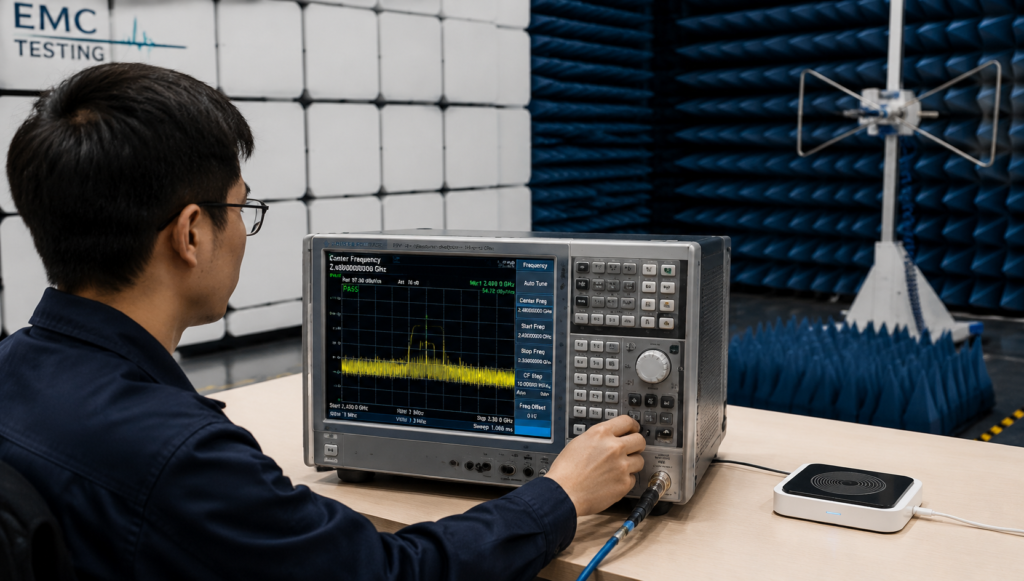
This is the issue that everyone is most concerned about. It should be noted that the following classification can only help with preliminary screening, and cannot replace the confirmation of Vietnam’s current product list and QCVN. Especially for wireless charging devices, it cannot be judged solely by “transmitter end” or “receiver end”.
| Charging products that may require MIC-related testing or conformity assessment | Products that usually do not trigger MIC RF testing solely due to wired charging function |
| Smart charging products with wireless communication functions such as Bluetooth and Wi-Fi, such as smart chargers, in-vehicle charging devices, smart power strips | Ordinary wired chargers, power adapters |
| Shared power banks with cellular networks, smart charging cabinets | Ordinary USB/USB-C charging cables, adapters, plugs |
| Charging accessories with wireless functions such as NFC and RF remote control | Charging sockets and power strips without wireless functions |
| Wireless charging transmitter end or receiver end, which shall be judged according to operating frequency, device classification, product list and applicable QCVN | Products that only have wired fast charging protocols, such as PD and QC, and have no over-the-air wireless transmission function |
| Charging heads, power banks or USB-C docks with wireless charging function, which shall be judged in combination with specific technical parameters | Ordinary charging accessories without wireless functions |
Wireless charging transmitter ends and receiver ends cannot be automatically exempted from or automatically included in MIC RF certification solely based on “whether they transmit”. Wireless charging usually uses near-field induction. Whether it falls under a certain Vietnamese mandatory technical regulation, and whether it involves radio, EMC or other product quality requirements, shall be confirmed separately according to the actual operating frequency, device purpose, current product list and applicable QCVN. Even if the receiver end does not fall under a certain RF transmission requirement, it may still be subject to other safety, EMC or product quality requirements.
After reading the comparison table, there are 3 boundary situations that are most likely to be misjudged, which must be noted:
The first is USB-C cables with E-Marker chips. Many people think E-Marker is an RF chip, but in fact it is mainly used to identify cable capabilities and participate in USB-C related wired protocols and power negotiation, with no over-the-air wireless transmission throughout the process, so it cannot be concluded that RF testing is required just because there is an E-Marker; but if the USB-C cable also has over-the-air wireless functions such as Bluetooth finding and NFC sensing, it shall be evaluated according to the corresponding product list and QCVN.
The second is pure magnetic field wireless charging, that is, wireless charging that has no data communication and only transmits energy by magnetic field. Many people think “it doesn’t even transmit data, it just charges, so no testing is needed”, but in fact, such a conclusion cannot be drawn directly. Qi-type wireless charging usually uses low-frequency near-field induction, not 2.4GHz wireless communication; whether it is subject to a certain MIC technical regulation or other mandatory requirements shall be judged according to the actual operating frequency, device classification and current Vietnamese regulations, and cannot be directly exempted from testing simply based on “having wireless energy transmission” or “no data communication”.
The third is products with certified wireless modules. Some sellers will say “the Bluetooth module I use has passed relevant Vietnamese certification, so the whole device doesn’t need to be tested, right?” The answer cannot be generalized. The testing or certification of the module usually only covers the module itself, and the power supply design, structure, antenna position and software configuration of the whole device may affect the final RF performance. Whether module materials can be used, whole device testing can be reduced, or simplified procedures are applicable shall be confirmed by specific regulations, certification bodies and the whole device configuration, and module documents cannot directly replace the whole device compliance assessment.
If you are still unsure after comparison, you can use the 3-step quick self-check method for preliminary judgment:
Step 1: Confirm the product category, whether it has wireless functions, the actual operating frequency, and whether it is on Vietnam’s current mandatory product list. You cannot use “active transmission” or “passive reception” as the absolute judgment.
Step 2: Go to the official website of the Vietnamese competent authority to compare the newly released mandatory product catalog and corresponding QCVN, and confirm the compliance path applicable to charging products, because the catalog and regulations may be updated, so do not judge based on old experience from a few years ago.
Step 3: If you are still unsure, find a testing, certification or compliance agency with corresponding Vietnamese regulatory service capabilities to conduct a pre-assessment. The judgment of professional agencies is more reliable than guessing by yourself, and can also avoid subsequent pitfalls.
What Exactly Are the Core Tests About?
Many people only look at the word “qualified” when they get the test report. In fact, the test items will vary with the wireless system, device category and applicable QCVN. Common items include frequency, output power, occupied bandwidth, out-of-band or spurious emissions, etc., but it cannot be generalized that all products with wireless functions must be tested uniformly.
| Test Indicator | Core Requirement | Supplementary Note |
| Frequency Band Compliance | Operate in accordance with the frequency bands allowed by Vietnam and applicable device categories | Bluetooth usually uses 2.4GHz; Wi-Fi may involve 2.4GHz, 5GHz and other frequency bands; Qi-type wireless charging usually uses low-frequency near-field induction and should not be classified as 2.4GHz |
| Transmit Power Limit | Shall not exceed the upper limit specified by the applicable frequency band and device category | The specific limits, power definitions and measurement calibers must be subject to the applicable QCVN, and “2.4GHz ≤ 100mW” cannot be used as a general conclusion for all Bluetooth devices or wireless charging devices |
| Occupied Bandwidth | The frequency band width occupied by the signal shall comply with the corresponding standard | The specific requirements depend on the wireless system, channel and operating mode |
| Out-of-Band or Spurious Emissions | Emissions outside the main operating signal shall not exceed the specified limits | Power supply noise, insufficient shielding or improper layout may cause related items to fail |
Here is a brief explanation of spurious emissions: just like when you speak, in addition to the normal sound, there will also be noise. If the noise is too loud, it will affect the people next to you speaking. The out-of-band or spurious emissions of wireless devices are the energy leaked outside the main signal. When they are too strong, they may interfere with other legal devices, so they are often the focus of testing and rectification.
Since charging products themselves also contain power supply circuits, changes in operating status may affect wireless performance, but specific test conditions cannot be applied with fixed numbers on your own. The laboratory shall conduct tests in accordance with the power supply, environment, operating mode and most unfavorable configuration specified in the applicable QCVN. If the product’s power supply status or fast charging gear will significantly affect wireless performance, the laboratory can include the relevant status in the assessment, but 100V to 240V, temperature changes or all fast charging gears cannot be regarded as unified Vietnamese regulatory requirements.
At the same time, the specified representative and most unfavorable operating modes shall be selected based on the applicable QCVN, and if necessary, cover wired, wireless and multi-port combination states that will significantly affect the results. For example, when a multi-port charger performs wired fast charging and wireless charging at the same time, the load may be large and the power supply noise may also change. Whether such states need to be tested depends on the product function, applicable standards and laboratory test plan.
The impact caused by power supply noise is usually evaluated through applicable EMC, out-of-band emission or spurious emission items, and not all charging products uniformly set an independent MIC RF item called “power supply linkage test”.
Products with different functions have different test focuses. You don’t need to memorize them by rote, just have a general understanding:
• Short-range communication category (Bluetooth/Wi-Fi): For Bluetooth, the operating frequency, power, occupied bandwidth, and out-of-band or spurious emissions are usually checked. For Wi-Fi, the allowed channels, bandwidth, power, out-of-band or spurious emissions and other items specified by the standard shall be checked according to the used frequency bands such as 2.4GHz and 5GHz. Frequency hopping related parameters are only checked when frequency hopping technology is applicable or the standard explicitly requires it.
• Wireless charging category: The applicable radio, EMC or other technical requirements shall be confirmed according to its actual operating frequency and device classification, and attention shall be paid to the operating stability under load, near-field energy leakage and the impact of power supply noise.
• Products with multiple wireless modules: In addition to evaluating the performance of each wireless system when working alone, it may also be necessary to evaluate the mutual interference when multiple modules work at the same time, which shall be subject to the applicable QCVN and test plan.
How Does the Practical Operation Process Work?
After understanding the test content, next we will talk about the whole process of actual operation, from preparation to completing the compliance procedures.
First is the preparation before testing. Doing these well can save a lot of time and money:
First is sample requirements. Representative samples, accessories and software versions consistent with the intended sales version shall be provided, complete whole devices shall be used as much as possible, and the power supply, charging cables and related loads matched during actual sales shall be prepared. For wireless charging devices, test loads and receiving devices shall be prepared in accordance with applicable standards or laboratory plans, and cannot be replaced at will.
Second is document preparation. Sort out the product model parameters, wireless module specifications, supported frequency bands and power, firmware version, antenna parameters and other materials in advance. All materials shall be consistent with the intended sales version, and specially adjusted configurations unrelated to the mass production version cannot be used.
Third is pre-test suggestions. If conditions permit, it is best to do a round of internal pre-test first, focusing on checking common problems such as power supply noise, shielding, power and frequency deviation. Rectifying in advance saves more time and cost than retesting after failing the formal test.
Fourth is status requirements. The test mode shall be determined by the applicable QCVN and the laboratory test plan. The laboratory will select normal, maximum or most unfavorable operating modes according to the standard, and test different function combinations if necessary; you should not forcibly set all wireless functions to maximum power and widest bandwidth on your own.
After preparation, you can go through the formal testing and compliance process. The basic steps are as follows:
Step 1: First confirm the mandatory supervision category the product belongs to, the applicable QCVN and the procedures that need to be handled, then submit samples and materials to testing and certification agencies with corresponding qualifications or accreditation scope. You cannot judge the agency requirements for all products solely based on the “MIC accredited laboratory list”.
Step 2: The testing agency shall complete applicable wireless, EMC or other item tests in accordance with the corresponding QCVN and test methods.
Step 3: Obtain the corresponding test report or technical document after passing the test; if it fails, it is necessary to rectify the problem and conduct supplementary testing or retesting according to the agency’s requirements.
Step 4: According to the mandatory supervision category the product belongs to and the applicable QCVN, go through the prescribed procedures such as conformity certification or conformity declaration. After completion, use the CR conformity mark in accordance with Vietnamese regulations, and fulfill the requirements for product labeling, instruction manuals and technical parameter marking. The “MIC mark” cannot be regarded as the unified name of Vietnam’s mandatory conformity mark, nor can it be considered that the legal sales procedures are automatically completed after obtaining the test report.
The cycle and cost that everyone is most concerned about actually have no fixed value, and are mainly affected by the following factors:
The cycle is jointly determined by the number of applicable QCVNs, the complexity of wireless functions and frequency bands, sample preparation status, laboratory scheduling, rectification and retesting, and subsequent certification or conformity declaration procedures. Products with a single wireless function may sometimes take several weeks, and multi-band, multi-function products or items that require rectification usually take longer. The 1-2 weeks or 2-4 weeks mentioned in the original text can only be used as a commercial estimate of individual agencies, and cannot be regarded as Vietnamese regulatory requirements or a universal commitment.
In terms of cost, it is usually affected by factors such as the number of wireless functions, frequency band complexity, number of test items, number of samples, and whether rectification and retesting are required. The more functions and the more complex the frequency band, the higher the cost usually is. Vietnam also does not have a unified official laboratory quotation applicable to all products, and the specific quotation shall be subject to the quotation of agencies with corresponding qualifications.
Finally, let’s talk about the division of compliance responsibilities. Different roles bear different responsibilities:
Importers, manufacturers, subjects of conformity declaration and distributors shall respectively bear the responsibilities for the authenticity of materials, product consistency, certification or declaration, labeling and market circulation management as stipulated by Vietnamese regulations. Overseas manufacturers or brand owners usually need to provide real technical materials and samples consistent with the intended sales version; importers or local business entities need to cooperate in declaration, document preservation and market management; distributors shall verify whether the product has applicable compliance documents. The specific responsibilities shall be determined according to the product category, Vietnamese law and contractual relationship, and cannot be generalized as one party bearing all responsibilities.
Advanced Pitfall Avoidance: Key Points That Semi-Proficient People Must Know
If you not only want to know “how to do it”, but also “how to judge whether it is right” and “how to avoid pitfalls”, you must finish reading this part.
First, how to judge whether a Vietnamese RF test report has use value? Don’t spend money on documents that cannot be used for subsequent procedures:
First, check the testing agency. It shall be verified whether the testing agency has the accreditation or designated qualification under Vietnamese regulations within the scope of the product and QCVN. Different compliance procedures may involve different testing, certification or designated agencies. You cannot only look at the agency name, nor can you directly equate “not on a certain list” with the report being invalid in all situations.
Second, check consistency. The product model, hardware version, firmware version, and antenna configuration in the report shall be consistent with the intended sales version. As long as the key configuration changes, a change assessment shall be conducted. For example, if a ceramic antenna is used during testing and a PCB antenna is used during mass production, the original report cannot be continued to be used without judgment.
Third, check the regulation version. The QCVN version and transition provisions applicable at the time of testing and at the time of product launch and import shall be checked. When regulations are updated, you cannot only look at the standard number on the report, but also confirm whether the old standard is still within the transition period and whether the certification body accepts the original test data.
Fourth, check the content. Don’t just look at the “qualified” conclusion on the first page. Turn to the back to see whether the test items cover the QCVN and operating modes actually applicable to the product. For example, if the product has two functions: wireless charging and Bluetooth, it is necessary to confirm whether the report or compliance document covers both functions, instead of only testing one of them.
In addition, it should be noted that test reports, conformity certificates and conformity declarations are not the same document. Whether the test report can continue to be used for Vietnamese compliance shall be confirmed in combination with the applicable QCVN version, transition period, product changes, certification body rules and the validity requirements of the report itself. It cannot be claimed that Vietnamese MIC compliance documents are uniformly “valid for a long time”. The term and validity of the test report, certificate and conformity declaration shall be confirmed separately.
Next are the rectification problems that often occur in the testing of charging products. Early inspection can improve the pass rate, but they should not be regarded as official statistical rankings:
Problems such as power supply noise, out-of-band or spurious emissions, transmit power deviation and frequency stability may all lead to failure. Charging products have built-in switching power supplies, and the noise of the power supply part may be coupled to the wireless part through layout, grounding, shielding or cables; wireless charging coils, antenna positions and housing structures may also affect the final results.
High transmit power may be related to RF parameter settings, antenna gain, firmware configuration or device consistency. Advertising “ultra-long wireless charging distance” or “super strong Bluetooth connection” does not necessarily mean that the product has increased transmit power, because the actual distance is also related to the antenna, coil, protocol, receiving sensitivity and structural design. When judging, you should check the actual power and test results, rather than drawing conclusions solely based on promotional slogans.
Frequency stability problems may be related to crystal oscillator accuracy, power supply changes, temperature changes, software configuration or device quality. Whether the requirements are finally met shall be judged based on the test conditions and limits specified in the applicable QCVN.
Without formal testing, risks can be preliminarily predicted from design documents, but this cannot guarantee qualification. It mainly depends on these three points:
First, look at the chip and module materials. Regular suppliers can usually provide relatively complete specifications, frequency band and power control materials, and product consistency is easier to manage; but using well-known chips does not mean automatic qualification, and it still depends on the whole device configuration and test results.
Second, look at the structure. If the product’s wireless module has reasonable shielding and filtering design, the power supply part has a clear layout, and the wireless module maintains an appropriate distance from the main noise sources, the risk of radiation or spurious problems is usually easier to control.
Third, look at the promotion and actual parameters. If the product promotes a long connection distance or wireless charging distance, the actual power, antenna or coil design, receiving sensitivity and test results shall be checked emphatically, instead of directly presuming that it must be achieved by increasing the transmit power.
In case the test fails, don’t panic. Rectify according to the specific problems in the test records:
If the radiation, out-of-band or spurious emissions exceed the standard, you can check the filter components, power supply shielding, wireless charging coil shielding, antenna position and wireless module layout, and adjust the design according to the test results.
If the transmit power exceeds the standard, you should check the RF chip parameters, firmware settings, antenna gain and power measurement caliber, and adjust the actual output to the range specified by the applicable QCVN without affecting the product safety and function.
If the frequency stability does not meet the standard, you should check the crystal oscillator, power supply, temperature and software configuration, and improve the device or circuit design according to the applicable test conditions.
Merchants doing the Vietnamese market are most likely to fall into these 6 compliance pitfalls, which must be avoided:
Pitfall 1: Directly replacing Vietnamese procedures with overseas reports such as CE and FCC.
Overseas compliance documents such as CE and FCC cannot automatically replace the conformity procedures stipulated by Vietnam. However, whether overseas test data can be adopted shall be confirmed according to the specific QCVN, laboratory accreditation scope, mutual recognition arrangements and the requirements of Vietnamese certification bodies. It cannot be completely denied, nor can it be generally considered that it can be used directly.
Pitfall 2: Only testing the wireless module without testing the whole device.
Module materials or module certification do not necessarily mean that the whole device is compliant. Power supply, structure, antenna, housing and software configuration will all affect RF performance. Usually, the whole device consistent with the intended sales version shall be evaluated.
Pitfall 3: Specially adjusted test samples, but reduced mass production versions.
For example, adding a shielding layer to the sample, using different chips or modifying power settings during testing, but removing these designs during mass production. Once the actual product is inconsistent with the compliance materials, it may lead to risks such as rectification, sales suspension, and certificate or declaration handling.
Pitfall 4: Replacing the Vietnamese sales version with reports from other regional versions.
Frequency bands, channels, power and software configurations may vary in different regions. It must be confirmed whether the version intended to be supplied to the Vietnamese market is consistent with the test sample and report.
Pitfall 5: Continuing to use the old report after product modification.
Replacing wireless chips, modules, antennas, power boards, wireless charging coils, or adjusting firmware frequency bands and power parameters shall all be subject to change assessment first. Whether supplementary testing or re-certification is required shall be confirmed by the applicable regulations and certification bodies according to the actual impact.
Pitfall 6: Thinking that having an RF report means you can sell legally.
The test report is only one of the technical documents. It is also necessary to complete the applicable conformity certification or conformity declaration according to the QCVN and mandatory supervision category the product belongs to, and use the CR mark and complete the labeling and instruction manual marking as required. The specific procedures cannot be uniformly referred to as “MIC type approval”.
Finally, let’s talk about the retest judgment rule after product change. The core is to see whether the change will affect the RF performance and the applicability of the original compliance documents.
When wireless chips, modules, antennas, power supplies, wireless charging coils, housing materials or firmware change, a change assessment shall be conducted first, and supplementary testing or re-certification shall be carried out if necessary. Even if a certain change seems small, as long as it changes the space near the antenna, shielding, heat dissipation or power supply noise, the impact cannot be directly excluded.
Changing the housing color, adjusting the packaging, changing the button shape or modifying the product silk screen usually does not affect the RF performance, but the certification or conformity declaration subject shall still confirm whether filing, updating technical materials or retesting is required according to applicable rules, and absolute exemption conclusions cannot be made on your own.
Extended Reference: Southeast Asian Market Differences and Data Reuse
If your products are not only sold in the Vietnamese market, but also in other Southeast Asian countries, here are two core reference points.
The first is the regulatory differences in major Southeast Asian markets:
Thailand’s NBTC may have local requirements in frequency band division, power limits, device categories and certification processes, and certificates cannot of course be mutually recognized with Vietnam. The test methods may be similar, but they still need to be handled in accordance with Thailand’s current device list and specific procedures.
Singapore’s IMDA may adopt supplier declaration, device registration, simplified registration or other compliance paths for different device categories, which cannot be generalized as a single supplier conformity declaration model. Not all products in Vietnam adopt unified type approval either, and many products are managed by conformity certification or conformity declaration. The technical requirements of the two countries may overlap, but the access paths must be confirmed separately.
The second is the prerequisite for test data reuse. If you have test data from other markets and want to use it in Vietnamese compliance procedures, you cannot only look at whether the report comes from a well-known laboratory, but also check at the same time:
First, whether the test standards, limits and test conditions are consistent with the applicable QCVN in Vietnam;
Second, whether the laboratory has accreditation or designated qualifications within the scope of the corresponding product and standard, or whether there are applicable mutual recognition arrangements;
Third, whether the test sample, hardware, firmware, antenna, frequency band and power configuration are consistent with the Vietnamese sales version;
Fourth, whether current Vietnamese regulations, certification bodies or competent authorities accept the report or test data.
The final acceptance shall be determined by the applicable competent authority, certification body or the agency responsible for the conformity procedure, not by the enterprise itself thinking it is compliant.
This concludes the core content of Vietnam’s MIC RF testing. After reading this article, you should be able to preliminarily judge whether the charging products in your hand may require Vietnam MIC-related testing or other conformity procedures, know that you cannot draw conclusions solely based on “whether there is active wireless transmission”, and also understand core indicators such as frequency band, power, out-of-band and spurious emissions. For merchants planning to enter the Vietnamese market, checking the product list, applicable QCVN, testing agency qualifications, product version and labeling requirements in advance can reduce the risk of subsequent rectification and document invalidation. When products are modified, a change assessment shall also be conducted first; when expanding to other Southeast Asian markets, the local frequency band, certification and data reuse rules shall be confirmed separately. Compliance is the foundation for entering overseas markets. Preparing well in advance can avoid a lot of unnecessary losses.