
Many practitioners in the charging product industry who are new to the Indian market are often asked, “Has your product obtained BEE energy efficiency certification?” Some say all chargers need it, some say only high-power ones do, and others confuse energy efficiency with safety certification. In the end, they either waste money on unnecessary certifications or have their goods detained at customs. Today, we will thoroughly explain the content related to chargers, power adapters and supporting charging products in India’s electronic product energy efficiency standards. From basic judgment to pitfall avoidance verification, you will be able to do it yourself after reading this.
First, clarify the applicable scope: all guidelines in this article are only for BEE energy efficiency applicability verification of chargers, power adapters and supporting charging products, and do not involve other categories of electronic products. All compliance conclusions must be based solely on valid official Indian documents on the date of inquiry. We do not presuppose that all charging products are subject to regulation, and the final judgment must be verified in combination with actual product parameters and the latest regulations.
Pre-Verification Preparation: First Make a Product Fact Card
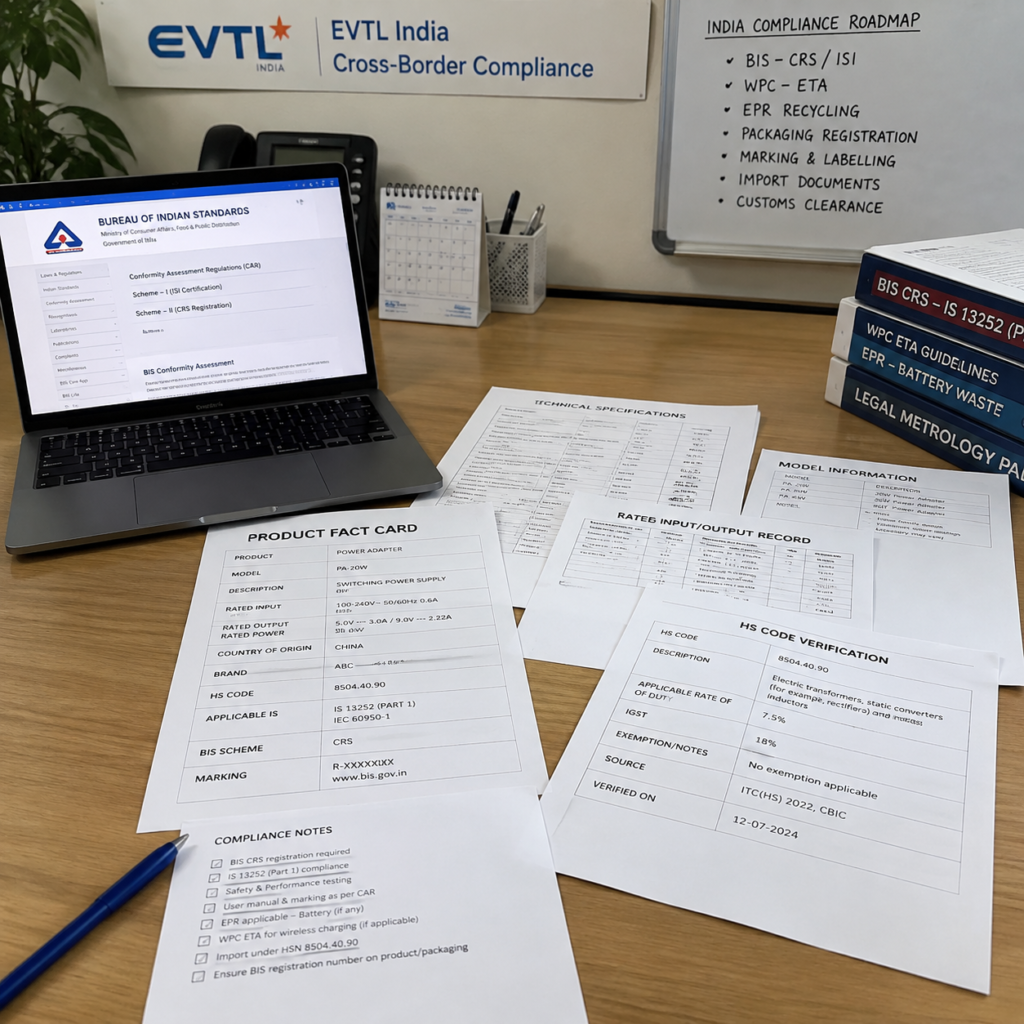
Before checking any regulations, first fully understand your own product — this is a step that many people skip but is most likely to cause pitfalls. If information is incomplete, all subsequent scope judgments are just guesswork. This “product fact card” is the basis of all verification work:
The core information to be confirmed includes: official product name and model, rated input/output parameters and rated power, number and type of ports, list of supported fast charging protocols, whether there is a built-in battery, sales/entry form (sold separately / bundled with complete device / for personal use), local Indian importer/responsible entity, customs HS code.
This card has two core functions: first, to avoid scope misjudgment caused by incomplete information, such as mistaking a multi-port fast charger for an ordinary single-port charger; second, all subsequent work such as matching the BEE catalog, selecting test plans, and handling registration must be based on this information.
Basic Understanding: Essence and Application Logic of BEE Energy Efficiency Rules
The First Misconception to Clarify Firmly: Not All Chargers Need BEE Energy Efficiency Compliance
BEE does not automatically determine applicability based on product names, and there is no default rule that “all charging products must comply”. To judge whether a product needs to meet the requirements, four elements must be considered simultaneously: matching degree of product definition, the latest BEE catalog, official notice for the corresponding product, and valid documents on the date of inquiry. Directly equating “charging products” with “BEE mandatory regulated products” is the most common mistake.
What Does BEE Regulate?
BEE energy efficiency is essentially an energy conservation and energy efficiency management system implemented by India in accordance with the Energy Conservation Act, 2001 and related rules and notices, rather than environmental protection regulations in the usual sense. It belongs to a different system from environmental compliance requirements such as e-waste and RoHS. Its regulatory goal is to reduce the waste of electrical energy of charging products in working, no-load/standby states.
For the market, if products within the mandatory scope are not compliant, they may face consequences such as import obstruction and sales ban; specific measures depend on applicable laws, product schemes and law enforcement decisions. For ordinary users, products with high energy efficiency can save electricity bills in long-term use, and high conversion efficiency means less heat generation and reduced carbon emissions.
Competent Authority and Management Methods
The official department responsible for coordinating energy efficiency policies is the Bureau of Energy Efficiency of India (BEE for short). The specific management methods are subject to product schemes and official notices, commonly including mandatory S&L, voluntary S&L, as well as minimum energy efficiency, registration or document submission requirements specified in certain regulations or product schemes, which cannot be summarized into five fixed categories.
If after checking the relevant laws, government gazettes, BEE product schemes and notices valid on the date of inquiry, the product is not found to be included in the corresponding BEE scheme, it can be temporarily treated as “not found to be included as of the date of inquiry”. This does not mean permanent exemption, and it is still necessary to verify other applicable requirements and conduct continuous rechecks.
| BEE Management Method or Requirement | Possible Nature | Core Description |
|---|---|---|
| Mandatory S&L (Standards & Labeling) | Mandatory | Meet energy efficiency grade requirements, complete registration according to the scheme and affix the star label |
| Voluntary S&L | Voluntary | Apply for registration on your own initiative, and use the label as required after the application is approved |
| Minimum Energy Performance Standards (MEPS) | Possibly applicable technical requirement | Some regulations or product schemes may specify minimum energy efficiency thresholds, subject to official documents |
| Registration or document submission | Possibly applicable procedural requirement | Some schemes may require registration, filing or document submission, specific requirements are subject to the corresponding documents |
| Not yet found to be included in the corresponding scheme | Inquiry conclusion | It only means that inclusion is not found in relevant public documents as of the date of inquiry, and does not represent permanent exemption |
Boundaries with Other Regulations: Don’t Confuse Them
Many people confuse BEE with other certifications. Remember: these rules are independent of each other and cannot replace each other:
| Regulation/Certification Type | Core Jurisdiction Scope | Can It Replace BEE Energy Efficiency? |
|---|---|---|
| BEE energy efficiency | Product power consumption level, energy saving capacity | It is the regulatory subject itself |
| BIS safety rules | Safety risks such as electric leakage and fire | No |
| E-waste rules (EPR/RoHS) | Waste recycling, hazardous substance restriction | No |
| USB-IF related certifications | USB specification compliance, interoperability and use of certification marks; does not mean support for all proprietary fast charging protocols | No |
In short: energy efficiency regulates whether the product saves power, safety regulates whether accidents will happen, interface certification mainly regulates whether USB specifications are met and whether products can interoperate according to specifications, recycling regulates how to handle products after scrapping — each regulates its own area. USB-IF related certifications also do not mean that the product supports or is compatible with all fast charging protocols, and in particular, many proprietary protocols other than USB-PD cannot be included in the scope of USB-IF certification.
Verification Methods of Regulatory Sources and Evidence Archiving Methods
Since all requirements are subject to official documents, which documents should be checked? How to keep evidence so that there will be no ambiguity afterwards?
Priority of Official Documents and Must-Check List
The priority of official documents from high to low is: formal laws / government gazette notices > official scheme documents on BEE official website > product catalog on BEE official website. When low-priority documents conflict with high-priority ones, the high-priority ones shall prevail.
The 5 categories of must-check documents include (the last two categories are simultaneous verification items, which are not under BEE’s jurisdiction but need to be confirmed simultaneously):
- Latest BEE S&L/MEPS product catalog: confirm whether the product is listed and which management method or requirement it corresponds to
- BEE official notice for the corresponding product: confirm implementation date, applicable scope, implementation standards, management requirements
- Applicable Indian national standards (IS standards): confirm test methods, index limits, judgment rules
- BIS Compulsory Registration Scheme (CRS) catalog: simultaneously confirm safety requirements
- E-waste related regulations: simultaneously confirm requirements such as EPR and RoHS
How to Keep Official Evidence
After checking the documents, be sure to keep the evidence well to avoid being unable to prove the basis for the judgment at that time after the regulations are updated. The archived content includes:
- Basic document information: title, official number, release date, revised version, official effective date
- Inquiry trace information: inquiry date, official link, screenshots of key applicable clauses
- Product matching information: exclusive requirements for corresponding power range, function category, and sales form
- Timeliness reminder: separately mark expired / soon-to-expire transitional policies to avoid judging with outdated rules
Evidence-Based Verification Process for Product Applicable Scope
With the document query method, we can judge the applicability of the product according to a five-step process. Please do not skip steps:
Step 1: First Confirm Whether It Is a Power Conversion Category
The core judgment feature is: whether the product has the power conversion function of converting mains electricity to low-voltage direct current.
Common categories to be verified include independent wall-plug mobile phone chargers, laptop/tablet power adapters, and multi-port fast chargers; if they do not belong to the power conversion category (such as pure charging cables), they are not subject to this type of energy efficiency regulation, and need to be checked against other regulations.
Step 2: Match the BEE Product Classification Decision Tree
After confirming that it is a power conversion category, then correspond to the specific category. The verification directions for different categories are completely different:
- Independent wall-plug low-power chargers: check the catalog and power range requirements, and shall not directly default to mandatory
- Laptop/tablet power adapters: check the applicable scope of the “external power supply” category in the catalog
- Multi-port fast chargers: check whether they are included in the corresponding category and the special rules for multi-port output
- Ordinary / E-Marker equipped USB-C charging cables: belong to the cable category, not within the energy efficiency regulation scope of power adapters
- Power banks: have both battery and charge-discharge conversion attributes, not within the default regulation scope, need to be verified separately
- Adapters sold bundled with complete devices: confirm in combination with BEE notices and complete device rules, and shall not directly default to exemption
- Car chargers: judged separately in combination with the BEE catalog and corresponding notices on the date of inquiry, no default conclusion
- Industrial/medical dedicated power supplies: check the rules for exclusive categories, and shall not apply the requirements for consumer chargers
Step 3: Query the Latest Catalog and Corresponding Notices
After finding the corresponding category, log in to the BEE official website to query the latest S&L/MEPS catalog and official notices, and confirm three core points: whether the product category is in the catalog, the corresponding management method or requirement, and the effective time and transitional policies.
Step 4: Issue Four-Level Verification Conclusions
After the check, there are only four conclusions. Do not casually say “definitely not needed” or “definitely needed”:
- Confirmed mandatory: Official documents clearly include it in the mandatory management scope, and compliance must be completed as required
- Confirmed voluntary: Official documents clearly include it in the voluntary management scope, and you can independently choose whether to apply
- Not found to be included as of the date of inquiry: Existing public documents do not mention inclusion in regulation, but this does not mean permanent exemption, and regular rechecks are required
- Insufficient evidence pending supplementary check: Product parameters/classification are unclear, or official documents are ambiguous, need to supplement information or consult the official authority
Step 5: Simultaneously Verify Parallel Regulatory Obligations
No matter what conclusion is drawn, it cannot be directly judged that “there are no compliance requirements”: mandatory/voluntary products need to be simultaneously verified for other requirements such as BIS safety and e-waste; products not included / pending supplementary check need to be checked against other corresponding regulations.
Compliance Requirements for Model/Scheme Changes
The same energy efficiency registration/filing only applies to products of the corresponding model. If the following changes occur, a re-application is required: replacement of key power components, change of core design structure of internal circuits, adjustment of rated input and output parameters, modification of firmware/power control logic, change of number/type of ports. Products with the same appearance but different internal schemes cannot share the same registration/filing.
Key Points for Checking Energy Efficiency Indicators and Test Plans
If the product is confirmed to require BEE energy efficiency compliance, the next step is to face testing. First, make it clear: there are no universal mandatory test items, all requirements are subject to official documents.
Description of Common Energy Efficiency Indicators
We divide the indicators into two categories for easy understanding:
The first category is the core indicators frequently required for external power supply products:
- No-load or zero-load power consumption: The input power consumption of an external power supply under specified input conditions when the output terminal is disconnected or does not provide the specified power to the load. The specific state definition and test method are subject to the applicable IS standards and product notices
- Average conversion efficiency: The ratio of mains electricity converted to low-voltage direct current. For example, if 100W alternating current goes in and 85W direct current comes out, the efficiency is 85%. The higher the efficiency, the more power is saved and the less heat is generated
The second category is indicators that are only applicable when explicitly required by the official authority, not every product needs to be tested:
- Standby power consumption: The continuous power consumption of a charger when connected to a dormant/fully charged device, the specific state needs to be defined according to applicable standards
- Power Factor (PF): The ratio of active power to apparent power, reflecting the utilization characteristic of the power supply for grid current. It is different from the conversion efficiency that converts input power to output power. Whether to test and the limits are subject to applicable official standards and notices
- Efficiency indicators under other specific working conditions, such as efficiency when multiple ports output simultaneously
Remember a unified rule: the names, test methods, and limits of all indicators are subject to BEE notices and IS standards. There are no universal values. Do not credulously believe empirical sayings such as “efficiency must reach 85% to pass”.
Key Points for Checking Test Plans
The test plan must meet two core requirements:
- Basic test conditions shall be implemented in accordance with the corresponding IS standards and BEE notices. For example, input voltage, ambient temperature, etc. cannot be set by yourself
- The test plan must be consistent with the product’s declared functions, and only when explicitly required by the official authority does it need to cover all protocol gears and multi-port simultaneous output combinations
The number of samples and selection rules are also subject to BEE notices / IS standards, and there are no universal requirements.
Laboratory Qualification and Report Validity
Whether a test report is valid depends on the laboratory’s qualification. Similarly, there is no unified rule, and it is subject to the official requirements of the corresponding product:
- Key points for qualification verification: laboratory name, validity period of accreditation certificate, accredited test standards/items, and covered product scope must match the tested product
- Accreditation requirements: whether BEE accreditation or NABL (National Accreditation Board for Testing and Calibration Laboratories of India) accreditation is required is subject to the official requirements of the corresponding product scheme
- Overseas test reports: can only be used when explicitly recognized by the BEE scheme, and shall not be defaulted to be valid or invalid
- Required fields in the report: product model/specification, test conditions, measured values of each indicator, basis for limits, laboratory seal and signature, accreditation mark
BEE Compliance Certificate and Label Rules
After passing the test, you need to apply for a compliance certificate and affix the label as required. There are also many pitfalls here.
Compliance Requirements for Different Management Methods
- Mandatory S&L category: need to affix the star label, and obtain the corresponding BEE registration/filing documents at the same time
- Voluntary S&L category: the star label can only be affixed after the application is approved. Unauthorized affixing without approval is a violation
- Products subject to minimum energy efficiency, registration or document submission requirements: meet the technical requirements and submit or retain the required documents in accordance with the corresponding official documents. Whether a label is required and the specific procedures are subject to the scheme documents
- Products not found to be included in the corresponding scheme as of the date of inquiry: no need to affix the corresponding BEE energy efficiency label accordingly, but it is still necessary to verify other applicable requirements and conduct continuous rechecks
Star Label Rules (Only Applicable to S&L Category)
- Label specifications: fields, colors, and sizes are subject to the official style of the corresponding scheme. Not all product labels are exactly the same
- Affixing requirements: mandatory S&L products need to be affixed to a conspicuous position on the product body or the minimum sales package, subject to official notices
- Labeling requirements: label information must be consistent with registration test results and filing information, and false labeling of star ratings or parameters is prohibited
- Validity period: the validity period of registration/label is subject to the provisions of the corresponding BEE notice, and re-application is required upon expiration
Validity Boundary of Compliance Certificate (Pitfall Avoidance)
Many people have misunderstandings about BEE compliance. Here are three “does not mean” clarifications:
- Does not mean the product is safe and qualified: safety is regulated by safety rules such as BIS, and energy efficiency and safety are two different things
- Does not mean fast charging speed: BEE energy efficiency grade is not equivalent to the charging speed indicator. The actual charging speed also depends on factors such as protocol negotiation between the charger and the device, rated output capacity, cable, battery status, temperature and power management
- Does not mean that supporting accessories (charging cables, plugs, etc.) are individually compliant: accessory compliance needs to be verified separately
Methods for Verifying the Authenticity of S&L Labels
If you want to check whether a product’s BEE label is real, there are three simple methods:
- Check whether the label has a clear BEE registration number (when required by the corresponding scheme)
- Check whether the models on the label, product body, and minimum sales package are consistent
- Query the filing information by model/registration number in the BEE official database to check the matching degree
Compliance Implementation Checklist and Risk Prevention and Control
One-Page Compliance Implementation Checklist
The entire compliance process can be carried out in six steps without missing items:
- Pre-preparation: complete the product fact card, confirm core parameters and sales form
- Classification judgment: complete the four-level conclusion judgment according to the process, and retain official evidence
- Testing phase: entrust a qualified laboratory to complete the test in accordance with applicable standards
- Registration and filing: submit an application according to the requirements of the corresponding scheme, and obtain compliance certificate documents
- Production and launch: affix labels as required (if needed), and retain a full set of compliance documents
- Import recheck: before import, check that the registration status and product parameters are consistent with the filing information
Division of Compliance Responsible Entities
- Indian importers, manufacturers, brand owners and the application entities specified in the scheme shall respectively bear the obligations of application, document authenticity, labeling, import or sales links in accordance with the applicable BEE scheme and relevant laws. The specific responsibilities shall be confirmed by official documents and actual transaction arrangements
- Overseas manufacturers/brand owners: need to provide qualified test reports and product technical documents
- Authorized agents: can handle registration/filing on behalf of others, but the final responsibilities of all parties still need to be confirmed according to the applicable scheme, relevant laws and actual transaction arrangements
- The responsible entities for requirements not under BEE jurisdiction (EPR, RoHS, etc.) shall be confirmed separately in accordance with the corresponding regulations
Compliance Evidence Package Checklist
All compliance documents need to be sorted and retained for verification:
- Basic documents: product fact card, description of classification judgment conclusion
- Official evidence: screenshots of BEE catalog/notices on the verification date, applicable standard clauses, inquiry trace records
- Test documents: test report, laboratory qualification certificate (including accreditation scope)
- Compliance documents: BEE registration/filing notice, label draft (if applicable)
- Change records: product model/scheme change records, corresponding compliance update documents
- Other documents: importer authorization documents, continuous compliance monitoring records
Common Reasons for Compliance Failure
The four most common pitfalls can be avoided in advance:
- Catalog misjudgment: failing to verify the latest official documents, and defaulting that the product needs/does not need compliance based on experience
- Invalid test: the test plan does not meet the standard requirements, or the laboratory qualification/accreditation scope does not match
- Inconsistent labeling/filing: false label labeling, inconsistent model, missing registration number or expired registration
- Change not updated: failing to re-apply for registration/filing after the product scheme/key parameters are changed
Compliance Risks and Trigger Scenarios
Non-compliance may face the following risks:
- Obstruction in customs, import or sales links: when mandatory regulated products fail to meet applicable registration, labeling or energy efficiency requirements, or the declared information is inconsistent with the filing, it may lead to obstruction in customs clearance, import or sales links
- Rectification, punishment or other law enforcement measures: when energy efficiency fails to meet standards in market spot checks, energy efficiency is falsely labeled, or registration is not completed as required, rectification, punishment or other law enforcement measures specified in applicable laws may be triggered
- Platform/channel requirement type: failure to provide qualified BEE compliance certificates may result in restrictions on listing
- Commercial loss type: delivery delays, customer rejection or claims caused by compliance issues are consequential commercial risks, and there is no unified compensation standard
The specific consequences must be confirmed based on relevant gazettes, schemes and law enforcement decisions. Detention of goods, return shipment, fines or sales bans cannot be regarded as results that will automatically occur in all non-compliance situations.
Continuous Compliance Requirements
Compliance is not a one-time thing. Three points must be done well:
- Regularly check the updates of BEE catalog and notices to avoid non-compliance after regulatory changes
- Start re-testing and application in advance before the registration/filing expires
- Evaluate whether it affects energy efficiency compliance before changing the product design/scheme
Self-Test Exercises and Conclusion Template
Competency Attainment Reference
You can compare with the following standards to see how well you have mastered:
Basic competence (can be mastered after reading):
- Can distinguish the different functions of BEE energy efficiency, BIS safety, and e-waste rules
- Can preliminarily judge whether charging products need BEE energy efficiency verification according to the process
- Can understand the core information of S&L labels and verify their authenticity
- Can explain the meaning of no-load power consumption and average conversion efficiency
Advanced competence (semi-proficient level):
- Can avoid common misconceptions (energy efficiency = safety, all charging cables need energy efficiency compliance, overseas reports are all usable/unusable, etc.)
- Can list the official documents to be verified and the key points of evidence archiving
- Can check the core items of test reports and laboratory qualifications
- Can check for basic compliance risks before import/procurement
Real Business Case Exercise
Case background: A brand exports four products to India at the same time: 65W single-port USB-C charger, 100W four-port fast charger, 240W USB-C charging cable with E-Marker, 10000mAh bidirectional fast charging power bank.
Exercise requirements: Judge the BEE energy efficiency applicability of the four products respectively, and explain the core documents to be verified.
Tip: Do not make a unified judgment solely based on “charging-related products”. You need to match them one by one according to the classification decision tree and confirm with the official catalog.
Self-Test True/False Questions (Covering Core Misconceptions)
See if you can get all of them right:
- All chargers exported to India must undergo BEE energy efficiency registration
(Answer: False. Only those clearly included in the mandatory catalog by the official authority are required, and verification must be carried out according to the process) - USB-C charging cables with E-Marker belong to the power adapter category and need to meet BEE energy efficiency requirements
(Answer: False. Charging cables are cable category, have no power conversion function, and are not subject to this type of regulation) - Test reports from overseas laboratories cannot be used for BEE energy efficiency registration at all
(Answer: False. They are only invalid when explicitly not recognized by the corresponding BEE scheme, subject to official documents) - The energy efficiency test of fast charging products must cover all fast charging protocol gears
(Answer: False. It only needs to be covered when explicitly required by the official authority; otherwise, it only needs to be consistent with the product’s declared functions) - Chargers sold bundled with mobile phones are necessarily exempt from BEE energy efficiency requirements
(Answer: False. It needs to be confirmed in combination with BEE notices and complete device rules, and shall not be directly defaulted to exemption) - The fields on the BEE star label are unified nationwide, and the label content of all products is exactly the same
(Answer: False. The label styles and fields of different categories are subject to the official requirements of the corresponding scheme)
In general, India’s BEE energy efficiency rules seem complicated, but the core logic is actually very simple: first fully understand your own product, then check the latest official documents, and do not draw conclusions based on experience or a single word from others. As long as you follow the process step by step, keep all evidence well, and conduct regular rechecks, you can avoid the vast majority of pitfalls.