
For those who export power adapters and chargers to Australia, almost everyone will first ask this question: is RCM mandatory? Some say CE is sufficient, some say an Australian standard plug is enough, and others say small-batch self-fulfillment shipments won’t be inspected. The actual situation is not as simple as “yes” or “no”; it must be judged based on product type, sales scenario, and even which Australian state the product is sold in. Today we will explain this matter thoroughly from basic judgment to pitfall avoidance details, and after reading it, you will be able to make a preliminary judgment on your own.
Core Conclusion and Quick Judgment
First, here is a directly applicable core conclusion: **Most commercial external power supplies and chargers that are directly connected to the Australian mains power supply need to be affixed with the RCM mark in accordance with the rules**. But first, we must clarify the most easily misunderstood premise: RCM is not a single “certificate” issued by an institution, but a mark of compliance commitment. The final requirements shall be subject to equipment classification, sales jurisdiction, and applicable laws and regulations.
If you are in a hurry, you can use 3 questions for a 30-second quick preliminary judgment:
| Judgment Question | Next Action |
| 1. Is it an independently supplied external power supply/charger directly connected to the Australian mains power supply? | No → Recheck according to the actual product category; Yes → Proceed to Question 2 |
| 2. Is it commercially supplied to the Australian market (sales, free gifts, and distribution all count)? | No → Recheck according to non-commercial scenarios; Yes → Proceed to Question 3 |
| 3. Is the sales location an EESS participating state/territory? | Yes → Evaluate RCM requirements according to EESS + ACMA rules; No → Additionally verify local electrical safety rules |
If you deal with the following types of products, it is basically certain that you need to go through the RCM compliance process: external power adapters and chargers sold independently for the Australian market (whether online or offline, wholesale or retail); charging products listed on Australian cross-border e-commerce sites (such as Amazon Australia), whether self-fulfilled or shipped from overseas warehouses; replaceable power accessories that can be sold separately, such as spare laptop power supplies and separately sold fast charging heads.
Basic Understanding of RCM
To understand why some products need it and some don’t, we must first clarify what RCM is.
The full name of RCM is Regulatory Compliance Mark, which applies to the regulatory frameworks of Australia and New Zealand. Today we mainly focus on Australian requirements. You can think of it as a “compliance commitment mark” affixed to the product — as long as it is affixed in accordance with the rules, it means that the manufacturer and the local Australian responsible party promise that the product meets the corresponding Australian regulatory requirements. It is not a “pass” issued by a laboratory or the government, but the final mark after the entire set of compliance work is completed.
From the perspective of covered regulatory scope, RCM mainly corresponds to three types of requirements: first, electrical safety, which refers to content related to personal safety such as electric shock prevention, fire prevention, and structural safety; second, electromagnetic compatibility (EMC for short), which simply involves issues such as electromagnetic disturbance emission and immunity; which items specific products need to meet shall be subject to the applicable regulatory notices of ACMA and the referenced standards, and cannot be generalized; third, radio communication compliance, for products that actively transmit wireless signals such as Bluetooth and Wi-Fi. Special attention should be paid: **Energy efficiency requirements are not within the scope of RCM**, and are separate independent compliance matters.
Many newcomers to the industry tend to confuse RCM with other common marks, so we specifically distinguish them here:
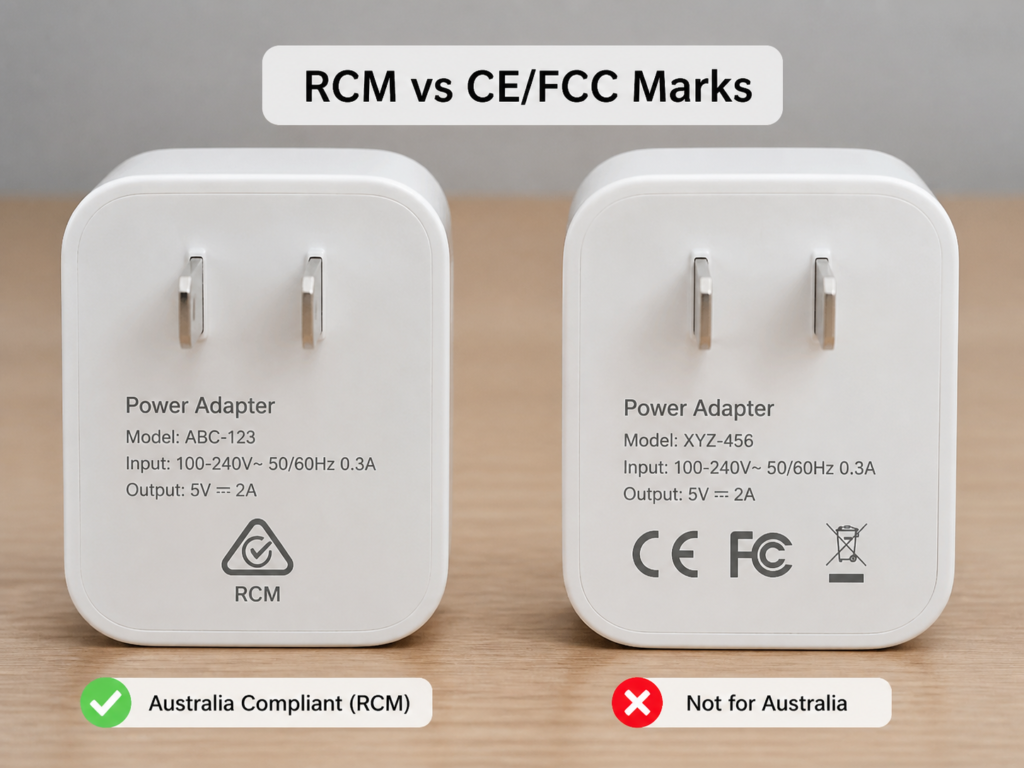
• **SAA certificate/third-party safety mark**: It can only prove that the product has passed safety tests and is part of the safety compliance documentation, but it does not cover requirements such as EESS registration and ACMA EMC compliance, and cannot be equated with RCM compliance.
• **Old C-Tick mark**: It was once used for EMC and some radio communication compliance marks; A-Tick was once used for telecommunications terminal equipment. For currently newly supplied products, RCM shall be used in accordance with current rules, and old marks shall not be used as substitutes for RCM.
• **European and American certifications such as CE/FCC**: Australia has its own independent regulatory system and does not directly recognize European and American certifications; these certificates cannot replace RCM compliance.
Three Parallel Compliance Paths for Adapters in Australia
Many people think that RCM is all compliance, but in fact, Australia has three sets of independent, non-substitutable regulatory rules for electronic and electrical products. Most mains-powered adapters need to meet the first two sets at the same time, and some also need to meet the third set.
1. EESS Electrical Safety Regulation (Regulating Electric Shock and Fire Risks)
The full name of EESS is Electrical Equipment Safety System, which is jointly implemented by voluntarily participating states and territories in Australia, and is not a unified mandatory system across Australia. Its scope of application covers all regulated electrical equipment connected to the Australian mains power supply, and the core requirement is to complete testing and registration according to the product’s risk level, and retain compliance documents.
Special attention should be paid to jurisdictional boundaries: EESS only applies to participating states and territories. For example, Western Australia has not joined EESS and has its own electrical safety rules. If your products are to be sold across Australia, you must confirm the requirements of each region one by one, and cannot assume they are universal across Australia.
2. ACMA EMC/Radio Regulation (Regulating Electromagnetic Interference and Wireless Transmission)
ACMA is the abbreviation of the Australian Communications and Media Authority, which is equivalent to the official department in charge of communications and electromagnetic compatibility in Australia. Its scope of application is wider: it shall be judged whether the product is a regulated electrical or electronic product according to ACMA EMC rules, and the applicable standards and any exemptions shall be determined. Adapters with electronic circuits usually require EMC compliance assessment, but the presence or absence of electronic circuits cannot be used as the sole criterion; if the product has intentional wireless transmission functions (such as Bluetooth, Wi-Fi, cellular network), it must additionally meet radio compliance requirements.
The core requirement of this part is to retain compliance evidence and affix the RCM mark in accordance with the rules. The compliance responsibility shall be borne by the local Australian supplier that meets ACMA requirements.
3. GEMS Energy Efficiency Regulation (Regulating Power Supply Energy Efficiency Levels)
The full name of GEMS is Greenhouse and Energy Minimum Standards, which is Australia’s energy efficiency regulatory system. Only some external power supply products are within the regulatory scope, and the specific scope shall be confirmed according to legal definitions. The core requirement is to meet the minimum energy efficiency standards, complete registration and marking. We emphasize again here: **GEMS is a completely independent compliance matter and is not included in the scope of RCM**. Even if the RCM mark is affixed, you must separately confirm whether GEMS is required.
Relationship Between the Three
The scope of application, requirements, and required documents of these three sets of rules are different and cannot replace each other. For most mains-connected external power adapters, they need to meet both EESS electrical safety and ACMA EMC requirements at the same time. Only after the compliance of these two parts is completed can the RCM mark be affixed; if the product is within the scope of GEMS regulation, additional energy efficiency registration is required, which has nothing to do with RCM.
Three-Step Method for Self-Compliance Judgment
After explaining the regulatory framework, let’s talk about how you can judge step by step whether your product needs RCM. There are three steps in total, just follow along.
Step 1: Determine Whether the Product Falls Within the Regulatory Scope
The most accurate judgment method is to compare with Australia’s official regulated equipment catalog and EESS risk classification database, combined with the product’s definition, input voltage, and supply form, rather than guessing based on name or power.
Common USB-A/C mobile phone chargers, laptop power adapters, desktop switching power supplies, and multi-port fast charging heads are basically within the regulatory scope. There are also some products that are usually not regulated as independent external adapters, but they must also be rechecked according to their actual form and cannot be directly exempted: for example, car chargers (not connected to mains power, need to be evaluated separately according to input voltage and purpose), built-in power modules of equipment (evaluated together with the whole machine, not regulated separately), pure data transmission cables (those without charging function are not power-regulated products), low-voltage input adapters (such as solar or car-powered adapters, non-mains input, need to be rechecked according to the definition).
In addition, additional functions should also be considered: it shall be judged whether the product is a regulated electrical or electronic product according to ACMA EMC rules, and the applicable standards and any exemptions shall be determined; adapters with electronic circuits usually require EMC compliance assessment, but the presence or absence of electronic circuits cannot be used as the sole criterion. For products with intentional wireless transmission functions, radio compliance shall also be evaluated; for external power supply products, it shall also be additionally evaluated whether they are within the scope of GEMS energy efficiency regulation.
Step 2: Determine the Entry/Supply Scenario
Many people think that compliance is required as long as the product is exported to Australia, but that is not the case. The trigger for compliance is “commercial supply within Australia”. If the goods are only shipped from the home country and have not entered the Australian circulation link, compliance requirements will not be triggered.
Scenarios that require complete commercial compliance include: commercial supply to Australia (whether online or offline, wholesale or retail, cross-border self-fulfillment or overseas warehouse); separately sold replacement chargers and power accessories; adapters sold with the whole machine but can be sold separately and have separate packaging; products used for commercial promotions, free gifts, and sample distribution (even if no money is charged, as long as it is for commercial use, it counts).
Scenarios that do not require commercial compliance include: personal use, non-commercial use items carried or mailed into the country (final judgment shall be subject to local regulatory determination); samples only used for R&D and testing that will not enter the circulation market; exhibition items temporarily entering the country for exhibition and not for sale; goods only transshipped through Australia and not entering the local circulation market.
Step 3: Confirm EESS Safety Level (Do Not Guess Based on Power/Name)
EESS divides regulated electrical equipment into 3 levels according to risk. The specific classification shall be confirmed by the responsible supplier against the EESS risk classification database, legal product definitions, and applicable standards:
• **Level 3 (Higher Risk)**: A certificate of conformity issued by an accredited body is required, and EESS equipment registration must be completed;
• **Level 2 (Medium Risk)**: EESS equipment registration must be completed, and compliance test evidence must be retained;
• **Level 1 (Lower Risk)**: No equipment registration is required, but safety requirements must still be met, and compliance evidence must be retained.
External mains power supplies shall first be judged according to the legal definition of “power supply or charger” in the EESS database. Products that meet the definition of this category are Level 3, and need to obtain a certificate of conformity issued by an accredited body and complete equipment registration; products that do not meet this definition shall be separately classified according to their actual category, and cannot be judged only by “external power supply” or power. If you are unsure, you can prepare product photos, nameplate parameters, plug type, and specifications, and find a local Australian responsible supplier or compliance agency to help confirm.
Core Requirements for Mandatory Compliance
If it is determined that RCM compliance is required, what specific requirements must be met? We will clarify the core requirements to prevent you from being misled by unreliable service providers.
Electrical Safety Compliance Requirements
Evidence requirements are based on the EESS risk level: if it is Level 3, there must be a certificate of conformity issued by an accredited body; Level 2 and Level 1 also need to retain corresponding test evidence. The applicable Australian standards are not uniform, and shall be determined according to the product’s input and output specifications, interface type, number of interfaces, plug type, and additional functions, and cannot be generalized.
If you already have test reports based on international or European standards such as CB, IEC, EN, and CISPR, you don’t need to retest completely. They can be used for difference assessment, and only the parts where Australian standards differ from international standards need to be retested. Whether retesting is required and how much to retest shall be evaluated by the responsible supplier or compliance agency.
EMC and Radio Compliance Requirements
For the EMC part, test evidence conforming to Australian and New Zealand standards and a declaration of conformity issued by the supplier must be retained. If the product has intentional transmission functions such as Bluetooth, Wi-Fi, and cellular, it must additionally meet ACMA’s radio requirements and retain corresponding compliance evidence. The compliance of these two parts is ultimately reflected by affixing the RCM mark in accordance with the rules.
Compliance Responsible Entity and Registration Requirements
This is a key point that many people easily overlook: there is no separate application for RCM itself. Before products are supplied in Australia, the responsible supplier that complies with EESS and/or ACMA rules and has completed necessary registrations must bear the responsibility. Overseas factories that do not have Australian legal qualifications and registration conditions cannot directly act as responsible suppliers; overseas brands can make compliance arrangements through eligible Australian registered entities, importers, or authorized agents. Specifically: the EESS responsible supplier must be a locally registered compliance entity in Australia, responsible for completing the corresponding level of EESS equipment registration (if applicable); ACMA’s EMC and radio compliance responsibilities must also be borne by a local Australian supplier that meets ACMA requirements; if the product is within the scope of GEMS regulation, the eligible responsible entity must also complete registration.
RCM Mark Usage Requirements
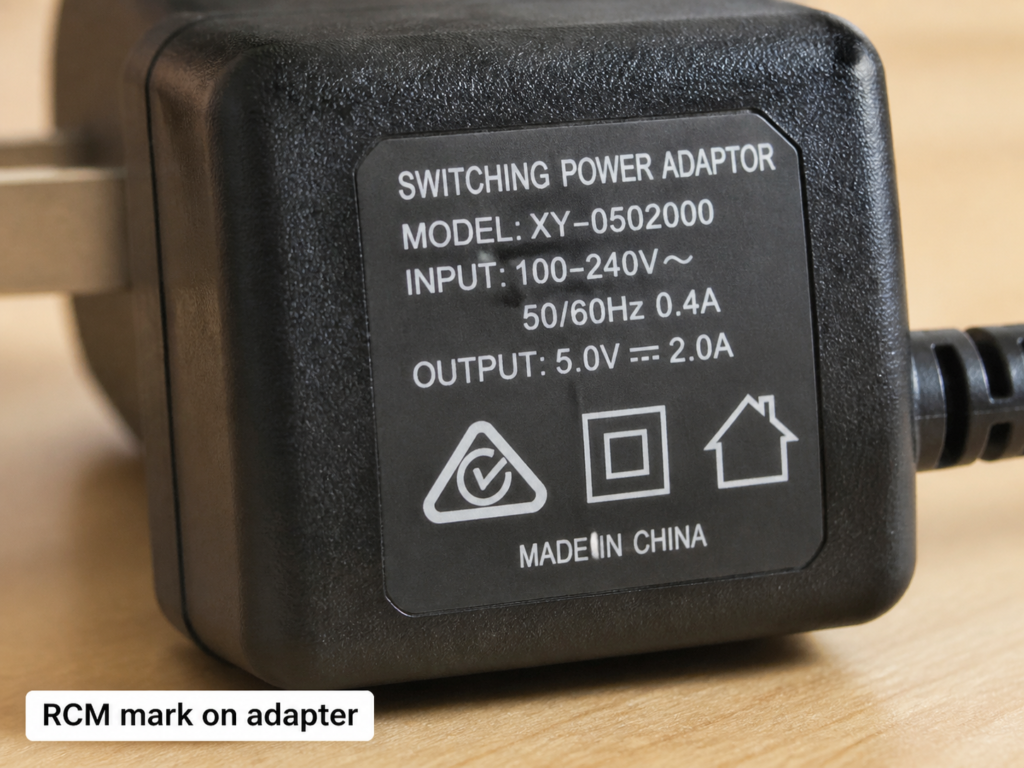
It is not just a matter of printing a sticker and pasting it on: first, the corresponding conformity assessment must be completed, the responsible entity must be in place, and all required registrations must be completed before the RCM mark can be affixed; the mark must be affixed to carriers permitted by regulations, such as the product body, nameplate, and packaging (according to specific requirements), and must be clear, durable, and not easily erased. Whether information such as product model, rated input and output parameters, and identification of the manufacturer/importer or responsible supplier must be marked, the marking location, and specific content shall be confirmed according to applicable electrical safety regulations, product standards, ACMA rules, and other applicable laws respectively, and should not be generally regarded as mandatory items on the same carrier as RCM.
Compliance Document Package and Storage Requirements
The responsible supplier shall keep conformity records applicable to the product and risk level, such as test reports, certificates (if applicable), declarations of conformity, technical specifications, and data that can prove that the model or variant is covered. BOM lists, key component data, label design drawings, and difference assessment reports shall be retained when required by applicable standards, certificate conditions, or change assessment. These documents shall be retained by the Australian responsible supplier, and the factory or exporter shall cooperate in providing technical materials, which must be available when the regulatory department conducts random inspections.
Explanation of Cycle and Cost
There is no statutory fixed cycle. The general estimated time includes the time for data gap assessment, testing or rectification (if the product does not meet requirements), Level 3 certificate application (if applicable), registration, and other links. There is no unified price for cost either; it will vary with the product’s power, number of interfaces, functional complexity, and risk level, and shall be evaluated based on the specific product.
Precautions for Mass Production Consistency
Mass-produced products and their variants must be clearly within the scope of coverage of test reports, certificates, and conformity assessments. When changes that may affect safety or EMC compliance occur, such as replacing the housing, plug, power, brand, or key components, it shall first be evaluated whether supplementary testing, certificate update, or re-registration is required. The original compliance documents cannot be directly used, otherwise it will be considered a violation.
Common Misconceptions and Pitfall Avoidance
The 7 most common pitfalls for newcomers, avoiding them can save you a lot of money and trouble.
Misconception 1: Having CE/FCC Means You Can Sell Directly in Australia
Truth: Australia has independent regulations, standards, and responsible entity requirements, and does not directly recognize European and American certifications. Test data based on international standards such as IEC, EN, and CISPR can only be used as a reference for difference assessment. Whether retesting is required and how much to retest shall be evaluated by the responsible supplier or compliance agency, and CE reports cannot be directly used as compliance evidence.
Misconception 2: RCM is a Certificate Issued by a Laboratory, and Getting It Means Everything is Done
Truth: RCM is a compliance mark, not a certificate. For RCM to be valid, it is necessary to complete testing or obtain the corresponding certificate, have a local Australian responsible entity, complete the required registration (if applicable), and affix the mark in accordance with the rules. None of these links can be missing; it is not called “having done RCM” just because you get a piece of paper.
Misconception 3: Having an Australian Standard Plug Equals Compliance
Truth: An Australian standard plug only means it can be inserted into Australian sockets, which is physical adaptation. It does not mean that the product’s safety, EMC, energy efficiency, registration and other requirements have been completed. To judge compliance, the full set of compliance documents must be checked, not just the plug.
Misconception 4: Small-Batch/Self-Fulfillment/Online Sales Will Not Be Inspected
Truth: Australian regulatory authorities, mainstream e-commerce platforms, and supply chain parties may all require compliance certificates or conduct random inspections. Customs clearance does not mean compliance. If a violation is found, goods may be detained, fines imposed, products removed from shelves, or even recalls required. Do not take chances.
Misconception 5: Overseas Factories Can Directly Apply for RCM and Affix the Mark
Truth: There is no separate application for RCM itself. Before products are supplied in Australia, the responsible supplier that complies with EESS and/or ACMA rules and has completed necessary registrations must bear the responsibility. Overseas factories that do not have Australian legal qualifications and registration conditions cannot directly act as responsible suppliers; overseas brands can make compliance arrangements through eligible Australian registered entities, importers, or authorized agents. Overseas factories or exporters can provide technical materials and cooperate with eligible responsible suppliers to complete compliance arrangements.
Misconception 6: Low-Power Chargers Do Not Need Compliance
Truth: As long as a product is directly connected to the mains power supply, there are safety risks of electric shock and fire. It must be judged whether it is within the regulatory scope against the EESS classification database, and power cannot be used as the sole judgment criterion. Even a small 5W charger, as long as it is connected to mains power, must be evaluated according to the rules.
Misconception 7: Having RCM Equals Full Compliance
Truth: RCM mainly corresponds to electrical safety, EMC, and radio compliance, and does not cover other parallel compliance requirements such as GEMS energy efficiency. If your product is within the scope of GEMS regulation, you need to do separate energy efficiency registration. Don’t think that everything is fine just because the RCM mark is affixed.
Detailed Judgment Rules for Special Scenarios
In addition to conventional separately sold adapters, there are some special scenarios where the judgment is relatively vague, so we will explain them separately.
Adapters Sold with Complete Machines
Many people think that adapters are sold with the whole machine and do not need separate compliance, but that is not the case: even if they are not sold separately, it is necessary to evaluate whether the adapter, as a component of the whole machine, is a regulated device. The compliance documents of the whole machine, the safety evidence of the adapter, the EMC assessment, and the scope of label coverage must all be confirmed by the responsible supplier. If the adapter can be sold separately and has separate packaging, it must be evaluated for compliance according to the requirements of independent supply, and cannot be passed off as part of the whole machine.
Judgment of Personal Use/Non-Commercial Entry
Many people ask “how many chargers brought into the country count as personal use”. In fact, there is no unified fixed quantity threshold. The regulatory department will make an overall judgment based on quantity, packaging, declared purpose, transaction records, etc. Moreover, regulatory rules may vary between different states/territories, and local requirements shall prevail. If they are used for sale, promotional gifts, commercial sample distribution, or continuous supply, even if the quantity is small, compliance must be done according to commercial supply, and cannot be counted as personal use.
Additional Requirements of Cross-Border E-Commerce Platforms
Now mainstream cross-border e-commerce platforms, such as Amazon Australia, may review product compliance qualifications before listing. Some platforms require uploading materials such as compliance documents, photos of the RCM mark, and EESS registration certificates, and listing is only allowed after passing the review. So even if you meet the regulatory requirements, you must understand the additional requirements of the platform in advance to avoid listing rejection.
Compliance Coverage for Multi-Model/OEM Products
Many sellers do OEM with different brands from the same factory, or products with different configurations in the same series. Here’s what to note: for products of different brands produced by the same factory, first confirm whether the test reports and certificates can cover the corresponding brands. Be sure to verify in advance before OEM, don’t think that the factory’s reports can be used directly. For products of the same series with different power, different interfaces, and different housings, if key components or structures have changed, the original compliance documents cannot be directly used, and the coverage scope must be re-evaluated.
Adapters with Special Functions
Now many chargers have various additional functions, and extra attention should be paid during judgment: for adapters with wireless charging function, in addition to evaluating electrical safety, EMC, and energy efficiency (if applicable), it shall also be evaluated whether ACMA radio communication rules, class licenses, and related technical requirements apply according to the radio energy transmission function, operating frequency band, and technical parameters; radio compliance cannot be excluded just because it is not a Bluetooth or Wi-Fi device. If it has intentional transmission functions such as Bluetooth, Wi-Fi, and cellular, in addition to basic safety and EMC, it must also meet ACMA’s radio requirements; in addition, all external power supply products must be additionally evaluated for compliance with GEMS energy efficiency regulations.
Pre-Export Verification and Capability Summary
Official Regulations and Database Verification
For the most accurate judgment, be sure to check information from official channels, such as the EESS equipment risk classification database, EESS registration requirements page, etc. It should be reminded that regulations, standard versions, and platform rules are dynamically updated. Don’t rely on old experience from a few years ago; be sure to follow the latest official requirements.
6-Item Compliance Self-Check List Before Exporting to Australia
You can check item by item against this:
□ Confirmed the compliance rules of the sales state/territory (whether it is an EESS participant or has local special rules)
□ Confirmed whether the product is within the regulatory scope against the EESS classification database, and whether it has wireless transmission/special functions
□ Confirmed that it is a commercial supply scenario, not an exception such as personal use/testing/exhibition
□ Confirmed the EESS safety level and corresponding requirements, and clarified whether EESS registration is required
□ Found a qualified local Australian responsible supplier and completed the required EESS/GEMS registration
□ Have compliance evidence for safety, EMC, radio (if applicable), and energy efficiency (if applicable) matching the mass production model
Matters You Can Independently Judge After Learning
After reading this article, you should be able to independently complete these judgments: you can quickly judge the general RCM requirements for power adapters exported to Australia based on product type and supply scenario; you can distinguish the difference between RCM and common marks such as CE, FCC, and SAA, and avoid the 7 common pitfalls for newcomers; you can understand the risk classification logic of EESS, and know the applicable scenarios for GEMS energy efficiency registration of Australian power adapters; you can complete the preliminary compliance check before export against the self-check list, and know which situations require confirmation from a professional agency; you can also handle the basic preparation work for Amazon Australia’s RCM review.
In general, whether RCM is required for power adapters exported to Australia is never a simple “yes” or “no”. The core depends on the product itself, the supply scenario, and the sales jurisdiction. Do not blindly believe the claim that “one certificate covers all of Australia”. Do a good job of self-check in advance and find the right eligible local Australian responsible entity to avoid the risks of goods detention, fines, and product removal.