
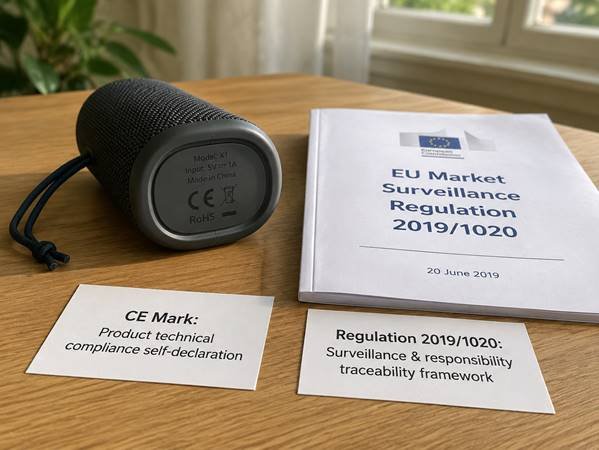
Most people doing business in the EU market are familiar with the CE mark, but when they first come into contact with the “Market Surveillance Regulation 2019/1020”, they often have questions: Is this a new CE-related requirement? My product already has the CE mark, do I still need to care about this? Let’s first reassure everyone: it is not a new technical compliance requirement, but a supporting surveillance framework for the CE compliance system. It was fully implemented on July 16, 2021, and its core function is to ensure that the CE mark is authentic and effective, and that responsible parties can be traced for non-compliant products. Most merchants selling CE-category products to the EU will be subject to its requirements. A common misunderstanding should also be clarified here: the CE mark is the manufacturer’s self-declaration that the product complies with applicable EU harmonized legislation, and is not equivalent to a certification certificate uniformly issued by the EU official. All compliance requirements mentioned later are developed around this basic logic.
1. Basic Understanding: What the Regulation Is and Its Relationship with CE
This is a regulatory regulation at the EU level with direct applicability — unlike “directives” which require member states to transpose them into national law, it takes effect without each member state separately enacting a corresponding version of the law. However, member states still need to specify specific penalty standards, the powers of surveillance authorities, and enforcement procedures through national rules. Its core function is to unify the surveillance and enforcement rules for CE-category products across all member states, solving the previous problems of being unable to trace responsible parties for cross-border non-compliant products and inconsistent surveillance standards among member states.
Put simply, CE-related directives/regulations govern “what technical standards products must meet”, and the CE mark is a compliance label affixed to products, representing the manufacturer’s declaration that the product meets the corresponding requirements. The 2019/1020 Regulation, on the other hand, governs “how surveillance is enforced, who is liable, and who to contact when problems arise”, and is the enforcement guarantee framework for the CE compliance system. Many people mistake this regulation for a new “type of CE certification”, which is the most common misunderstanding — it is not a certification, does not require additional testing to obtain a certificate, but requires clarifying the responsibility chain, labeling, and document management for CE compliance, so that EU surveillance authorities can find a local contact entity.
Before discussing specific requirements, let’s first clarify three basic concepts related to the triggering of obligations, which will be used repeatedly later:
The first is placing on the market, which refers to the act of a specific product first entering the EU market in the context of commercial activities — this is the starting point for most compliance obligations. “Entering” here does not necessarily mean completing the final sale; as long as the product is provided to the EU market for commercial purposes, whether for a fee or free of charge, it counts.
The second is making available on the market, which refers to all supply activities such as wholesale, retail, and distribution in the entire commercial circulation chain after the product enters the EU, as long as it is a market-oriented commercial circulation.
The third is putting into service, which refers to the point when a specific high-risk product is first put into operation in the EU for its intended design purpose. This concept only generates obligations when explicitly stipulated in the corresponding EU product regulations; it does not apply simply because a product is high-risk, and most ordinary consumer products do not need to pay attention to this point.
2. Quick Assessment: Whether Your Products and Business Need to Comply
What everyone is most concerned about is definitely “do I need to comply with this regulation”. First, here is a 10-second quick assessment criterion: as long as the product requires the CE mark and does not belong to the categories explicitly excluded by the regulation, this regulation basically applies. If the corresponding product has a specialized EU industry regulation that makes special provisions on surveillance enforcement, the special provisions take precedence. It is not that the regulation is completely excluded as long as there is a specialized regulation; judgment needs to be made in combination with specific clauses.
Common Applicable Products and Entities
Most common CE-category products are within the scope, such as toys, consumer electronics, low-voltage electrical appliances, personal protective equipment (PPE, such as masks, goggles), general machinery, wireless equipment, construction products, etc.
The scope of applicable entities is also very wide. Whether it is product manufacturers, importers who bring goods into the EU, distributors who purchase goods for resale, or cross-border e-commerce sellers, as long as they place or make available regulated products to the EU, they must comply with the corresponding obligations.
Different Types of Exclusion Rules
Note that not all products “with specialized regulations” follow the same set of judgment logic; they need to be divided into two categories:
The first category is products explicitly excluded by the regulation: the following categories are directly excluded from the scope of application by the regulation, and do not need to comply with the general requirements of this regulation at all, but must be implemented in accordance with their respective specialized EU surveillance regulations: food and feed, pharmaceuticals, medical devices, cosmetics, aviation/maritime/railway special equipment, live animals and plants, etc. If your products belong to these categories, you can directly check the surveillance requirements of the corresponding industry regulations, without applying the general self-inspection path in this article.
The second category is products with specialized surveillance rules but not excluded: although some CE-category products fall within the scope of EU harmonized legislation, they have specialized industry regulations that make special provisions on surveillance enforcement and responsible entities (such as specialized directives for some high-risk categories). For such products, the surveillance clauses of the specialized regulations take precedence, and for matters not explicitly stipulated in the specialized regulations, the general requirements of this regulation shall be supplemented and complied with.
Scenarios That Do Not Trigger Obligations
The following scenarios usually do not trigger obligations under this regulation because they do not constitute commercial placing on the market or making available, and do not enter the EU market circulation chain: First, personal use entry for non-sales purposes (such as personal items carried during travel, non-commercial gifts sent to relatives and friends). If the quantity exceeds the reasonable amount for personal use, it may be deemed as commercial making available. Second, R&D test samples that do not enter market circulation, which only qualify if they are used for internal testing only and are not sold externally. Third, antiques over 100 years old, which must meet the preconditions for antique exemption in the corresponding product regulations, and are not directly exempted solely based on age.
Boundaries of Obligation-Triggering Scenarios
The core criterion for judging whether an obligation is triggered is: whether there is a commercial supply act targeting the EU market. Offline physical store sales, cross-border import to the EU, shipping from EU overseas warehouses, and e-commerce sales targeting EU consumers (even cross-border direct mail) usually trigger obligations as long as they are commercial sales acts. If advertising is only placed outside the EU alone, without sales offers, order acceptance, or product delivery targeting the EU market, it is usually not sufficient to be deemed as targeting the EU market on its own.
A special reminder here: the model of cross-border direct mail to EU consumers may also trigger compliance obligations. Don’t think that just because the goods are sent directly from a non-EU country, you definitely don’t need to comply.
If you are still unsure, you can use the 3-step judgment method to sort it out step by step:
Step 1: First confirm whether your product is a CE-category product covered by EU harmonized regulations — if yes, there is a high probability that this regulation applies;
Step 2: Then check whether the corresponding product belongs to the categories explicitly excluded by the regulation, or whether there are specialized regulations that make special provisions on surveillance enforcement — excluded categories directly apply specialized rules, and special provisions take precedence;
Step 3: If you are still unsure, you can consult the public guidelines of the market surveillance authority of the corresponding member state, or find a reliable compliance service provider to help with the judgment.
3. Who Is Liable: Understand Your Role and Obligations
The core logic of EU surveillance is that “a contactable responsible entity within the EU must be identifiable”. There is a unified legal concept for this responsible entity called economic operator — simply put, it is a responsible party that has a legal physical address within the EU and can liaise with surveillance authorities. The commonly mentioned “EU representative” (authorized representative) is only one type of economic operator. In addition, manufacturers within the EU, importers, and eligible fulfilment service providers may all become economic operators, and the responsibilities of different roles cannot be substituted for each other. Many people think that an economic operator is just a nominal address, which is wrong — if the surveillance authority cannot contact your corresponding economic operator, it may be directly treated as a violation.
Judgment Logic for Economic Operators
To determine which type of entity bears the responsibility of economic operator, it is necessary to check sequentially according to the entities actually existing in the supply chain, rather than a fixed priority of liability. The core is to ensure that there is a domestic entity that can liaise with surveillance authorities:
1. If the manufacturer of the product is a legal entity registered within the EU, the manufacturer shall act as the economic operator;
2. If the manufacturer is not located within the EU, but there is an importer who introduces the product into the EU market, the importer shall usually act as the economic operator;
3. If there is no eligible EU importer, the overseas manufacturer may designate an authorized representative within the EU (i.e., the commonly mentioned “EU representative”) in writing as the economic operator;
4. Only if none of the above three types of entities exist, shall a fulfilment service provider that meets the statutory conditions bear the corresponding economic operator responsibility.
It should be specially noted here: overseas manufacturers must ensure that the product has an EU-based economic operator that meets the requirements of the regulation, but this entity is not necessarily an authorized representative — if there is already an eligible EU importer in the supply chain, the importer can directly assume the responsibilities of economic operator without the need to find an additional EU representative. However, if specific product regulations (such as specialized regulations for some high-risk categories) have additional or stricter provisions on authorized representatives, the requirements of the product regulations must also be met.
Core Obligations of Each Role
Different roles bear different responsibilities, and you can find your corresponding position:
• Manufacturer: Bears the ultimate responsibility for product compliance. Responsible for compiling, updating, and retaining product technical documentation in accordance with applicable product regulations, signing the EU Declaration of Conformity (DoC), affixing the CE mark as required, and ensuring that the product has a compliant EU-based economic operator (this entity can be an importer, authorized representative, or eligible fulfilment service provider, depending on the supply chain arrangement and product regulatory requirements). A supplementary note here: the DoC is a formal compliance commitment issued by the manufacturer, which must correspond to the specific applicable regulations, product models and versions. In principle, it is signed by the manufacturer or the responsible entity explicitly specified in the applicable product regulations; an authorized representative does not automatically obtain the right to sign the DoC on behalf of the manufacturer just because it is authorized to liaise with surveillance authorities. It can only handle relevant document matters on behalf of the manufacturer if permitted by specific regulations and explicitly agreed in the authorization document.
• Importer: Before the product enters the EU market, it is necessary to verify the upstream compliance information (such as whether the labeling is complete, whether the DoC is valid), retain a copy of the DoC, ensure that relevant compliance documents can be provided when required by surveillance authorities, and cooperate with traceability.
• Distributor: Shall not sell obviously non-compliant products, shall provide information on upstream suppliers during surveillance inspections, and cooperate with surveillance traceability work.
• Authorized representative (EU representative): Must hold a formal written authorization document issued by the manufacturer, keep compliance documents and liaise with surveillance investigations within the scope of authorization, and does not bear the ultimate compliance responsibility for the product itself.
• Fulfilment service provider: Only needs to bear economic operator responsibility when it meets the statutory conditions at the same time, and cannot be directly identified solely by the service name (such as FBA, overseas warehouse).
Statutory Identification Boundaries of Fulfilment Service Providers
According to the provisions of the regulation, the identification of a fulfilment service provider needs to meet three core statutory elements at the same time, which is specifically judged by the actual service contract and business chain, rather than the service name:
First, it does not acquire ownership of the product;
Second, it simultaneously provides statutory fulfilment services such as warehousing, packaging/address marking, and shipping;
Third, there are no three types of responsible entities in the product supply chain: EU-based manufacturers, importers, or duly authorized representatives.
Pure transportation, postal services, ordinary parcel delivery, freight forwarding, and services that only provide basic warehousing do not belong to the fulfilment service providers mentioned here. Returns are a common supporting service in practice, not a necessary condition for statutory identification, and do not need to be used as a core judgment criterion.
FBA (Fulfillment by Amazon), which everyone is most concerned about, follows this judgment logic: FBA is not an automatic authorized representative, nor is it an automatic fulfilment service provider. Whether it constitutes a fulfilment service provider should be comprehensively judged based on the actual service content provided, contractual agreements, whether it acquires ownership of the product, and whether other economic operators already exist in the product chain. First, an authorized representative must have formal written authorization from the manufacturer, clearly stipulating the scope of responsibility for surveillance liaison. A simple warehousing address itself does not have this obligation, so the FBA warehousing address cannot be directly used as the EU representative address. Second, when other economic operators already exist, FBA is usually just a third party providing logistics services and does not need to bear economic operator responsibility. Directly labeling the warehousing address as EU representative information constitutes invalid compliance and may face surveillance penalties.
1-Minute Role Self-Assessment
If you still can’t figure out which category you belong to, you can directly compare:
• You are located overseas, lead the design and production of products, and sell to the EU — you are an overseas manufacturer, and you need to ensure that there is a compliant EU-based economic operator (which can be assumed by the importer, or you can designate an authorized representative yourself);
• You purchase products from overseas and ship them to the EU for sale — you are an importer, and you can directly act as an economic operator without finding an additional EU representative (unless otherwise required by specific product regulations);
• You purchase goods from upstream within the EU and then resell them — you are a distributor;
• You sell products under your own brand, or make substantial modifications to the products — you will be regarded as a manufacturer and shall bear all the responsibilities of a manufacturer.
4. Essential Entry-Level Tasks: Core Compliance Requirements and Pre-Market Self-Inspection
After clarifying your role, the next step is the specific tasks to be done. Whether you are a manufacturer or a seller, these core requirements are unavoidable.
Product Labeling Requirements
In addition to the CE mark, according to the requirements of the regulation and corresponding product regulations, there are two types of core contact information that need to be marked on the product: first, the name or trademark of the manufacturer, and second, the name and physical postal address of the EU-based economic operator.
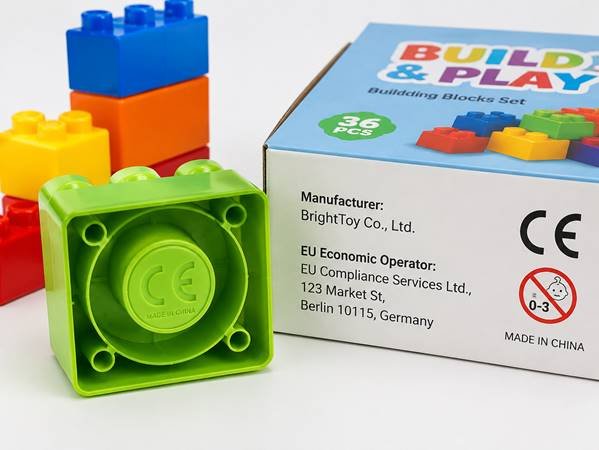
It should be clarified first: the specific labeling position, font size, and whether it can be marked on the packaging or accompanying documents shall ultimately be subject to the applicable specific product regulations. “Too small product size” is only one of the common situations where labeling on packaging/accompanying documents is allowed, not a unified exemption rule.
There are also several details to note: First, the label must be clear, durable, and easy to read. Some product regulations also allow supplementary electronic contact information, but you cannot only mark email, phone number, or website; there must be a contactable physical address. Second, the product model and entity information on the product, packaging, DoC, and online sales pages should be authentic, traceable, and consistent with each other, to avoid situations where the model marked on the page does not match the actual product. Third, the information on the online page cannot replace the statutory labeling on the product or packaging. No matter how complete the page information is, if the actual product is not labeled as required, it may still constitute a violation.
Document Retention Requirements
Different entities have different document obligations, so don’t confuse them:
• Manufacturer: Responsible for compiling, updating, and retaining complete product technical documentation (including design materials, test reports, risk assessments, etc., used to prove that the product meets CE requirements) and the EU Declaration of Conformity (DoC) in accordance with applicable product regulations, and bears ultimate responsibility for the authenticity and completeness of the documents.
• Authorized representative: Keeps or provides relevant compliance documents in accordance with the scope of written authorization and the requirements of applicable regulations, ensuring that surveillance authorities can obtain them in a timely manner.
• Importer: Needs to retain a copy of the DoC, verify the validity of upstream compliance documents, and be able to provide them in a timely manner when required by surveillance authorities.
• Distributor: Needs to retain the contact information of upstream suppliers, cooperate with surveillance traceability, and provide relevant materials held by them as required.
The document retention period is usually 10 years as required by applicable product regulations. In practice, it is recommended to manage it as “10 years after the last unit or last batch of products is placed on the EU market”; if a specific CE directive/regulation stipulates a longer period, a different starting point, or special requirements, the explicit provisions of the corresponding regulation shall prevail.
To judge whether a document is valid, you can look at three core points: first, the signatory of the DoC is legal and meets the requirements of applicable product regulations; second, the model and version on the DoC are consistent with the actually sold product; third, the technical documentation covers the currently sold product version, not information of discontinued old models.
How to Judge Whether an Authorized Representative (EU Representative) Is Reliable
If overseas sellers need to designate an authorized representative (EU representative), they can judge whether it is reliable against these three criteria:
First, a formal written authorization agreement must be signed, clarifying the scope of responsibility, authorization period, liaison process, etc. Oral authorization or authorization without clear responsibility agreements is invalid;
Second, it has a real physical address within the EU, can respond to surveillance inquiries in a timely manner, and is not a nominal address with no one to liaise with;
Third, prioritize choosing institutions with corresponding product compliance experience. For example, for the toy category, choose a service provider familiar with toy CE regulations, who can cooperate more efficiently in handling problems.
A pitfall to especially avoid is the nominal address of freight forwarders or warehousing companies. Such addresses usually have no dedicated personnel to liaise with surveillance authorities. If you can’t be contacted during an inspection, it will be directly treated as a violation.
4 Quick Pre-Market Self-Inspections
Before products enter the EU market, you can spend a few minutes doing a quick self-inspection to avoid elementary mistakes:
1. Check labeling: The product or packaging has a compliant CE mark and the physical address of the EU economic operator, and the labeling method meets the requirements of the corresponding product regulations;
2. Check documents: There are corresponding valid technical documentation and DoC, and the model is consistent with the actual product;
3. Check authorization: If an authorized representative is used as the economic operator, there is a formal written authorization agreement;
4. Check verification: If you are an importer or distributor, you have verified that the compliance information provided by the upstream is authentic and valid.
5. How Surveillance Is Conducted: Inspection Logic and Violation Response
Many people’s impression of EU surveillance is that it is “very strict, but they don’t know how inspections are conducted or what to do if caught”. In fact, its enforcement logic is very clear.
How the EU Surveillance System Works
At the EU level, there is no unified deployment of personnel to carry out cross-border inspections. Specific surveillance work is carried out by the market surveillance authorities of each member state responsible for daily inspections within their own territory.
National surveillance authorities do not act independently; they mainly achieve cross-border cooperation through two core systems, but the functions and scope of application of the two systems are different:
First, Safety Gate (the EU rapid alert system for product safety), which is mainly used to exchange safety risk information on dangerous non-food consumer products. Only non-food consumer products involving personal health and safety risks will have warnings issued through this system;
Second, ICSMS (EU Market Surveillance Information System), which is mainly used to share general surveillance information such as inspection results and enforcement measures, to facilitate cooperation among national surveillance authorities.
Measures such as recall and sales restriction taken by a member state may affect other member states through the above-mentioned cooperation mechanisms, but they do not automatically trigger an EU-wide sales ban. The specific situation depends on the product risk level and the final enforcement decisions of each member state.
Customs mainly conducts random inspections on surface compliance issues such as labeling at the border entry stage, and may suspend release and coordinate with market surveillance authorities when necessary. It should be clarified here: customs release does not mean that the product is fully compliant. After entering the market, surveillance authorities can still conduct in-depth inspections such as document verification and product sampling tests. Compliance requirements run through the entire circulation cycle of the product in the EU market.
Common Inspection Scenarios and Triggering Reasons
Inspection scenarios are divided into two categories: offline and online. Offline mainly includes random customs entry inspections, physical store sampling inspections, and inspections during market circulation; online mainly includes e-commerce platform compliance checks, random cross-border parcel inspections, and surveillance authority monitoring of online sales pages.
There are many reasons for triggering inspections, which may be random spot checks, consumer complaints, peer reports, special rectification of specific categories, or notifications of related products by other member states through the cooperation system.
Inspection Priorities and Possible Surveillance Measures
There are usually four core priorities of surveillance inspections: whether the labeling is complete and compliant, whether the documents are complete and valid, whether the product has safety hazards, and whether the responsible entity is traceable. According to the nature of the violation, the degree of risk, the legal provisions of the member state, and the rectification situation, the surveillance authority will take different measures, which can be roughly divided into three categories:
1. Formal minor violations: For example, unclear labeling, minor flaws in contact information, non-standard affixing of the CE mark but the product actually meets the requirements, completed conformity assessment but missed affixing the mark, etc. Usually, a time limit for rectification will be required, and sales can continue after rectification is qualified;
2. Document and traceability violations: For example, lack of valid compliance documents, unreachable economic operator, inability to trace the upstream of the product, failure to complete the applicable conformity assessment, etc. Measures such as detention of goods, suspension of supply, and restriction of sales may be taken, and release may be granted after rectification is qualified;
3. Substantial safety serious violations: For example, the product has clear safety hazards, does not meet applicable safety standards, etc. It may be required to withdraw, recall, destroy the product, or even prohibit sales on the market.
It should be noted that the absence of the CE mark cannot be directly equated with the product having safety hazards; it must be judged in combination with the actual situation. Regarding the amount of fines, there is no unified standard in the EU, which is specifically stipulated by each member state. The amount may vary greatly between different countries, and the penalty procedures and appeal periods are also subject to local laws.
Basic Response Ideas After Being Inspected
In case you actually encounter an inspection, don’t panic, you can handle it according to these steps:
Step 1: First confirm the surveillance identity of the other party, ask clearly about the specific reason for the inspection, and do not casually sign documents whose content you do not understand;
Step 2: Contact your EU-based economic operator immediately, and they will liaise with the surveillance authority and provide compliance documents as required;
Step 3: Rectify in a timely manner in accordance with surveillance requirements, minimize the impact of the violation, and avoid risk information being synchronized to the EU-level cooperation system.
If you have objections to the penalty result, you can also file an appeal with the surveillance authority in accordance with local regulations.
6. E-Commerce Special: Special Requirements for Online Sales
Now more and more people are doing cross-border e-commerce, and many people are unclear about the compliance requirements for online sales. Here is a special explanation.
How to Judge Whether Sales Are Targeting the EU Market
The core of judging whether online sales are targeting the EU market is to see whether your sales offer is targeted at end users within the EU. The following factors will be used as a reference for comprehensive judgment, and meeting any one of them does not necessarily trigger the obligation: the sales page uses the official language of the target member state, accepts orders from EU consumers, supports delivery to the EU, settles in euros or the currency of the member state, places advertisements specifically targeting the EU market, and the page clearly states that it can ship to the EU.
A reminder here: the cross-border direct mail model also applies to the aforementioned triggering rules, and the specific judgment criteria can refer to the content of the applicable scope section above.
Information to Be Displayed on Online Product Pages
In accordance with the requirements of the regulation and related product regulations, product pages sold to the EU need to display at least the following information: product name, model, and other identification information required by applicable product regulations (batch or serial number must also be marked when required by specific regulations); the name and contact address of the manufacturer; the name and physical address of the EU-based economic operator; applicable safety warnings or risk reminder information.
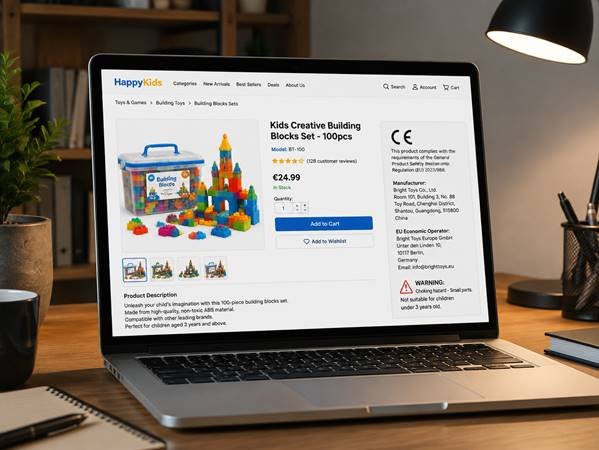
Regarding the display of the CE mark, this regulation does not uniformly require all products to display the CE mark on e-commerce pages. The specific requirements depend on the corresponding applicable product regulations, e-commerce platform rules, and local surveillance requirements — once relevant rules require the CE mark to be displayed on the page, the mark must be clearly visible. Regardless of whether the CE mark is displayed on the page, the statutory labeling on the product and packaging must still be implemented in accordance with applicable regulations, and page information cannot replace physical product labeling.
Roles and Obligations of E-Commerce Platforms
Many sellers have a misunderstanding: I sell goods on the platform, and the platform will help me handle compliance, so I don’t need to find an economic operator myself. This idea is wrong.
E-commerce platforms are not natural economic operators; whether they bear responsibility depends on their actual business role. The legal sources of different obligations are also different: this regulation mainly requires that online sales offers targeting the EU must display prescribed product identification information, manufacturer and economic operator information, safety warnings, etc.; while the platform’s obligations such as proactive review, taking down non-compliant links, and providing seller information may come from the Digital Services Act, general product safety regulations, the platform’s own rules, or specific orders from surveillance authorities, not all directly from this regulation.
No matter what obligations the platform bears, the ultimate responsibility for product compliance still lies with the seller itself, and the platform will not bear product compliance responsibility for you.
High-Frequency Compliance Risks for Cross-Border E-Commerce
Friends who do cross-border e-commerce, these pitfalls are the easiest to step into, so be sure to pay attention:
First, only marking the economic operator information on the product page, and not marking the physical address on the product or packaging as required, is a clear violation. The specific reason can refer to the content of the product labeling requirements section above;
Second, directly using the address of FBA or other overseas warehouses as the authorized representative address without a formal written authorization agreement constitutes invalid compliance. The specific judgment criteria can refer to the explanation in the fulfilment service provider section above;
Third, the same product is listed on multiple platforms and multiple links, and only some links display compliance information, while other links do not display it as required. If found, you may also be penalized.
7. Pitfall Avoidance Guide: Clarification of Common Cognitive Misconceptions
Here we only clarify the core cognitive misconceptions that everyone is most likely to confuse, to avoid repetition with the previous content:
1. Misconception: A product with the CE mark is equivalent to complying with Regulation 2019/1020
Clarification: The CE mark is a technical compliance declaration of the product, proving that the product itself meets the corresponding safety standards; this regulation is a requirement for surveillance procedures and responsibility traceability, with the core of clarifying domestic responsible entities and standardizing labeling and document retention. Both are indispensable. Only technical compliance without implementing the requirements of the surveillance procedures is still a violation, and may be subject to rectification requirements, suspension of supply, detention, or other restrictive measures.
2. Misconception: Only doing online e-commerce does not require compliance with this regulation
Clarification: As long as it is a commercial sale targeting the EU market, compliance is required whether online or offline. E-commerce platforms will also require sellers to provide economic operator information, and the cross-border direct mail model also applies. Those who only place advertisements outside the EU and have no actual delivery within the EU do not trigger obligations.
3. Misconception: Products brought into the EU for personal use also need to comply with this regulation
Clarification: Personal items carried or mailed by individuals for non-commercial purposes do not need to comply with this regulation; but if the quantity exceeds the reasonable amount for personal use, it may be deemed as commercial supply, triggering compliance obligations.
4. Misconception: An EU representative must have official qualifications, and hiring an EU representative can bear all product responsibilities for me
Clarification: First of all, this regulation itself does not have unified requirements for EU representative certification, registration certificates, or official qualification examinations. As long as it is a natural or legal person established within the EU, with a real and contactable physical address, holding formal written authorization from the manufacturer, and able to perform surveillance assistance obligations, it can act as an authorized representative; in practice, institutions with corresponding product compliance experience are preferred, as they will be more efficient in responding to inspections. Second, the authorized representative is only responsible for keeping documents, liaising with surveillance authorities, and assisting investigations in accordance with the written authorization. The manufacturer always bears the ultimate responsibility for the product’s design, testing, technical documentation, DoC authenticity, and ongoing compliance, and the product’s own compliance responsibility will not be transferred just because an EU representative is designated.
8. Summary: 6 Things You Can Independently Judge
After reading this content, you should be able to independently judge these 6 key things:
First, whether your products and business fall within the scope of application of Market Surveillance Regulation 2019/1020;
Second, what type of responsible entity you are in the supply chain and what basic compliance obligations you need to bear;
Third, the three core actions required for compliance: labeling product information as required, preparing and retaining compliance documents, and ensuring that there is a compliant EU-based economic operator;
Fourth, how to judge whether the authorized representative (EU representative) you choose is compliant and reliable;
Fifth, whether your online sales trigger compliance obligations in the EU market, and what necessary information needs to be displayed on the product page;
Sixth, the common consequences of violations and the basic response ideas after being inspected.
When doing business in the EU market, compliance is not a one-time task, but something that runs through the entire sales cycle. Sorting out these basic requirements in advance can not only avoid unnecessary detention of goods or fines, but also make your business more stable.