
For importers operating in the EU market, many have held this misunderstanding: once a product passes CE certification and has no quality issues, everything is settled. It is not until one day they receive a platform notification that products will be removed from shelves due to non-compliant packaging, or even receive a fine from the regulatory authority, that they realize — packaging itself has a set of independent regulatory requirements, and importers are the primary responsible parties.
Many people’s impression of EU packaging regulations stays at “needing to stick a recycling label” and “needing to pay EPR fees”, but they often have only a vague understanding of which packaging is regulated, whether they are the responsible entity, what tasks need to be done, and how responsibilities are divided under different import modes. This article explains the packaging compliance responsibilities that importers need to know, from entry-level judgment to advanced responsibility division. After reading it, you can start operations immediately and avoid most common pitfalls.
I. First Step: Determine Whether You Need to Bear Responsibilities under EU Packaging Regulations
1. What Exactly Do EU Packaging Regulations Regulate? (Plain Language Version)
Simply put, the EU manages packaging across the entire chain — from packaging production, loading and use, to being opened by consumers, and finally disposal and recycling. There are requirements for every link, not just whether the packaging looks good or has correct printed text.
Its core logic is very clear: whoever first places packaging (or packaged goods) on the EU market bears the primary responsibility.
The specific regulatory content can be grouped into four categories: first, the safety of packaging materials, which must not contain toxic and harmful substances; second, packaging should be minimized as much as possible, and excessive packaging is prohibited; third, the cost of recycling and treatment shall be borne by the party placing products on the market; fourth, clear information must be provided to consumers so they know how to sort and discard packaging.
Many people mistakenly believe that packaging compliance is just sticking a recycling label. In fact, subsequent recycling costs, material safety, and design requirements are all within the scope of responsibility.
2. Who Is the Responsible Importer? 3-Step Quick Determination
Not all merchants engaged in trade with the EU are liable. You can use a three-step method to quickly determine whether you are a legally responsible entity:
Step 1: Check whether you have a formal business entity within the EU — that is, a registered company or permanent establishment in the EU, which is an “economic operator” as defined by EU law. As long as you are an importer within the EU, you basically meet this requirement.
If you are a seller entirely located outside the EU and have no entity within the EU, you usually need to designate an importer within the EU to bear import and placing responsibilities in accordance with the EPR rules of the target country, platform requirements, or relevant PPWR arrangements, or designate an authorized representative to handle EPR registration, declaration, payment, and document receipt within the scope permitted by the member state; however, the authorization of the authorized representative does not automatically exempt overseas sellers or actual placing entities from regulatory responsibilities, and obligations cannot be directly evaded on the grounds of being an “overseas entity”.
Step 2: Check whether you are the first person to place packaged goods (or empty packaging) on the market of a certain EU member state. For example, if you import a batch of cosmetics from China to Germany and put them on sale in the German market for the first time, you are the responsible entity for the German market.
Step 3: Check whether you fall into the category of “producer” under the EPR system of that country. The “producer” here does not refer to the factory that produces packaging, but the entity that first places packaging on the market, and almost all importers meet this definition.
Special attention should be paid here: “first placing on the market” shall be determined separately according to the target member state of actual sales and distribution, not just the country of customs clearance; if the same batch of goods is cleared in Germany and then sold to France and Italy, it is still necessary to check the EPR and labeling requirements of these countries respectively.
Therefore, importers within the EU are usually both the primary responsible parties under packaging regulations and fall into the category of “producer” under the EPR of the target country; the responsibility boundaries of other market entities can be referred to in the table below:
| Entity Type | Core Responsibilities | Bear Primary EPR Responsibility |
| Overseas manufacturer (no EU entity) | Provide compliant packaging in accordance with the contract, not directly subject to EU regulation | No |
| EU-based importer | Primary responsible party for first placing on the market, bearing full-chain compliance obligations | Yes |
| EU distributor | Ensure packaging is intact and labels are clear during the sales process | No |
| E-commerce platform | Verify sellers’ EPR qualifications, bear joint liability if verification is not conducted | No (except for joint liability) |
| Authorized Representative (AR) | Perform EPR obligations for designated member states on behalf of the principal in accordance with the authorization agreement, without exempting importers from regulatory responsibilities | Subject to authorization agreement |
| Fulfillment service provider | Those only providing warehousing and distribution are not liable; those who independently decide on packaging materials bear compliance responsibilities for the corresponding packaging | Depends on the situation |
It should be noted that the evidence to determine whether you are a responsible entity mainly includes customs declaration documents, sales contracts, warehousing and distribution records, and the registered entity of the platform account, etc. It is not enough to verbally claim that you are not.
3. Which Packaging Is Within the Regulatory Scope? Don’t Miss Any
The EU has a very broad definition of packaging. It is not only small boxes for products that count. By use, it can be divided into three categories:
The first category is sales packaging, which is the packaging that directly wraps the product and reaches the consumer, such as the paper box for lipstick and the bottle for skin care products;
The second category is combined packaging, which is the packaging that holds multiple products together, such as the outer box of a skin care set and holiday gift boxes;
The third category is transport packaging, which is outer boxes, pallets, cushioning foam, bubble bags, etc. used to protect products during transportation.
Many people tend to miss some auxiliary materials: tape, hang tags, stickers, packing straps, sealing stickers, label films — all of these fall into the category of packaging and must be included in compliance management.
There are also several special situations that are easily confused. Here we clarify the boundaries:
• Empty packaging import: If you specifically import empty packaging such as cartons and gift boxes for sale, it also falls within the regulatory scope;
• B2B industrial packaging: Transport packaging and industrial packaging circulated between enterprises also need to be compliant, except that the EPR rate in some countries is lower than that of civilian packaging;
• Disposable catering/service packaging: Packaging used in service scenarios such as takeaway boxes and shopping bags is also within the regulatory scope;
• Packaged samples and exhibition supplies: If they are used for commercial promotion and will be sold later, they need to be compliant; if they enter the country under the temporary import procedure, are not sold or commercially placed on the EU market, and are re-exported within the specified period (usually within 6 months), they can usually be exempted from general packaging compliance requirements according to temporary import rules; documents such as temporary import guarantees, exhibition documents, and re-export certificates must be kept for inspection;
• Packaging of second-hand/refurbished goods: If there is no repackaging and it was already compliant when first placed on the EU market, there is no need to bear repeated responsibilities; but if it is repackaged and then sold, it shall be counted as new packaging.
The most common misunderstanding is that transport packaging, pallets, and cushioning materials are not considered packaging and do not need to be declared. In fact, all of these are within the regulatory scope, and missing them can easily lead to fines.
4. When Does Responsibility Trigger? What Situations Can Be Exempted?
Many people think that responsibility is triggered only after the product is sold, but that is not the case — the trigger point for responsibility is when the packaging or packaged goods first become available for sale or use on the EU market, not when the actual sale is completed.
After goods enter an EU overseas warehouse, mere warehousing and temporary storage do not necessarily equal placing on the market; however, after customs clearance is completed, when the goods are listed on shelves, can be ordered by EU customers, can be delivered, or have been handed over to distributors for use, responsibility is usually determined to be triggered based on first availability for sale/use. The specific trigger point still needs to be comprehensively judged based on the customs clearance entity, ownership of goods, whether they have been listed, and whether they are available for sale or use.
Of course, there are also exemption situations. The two most basic ones are: first, all packaging/goods are completely exported for sale outside the EU and are not circulated within the EU; second, temporarily imported goods that will be re-exported within 6 months, such as exhibition samples. There are also some special exemptions, such as packaging for military and medical dangerous goods, which are implemented in accordance with special regulations and do not apply to general packaging rules.
It should be noted that exemptions are not self-declared. There must be supporting documents, such as export declaration forms, temporary import guarantee documents, etc., otherwise the regulator will not recognize them.
II. Understand the Underlying Logic: Core Rules of EU Packaging Regulations
After figuring out whether you need to bear responsibility, don’t rush to find a service provider to register. You must first understand the underlying logic of this set of rules, otherwise you can easily step into pitfalls or waste money.
1. Transition from Old Directive to New Regulation: What Is the Difference Between PPWD and PPWR?
Many people have heard of abbreviations like PPWD and PPWR. In fact, they are the old and new versions of EU packaging regulations:
The old one is the (abbreviated as PPWD, number 94/62/EC). It is a minimum framework at the EU level, and each member state must transpose it into its own national law before it can be implemented. Therefore, the rules of each country vary greatly — for example, Germany has the (VerpackG); France’s packaging EPR and labeling requirements are mainly implemented based on the French Environmental Code, the Anti-Waste and Circular Economy Law framework, and the operating rules of PROs such as CITEO, with different processes, rates, and labeling requirements.
The new one is the (abbreviated as PPWR, number Regulation (EU) 2025/40). It is a unified regulation directly applicable in the EU, which does not need to be transposed by each country. In the future, EU-wide packaging rules will be gradually unified. PPWR has been published and entered into force in the Official Journal of the EU, but entry into force does not mean that all obligations apply immediately; importers still currently implement in accordance with the local packaging law/EPR system of the target country, and need to adjust packaging plans in advance according to the application dates and transition periods of each PPWR clause. The application date of most general provisions is August 12, 2026, and some requirements such as recycled content, recyclability classification, and unified labels have later phased implementation dates.
For importers, it is still necessary to implement in accordance with the old laws of the target sales country (that is, the local laws transposed from PPWD) now, but you must pay attention to the transition period requirements of PPWR simultaneously and adjust packaging plans in advance. Otherwise, it will be too late to make changes when the new regulation is fully implemented.
2. What Exactly Is the Commonly Mentioned EPR?
You must have heard the term EPR. Many people think it is a type of certification, but it is not. The full name of EPR is Extended Producer Responsibility. In plain language: whoever puts packaging into the EU market pays for the subsequent recycling and treatment costs, instead of the government and taxpayers bearing the cost.
Its operation process is very simple: first register in the target country, then regularly declare how much packaging you have placed, pay the fee to the officially authorized recycling organization (abbreviated as PRO), and finally obtain a compliance certificate.
A key feature to remember here is: EPR is implemented separately by member state. If you have obtained EPR for Germany, it can only be used in Germany. You need to apply separately for France and Italy. There is no such thing as “one certificate valid for the whole of Europe”.
3. Packaging Compliance ≠ Product Compliance, Don’t Confuse Them
This is a very important distinction: product compliance is the safety requirement of the product itself, such as CE certification and food contact material safety; while packaging compliance is the exclusive requirement for packaging such as boxes, cartons, and foam that hold products. The two are completely independent.
Many importers think that having a CE mark on the product means full compliance, but end up being fined for excessive heavy metals in packaging materials or not paying EPR fees, precisely because they do not understand this difference. Before import, be sure to separately confirm the compliance responsibilities of products and packaging, and both must meet the requirements.
III. 6 Core Compliance Obligations That Importers Must Fulfill
If you have confirmed that you are a responsible entity, then the following 6 things are mandatory. Missing any one may result in non-compliance.
1. EPR Registration, Declaration and Payment
This is the most basic obligation, and it is also the first thing e-commerce platforms check.
Registration Requirements
You must separately register for EPR in each target member state where you actually sell, and join a locally officially recognized Producer Responsibility Organization (PRO). You cannot just find any institution to pay the fee.
Declaration Specifications
When declaring, you must clearly report the placement date, packaging material, weight, and quantity in accordance with the requirements of the target country, and also distinguish between household and industrial use, and between B2C and B2B scenarios. Some countries allow deduction of packaging quantities from returned goods or re-exported goods, so you can pay a little less. The declaration cycle varies from country to country: some are annual, some quarterly, some monthly. For composite material packaging, some countries require splitting materials and declaring separately, while others declare based on the main material with the highest proportion. The specific rules depend on the target country.
Fee Rules
The fee is calculated based on the material, weight, and recyclability of the packaging, and the rates vary greatly from country to country. For example, the fee for plastic is higher than that for paper, and hard-to-recycle composite materials are more expensive. Some countries have a minimum payment amount, and most countries do not have an exemption for “too low sales volume”. Even if you only sell 1 item a year, you need to register and pay.
Platform Requirements
Now mainstream e-commerce platforms require sellers to upload their EPR number. If you don’t have one, your products may be directly restricted from being listed, or even your security deposit may be deducted.
2. Compliance of Hazardous Substances in Packaging Materials
Packaging materials must not contain toxic and harmful substances, which is a mandatory requirement.
The general restriction is: the total content of four heavy metals — lead, cadmium, mercury, and hexavalent chromium — must not exceed 100 ppm. This requirement applies to all packaging materials. Of course, there are exemptions for some specific materials or recycling systems, subject to the detailed rules of the member states.
In addition to heavy metals, packaging must also comply with the Substances of Very High Concern (SVHC) requirements of the REACH Regulation; if it is food contact packaging, it must additionally comply with EU food contact material rules. In the new PPWR, there are stricter restrictions on PFAS (commonly known as “forever chemicals”) in food contact packaging, which will take effect in phases. Importers of food products should pay special attention.

How to check whether materials are compliant? The most direct method is to require suppliers to provide reports issued by laboratories with corresponding testing qualifications and accreditation scope, with test items covering the corresponding regulatory requirements. You can also require suppliers to provide a declaration of conformity. The corresponding declaration of conformity must also clearly state the specific covered packaging materials, applicable regulatory clauses, and supplier/batch or formula scope. A general company-wide declaration cannot replace the compliance certificate for specific materials. It should be noted that you should check whether the report corresponds to the current material, formula, and process, and whether the testing institution’s qualifications are valid. If the supplier changes materials or processes, the report must be updated. Some platforms or customers may require reports issued within 1-3 years, subject to the corresponding requirements.
3. Packaging Minimization and Recyclable Design
Simply put, packaging should not be excessive and should be as easy to recycle as possible.
The basic requirement is: the weight and volume of packaging must not exceed the necessary limit to protect the product. It is prohibited to use extra packaging just to make the product look bigger or better, which is what we often call “excessive packaging”. In addition, priority should be given to single materials that are easy to recycle, and composite materials that cannot be separated should be avoided as much as possible. For example, paper-plastic composite packaging is difficult to handle during recycling and has high costs.
The new PPWR adds many mandatory requirements, which will take effect in phases:
• It clarifies the quantitative standard for the void ratio of excessive packaging, and prohibits unnecessary multi-layer packaging. The specific scope of application and calculation method shall be subject to the PPWR provisions and subsequent implementation rules;
• Some plastic packaging must meet the minimum recycled content requirement. This requirement is set in phases according to the type and use of plastic packaging (such as food contact/non-food contact, disposable/reusable), and not all plastic packaging implements the same proportion;
• Packaging will be divided into different grades according to recyclability, and low-grade packaging will be restricted or even prohibited from use;
• Restrict or prohibit some specific disposable plastic packaging forms, such as some disposable small-sized hotel toiletries packaging, some disposable packaging in catering scenarios, specific unnecessary group packaging, etc.; the specific content shall be subject to the PPWR provisions and subsequent implementation lists;
• These restrictions are not implemented in a one-size-fits-all manner for “all disposable plastic packaging”. It is necessary to simultaneously check the packaging use, sales scenario, whether it is food contact, whether it belongs to the exemption category, and the specific application date;
• For reusable packaging, it is not enough to just print a “recyclable” label. There must be an actual closed-loop recycling and return system, for example, you can take back and reuse the packaging when consumers return it.
Of course, packaging with special functional requirements such as pharmaceuticals and dangerous goods can be implemented in accordance with the official exemption list and do not need to fully meet these requirements.
4. Packaging Labeling Compliance
At the current stage, material classification labels and recycling instructions are mainly implemented in accordance with the requirements of the target member state; some packaging uses plastic resin identification codes, paper or composite material labels, but it cannot be assumed that they are uniformly mandatory across the EU. The PPWR unified label requirement will be implemented in phases, and country-specific rules still need to be checked during the transition period.
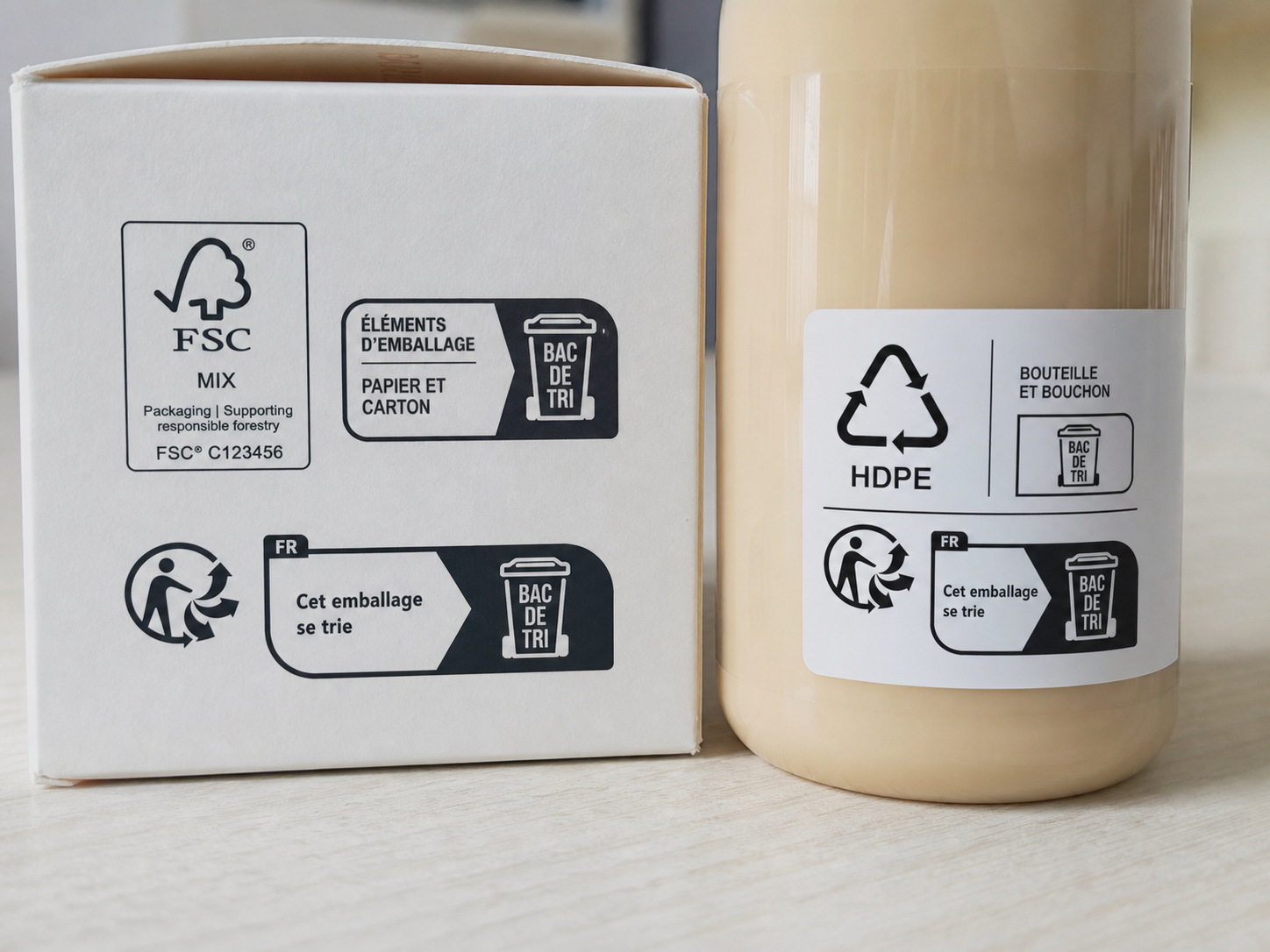
In practice, confirmation should be made item by item according to the target country: whether plastic resin identification codes, paper/composite material labels, and recycling instructions are mandatory requirements, recommended practices, or just industry conventions; countries with mandatory recycling labels such as France should be prioritized, while Germany focuses on checking LUCID registration and system participation. Do not treat the Green Dot as a general mandatory label.
As for country-specific requirements, different member states have their own exclusive rules: for example, France mandates the Triman recycling label, and products cannot be sold without it; Germany does not have a mandatory general recycling label. The commonly heard “Green Dot” is a licensed trademark that can only be used if you have signed an authorization agreement with the corresponding PRO, and cannot be affixed randomly.
PPWR will gradually promote a unified EU-wide packaging recycling label, which will reduce differences in country-specific rules during the transition period. However, in terms of member state language requirements, deposit return system supporting measures, and supplementary rules for specific packaging categories, it is still necessary to check according to the target country’s requirements, and existing mandatory labels cannot be discontinued in advance.
Also note that environmental claims cannot be made randomly: for example, if you print statements such as “recyclable”, “degradable”, “eco-friendly” on the packaging, you must have a compliant basis, otherwise it will constitute false advertising, violate consumer protection rules, and lead to complaints or fines.
All labels must be clearly visible, not easy to wear, and their position must comply with the regulations of the target country. They cannot be affixed in places that consumers cannot see, or fall off as soon as they are torn.
5. Obligation to Retain Compliance Documents
All documents related to packaging compliance must be kept well and cannot be lost. They must be available at any time during regulatory spot checks.
The main documents that need to be retained include: material test reports, EPR registration certificates, supplier compliance declarations, and declaration and payment records.
Most member states require these documents to be retained for at least 3-5 years, either electronically or in paper form, but they must be readily accessible. Some countries also require documents to be available in the national language. For example, France requires compliance documents in French.
If the packaging material, design, or supplier changes, the corresponding documents must be updated in a timely manner, and old ones cannot be used.
6. Pre-Placing Verification and Non-Compliance Rectification and Recall
PPWR clearly requires that importers must conduct verification before placing packaging on the market: check whether the materials meet the requirements, whether the labels are correctly affixed, and whether the compliance documents are complete. Only after confirming that they meet the target country’s rules can they be placed on the market.
If non-compliance is found during verification, the product cannot be placed on the market. The supplier must first be required to rectify, and the upstream producer must also be notified.
If non-compliance is found in a regulatory spot check, rectification must be completed within the specified period, such as changing packaging or supplementing labels. If non-compliant packaging has already entered the market, it must be recalled as required; in case of serious violations, it must also be proactively reported to the regulatory authority and cannot be concealed — for example, when packaging materials have safety risks, restricted substances such as heavy metals/PFAS exceed the standard, incorrect labels may lead to large-scale incorrect disposal, or the regulatory notice explicitly requires reporting, it shall be handled in accordance with the legal procedures of the member state.
IV. Ready-to-Use Guide for Beginners: 6 Steps to Practical Packaging Compliance
If you are a beginner who has just come into contact with this, you don’t have to figure it out on your own. Follow these 6 steps to complete basic compliance without missing any items.
Step 1: Sort Out the Full Packaging List
First list all your packaging, none of which can be missed, including sales packaging, combined packaging, transport packaging, and easily missed auxiliary materials such as tape, hang tags, and stickers.
When counting, record by each SKU, and clearly state the material, individual weight, and estimated annual import volume of each type of packaging. If there are special packaging such as gift sets, promotional packs, and seasonal limited editions, they must be counted separately and cannot be mixed with ordinary models.
It is recommended to make an electronic ledger, with core fields including: SKU, packaging level (sales/combined/transport), material composition, unit weight, supplier, target sales country, annual placement volume, whether it is household or industrial packaging, recyclability grade, recycled material proportion, and corresponding compliance document number.
Checkpoint: No auxiliary materials are missed, and composite materials are classified according to the target country’s rules.
Step 2: Confirm the Specific Rules of the Target Member States
Because the rules of each country are different under the current old law, you must first confirm the specific requirements of all countries where you actually sell, not just the country of customs clearance — for example, if you clear customs in Germany but also sell products to France, you must also comply with France’s rules.
You can first remember the core differences of several key countries: Germany uses the LUCID system for EPR registration, France mandates the Triman label, and Italy’s EPR system is CONAI.
There are three channels to query rules: the official website of the member state’s environmental protection department, professional compliance service providers, and e-commerce platform compliance guides. These are all relatively reliable.
Checkpoint: Covers all actual sales/distribution countries, not just the customs clearance country.
Step 3: Request Compliance Certificates from Suppliers
Ask your packaging supplier or overseas supplier for the necessary compliance documents: first, the packaging material test report issued by a laboratory with corresponding testing qualifications, and second, the hazardous substance compliance declaration.
After getting the documents, check them: does the report correspond to the material and process of this packaging? Is the testing institution’s qualification valid? Is it for the current supplier and current formula? Don’t just take a report and ignore it. Many suppliers provide reports from several years ago or for other products, which are useless at all.
It is best to clearly stipulate in the contract with the supplier that the supplier shall provide accurate packaging data, notify in advance of changes in materials or processes, and specify how to share compliance-related costs to avoid disputes later.
Checkpoint: Hold written compliance documents; verbal promises are invalid.
Step 4: Apply for EPR Registration in Target Countries
After confirming the target countries, you can apply for EPR registration. You can apply to the environmental protection agency of the member state by yourself, or entrust a reliable compliance service provider to handle it. The latter is more worry-free, especially if you need to handle multiple countries.
The materials required for processing generally include: qualification certificate of the EU-based entity (such as enterprise registration information, VAT/tax number or local identification information), contact person and address, brand or platform store information, packaging list (including category and material), annual estimated usage, etc. The specific requirements shall be subject to the target country’s registration system and PRO requirements.
If the importer or seller does not meet the local/EU entity requirements required by the target country, you should first confirm whether the country allows handling through an authorized representative or compliance service provider, and whether the authorization scope covers the whole process of obligations such as registration, declaration, payment, and receipt of regulatory documents.
After obtaining the official registration number, upload it to the corresponding e-commerce platform in a timely manner.
Checkpoint: Official registration number has been obtained, and a contract has been signed with an accredited PRO.
Step 5: Affix Compliance Labels as Required
During packaging production, labels must be affixed as required. The order is to first affix the general material classification label (according to the target country’s requirements), and then affix the exclusive recycling label of the target country.
If selling to multiple countries, note that the label instructions must be in the official language of the target country. For example, products sold to France must have French instructions, and products sold to Germany must have German instructions.
For all environmental-related claims on packaging, such as “recyclable” and “degradable”, be sure to keep supporting documents and do not print them randomly.
Checkpoint: The position and clarity of labels meet the requirements, and no exclusive labels are missing.
Step 6: Regular Declaration and Document Update
Registration is not the end of the matter. You must declare the actual placement volume of your packaging according to the cycle required by the target country, and pay the recycling fee on time.
If you later change the packaging material, design, or supplier, you must re-request the test report and update your packaging ledger and compliance documents.
In addition, pay attention to the transition period requirements of PPWR simultaneously and adjust your packaging plan in advance: most PPWR obligations usually apply from August 12, 2026, but requirements such as recycled content and recyclability grade have later phased deadlines. You should check the specific effective date according to the packaging type. Making changes in advance is much cheaper than temporary changes.
Checkpoint: Declare on time, and payment vouchers are completely retained.
V. Advanced Judgment: Responsibility Boundaries in Different Scenarios
After understanding basic compliance, many people will encounter some complex scenarios, such as different import modes and different partners. How to divide the responsibilities? This part is semi-professional content, helping you clarify boundaries so you don’t take the blame for others.
1. Responsibility Division Under Different Import Modes
Different import modes have different responsible entities. The core judgment standard is: who is the domestic entity that first places packaging on the EU market.
• Traditional B2B general trade: The domestic receiving trader is the responsible entity and bears full responsibility, because you complete the customs declaration and place the goods on the EU market for the first time.
Key judgment point: Who completes the customs declaration and first places the goods on the target country’s market.
• Overseas warehouse mode: The domestic declaration and placing entity that transports goods into the EU overseas warehouse bears responsibility; the authorized representative only performs EPR obligations on behalf of the principal within the scope of authorization and the scope permitted by the member state’s rules. Responsibility is triggered when the goods reach a state of being available for sale/use.
Key judgment point: Who is the domestic declaration entity for goods entering the EU, the owner of the goods, and the responsible party for listing and sales.
• Cross-border direct mail small parcels: Small parcels for personal use, non-commercial placement, and meeting local customs/tax exemption or simplification conditions may not be processed as ordinary commercial EPR declarations; but tax exemption does not automatically exempt packaging responsibilities. Even if the value of commercially sold small parcels is very low, they cannot be automatically exempted. It is necessary to confirm the EU-based responsible entity (such as designated importer or authorized representative) according to the destination country’s rules.
Key judgment point: Whether it is a commercial placement, and whether there is a clear EU-based responsible entity.
• Third-party logistics agency import: Even if the logistics provider helps you with customs clearance, the legal primary responsible party is still the domestic entity that first places the goods on the market, that is, you. You can agree on recourse of responsibility in the contract, but the regulator will still find you first.
Key judgment point: Who is the legal domestic economic operator that first places the goods on the market.
• Authorized Representative (AR): The authorized representative can help you perform EPR obligations for designated member states, but this does not mean you don’t have to bear responsibility. The primary responsible party for regulation is still the importer or seller. The specific responsibility boundary depends on PPWR, member state laws, and the agreement in your authorization document.
Key judgment point: Whether the authorization scope covers the full-chain obligations such as EPR declaration and compliance of the corresponding member state.
2. Responsibility Differences of Different Packaging Providers
Sometimes the packaging is not made by yourself, for example, provided by the supplier or repackaged by the logistics provider. How is the responsibility calculated in this case?
• All packaging provided by overseas suppliers: No matter who produces it, as long as you import it into the EU, you are 100% responsible to EU regulators. If something goes wrong, the regulator will find you, and then you can seek compensation from the supplier.
• Transport packaging repackaged by EU-based logistics providers: If the logistics provider independently decides what cushioning materials to use and what outer boxes to use for repackaging, then the responsibility for this part of the transport packaging is borne by the logistics provider.
• Customer-specified packaging solutions: If your customer requires a certain type of packaging, you are still responsible to EU regulators. You cannot say “the customer asked me to use it”, but you can pursue responsibility from the customer afterwards according to the contract agreement.
Simply put, internal responsibility division is based on the decision-maker of packaging design and material selection; when facing EU regulation externally, the importer is usually the primary responsible party for the packaging it first places on the market; however, for secondary packaging newly added and placed by EU-based logistics providers, distributors or other entities, the corresponding entity shall bear the corresponding compliance responsibility for the newly added part.
3. Responsibility Division with Other Market Entities
In addition to the basic responsibility division in the previous table, here are supplementary clarifications for several easily confused details:
• Even if the e-commerce platform withholds EPR fees, it does not replace the importer’s primary responsibility, and compliance obligations are still borne by the first placing entity;
• Fulfillment service providers that only provide warehousing and distribution do not bear primary responsibility; those who independently decide on packaging materials shall bear the corresponding packaging responsibility by themselves;
• Overseas manufacturers without EU-based entities are not directly subject to EU regulation, and importers cannot confront regulatory requirements on the grounds of “supplier responsibility”.
4. Responsibility Judgment for Special Packaging
There are several types of special packaging whose responsibility requirements are different from ordinary packaging, so special attention should be paid:
• Reusable packaging: It is not enough to just print “recyclable” or “reusable” on the packaging. You must prove that you have an actual closed-loop recycling and return mechanism, such as recycling points and return processes. Otherwise, it will still be recognized as ordinary disposable packaging.
• Composite material packaging: According to the rules of the target country, either split the materials and declare separately, or declare according to the main material. Different classification methods directly affect the fees you have to pay and the labels you have to affix. Be sure to confirm clearly in advance.
• Packaging for food, cosmetics, and children’s products: In addition to the packaging rules themselves, this type of packaging must also be superimposed with relevant product safety rules, such as food contact material requirements and children’s product safety requirements. The compliance risk is higher, so be more cautious.
• B2B industrial packaging: In some countries, the EPR rate for industrial packaging is much lower than that for household packaging. If you are in the B2B business, be sure to declare by category according to the target country’s rules, which can save a lot of costs.
It should be noted that when the use, material complexity, and sales scenario of packaging change, the responsibility requirements will also change accordingly. You must re-evaluate in a timely manner and cannot always follow the old rules.
VI. Pitfall Avoidance Guide: Consequences of Violations and Common Misconceptions
Many people think “I sell in small quantities, no one will check”. In fact, the enforcement sources of packaging compliance include member state regulatory spot checks, platform verification, and customer audits; even for small-batch sales, you may be required to rectify due to missing EPR number, non-compliant labels, or incomplete material documents.
1. Common Types of Violation Penalties
There are four main types of penalties after violations:
The first type is customs interception. However, only some member states will take entry interception measures for serious material safety violations and goods without compliance certificates. Mere unregistered EPR generally does not directly lead to cargo detention.
The second type is market regulatory penalties, which are the most common, including fines, prohibition of sales, order for rectification, etc. Most violations fall into this category.
The third type is platform penalties, such as product removal, restriction of store sales permissions, deduction of security deposit, etc. E-commerce sellers encounter this the most.
The fourth type is credit and access restrictions: some member states or platforms may record repeated violations and restrict sales permissions; in case of serious or persistent violations, you may be prohibited from selling relevant products or entering specific markets. The specific consequences shall be subject to the law enforcement rules of the member states and platform policies.
2. Fine Rules and Typical References
The EU does not have a unified fine standard, which is stipulated by each member state’s own legislation, with great differences. For example, Germany’s (VerpackG) stipulates that selling without registration can be fined up to 200,000 euros. This is a typical maximum penalty reference for “selling without registration”; other types of violations such as non-participation in the system, failure to declare on time, and false declaration may correspond to different penalty rules, and the same amount cannot be simply applied.
The specific amount of the fine depends on the severity of the violation, the scale of the goods value, whether it is the first violation, and whether there is active rectification, all of which will affect the fine amount. If you want to know the fine standard of a specific country, it is best to check the official regulations of the target member state’s environmental protection department or packaging law, and don’t listen to online rumors.
3. 6 Core Cognitive Misconceptions Most Likely to Be Stepped On
Many people violate regulations not intentionally, but because of wrong cognition. These 6 are the most common core misconceptions, which must be avoided:
1. “Packaging compliance is the business of overseas manufacturers, importers do not need to bear responsibility”: EU regulation follows the logic of “whoever places first is responsible”. If the overseas manufacturer has no EU entity, the importer is the primary responsible party, and cannot evade responsibility on the grounds of “supplier responsibility”.
2. “EPR registered in one country is valid for the whole of Europe”: EPR is implemented separately by member state. Each sales country needs to be registered separately, and there is no EU-wide qualification.
3. “Transport packaging, pallets, and cushioning materials are not considered packaging”: These transport auxiliary packaging are all within the regulatory scope, and missing them is a violation.
4. “Small-batch/test sales do not need EPR”: Most countries have no sales volume exemption. Even if you sell 1 item a year, you need to register, and platforms will mandatory verify the EPR number.
5. “The platform will handle all packaging compliance”: Platform verification or withholding does not mean that it bears the primary responsibility for materials, labels, and declarations on your behalf.
6. “You can label ‘recyclable’ and ‘eco-friendly’ randomly”: Environmental claims need to have a compliant basis. False claims violate consumer protection rules and may lead to complaints or fines.
4. Quick Risk Assessment: 4-Step Self-Test for Violations
If you are not sure whether you are at risk now, you can use 4 steps to quickly self-test:
Step 1, Check identity: Are you a responsible entity that first places goods on the EU market?
Step 2, Check scope: Are all your packaging included in compliance management, and is there any omission?
Step 3, Check countries: Does it cover all member states where you actually sell?
Step 4, Check documents: Do you have complete testing, registration, and declaration documents?
As long as one item is not satisfied, there is a compliance risk, and it should be remedied as soon as possible.
VII. Self-Check List and Post-Learning Competence Summary
Finally, we have sorted out a quick self-check list and priority suggestions for emergency situations for your reference.
Quick Self-Check List for Importer Packaging Compliance
You can tick the items below. All items completed count as basic compliance:
□ Confirmed that you are a responsible importer under EU packaging regulations
□ Sorted out the full packaging list (including auxiliary materials, transport packaging, and special scenario packaging)
□ Confirmed the specific compliance requirements of all target sales countries
□ Requested and verified compliance certification documents from suppliers
□ Completed EPR registration and payment for all target countries
□ Affixed general + country-specific exclusive labels as required
□ Established a compliance document retention mechanism that meets the storage period requirements
6 Things You Can Independently Judge After Learning
After reading this article, you should be able to independently make these judgments:
1. Can judge whether you are a responsible importer under EU packaging regulations;
2. Can judge which packaging falls within the EU regulatory scope without omission;
3. Can complete the basic full-process operation of packaging compliance step by step;
4. Can judge the responsibility boundaries under different import modes and cooperation modes;
5. Can identify core compliance misconceptions and assess your own risk level;
6. Can clarify the consequences of violations and the priority direction for supplementary compliance.
30-Minute Quick Compliance Priority Judgment
If you are in a hurry to list products now, or have just received a compliance notification from the platform, you can follow this priority order, and you can sort out your ideas in 30 minutes:
Step 1 (10 minutes): First confirm whether you are a responsible entity and all member states where you actually sell. Don’t rush to register blindly and waste money.
Step 2 (10 minutes): Prioritize completing EPR registration in the target country, and upload the number to the platform immediately after getting it — this is the highest risk item, which directly affects whether you can list products for sale.
Step 3 (5 minutes): Check whether your packaging labels meet the mandatory requirements of the target country. For example, whether the Triman label is affixed for products sold to France. This is also frequently checked by platforms and regulators.
Step 4 (5 minutes): Sort out the document gaps in material testing and design compliance, and complete them according to risk level. For example, food contact packaging should be prioritized, and products with a large proportion of plastic packaging should also be prioritized.
After completing the above four steps, you can gradually update your packaging design according to the PPWR transition period requirements. High-risk scenarios such as food contact, high proportion of plastic packaging, and sales in multiple member states are recommended to be prioritized.