
For those doing business in the EU market, you have more or less heard of the ErP label, but many people either think it is just a random energy-saving sticker to paste on, or cannot figure out how to affix it compliantly. At best, products are taken off the platform; at worst, goods are detained at customs. Today, we will thoroughly explain the ErP label affixing specifications from beginner to advanced levels. Whether you are a new small seller or an experienced operator looking to fill in gaps, you will find useful content here.
First, Understand: What Exactly Is the ErP Label?
The “ErP label” people usually refer to generally means the mandatory energy efficiency label under the EU ErP Ecodesign Requirements framework. ErP itself is the EU’s environmental protection and energy-saving requirement for all energy-related products, and this label turns complex energy efficiency parameters into a comparison tool that ordinary people can understand at a glance — just like the energy efficiency rating you look at when buying a refrigerator: you don’t need to flip through the manual, you can tell which one is more energy-efficient just by the color. It is not an additional voluntary certification, but a type of compliance requirement for EU market access. As long as the product falls within the scope, it must be displayed in accordance with regulations when placed on the market for sale.
Those who are new to this are prone to three conceptual misunderstandings. Let’s first clarify the boundaries to avoid going astray from the start:
The first misunderstanding is thinking there is a unified “special ErP logo”. Many people print their own stickers that say “ErP Compliant” and think they can get away with it. In fact, the EU has no such special logo at all. The statutory ErP label is the one with colored energy efficiency ratings. Self-made stickers are completely invalid, and may even be judged as misleading consumers.
The second misunderstanding is equating the ErP label with the CE mark. CE is the “general pass” for EU compliance, covering multiple basic requirements such as safety, electromagnetic compatibility, and health. The ErP energy efficiency label is another type of compliance requirement alongside CE, specifically for the display of energy efficiency information of energy-using products. The two cannot replace each other — even if you have the CE mark, if you do not affix the ErP label as required, it is still non-compliant.
The third misunderstanding is confusing the ErP label with ENERGY STAR. ENERGY STAR is a global voluntary energy-saving certification initiated by the United States. You can get it if you want, and you can sell products without it (as long as they comply with local regulations). However, the ErP label is a mandatory requirement in the EU. As long as the product falls within the scope, it must be displayed in accordance with regulations when entering the EU market.
To help you quickly distinguish between them, here is a comparison table:
| Label Type | Nature | Core Function | Mandatory in the EU Market |
|---|---|---|---|
| ErP Energy Efficiency Label | Mandatory label under the EU ErP framework | Intuitively display the product’s energy efficiency rating | Yes (for covered product categories) |
| CE Mark | General EU compliance mark | Prove that the product meets EU basic safety requirements | Yes (for the vast majority of categories) |
| ENERGY STAR Label | Global voluntary energy-saving certification | Prove that the product meets voluntary energy-saving standards | No |
How to Judge Whether Your Product Needs to Be Labeled?
Most products related to energy consumption are within the mandatory scope. Common ones include major home appliances (refrigerators, washing machines, air conditioners, water heaters), consumer electronics (TVs, monitors, laptops), lighting products (bulbs, lamps, light sources), as well as industrial energy-using products such as HVAC equipment, motors, water pumps, and power adapters, which basically all need to be labeled. However, for specific applicability, you must refer to the corresponding category regulations and the official EPREL list, and cannot judge solely by product name or industry experience.
However, there are also exemption cases that comply with the rules: military products, laboratory prototypes, second-hand products, spare parts for repair, and small-batch handmade products that meet EU regulations do not need to be labeled. Note that exemptions are not a one-size-fits-all approach based on industry names; you need to check the specific product type and the explicit exemption clauses in the regulations.
But don’t make a judgment on a whim. The most accurate method is to check the EU’s official EPREL energy efficiency registration database. EPREL is the official database dedicated to managing the registration of energy efficiency products in the EU, which contains a complete list of covered product categories. For the vast majority of categories that require ErP labeling, registration must be completed in this database first to generate the corresponding compliant label and QR code. Consumers can scan the code to directly jump to the product detail page in the database. Specific registration requirements are subject to the corresponding category regulations.
Labeling Responsibilities of Different Parties
Different parties bear different responsibilities. You can check which applies to you:
- The manufacturer or EU importer is the primary responsible party, responsible for EPREL registration, producing compliant labels, and ensuring that the label parameters are consistent with the actual test results of the product, and no false labeling is allowed.
- The responsibility of physical stores or distributors is to ensure that the labels on shelves and packaging are complete and visible. They cannot cover them with price stickers or promotional stickers, let alone tamper with the content without authorization.
- E-commerce sellers and platforms must ensure that electronic labels on product detail pages and advertisements are compliant. They cannot hide them, nor modify parameters.
What a Compliant ErP Label Looks Like
A compliant ErP label contains 4 types of core information; missing any one makes it non-compliant:
First is the energy efficiency rating bar, which is the colored long ruler people often see. It has 7 levels from A (most energy-efficient) to G (most energy-consuming), with colors transitioning from dark green to red. The current general version no longer has plus-rated levels such as A+ and A++, so do not mix and match old version templates casually.
Second is category-specific parameters. Different categories have different requirements. For example, refrigerators need to be marked with annual power consumption, bulbs with luminous flux, air conditioners with cooling capacity, as well as noise value, etc. The specific requirements are subject to the corresponding category regulations; you cannot mark whatever you want.
Third is identification information, that is, the brand or supplier name and product model, which must match the EPREL registration information and the product’s own model.
Fourth is the official QR code, which directly jumps to the detail page of the corresponding product in EPREL after scanning. It must be officially generated after registration, and self-made QR codes cannot be used.
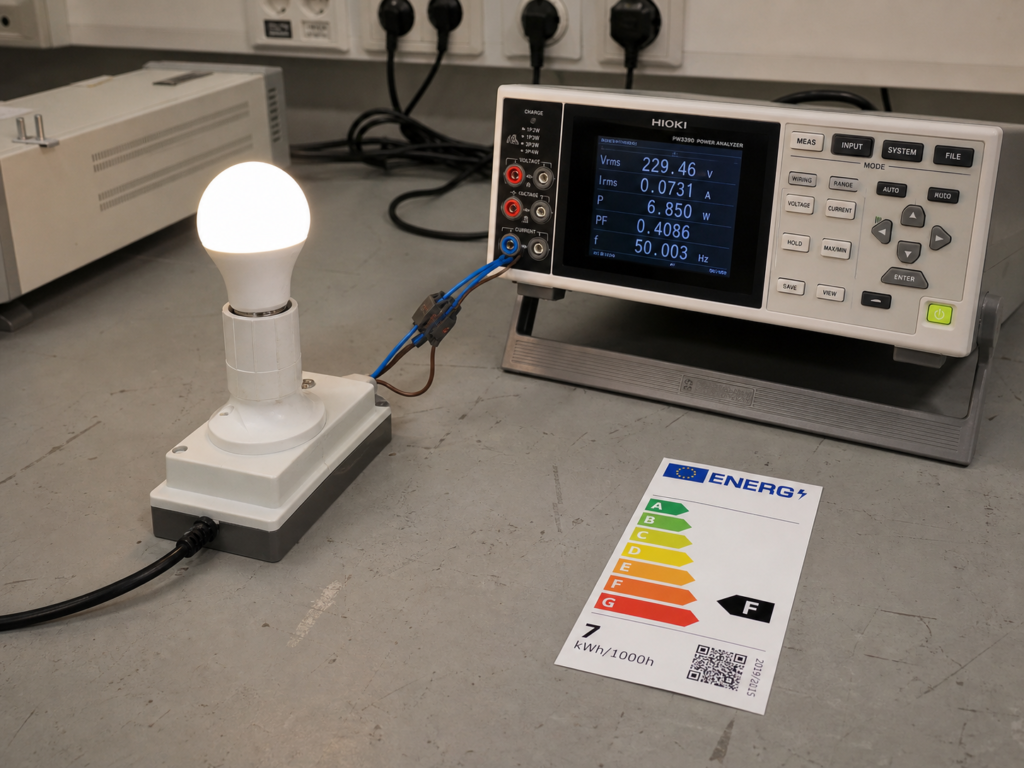
In addition to content, there are several general style requirements that all categories must comply with:
- There is no unified fixed size. The general rule is that the minimum width shall not be less than 36mm, and it can be scaled up proportionally; if it needs to be scaled down, the text must be clearly readable, and it cannot be so small that a magnifying glass is needed. If the corresponding category regulations have specific size requirements, those provisions shall take precedence.
- The energy efficiency color scale must use the standard colors specified by the EU. It cannot be changed to black and white, nor can the hue be adjusted without authorization.
- At a normal reading distance (about 30cm, which is the conventional distance for holding a product), text, patterns, and QR codes must be clearly distinguishable, and the QR code must be scannable normally.
- The new A-G seven-level label is the current general version of EU energy efficiency labels. Old version labels with “+” signs may only be valid in a few compliant transition scenarios or for historical inventory. The specific applicable version needs to be judged in combination with the time when the product is first placed on the EU market and the corresponding category regulations.
There are also requirements for materials and durability; you can’t just print a piece of paper and stick it on:
First, it must be firmly affixed and able to withstand the friction of normal transportation and handling; second, during the entire stage of consumers’ purchase decision — that is, from leaving the factory to before the consumer unpacks — it must not fade, fall off, or be damaged; if it is a product for outdoor use, it must also have weather resistance, able to adapt to changes in temperature, humidity, and ultraviolet radiation.
Where to Affix the Label: General Position Rules
Product Body Affixing Rules
It is preferred to affix it in a conspicuous place on the front of the product, preferably in the same area as compliance information such as the CE mark and product model, so that consumers can see it at a glance.
If it is a very small product (such as a low-power bulb) and the front is really too small to fit, it can be affixed to the side, bottom, or a hang tag, but it must comply with the rules of the corresponding category. Not all small products can be casually labeled on the bottom.
It must never be affixed in a position that requires flipping or moving the product to see (except for very small products), nor on easily peelable protective films, easily worn surfaces, or internal parts — a label that consumers cannot see is equivalent to not being affixed.
Outer Packaging Affixing Rules
The outer packaging of large and medium-sized products must be labeled, in a conspicuous position on the front or side. Key information such as energy efficiency rating and QR code must not be blocked by logistics stickers or sealing tape.
Small-sized products can only be labeled on the sales packaging, which also depends on the requirements of the corresponding category.
Online Sales Page Display Rules
Now there are many people doing e-commerce, and many of them make mistakes. The complete label image must be placed on the first screen of the detail page, in the main image area, or next to the price, and cannot be hidden at the very bottom of the page. A product information sheet must also be provided simultaneously, which can be an image, PDF, or a direct EPREL link.
The label image must not be cropped or blurry, and the parameters must be completely consistent with the physical label. You cannot mark grade A online while the physical product is grade C. In addition, labels and product information must use the official language of the target sales country, and cannot use only English to cover the entire EU.
Advertising and Promotion Display Rules
Whether it is social media ads, search ads, price comparison websites, or offline promotional flyers, as long as the price is mentioned, or the promotion involves energy saving or power consumption, the energy efficiency rating must be displayed. Vague marketing phrases such as “super energy-saving” and “most power-efficient” cannot be used to replace statutory energy efficiency label information.
Special Affixing Requirements for Common Categories
The above are general rules, but different categories have their own exclusive requirements. Don’t treat them all the same. You can check which applies to you:
Major Home Appliances and HVAC & Refrigeration (Refrigerators, Air Conditioners, Water Heaters, etc.)
These products are large in size, attract high consumer attention, and have the strictest requirements: they must be affixed both in a conspicuous place on the front of the product and on the front of the outer packaging, and neither position can be missing. If it is a built-in product (such as an oven or dishwasher embedded in a cabinet) and the front cannot be labeled, it can be affixed to the inner side visible after opening the door, and the size must meet the category-specific requirements. In addition, products of the same series with different capacities and powers may have different energy efficiency ratings. The same label must never be shared, and each model must use the corresponding version.
Lighting (Bulbs, Lamps, Light Sources, etc.)
Low-power bulbs are too small to be labeled themselves, so they can only be labeled on the independent sales packaging; if it is a multi-pack product, each independent small package must be labeled, and you cannot just stick one on the outer box. Large lamps must be affixed in a position that is still visible after installation, and cannot be affixed to the back that is blocked after installation. Replaceable light sources need to be labeled separately, while integrated light sources (such as LED beads soldered into ceiling lamps) can be labeled together with the lamp, no separate labeling is required.
Consumer Electronics (TVs, Monitors, Laptops, etc.)
Labels for TVs and monitors must be affixed to the front bezel below the screen, so that consumers can see them when looking at the screen. Portable products such as laptops and tablets have small front space, so they can be affixed to the bottom of the body, which is allowed by category rules. In addition, for consumer electronics sold online, the label image must be placed in the same display area as the product’s main image, and cannot be hidden deep in the detail page.
Industrial Energy-Using Products (Motors, Pumps, Power Adapters, etc.)
The display carrier requirements for such products are subject to the corresponding category regulations: in most cases, they are preferentially affixed to the product nameplate, in the same area as the CE mark and rated parameters, without needing to find a separate position. Some industrial energy-using products sold for B2B scenarios can be supplemented with energy efficiency parameters on packaging and technical documents in accordance with regulatory requirements, but it cannot be assumed that all industrial products are exempt from product body labeling. For such products, core indicators required by regulations such as standby power consumption and efficiency rating must be prominently marked, and must not be omitted.
Practical Operation: Affixing and Beginner Self-Inspection
After talking about so many rules, the actual operation is actually not difficult; just pay attention to a few key points.
Preparation Before Affixing
First, check the label: confirm that the model, parameters, version, and language all meet the requirements of the target market. Don’t take the wrong one and only find out after sticking it on, as peeling it off easily leaves adhesive residue.
Then clean the affixing surface: wipe off oil stains, dust, and old adhesive residue, keep it dry and flat, otherwise it will not stick firmly and will easily fall off.
Tools don’t need to be complicated; a clean soft cloth is enough. If you have a scraper, you can use it to smooth out air bubbles; it’s okay if you don’t.
Key Points for Standard Affixing Operation
After aligning with the predetermined position, press slowly from the center to the surroundings to drive out air bubbles. Otherwise, bulges after affixing are not only unsightly, but also easily cause the edges to curl and fall off. Press the edges several times with emphasis to ensure they are firmly stuck and have no curled edges.
After affixing, check again: are there any wrinkles, is any key information blocked, are the text and QR code clear. It is best to operate in a room temperature and dry environment; too cold, too hot, or too humid conditions will affect the adhesiveness of the glue.
Beginner 3-Step Quick Self-Inspection Method
After affixing, go through these 3 steps quickly, and you can find the vast majority of obvious problems in 1 minute:
- From the perspective of an ordinary consumer, can you see the complete label without unpacking? If you need to unpack or flip the product to see it, the position is wrong.
- Compare with the corresponding product template in the EPREL database to check whether the content and style of the label are consistent, and whether there are missing items or extra content that should not be there.
- Check whether the parameters on the label (such as energy efficiency rating, annual power consumption) match the actual product parameters and registered parameters, and whether there is false labeling.
Advanced Pitfall Avoidance: Semi-Proficient Judgment and Boundary Handling
If you have mastered the basic rules and want to avoid those easily overlooked hidden problems, you also need to pay attention to these contents.
High-Frequency Pitfall Misconceptions
The most common mistakes people make can be divided into three categories:
- Content category: Using old version labels with “+” signs (most likely to happen with old inventory); applying label templates across categories (for example, modifying a refrigerator label for use on an air conditioner); inconsistent model, parameters, and EPREL registration information.
- Position category: Placing the label in the manual or internal technical documents; affixing it on easily peelable protective film, which consumers tear off as soon as they unpack; only writing “energy efficiency grade A” online without putting the complete label image.
- Operation category: The label has wrinkles or air bubbles that block the energy efficiency rating or QR code; the QR code is invalid and cannot be scanned; using self-made “ErP Compliant” stickers to replace the statutory energy efficiency label.
Common Consequences of Non-Compliance
Don’t take chances. The cost of non-compliant ErP labeling is not small:
On the regulatory side, goods may be detained, fined, or prohibited from entering the country; in serious cases, they will be forcibly removed from the market or even recalled. E-commerce platforms will directly take down listings, or even freeze sales permissions. On the market side, you may also encounter situations where distributors reject goods or consumers file complaints, affecting brand reputation.
Boundary Judgment for Special Scenarios
There are several gray areas that many people are unsure about. Here we will clarify the rules for everyone:
- Set/combined products: Each independent product within the set that falls within the ErP scope must have its own label; the outer packaging of the set must either have the energy efficiency label of the main product, or mark the energy efficiency information of all included energy-using products; non-energy efficiency accessories (such as screws, remote controls) do not need to be labeled.
- Old inventory handling: The label version is judged based on the time when the product is first placed on the EU market. For products that require the new version according to the corresponding category regulations, even if they were produced earlier, as long as they are entering the EU market for the first time, the current version label must be used.
- Custom/small-batch products: “Small quantity” does not automatically grant exemption. You must first confirm whether it meets the EU’s exemption conditions such as small-batch handmade products. If it does not meet the conditions, even if you only sell a few, you must label them as required.
- Built-in/special-shaped small products: “Small size” also does not automatically grant exemption. Compact version labels must be used in accordance with the rules of the corresponding category to ensure visibility before consumers purchase. You cannot use “no space to stick” as a reason not to label.
Semi-Proficient Pre-Market Review Checklist
If you want to conduct a comprehensive pre-market inspection, go through these four points, and there will basically be no major problems:
- Multi-carrier consistency: The physical product, packaging, online page, and EPREL registration information are completely unified, with no discrepancies.
- QR code validity: Conduct an actual scan test to confirm that it can normally jump to the EPREL page of the corresponding product.
- Language compliance: Labels and product information use the official language of the target sales country, not just English.
- Version adaptability: The label version matches the time when the product is first placed on the market and the requirements of the corresponding category regulations, and expired old version labels are not used.
Overall, the core logic of ErP label affixing specifications is very clear: it is to allow consumers to clearly and intuitively see the real energy efficiency information of products throughout the entire purchase decision stage. For those doing business in the EU market, you can avoid the vast majority of risks by grasping three core judgment points: first, recognize the compliant ErP energy efficiency label, do not confuse it with other labels such as CE and ENERGY STAR, let alone replace it with self-made stickers; second, first confirm whether the product is within the scope through the official EPREL list and corresponding category regulations, do not make decisions based on experience; third, ensure that the information on the product body, outer packaging, online display page, and EPREL registration is completely consistent, and the parameters, version, and language all match.