
You may have just received a platform notification from your EU site requiring you to upload EPR qualifications, otherwise your products will be removed from the shelves. After searching around for information, some say you need to register, some say you need to label, and others say one number is valid across the whole of Europe — the more you read, the more confused you get. In fact, EPR is not that complicated. It is essentially a set of environmental responsibility rules of European countries. As long as you understand the core logic and judge step by step, ordinary sellers can sort out the compliance requirements by themselves and avoid common pitfalls.
I. Basic Understanding of EPR: Core Logic That New Sellers Must Master
What is EPR?
In plain terms, it means whoever first places a product or its packaging on the market of a European country shall bear the recycling and disposal cost of the product after it is discarded. The professional name of this set of rules is “Extended Producer Responsibility”, abbreviated as EPR.
Many people think EPR is a one-time certification or tax payment, but it is not. It is a set of ongoing compliance obligations, including five core links: “registration, labeling, declaration, payment, and archiving”. Missing any one of them does not count as full compliance.
In terms of coverage, the 27 EU member states, plus the three European Economic Area (EEA) countries of Norway, Iceland, and Liechtenstein, have each formulated their own EPR implementation rules. Sellers need to register separately and perform obligations separately according to the actual destination country of sale. There is no unified EPR registration number that can cover the whole of Europe or the entire EEA. The United Kingdom and Switzerland have left the EU system, so their own producer responsibility rules apply separately, and registration numbers from EU countries cannot be used.
Why EPR Must Be Taken Seriously
EPR is a mandatory compliance requirement in European countries, not an optional item. The consequences of non-compliance range from products being removed from shelves and listing restrictions by the platform, to customs detaining and destroying goods, imposing administrative fines, and even banning stores. There is no unified standard for the amount of fines, which depends on the country, the category of violation, and the severity.
Mainstream cross-border platforms such as Amazon, AliExpress, Temu, and eBay will gradually verify sellers’ EPR qualifications according to different sites, categories, delivery modes, and account compliance status. Those who fail to submit valid materials as required may face risks of product listing restrictions, removal, or even account restrictions. The specific verified categories, materials, and time requirements shall be subject to the latest notification in the platform backend.
Differences Between EPR and Other EU Compliance Requirements
Many new sellers confuse EPR with CE, VAT, etc. In fact, their regulatory directions are completely different, and they cannot replace each other:
• CE marking: It is a conformity mark of the EU for products covered by specific harmonized regulations, used to prove that products meet the relevant EU safety, health, and environmental protection requirements. Not all products sold to the EU require the CE mark. You need to first determine whether the product falls within the scope of application of the corresponding harmonized regulations.
• RoHS Directive: It mainly targets restricted hazardous substances in electrical and electronic products, and is an access requirement for specific categories, which is completely independent of EPR’s environmental protection recycling obligations.
• VAT: It is value-added tax on sales, collected by the tax authority. It is two completely different statutory payment obligations from EPR recycling fees, and they cannot replace each other.
• GPSR: It is the EU General Product Safety Regulation, focusing on product safety responsibilities and consumer rights protection, and does not involve the recycling obligation of waste products.
In short: even if you are compliant with CE, RoHS, VAT, or GPSR, it does not mean you have completed EPR compliance. All requirements must be fulfilled separately.
What to Pay Attention to in the New Packaging Regulation (PPWR)
The EU Packaging and Packaging Waste Regulation (abbreviated as PPWR) has entered the legislative implementation stage. Relevant obligations will be applied in phases and will be connected with the implementation rules and transitional arrangements of member states; sellers should not understand that all obligations will be implemented simultaneously across the EU in 2025.
The change directions that sellers need to focus on in the future include: unified packaging recyclability requirements, packaging reduction targets, proportion of recycled materials used, packaging label information requirements, and refinement of placement data declarations. The specific applicable categories and time nodes shall be subject to the implementation rules issued by the destination country. There is currently no unified EU-wide implementation schedule.
4 Basic Cognitive Questions That New Sellers Most Easily Get Wrong
Sellers who are new to EPR almost always fall into these cognitive pitfalls. Avoiding them in advance can save a lot of trouble:
1. “Only local EU merchants need to do it, domestic self-shipping does not”: Wrong. As long as the entity places products on the market of EU/EEA countries for commercial purposes, regardless of whether it uses self-shipping, FBA, or overseas warehouse mode, it needs to bear EPR obligations in accordance with the rules of the destination country, which has nothing to do with the seller’s location.
2. “One EPR number is valid across the whole of Europe”: Wrong. EPR for each country and each category needs to be registered separately. The registration number is only valid for the corresponding category in the corresponding country, and cannot be used across countries or categories. There is also no unified EPR registration number covering the whole of Europe.
3. “Low sales volume or small sales quantity can be exempted”: Wrong. Most categories in most countries (especially packaging) have no sales volume or sales revenue exemption. Even if you only sell one item a year, as long as it falls within the mandatory coverage scope, you need to complete compliance.
4. “The platform or FBA will do EPR for me”: Wrong. The platform is only responsible for verifying the seller’s compliance qualifications, and FBA only provides warehousing and distribution services. The subject of the legal obligation of EPR is always the seller, and the platform or logistics party will not complete the entire compliance process on your behalf.
II. Applicability Judgment: 3 Steps to Confirm Whether You Need to Do EPR
You don’t need to ask people everywhere. By checking according to these three steps, you can draw a basically accurate conclusion by yourself. For complex situations, you can further verify the rules of the destination country. The following judgment logic is a general framework, and all specific requirements shall be subject to the latest official rules of the destination country in the current year.
Step 1: Confirm the Implementation Status of EPR in the Target Site
Not all categories in all European countries have mandatory EPR requirements. First, confirm whether there are relevant requirements for the sites you are selling on:
• For popular sites such as Germany, France, Italy, Spain, the Netherlands, and Poland, EPR for core categories has been implemented.
• Some categories in some countries (such as textiles, furniture, etc.) may still be in the transition period and are not yet mandatory.
Regarding distance selling (for example, self-shipping from China to France, or shipping from a German warehouse to Italy), compliance requirements can be judged in three steps:
① First, confirm whether the destination country has implemented mandatory EPR requirements for this category;
② Then confirm whether a distance selling threshold is set, and the calculation caliber of the threshold (whether it is based on sales volume, packaging weight/quantity, annual sales revenue, or on the premise of having a local entity);
③ If the destination country does not set a distance selling threshold for this category (such as France), or your sales volume/amount has exceeded the threshold, you need to complete compliance in accordance with local rules.
There is no unified EU-wide standard for distance selling rules. Sellers should check the latest rules of the current year from the official institutions of the destination country, officially recognized PROs (Producer Responsibility Organizations), or the platform compliance portal, and should not judge only based on general experience.
Step 2: Confirm Whether Products and Packaging Are Within the Coverage Scope
The coverage of EPR is divided into two categories: one is the basic category with extremely wide coverage, and the other is the category that needs to be added for specific products. The general judgment logic is as follows:
• Basic category: packaging. Packaging is the category with the widest EPR coverage. In practice, inner packaging (such as small paper boxes for lipsticks), sales packaging (such as product color boxes), logistics packaging (such as express outer boxes), filling materials (such as foam, bubble bags), tape, and product labels should all be included in the packaging judgment list first.
On this basis, confirm the ownership of the declaration obligation for each item according to the destination country’s packaging definition, placement chain, and responsible subject rules — for example, for packaging replaced twice by platform warehouses, logistics packaging placed in advance by importers, etc., you need to first judge “who is the subject that first places this packaging” and “whether a third party (such as the platform, warehousing party, importer) has assumed the corresponding declaration responsibility”, and retain relevant vouchers to avoid missing or repeated declarations. It cannot be generally counted as all seller obligations.
• Common categories that require additional compliance:
• WEEE (electrical and electronic equipment): usually refers to products that operate on electric current or electromagnetic fields, such as small home appliances, battery-powered electronic toys, some mobile phone accessories, decorative items with lights, etc. However, whether it is specifically included in the scope needs to be confirmed according to the destination country’s definition of product function, power supply method, and components. Not all “electrical” accessories belong to the same category.
• Batteries: usually include separately sold batteries, built-in batteries in products, batteries included with products (such as AA batteries given with toys), power banks, etc. Some countries set different declaration requirements according to battery types (dry batteries, lithium batteries, button batteries, etc.) and whether they are integrated with the product.
• Other categories: textiles, furniture, tires, etc., depending on the implementation progress and rules of different countries.
Two general rules should be noted here: first, the superposition rule. If a product involves multiple categories, it usually needs to cover all corresponding EPR obligations — for example, a desk lamp with a built-in battery generally needs to cover three categories: packaging, WEEE, and batteries, but the specific classification is still subject to the rules of the destination country. Second, special scenarios are not easily exempted. Gifts, trial packs, and accessories in sets, as long as they are placed on the market together with the product, usually need to be included in the declaration scope, and cannot be directly exempted on the grounds of “free gift”.
Step 3: Confirm Whether You Are the Subject of EPR Obligations
Many people ask “I do white label products, do I need to do it?” “Can I use my supplier’s number?” In fact, there is no unified cross-border definition of the subject of EPR obligations, which needs to be judged one by one according to the regulations of the destination country. The general judgment framework is:
First, confirm whether you place products on the market of the destination country for commercial purposes (including all sales modes such as self-shipping, FBA, and overseas warehouses);
Second, check the division of responsibilities of overseas distance sellers, non-EU producers, and importers in the regulations of the destination country — most countries list the “commercial entity that first places products on the domestic market” as the primary responsible person. If you use a local EU importer for customs clearance, the importer may bear joint and several liability, but this does not exempt the seller from compliance obligations.
It should be specially noted that the contract between you and the supplier or importer can only allocate the performance responsibilities and costs of both parties, and cannot change the legal identity of the responsible subject. Even if the contract stipulates that the other party is responsible for EPR, the regulatory authority may still hold you accountable.
The only universal exemption is: personal non-commercial resale of second-hand idle items does not need to bear EPR obligations.
Two Quick Judgment Tools
If you have many products and miscellaneous sites, you can use these two methods to sort out quickly, which can greatly reduce the risk of missing items:
• Disassembly method: Disassemble each product into “main body + built-in battery + packaging + accompanying accessories”, corresponding to EPR categories respectively, and check the rules of the destination country one by one. For example, for wireless earphones, the earphone body usually belongs to WEEE, the built-in battery belongs to the battery category, and the color box + express box + filling belongs to the packaging category. The specific classification shall be confirmed according to the rules of the destination country.
• List method: Make a list of “target sales country + product category + annual placement volume/weight”, and check one by one against the rules of each country to avoid omissions.
III. Differences in EPR Requirements for Core Sites (Common Version for Cross-Border Sellers)
Many sellers ask “I have done EPR for Germany, can I use it for France?” The answer is no — EPR does not have a unified EU registration number, and the rules of each country are quite different. Understanding the differences between core sites first can save a lot of detours.
The Most Important Premise: There Is No EPR Number Valid Across the Whole of Europe
EPR for each country and each category must be registered and declared separately. The registration number is only valid for the corresponding category in the corresponding country. For example, if you have EPR-related qualifications for German packaging, you can neither use it for the WEEE category in Germany nor for the packaging category in France.
The platform requirements are the same: for products on which site, you must upload the EPR qualification of the corresponding country and corresponding category, and you cannot mix them.
Characteristics of the Two Core Sites: Germany and France
Germany and France are the most common sites for cross-border sellers, and also the two countries with the most mature EPR implementation and the strictest verification:
• German site: It is currently one of the sites with the strictest EPR implementation. The mandatory categories frequently involved by cross-border sellers include packaging, WEEE (electrical and electronic equipment), batteries, etc.; whether extended categories such as textiles have been mandatorily applied shall be subject to the latest rules of the German competent authority and the corresponding recycling system. Compliance requirements for different categories vary greatly: ① Packaging: It is necessary to complete producer registration in the official LUCID system, join an officially recognized packaging recycling system, and submit placement data declarations as required. The declaration frequency is determined according to the rules of the recycling system and the placement volume, and is not uniformly divided into annual or quarterly according to the placement volume. ② WEEE and batteries: Overseas sellers usually need to appoint a local German authorized representative, complete special registration and join the corresponding recycling system. The specific requirements need to be checked against the latest official German rules according to product categories.
• French site: It is one of the sites with the most complete EPR coverage categories, and mandatory requirements for multiple categories such as packaging, WEEE, batteries, textiles, and furniture have been implemented. The core characteristics of French EPR include: sellers need to obtain a unique producer identification code and join an officially recognized recycling organization for the corresponding category (uniformly supervised by the French Environment and Energy Management Agency ADEME); for applicable products and packaging, the Triman logo and the classified recycling information of the corresponding category (i.e., Info-tri requirements) must be displayed in accordance with the current French labeling rules. The specific logo’s graphic, size, position, language, and the display requirements of the online product detail page must be checked separately according to the category and packaging form. Not all categories have exactly the same labeling requirements. The declaration cycle for most categories is annual.
Rule Characteristics of Other Popular Sites
Italy, Spain, the Netherlands, and Poland are other EU sites commonly used by cross-border sellers. The EPR rules of these countries are obviously different from those of Germany and France, and cannot be directly inferred from the compliance experience of Germany and France. The core characteristics can be summarized into four points:
① The registration and declaration process is usually simpler than that of Germany and France, but it does not mean that no compliance is required, and all obligations still need to be fulfilled in accordance with local rules;
② Some categories are implemented later, and some are still in the transition period. The time node of mandatory requirements shall be subject to official announcements;
③ Under the same placement volume, the compliance cost is generally lower than that of German and French sites, but the specific amount is still subject to the official quotation of the corresponding PRO;
④ Non-EU entity sellers may need to appoint a local authorized representative for some categories in some countries.
Each country has different regulations on registration subject requirements, declaration systems, packaging responsibility division, WEEE/battery category scope, etc. Sellers still need to check one by one according to the specific rules of the destination country to avoid pitfalls due to empiricism.
Comparison of Core Rules of Popular Sites
To facilitate you to quickly sort out the differences, here is a comparison of the core rules of 6 popular sites. The specific requirements shall be subject to the latest announcements of the competent authorities of each country:
| Country | Mandatory core categories already implemented (frequently involved by cross-border sellers) | Core requirement differences for overseas sellers | Registration/processing cycle | Reference minimum cost for small and medium-sized sellers | Characteristics of declaration frequency | Core labeling requirements |
| Germany | Packaging, WEEE, batteries, etc.; extended categories are subject to the latest official rules | Packaging needs to be registered in the LUCID system + join an officially recognized recycling system; WEEE/batteries usually require a local authorized representative | Usually 1–4 weeks, categories such as WEEE/batteries may take longer, depending on data completeness and category | For small placement volume of packaging (within 100kg per year), it is usually about 50–200 euros/year; WEEE/battery categories are usually higher, fluctuating according to PRO and service methods | Declaration frequency varies by category and recycling system; packaging is usually annual/quarterly | WEEE and battery categories need to be affixed with the crossed-out trash bin logo; packaging provides recycling information according to local rules |
| France | Packaging, WEEE, batteries, textiles, furniture, etc. | Need to obtain a unique producer identification code and join an officially recognized recycling organization for the corresponding category | Usually 1–4 weeks, depending on category and data completeness | For small placement volume of packaging (within 100kg per year), it is usually about 50–200 euros/year; other categories fluctuate greatly by type | Most categories are declared annually | Applicable products/packaging need to display the Triman logo and classified recycling information, which must meet requirements both online and offline |
| Italy | Packaging, WEEE, batteries, etc. | Some categories require a local representative | Usually 1–3 weeks, depending on category | Small placement volume of packaging is usually tens to hundreds of euros/year, and the overall cost is usually lower than that of Germany and France | Packaging is usually semi-annual/annual, others are mostly annual | WEEE and battery categories need to be affixed with the crossed-out trash bin logo; packaging is implemented according to local rules |
| Spain | Packaging, WEEE, batteries, etc. | Some categories need to be registered through a local entity | Usually 1–3 weeks, depending on category | Small placement volume of packaging is usually tens to hundreds of euros/year, and the overall cost is usually lower than that of Germany and France | Packaging is usually quarterly/annual, others are mostly annual | WEEE and battery categories need to be affixed with the crossed-out trash bin logo; packaging is implemented according to local rules |
| Netherlands | Packaging, WEEE, batteries, etc. | Some categories can be directly registered by overseas sellers, some require a local representative | Usually 1–3 weeks, depending on category | Small placement volume of packaging is usually tens to hundreds of euros/year, and the overall cost is usually lower than that of Germany and France | Packaging is mostly annual, others depend on the category | WEEE and battery categories need to be affixed with the crossed-out trash bin logo; packaging is implemented according to local rules |
| Poland | Packaging, WEEE, batteries, etc. | Most categories require a local authorized representative | Usually 1–3 weeks, depending on category | Small placement volume of packaging is usually tens to hundreds of euros/year, and the overall cost is usually lower than that of Germany and France | Packaging is usually quarterly/annual, others are mostly annual | WEEE and battery categories need to be affixed with the crossed-out trash bin logo; packaging is implemented according to local rules |
Note: The above information is compiled from current general rules, and specific requirements are subject to the latest announcements of the competent authorities of each country or officially recognized recycling organizations; there is no EU-wide unified labeling or registration requirement, which needs to be checked separately according to the sales country. The cost is a reference value for small and medium-sized sellers with an annual placement volume of less than 100kg around 2024, excluding large-volume placement, special categories, and additional service fees. The actual cost fluctuates with placement volume, PRO policies, and service content. In addition, the “Green Dot” is only a logo of some recycling systems in some countries, not a mandatory requirement applicable across the whole of Europe. Do not affix it blindly.
IV. Full EPR Compliance Process: From Registration to Daily Execution
After figuring out whether you need to do it, let’s sort out the complete compliance process. From preparing materials to daily maintenance, each step has clear general requirements, and specific details need to be adjusted according to the rules of the destination country.
Materials to Prepare Before Registration
Before registering for EPR, preparing these basic materials first can save a lot of time:
• Basic qualifications: business license, legal person’s identity certificate (ID card or passport), store link.
• Product information: category list, estimated annual placement volume (counted by weight or quantity, according to category requirements).
• Supplementary materials (if applicable): Some countries require non-EU entity sellers to provide information on local authorized representatives/environmental representatives. This is not mixed with the EU Authorized Representative (EAR) in the context of CE/GPSR. Whether it is required shall be subject to the special EPR rules of the destination country, and can be verified in advance before registration.
Registration Channels and Core Process
There are two common channels for EPR registration, and you can choose according to your own situation:
• Official self-registration: Suitable for sellers with local EU entities, who understand the local language and are familiar with regulations. They directly connect with the officially recognized Producer Responsibility Organization (PRO) of the destination country, with no service fee, but the process is relatively complex, and they need to follow up all links by themselves.
• Service provider agency registration: Suitable for most ordinary cross-border sellers. The service provider connects with recycling institutions, handles materials and language issues, saving time, but requires a certain service fee.
The Producer Responsibility Organization (PRO) mentioned here is the operating entity of the recycling system that undertakes the performance of producer responsibilities, responsible for receiving producers’ declarations, organizing recycling and disposal, and connecting with regulatory agencies; its legal status depends on the system of each country. In some countries, it is directly authorized by the government, and in some, it is a qualified industry self-regulatory organization. Sellers need to choose a PRO officially recognized by the destination country for cooperation.
No matter which channel you choose, the core process is basically the same: submit materials → official/PRO review (ranging from 1-4 weeks, depending on the country and category) → sign a recycling agreement with the officially recognized PRO → pay relevant fees → obtain the official EPR registration document or identification code.
After obtaining EPR-related documents, it is recommended to verify the validity from two dimensions: first, confirm that the issuing entity of the document is the competent authority of the destination country, the official registration system, or the PRO recognized by the country, rather than an unqualified third-party institution; second, confirm that the corresponding recycling agreement, authorized representative (if required), declaration status, and payment status are all valid — the validity of EPR in some countries does not take the public system query as the only standard. If only the registration number can be found but the declaration and payment are not made on time, it is still in a non-compliant state. For example, the LUCID registration of German packaging and the French producer identification code can be queried in the corresponding official systems, but it is still necessary to simultaneously confirm that the recycling agreement and declaration status are normal.
Compliance Differences of Different Delivery Modes
Whether it is FBA, third-party overseas warehouse, or self-shipping, the primary subject of EPR obligations is usually the seller, but the verification scenarios and time points are different:
• Platform self-operated warehouses such as FBA: The platform will verify the EPR qualification of the corresponding site during product listing and warehousing. Failure to upload valid qualifications may result in inability to enter the warehouse or removal from shelves.
• Third-party overseas warehouses: The warehouse itself usually does not bear EPR compliance responsibilities. Compliance risks mainly come from customs clearance verification, platform patrol inspections, or local regulatory spot checks.
• Self-shipping: It is generally verified during customs clearance or daily platform patrol inspections, and must comply with the distance selling rules of the destination country. If non-compliance is found, the product will be directly removed from the shelves.
4 Core Compliance Requirements for Daily Operations
Obtaining registration qualification is only the starting point of compliance. You also need to do these 4 things well in daily operation to be considered continuously compliant:
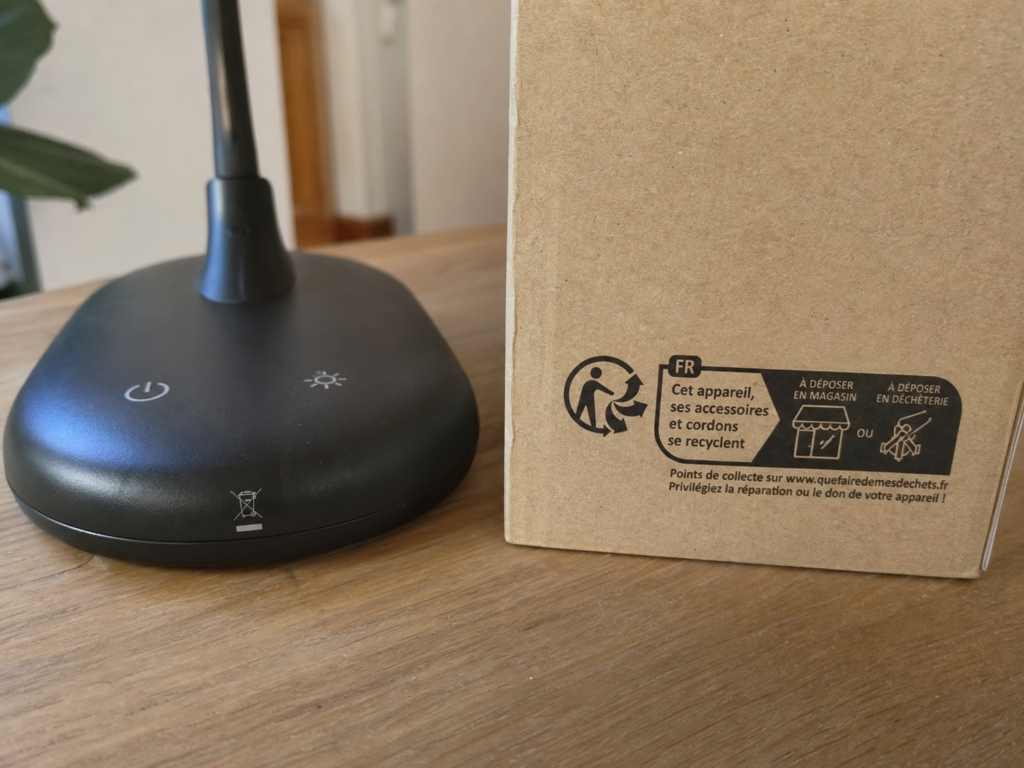
1. Affix labels as required: Labeling requirements vary by country and category. For example, applicable categories in France need to be affixed with the Triman logo, and electronic products usually need to have the crossed-out trash bin logo. Here is a common misunderstanding to clarify: the “Green Dot” is only a logo of some recycling systems, not a mandatory requirement applicable across the whole of Europe. Do not affix it randomly, just follow the requirements of the corresponding country.
2. Product page compliance: Some countries require product detail pages to display environmental protection information or EPR-related identification codes, and they need to be in the local language. For example, the French site needs to mark recycling instructions in French. The specific requirements shall be implemented in accordance with the rules of the destination country.
3. Establish data ledger: It is recommended that sellers record data such as product placement volume, packaging weight and material, battery quantity/weight, and sales site on a monthly basis, and establish a complete ledger to facilitate subsequent declaration and verification. The specific data retention period shall be determined according to the regulatory requirements of the destination country, usually ranging from 3 to 5 years.
4. Upload to the platform in time: After obtaining the qualification, upload it to the compliance portal of the platform backend of the corresponding site as soon as possible. Don’t wait for the platform to urge you, to avoid product removal.
Key Points for Responding to Platform Verification
The verification logic of mainstream platforms is basically the same: sellers are required to upload EPR qualifications for the corresponding country and category in the backend, and those who fail to provide them on time may have their products removed. In addition to registration documents, the platform occasionally requires supplementary materials such as recycling organization contracts, declaration payment vouchers, and product category descriptions. Just pay attention to keeping them on hand.
Some platforms provide EPR-related collection, declaration agency, or partial performance agency services in specific countries or categories. When using such services, sellers need to check the service scope one by one: whether it covers registration, labeling guidance, data declaration, payment, dispute handling and other links, or only undertakes the fee collection agency function. It should be noted that the platform only provides assistance within the corresponding service scope, and the seller’s legal responsibility as a product placer remains unchanged, and still needs to confirm the compliance of the whole process by itself.
Precautions for Declaration and Payment
The EPR declaration cycle varies by country, category, and PRO rules, including monthly, quarterly, and annual. When registering, you should remember the declaration deadline clearly, and it is best to set a reminder to avoid omission.
The fee is generally settled based on the actual placement volume. The fee paid during registration is usually an estimated fee, which is settled according to the rules after checking the actual data at the end of the year. Whether it is refunded for overpayment and supplemented for underpayment, or carried forward to the next year, shall be determined according to the rules of the destination country and the PRO contract agreement. There is no unified cross-border standard.
If you declare or pay overdue, late fees will usually be incurred, and in serious cases, the registration qualification may be cancelled, affecting subsequent sales. Therefore, be sure to complete the declaration and payment on time.
V. Cost Composition and Decision-Making Logic for Small and Medium-Sized Sellers
Many sellers are most concerned about the cost of EPR. In fact, there is no unified pricing for EPR, and there are great differences between different countries, different categories, and different placement volumes. We can split the cost into three core components and then estimate according to our own situation.
3 Core Components of EPR Cost
• Fixed fees: Including the registration fee of the official system, the membership fee or annual management fee of the recycling organization (PRO), etc. This part of the fee has nothing to do with the placement volume, and must be paid as long as the registration is completed. The specific amount varies according to the country, category, and PRO policy.
• Variable recycling and disposal fee: This is the largest part of EPR cost, calculated based on the weight, quantity, material, and category of products/packaging actually placed on the market. For example, packaging is calculated by multiplying the weight of different materials (paper, plastic, glass, etc.) by the corresponding rate, electrical and electronic products are charged by product category and weight, and batteries are charged by battery type (dry batteries, lithium batteries, etc.) and weight. Most categories set a minimum charging threshold, and even if the placement volume is very small, a basic recycling fee must be paid.
• Service fee: If you choose to find a compliance service provider to handle registration, declaration, consultation and other services, you need to pay the corresponding service fee; if you are a seller with an EU entity and strong language skills who directly connects with the official PRO for registration, there is no such expense.
Cost Reference for Common Categories (Small Seller Version for German and French Sites)
To facilitate small and medium-sized sellers to make budgets quickly, here are the common cost reference ranges for small sellers on German and French sites with an annual placement volume of less than 100kg around 2024:
• Packaging: about 50–200 euros/year
• Small electrical and electronic products (such as small accessories, small home appliances): about 200–1000 euros/year
• Batteries: about 150–800 euros/year
The above is only a general market reference. Whether it includes registration fee, minimum recycling fee, annual fee, declaration fee and service fee needs to be confirmed with the service provider or PRO item by item. The final cost is subject to the real-time quotation of the official PRO or compliance service provider.
General Logic of Cost Estimation
You can estimate the approximate cost by yourself in the way of “by country + by category”:
1. First list all target sales countries and the EPR categories involved in each country (for example, the German site involves three categories: packaging, WEEE, and batteries).
2. For each category, count the estimated annual placement volume separately: packaging is counted by the weight of different materials, electrical and electronic products are counted by product quantity/weight, and batteries are counted by battery type and weight.
3. Correspondingly query the public price list of the officially recognized PRO in the destination country, or consult a compliance service provider to obtain a real-time quotation. Add the fixed fee + minimum recycling fee (or recycling fee calculated based on actual placement volume) + optional service fee, which is the approximate annual cost of this category.
For example: if you are a seller of small desk lamps with built-in batteries on the German site, with a total annual packaging placement weight of less than 100kg, 50 small electrical appliances, and a total built-in battery weight of 20kg, your EPR cost consists of “packaging fixed fee + minimum recycling fee + WEEE fixed fee + minimum recycling fee + battery fixed fee + minimum recycling fee + (optional) service provider agency fee”. The specific amount is subject to the official price list of the corresponding German PRO, and there is no unified general standard.
Compliance Priority Decision for Small and Medium-Sized Sellers
Small and medium-sized sellers do not need to complete EPR registration for all countries and all categories at one time, and can advance step by step according to priority, but on the premise of “no violation”:
• Site priority: Prioritize the compliance of core profitable sites to control upfront costs.
• Category priority: First do the packaging category with the widest coverage, then do other categories corresponding to the product (such as WEEE, batteries), to ensure no missing items and no unnecessary redundant registration.
• Channel selection: Ordinary small and medium-sized sellers are recommended to choose a reliable compliance service provider to handle it on their behalf, saving time and communication costs; if you have a local EU entity and are familiar with the local language and regulations, you can also choose to directly connect with the official PRO for registration.
• Transition period arrangement: If a category in the destination country has just implemented mandatory requirements and has a compliance transition period, be sure to complete registration and related preparations before the end of the transition period to avoid violations and fines after the transition period.
How to Judge a Reliable EPR Service Provider
The quality of EPR service providers on the market varies. Screening according to these dimensions will help to select compliant service providers and greatly reduce the risk of pitfalls:
1. Check qualifications: Confirm whether the service provider has the cooperation authorization or service qualification of the officially recognized PRO in the corresponding country, rather than an unqualified intermediary.
2. Check authenticity: Confirm that the registration document or identification code issued by the service provider can be queried for the corresponding subject information in the official system or PRO system of the corresponding country.
3. Check service content: Ask clearly about the specific items included in the service, whether it only provides registration services, or includes full-process services such as declaration, renewal, problem response, and policy update reminders. Many low-cost services only include registration, and subsequent declarations and changes require additional fees.
4. Check fee details: Require the other party to provide clear fee details, confirm whether there are hidden fees, such as whether declaration fees, data upload fees, change fees, etc. need to be paid additionally, to avoid the situation where it seems cheap at the early stage but the additional fees are higher later.
There is also a red line that must never be touched: “Shared EPR number” is an illegal act and must never be purchased. Using someone else’s EPR qualification is equivalent to impersonating someone else’s identity. Once found, it will be directly judged as a violation, and in serious cases, it will lead to store ban.
VI. Pitfall Avoidance and Risk Self-Check: From Beginner to Judgment
In the process of doing EPR, many pitfalls are in the details of operation, which can be avoided if you know them in advance. Finally, we have sorted out common operation misunderstandings and self-check methods to help you quickly judge your compliance status.
5 Most Common Practical Pitfalls in Operation
Many sellers do not fail to understand the basic rules, but tend to ignore details in actual operation, leading to compliance risks. The following are high-frequency practical misunderstandings:
1. Only count product boxes for packaging, missing logistics packaging and filling materials: Many sellers only declare the sales packaging of products, forgetting logistics packaging such as express outer boxes, bubble wrap, and foam filling. These usually fall within the accounting scope of packaging EPR, and missing declarations may lead to false declaration data.
2. Everything is fine once you get the registration number, no need to worry about declaration and payment: Registration is only the first step of EPR compliance. Submitting declaration data on time, paying recycling fees, updating information, and renewing on time are the core of continuous compliance. Missing any one of them does not count as full compliance.
3. Directly use the supplier’s EPR number: Suppliers are usually not the placers of products in the EU market, and their EPR registration numbers cannot be directly applied to your store. Even if the supplier promises it is available, you need to first confirm whether it is recognized in the rules of the destination country to avoid violations.
4. Missing declarations of built-in batteries, gifts, and trial packs: For products with built-in batteries (such as wireless earphones, electric toys), only WEEE is declared and the battery category is forgotten. Gifts and trial packs are thought to be free so no need to declare. These are common missing declaration scenarios. As long as they are placed on the market together with the product, they usually need to be included.
5. Unclear responsibility for secondary packaging in platform warehouses: For example, for outer boxes replaced by FBA and secondary packaging in overseas warehouses, it is not clear who should declare, which is prone to missing or repeated declarations. It is necessary to confirm the responsibility attribution with the platform/warehousing party in advance and retain relevant vouchers.
Scenarios Prone to Missing or Repeated Declarations and Adjustment Methods
The accuracy of declaration data is the core of EPR compliance. The following are the scenarios most prone to missing or repeated declarations, which require special attention:
• Common missing declaration scenarios: Missing declaration of battery category for products with built-in batteries, gifts/trial packs not included in the declaration, missing declaration due to unconfirmed responsibility for secondary packaging in platform/overseas warehouses, accessories included with products (such as charging cables, batteries) not included in the calculation.
• Common repeated declaration scenarios: The platform, importer, and seller respectively declare the same category of the same batch of goods, the accompanying battery is counted in both the product category and the battery category, and the packaging that has been declared by a third party is repeatedly counted by the seller.
If there are returns, order cancellations, cross-border inventory transfers, or it is confirmed that a certain part has been declared by a third party such as the platform/importer, it can be deducted from the declaration data only on the premise that it complies with the declaration rules of the destination country and can provide valid vouchers (such as return records, inventory transfer orders, third-party declaration certificates). You are not allowed to arbitrarily deduct the declaration volume by yourself.
Risk Levels and Consequences of Non-Compliance
The consequences of EPR non-compliance are not uniform, and will be handled in grades according to the violating country, category, severity, and rectification situation:
• Mild risk: Products are removed from the platform, listing is restricted, and rectification within a time limit is required. Whether the sales qualification is restored is determined by the platform or the competent authority based on the rectification results.
• Moderate risk: Required to pay back fees, pay late fees, and impose administrative fines. The amount of fines depends on the rules of each country and the degree of violation, and there is no unified standard.
• Severe risk: Goods are detained or destroyed by customs, sales bans are issued, and accounts are banned, usually in cases of serious violations or refusal to rectify.
Overall, the earlier the rectification and the higher the cooperation degree, the relatively smaller the impact of the penalty.
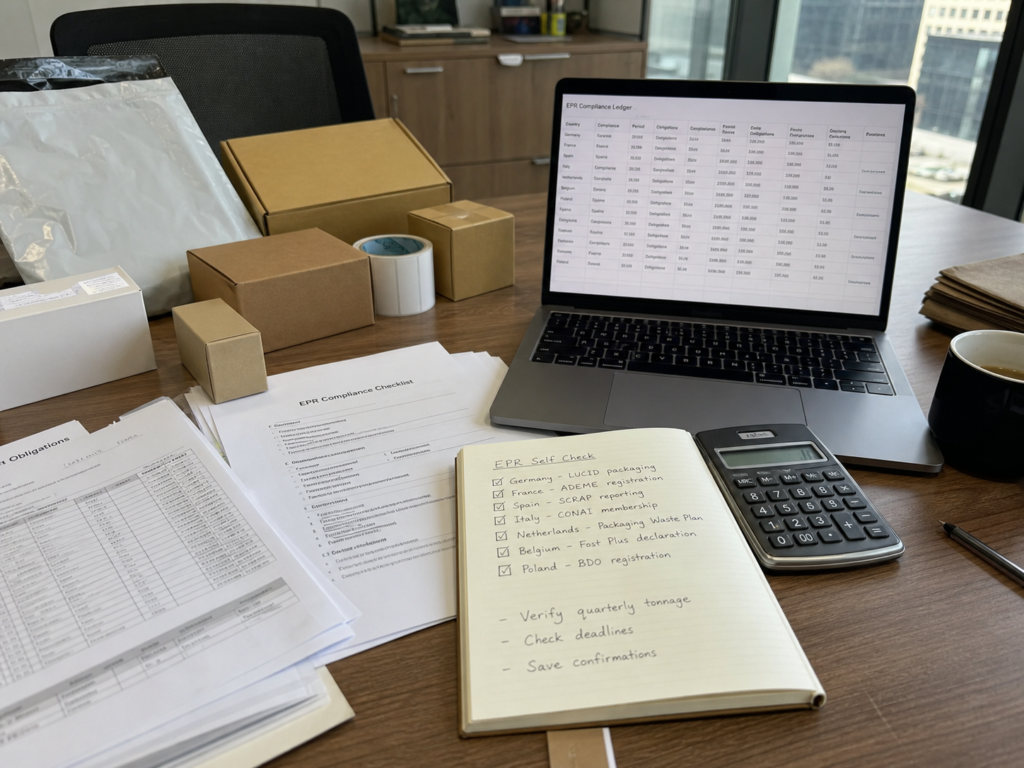
Quick EPR Self-Check List for Cross-Border Sellers
You can compare the following 5 dimensions to quickly check the EPR compliance risks of your store and fill in the loopholes in time:
1. Check site rules: Confirm that the EPR category requirements implemented by all active sites cover all your active product categories.
2. Check product coverage: Confirm that all active products, packaging, accessories, and gifts correspond to the corresponding EPR categories, with no missing items.
3. Check qualification validity: Confirm that valid EPR documents for the corresponding country and corresponding category have been obtained, and the registration subject, recycling agreement, and declaration payment status are all normal.
4. Check operation execution: Confirm that EPR-related information has been uploaded to the backend of the corresponding site, recycling labels have been affixed as required, and sales data ledgers are completely retained.
5. Check declaration records: Confirm that all due declarations have been completed on time, fees have been paid, and there are no overdue records.
Summary
As the core requirement of environmental compliance in European countries, EPR seems to have many links and detailed rules, but as long as you clarify the core logic of “who places, who is responsible”, and advance according to the steps of “first judge the scope of application, then implement step by step according to site categories, and do a good job in daily data retention and timely declaration”, ordinary sellers can also complete compliance smoothly. For small and medium-sized sellers, prioritizing coverage of core profitable sites and mandatory categories, simultaneously paying attention to rule updates in the destination country, and verifying official rules or consulting professionals in time when encountering uncertain problems is a safe choice that balances cost and compliance.