
Most practitioners exporting smart products to the EU are most concerned about the enforcement and penalty issues of the CRA (Cyber Resilience Act): whether their products will be inspected, how much they will be fined for violations, and how to respond when receiving an enforcement notice. EU cybersecurity regulations have strict requirements, and violations may have a substantial impact on business. This article explains step by step from the scope of application, enforcement subjects, process rules to risk avoidance methods, covering the needs of introductory understanding and practical judgment.
1. Basic Introduction: Core Boundaries and Common Misconceptions of CRA Enforcement
What is CRA Enforcement and Penalty?
In plain terms, CRA enforcement and penalties refer to the inspections, rectification requirements, and punitive measures taken by the EU against smart products sold locally if their cybersecurity does not meet standards. Its core purpose is not to impose fines, but to force enterprises to embed security requirements from the product design stage (commonly referred to in the industry as “security-by-design”), and it is the core link for the implementation of the entire CRA. In terms of nature, CRA penalties are mainly administrative penalties, and only in extreme cases—such as when an enterprise intentionally violates regulations and causes a major safety accident—may criminal liability be triggered.
Which Products and Entities Are Regulated?
The CRA covers a wide range of products: all consumer or commercial smart products with networking functions or built-in software sold in the EU market (referred to in the regulation as “products with digital elements”, abbreviated as PDE) are within the scope of regulation. This includes not only the hardware itself, but also supporting mobile apps and embedded software. Cloud services/remote data processing solutions are usually included in the CRA’s liability scope only when they are necessary for the product to realize its functions, provided by the manufacturer, or placed on the market together with the product; standalone general-purpose cloud services need to be judged separately. Common examples such as smart home appliances, home routers, surveillance cameras, smart door locks, and even industrial control equipment used in factories are all regulated categories.
In terms of responsible entities, manufacturers are the primary responsible parties, but manufacturers are not the only ones that can be fined. Importers, distributors, online platforms, and EU authorized representatives who knowingly sell or list non-compliant products shall bear joint and several liability.
Which Products Are Not Subject to CRA Regulation?
Two categories of products are legally excluded from the scope of CRA regulation and do not need to comply with CRA requirements:
One category is products already covered by special regulations. For example, medical devices are regulated by the MDR (Medical Device Regulation), automobiles are subject to dedicated automotive cybersecurity regulations, and aviation equipment, military products, etc., have their own industry safety rules, so the CRA does not apply to them.
The other category is non-commercial products, such as second-hand items for personal use, non-commercial prototypes for scientific research, and products for internal enterprise use that are not sold to the public, which are also not within the enforcement scope of the CRA.
Implementation Timeline
CRA enforcement is not implemented in one step, and there are clear transitional arrangements: it will officially enter into force at the end of 2024, the reporting obligation for vulnerabilities and serious security incidents will be activated 21 months after entry into force (around mid-2026), and compliance enforcement for most products will not start until 36 months after entry into force (around the end of 2027). It should be noted that these are approximate time nodes; the specific dates shall be subject to the Official Journal of the European Union and the implementation notices of each member state, and the implementation pace may vary slightly among different member states.
6 Most Common Cognitive Misconceptions
Enterprises that are new to the CRA are prone to several cognitive pitfalls, which are clarified here:
- Misconception 1: Only EU-based enterprises need to comply: As long as products are sold to the EU market, overseas enterprises are also subject to regulation. The EU can freeze enterprises’ assets within the EU and prohibit product entry through cross-border enforcement cooperation, so there is no room for “overseas exemption”.
- Misconception 2: Small and micro enterprises are fully exempt: Micro-enterprises with fewer than 10 employees and annual revenue of less than 2 million euros can enjoy simplified compliance procedures, but they still need to comply with core cybersecurity requirements and are not fully exempt from liability.
- Misconception 3: Only manufacturers are fined, and distributors and platforms are not involved: Importers, distributors, online platforms, and EU authorized representatives who knowingly sell or list non-compliant products shall bear joint and several liability.
- Misconception 4: Products with the CE mark will not be inspected: The CE mark indicates that the product has completed the applicable conformity assessment procedure; most ordinary products can be self-assessed and declared by the enterprise, and some important/key products may require third-party assessment. Either way, market surveillance authorities can still conduct random inspections and verification, and those found to be non-compliant will also be penalized.
- Misconception 5: CRA and GDPR cannot be penalized at the same time: If the same act violates different obligations of the two laws (for example, a product vulnerability leads to user data leakage, which violates both the CRA’s product security requirements and the GDPR’s data protection requirements), separate penalties can be imposed, which does not constitute double punishment.
- Misconception 6: No penalty will be imposed if no security incident occurs: CRA enforcement is not only initiated after an accident occurs; compliance defects found in routine random inspections will also trigger penalties, so one should not take chances.
2. Enforcement Subjects: Who Has the Right to Inspect and Who Has the Right to Impose Penalties?
The CRA enforcement system has a clear division of powers and responsibilities—not all institutions involved in supervision have the right to impose penalties.
Member State Competent Authorities: Core Enforcers
Each EU member state will designate its local market surveillance authority as the competent authority (abbreviated as NCA), such as Germany’s BSI and France’s ANSSI. The specific competent authority and whether enforcement is divided between cybersecurity agencies and market surveillance agencies shall be subject to the official designation and implementing legislation of each member state. These institutions are the core of CRA enforcement. Formal penalty decisions are usually made by the member state competent authority or the market surveillance authority designated by it in accordance with the law. After receiving relevant notices, enterprises should verify the qualification of the issuing agency, clear legal basis, case number, remedy period, and official contact information, to avoid crediting false notices from unofficial channels.
Their core powers include: inspecting products, requesting compliance documents, issuing rectification requirements, imposing fines, and taking market access prohibition measures. Daily enforcement and case handling in the local market are the responsibility of the corresponding member state competent authority. The European Commission, ENISA, and CSIRT usually do not directly make penalty decisions, and all enforcement is implemented through member states.
EU-level Institutions: Coordinating Rules, Not Directly Issuing Fines
EU-level institutions are mainly responsible for rule unification and cross-border coordination, and will not directly issue penalty notices to enterprises.
Among them, the European Commission is responsible for formulating unified implementation rules, coordinating cross-border enforcement cases, and supervising the consistency of enforcement among member states. The European Union Agency for Cybersecurity (abbreviated as ENISA) and the CRA Coordination Group are responsible for unifying enforcement standards, providing technical support, and compiling violation information across the EU. The Computer Security Incident Response Team (abbreviated as CSIRT) only participates in the information flow of vulnerabilities and security incidents, and has no direct enforcement power.
Auxiliary Institutions Cooperating in Enforcement
There are two other types of institutions that participate in the enforcement process but do not have the power to impose fines themselves, and their work conclusions can be used as enforcement clues:
One type is Notified Bodies, which only conduct third-party conformity assessment for high-risk products. If the assessment fails, the conclusion will be transferred to the competent authority as an enforcement clue, but Notified Bodies themselves cannot issue fines.
The other type is customs authorities, which are usually not responsible for making CRA-related fine decisions, but can take measures such as suspending release, detaining, or intercepting suspected non-compliant products at the border in accordance with the law, and synchronize relevant clues to the market surveillance department to prevent problematic products from entering the country.
Reminder on the boundary of powers and responsibilities: Only member state competent authorities and their legally authorized institutions can make formal penalty decisions. Notices from other institutions are mostly clue transfers or cooperation requirements. After receiving them, enterprises can first verify the issuing subject, and then cooperate as required.
3. Enforcement Triggers and Core Inspection Content
There are 6 common triggers for enforcement inspections, which are not randomly initiated, and there is a fixed scope of inspection.
6 Common Enforcement Triggers
- Routine random inspection: Regulators allocate inspection priorities according to product risk levels, including local random inspections organized by individual member states and special actions uniformly initiated at the EU level.
- Complaints and reports: Users, security researchers, and even competitors can report product vulnerabilities or violations, and inspections will be initiated if the report is verified to be true.
- Security incident trigger: When accidents such as large-scale vulnerability attacks, data leaks, or personal injury occur to products, regulators will directly intervene in the investigation.
- Public disclosure of vulnerabilities: When third-party security researchers publicly disclose unpatched high-risk vulnerabilities in products, regulators will launch verification.
- Customs/channel investigation: If products are found to be non-compliant during border customs clearance, or problems are found when online platforms verify the qualifications of settled merchants, clues will be transferred to the competent authority.
- Media/public opinion exposure: When publicly reported product safety issues attract regulatory attention, enforcement inspections will also be triggered.
3 Core Categories of Enforcement Inspection Content
Many people worry that inspections will involve core technical secrets. In fact, CRA enforcement inspections mainly focus on three categories of content, and generally do not require enterprises to provide core sensitive information such as source code:
The first category is document compliance, which mainly checks whether the CE mark, technical documentation, declaration of conformity, safety instructions, and EU authorized representative information are complete and authentic.
The second category is product security, which mainly checks whether basic security design meets standards, such as the most basic requirements like whether modification of default passwords is supported and whether there is a security update function, and will not dig too deep into detailed technical implementation.
The third category is process obligations, which mainly checks whether enterprises have established required vulnerability management mechanisms, security update mechanisms, and incident reporting mechanisms, to see whether the processes are complete.
Differences in Inspection Strictness for Products of Different Risk Levels
The inspection strictness is not the same for all products, and regulators allocate enforcement resources according to the risk level of the product:
High-risk products such as smart door locks, children’s smart watches, and industrial control equipment have a higher probability of random inspection and more comprehensive inspection dimensions.
Ordinary consumer smart products such as smart TVs and home routers are mainly subject to routine random inspections, focusing on core security requirements.
Low-risk simple products such as smart light bulbs and smart sockets have a very low probability of random inspection, and inspections are generally only initiated when complaints are received.
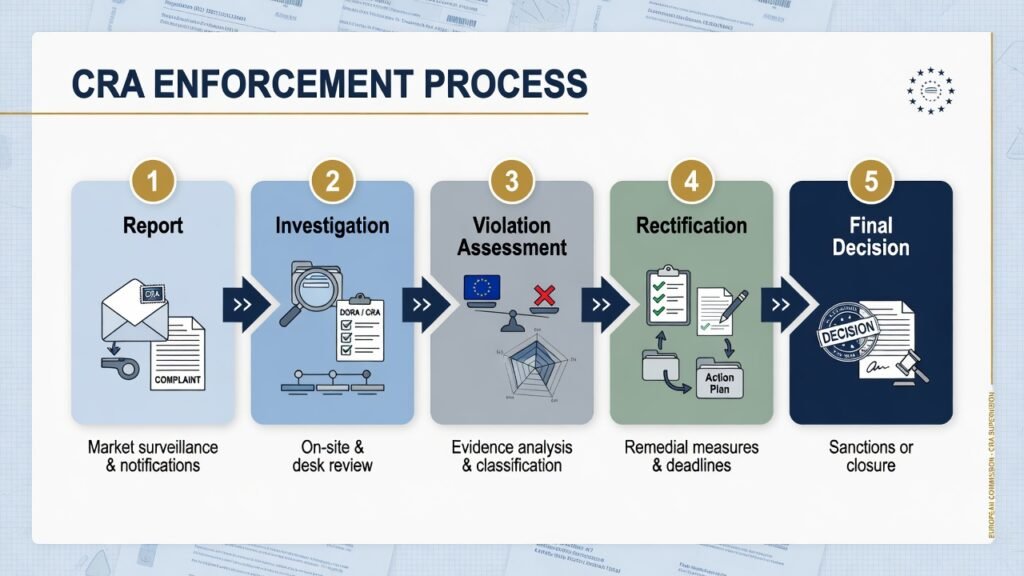
4. Full Enforcement Process: From Clues to Final Results
CRA enforcement has a complete legal process, which requires multiple links from clue collection to final penalty, and enterprises can respond reasonably according to the process nodes.
Step 1: Clue Collection and Preliminary Assessment
After regulators obtain clues, the first step is to conduct a preliminary assessment to determine whether the product is within the scope of CRA regulation and whether there is an immediate security risk. If the assessment finds a serious immediate risk, for example, a product vulnerability may directly lead to the theft of users’ homes, regulators can directly initiate temporary risk control measures, such as suspending sales and requiring platforms to remove the product, to control the risk first before conducting further investigations.
Step 2: Investigation and Evidence Collection, and Enterprise Cooperation Obligations
If the assessment confirms that an investigation is needed, it will enter the evidence collection stage. The form of inspection varies according to the risk level: for minor violations, enterprises are usually notified in advance, and for high-risk products, surprise inspections may be adopted.
The main content that enterprises need to cooperate with is to submit compliance documents within the specified time and accept third-party testing. Generally, source code is not required, so there is no need to worry too much about core technology leakage. There is a red line that must never be crossed: concealing information, forging materials, or obstructing inspections will directly increase the penalty level. Even if it was originally a minor problem, fraud will turn it into a major problem.
Step 3: Violation Determination and Rectification Notice
After the investigation is completed, regulators will make a violation determination based on the legal requirements of the CRA and the unified EU assessment criteria. If a violation is confirmed, a formal rectification notice will be issued to the enterprise, clearly stating the specific violation items, rectification requirements, and rectification period.
Enterprises also have statutory remedy rights: if they disagree with the determination result, they can submit an appeal, supplement compliance evidence, or even apply for a hearing within the specified period.
Step 4: Rectification Verification and Penalty Trigger
The handling results after rectification are judged in two categories:
The first category is minor document/marking defects, first-time violations, and no actual security risk caused. As long as the rectification is completed on time and passes verification, usually only a written warning or a time limit for correction will be given, and no fine will be imposed;
The second category involves defects in core security requirements, failure to fulfill the serious incident reporting obligation, concealment or fraud, personal or property damage caused, or repeated violations. Even if rectification is completed afterwards, a fine may still be imposed for the existing illegal acts.
If the rectification fails or is not completed within the time limit, the penalty procedure will be officially initiated.
Cross-border Violations and Remedy Paths
For violation cases involving multiple member states, the lead member state will usually coordinate EU-level mechanisms to reduce duplicate enforcement, but enterprises still need to assess the possible local market control measures taken by different member states, the independent responsibilities of different supply chain entities, and the risk of concurrent penalties under other regulations such as the GDPR.
If an enterprise is dissatisfied with the final penalty decision, it can appeal to the local administrative court, and for particularly major disputes, it can appeal to the Court of Justice of the European Union.
Key reminder: Measures such as suspension of sales and removal from shelves during the investigation period are all temporary risk control measures, not final penalty conclusions. If an enterprise can submit sufficient compliance evidence, it can apply for the lifting of these temporary measures.
5. Types of Penalties and Fine Discretion Rules
If the violation circumstances meet the penalty standards, CRA penalties are divided into two categories: non-monetary measures and administrative fines, and the fine amount is not uniformly implemented according to the upper limit.
Non-monetary Penalties: Often Have a Greater Impact on Business
Many people only focus on the fine amount, but in fact, non-monetary penalties often have a greater impact on business, and in severe cases, they may even directly lose the EU market.
Mild non-monetary penalties include written warnings and orders to correct documents or rectify defects within a time limit, which are generally applicable to minor violations.
Moderate penalties include suspending the sale of problematic batches of products, requiring removal from shelves, and withdrawing problematic products from all channels, which will directly affect current sales.
Severe penalties are very serious, including EU-wide sales ban, mandatory recall of all problematic products, requiring the cessation of use or correction of non-compliant CE marks, and suspension of related services; if third-party conformity assessment certificates issued by Notified Bodies are involved, the relevant certificates may be suspended or revoked, which basically means completely withdrawing from the EU market.
Only in extreme cases, that is, when enterprises intentionally violate regulations and cause major safety accidents, will the domestic laws of some member states impose additional criminal penalties, which is very rare.
Three Tiers of Administrative Fine Benchmarks
The following three tiers of amounts are the maximum penalty upper limits that the CRA requires member states’ domestic laws to set at a minimum. They are neither the fixed fine amount for each case nor a unified fine directly issued by the European Commission; the actual fine amount is at the discretion of the member state competent authority in combination with its own implementing rules and the specific circumstances of the case.
- First tier (heaviest): At least 15 million euros, or 2.5% of the enterprise’s total global turnover in the previous fiscal year (whichever is higher). It applies to serious violation scenarios such as violating core cybersecurity requirements, placing products on the market without conformity assessment, refusing to rectify, and intentionally concealing major risks.
- Second tier (moderate): At least 10 million euros, or 2% of global annual turnover (whichever is higher). It applies to scenarios such as failure to fulfill the vulnerability/security incident reporting obligation, substandard security updates, and failure to cooperate with inspections.
- Third tier (mild): At least 5 million euros, or 1.5% of global annual turnover (whichever is higher). It applies to scenarios such as incomplete documents, incorrect marking, and providing false/misleading information.
Discretionary Factors for Fine Amount
The upper limit of the fine is the statutory maximum value, and the actual amount is at the discretion of the regulator according to the specific circumstances. The fine amount in most cases will be lower than the upper limit.
When exercising discretion, regulators will consider two types of factors: aggravating and mitigating:
Aggravating factors include long duration of the violation, subjective intent or concealment, large number of affected users, personal or property damage caused, repeated violations, etc. In these cases, the fine will be calculated higher.
Mitigating factors include proactive reporting of problems, active cooperation with the investigation, proactive repair or recall before regulatory intervention, small enterprise scale, etc. In these cases, the fine will be handled leniently.
There is also a very important point: the calculation base of the fine is the consolidated global group turnover of the responsible entity in the previous fiscal year, not only the revenue in the EU region. Many enterprises get this wrong, so do not mistakenly think that only the income from the EU market is fined.
6. Enforcement Coordination with Other EU Regulations (Intermediate Level)
Enterprises operating in the EU market usually also come into contact with regulations such as GDPR, NIS2, and AI Act. They need to clarify the enforcement boundaries between the CRA and these regulations to avoid overlapping risks.
Enforcement Differences of 4 Frequently Related Regulations
For your convenience, we have compiled the enforcement differences between the CRA and three other common EU cybersecurity and data-related regulations into a table:
| Regulation Name | Regulated Object | Penalty Focus | Maximum Fine (Percentage of Global Turnover) |
|---|---|---|---|
| CRA (Cyber Resilience Act) | Cybersecurity of products with digital elements themselves | Product security defects | 2.5% (EU minimum benchmark) |
| GDPR (General Data Protection Regulation) | Personal data processing activities | Data privacy violations | 4% |
| NIS2 (Network and Information Systems Directive 2) | Organizational security governance of essential entities and important entities | Organizational security management compliance | For essential entities: at least 10 million euros or 2% maximum; for important entities: at least 7 million euros or 1.4% maximum, subject to member state transposition laws |
| AI Act (Artificial Intelligence Act) | Risk compliance of AI systems | AI system violations | 7% |
Will the Same Incident Trigger Penalties Under Multiple Regulations?
Many people are concerned about “whether one incident will be fined multiple times”. The conclusion is that it usually can, because the regulatory purposes of each regulation are different, and the legal interests protected are also different, so concurrent penalties do not constitute “double punishment”.
The most typical scenario is a smart camera vulnerability leading to user data leakage: this incident violates both the CRA’s requirements for product cybersecurity and the GDPR’s requirements for personal data protection, and the two regulatory agencies can impose penalties separately.
Of course, there are exceptions. The domestic laws of some member states have concurrence restrictions. If the same act violates multiple laws, the heaviest tier of penalty will be selected instead of separate penalties. The specific situation depends on local legal provisions.
Risk Reminder for Concurrent Application of Multiple Regulations
Precisely because multiple regulations may apply simultaneously, enterprises should not only comply with one regulation. For example, when a security incident occurs, it is necessary to assess at the same time whether it is necessary to fulfill the CRA’s incident reporting obligation and the GDPR’s data breach notification obligation, so as not to miss any reporting.
When receiving an investigation notice from one regulatory agency, it is also necessary to simultaneously assess whether it will trigger the jurisdiction of other regulatory agencies, and prepare responses in advance to avoid attending to one thing and losing another.
7. Pitfall Avoidance Guide: How to Reduce CRA Penalty Risks
Combined with enforcement rules and common violation scenarios, enterprises can effectively reduce penalty risks through basic compliance layout and standardized responses.
3 Basic Compliance Tasks Must Be Done Before Launch
Doing these three basic tasks well before launch can cover more than 70% of common violations, which is very cost-effective:
The first is product-side compliance: verify basic security requirements, such as whether modification of default passwords is supported, whether there is a security update function, and whether the security update period is clearly notified to users. High-risk products also need to complete third-party conformity assessment as required.
The second is document-side preparation: sort out compliance documents in advance, including technical documentation, declaration of conformity, security test records, vulnerability management process descriptions, etc. Do not wait for regulators to request them before making temporary supplements.
The third is responsibility-side arrangement: non-EU manufacturers should confirm whether it is necessary to designate an EU authorized representative, or undertake regulatory liaison obligations through EU-based responsible entities such as importers, to ensure that the competent authority has a contactable EU-side responsible interface, so as to avoid increased penalties due to loss of contact.
5 High-frequency Violation Scenarios
There are several violation scenarios that enterprises are most likely to fall into, which are listed separately here to remind everyone:
- Pitfall 1: Thinking only hardware needs to comply: Supporting apps, embedded software, and eligible associated cloud services of smart devices are all within the scope of CRA regulation, and also need to meet security requirements.
- Pitfall 2: Terminating security updates as soon as products are sold out: Enterprises need to provide security updates within the support period required by regulations and the expected service life of the product. The specific period shall be determined in combination with the product type, official final text, and member state implementation interpretations, and support cannot be terminated at the end of sales.
- Pitfall 3: Concealing vulnerabilities after they are discovered: This is a high-risk practice. Disclosing vulnerabilities in a timely manner as required, pushing fix updates, and proactively reporting high-risk vulnerabilities to regulators can be used as a basis for mitigating liability; concealment, once verified, will directly increase the penalty.
- Pitfall 4: Importers/platforms do not verify compliance: Importers need to verify product compliance, and online platforms need to verify the compliance certificates of settled merchants. Those who still import or list products knowing they are non-compliant shall bear joint and several liability.
- Pitfall 5: Exaggerating security capabilities in external publicity: Product descriptions and official website publicity content must be consistent with actual compliance capabilities. If there are statements inconsistent with reality such as “bank-level security” and “military-grade encryption”, penalties will be imposed for providing misleading information.
Correct Response After Receiving an Enforcement Notice
If you receive an enforcement notice, you can effectively control risks by following the four standardized steps below:
Step 1: Verify the authenticity of the notice. Only formal notices from member state competent authorities and their authorized institutions are valid. First verify the qualification of the issuing subject, official contact information, and case information. Do not casually reply to notices from unfamiliar channels, and do not delay and miss the statutory deadline.
Step 2: Clarify the violation items. Immediately contact the EU-side responsible entity (authorized representative or importer) or a local compliance lawyer, sort out the involved products, specific violation items, and response period, to avoid leaving unfavorable evidence by casual replies.
Step 3: Submit materials in accordance with regulations. Sort out compliance documents and supporting materials truthfully. Red line reminder: Do not destroy or tamper with relevant records, do not conceal information or forge materials, otherwise the penalty level will be directly increased.
Step 4: Handle by category. If you disagree with the violation determination, submit an appeal with compliance proof within the specified period; if there is indeed a violation, proactively submit a rectification plan and risk mitigation measures to strive for lenient treatment.
Effective Paths to Strive for Mitigated Penalties
In the case of confirmed violations, the following paths can be used to strive for mitigated penalties:
- Proactively report security issues that have not yet been discovered by regulators;
- Quickly initiate risk mitigation measures such as rectification and recall to reduce the impact of the incident;
- Explain the reasons for the violation (such as no subjective intent) at the hearing stage, and state that the scope of impact is limited and remedial measures have been implemented.
8. Quick Self-inspection and Capability Summary
After reading the above rules, you can quickly judge the CRA risk of your own business through the following simple steps and clarify the core capability requirements.
3 Steps to Quickly Judge Whether Your Business/Products Are Subject to CRA Enforcement
Step 1: First check whether your product has digital connectivity or software functions and is sold in the EU market. If yes, it may be subject to CRA regulation.
Step 2: Check your role in the supply chain, whether you are a manufacturer, importer, distributor, online platform, or EU authorized representative. If yes, you have corresponding compliance responsibilities.
Step 3: Check whether your product falls within the legal exclusion scope, such as medical devices, military products, or products for internal enterprise use that are not sold to the public. If yes, it is not subject to CRA regulation.
Quick Judgment of Violation Risk Level
According to the product type, you can quickly judge your own violation risk level and allocate compliance resources reasonably:
High-risk products include children’s smart products, products involving personal safety (such as smart door locks, health monitoring smart wearables, when they are not medical devices regulated by the MDR), and products for critical infrastructure. Compliance resources should be focused on these products.
Medium-risk products include ordinary smart home appliances and consumer electronics (such as smart TVs and home routers), which only need to comply with basic requirements.
Low-risk products are products with simple functions that do not collect sensitive data (such as smart light bulbs and smart sockets). As long as basic compliance is done well, the probability of being inspected is very low.
Core Capabilities You Will Master After Learning
After reading this article, you should have mastered these core capabilities: being able to accurately judge whether your own business and products are subject to CRA enforcement, being able to distinguish the penalty types and approximate fine tiers corresponding to different violation levels, being able to identify common violation risks and conduct basic compliance self-inspections, being clear about the core response principles and pitfall avoidance points after receiving an enforcement notice, and being able to judge the enforcement boundaries between the CRA and other regulations such as the GDPR to avoid the risk of overlapping multiple regulations. The core logic of CRA enforcement is to force enterprises to implement cybersecurity requirements from the design stage. By laying out basic compliance in advance and actively cooperating with regulatory rectification, most penalty risks can be effectively reduced.