
Many cross-border sellers of charging products, when entering the Canadian market for the first time, most easily fall into the pit of “making do with US certifications”—they assume that having UL and FCC certifications is sufficient to sell, only to have their goods detained by customs immediately upon arrival, or removed from platforms just a few days after listing, resulting in considerable losses. Canada’s market access rules may look similar to those of the US, but in fact they have many exclusive requirements. Especially for products that directly contact mains electricity or have circuits, such as charging cables and chargers, if the certifications and compliance documents are not prepared correctly, sales may not proceed smoothly.
This content is specifically targeted at charging cables, USB/USB-C data cables, chargers, power adapters, interface connectors, and accessories with charging functions, and does not cover categories such as toys, large household appliances, medical devices, and industrial equipment. From the most basic regulatory logic to the specific certification checklist, and then to tips for beginners to avoid pitfalls, it will help you go from beginner to semi-proficient and avoid detours.
First, Understand the Basic Logic of Access for Charging Products in Canada
Why is Certification an Important Threshold?
Many beginners think certification is “spending money to buy a certificate”, but in fact Canada’s regulatory logic is very clear: first, to prevent electrical safety accidents and avoid electric leakage and fire that harm consumers; second, to limit electromagnetic interference and reduce the impact of products on home devices such as TVs and routers; third, to promote energy efficiency and reduce unnecessary power waste; finally, to protect consumer rights and let people buy with confidence.
If you sell without completing the corresponding compliance work, common consequences include requests for supplementary materials during customs or regulatory processes, and platform delisting. In severe cases, you may also face fines, corrective measures, or even product recalls. The specific consequences depend on product risk, sales method, and the regulations violated.
Who Manages These Rules?
Canada’s regulation is divided into two levels: federal and provincial. You don’t need to memorize them by rote, just understand what each is responsible for.
At the federal level, unified national rules are mainly managed: Innovation, Science and Economic Development Canada (ISED for short) is responsible for electromagnetic and wireless compliance; Natural Resources Canada (NRCan for short) manages energy efficiency requirements; and Health Canada is responsible for the national bottom line of consumer product safety, that is, products must not have unreasonable safety risks.
The provincial level is responsible for the implementation of many electrical safety requirements, such as electrical product approval and daily spot checks; electronic waste recycling may also be implemented in accordance with provincial systems. The province of Quebec also has relatively strict French language requirements, which also need to be confirmed separately.
There is an important mechanism here: SCC, the Standards Council of Canada, is Canada’s national accreditation body, responsible for accrediting relevant certification bodies and laboratories. SCC itself does not directly issue certificates for products. Products directly connected to the Canadian mains supply usually must obtain electrical safety approval recognized by the target province. The common method is certification by an SCC-accredited certification body, or on-site assessment by an accredited body. Which method is specifically accepted depends on the target province, product type, and applicable standards.
Several Basic Concepts That Are Easy to Confuse
People who are new to certification often confuse certification, declaration of conformity, filing, and commercial requirements, but in fact they are very different:
Certification is a certificate issued after passing testing or assessment by a qualified third-party institution; a declaration of conformity is a statement issued by the responsible supplier in accordance with applicable requirements, with corresponding test records kept; filing or report refers to submitting product and energy efficiency information to the competent authority in accordance with regulations; while commercial requirements are conditions put forward by platforms, retailers, or customers themselves, which are not necessarily mandatory legal requirements, such as environmental protection declarations required by some customers.
Also remember two core principles: first, there is no “universal certification”—different products require different certification combinations, which must be matched according to the product’s function, power, input method, and sales province; second, CE certification, US FCC certification, and US UL/ETL certifications without Canadian scope cannot be directly regarded as Canadian compliance. You must confirm whether there is a Canadian applicable version, approval method, or separate Canadian requirements.
Who Is Responsible for Compliance?
Don’t think that compliance is only the manufacturer’s business. In fact, manufacturers, local Canadian importers, brand owners, and platform sellers may all bear corresponding responsibilities according to their specific roles. For example, if you are a third-party seller on Amazon Canada, even if you source goods from domestic suppliers, as long as you are the one selling, you may be required to provide materials and take corrective measures when product compliance issues arise. Therefore, you must verify in advance whether the supplier’s certification and test documents are real and valid, and confirm that the models covered by the documents are consistent with the actual products.
Federal and Provincial Electrical Safety Requirements: Key Focus for Products Directly Connected to Mains Electricity
Electrical Safety Approval: The First Line of Defense Against Electric Shock and Fire
This is the confirmation of product electrical safety by a third-party institution or accredited assessment method, focusing on reducing risks such as electric leakage, electric shock, overheating, and fire.
Wall-plug chargers, power adapters, and charging sets with AC plugs that are directly connected to the Canadian mains supply usually fall within the scope of provincial electrical safety approval. Simply put, for charging products that can be directly plugged into Canadian wall sockets, before sales, you should confirm the certification or on-site assessment method accepted by the target province, as well as the safety standards applicable to the product.
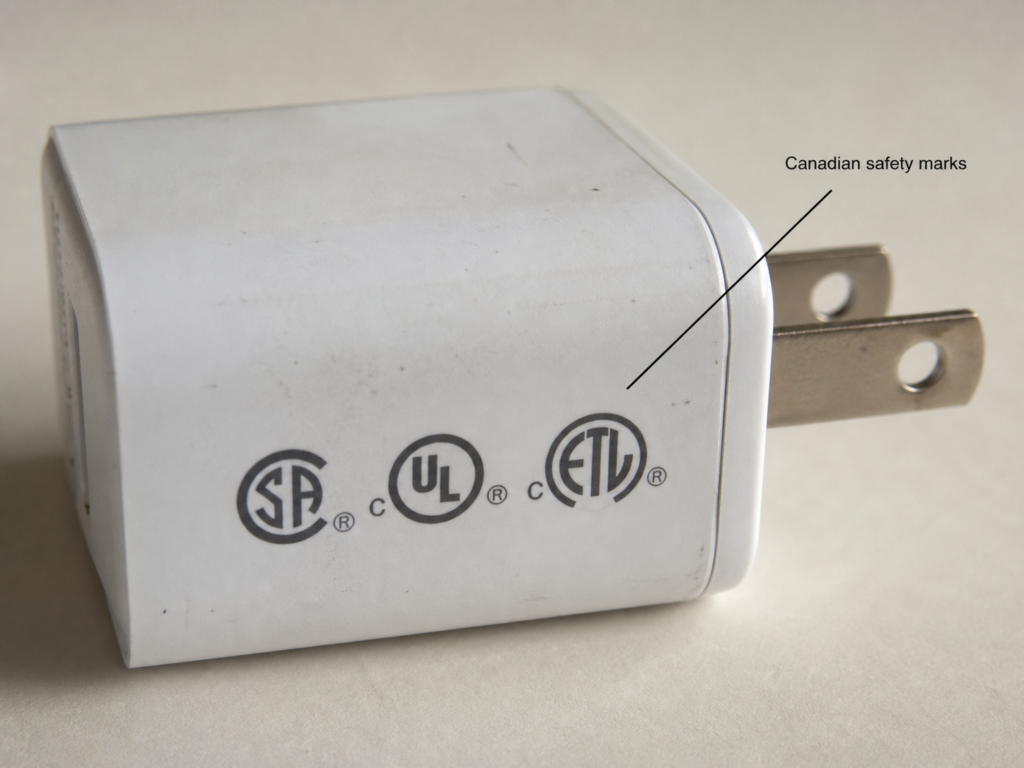
Valid certification marks may include Canadian-applicable electrical safety marks such as CSA, cUL, and cETL. You cannot judge authenticity or whether it applies to Canada solely by the presence of the letter “c” or “CA”. Instead, you should check the certification mark, product model, certification scope, and status in the certification body’s directory. Core requirements usually include: the mark on the product body is clear and visible, the certification or approval status is valid, and the model in the certificate or directory is consistent with the actual product.
Ordinary purely passive charging cables without chips, as well as simple low-voltage connectors, usually do not directly contact mains electricity, so the applicable safety approval requirements may be different, and the certification list for wall-plug chargers should not be directly applied. Whether separate approval is required depends on the rated voltage, intended use, product structure, target provincial regulations, and sales scenario.
As a supplement, information technology and audio/video power products commonly apply the Canadian adopted version of CSA/UL/IEC 62368-1, but the applicable standard should ultimately be determined by the certification body according to the product’s intended use, structure, and certification scope; other products may apply different standards.
ISED Electromagnetic and Wireless Compliance: Prevent Radio Frequency Interference
ISED’s relevant requirements are mainly used to limit radio frequency interference generated by wireless devices and digital devices. ICES-003 mainly targets unintentional emissions of digital devices and corresponding test requirements. It cannot be generalized that the product has been proven to have complete immunity, nor can it be simply understood that the product will not malfunction in any interference environment.
ISED-related requirements can be roughly divided into two categories, but the specific applicable standards still depend on product functions:
One category is products with radio transmission functions, such as Bluetooth, Wi-Fi and other wireless communication devices, which usually need to be certified in accordance with applicable RSS requirements and obtain the corresponding certification number. The product must also be marked with relevant information in accordance with ISED requirements.
The other category is products that only have digital circuits and no active wireless transmission, such as some fast chargers, USB-C fast charging cables with E-Marker chips, and smart power adapters, which may need to comply with ICES-003. Many products can complete compliance through the Supplier’s Declaration of Conformity (SDoC), but compliant test reports and technical records should still be prepared and kept for inspection.
For charging products, those that require wireless device certification are usually charging accessories with wireless transmission functions such as Bluetooth or Wi-Fi. Wireless charging devices cannot be lumped together with Bluetooth and Wi-Fi. Applicable requirements such as RSS-216, ICES, or others should be judged separately according to operating frequency, transmission method, and whether they have communication functions.
Purely passive ordinary charging cables and simple connectors without chips are usually not within the scope of wireless device certification, and usually do not trigger digital device emission requirements. However, if the product contains active electronic components, or is sold in combination with a host with circuits, the applicable scope should be reconfirmed.
For wireless device certification, the Canadian responsible party or authorized representative should be determined in accordance with ISED rules; ICES-003 products usually prove compliance through the supplier’s declaration of conformity and test records, and it cannot be generalized that all products must have a local Canadian authorized representative.
Energy Efficiency Requirements: First Confirm Whether It Is a Regulated External Power Supply
NRCan Energy Efficiency Report: Pay Attention Even for Low Power
Many people think that only high-power power supplies need to pay attention to energy efficiency, but in fact Canada has minimum energy efficiency requirements for some external power supplies. These requirements mainly focus on the energy consumption of products in working, standby, or no-load states.
Products with a rated output power not exceeding 250W and meeting the definition of “External Power Supply” in Canadian regulations usually need to fulfill the prescribed testing and energy efficiency report obligations in accordance with Canada’s . You cannot judge that all chargers automatically fall into the same regulated category solely based on “power not exceeding 250W”; you also need to look at input and output methods, intended use, whether they are integrated into other devices, product category, and regulatory exclusions. 5W products also cannot be directly assumed to be exempt, and should be confirmed item by item according to the definition.
Products within the scope usually need to undergo energy efficiency testing in accordance with regulations, and submit energy efficiency reports and product information to NRCan. Do not refer to NRCan report registration as a unified product certification, nor claim that all products must be affixed with a unified NRCan energy efficiency mark.
Purely passive charging cables, simple connectors, and products that are not External Power Supplies usually do not apply to the External Power Supply energy efficiency report requirement, but should still be confirmed according to the specific functions of the product and regulatory definitions.
A special reminder here: US DOE and CEC energy efficiency requirements cannot directly replace Canada’s NRCan regulatory obligations. Whether existing US test data can be used depends on the test method, product definition, and Canadian regulatory requirements, and it cannot be directly assumed that the Canadian report has been completed.
If These Supporting Requirements Are Not Met, All Certifications Are Useless
Many people think that getting the certification certificate means everything is fine, but in fact there are still many labels, documents, and product safety responsibilities that need to be handled simultaneously. If not done, even if the certification is real, you may encounter problems during sales, spot checks, or platform audits.
English-French Bilingual Labels Must Be Checked According to Specific Rules
Canada’s official languages are English and French, but different information is subject to federal packaging and labeling rules, electrical safety standards, ISED labeling requirements, and language regulations of the sales province respectively. It cannot be simply generalized that all information on the product body, packaging, manuals, and online pages must be presented bilingually according to the same rule.
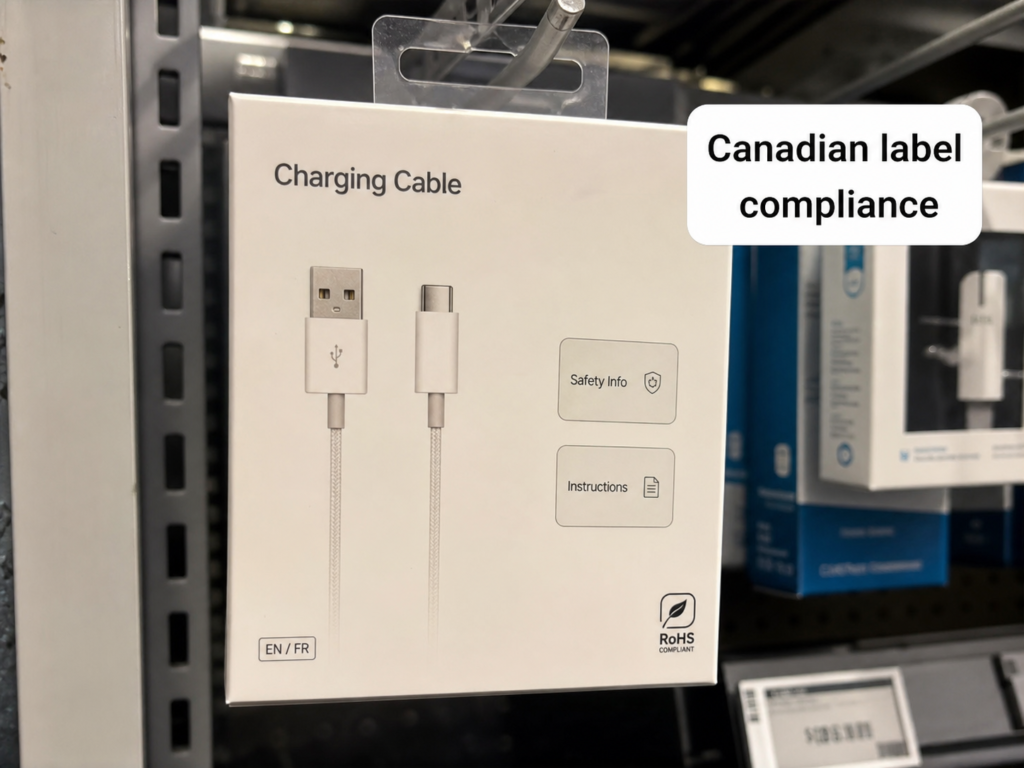
For applicable pre-packaged consumer product labels and safety warnings, English and French versions should be prepared, and requirements such as product name, quantity, responsible party information, warning statements, and instructions for use should be checked separately. Electrical parameters, certification marks, wireless device information, etc., must also be confirmed for labeling methods in accordance with corresponding standards or competent authority requirements.
If the product is to be sold in Quebec, the French language requirements for product identification, promotional materials, commercial advertisements, websites, and after-sales materials must also be confirmed in accordance with the and its implementation rules. The specific requirements of Quebec cannot be replaced by a unified national “bilingual label” rule.
The most critical rule is: the model, parameters, brand, and certification information on the label should be consistent with the actual situation of the product and the certification and test documents, and cannot be modified at will. Otherwise, even if the certificate is real, you may be required to make rectifications due to inconsistency between the label and the documents or product.
Confirm Local Contacts According to Product and Sales Arrangements
Canada does not have a unified “local authorized representative” obligation covering all ISED products, electrical safety certifications, and CCPSA consumer product safety scenarios.
Depending on the product and responsible party arrangement, a Canadian importer, ISED certification responsible party, or other local contact may be required. For wireless device certification, the responsible party or authorized representative must be confirmed in accordance with ISED rules; for electrical safety approval, it depends on the requirements of the certification body and the target provincial competent authority; under CCPSA, responsible entities such as manufacturers and importers also bear obligations for record-keeping, incident reporting, and product safety.
Therefore, “local Canadian authorized representative” cannot be simply listed as a unified mandatory item for all charging products. Overseas sellers should separately confirm the specific requirements of ISED, certification bodies, target provinces, and CCPSA before shipping, and ensure that effective contacts can be provided in a timely manner when regulators or platforms need to contact them.
Compliance Documents Must Be Kept Separately According to Regulations
All compliance-related documents must be kept well and not lost. Common documents include: certification or approval documents, test reports, supplier qualifications, declarations of conformity, energy efficiency reports, responsible party information, sales records, and product change records.
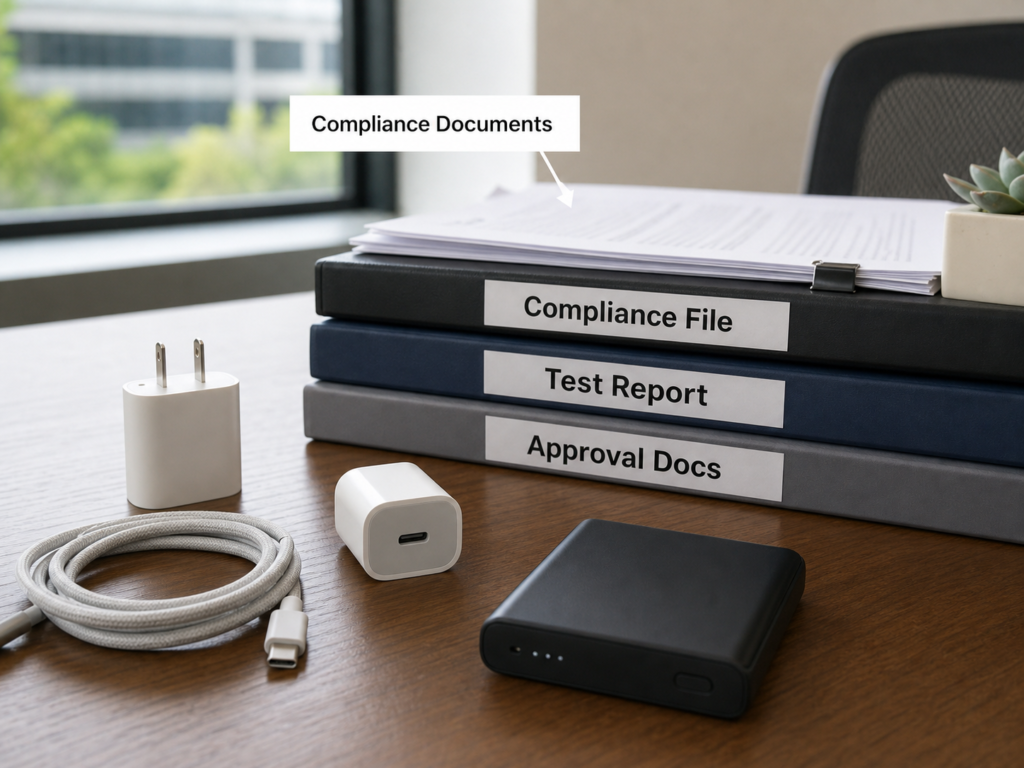
The retention period cannot be covered by a single number for all regulations. Records should be kept separately in accordance with applicable regulations; CCPSA-related records are usually kept for at least six years, and must also comply with the time limits stipulated by ISED, NRCan, certification bodies, and provincial regulations. When regulatory authorities conduct spot checks, complete documents corresponding to the product model must be provided within the specified time.
The CCPSA Consumer Product Safety Bottom Line Must Not Be Crossed
CCPSA is Canada’s , which requires that consumer products sold in Canada must not have unreasonable safety risks. Even if all certifications are complete, if the product still has obvious safety hazards, you may be required to take corrective measures.
For charging products, the key points to pay attention to are electric shock prevention, overheating and fire prevention, and whether the mechanical structure has sharp edges and corners that may harm consumers.
If responsible entities such as manufacturers and importers experience an incident specified in CCPSA, or find that the product may cause serious or fatal health risks, they must report to Health Canada within the specified time limit in accordance with regulations, and take corrective measures according to the risk. Recalls can be implemented voluntarily by enterprises, or required by regulatory authorities. Not all safety issues can be simply attributed to the same reporting process.
Scenario-Based Certification: Required for Specific Scenarios, and Can Also Improve Competitiveness
In addition to federal and provincial mandatory requirements, there are some certifications or responsibility systems that are not uniformly mandatory for all products, but may be required in specific sales scenarios, or can help you meet the requirements of platforms, retailers, and customers.
Voluntary Safety Certification for Passive Products
Purely passive charging cables and ordinary USB connectors, because they are not directly connected to mains electricity, are usually not within the scope of wireless device certification, and the federal level does not necessarily require the same safety certification as wall-plug power supplies. However, if you are entering e-commerce platforms, large offline retailers, or you are targeting the high-quality market, you will often be required to provide corresponding safety test or certification documents.
Common cable safety certifications include CSA cable safety certification and cUL cable certification. Whether they are applicable and the specific standards should be confirmed according to the cable structure, rated voltage, intended use, and sales channel.
USB-IF Official Certification
USB-IF is the industry certification system of the USB Implementers Forum, mainly used to prove that products comply with corresponding USB specifications and meet the testing, marking, and authorization requirements in the USB ecosystem.
Applicable products include USB/USB-C charging cables, chargers with USB interfaces, USB connectors, etc. Whether you need to obtain USB-IF certification depends on the USB specification used by the product, mark authorization, and platform or customer requirements. When focusing on fast charging, high-quality markets, or wishing to use relevant USB trademarks and marks, it is usually more necessary to carefully check USB-IF requirements.
It should be particularly noted that USB-IF certification is not a Canadian statutory market access certification, cannot replace electrical safety, ISED, or energy efficiency requirements, and does not guarantee that there is no USB-related patent infringement. Patent, trademark, and licensing issues still need to be reviewed separately.
Provincial Electronic Waste Recycling Requirements
Electronic waste recycling in Canada is not a unified set of national requirements, but is managed by different provinces through their respective producer responsibility systems. The coverage, responsible entities, registration methods, reporting cycles, and fees for electronic products and batteries may all differ.
Therefore, the electronic and electrical equipment and battery producer responsibility systems and product classifications should be checked separately according to the actual sales province. Only when the target provincial regulations include the product in the scope and the seller is a responsible producer may registration, reporting, or fee payment be required. Do not pre-list all chargers, adapters, and battery-containing products as unified mandatory items in all provinces, nor regard Ontario, Quebec, BC, and Alberta as having completely identical systems.
Transportation Compliance for Products Containing Lithium Batteries
If your product is a power bank or a charging accessory with a built-in battery, then transportation must also comply with lithium battery transportation requirements.
For products containing lithium batteries, first confirm that the battery meets the UN 38.3 test requirements and have the test summary available. Then, according to the transportation method, lithium battery type, watt-hour rating, quantity, and packaging, determine the marking, packaging, documentation, and dangerous goods carriage requirements under Canada’s TDG regulations and the ICAO/IATA regulations commonly used for international air transport.
The UN 38.3 test summary alone cannot be equated with full transportation compliance, nor can it be assumed that every ordinary lithium battery shipment must submit classification and packaging documents in exactly the same form.
A special note here: UN 38.3 mainly addresses battery testing requirements in the transportation link, and cannot replace product safety, electromagnetic, and energy efficiency compliance. The required items still need to be completed.
Commercial Environmental Protection Requirements
There are also some environmental protection-related requirements, such as RoHS, REACH, and halogen-free declarations. These are usually not unified federal market access certifications for charging products in Canada, and are mostly commercial requirements of retailers, platforms, or customers themselves.
Whether you need to prepare them should be confirmed according to the sales channel, customer contract, and product material situation. Do not confuse commercial environmental protection requirements with statutory access requirements, nor think that a declaration required by a certain platform or customer is a unified mandatory certification for all products entering Canada.
Quick Checklist by Product: Direct Application for Beginners
To facilitate everyone to quickly correspond to their own products, we have compiled a certification list for 5 common types of charging products. The table can only be used as a preliminary screening, and ultimately must be confirmed according to product definition, target province, and sales method.
| Product Type | Mandatory or Key Confirmation Items | Supplementary Safety Requirements | Scenario-Recommended Items |
| Wall-plug charger / power adapter | Electrical safety approval recognized by the target province; ISED electromagnetic compliance (judge wireless certification or ICES-003 according to function); if meeting the definition of External Power Supply, fulfill NRCan energy efficiency report obligations; applicable English-French labels and safety information; retention of compliance documents | – | USB-IF certification (with USB interface), electronic waste registration applicable to the target sales province |
| USB/USB-C fast charging cable with E-Marker chip | Confirm ICES-003 or other applicable requirements according to the digital circuit situation; applicable English-French labels and product information; retention of compliance documents | When sold as part of a set, confirm the safety requirements applicable to the entire set of products | USB-IF certification, voluntary cable safety certification |
| Purely passive ordinary charging cable / simple connector | Usually not within the scope of wireless device certification, and usually do not trigger digital device emission requirements; check applicable provincial electrical safety, product labeling, packaging, and consumer protection requirements | – | Voluntary cable safety certification, USB-IF certification (when focusing on quality) |
| Charging accessories with wireless functions (wireless charger / Bluetooth charging dock / smart socket) | For models with AC input, confirm target province electrical safety approval; wireless functions such as Bluetooth and Wi-Fi obtain ISED certification according to applicable RSS; for wireless charging devices, judge RSS-216, ICES or other requirements according to frequency, transmission method, and communication function; prepare applicable labels and compliance documents | – | If the product meets the definition of an External Power Supply, fulfill NRCan energy efficiency report obligations; check the electronic waste recycling system of the sales province |
| Charging products containing lithium batteries (power bank / wireless charger with battery) | For models with AC input, confirm target province electrical safety approval; for products with wireless or digital circuits, confirm ISED or ICES requirements; prepare applicable labels and compliance documents; complete corresponding lithium battery transportation compliance | – | Battery recycling registration in the sales province (if applicable); if the external power supply meets the definition of an External Power Supply, fulfill NRCan energy efficiency report obligations |
Beginner’s Guide to Avoiding Pitfalls and Certification Processing (Semi-Proficient Advancement)
If you not only want to know which certifications to do, but also want to be able to judge authenticity, avoid pitfalls, and plan the certification process yourself, you should read this part carefully.
How to Quickly Judge Whether Certification Marks and Documents Are Reliable?
There are many fake certifications on the market. In fact, as long as you check the official directories or databases of the corresponding institutions, you can initially distinguish them, instead of just guessing with the naked eye:
• **Electrical safety approval**: In the official directory of the relevant certification body, verify the institution’s qualification, product model, certification mark, certification scope, and status. Don’t just look at whether there is a CSA, UL, or ETL pattern on the product.
• **ISED certification**: For wireless devices that require a certification number, you can enter the certification number in the ISED official database to check whether the model, applicant, and certification information are consistent.
• **NRCan energy efficiency**: For products in categories such as regulated External Power Supplies, confirm whether energy efficiency testing and reporting have been completed in accordance with regulations, and keep relevant product information and report records.
Common suspicious situations include: only having US UL/ETL marks without Canadian applicable scope; using forged CSA marks without verifiable numbers or directory records; inconsistent product models and models on the certificate; the certificate scope does not cover the actual input, output, housing, or functional configuration.
6 Common Beginner Misconceptions, Don’t Step on Them
We have compiled the 6 most common mistakes made by beginners to help you avoid them in advance:
1. **Having US certifications means you can sell**: Wrong. Canada has its own electrical safety, electromagnetic, wireless, and energy efficiency requirements. cUL is not the same as ordinary UL, and FCC is not the same as ISED. Whether US documents can be used as a technical basis depends on the Canadian applicable scope and the assessment of the specific institution.
2. **Low-power chargers don’t need energy efficiency**: Wrong. Products with a rated output power not exceeding 250W and meeting the Canadian definition of an External Power Supply usually need to fulfill energy efficiency report obligations. 5W products should also be confirmed according to the definition, and cannot be judged as exempt solely based on low power.
3. **Passive cables don’t need compliance at all**: Wrong. Purely passive cables are usually not within the scope of wireless device certification, but you still need to check applicable provincial electrical safety, labeling, packaging, and consumer protection requirements. When sold separately, platforms and retailers may also require safety testing or certification.
4. **Certification is valid for life once done**: Wrong. If standards are updated, products are redesigned, key components change, or sales scope changes, re-assessment may be required; some certification schemes may also involve periodic reviews or factory inspections.
5. **Only doing certification and not worrying about labels**: Wrong. Labels, warning statements, model numbers, and responsible party information must also comply with applicable regulations, standards, and sales province requirements. Inconsistent labels with products or documents, even if the certification is real, may require rectification.
6. **Being able to list on the platform equals compliance**: Wrong. The platform’s initial review is only a commercial review and does not replace provincial electrical safety regulation, ISED, NRCan, or CCPSA requirements. Products may still be subject to spot checks, rectification requirements, or recalls later, and responsibility will not automatically disappear just because the platform passed the review.
5-Step Basic Decision-Making Logic for Certification Processing
If you don’t know where to start, following these 5 steps will be more reliable:
Step 1: First clarify the product attributes: check whether the product is plugged into mains electricity, has chips or wireless functions, contains batteries, what the power is, and whether it is an External Power Supply. Then list the applicable safety, electromagnetic, wireless, and energy efficiency items.
Step 2: Confirm the sales scenario: whether it is e-commerce or offline, which target provinces to sell in, whether the platform has additional requirements, and add the requirements of retailers, platforms, electronic waste recycling, and language.
Step 3: Select appropriate service providers for each item: for electrical safety items, choose SCC-accredited certification bodies within the corresponding scope; for wireless products, choose laboratories or certification bodies accepted by ISED; for NRCan energy efficiency items, choose compliance service providers that can complete testing and reporting in accordance with regulations. Check their qualifications and business scope item by item. There is no universal requirement that one institution must have all three “accreditation qualifications” of SCC, ISED, and NRCan.
If the product already has a CB certificate and report, it can sometimes be used as the technical basis for Canadian certification applications. However, the corresponding SCC-accredited certification body must assess Canadian national differences and decide whether supplementary testing, document review, sample assessment, or on-site assessment is required. Direct conversion of certification is not guaranteed.
Step 4: Prepare supporting materials simultaneously: don’t wait for the certification to be completed before preparing labels, manuals, responsible party information, and platform materials. Preparing them in advance and confirming them during the testing phase can reduce rework due to inconsistent labels or documents after certification is completed.
Step 5: Keep documents and establish a change process: all certification, testing, energy efficiency, label, and sales materials must be kept for the applicable period. When the product is redesigned, chips are changed, power supply solutions are changed, parameters are adjusted, or suppliers are replaced in the future, first confirm whether re-assessment is required to avoid the original documents no longer covering the new product.
Notes on Customs Clearance and Platform Audit
Many people have completed all certifications but still get stuck during customs clearance or platform audits, mostly because the materials are not prepared correctly.
When importing, common import documents such as commercial invoices and packing lists should be prepared in accordance with the declaration requirements of the Canada Border Services Agency (CBSA). Certification certificates, ISED labels or certification materials, ICES compliance documents, NRCan energy efficiency reports, etc., should be properly kept when applicable to the product, in case of regulatory spot checks or platform audits. They are not unified documents that must be submitted to CBSA for every shipment of all charging products. Whether to submit depends on the specific goods and regulatory requirements.
If you are selling on e-commerce platforms, such as Amazon Canada, a common requirement is to upload certification certificates, label photos, test reports, or Canadian responsible party contact information. The specific requirements are subject to the platform’s current audit requirements. Common reasons for rejection include: labels or warning information do not meet applicable language requirements, electrical safety documents do not cover Canada or the target province, the ISED certification number is inconsistent with the product model, or regulated External Power Supplies have not completed the corresponding NRCan energy efficiency report.
Reference for Certification Cost and Cycle (Beginner’s Understanding)
Many people care about how much certification costs and how long it takes, but there is no unified official market price for this.
The cost and cycle depend on the product category, test items, whether there is an acceptable test report, Canadian national differences, whether factory inspection is required, and the number of rectifications, etc. The cost structures of ISED digital device SDoC, wireless device certification, and laboratory testing vary greatly; NRCan energy efficiency reports should also not be simply generalized as a fixed “filing fee”.
Usually, when the materials are complete, the product structure is simple, and no rectification is required, the cycle will be relatively short; when the product has complex functions, involves wireless or multiple safety tests, or fails the test and requires rectification, the cycle will be significantly extended. The specific cost and cycle shall be subject to the formal quotation issued by the laboratory, certification body, or compliance service provider for the actual product. Don’t just look at low prices.
Summary
Overall, although the access rules for charging products in Canada seem detailed, as long as you sort out the logic and prepare accordingly according to product type, function, power, sales province, and sales scenario, you can reduce unnecessary risks. After reading this content, you can basically independently complete the following things: quickly judge the compliance items that need key confirmation when 5 common types of charging products enter Canada, distinguish more than 3 common suspicious certification marks, avoid 6 most common access pitfalls for beginners, list a basic compliance handling plan according to product type, sales channel, and target province, and also check the consistency of certification documents, labels, and products, and identify common risks in customs clearance and platform audits in advance.
If you are unsure about the specific requirements of a certain product, it is best to confirm with the corresponding SCC-accredited certification body, ISED compliance laboratory, or professional compliance consultant before shipping, and separately check the electrical safety and producer responsibility systems of the target province, to avoid unnecessary losses caused by misusing US certifications, missing energy efficiency reports, or incomplete label information.