
Have you ever encountered these situations: a charger plugged into the same power strip slows down your router’s internet speed, or a USB-C cable with an E-Marker chip makes a buzzing noise when placed near wireless earbuds? These are typical manifestations of electromagnetic interference. Friends who run cross-border businesses for charging products must often come across EN 55032 required by the EU and FCC Part 15 required by the US. Many people who are new to them cannot tell the difference between the two, and even use the wrong standard and do useless work. Today, we will explain these two sets of standards thoroughly, from basic entry-level knowledge to practical decision-making.
First, Understand the Basics: Don’t Compare the Wrong Objects
First, let’s supplement the most basic concept for those who are new to this: the EMC (Electromagnetic Compatibility) we often talk about is, simply put, the general rule for electronic products to “not disturb others and not be disturbed by others”. It has two core branches: one is EMI (Electromagnetic Interference, also called electromagnetic emission), which means your product must not emit random radio waves to interfere with other devices; the other is EMS (Electromagnetic Immunity), which means your product must be able to withstand interference from other devices. The EN 55032 and FCC Part 15 we are comparing today only involve EMI, that is, the “not disturbing others” part. Anti-interference has separate standards and is not within the scope of today’s comparison.
First Clarify the Equivalent Boundary of Comparison
Many people directly compare “EN 55032” with “FCC Part 15” as a whole, which is actually not equivalent. The positioning scopes of the two are very different:
- EN 55032 is the EU’s electromagnetic emission standard for multimedia equipment, based on the international standard CISPR 32, and applies to equipment with a rated voltage not exceeding 600V.
- FCC Part 15 is the part of the US Federal Communications Commission’s regulations on radio frequency equipment, covering intentional radiators, unintentional radiators, and incidental radiators, etc.; among them, Subpart B specifies the requirements for unintentional radiators such as digital devices.
The equivalent comparison object for us today is EN 55032 ↔ FCC Part 15 Subpart B (unintentional emission digital device part). Other subparts of FCC, anti-interference, safety regulations, energy efficiency and other items are not within the scope of this discussion.
From the perspective of basic positioning, the applicable regions and legal effects of the two are completely different:
- EN 55032 applies to the EU and the European Economic Area. Products complying with the version listed in the OJEU (Official Journal of the European Union) can be directly presumed to meet the emission requirements of the CE-EMC Directive.
- FCC Part 15 Subpart B applies to the US and markets under the jurisdiction of the US Federal Communications Commission; other North American countries such as Canada and Mexico need to check local regulations separately. Violations may result in product detention and fines for the responsible party.
3 Basic Misconceptions Beginners Must Avoid
Here are 3 most common pitfalls for beginners, so you don’t go astray at the very beginning:
First, the two sets of standards only correspond to their respective regulatory regions, they do not recognize each other — passing EN 55032 does not mean meeting FCC requirements, and vice versa.
Second, they only test electromagnetic emission (that is, whether the product will interfere with others), and do not cover other requirements such as anti-interference, safety regulations, and energy efficiency at all. Don’t think that passing EMI means the product is fully compliant.
Third, passing a single standard does not allow direct sales to another market, and the compliance process for the corresponding market must be completed separately.
Unified Caliber for Formal Comparison
To avoid invalid comparisons, let’s first unify all the premises of the comparison — just like an exam needs a unified test paper and unified scoring standards to compare results:
- Product scope: consumer-grade charging products without wireless functions such as Bluetooth, Wi-Fi, wireless charging (chargers, power adapters, data cables with chips, wired docking stations)
- Classification benchmark: uniformly take Class B (the strictest grade for consumer use) for residential environment use as the core comparison object
- Core comparison items: only compare the two core items of conducted emission and radiated emission
- Test status: all tested under the worst working conditions of normal product operation
If your product falls into the following situations, today’s conclusions will not apply and require separate evaluation: products with radio frequency functions such as Bluetooth/Wi-Fi/wireless charging; products for special scenarios such as industrial and medical use; products that need to test other EMC/safety items such as anti-interference, harmonics, and surges.
Comparison 1: Which Standard Actually Applies to Your Product?
First, solve the most practical problem: do my products need to comply with these two standards?
Regulatory Attributes and Enforceability
The common point of the two is: both are access thresholds for the target market, and violations may lead to detention of goods and fines.
But the regulatory logic is completely different:
- EN 55032 belongs to the CE self-declaration system, which does not require certification by an official body. As long as there are test reports and technical documents that meet the requirements, the enterprise can sign the declaration of conformity on its own.
- FCC Part 15 Subpart B is a mandatory federal regulation of the United States. Compliance must be achieved through the prescribed authorization path, and self-declaration by enterprises alone is not valid.
Overlap and Differences in Product Coverage
The coverage scopes of the two overlap, but each also has extensions:
- Overlapping coverage: Whether chargers, adapters, cables with chips, and docking stations are subject to EN 55032 or FCC Part 15 Subpart B cannot be judged only by whether there is a chip. It is necessary to check product functions, standard scopes, and regulatory exemptions respectively. Especially on the FCC side, power supply devices specifically used to power other equipment may be eligible for the exemption under §15.103(d); docking stations with digital functions, etc., usually need to be further evaluated according to digital device rules.
- Additional coverage of EN 55032: Multimedia and audio-visual equipment with a rated voltage ≤600V, such as monitors, speakers, etc.
- Additional coverage of FCC Part 15 Subpart B: Applies to devices that meet the definition of “digital device” and do not fall under regulatory exemptions; its scope and that of EN 55032 cannot be simply compared in terms of breadth solely based on whether they contain digital circuits.
Special attention should be paid here: independently sold power adapters cannot be directly assumed to fall under the standard, and their applicability needs to be judged in combination with their end use (for example, for multimedia equipment or industrial equipment).
Classification Logic of Class A/Class B
Many people confuse Class A and Class B, thinking that A is a higher level, but that’s not the case at all.
Class A/Class B are divided according to the use environment and sales positioning specified in the applicable standards, and have nothing to do with product performance grades. FCC Class A is usually for commercial, industrial or business environments; Class B is for residential environments. Whether a specific product can be compliant as Class A should be judged according to the definition of applicable standards, intended use, sales and use instructions, and cannot be determined only by the “industrial grade” or “consumer grade” label.
To judge which category a product belongs to, it mainly depends on four dimensions: product classification, intended use environment, instruction manual labeling, and marketing target. Remember: there is no saying that “A is more advanced”, Class A and Class B just have different applicable scenarios.
Four-Step Judgment Method for Applicability of Charging Products
For charging products, you can use these four steps to quickly judge whether these two standards apply:
Step 1, look at the product form: Whether chargers, adapters, cables with chips, and docking stations are subject to EN 55032 or FCC Part 15 Subpart B cannot be judged only by whether there is a chip. It is necessary to check product functions, standard scopes, and regulatory exemptions respectively. Especially on the FCC side, power supply devices specifically used to power other equipment may be eligible for the exemption under §15.103(d); docking stations with digital functions, etc., usually need to be further evaluated according to digital device rules.
Step 2, look at standard matching: On the EU side, check whether the product falls into the category of Multimedia Equipment (MME) and whether other CISPR standards need to be applied; on the FCC side, check whether it meets the definition of “digital device” and whether it falls under relevant regulatory exemptions.
Step 3, look at circuit functions: If the product has wireless functions (such as a charger with Bluetooth, a docking station with wireless charging), in addition to the emission requirements of these two standards, it must also comply with relevant radio frequency rules, and these two items cannot be tested alone.
Step 4, look at market scenarios: Products sold to ordinary households usually need to be evaluated as Class B; products sold to commercial, industrial and other scenarios should be judged whether they can be evaluated as Class A according to the classification definition, intended use and instructions of applicable standards.
Comparison 2: Test Content and Limits, Which Is Stricter?
Many people will directly ask “which standard is stricter”, but in fact, there is no unified answer to this question. You must first understand the basic logic of testing.
Plain Language Explanation of Two Core Test Items
First, let’s clarify the two most commonly heard test items:
- Conducted emission: Electrical interference transmitted by the product through wired paths. EN 55032 may require evaluation of disturbances on corresponding wired ports due to port categories and product configurations; the general conducted emission limits of FCC Part 15 Subpart B are mainly for AC power lines.
- Radiated emission: Radio interference emitted by the product through the air. For example, the noise that occurs when a USB-C cable with E-Marker is placed near wireless earbuds is a problem of radiated emission.
For charging products, the common sources of exceeding the limit are also very fixed: low-frequency conduction of switching power supplies is prone to exceeding the limit, and high-frequency radiation of high-speed USB interfaces is prone to exceeding the limit.
Mapping Rules of Test Items and Ports
The test logics of the two sets of standards are not exactly the same. The items to be tested need to be determined according to the product’s port type, standard clauses, and test plan. Not all products test the same content.
EN 55032 may require evaluation of disturbances on corresponding wired ports due to port categories and product configurations; the general conducted emission limits of FCC Part 15 Subpart B are mainly for AC power lines. Whether specific tests are required for signal ports such as USB and HDMI should be determined according to applicable standard clauses and product categories respectively, and EN port requirements cannot be directly applied to FCC Subpart B.
Radiated emission tests are all for the whole machine radiation. During the test, the prototype and cables must be placed in accordance with standard requirements, and cannot be placed arbitrarily.
Take two typical charging scenarios: a single-port PD charger usually needs to combine its actual applicable scope to evaluate AC power line conduction and whole machine radiation; for a docking station with HDMI and USB 3.0, whether conducted disturbance tests are required for its signal ports should be confirmed according to the corresponding clauses of EN 55032 and FCC Part 15 Subpart B respectively.
The specific ports to be tested shall ultimately be subject to the formal test plan of the corresponding standard version, and do not judge by yourself.
Core Premise of Limit Comparison
Many people make a low-level mistake when comparing limits: directly comparing values under different test conditions. For example, comparing the radiation limit of EN 10-meter method with that of FCC 3-meter method, this definitely cannot lead to a correct conclusion.
To compare limits, 4 variables must be unified first: frequency range, test distance, detector type, limit table source, without any one of which the comparison is meaningless.
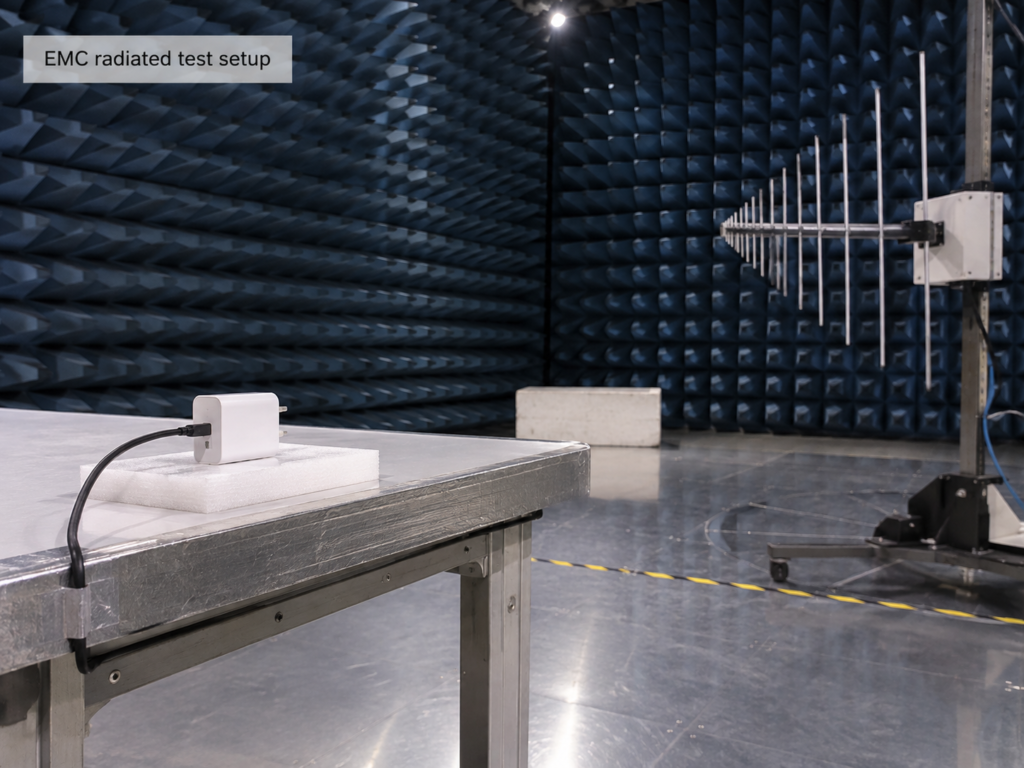
The most common variable difference is: the radiation test of EN 55032 usually uses the 10-meter method (the antenna is 10 meters away from the prototype), while the basic limit of FCC Class B is the 3-meter method (the antenna is 3 meters away from the prototype). With different distances, the measured values will definitely be different, and you cannot directly compare the sizes.
Special reminder here: extrapolation of test distance (for example, converting 3-meter values to 10-meter values) must meet the requirements of corresponding standards, sites, and laboratories. Self-conversion is prohibited, and the results of self-conversion are completely invalid.
Correct Judgment Logic of “Which Is Stricter”
Which standard is stricter? The correct judgment method is: under the premise of unifying all variables, compare the corresponding limit tables frequency band by frequency band to get a specific conclusion.
Under the same frequency band, distance, detector and arrangement conditions, the conduction limits of mains power ports have many sections that are the same or close; the radiation limits need to be compared item by item according to specific frequency bands and test distances, and cannot be generalized that one side is looser overall in the middle and high frequencies.
But the final conclusion must be based on the official limit table of the corresponding standard and the actual test results of the product — different products have different frequency bands that exceed the limit. For product A, EN is stricter, for product B, FCC may be stricter, and it cannot be generalized.
Comparison 3: What Are the Differences in Test Process and Qualification Judgment?
The test content is similar, but the test process and qualification rules are different. These differences directly affect whether the report you get is valid.
Test Sample and Working Condition Requirements
The common point of the two is: the test sample, cables, accessories and loads should represent the configuration to be sold, and be tested in the working mode that may produce the maximum disturbance in normal use. Special prototypes that are obviously inconsistent with the sold products cannot be used.
The differences are:
- EN 55032 requires covering all typical working modes, and the worst working condition needs to be confirmed through pre-scanning, and you cannot randomly select a mode for testing.
- FCC Part 15 Subpart B prioritizes testing the worst working condition, but the basis for selecting this working condition must be stated in the report.
For example, for a single-port PD charger, for products with multiple gears such as PD, the most unfavorable mode should be confirmed through pre-scanning, technical analysis or necessary tests; not all gears necessarily need to complete the full final test. Another example is a docking station, no matter which standard, it needs to be tested under the normal combined working condition that may produce the maximum disturbance, such as charging, transmitting data, and connecting video at the same time.
Test Site Requirements
The common requirement of the two is: the test site must be verified by the corresponding standard to avoid external electromagnetic interference affecting the results.
Both EN 55032 and FCC Part 15 can be tested according to prescribed methods in test sites that meet corresponding verification requirements, such as open area test sites or semi-anechoic chambers. A semi-anechoic chamber is usually a shielded room, with absorbing materials used on the walls and ceiling, and a conductive reflection ground plane on the floor.
Qualification Judgment Rules
The basic requirements of the two are consistent: the measured values of all test frequency points must be lower than the corresponding limits, and if any one frequency point exceeds the limit, it is unqualified.
But there are differences in judgment details:
- The compliance judgment of EN 55032 is based on whether the measured disturbance value does not exceed the applicable limit. The laboratory shall evaluate and control the uncertainty in accordance with relevant CISPR measurement uncertainty documents, but it cannot be simply treated as a unified “limit plus or minus several dB” rule set by the laboratory itself. Product design margin is a risk control issue for the manufacturer.
- FCC Part 15 Subpart B is judged according to the method specified in the regulations. It does not completely ignore measurement uncertainty, but the judgment logic is different from that of EN.
Common Sources of Test Errors for Charging Products
Many sellers will encounter that the same product has a difference of several dB in test results in different laboratories, which is usually caused by the following reasons:
- Inconsistent test loads and cable specifications, with differences of up to several dB;
- Failure to select the real worst working mode;
- The prototype is a non-mass-produced version, which is inconsistent with the final sold product;
- The placement position and length of cables do not meet the standard requirements.
Comparison 4: How to Calculate Compliance Path and Cost?
Passing the test is only the first step. To complete compliance, you have to go through the corresponding process, and the paths of the two are very different.
EU EMC Directive Compliance Chain (Corresponding to EN 55032)
- Responsible subject: Manufacturer, importer/authorized representative in the EU (authorized representative is not mandatory for all enterprises).
- Core process: Testing → preparation of technical documentation (TCF) → risk and conformity assessment → signing of EU Declaration of Conformity (DoC).
- Marking and traceability: The product is affixed with the CE mark, and all documents can be traced back to the responsible subject.
- Standard function: The version of EN 55032 that has been cited by the OJEU and is applicable to the product can provide a presumption of conformity for the basic requirements of the EMC Directive it covers; the manufacturer must still retain technical documentation, complete conformity assessment and sign the EU DoC, and this presumption can be overturned by contrary evidence in market supervision.
- Document retention: Retained for 10 years after the last time the product is placed on the market, for regulatory spot checks.
US FCC Equipment Authorization Chain (Corresponding to Part 15 Subpart B)
- Equipment classification: Digital devices are divided into Class A/Class B, and most consumer-grade charging products are Class B.
- Authorization path: The FCC equipment authorization procedure is specified by regulations according to equipment category, and is not freely chosen by enterprises. Most digital devices regulated by Part 15 Subpart B adopt SDoC; only specific equipment listed in §15.101 that requires certification adopt Certification and obtain an FCC ID.
- Responsible subject: There must be a local responsible party in the US, which is a mandatory requirement.
- Test requirements: For equipment subject to SDoC and requiring testing, it shall be confirmed that the measurement is carried out by an accredited testing laboratory recognized by FCC rules; when selecting a laboratory, its FCC accreditation status and its ISO/IEC 17025 accreditation scope should be verified, rather than just regarding ISO 17025 as an optional bonus item. Certification requires review and issuance of certificates by a TCB (Telecommunication Certification Body) recognized by the FCC.
- Labeling and retention: Products shall be marked with compliance information in accordance with regulations, and the document retention period depends on the authorization path.
Compliance Cost and Data Reuse Evaluation
There is no fixed price for compliance. The core influencing variables include: number of ports, operating frequency/rate, number of test modes, number of prototypes, rectification needs, and whether there is wireless function.
Many people ask: can the test data of EN 55032 be used for FCC? The answer is: existing data can be referenced, but there is no automatic mutual recognition. The undertaking laboratory needs to confirm that the data meets the requirements before it can be reused. You cannot directly use the EN report as an FCC report.
There is no fixed value for the compliance cycle either. It is mainly affected by test scheduling, rectification rounds, and document review speed. If the product passes once, it is fast; if there are several rounds of rectification, the cycle will be greatly lengthened.
Practical Guide: Practical Tools from Selecting Standards to Sending for Testing
After talking about the theory, let’s introduce some directly usable tools to help you make decisions quickly.
EMC Standard Selection Decision Table for Charging Products
| Product Type | Core Test Requirements (for the two sets of standards compared this time) |
|---|---|
| Pure passive chip-free charging cable | Whether it is applicable needs to be judged in combination with product nature and target market rules, and a conclusion cannot be drawn directly only based on no chip |
| Data cable with chip / basic single-port charger (consumer grade) | It is necessary to check the applicable scope of EN 55032, as well as the FCC digital device definition and regulatory exemptions respectively; when meeting the applicable conditions, test according to the corresponding Class and items |
| Docking station with high-speed interface (consumer grade) | Usually needs to be further evaluated according to digital device rules; EN port requirements and FCC AC power line conduction requirements shall be confirmed separately |
| Charging products with wireless functions | Applicable regulations and standards shall be determined respectively according to specific wireless functions; wireless charging shall not be generally regarded as a Part 15 item |
| Industrial charging equipment | It shall be judged whether it can be tested as Class A according to the classification definition, intended use, sales and use instructions of applicable standards |
Method of Selecting Compliance Path by Market
- Only sold in the EU/EEA: EN 55032 can only be used to evaluate the EMC emission requirements within its applicable scope; RoHS, Low Voltage Directive, Radio Equipment Directive or other applicable regulations should also be checked respectively.
- Only sold in the US: Select the corresponding authorization procedure specified by regulations in accordance with the requirements of FCC Part 15 Subpart B.
- Sold in both Europe and the US: Choose a laboratory with test qualifications for both sets of standards, unify test conditions, and reuse part of the data to reduce costs, without having to test twice completely.
- When in doubt: First split the product functions (with or without chips, with or without wireless, use scenarios), then check against the target market rules, or consult a reliable laboratory.
Quick Judgment Method for Validity of EMC Test Reports
Got the report and don’t know if it’s useful? Just look at these four points:
First, look at sample information: If there are differences in model, hardware, software, cables or configuration from the sold product, it should be confirmed whether the report has a representative basis and difference assessment covering the variant; if there is no coverage basis, it cannot be used directly.
Second, look at test conditions: Whether the Class classification, test distance, detector type, and worst working condition are clearly marked. If any key information is missing, it should be questioned.
Third, look at laboratory capability: EN reports are recommended to be issued by laboratories with ISO 17025 qualification; for FCC reports, it depends on whether the laboratory has the corresponding authorization qualification.
Fourth, look at test items: Whether all mandatory test items of the corresponding standard are covered, and reports with missing items cannot pass regulatory spot checks.
Scenarios That Require Re-testing
Do you need to re-test if the product is changed? Re-testing is required (or at least let the laboratory evaluate) in the following situations:
- Replacement of main control chip / power supply solution;
- Replacement of housing / shielding structure / standard cables;
- Addition / modification of product functions;
- When the sales region or authorization path changes, the applicability of applicable regulations, limits, test methods and existing data shall be rechecked; if necessary, supplementary testing or re-testing shall be carried out.
Quick Check List Before Sending for Testing
Following this preparation can save a lot of detours:
- Product information: Confirm functions, ports, rated parameters, ensure it is a mass-produced version, don’t waste testing on engineering samples.
- Target requirements: Clarify the target market, Class classification, authorization path, don’t test the wrong standard.
- Test supporting: Prepare standard cables and corresponding loads, and explain test mode requirements in advance.
- Laboratory qualification: Confirm that the laboratory has the test capability for corresponding standards and corresponding paths, don’t find the wrong institution.
Summary: 5 Things You Can Now Judge
After reading this comparison, you should have sorted out the core logic:
First, you have clarified the equivalent comparison boundary of the two sets of standards, and will no longer make invalid comparisons between the entire FCC Part 15 and EN 55032.
Second, you can use the four-step judgment method to determine product applicability, and also distinguish that Class A/B are environmental classifications, not product performance grades.
Third, you have mastered the basic method of limit comparison, and know that “which is stricter” cannot be generalized, and must be compared frequency band by frequency band after unifying all variables.
Fourth, you can clearly explain the core differences between the two sets of standards in test process, qualification judgment, and compliance path, and will not be fooled by unreliable service providers.
Fifth, you can choose a suitable compliance solution according to product functions and target markets, know how to judge the validity of test reports, and also know what to prepare before sending for testing.
The most feared thing in cross-border compliance is “taking it for granted” — don’t apply the rules of market A to market B, and don’t apply other people’s product experience to your own products. Combining the actual situation with the corresponding rules is the most reliable way.