
If you have ever bought chargers or power adapters for the US market, or handled compliance for charging products sold in the US, you must have seen the two labels “DOE Level VI” and “Energy Star”. Many people are confused about their differences: some think both are mandatory certifications, some believe chargers with the Energy Star label are definitely higher-end, and others mistake energy efficiency standards for safety certifications. In fact, the positioning, scope of application, and mandatory force of these two standards are completely different. Understanding them well can help you avoid pitfalls when buying products and also reduce detours in compliance work.
First, Get the Basics Right: What Are We Comparing?
Before the formal comparison, we need to clarify the role of energy efficiency standards and the unified criteria for comparison, otherwise it is easy to compare the wrong objects.
Energy efficiency standards are essentially unified rules for the power consumption of plug-in charging products: a charger plugged into the wall will secretly consume a small amount of power even when it is not charging (commonly known as “vampire power draw”), and a portion of the electricity will also be wasted as heat during charging. Energy efficiency standards set a threshold for this waste. On the one hand, they may determine whether a product can be sold legally; on the other hand, they also affect the electricity bills of users during long-term use, and can reduce unnecessary carbon emissions.
The core positioning of these two standards is different from the very beginning. Let’s state the conclusion clearly first so that we won’t get confused later:
- DOE Level VI is a mandatory US energy efficiency requirement applicable to some external power supplies, and it is the compliance baseline for relevant products;
- Energy Star is a voluntary high-efficiency labeling program. The standalone External Power Supply (EPS) program has been suspended, so ordinary separately sold USB wall chargers and external adapters can no longer obtain new certification under this program; whether Energy Star applies also depends on whether the end product falls under currently valid product categories.
All our subsequent comparisons are based on the following unified criteria:
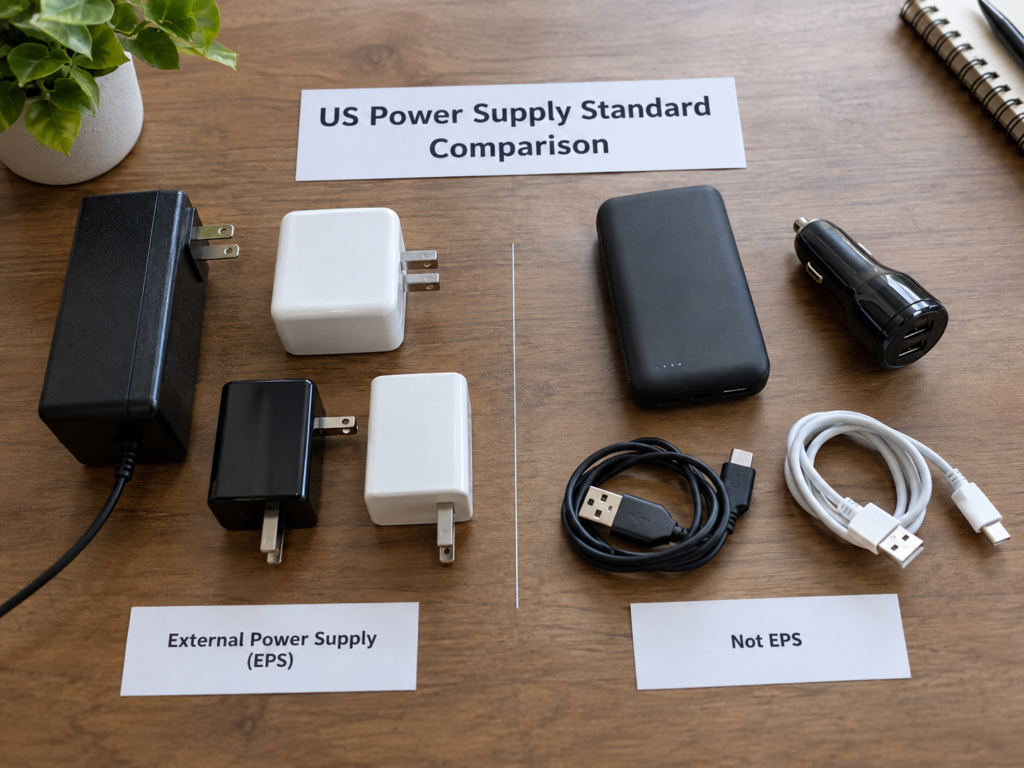
- The core object is plug-in external power supply (EPS) — that is, what we commonly call chargers and power adapters, devices that are directly plugged into the wall to convert alternating current (AC) into direct current (DC) that can be used by devices;
- Covered categories include mobile phone chargers, USB-C fast chargers, laptop power adapters, and multi-port chargers;
- Power banks, car chargers, and data cables usually do not have an AC input part, and generally do not fall into the category of external power supplies discussed here;
- According to the DOE external power supply test procedure, products designed for US AC mains operation are usually tested at 115V/60Hz; when comparing, it should also be ensured that the product category and applicable test conditions are consistent, otherwise it is meaningless to compare the energy efficiency of a 10W charger and a 100W charger.
DOE Level VI: An Important Mandatory Energy Efficiency Requirement for Sales in the US
DOE Level VI is one of the energy efficiency requirements for external power supplies formulated by the US Department of Energy (DOE). For direct-operation external power supplies that fall within the scope of 10 CFR 430.32(w), Level VI is a mandatory energy efficiency requirement for the US market; whether it applies and which level of requirement applies cannot be judged solely by whether the product is plug-in or sold separately. It must be judged item by item in combination with direct or indirect operation, Class A attribute, output parameters, and statutory exemptions.
There is a common misunderstanding here: many people think DOE Level VI is a certification certificate issued by the government, but it is not. Manufacturers need to test basic models in accordance with the test procedures specified by the DOE, determine representative values according to certification rules, and submit certification reports or data to the DOE; enterprises can entrust third-party laboratories for testing, but third-party testing is not a unified statutory precondition for all external power supplies. The government supervises through random inspections and other methods, so it is not enough to just print a label casually.
Scope of Application
It cannot be simply stated that DOE Level VI covers all plug-in charging external power supplies with a rated power of ≤250W. The current rules distinguish between direct-operation and indirect-operation external power supplies, as well as categories such as Class A and Non-Class A:
- Direct-operation external power supplies are subject to Level VI;
- Indirect-operation Class A external power supplies are subject to Level IV;
- There is no such standard for indirect-operation Non-Class A external power supplies;
- The limit table for single-voltage external power supplies under Level VI also includes power levels with output power greater than 250W, so 250W is not the general maximum coverage upper limit for Level VI.
Power banks, car chargers, data cables, and built-in power supplies of devices (such as the internal power supply of a desktop computer) usually do not fall into the scope of external power supplies discussed here. In addition, external power supplies for medical devices, AC-AC external power supplies for specific security or life safety alarm and monitoring systems, and external power supplies for battery charging of specific electric products may be subject to exemptions or inapplicable conditions. Specific requirements need to be checked separately, and consumer-grade standards cannot be directly applied.
Core Assessment Indicators
DOE Level VI mainly assesses two indicators, both centered on “power saving”:
- No-load power consumption: This is the “stealth power draw” of a charger when it is plugged in but not connected to a device for charging. The lower the value, the more power it saves. For example, a charger that is plugged in at the bedside all year round may consume several kilowatt-hours of electricity in no-load mode in a year, and this indicator is for addressing this kind of waste.
- Average operating efficiency: This refers to the proportion of electrical energy that is actually used for charging the device during charging, while the rest is wasted as heat. It is calculated as the average of efficiencies under four different charging loads: 25%, 50%, 75%, and 100%. The higher the value, the more power it saves.
The limits of these two indicators are not fixed values, but are graded according to power segments and product categories — the requirements for chargers with higher power will be slightly different. In addition, it should be noted that for multi-port chargers and PD fast chargers, the assessment level should be determined according to their applicable rules and rated output parameters, and cannot be simply judged only by the maximum power of a single port. For example, a dual-port fast charger with a total power of 65W cannot be considered to have the energy efficiency requirements of a 20W product just because the maximum power of a single port is only 20W.
How to Judge Compliance
To judge whether a product is subject to DOE Level VI, first check whether there are labels such as “VI”, “Level VI”, or “DOE VI” on the product nameplate or packaging; however, the label can only be used as a preliminary clue and should not be used alone as the final basis for judgment.
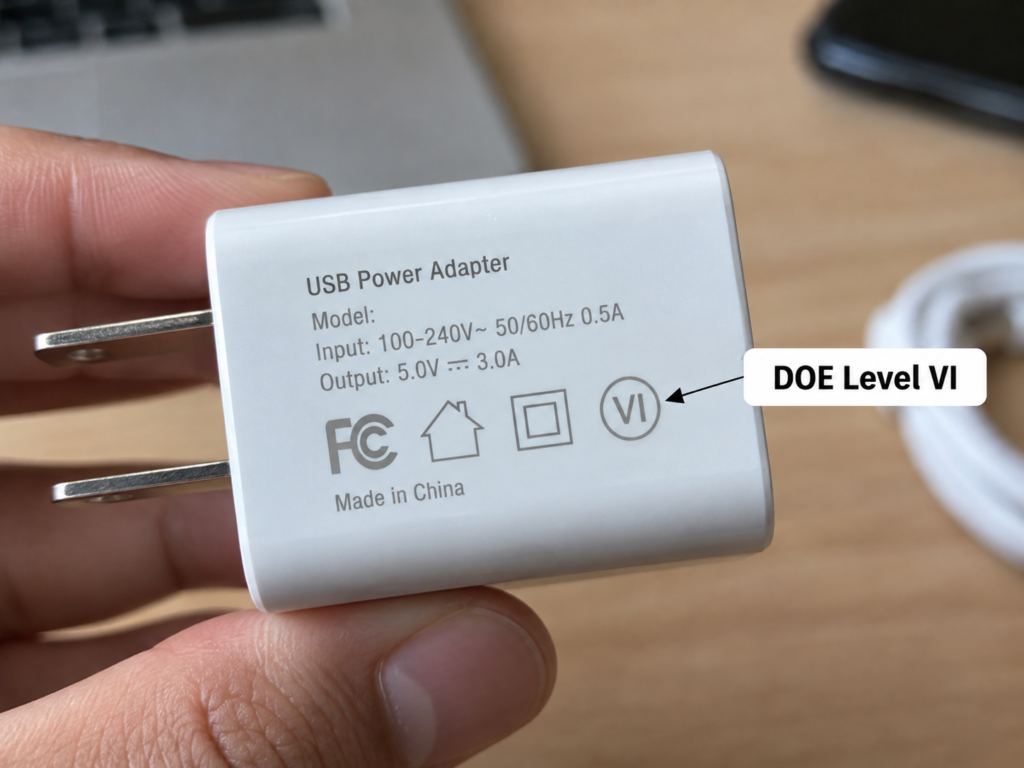
For further verification, you can enter the product model in the DOE’s official CCMS database to query. Note that the model must be exactly the same as the one on the product, to avoid merchants using the compliance materials of Model A for Model B, which is a case of misattribution. At the same time, it should also be noted that whether Level VI applies itself still needs to be judged in combination with the product category and power supply structure.
Energy Star: The Most Misunderstood Voluntary High-Efficiency Label
Energy Star is a voluntary energy efficiency labeling program, launched by the US Environmental Protection Agency (EPA) in 1992, and later jointly managed by the EPA and the DOE. It is used to identify energy-saving products that meet corresponding specifications, and is often used for green procurement and brand promotion, but it has no mandatory access effect — not having this certification does not mean that the product cannot be sold legally, it just means that the label cannot be used for promotion.
The Energy Star certification for charging products is the most prone to pitfalls, and we must focus on correcting misunderstandings:
Energy Star’s standalone External Power Supply (EPS) program was suspended on December 31, 2010. This means that ordinary separately sold USB wall chargers, chargers, and external adapters can no longer obtain new Energy Star certification under the standalone EPS program.
But this does not mean that Energy Star only certifies complete machines. Energy Star still has different valid product categories at present, including complete machine categories such as laptops, monitors, and printers, as well as standalone end product categories such as uninterruptible power supplies (UPS) and electric vehicle supply equipment. Therefore, when you see a product claiming to have passed Energy Star certification, the correct way to judge is not to first check whether it is a complete machine, but to verify which current product category it belongs to and whether the specific model can be found in official records.
If you see an ordinary separately sold charger claiming “Energy Star certification”, you should not directly presume it is valid on the grounds of “old stock”, but should verify the product category, model, and official certification records it claims; if it claims standalone EPS certification, you should be highly vigilant.
Assessment Requirements for Matching Power Supplies
Although standalone external power supplies can no longer apply for certification under the Energy Star EPS program, some end complete machines that are eligible for Energy Star do have requirements for matching power supplies. However, these requirements cannot be generally said to be stricter than DOE Level VI, nor can they be compared with a unified percentage difference.
The specification requirements for different complete machine categories are not exactly the same. For example, in the current specifications related to computers, monitors, and televisions, matching external power supplies are usually required to reach Level VI or higher. In addition, some complete machine categories also additionally assess the energy consumption of the complete machine in on, sleep, standby, or off modes.
Two things need to be distinguished here:
- The no-load power consumption and average efficiency of the external power supply are the energy efficiency performance of the power supply itself;
- The standby or sleep power consumption of the complete machine is the overall power consumption performance of the device after it is connected to the power supply.
Therefore, the standby or sleep requirements in the Energy Star complete machine specifications cannot be directly interpreted as stricter no-load power consumption requirements for the matching charger. The specific requirements shall be subject to the currently valid Energy Star specifications for the corresponding complete machine category.
How to Identify a Genuine Energy Star Label
The key to a genuine Energy Star label is not the color, but whether it uses the approved mark and whether it corresponds to the specific certified product model. The mark can be cyan, black, white, or a reversed version, and authenticity cannot be judged solely by “whether it is blue”.
When identifying, you can pay attention to two points:
First, check the specific product category corresponding to the label. For example, laptops, monitors, UPS, etc. may fall under current Energy Star product categories; ordinary standalone USB wall chargers or general external adapters cannot obtain new certification under the suspended EPS program.
Second, you can enter the certification number or product model in the Energy Star official website database to query. It is more valuable for reference only when the model, category, and official records correspond.
Core Comparison Under Unified Criteria: Understand the Differences in One Table
For a more intuitive view, we have sorted out the core differences between the two standards in the table below. It should be noted that whether DOE Level VI applies depends on the statutory category of the external power supply; whether Energy Star applies depends on whether the product falls under its currently valid product categories.
| Comparison Dimension | DOE Level VI | Energy Star |
|---|---|---|
| Nature and Mandatory Force | Mandatory energy efficiency requirement for direct-operation external power supplies within the applicable scope | Voluntary certification or labeling program, which does not replace applicable mandatory regulations |
| Applicable Product Scope | Must be judged based on direct/indirect operation, Class A attribute, output parameters, and exemption conditions | Must be judged based on currently valid product categories; the standalone EPS program has been suspended |
| Core Energy Efficiency Requirements | No-load power consumption, average efficiency, etc., are graded according to applicable categories and power segments | Specific specifications vary by product category; some complete machine specifications require matching EPS to reach Level VI or higher, and may assess the energy consumption of the complete machine in on, sleep, standby, or off modes |
| Compliance Process | Complete testing in accordance with DOE test procedures, determine representative values according to certification rules, and submit certification reports or data | Usually involves complete machine testing, and review by accredited laboratories and accredited certification bodies; specific requirements are subject to product category specifications |
| Consequences of Violation | For applicable products, failure in random inspections may lead to consequences such as law enforcement and removal from shelves; e-commerce platforms may also require compliance materials | Failure in regular random inspections may result in cancellation of certification qualification and prohibition of using the label |
Of course, there are several exceptions to note:
- Products that are not within the scope of the DOE external power supply rules cannot be directly deemed to must comply with Level VI just because they are plug-in products;
- For Energy Star complete machines equipped with EPS subject to DOE external power supply rules, the matching EPS must still meet the applicable DOE requirements;
- Whether Energy Star applies cannot be simply divided into “complete machine” or “standalone product”, but should be verified against specific product categories;
- Energy Star complete machine certification usually also involves complete machine testing and review by accredited laboratories and accredited certification bodies, but the cost and cycle will vary depending on product category, test scope, certification body, and existing test data, so it cannot be generally said to be 2-3 times that of DOE;
- Ordinary chargers sold separately in small batches generally cannot obtain new certification under the suspended Energy Star EPS program.
How to Judge in Actual Scenarios? Just Follow the Steps
After talking about the rules, let’s apply them to actual usage scenarios. Whether it is ordinary consumers buying products or cross-border sellers doing compliance work, they can directly follow these steps.
Purchase Steps for Ordinary Consumers
- First step: Check basic information: When buying an ordinary plug-in charger, you can check whether there are energy efficiency labels such as “VI” or “Level VI” on the nameplate or packaging; but if there is no label, you don’t have to conclude that the product is non-compliant based solely on this, because whether Level VI applies is still related to the product category and specific circumstances;
- Second step: Consider the usage scenario: If it is a commonly used charger that is plugged into the socket all year round (such as a fixed charger by the bedside or on the desk), prioritize products with lower no-load power consumption, and don’t worry about whether ordinary separate chargers have the Energy Star label;
- Third step: Choose according to needs: If it is an occasionally used travel charger, focus on confirming that the product source is reliable, the parameters are suitable for the device, and pay attention to its applicable energy efficiency and safety compliance information;
- Supplement: If you are buying a complete machine with a power supply (such as a laptop or monitor), you can additionally check whether the complete machine has Energy Star certification, which indicates that the product meets the energy-saving specifications of the corresponding category.
Compliance Judgment for Cross-border Sellers/New Product Development
- Basic red lines must not be crossed: First, judge whether the product falls within the scope of the DOE external power supply rules. For direct-operation external power supplies that fall within the scope of 10 CFR 430.32(w), they must meet the DOE Level VI requirements; you cannot skip the judgment of category, output parameters, and exemption conditions just because the product is a separately sold plug-in charger;
- Whether to do Energy Star depends on the product category:
- Ordinary separately sold USB chargers or external adapters: cannot obtain new certification under the suspended standalone EPS program, and should not be promoted as “Energy Star EPS certified” on detail pages or packaging;
- Power supplies sold with complete machines: If the category of the complete machine is eligible for Energy Star, the matching external power supply and complete machine energy consumption requirements should be verified against the current specifications of the complete machine;
- Other standalone end products: The possibility of Energy Star cannot be completely ruled out, and it should first be confirmed whether they fall under currently valid product categories.
Tips for Quickly Distinguishing the Two Labels
- Check the label and materials: DOE Level VI is usually the text “VI” or “Level VI”, printed on the power supply nameplate or packaging; the Energy Star mark can be cyan, black, white, or a reversed version, and color is not the basis for judging authenticity;
- Check applicable objects: DOE Level VI focuses on the external power supply itself that meets the applicable conditions; Energy Star must correspond to specific valid product categories and certified models. Ordinary standalone USB wall chargers cannot obtain new Energy Star certification under the suspended EPS program, but it cannot be deduced from this that all standalone products cannot have Energy Star certification.
Avoiding Common Misconceptions
Regarding these two standards, many people have deep-rooted misunderstandings. We have sorted out the 6 most common pitfalls to help you clarify them all at once:
❌ Misconception 1: If you pass Energy Star, you don’t need to pass DOE
✅ Correct answer: If an Energy Star end product is equipped with EPS subject to DOE external power supply rules, the EPS must still meet the applicable DOE requirements; but Energy Star complete machine certification cannot replace any applicable DOE mandatory requirements, and the specific situation should be judged according to product category and power supply structure.
❌ Misconception 2: All USB charging products must comply with DOE Level VI
✅ Correct answer: No. Whether it applies depends on whether the product falls into the external power supply category in the DOE rules, and is judged in combination with direct or indirect operation, Class A attribute, output parameters, and exemption conditions. Products without AC input, such as power banks, car chargers, and data cables, usually do not fall into the scope of external power supplies discussed here.
❌ Misconception 3: Separately sold chargers with Energy Star certification are more high-end
✅ Correct answer: The Energy Star program for standalone external power supplies was suspended at the end of 2010, and ordinary new USB wall chargers cannot obtain new certification under this program. When seeing such promotions, you should verify the specific product category, model, and official certification records it claims; if it claims standalone EPS certification, you should be highly vigilant.
❌ Misconception 4: A product with a printed label must be genuinely compliant
✅ Correct answer: The label is only the first step. Genuine compliance or certification should correspond to official records: DOE products can be verified by model in the CCMS database; Energy Star products can be queried by product category, certification number, or model on the official website. Note that it must correspond exactly to the product model to avoid misattribution.
❌ Misconception 5: The higher the energy efficiency, the faster the charging speed
✅ Correct answer: Energy efficiency refers to the “degree of power saving”, and has nothing to do with charging speed (which is determined by power and charging protocol). For example, a 20W high-efficiency charger will definitely charge slower than a 65W ordinary-efficiency charger, but it wastes less electricity during charging.
❌ Misconception 6: DOE Level VI is a safety certification
✅ Correct answer: DOE Level VI only assesses energy efficiency, that is, whether it saves power, and does not involve electrical safety, fire protection, electromagnetic compatibility and other performance at all. For safety-related matters, you need to look at other certifications such as UL and FCC.
Summary
Overall, DOE Level VI and Energy Star are two energy efficiency systems with different positioning, and the core differences lie in “mandatory or voluntary” and “how to judge applicable objects”.
As long as you remember three core conclusions, you can make quick judgments:
First, for direct-operation external power supplies that fall within the scope of DOE rules, DOE Level VI is an important mandatory energy efficiency requirement; whether it applies cannot be generalized simply as “separately sold plug-in chargers”.
Second, Energy Star’s standalone external power supply program has been suspended, and ordinary separately sold USB chargers have no current new EPS certification; but Energy Star is not only for complete machines, and still needs to be judged according to specific product categories and official records.
Third, the applicability and requirements of the two systems vary with the product’s power supply structure, category, power, and usage scenario, so don’t generalize.
Whether it is daily purchase or product compliance, first figure out which category the product belongs to, and then check the corresponding requirements, so that you won’t fall into pitfalls.