
If you run a business selling lithium batteries or power banks in the Japanese market, or have bought a portable charger in Japan, you’ve most likely seen the PSE mark. But many people’s understanding of it is either too vague or full of misconceptions: some think it’s a top quality award, some believe you can just stick a random label to get away with it, and others waste money on the wrong type of certification.
In this article, we will thoroughly explain lithium battery PSE certification, from basic definitions, scope determination, and type differentiation to practical operation processes and pitfall avoidance methods. Whether you are a cross-border seller just starting out, or an ordinary consumer looking to choose safe products, you will be able to understand and use this information.
Basic Understanding: What is Lithium Battery PSE, and Why Is It Important
Lithium battery PSE is essentially a mandatory market access requirement for lithium-ion storage batteries under Japan’s , and the authority responsible for regulating this rule is the Ministry of Economy, Trade and Industry of Japan (hereinafter referred to as METI). PSE requires regulated objects to comply with specified safety technical standards to reduce risks such as fire and rupture under abnormal charging, short circuit, impact and other conditions; it is not a guarantee that failure, fire or liquid leakage will never occur under any usage conditions. It is not an optional honorary certification, but the minimum threshold for entering the Japanese market.
For sellers, the consequences of non-compliance are straightforward: non-compliant products may be subject to METI’s report collection, improvement or hazard prevention orders, and may bear corresponding penalties; platforms may also remove products based on their own rules. Whether products are detained or disposed of by customs during import depends on the Customs Law and specific law enforcement circumstances. Whether it is a Japanese local brand or an overseas brand, it must comply as long as it is placed on the Japanese market. For consumers, the PSE mark is the basic safety trust identifier for lithium batteries in the Japanese market—having this mark at least means the product should meet the corresponding statutory safety requirements.
Here we will first clarify the three most common cognitive misconceptions to avoid going astray later:
First, it is not a quality or performance certification. It only verifies basic safety, and does not prove whether the capacity is sufficient, whether fast charging is fast, or whether the service life is long;
Second, it is not globally applicable. It only applies within the framework of Japan’s Electrical Appliance and Material Safety Law, and cannot replace compliance requirements that may apply in other markets. EU products may involve relevant regulations under the CE framework; for the US, FCC radio frequency/electromagnetic compatibility requirements, transportation requirements, and potentially applicable product safety or state-level requirements should be judged based on product functions, and FCC should not be regarded as a lithium battery safety certification;
Third, it is not a one-and-done matter. After obtaining compliance qualification, you must continue to meet technical standards, retain relevant records, and be ready to respond to official spot checks at any time.
Scope Determination: Does Your Lithium Battery/Power Bank Need PSE
The first question many people care about most is “Does my product actually need PSE?” In fact, you can quickly get a conclusion by following a three-step method.
Three-Step Method for Scope Determination
First step, confirm the product attribute first: the regulated object is single cells or battery packs that can be used immediately—that is, products that can be used as power sources directly without additional assembly. Generally, batteries already assembled in terminal devices are usually not separately regulated as lithium-ion storage batteries when imported or sold together with the terminal; but power banks, which are mainly used as external power sources for electronic devices, are an exception. Even if their storage battery is installed in the same non-easily detachable housing as circuits such as charging and boost circuits, it is still regulated as a “lithium-ion storage battery” and subject to corresponding technical standards.
Second step, calculate the energy density threshold: note that it is calculated based on the volumetric energy density of a single cell, and only those ≥400Wh/L will be included in the regulation. The so-called volumetric energy density, simply put, is how much electricity a cell can store per liter of volume. When calculating, you should use the rated energy (Wh, equal to rated voltage × rated capacity) of a single cell divided by the volume (liters) of the single cell. You cannot directly convert using the mAh or Wh of the whole device, which is a mistake many people easily make.
Third step, check the statutory exclusion scope: if the lithium battery is used in automobiles, electric power-assisted bicycles, medical devices, or industrial machinery, it does not need to comply with this rule; samples for personal use entry, R&D and testing are also not within the scope of regulation.
Common Products That Require Compliance
Against the above rules, several of the most common types of products that require compliance are easy to correspond to:
Individually sold lithium-ion replacement battery packs that can be used directly;
Various types of power banks (portable chargers)—whether it is an ordinary USB output model, a magnetic wireless charging model, or a model with a built-in cable, they are all judged based on the statutory interpretation of the power bank as a whole;
High energy density single cells that can be circulated independently (meeting the definition and with energy density ≥400Wh/L);
Power banks with detachable cells: both the independently circulatable cells and the whole battery pack need to be compliant separately.
Judgment Rules for Import/Sales Forms
Sellers should also pay special attention to the impact of sales forms on compliance requirements, which are mainly divided into three types:
The first is the fully built-in form: generally, batteries in terminal devices that are fully assembled in the device and not sold separately are usually not subject to separate regulation as lithium-ion storage batteries; whether the terminal itself is subject to PSE should be judged separately based on whether it is an item listed in the catalog of the Electrical Appliance and Material Safety Law. However, power banks, which are mainly used as external power sources for electronic devices, do not apply this exclusion logic;
The second is the separated bundled form: if the battery and the terminal are packaged separately but imported or sold together, the battery needs to be compliant separately;
The third is the separate sales form: products circulated independently such as replacement batteries and independent power banks must directly complete compliance.
Confusing Product Boundaries
There are two types of products that are often confused, which are explained separately here:
First, power banks and portable energy storage power supplies: commonly referred to portable energy storage power supplies equipped with lithium-ion storage batteries and with AC output are currently not subject to PSE regulation under the Electrical Appliance and Material Safety Law as a whole, and the power bank rules cannot be directly applied; however, the accompanying or charging AC-to-DC power supply units, etc., should be judged separately according to their respective items;
Second, matching chargers: USB/USB-C chargers with AC input are independent electrical appliances, and their PSE should be judged according to their own items, and cannot be confused with battery certification.
Type Clarification: Lithium-Ion Storage Batteries Are Subject to Circular PSE
Many people struggle with “whether to do diamond-shaped or circular PSE”, and even think that diamond-shaped PSE is a more advanced certification. In fact, this classification is statutory, and you don’t need to choose it yourself.
Core Differences Between the Two Types of PSE
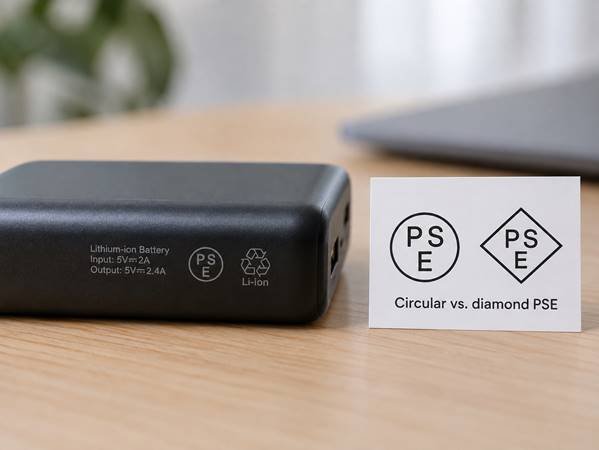
Japan’s PSE certification is divided into two categories, which are statutory divisions based on product risk levels, and have nothing to do with product quality. The specific differences can be referred to in the table below:
| Comparison Item | Diamond-shaped PSE (Specified Electrical Appliances and Materials) | Circular PSE (Non-specified Electrical Appliances and Materials) |
| Risk Level | High-risk products | Non-high-risk products |
| Compliance Requirements | Business operators must submit business notifications and obtain a conformity inspection certificate issued by a registered conformity assessment body | Business operators must also submit business notifications, conduct self-inspections, keep records and affix marks, but usually do not need such third-party conformity inspection certificates |
| Classification Basis | METI’s statutory | Same as left, unrelated to product quality and capacity |
| Applicability to Lithium Batteries | Not applicable | Uniformly applicable to lithium-ion storage batteries that meet the threshold |
The only basis for judging the classification is METI’s latest , and you cannot arbitrarily judge based on the danger or capacity of the product.
Official Classification Conclusion
According to METI’s current classification, lithium-ion storage batteries (including power banks) that meet the energy density threshold are non-specified electrical appliances and materials, and are uniformly subject to circular PSE. Capacity and energy density only affect whether the product is included in the regulation, and will not change its classification—even a 30000mAh large-capacity power bank, as long as it belongs to the storage battery category, uses circular PSE.
Common Classification Misconceptions
Here we correct three of the most common wrong perceptions:
First, diamond-shaped PSE is not a “more advanced certification”, it is just a statutory classification for high-risk products, and has nothing to do with product quality. The reason lithium batteries use circular PSE is not because the requirements are low, but because the statutory classification is so;
Second, the statement that power banks with large capacity need to do diamond-shaped PSE is completely wrong. The storage battery category uniformly uses circular PSE, which has nothing to do with capacity;
Third, batteries and chargers cannot share the PSE category. They belong to different types of electrical appliances and materials, and their respective compliance requirements need to be judged separately.
Core of Compliance: What Safety Requirements Does PSE Actually Verify
Many people think that PSE will test various performances, but in fact its verification scope is very clear, only focusing on safety.
Boundaries of Verification Scope
First of all, it must be clear: PSE only verifies safety, and does not verify performance indicators such as capacity, charging speed, cycle life, and fast charging protocols. PSE requires products to comply with corresponding safety technical standards to reduce risks such as fire and rupture under abnormal charging, short circuit, impact and other conditions; it is not a guarantee that failure, fire or liquid leakage will never occur under any usage conditions. If dropped, exposed to water, aged or used incorrectly, failure may still occur. Do not deify the role of certification.
Core Safety Verification Logic
The PSE technical standards specify design requirements and test items for single cells, battery packs and applicable standards respectively, involving safety aspects such as overcharge, external short circuit, temperature change, drop, impact, and crush. Battery packs must also meet the specified overcharge protection requirements.
Whether specific protection designs such as overcurrent and overdischarge are required should be confirmed item by item according to applicable technical standards and product structure; do not generalize the nail penetration test or four types of protection functions as the unified mandatory requirements for all PSE products.
Verification Focus of Different Product Forms
Different forms of lithium batteries have slightly different verification focuses:
For circulatable single cells, the focus is on verifying chemical stability and structural safety;
In addition to the safety of the cell itself, battery packs also need to additionally confirm the requirements for protection circuits, overcharge protection and other aspects in the applicable technical standards;
Even if a power bank installs the storage battery and circuits such as USB output, wireless charging, charging or boost in the same non-easily detachable housing, it is still treated as a regulated object of lithium-ion storage batteries and subject to corresponding technical standards. It is not possible to only separately judge the storage battery part of it.
Rules After the 2024 Transition Period
Regarding the latest technical requirements, we need to make it clear here to avoid being misled by false information: in December 2022, METI revised the technical standards for lithium batteries, added technical requirements such as voltage monitoring, and set a 2-year transition period; the transition period expired on December 28, 2024. The revised technical standards apply from December 28, 2024; however, for products manufactured or imported before the effective date, there are transitional measures in the supplementary provisions of the revision. The application of the old or new technical standards should be confirmed on a case-by-case basis based on the manufacturing date, import date, product status and conditions of the supplementary provisions, and cannot be judged solely based on the sales or circulation date.
Confusing Rule Boundaries
There are several rules that are often confused with PSE, which are clarified all at once here:
• UN38.3: It addresses the transportation safety of lithium batteries, has nothing to do with market access, and cannot replace PSE;
• CB/IEC reports: They can only be used as a source of technical evidence, and data can be partially reused when standards match, but they cannot replace PSE compliance obligations;
• Air carry rules: They are formulated by civil aviation authorities and airlines based on rated energy (Wh), and have nothing to do with whether there is PSE;
• Platform audit rules: Some e-commerce platforms may add additional requirements on the basis of PSE, but these are platform rules and do not represent statutory PSE obligations.
Practical Operation Process: Complete Compliance Steps for Circular PSE
Unlike diamond-shaped PSE, circular PSE does not have a unified certification issuance link by METI. It is a complete compliance chain for which the business operator is responsible. Before operation, two core prerequisites must be confirmed first.
Two Pre-confirmations
The first prerequisite is product scope confirmation: the product has been confirmed to be within the regulation scope according to the three-step method above, to avoid working in vain.
The second prerequisite is the confirmation of the reporting entity mode. Here, attention should be paid to the new rules that take effect on December 25, 2025, which are divided into two modes:
• Japanese importer mode: For products imported and sold by a domestic Japanese import business operator, usually the actual importer shall submit a business notification and bear corresponding obligations in accordance with the ;
• Specified import business operator mode: When an overseas business operator directly sells PSE target products to general Japanese consumers through platforms and causes their import without going through a domestic Japanese import business operator, it shall submit a notification as a specified import business operator and appoint a domestic Japanese administrator who meets statutory conditions. For the Japanese overseas warehouse mode, the actual importer, the time point when import occurs, and whether there is a domestic Japanese import business operator should be confirmed on a case-by-case basis; it cannot be automatically deemed as a specified import business operator just because of “shipping from overseas warehouse”.
Complete Compliance Chain
After confirming the prerequisites, proceed according to the following six steps:
The first step is technical standard assessment: against the technical standards for lithium batteries of the , sort out the compliance of product design and key components (cells, protection boards, etc.), and check for problems in advance;
The second step is test verification: you can test by yourself, or entrust a capable laboratory to test. There is no mandatory requirement to use a designated institution, but the test data must be true and can support compliance. Test reports at the type or design stage can be used as evidence of conformity to technical standards, but cannot replace statutory self-inspection;
The third step is self-inspection and record retention: the notified business operator must conduct 100% inspection on finished products in accordance with regulations, make inspection records, and keep them for at least 3 years from the date of inspection. Test reports, technical documents and batch traceability materials can be used as supplementary management materials for official spot checks;
The fourth step is business declaration: the reporting entity (Japanese importer or specified import business operator) completes the business declaration to METI;
The fifth step is statutory marking: after affixing the circular PSE mark and required information, the product can be launched on the market;
The sixth step is post-launch management: maintain product consistency, monitor safety risks, and follow up on regulatory updates.
Compliance Cycle and Influencing Factors
The entire process usually takes several weeks to several months, and the specific duration depends on product complexity, data completeness, and whether rectification is required. There are three most common causes of delay: incomplete data, cells that do not meet technical requirements, and frequent design changes.
Here we emphasize again: circular PSE does not have a unified certification issuance link by METI. Do not believe the statement of “quickly obtaining a circular PSE certificate”, because there is no official unified product certificate at all.
Division of Responsibilities for Different Roles
The responsibilities of different roles in the compliance process must be clarified to avoid shifting blame:
The responsibility of overseas manufacturers is to ensure that products meet safety requirements and provide true and complete technical documents;
Japanese importers/specified import business operators are responsible for business declaration, document preservation, responding to spot checks and recalls;
Cross-border e-commerce sellers must ensure that listing information is consistent with compliance information. For the case of shipping from Japanese overseas warehouses, the responsible entity should also be judged based on the actual importer, the time point when import occurs, and whether there is a domestic Japanese import business operator, and cannot be generalized only based on the shipping location.
Labeling Specifications: Circular PSE Label Requirements and Verification
Labels are the most intuitive manifestation of PSE compliance. Whether it is a seller labeling or a consumer purchasing, you must master the basic judgment methods.
Label Content Requirements
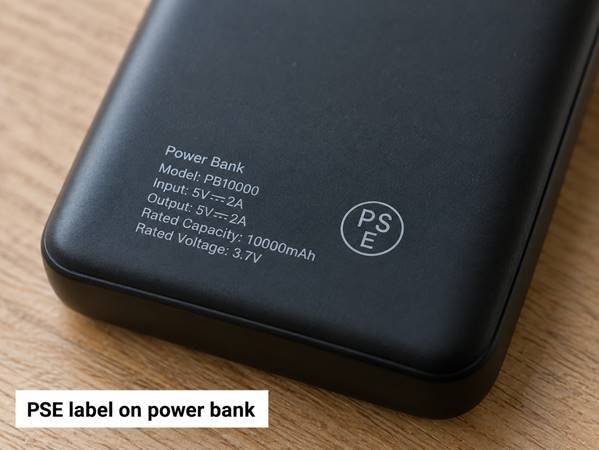
There are four statutory required contents, and none of them can be missing for compliance: circular PSE mark with standard proportion, name/abbreviation/trademark of the reporting business operator, rated voltage, rated capacity.
There are also some contents recommended or required by other regulations, such as rated energy (Wh), product model, Japanese safety warning language, recycling mark, etc. It is better to have them, but their absence does not affect the compliance of PSE itself.
In addition, note: this category shall be marked with the circular PSE mark and statutory marking items in accordance with the rules for non-specified electrical appliances and materials; diamond-shaped PSE marks or third-party certificates shall not be used as a substitute for its applicable circular PSE.
Common Labeling Errors and Risks
Several of the most common labeling errors must be avoided:
Using marks such as CE, KC, UN38.3 to impersonate PSE;
Label parameters are inconsistent with actual products and technical documents;
Missing reporting business operator information, deformed PSE mark or wrong proportion;
Labels are blurred and easy to erase, and the position does not meet readability requirements.
Label Verification Method
To initially judge the compliance of labels, just follow four steps:
First, look at the mark: it should be circular PSE, and no diamond-shaped mark is allowed;
Second, look at the parameters: rated voltage and rated capacity are clearly marked, and the reporting entity information is traceable;
Third, check consistency: the brand and core parameters of the product body, packaging, and manual are consistent;
Fourth, note: Wh, warning language, etc. are additional contents and do not affect the judgment of statutory PSE compliance.
Common Misconceptions About Power Bank Parameters
Regarding the parameters of power banks, three misconceptions are most easily confused:
First, the nominal capacity is not equal to the actual output capacity. The rated output capacity is affected by buck-boost loss and test conditions, and is usually lower than the cell capacity. This is a normal phenomenon and has nothing to do with PSE;
Second, having PSE does not mean supporting fast charging. PSE does not verify fast charging function. Fast charging is a performance indicator and is not within the scope of safety verification;
Third, having PSE does not mean it can be taken on the plane. Air carry is implemented according to Wh and airline regulations, and has nothing to do with PSE at all.
Advanced Pitfall Avoidance: Compliance Verification and Change Management
Many sellers think everything is fine after completing compliance, but in fact there are still many pitfalls to step on later. This part of the content will help you avoid 90% of compliance problems.
Circular PSE Compliance Verification Method
Because circular PSE does not have an official universal product certificate, verification cannot only look at “whether there is a certificate”, but must be confirmed from three aspects:
First, check the reporting entity: confirm that the other party has completed the business notification under the and has legal qualifications;
Second, check technical documents: confirm that the test report covers the current technical standards, and the key components are consistent with the actual product;
Third, check physical consistency: the product structure, rated parameters, and marking information match the technical documents and declaration information.
Re-evaluation of Safety-related Changes
When the product is remodeled or adjusted, do you need to redo compliance? You can refer to the matrix below:
| Change Type | Is Full Re-evaluation Required? | Handling Method |
| Replacing cell model, modifying protection circuit design, changing series-parallel connection mode, adjusting rated parameters, changing core structure | Change impact assessment shall be conducted | Where the change may affect the conformity with technical standards, the representativeness of existing tests, or statutory marking, corresponding verification shall be supplemented, and technical documents, inspection records and markings shall be updated. Notification changes shall be handled in accordance with regulations only when statutory notification items change |
| Changing appearance color, replacing packaging, adjusting non-safety text on labels | Depends on the impact of the change | It shall be confirmed that the change will not cause inconsistency, unreadability or misleading of statutory marking; relevant records and markings shall be updated if necessary |
Here we emphasize again: there is no such thing as “certificate validity period” or “renewal” for this category. The core is that the product always complies with the current technical standards. As long as the product remains unchanged and the regulations remain unchanged, compliance will always be valid.
Common Pitfalls for Overseas Cross-border Sellers
Four pitfalls that overseas sellers are most likely to step on must be avoided in advance:
First, mistakenly believing that affiliating a Japanese contact person is enough: after 2025, specified import business operators need to appoint a statutory domestic administrator, and ordinary affiliation is not compliant;
Second, using cell PSE to replace the whole battery pack PSE: cell compliance does not mean that the finished battery pack is compliant, and the finished product still needs to complete a separate compliance assessment;
Third, OEM/ODM private label products are not re-evaluated: it shall be confirmed whether the actual product, marking subject, statutory marking and technical materials are still consistent; there is no circular PSE “qualification” that can be automatically applied regardless of the actual product, and whether supplementary verification is required depends on the impact of specific changes;
Fourth, listing information is inconsistent with compliance information: inconsistent parameters and wrong brand labeling will be removed by the platform, and even trigger official spot checks.
Post-compliance Continuous Management Requirements
After compliance is completed, it is not that you don’t need to care about it anymore. You also need to do a good job of continuous management:
Maintain the consistency of product structure, key components, and production processes with those during verification, and shall not change them at will. Changes involving safety need to be re-evaluated;
The notified business operator shall conduct 100% inspection on finished products in accordance with regulations, make inspection records and keep them for 3 years from the date of inspection; batch traceability materials can be used as supplementary management materials;
Monitor consumer complaints, abnormal heating, swelling and other problems. For major risks, sales shall be stopped in time and recall shall be evaluated;
Regularly pay attention to METI regulatory updates and adjust compliance plans in a timely manner.
Practical Tools: Self-check List and Frequently Asked Questions
Finally, two practical self-check lists and high-frequency questions are sorted out for your quick comparison.
Seller Entry Self-check List (5 Steps)
First step: confirm the product type (circulatable lithium-ion storage battery/battery pack/fully built-in battery);
Second step: confirm the import/sales form (separate sales/separated bundled/fully built-in);
Third step: calculate the volumetric energy density based on a single cell, and confirm whether it meets the 400Wh/L threshold;
Fourth step: confirm the reporting entity mode (domestic Japanese import business operator for actually imported products (notified business operator)/specified import business operator + domestic administrator);
Fifth step: check whether the test report covers the current technical standards of the .
Consumer Purchase Check List
Look at the mark: there is a standard circular PSE mark without deformation;
Look at the information: there is reporting business operator information, clear rated voltage and capacity;
Look at consistency: the brand and model of the product, packaging, and manual are consistent;
Look at the channel: buy from regular platforms/stores, and avoid low-priced unknown products.
High-frequency FAQ
Is PSE mandatory for power banks?
Not necessarily. Power banks mainly used as external power sources for electronic devices are still judged as regulated objects of lithium-ion storage batteries even if the storage battery is installed in the same non-easily detachable housing as circuits such as charging and boost circuits; whether compliance is required needs to be confirmed in combination with statutory conditions such as whether the volumetric energy density of a single cell reaches 400Wh/L. Generally, batteries that are fully built into terminal devices and not circulated separately usually do not need to do PSE according to the storage battery category.
How to calculate 400Wh/L?
Divide the rated energy (Wh, equal to rated voltage × rated capacity) of a single cell by the volume (liters) of the single cell. You cannot directly convert using the Wh or mAh of the whole device, nor can you calculate using the energy density of the entire battery pack.
What is the difference between circular and diamond-shaped PSE?
The two are statutory classifications under Japan’s , and have nothing to do with product quality. Diamond-shaped PSE applies to high-risk specified electrical appliances and materials, requiring authorized third-party testing and certification + official filing; circular PSE applies to non-specified electrical appliances and materials, and the business operator is responsible for compliance, declaration, and archiving. Lithium-ion storage batteries that meet the threshold are uniformly subject to circular PSE, regardless of capacity.
How do overseas sellers declare in 2026?
If imported and sold through a domestic Japanese import business operator, usually the actual importer shall submit a business notification and bear corresponding obligations in accordance with the ; if an overseas business operator directly sells PSE target products to general Japanese consumers through platforms and causes their import without going through a domestic Japanese import business operator, it needs to appoint a domestic Japanese administrator who meets statutory conditions as a specified import business operator and handle the declaration. The Japanese overseas warehouse mode should be judged on a case-by-case basis in combination with the actual importer, the time point when import occurs, and whether there is a domestic Japanese import business operator, and cannot be generalized just because of shipping from overseas warehouse.
Can PSE replace UN38.3?
No. PSE is a market access safety requirement in Japan, targeting the safety of products sold on the market; UN38.3 is a transportation safety requirement for lithium batteries, targeting the safety of the transportation link. The two have completely different application scenarios and cannot replace each other.
Overall, lithium battery PSE certification is not a profound technical threshold, nor is it a marketing gimmick used to brag about quality. It is just the basic safety access requirement for lithium batteries in the Japanese market. As long as you figure out the three-step method for scope determination, remember that storage batteries are uniformly subject to circular PSE, proceed step by step according to the compliance chain, and avoid common pitfalls, you can successfully complete compliance and quickly judge the compliance of a product.