
If you run a USB charger business for the U.S. market, or have bought a charger online in the U.S., you must have seen the FCC mark printed on products. Many people think this is a “safety certification”, believing that products with this mark won’t catch fire or damage phones while charging — but this is completely wrong. The FCC only regulates one thing: whether the electromagnetic waves leaked by the charger will interfere with other electronic devices. Before marketing, importing, or selling chargers subject to FCC Part 15 in the U.S., applicable equipment authorization must be completed, and requirements for labeling, records, etc. must be met; non-compliant products may face enforcement measures such as entry refusal, detention, recall, or cessation of sales. Today we will explain FCC certification for USB chargers clearly from basics to pitfalls, whether you are an ordinary buyer, small seller, or purchaser, you can use what you learn right after reading.
1. First, Understand: What Exactly is FCC Certification? What Does It Regulate and What Doesn’t It?
FCC is the abbreviation of the Federal Communications Commission of the United States. This certification is essentially a mandatory requirement for electromagnetic compliance, not a safety certification. Its core function is to control the electromagnetic wave leakage of electronic products to avoid interfering with other surrounding electronic devices. For regulated equipment sold or imported in the U.S., equipment authorization and related compliance requirements must be completed in accordance with applicable rules.
The reason for this set of rules is that the switching power supply in USB chargers needs to switch current at high speed, which generates electronic noise during operation. This noise can propagate along the power line and also spread through the air. Without restrictions, it may affect the normal use of nearby devices such as mobile phones, speakers, and routers.
Many people have the biggest misunderstanding about FCC, that is, they regard it as a “universal quality certification”. In fact, its regulatory boundary is very clear, and the FCC does not regulate the following contents at all:
First, charging safety, such as whether it will catch fire, whether it will cause electric shock, whether it will get too hot after long-term charging — these fall under the jurisdiction of safety certifications such as UL and ETL, and have nothing to do with the FCC;
Second, performance indicators, such as whether the actual power of the charger is sufficient, how fast it charges, whether it supports PD fast charging, and whether the interface is durable — the FCC does not involve these;
Third, energy efficiency requirements, such as how much power is consumed in standby mode and how high the conversion efficiency is — these are under the jurisdiction of the U.S. Department of Energy (DOE) or the California Energy Commission (CEC);
Finally, anti-interference ability, that is, whether the charger will malfunction or work normally when interfered by other devices — this is also not a mandatory requirement of the FCC.
Core Classification of FCC: Unintentional Radiation vs. Intentional Radiation
For chargers covered in this guide, the key distinction is usually between unintentional radiating devices and intentional radiating devices. However, FCC Part 15 also involves other device categories, and the final authorization method to be adopted still needs to be judged based on specific FCC provisions, product functions, and whether certain exceptions apply.
One type is devices that do not actively transmit wireless signals themselves, but inevitably leak a little electromagnetic noise during operation. This type is called “unintentional radiating devices” in FCC rules, and ordinary wired USB chargers we use daily usually fall into this category;
The other type is devices that need to actively transmit wireless signals themselves, such as smart chargers with Bluetooth, WiFi, or remote control functions. This type is called “intentional radiating devices”, and usually needs to be evaluated in accordance with stricter wireless device authorization rules.
Core Differences Between FCC and Other Common Certifications
Many people easily confuse different certifications. We have compiled a comparison table to clearly see their respective responsibilities at a glance:
| Certification Type | Core Regulatory Scope | Relationship with FCC |
| UL/ETL | Electrical safety (fire prevention, electric shock prevention, temperature rise, etc.) | Different division of labor, cannot replace each other |
| CE | Multiple types of compliance requirements for the EU market (including electromagnetic compatibility, safety, etc.) | Different applicable regions, different rules and liability mechanisms, cannot replace FCC |
| USB-IF | USB interface specifications, fast charging protocol compatibility | Completely different regulatory direction, has nothing to do with electromagnetic compliance |
| DOE/CEC | Energy efficiency (standby power consumption, conversion efficiency, etc.) | Different assessment objectives, regulated separately |
2. Which USB Chargers Need FCC Compliance?
First of all, a major premise must be clarified: if a USB charger is sold for the U.S. market or imported into the U.S., it is necessary to complete the applicable FCC equipment authorization and compliance evaluation based on the product’s circuit, function, and purpose. Simply storing goods in a U.S. warehouse and preparing for sale does not allow you to bypass the corresponding requirements.
Common products of this type that need evaluation include: wall-mounted single-port and multi-port USB chargers, including PD fast charging and GaN gallium nitride models; car USB chargers; laptop power supplies with USB output, desktop charging stations; and wired chargers with digital display and smart identification functions — as long as they contain active electronic circuits inside, you cannot judge whether compliance is required just by the appearance.
Of course, there are cases where separate Part 15 equipment authorization is not required. Purely passive USB charging cables or adapters without active electronic circuits are usually not subject to Part 15 equipment authorization, because they themselves do not generate electromagnetic noise caused by active electronic circuits. However, cables and adapters that contain identification chips, conversion circuits, protection circuits, or wireless functions require separate evaluation. Products sold only in markets outside the U.S. are not subject to U.S. FCC market access requirements. As for original chargers that are compliant with the whole machine and not sold separately, such as the charger included in the mobile phone box, it must be judged in combination with the authorization scope of the whole machine, product sales method, and actual labeling situation, and cannot be generalized solely by the phrase “sold with the whole machine”.
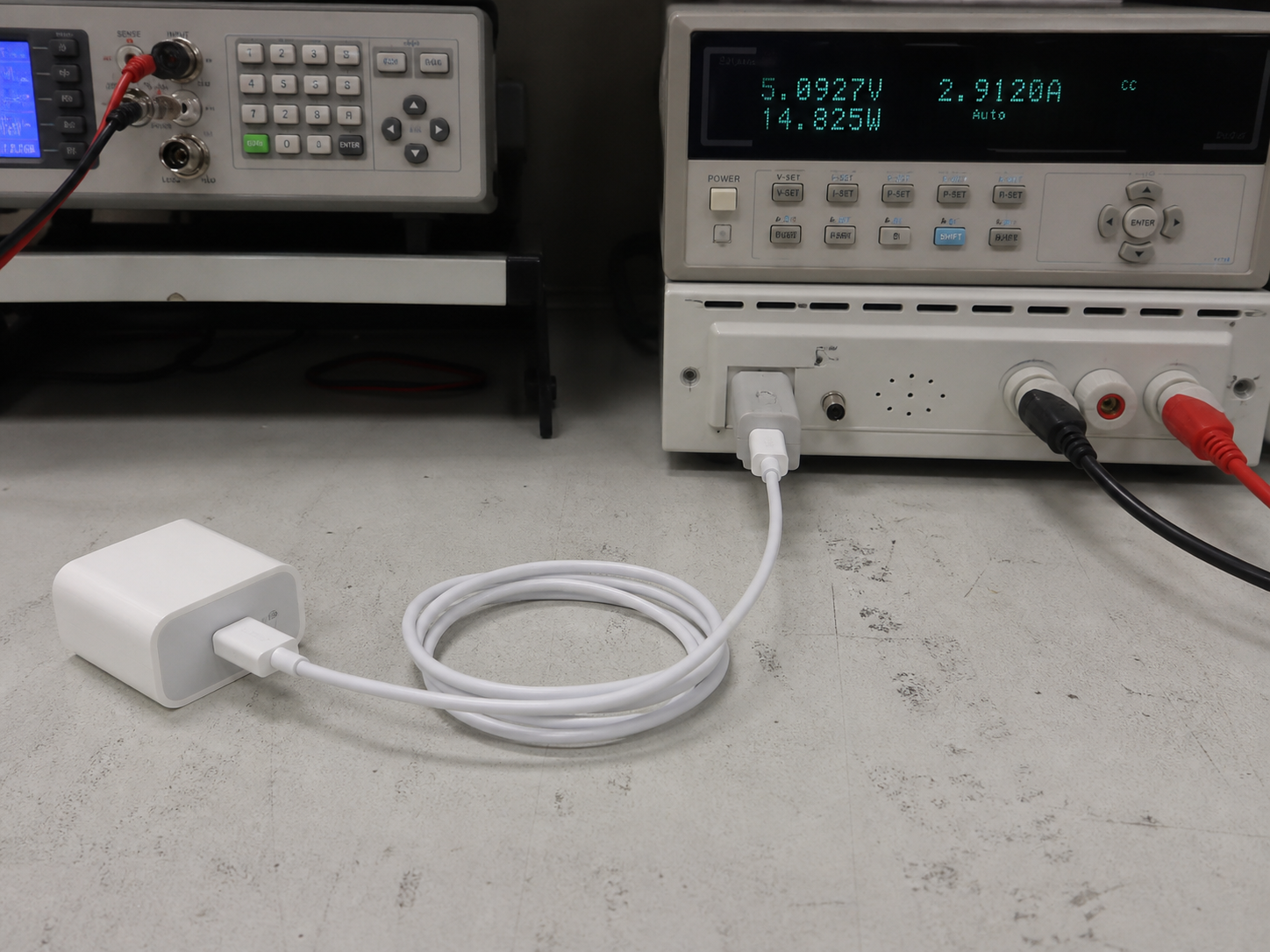
Charging equipment for industrial, commercial, or professional use is not automatically exempt either. It is still necessary to evaluate applicable requirements such as FCC Part 15 based on its circuit, function, and purpose; its emission limits may be determined according to Class A or other corresponding rules.
There are also several types of products that are easy to confuse, and the judgment rules should be noted: smart chargers with Bluetooth, WiFi, or remote control functions are intentional radiating devices, and the requirements are much stricter than ordinary wired chargers; wireless charging pads or chargers with wireless charging functions involve additional rules for wireless power supply, which are not within the core discussion scope of this guide; USB cables with chips, digital displays, or wireless modules cannot be directly counted as ordinary cables, and need to be separately evaluated for compliance requirements.
Power banks have additional requirements in terms of batteries, transportation, and safety, but their electronic circuits may still be FCC Part 15 devices; if they contain wireless transmission functions, corresponding intentional radiation requirements also need to be evaluated. Their structure and test focus may be different from wall chargers, and whether the specific test items in this guide apply should be judged in combination with the product structure and function.
3. What Exactly Does the FCC Test? What Are the Core Regulatory Requirements?
The core regulatory logic of the FCC is actually very simple: limit the upper limit of electromagnetic waves leaked by the charger to avoid it interfering with other surrounding electronic devices. Chargers mainly intended for residential environments are usually evaluated according to Class B limits; whether they specifically belong to Class A or Class B should be determined according to FCC regulations on the use, design, and marketing methods of the device, rather than just looking at whether the product is used at home.
Ordinary wired USB chargers are usually managed according to the rules for unintentional radiating devices.
Specifically, the core usually includes two types, both of which are related to our daily experience: one is called conducted emission, which refers to electromagnetic noise transmitted back to the power grid along the power line. For example, the buzzing noise from speakers and radios on the same power strip may be related to conducted emission; the other is called radiated emission, which refers to electromagnetic waves propagating directly through the air, which may increase the risk of interference to nearby wireless devices.
However, slow WiFi and stuttering Bluetooth headsets may also be caused by channel congestion, distance, device coexistence mechanisms, network problems, or device failures. You cannot conclude that the charger is the cause solely based on these phenomena, let alone interpret FCC limit testing as meaning that the product will absolutely never cause interference in all environments.
During testing, representative and potentially most unfavorable operating modes should be selected according to product functions and applicable FCC test methods. It is usually necessary to evaluate different output configurations, port combinations, and fast charging gears; however, whether it is necessary to test every load point of no-load, half-load, and full-load, whether it is necessary to cover every multi-port combination, or whether it is necessary to test the moment of fast charging switching, should be determined by applicable rules and the laboratory test plan. Not all products must mechanically complete exactly the same tests.
Many people think that the higher the power of the charger, the more difficult it is to pass the FCC test, but this is a misunderstanding. Power level does not directly determine the difficulty of compliance. High-power chargers can still meet the standards as long as they have good shielding and filtering design; on the contrary, products with the same power may have very different interference levels due to different designs and materials — for example, for the same 65W GaN charger, some use relatively complete shielding structures and filtering components, so the interference may be smaller; some have insufficient filtering design, so the interference may naturally be greater.
4. How to Choose the Compliance Path: SDoC vs FCC ID
After confirming that the product needs compliance, the next most critical step is to choose the right compliance path. When judging the path, you cannot generalize only by the condition of “whether there is a wireless signal”, but also look at the applicable FCC provisions, product functions, device categories, and whether there are authorization exceptions.
For ordinary wired chargers, the SDoC path for unintentional radiating devices is usually the key consideration; for products with Bluetooth, WiFi, or other active wireless transmission functions, the Certification path is usually required.
Path 1: SDoC (Supplier’s Declaration of Conformity)
This path is usually applicable to unintentional radiating devices such as ordinary wired USB chargers. Its logic is: the responsible party that meets the regulations makes a declaration that the product meets FCC requirements, and there is no need to apply for an FCC ID from the FCC for each ordinary wired charger.
It should be noted here that SDoC does not mean “just write a declaration casually”. The product should be tested in accordance with applicable FCC rules and measurement methods, and test records or reports should be kept. The testing should be carried out by a laboratory with corresponding technical capabilities. Unlike Certification, SDoC products usually do not need to submit complete test reports to an FCC-recognized Telecommunication Certification Body (TCB) for equipment certification review, but the responsible party must be able to provide relevant materials when needed.
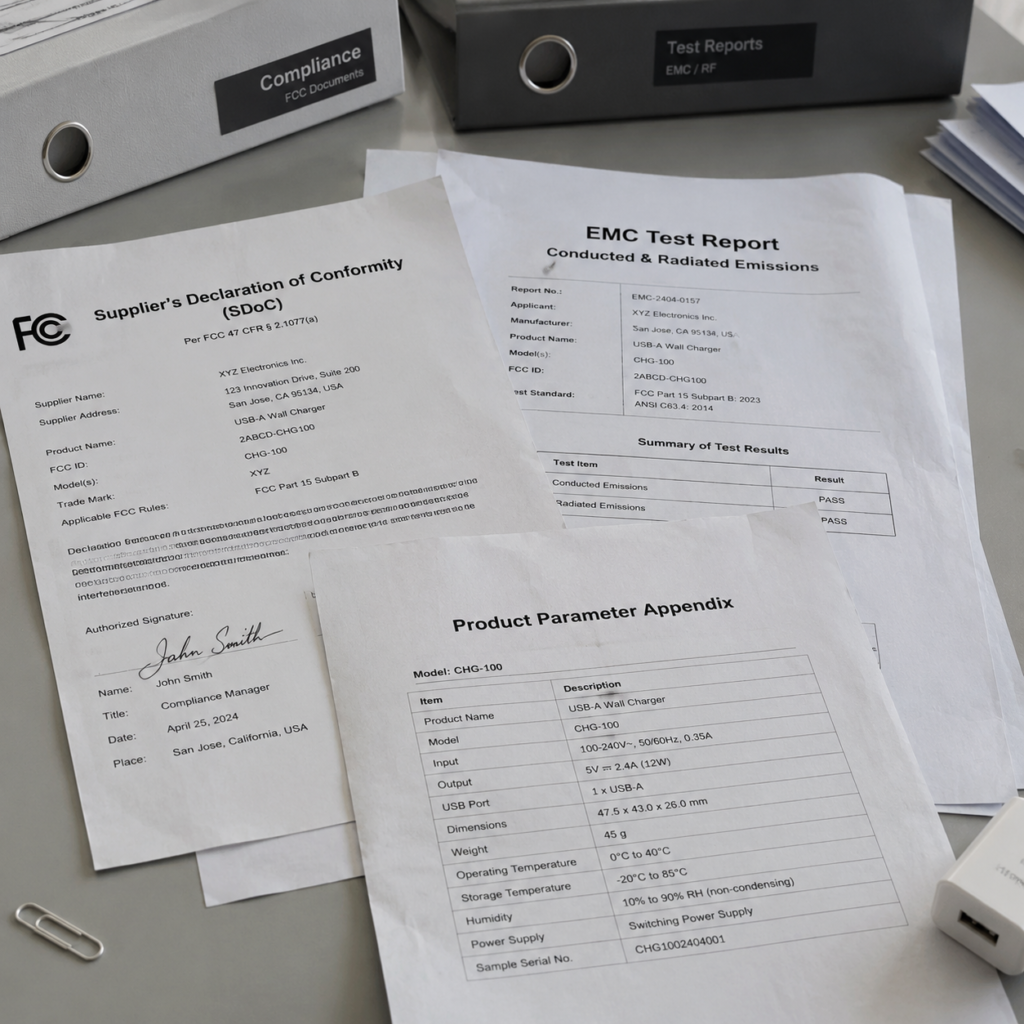
Products on the SDoC path do not have an FCC ID, so it is usually normal that the corresponding FCC ID cannot be found in the FCC official database. The responsible party, product identification information, compliance declaration, and related records on the product and documents should meet the FCC’s labeling and document requirements.
Path 2: Certification (FCC ID Certification)
This path is usually applicable to intentional radiating devices such as smart chargers with active wireless transmission functions. After the test is completed, the application materials are submitted to an FCC-recognized Telecommunication Certification Body (TCB) for review. After approval by the TCB, an equipment authorization document is issued. The product uses an FCC ID composed of the Grantee Code and the product code, and the corresponding records are made public in the FCC database.
There is a common simplified rule here: certified wireless modules can reduce part of the radio frequency test on the premise of meeting their module authorization conditions, antenna and installation requirements. However, the host may still need to complete applicable unintentional radiation, radio frequency exposure, and other whole-machine evaluations.
If the antenna, radio frequency parameters, installation method, or other designs that may affect transmission are changed, re-evaluation should be carried out in accordance with the FCC’s permissive change rules, and supplementary testing, change application, or re-authorization should be carried out if necessary. Not all power supply or shielding changes will automatically trigger re-certification, but it cannot be assumed that module certification can cover all compliance obligations of the whole machine.
Core Difference Comparison Between the Two Paths
To help you quickly distinguish, we have sorted out the core differences between the two paths into a table:
| Comparison Item | SDoC (Supplier’s Declaration of Conformity) | Certification (FCC ID Certification) |
| Applicable Products | Usually ordinary wired USB chargers (unintentional radiation type) | Usually smart chargers with Bluetooth/WiFi/remote control (intentional radiation type) |
| Official Filing | Usually no public FCC ID filing | There is official filing, which can be queried by FCC ID |
| Labeling Requirements | Mark product identification information, responsible party information, and compliance declaration in accordance with FCC rules | Use an FCC ID composed of Grantee Code and product code, and meet corresponding labeling requirements |
| Review Intensity | Test in accordance with applicable rules and the responsible party makes a declaration | Usually requires testing by an FCC-recognized testing laboratory and review by a TCB |
| Responsible Subject | The responsible party that meets FCC regulations bears corresponding responsibilities | The Grantee, as well as the manufacturer, importer, and marketing entity, bear their respective corresponding obligations |
5. Getting Started with Application: Process, Cycle, and Pitfall Avoidance
After determining the compliance path, the next step is the actual application process. Many people are prone to pitfalls when doing it for the first time, either choosing the wrong laboratory or spending money unjustly. We have sorted out the key points of the whole process from preparation to obtaining certification.
Good preliminary preparation can save a lot of detours: first of all, you must clearly judge the compliance path first. Don’t go for FCC ID when it is obviously an ordinary wired charger, which is a waste of money; secondly, you should prepare a sufficient number of final sales version prototypes according to the laboratory test plan. The prototypes usually need to include the final shell, cables, firmware, accessories, and label status. You cannot use engineering prototypes that are very different from the mass-produced version for testing; finally, sort out the product parameters, brand information, and information of the U.S. responsible party or related authorized entities.
When choosing a testing laboratory, the Certification path usually requires the use of an FCC-recognized testing laboratory, and a TCB will conduct subsequent review. For SDoC products, you should choose a laboratory with corresponding technical capabilities that can complete testing in accordance with applicable FCC measurement methods and provide complete records.
There are two common pitfalls that must be avoided: the first is not to buy ready-made reports that are applied to other models. Even if the appearance is exactly the same, as long as the model, parameters, and number of interfaces are different, it is non-compliant, and if it is spot-checked, it may still be deemed as mismatched materials; the second is not to believe the promise of “guaranteed pass”. Whether it can pass ultimately depends on the design of the product itself. The laboratory can at most help you find problems and put forward rectification suggestions. If the product’s own shielding and filtering are extremely poor, no one can guarantee that it will pass.
The core test items usually include conducted emission and radiated emission. If the test fails, common reasons may include insufficient shielding design, unreasonable configuration of filtering components, or increased noise caused by circuit layout. The rectification direction should also be determined according to the test results, such as optimizing the shielding structure, adjusting the circuit layout, or replacing appropriate filtering components, rather than simply thinking that adding one component will definitely solve the problem.
After passing the test, you can sort out the compliance documents: for the SDoC path, test records or reports should be kept, and the compliance declaration should be signed by the responsible party that meets the regulations; for the Certification path, the test materials must also be reviewed by the TCB, and after passing the review, the FCC ID and equipment authorization document are obtained.
Many people ask how long the certification is valid. Equipment authorization usually does not have a unified fixed expiration date, but this does not mean that the product never needs maintenance. If FCC rules, test standards, or product design change, it is necessary to evaluate whether supplementary testing, change application, or re-authorization is required in accordance with applicable transition requirements and permissive change rules. Usually, these documents must be kept for a long time in accordance with regulations, in case of spot checks by customs, e-commerce platforms, or the FCC.
As for the cycle and cost that everyone is most concerned about, the FCC has no unified prescribed application price or fixed cycle. The actual time and cost depend on the test items, product complexity, scheduling of laboratories and TCBs, wireless functions, number of rectifications, and completeness of materials. SDoC usually mainly depends on testing and rectification; Certification also adds TCB review and wireless-related testing, and the actual cycle may be significantly different. Therefore, you should inquire about the price from the laboratory or TCB according to the specific model, and confirm the test plan, rather than taking a certain market estimate as a fixed commitment.
In addition, e-commerce platforms such as Amazon may require applicable FCC authorization, test reports, SDoC, or other compliance materials during listing, review, or spot check. The specific requirements are subject to the platform’s current policies and product category requirements. It is best to prepare the documents before sales, don’t wait until the product is under review to look for them temporarily.
6. How to Check the Authenticity of FCC Compliance?
Whether you are an ordinary buyer or a purchaser, the most common question is: how to judge whether the FCC compliance of a charger is real or fake? In fact, the first step is not to check the database, but to first check whether the product’s own labeling and documents are standardized.
If it is an ordinary wired charger, it usually follows the SDoC path, and should provide product identification information, the name of the U.S. responsible party, and contact information such as U.S. address or telephone number in accordance with FCC regulations, and provide the required compliance declaration. The specific content and location should be confirmed in combination with 47 CFR §2.1077 and applicable Part 15 provisions. A website cannot of course replace the responsible party’s contact information required by the FCC.
If it is a smart charger with wireless function, it follows the Certification path, and usually should be marked with the complete FCC ID, or provide relevant information on the product, packaging, or manual in a permitted manner. Here is a very simple way to avoid pitfalls: if the product only prints the words “FCC certified”, and there is no model, responsible party, or verifiable documents, you should be vigilant, and cannot take these words as proof of compliance.
After reading the label, the second step is to verify the corresponding supporting documents according to the path. If it is an ordinary wired charger with SDoC, you can ask the seller to provide the test report or test record of the corresponding model, as well as the declaration of conformity, and check whether the brand, model, and parameters on it are consistent with the actual product; if it is a smart charger with Certification, you can directly go to the FCC official database and enter the complete FCC ID to query the filing information.
When checking the FCC ID, don’t just think it’s okay if you find the result. You should focus on checking these fields: first, the FCC ID must be exactly the same as that on the product label, not a single letter or number can be wrong; second, the name of the applicant or Grantee must correspond to the brand party, authorized entity, or actual document relationship; third, the product description must match the actual function. For example, if the filing says it has Bluetooth, but the product you get has WiFi, further verification is needed; fourth, you need to check the authorization status and authorization documents, not just the title of the search result.
Common document problems can also be identified from these aspects: if the product explicitly claims to use Certification and provides a complete FCC ID, but the ID cannot be verified in the FCC official database, it should be regarded as a major abnormality, and the applicant should be required to explain and provide authorization documents; but you cannot assert that all products that cannot be found are necessarily fake, because SDoC products do not have an FCC ID at all. If the model, power, and number of interfaces in the report or filing do not match the actual product, it may be that the report is misappropriated or the product has not been re-evaluated after change; fast chargers whose prices are far lower than regular products with the same configuration are likely to have no complete and real compliance documents; products with the same appearance but different brands cannot share certification reports just because they look the same. You must check whether the authorization scope, responsible party, and actual product are consistent.
Finally, I would like to remind you of several common limitations of querying, so as not to misjudge: first, it is normal for ordinary SDoC products not to be found in the FCC ID database, because SDoC does not require an FCC ID, which does not mean it is non-compliant; second, if only the FCC ID of the wireless module is found, it does not mean that the whole machine is fully compliant, because the switching power supply, digital circuit, installation method, and radio frequency exposure of the whole machine may still need separate evaluation; third, the same appearance does not mean the same internal design. Many public mold products have the same appearance, but the internal circuit boards, shielding, and components are very different. You cannot judge compliance just by the appearance.
7. Common Misconceptions and Compliance Risks
Finally, we have sorted out several of the most common cognitive misconceptions to help you fully understand FCC certification:
The first misconception: FCC is a safety certification. This is what most people get wrong. The FCC only manages electromagnetic interference, and has nothing to do with fire prevention, electric shock prevention, and charging safety. Don’t think the product is safe just because you see the FCC mark.
The second misconception: all USB chargers must have an FCC ID. No, ordinary wired chargers usually follow the SDoC path and have no FCC ID at all. You cannot say they are non-compliant just because you can’t find the ID.
The third misconception: having CE certification meets FCC requirements. CE is a European Union certification, with different applicable regions, rules, and liability mechanisms, and cannot replace FCC at all.
The fourth misconception: having an FCC mark means compliance. The FCC mark or FCC ID itself cannot prove product compliance. You must check the applicable equipment authorization and documents; but these marks cannot be forged or misused at will, and the specific use method must comply with FCC labeling and equipment authorization rules. For some SDoC devices, the FCC mark is not the only or inevitable basis for judgment.
If you are in charge of product selection or procurement, you must remember these key points: don’t buy bulk chargers without brand, model, or compliance marks. Such products are usually difficult to provide complete compliance documents; for multi-port fast chargers, confirm whether the test plan or test report covers representative multi-port simultaneous output scenarios. If only single-port is evaluated, you cannot directly infer that it meets the requirements when multiple ports are used together; if the product replaces core components, such as power chips, shielding structures, or wireless modules, be sure to re-evaluate the compliance. The original report cannot be used directly without judgment.
For private label products, it is necessary to check whether the authorization holder or SDoC responsible party is real, whether the authorization scope covers the brand and model, and confirm that the responsibility and document chain between the importer, manufacturer, and sales entity are clear. The above entities do not necessarily have to be exactly the same, but there cannot be situations such as false responsible parties, mismatched authorization scopes, or untraceable documents.
Many people think that the FCC does not check strictly and take a chance, but in fact, the risk of non-compliance is very high: first, when importing, it may be refused entry, detained, or returned by U.S. customs; second, e-commerce platforms will remove the product, or even freeze sales permissions; if it is spot-checked by the FCC, it may also face penalties such as fines, recalls, or cessation of sales.
It is particularly reminded here that the responsibility allocation depends on the authorization type and specific enterprise role. SDoC must designate a responsible party that meets FCC regulations; Certification involves the corresponding obligations of the Grantee, as well as the manufacturer, importer, and marketing entity. If the foundry also acts as the manufacturer or the designated responsible party, it may also bear corresponding responsibilities. It cannot be generally considered that the foundry never bears responsibility.
So far, the content related to FCC certification for USB chargers has been explained. After reading this article, you should be able to distinguish the role, regulatory scope, and boundaries of FCC, and no longer confuse it with safety, energy efficiency, and fast charging certifications; you can initially judge whether a USB charger should consider SDoC or FCC ID according to product functions and applicable rules; you can identify common problems through product labeling, compliance documents, and official database queries; you can also know that the cycle and cost need to be confirmed according to the specific model, to avoid being misled by fixed market estimates. For sellers doing the U.S. market, FCC compliance is not an optional bonus item, but a basic requirement that must be completed seriously. Only by understanding the rules in advance can you reduce unnecessary risks of goods being detained, removed from shelves, or recalled.