
Many people who live in Europe, buy EU-version electronic products via cross-border shopping, or run small cross-border businesses will see the two letters “CE” on USB chargers, but few can clearly explain what it is. Some people think it is a “quality gold award” issued by the EU, and buying a charger with the CE mark at a high price is absolutely safe; others think it is just a randomly printed mark and is useless. In fact, both of these ideas are wrong. Today we will thoroughly explain the CE certification for USB chargers, from the most basic definition to authenticity identification, and then to practical checklists for different roles. After reading this, you will understand most of it from entry level, and will no longer be fooled by merchants.
First, Understand What the CE Mark Really Is
Let’s start with the most straightforward definition: CE is the market access threshold for the EU, not a quality award.
The CE mark is not a universal mark that all products sold in the EU and the European Economic Area must use. For USB chargers placed on the market in the EU and the European Economic Area, it is usually necessary to assess EU regulations such as low voltage, electromagnetic compatibility, RoHS, and applicable energy efficiency, and affix the CE mark when required by relevant regulations. That is to say, CE only applies to products covered by corresponding EU harmonized regulations.
Also note that the core of CE is manufacturer self-declaration — for the vast majority of consumer-grade products, there is no need for an official EU body to issue a certificate. As long as the manufacturer completes the conformity assessment as required, prepares and saves technical documents, it can affix the CE mark after meeting the conditions. CE only guarantees the “minimum standard for legal sale”, does not represent performance indicators such as fast charging speed and long service life, and is even less a proof of “top quality”.
You may ask: Which USB chargers need CE certification? Do all USB-enabled ones need it? We can look at it in several categories:
The first category is those that must be fully compliant: commonly used wall-plug USB-A/C charging heads, desktop multi-port charging stations, USB-C power adapters for laptops, travel chargers with replaceable plugs, and even chargers included with mobile phones and tablets, as long as they are commercially sold in the EU, usually need to complete conformity assessment according to applicable regulations, and affix the CE mark when required by regulations.
The second category is those that need to be assessed on a case-by-case basis: in-car USB chargers usually have an input of 12V or 24V DC from the car, which generally does not fall within the voltage range of the Low Voltage Directive (LVD), but this does not mean that they only need to meet electromagnetic compatibility and environmental protection requirements. It is also necessary to assess EMC, RoHS, WEEE, general product safety requirements, and possibly applicable automotive-related regulations according to the product’s purpose and function; if it has wireless functions such as Bluetooth and wireless charging, it may also involve the Radio Equipment Directive (RED).
There are also two boundary situations to note: chargers imported for personal use and not for commercial purposes usually do not fall within the scope of CE obligations when manufacturers place products on the EU market, but it cannot be inferred from this that they do not need to meet any safety or customs requirements. If second-hand products are re-supplied as part of a commercial activity, applicable product safety and market supervision responsibilities still need to be assessed.
Here we also need to clarify two easily confused boundaries: First, separately sold USB charging cables are not independent chargers, have their own compliance requirements, and cannot use the charger’s CE to make up for it; second, the “PD fast charging” and “GaN (gallium nitride)” promoted by many merchants are only charging protocols or material technologies, which do not mean automatic compliance with CE requirements. Compliance still requires separate testing and assessment.
So why should ordinary users care about CE? To put it bluntly, there are two benefits: first, it reduces safety risks. Chargers that meet relevant requirements have a bottom line at least in basic safety such as electric shock prevention and fire prevention, and are not easy to burn out mobile phones or even cause fires; second, when buying EU-version chargers via cross-border shopping or online, you can quickly filter out fake and shoddy products, and also avoid buying non-compliant products that may be removed from shelves by regulators at any time.
4 Areas Covered by CE Certification, All Related to Your Use
Many people think that CE is just a process of “paying money to get the mark”, but in fact its requirements cover several dimensions from safety to environmental protection, each of which is closely related to daily use. Let’s go through them one by one:
Electrical Safety: The Core Barrier Against Electric Shock and Fire
Its requirements are very practical: for example, for electric shock prevention, the pins of the charging head must be firm, and the gap of the shell cannot be large enough for fingers to reach in and touch the live parts inside; for example, for overheating and fire protection, whether in normal use, short circuit or overload, the charging head should have corresponding temperature and protection control, and there should be no risk of dangerous overheating or fire.
Products must also be verified for mechanical strength, enclosure protection, and electric shock prevention performance in accordance with applicable harmonized standards. Whether drop, impact and other tests are carried out, as well as the test height and conditions, depends on the standards adopted and the product type, and cannot be simply summarized as all USB chargers must pass a unified 1-meter drop test.
The plug must also comply with the relevant standards of the target EU country. For example, Germany commonly uses two-round plugs, Ireland uses three-flat plugs, and the size, strength and structure of the pins must be suitable for the target market.
If it is a charger with USB-C or PD fast charging, the output capability, negotiation and protection functions should also be verified in accordance with applicable USB specifications, as well as safety, EMC and consumer information requirements. When encountering incompatible devices, the product should conduct reasonable power negotiation or protection in accordance with the design and applicable requirements to avoid dangerous output. Multi-port products should also clearly, accurately and non-misleadingly state the capabilities of each port and the limitations of combined use. The specific labeling content depends on applicable regulations and standards.
Let’s mention the boundary here: since car chargers usually do not have mains input, they generally do not fall within the applicable voltage range of the LVD.
Electromagnetic Compatibility: Guarantee of Mutual Non-Interference
Electromagnetic Compatibility (EMC for short), simply put, is “mutual non-interference”.
It has two directions: one is “emission requirements”, that is, when the charger is working, it cannot emit excessive electromagnetic interference to affect nearby devices such as WiFi, Bluetooth headsets, and routers — you definitely don’t want to cut off the internet just by charging something, right? The other is “immunity requirements”, that is, when there is external electromagnetic interference, such as when a microwave oven is turned on nearby, the charger should try to maintain normal operation, and should not enter a dangerous state or have abnormal output due to interference.
Many people think that high-power GaN chargers and multi-port fast chargers have looser EMC requirements? Actually, no. High power, GaN and multi-port design do not automatically get EMC exemption, and still need to meet applicable EMC limits; but the specific test items and limits may vary depending on product classification, ports, functions and operating modes.
Environmental Protection and Recycling: Rules for Materials and Waste Disposal
This part corresponds to the two directives RoHS and WEEE.
RoHS restricts 10 substances in electrical and electronic equipment, including heavy metals such as lead, mercury, cadmium, hexavalent chromium, as well as flame retardants such as polybrominated biphenyls (PBB) and polybrominated diphenyl ethers (PBDE), and 4 phthalates. The assessment should be based on the limits of homogeneous materials, and consider applicable exemptions stipulated by regulations, not just checking heavy metals.
The WEEE Directive is about waste disposal, usually involving producer registration, recycling information and treatment responsibility for waste electrical and electronic equipment. When applicable, products should also use recycling signs such as the crossed-out waste bin, and after being discarded, they should be sorted and recycled in accordance with local requirements, and cannot be thrown into domestic waste casually.
There is a common misunderstanding here: many merchants promote “lead-free” and “environmentally friendly materials”, which is not the same as fully meeting RoHS requirements. RoHS restricts 10 substances, and the judgment must be combined with the limits of homogeneous materials and applicable exemptions, and cannot be concluded solely based on promotional slogans.
Energy Efficiency Requirements: Reducing Ineffective Power Consumption
Energy efficiency requirements are not judged by the same set of simple rules for all power adapters. First, confirm whether the product is an external power supply as defined in Regulation (EU) 2019/1782 and within its scope of application, and then assess no-load power consumption, average active efficiency and other requirements in accordance with the corresponding provisions. The rated output power, output voltage, operating mode and whether the product supports multi-voltage output may affect the scope of application.
Multi-port and multi-voltage products also cannot be dismissed with just “judged according to actual operating mode”, but should be assessed in accordance with the specific definitions and conditions in the regulation.
For users, the most direct benefit is reducing ineffective power consumption during standby, and wasting less electricity when left plugged in.
5 Compliance Steps from Design to EU Market Launch
After understanding the requirements, you may be curious: what processes does a USB charger have to go through before it can be legally labeled with CE and sold in the EU? In fact, most of the time there is no need to go to the EU official, and the manufacturer can follow the steps by itself. We break it down into 5 steps:
Step 1: Confirm Product Identity — Same Appearance Does Not Equal Same Certification
Many small sellers easily fall into this pit: with the same shell, I make 20W and 65W versions, can I share a set of CE documents? You can’t take it for granted that you can. First of all, clarify the core parameters of the product: input and output specifications, interface type, power, whether it has wireless functions, these differences may affect testing and assessment. Also distinguish the sales form: whether it is sold independently, included with a mobile phone, OEM produced, or sold on cross-border e-commerce platforms, different forms have different responsible entities.
The core rule is: when power, plug, internal circuit or key components change, a change impact analysis should be carried out, and supplementary or re-testing should be done based on the results. Whether multiple models or variants can be covered by the same set of technical documents and EU declaration of conformity depends on whether the manufacturer can prove that all variants meet applicable requirements, and it is not necessarily required that each variant separately obtain a so-called “certification”.
Step 2: Choose the Appropriate Compliance Assessment Mode
The vast majority of consumer-grade USB chargers can use the mode of “self-declaration plus technical document archiving”, and there is no mandatory requirement to find a third-party body to issue a certificate, let alone official EU approval.
But whether a Notified Body (NB for short) of the EU needs to be involved cannot be judged only by whether the product is “medical” or “industrial” supporting equipment. Instead, first identify the product and applicable regulations, and then judge according to the conformity assessment procedures stipulated in the corresponding regulations. Ordinary industrial power supplies do not necessarily require a notified body; independent chargers do not automatically become medical devices requiring notified body involvement just because they are used with medical equipment.
Here we need to particularly clarify: self-declaration does not mean making random promises and printing the mark by yourself. The manufacturer still needs to complete the necessary conformity assessment, prepare real technical documents and test and verification materials, and bear responsibility for product compliance.
Step 3: Complete Testing and Prepare Technical Documents
Manufacturers should complete necessary verification and testing in accordance with applicable regulations and harmonized standards, which can be done by themselves or entrusted to a laboratory with corresponding capabilities. The third-party laboratory report itself is not equal to CE certification, and the final conformity responsibility still rests with the manufacturer.
Then prepare a complete set of technical documents, including product manuals, circuit diagrams, bill of materials, test or verification reports, risk assessment statements, etc. These are the core basis for proving product compliance.
There is no unified statutory period for testing and document preparation. Product complexity, test items, sample status, laboratory scheduling and number of rectifications will all affect the actual time. To judge whether a service is reliable, you can’t just look at the other party’s promise of “how many days to complete”, but should check the real test records, technical documents and EU declaration of conformity.
Step 4: Sign the Declaration of Conformity and Archive It
The EU Declaration of Conformity (DoC for short) is an important document for CE compliance, equivalent to the manufacturer’s formal declaration that the product meets applicable regulations.
The EU Declaration of Conformity is signed by the manufacturer. The manufacturer may, through written authorization, let an authorized representative within the EU perform clearly listed administrative tasks such as document preservation and cooperation with supervision on its behalf, but the authorized representative cannot therefore take over the manufacturer’s primary responsibility for product conformity.
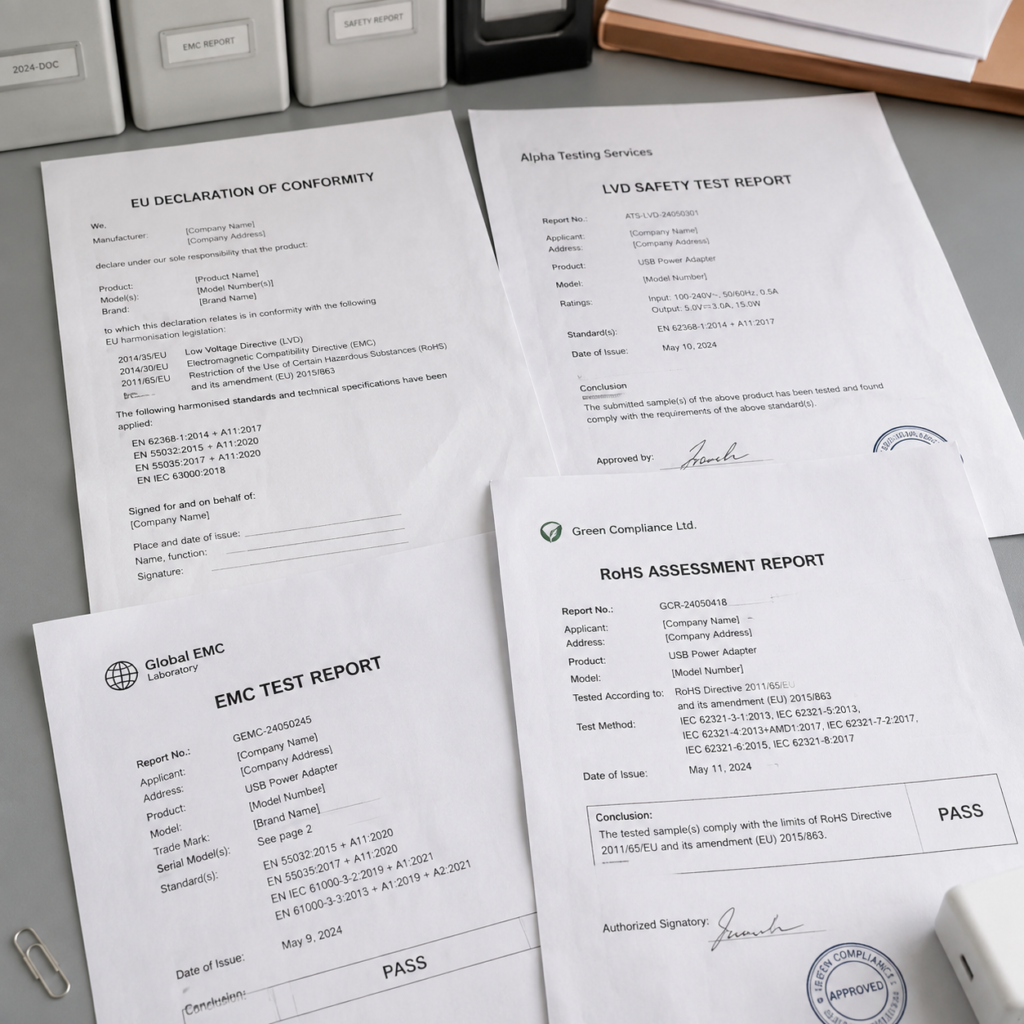
The declaration should clearly state the product model, manufacturer information, applicable EU regulations or directives, date of signing, etc. In accordance with applicable regulatory requirements, the DoC and the full set of technical documents usually need to be kept for at least 10 years from the date the product is placed on the market, and EU regulatory authorities can conduct random inspections.
Step 5: Affix the Mark and Officially Launch
The CE mark should be clear, visible, legible and durable, usually with a height of not less than 5 mm, but exceptions may be allowed where regulations permit. The CE mark can use labels that meet durability requirements, which does not mean that stickers are prohibited; the key is that the mark cannot be easily peeled off, blurred or unrecognizable, and should be affixed to the product body as much as possible. If the product size or nature is not suitable, it may also be placed on the packaging or accompanying documents in accordance with applicable rules.
In addition to the CE mark, the product should also provide information such as the manufacturer’s name, product model, input and output parameters according to applicable requirements. The information of the manufacturer, importer or EU responsible person should also be provided in accordance with applicable product regulations and market supervision rules, and cannot be generally stated as “all chargers must have the EU responsible person marked on the body starting from 2024”. If WEEE requirements apply, the corresponding recycling mark should also be affixed.
4 Authenticity Verification Methods Ordinary Users Can Operate
Since most are manufacturer self-declarations, there must be bad merchants who print a CE mark randomly and sell it. The following 4 methods do not require a laboratory, and ordinary users can quickly judge by themselves, arranged from fastest to most accurate:
10-Second Appearance Preliminary Screening Method: Quickly Eliminate Low-Quality Fake Marks
First look at the CE mark: check whether the mark conforms to the specified graphic proportion, whether it is clear, visible, durable, and consistent with the information on the product documents. Do not simply equate abnormal letter spacing with the so-called “China Export” mark, nor can you confirm that the product is definitely compliant just by the appearance of the CE mark.
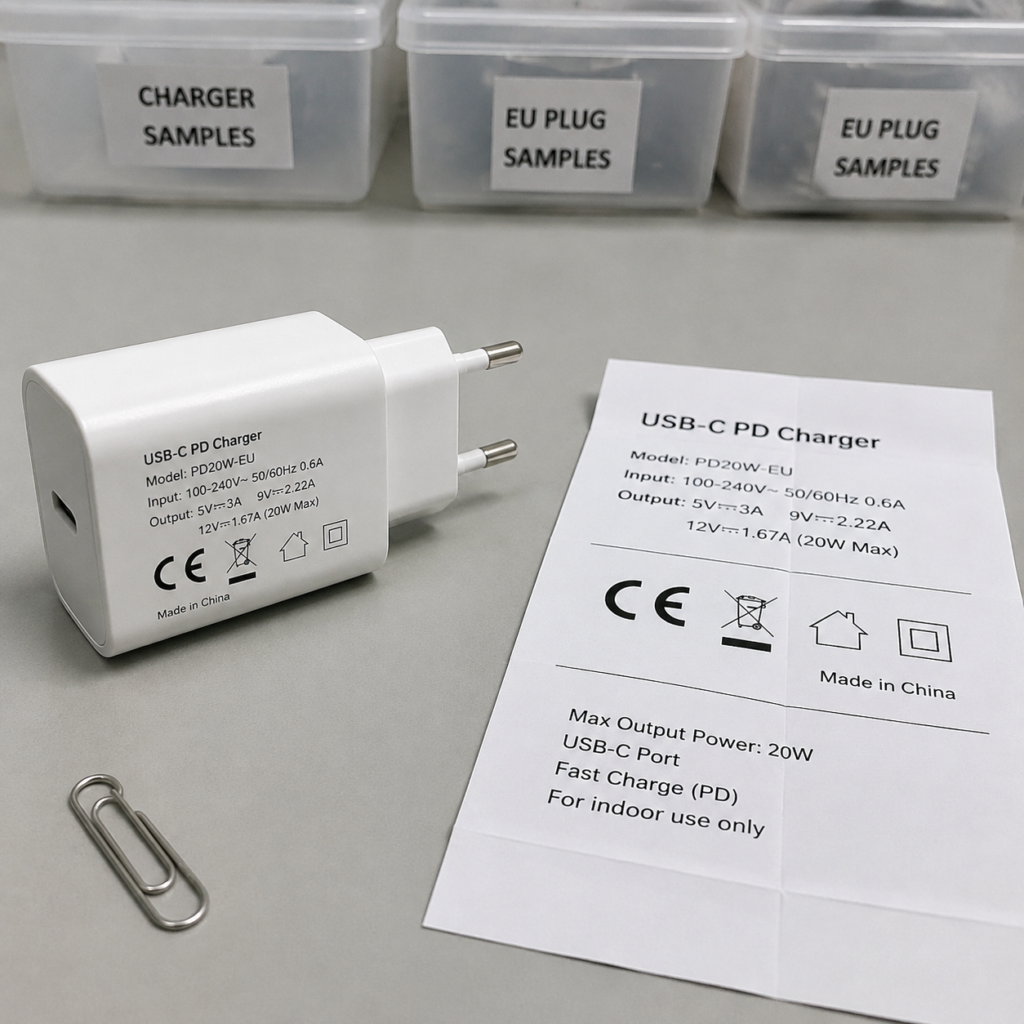
Then look at the parameters: check whether the input rated voltage, frequency and output parameters are clear, true, and suitable for the power grid of the target country. Do not take “100-240V~ 50/60Hz” as the mandatory format for all EU chargers. The EU power grid is usually 230V, 50Hz, but chargers can be marked with the actual rated input range according to the design, such as 220-240V or other applicable ranges.
Then look at the plug: the shape of the pins must comply with the standards of your country, and cannot be loose or deformed.
There is an obvious risk signal: if a charger only has the CE mark and no parameter, manufacturer, or model information, you should be more vigilant. However, appearance inspection can only be used as a preliminary screening, and cannot replace document verification and actual compliance assessment.
Document Verification Method: The Most Reliable Verification Method
Many people ask merchants for a “CE certificate”, but they are looking for the wrong thing — ordinary consumer-grade chargers usually do not have a so-called official EU CE certificate, and the core document is the DoC (EU Declaration of Conformity). You can directly ask the merchant for the DoC document, and then check three points:
First, is the core information correct: the product model, manufacturer name, and the EU responsible person or economic operator information that should be provided according to applicable rules should be consistent with the physical product and the sales page.
Second, are the regulations listed correctly: the DoC should list the actually applicable regulations. For example, ordinary chargers with mains input usually need to be assessed in combination with LVD, EMC, RoHS and applicable energy efficiency requirements; the specific content still depends on the product design and regulatory scope. If unrelated regulations are piled up, it is probably a randomly modified template.
Third, be wary of common tricks: for example, merchants use test reports of other models to impersonate, or use ordinary quality inspection reports as CE compliance vouchers. These cannot directly prove that the current product meets CE requirements.
Parameter Reverse Deduction Method: Avoid Falsely Marked Fake Certifications
Some merchants print the CE mark, but the parameters may be falsely marked. We can check combined with product information and documents:
First, check whether the rated input, output capability, temperature rise and protection functions match each other, and verify whether the model, sample in the test report are consistent with the physical product. The product volume alone cannot prove that a 100W product is fake, but if the advertised parameters are obviously unreasonable, you should further request explanation and document support.
If the charger only marks 110V input, it is usually not suitable for direct connection to the EU 230V power grid, but this cannot be judged solely on this piece of information that its CE is “impossible”, it also depends on the product design and the market it claims to be applicable to.
For fast charging promotion, if the merchant claims to support PD or QC, the relevant protocols and output capabilities should be true, clear and non-misleading. What specific information needs to be marked should be judged in accordance with applicable regulations, standards and consumer information requirements, and cannot be concluded solely based on “whether the protocol name is written”.
The same goes for multi-port chargers: power information should truthfully and clearly state the capabilities of each port and the limitations when used simultaneously. Whether it is necessary to list the total power, combined output and distribution method should be judged according to applicable regulations and standards, rather than taking a certain labeling format as a unified CE condition for all products.
Database and Recall Information Auxiliary Judgment
Many people think there is an official CE certification database where you can check by entering the model, but there isn’t — because the vast majority of products are manufacturer self-declared, the EU does not have a unified CE registration database. CE databases on third-party platforms can only be used as reference clues, not as fact.
You can query the EU Safety Gate (formerly RAPEX) rapid alert system for dangerous non-food products to see if the model or brand you bought has been notified for safety issues. But note the boundary: not finding a record does not mean the product is definitely compliant, you still have to judge combined with appearance, documents and parameters.
The Most Common Misconceptions About CE
In the process of judging CE, many people have some deep-rooted misunderstandings, which instead make them prone to pitfalls. We have sorted out the most common ones:
Misconceptions About the Essence of CE
The first misconception: having the CE mark equals safety and high quality. Wrong, CE is only the minimum access threshold, which only means that the manufacturer claims the product meets applicable basic requirements. If you encounter a fake mark, or the mass-produced product is different from the test sample, there are still safety risks.
The second misconception: CE is a certificate issued by the EU official. Wrong, ordinary consumer-grade products are usually self-declared by the manufacturer, do not need official EU certification, and there is no such thing as a unified “official CE certificate”.
The third misconception: CE has a fixed validity period. Not entirely correct. The CE mark usually does not have a unified fixed validity period, but the manufacturer must continuously ensure that the product, technical documents and declaration of conformity comply with the applicable regulations at the time. When the product is changed, regulations change or relevant standards are converted, it may be necessary to re-assess and update documents.
Misconceptions About the Scope of Application
The first misconception: CE is globally applicable. Wrong, CE is mainly applicable to markets that adopt relevant rules such as the EU and the European Economic Area. Other countries and regions have their own access rules, such as FCC in the US and CCC in China, which cannot be directly used universally.
The second misconception: chargers with USB-C interface, PD protocol, GaN materials naturally comply with CE. Wrong, interface, protocol, materials and compliance are two different things. No matter what technology is used, separate testing and verification are required before the CE mark can be affixed.
The third misconception: low-power small chargers do not need CE. Wrong, even 5W, 10W small charging heads, as long as they are mains input products covered by applicable regulations, may involve electric shock, overheating and electromagnetic compatibility risks, and still need to complete the corresponding compliance assessment.
The fourth misconception: chargers of the same series with different powers can directly share a set of CE materials. Wrong, different power, internal circuit, interface or key components may affect test results and compliance conclusions. Whether the same set of technical documents and DoC can cover must be proved through difference analysis and evidence, and cannot be directly assumed.
Trigger Conditions for Reassessment
Many people don’t know when they need to redo the CE assessment, so we also list them:
Situations that usually require reassessment or supplementary verification include: changing the internal circuit, adjusting the output power, changing the interface type, replacing key safety components (such as transformers, capacitors), or changes in relevant regulations and applicable standards. Whether all these changes require full retesting depends on the results of the impact analysis.
Changing packaging, modifying label stickers, changing shell color with the same power, replacing non-critical small components that do not affect safety and performance, usually do not require a complete reassessment for this reason, but change records should still be kept, and it should be confirmed that product conformity is not affected.
Risk Boundaries in Use
CE testing and assessment are carried out under specified test conditions. If you stuff the charging head in a place with poor heat dissipation such as under a quilt or in a sofa gap, or use it in a humid place like a bathroom, or use a charging cable with a broken skin, even with CE, problems may occur.
If you find the shell cracked, pins loose, abnormal heating, burning smell, or repeated charging interruptions during use, you must stop using it immediately, don’t use it anymore.
Core Differences Between CE and Other Common Charger Certifications
In addition to CE, you may have seen marks such as UKCA, FCC, CCC on chargers. What’s the difference between them and CE? Can one be used universally? Let’s make a simple core comparison:
Difference from UKCA (UK Conformity Assessed): The UKCA system was formed after Brexit, but the UK continues to recognize the CE mark for many products under specified conditions. Whether only CE can be used and whether UKCA is required should be judged according to the current regulations of the UK government for specific product categories and markets. Northern Ireland also applies relevant EU rules. The technical requirements of CE and UKCA are similar, but it cannot be simply assumed that the two are automatically mutually recognized in all products and markets.
Difference from FCC (US Federal Communications Commission): The US FCC mainly regulates radio frequency emission and related interference requirements. Chargers without wireless functions may also be subject to FCC Part 15 equipment authorization requirements because they contain digital circuits, but whether they apply and what procedures to use should be judged according to specific product classification. FCC compliance does not replace electrical safety requirements; CE requires assessment of electrical safety, EMC, environmental protection and energy efficiency according to applicable regulations.
Difference from mandatory certifications in other regions: Whether China’s CCC applies and whether certification or self-declaration is adopted depends on whether the product is included in the China Compulsory Product Certification Catalog and the corresponding implementation rules, and cannot be generalized that all CCC products are issued by designated bodies. Japan’s PSE and Australia’s RCM are also local mandatory access requirements, with specific regulations varying, and they are not directly mutually recognized with CE.
Quick Checklists for Different Roles
After talking so much, you may still feel a bit scattered. We have compiled two quick checklists, whether you are an ordinary consumer buying a charger, or running a small cross-border business selling to the EU, you can use them directly:
Ordinary Consumer Purchase Inspection Checklist
First look: the appearance has a clear CE mark, not a mark that is easy to peel off or unrecognizable; there are complete input and output parameters, manufacturer name, model, and responsible person or economic operator information that should be provided according to applicable rules; the plug meets the standards of the country where it is located, no looseness or deformation.
Second ask: ask the merchant for the DoC (EU Declaration of Conformity), and check whether the product model and manufacturer information on it are consistent with the physical product.
Third check: the input voltage and frequency are suitable for the power grid of the target country; the power is not obviously falsely marked; the multi-port charger has clear and true descriptions of port capabilities and combined use limitations.
Usage reminder: If abnormal heating, shell cracking, burning smell, or repeated charging interruptions occur during use, stop using it immediately.
Compliance Checklist for Small Cross-Border Sellers/Importers
Listing preparation: complete necessary testing and verification in accordance with applicable regulations and harmonized standards, archive the full set of technical documents and DoC; confirm the information requirements for economic operators or responsible persons within the EU in accordance with applicable product regulations and market supervision rules.
Information verification: the parameters, model, and CE mark on product labels, packaging, and manuals must be consistent with those on the technical documents and DoC; manuals and labels must be provided in the language required by the target market.
Pit avoidance tips: don’t just trust services that promise “quick CE certificate”. Ordinary consumer-grade chargers usually adopt manufacturer self-declaration, but this does not mean that testing, technical documents and declaration of conformity can be skipped; if it is a special charger supporting medical or industrial equipment, first identify the product and applicable regulations, and then confirm whether a notified body is required to participate.
Random inspection response: organize the full set of technical documents and DoC in advance, ensure that the products on sale are completely consistent with the samples in the documents, so that you can smoothly respond to regulatory random inspections.
Overall, CE certification is not an unattainable quality medal, nor is it a randomly printed decoration. It is a compliance requirement that applicable products need to meet when entering the EU market — it cannot guarantee that the charger you buy is the best, but it can show that the manufacturer needs to be responsible for applicable safety, environmental protection and other regulatory requirements. Whether you are an ordinary consumer buying a charging head, or running a small cross-border business selling goods to the EU, understanding the essence of CE, knowing how to check documents and parameters, and being able to avoid common misconceptions will help you spend less money in vain, avoid fewer safety risks, and also avoid troubles caused by non-compliance.