
People who have bought chargers or charging cables in the US may have seen a warning line on the packaging or product detail page that reads “This product contains chemicals known to the State of California to cause cancer or reproductive toxicity” — this is commonly referred to as Prop 65. Sellers engaged in import or wholesale business have most likely heard of TSCA. Many people are confused about the difference between these two regulations: both regulate chemicals, so why are there two? Does a product with a warning mean it is toxic? Which regulation do charging products sold to the US need to comply with?
Today, we will focus on products such as charging cables, chargers, power adapters, and interface connectors, and explain Prop 65 and TSCA clearly from basic definitions to practical judgment — so that ordinary consumers can understand warnings and assess risks, and sellers and purchasers can avoid the pitfalls of non-compliant delisting, fines, or even lawsuits. First, let us correct a most common misconception: many people think chemical control only targets batteries, but that is not true — the outer sheath of charging cables, solder of interfaces, plastic shells of chargers, and even ink on packaging may be subject to the control of these two regulations. Do not think that just because you do not sell batteries, it has nothing to do with you.
Get Started First: Core Identities and Applicable Boundaries of the Two Regulations
To distinguish Prop 65 from TSCA, first remember their most essential difference: one is California’s “notification rule”, and the other is a federal “access rule”.
Core Identities of the Two Regulations
Prop 65 is a California state-level consumer right-to-know regulation, with the official name of the , and is abbreviated as Prop 65 in the industry. Its core logic is not to prohibit the use of harmful substances, but to require enterprises to clearly inform consumers of “possible harmful substance exposure risks” under specific circumstances, which essentially guarantees the right to know.
TSCA is the federal-level of the United States, which mainly manages whether chemical substances can be produced or imported in the United States, and whether certain substances are restricted under specific uses. In short, before chemical substances themselves enter US commercial circulation, they usually need to meet the corresponding TSCA requirements; this is not the same as whether Prop 65 requires a warning.
One-sentence summary of the core difference: Prop 65 regulates “whether you need to state it”, and TSCA regulates “whether chemical substances can be produced, imported, or used for specific purposes in accordance with regulations”.
Applicable Products and Regions
First, look at the product scope. Both regulations may be related to the charging products we often contact: charging cables, data cables, chargers, power adapters, and interface connectors all need to be judged in combination with specific situations. The highly related components include cable sheath/insulation layer, solder, interface plating, plastic shell, thermal conductive/flame retardant materials, and even label ink on packaging.
Then look at the geographical boundary, which is the easiest criterion to judge:
• Prop 65 only covers California, but note: as long as the product will be delivered to consumers in California, it counts. Even if your warehouse is in another state, you operate e-commerce and ship express to California, or a distributor resells the goods to California, it may fall within the applicable scope of Prop 65.
• TSCA is a federal regulation applicable to the entire United States. However, complete consumer products such as chargers and charging cables usually fall under the “articles” referred to in TSCA. The applicable rules for articles are not exactly the same as those for separately imported chemical substances and mixtures, and you cannot simply treat all materials inside the finished product as chemical raw materials that need to be declared item by item.
Core Rules of Prop 65: What Should Charging Products Pay Attention To?
Many people’s impression of Prop 65 is that “it sues and fines at every turn”, but as long as you understand its control logic, it is not so scary.
Control Logic: Warning Required, Not Prohibited
Prop 65 usually requires enterprises to provide clear and reasonable warnings when they knowingly and intentionally cause personal exposure to California-listed chemical substances, unless the enterprise can prove that the exposure is below the applicable safe harbor level, or meets other statutory exemptions.
Pay attention to three key points:
First, it does not prohibit the use of listed chemical substances, but only requires notification under applicable circumstances — even if the product contains substances such as lead and phthalates, it does not mean that the product is necessarily illegal or unqualified.
Second, compliance does not mean that the product is “toxic and unqualified”. The warning is just a risk notification, just like the health warning on a cigarette pack, which does not mean that you will get sick after one contact.
Third, the core of judgment is actual human exposure, not the total content in the material, and you cannot only look at the narrow sense of “normal use”. Enterprises usually need to judge in combination with product characteristics and reasonably foreseeable exposure scenarios — for example, the lead content in the material is very high, but if it is sealed in a plastic shell and it is difficult to cause relevant exposure under normal contact and reasonably foreseeable use scenarios, the conclusion may be different.
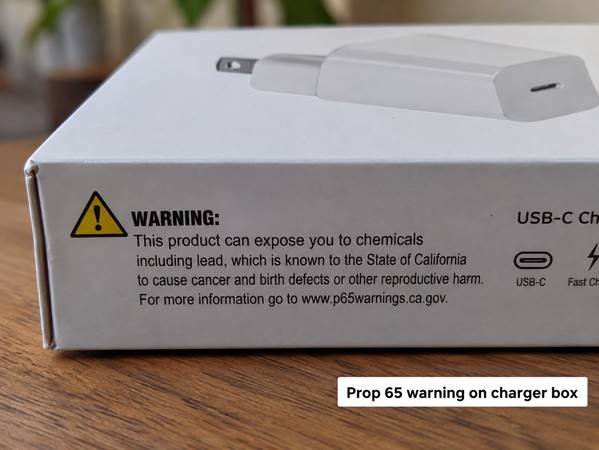
You may have seen a line of warning text with black text on white background or black text on yellow background on the side of the charger box sold in California, or at the bottom of the Amazon product detail page — this is the warning required by Prop 65. However, the warning position cannot be replaced at will: for physical retail, warnings should usually be provided on product labels, or compliant shelf signs, labels, or placards should be used at display points; for online sales, warnings must be provided before consumers complete their purchase, and corresponding warnings must also be provided on the delivered product or packaging. It is not always necessary to print it directly on the product itself.
High-Frequency Controlled Substances and Exposure Scenarios for Charging Products
There are thousands of substances on the Prop 65 control list, but for charging products, the three most commonly encountered categories correspond to different components and exposure scenarios:
• Soft PVC cable/insulation layer: phthalates (plasticizers) may be added to make the cable softer. In cases of skin contact, wear, etc., relevant exposure may need to be assessed.
• Solder/interface plating: traditional solder may contain lead, and some interface plating may involve metals such as cadmium. Wear, dust contact and other situations may be assessment factors.
• Shell/flame retardant materials: many charger shells add flame retardant materials for fire prevention. Whether there is exposure that needs attention during long-term contact or when the charger heats up should be judged in combination with specific substances and product conditions.
Key Concept: Safe Harbor Threshold
Many people will ask: how much exposure is required to give a warning? Prop 65 has the concept of “safe harbor threshold”, which is simply a reference line that enterprises can use to prove that no warning is needed. As long as it can be proved that the exposure level is below the applicable safe harbor level, it can usually be used as a defense basis for not requiring a warning.
There are two types of safe harbor thresholds:
• NSRL (No Significant Risk Level): for carcinogens, it refers to the daily exposure level at which lifetime exposure is not expected to cause more than 1 additional case of cancer per 100,000 people.
• MADL (Maximum Allowable Daily Level): for reproductive toxic substances, it is usually calculated by dividing the no-observed-effect level by 1,000.
It should be particularly noted that not every Prop 65 listed substance has a safe harbor. When there is no clear safe harbor value, it cannot be simply understood as “no requirement at all” or “a warning is definitely required”. It is still necessary to judge whether there is sufficient basis to prove that no warning is needed in combination with specific exposure scenarios.
How to Achieve Compliance?
There are usually two compliance paths for Prop 65:
The first is optimizing material selection, for example, replacing soft PVC with other suitable materials, or using lead-free solder, to minimize possible exposure. If an enterprise can prove that the exposure is below the applicable safe harbor level, there is usually no need to provide a warning, which is more worry-free for both consumers and sellers.
The second is displaying warnings as required. If the material cannot be changed for the time being, or it cannot be proved that the exposure is below the applicable safe harbor level, a warning must be provided in accordance with California rules. The warning positions and delivery requirements for physical retail, online sales, and catalog sales are different. You cannot just put a prompt on the product detail page and default to completing all obligations.
Enforcement and Penalties
The enforcement mechanism of Prop 65 is quite special. OEHHA is mainly responsible for listing, risk assessment, and warning rules; enforcement can be carried out by the California Attorney General and eligible local procuratorial organs. Private individuals or public welfare organizations can also initiate lawsuits after fulfilling procedures such as the 60-day notice.
This is also why many sellers receive “professional anti-counterfeiting” style lawsuit letters. The statutory maximum civil penalty is $2,500 per violation per day, not a fixed $2,500 per product per day; how to count specific violations depends on the facts of the case and the court’s discretion. Common trigger scenarios include consumer complaints, reports from competitors or public welfare organizations.
In addition, small businesses with fewer than 10 employees are usually eligible for exemption from warning obligations under the regulation, but note: many e-commerce platforms and large distributors will require suppliers to provide Prop 65 related materials regardless of the size of your company, so even small merchants cannot completely ignore it.
Core Rules of TSCA: What Should Charging Products Pay Attention To?
Unlike Prop 65’s “risk notification”, TSCA focuses on managing the production and import of chemical substances themselves, as well as specific restrictions applicable to certain substances, uses, or product types.
Control Logic: First Distinguish Whether the Imported Goods Are Chemicals or Finished Products
One of the important rules of TSCA is: if an enterprise wants to produce or import chemical substances themselves in the United States, it usually needs to judge whether the substance is included in the TSCA Inventory of Existing Chemical Substances maintained by the EPA, or whether it meets applicable exemption, notification, or restriction requirements.
But here we must clarify a common misconception: complete consumer products such as chargers, charging cables, and power adapters usually belong to “articles” as referred to in TSCA. Chemical substances imported as part of an article are usually not subject to the PMN requirements of Section 5 of TSCA; article imports are also usually exempt from the import certification of Section 13 of TSCA.
In short, you cannot directly conclude that an importer must check item by item whether all components of a complete charging cable are publicly listed on the TSCA Inventory just because it contains plastic, metal, and adhesives inside. Whether it is subject to specific TSCA constraints depends first on whether the imported goods are chemical substances, mixtures, or complete articles; it also depends on whether there are special rules clearly applicable to the substance, use, or article.
High-Frequency Control Scenarios for Charging Products
The TSCA Inventory of Existing Chemical Substances involves a large number of substances, but for complete conventional charging products imported, you cannot directly presume a TSCA Inventory or PMN violation just because new plastics, new plating, or new thermal conductive adhesives are used in them.
A more practical judgment method is divided into two situations:
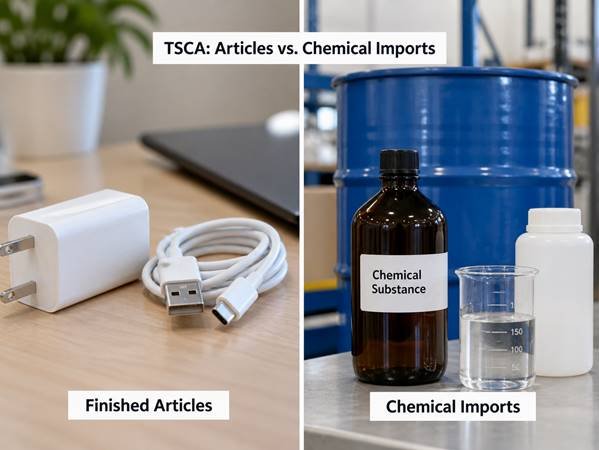
• What is imported is the chemical substance or mixture itself: for example, an enterprise separately imports a certain new thermal conductive adhesive, potting adhesive, flame retardant additive, or plastic pellet for production in the United States. In this case, it is necessary to evaluate the TSCA Inventory, PMN, exemptions, and specific restriction requirements.
• What is imported is a complete charging product: for example, an already assembled charger, charging cable, or power adapter. Such products are usually imported as articles and are usually eligible for article-related exemptions; but it is still necessary to check whether there are Section 6 restrictions of TSCA, SNUR, or other special provisions that clearly cover the substance, use, or article.
Therefore, “new materials” do not automatically mean that “finished product imports will be detained by customs”. What really needs to be judged is: whether the material enters the United States separately as a chemical substance or mixture, and whether there are rules specifically applicable to the substance or finished article.
Key Concept: Inventory of Existing Chemical Substances
One of the cores of TSCA is the “Inventory of Existing Chemical Substances” maintained by the EPA. As of 2024, there are approximately 86,000 chemical substances on the inventory.
Two points should be noted here:
First, being listed does not mean that all uses are approved by the EPA. The TSCA Inventory lists existing chemical substances and distinguishes between active and inactive status. A certain substance being on the inventory does not mean that it can be used for any purpose without restriction, nor does it mean that the EPA has “approved” all uses.
Second, whether it is a significant new use depends on the specific SNUR rules. The use of a listed substance for the outer sheath of a charging cable does not automatically constitute a “significant new use” within the meaning of TSCA. Enterprises need to search whether the substance is subject to the SNUR issued by the EPA, and check the specific uses, concentrations, exposure conditions, and exemptions defined in the rules. Only when the proposed activity falls under the significant new use specified in the SNUR is it necessary to submit a Significant New Use Notice, that is, SNUN.
In addition, being listed on the Inventory does not mean that there are no restrictions. You should search for Section 6 rules of TSCA, SNUR, orders, and exemption conditions by specific chemical substance. For example, some PFAS and asbestos uses are restricted by specific rules, but it cannot be generalized that all PFAS or asbestos are generally prohibited in consumer electronics.
How to Achieve Compliance?
The compliance path of TSCA first depends on what exactly the enterprise imports or produces:
The first situation is importing or manufacturing chemical substances or mixtures themselves. In this case, it should be confirmed whether they are included in the TSCA Inventory, and whether there are applicable exemptions, restrictions, or import certification obligations. New chemical substances usually need to submit a Pre-Manufacturing Notice, that is, PMN, before manufacture or import. After review, the EPA may take no action, or may impose restrictions, issue orders, or prohibit. It cannot be simply understood as “it will definitely be approved after submission”.
The second situation is importing complete charging products and other articles. Such products usually do not need PMN or TSCA Section 13 import certification because of their internal components, but it is still necessary to separately screen whether there are specific TSCA rules for relevant substances, uses, or articles, especially when involving restricted substances, special coatings, flame retardants, or other materials covered by clear rules.
Enforcement and Penalties
The enforcement subject of TSCA is the federal EPA, which is official enforcement, and there is no private enforcement litigation mechanism like Prop 65. The maximum fine is $50,000 per day (2024 standard, adjusted according to the circumstances of the violation), which is much higher than Prop 65. Common trigger scenarios include customs random inspection, EPA daily inspection, and inconsistent import declaration information. If the violation is serious, it may be prohibited from import or even subject to mandatory recall.
However, for complete chargers, charging cables and other articles, “customs detention” cannot be simply attributed to the fact that a certain material inside is not publicly listed on the Inventory. Whether it involves TSCA issues still needs to be judged based on the specific form of goods and applicable rules.
Unified Comparison of Core Dimensions: A Table to Clarify the Differences
It may still be a bit confusing to explain them separately. We directly compare the two regulations on 6 dimensions that most affect practical operation. Behind each dimension, we will tell you “under what circumstances the conclusion will be different” to avoid rote memorization.
| Comparison Dimension | Prop 65 | TSCA |
| Legal level and applicable region | California state-level, covering products entering the California market (including e-commerce delivery and resale) | Federal-level, applicable to the whole US; requirements for chemical substances, mixtures and complete articles are different |
| Control logic and core objectives | Protect consumers’ right to know, the core is whether it causes exposure to listed chemical substances and whether a warning is required, and does not prohibit the use of substances | Prevent and control environmental and health risks, focusing on the production, import and specific use restrictions of chemical substances; complete articles usually apply different rules |
| Control objects and substance scope | Carcinogenic/reproductive toxic substances, about 1,000 kinds (2024), updated annually, focusing on human exposure of finished products | Commercial chemical substances and their specific uses, the inventory has about 86,000 kinds (2024); being listed does not mean that all uses are unrestricted |
| Control links and responsible entities | Controlled in the sales/use links, the entire supply chain (manufacturers, importers, sellers) may be held responsible | Mainly involves the manufacture, import, and processing of chemical substances or mixtures; whether it applies to articles depends on specific rules |
| Compliance requirements and proof methods | No mandatory certification, judged based on supplier declarations, exposure assessments and other materials, and may need to self-prove compliance after violations | First distinguish between chemical substances, mixtures and articles; complete articles usually do not need TSCA Section 13 import certification, and specific rules are judged separately |
| Enforcement mechanism and penalties | Both official and private enforcement are available, the maximum civil penalty is $2,500 per violation per day, mostly triggered by reports/lawsuits, and settlement costs are high | Only EPA official enforcement, maximum fine of $50,000 per day, mostly triggered by customs/random inspections, violations may lead to sales ban |
Conclusion Changes in Different Scenarios
The ones in the table are basic rules, but in actual operation, the conclusion will change when the situation changes. These key points must be remembered:
1. Geographical change: If your products are only sold to non-California regions in the US, usually there is no Prop 65 warning obligation, but you should still judge whether there are applicable TSCA rules; if you plan to expand the California market later, it is still time to make up for Prop 65 compliance, but it is best to leave room for material selection in advance.
2. Logical priority: If the chemical substances separately produced or imported by an enterprise do not meet the applicable TSCA requirements, even if the final product has a Prop 65 warning, it cannot solve the TSCA problem — the warning is a right-to-know tool and cannot replace other chemical regulatory obligations.
3. Substance scope: Substances not on the Prop 65 list do not mean that there must be no TSCA requirements. For example, a certain new plastic is not a carcinogenic or reproductive toxic substance, and may not require a Prop 65 warning; but if it is imported separately as a chemical substance or mixture, it may still be necessary to judge the TSCA Inventory, exemptions or restrictions. Substances that may be involved in both regulations include lead, cadmium, phthalates, some flame retardants, etc., but the specific obligations are different.
4. Link difference: For charging products produced in the United States, if an enterprise manufactures or uses chemical substances or mixtures by itself, it may need to first judge TSCA requirements; while Prop 65 usually becomes a focus when the product causes personal exposure in California. For imported complete finished products, whether TSCA applies depends on the rules for it as an article and whether there are specific restrictions.
5. Exemption situation: TSCA exemptions such as R&D activities and low volume have their own statutory or regulatory conditions, and cannot be judged only by whether they are non-commercial or small in quantity. For complete commercial charging products, first judge whether they are eligible for the article exemption as an article, and then check whether there are specific TSCA rules applicable to the article or the substances in it. The Prop 65 exemption for enterprises with fewer than 10 people is only for the regulation itself, and does not include the requirements of platforms or supply chains.
6. Risk focus: If you import chemical substances, mixtures, or products restricted by specific TSCA rules on a large scale, the penalty for TSCA violations may be higher; if you do retail in California, the litigation risk of Prop 65 is higher, and in many cases the settlement cost is higher than the fine.
Practical Judgment of Charging Product Compliance: From Beginner to Advanced
After finishing the rules, let us go back to actual operation. Whether you are a seller, a purchaser, or an ordinary consumer, you can use the following methods to make a quick judgment.
Three-Step Quick Judgment of Applicable Regulations
You do not need to memorize complex rules. Follow these three steps, and you can judge correctly in 90% of cases:
Step 1: Look at the sales region: If the product will be sold to California, including e-commerce delivery and dealer resale, you need to evaluate Prop 65, and at the same time judge whether there are applicable TSCA rules; if it is only sold in non-California regions, usually there is no need to provide California warnings in accordance with Prop 65, but TSCA related restrictions still cannot be ignored.
Step 2: Look at the form of imported or produced goods: If what is imported is a complete charging cable, charger or power adapter, it is usually treated as an article, and PMN or import certification requirements should not be directly applied item by item according to raw materials; if what is imported is chemical substances or mixtures such as plastic pellets, thermal conductive adhesives, potting adhesives, flame retardants, etc., you should focus on checking the TSCA Inventory, exemptions and restrictions.
Step 3: Look at the sales channel: Nationwide e-commerce delivery may cause goods to enter California, thus requiring Prop 65 evaluation; platforms may also require warnings, tests or compliance documents based on their own policies. It should be verified based on the current and specific category policies of the sales platform, and it cannot be assumed that all platforms will spot-check both Prop 65 and TSCA at the same time.
Judgment Methods for Four Typical Scenarios
Let us take the four most common scenarios of charging products as examples, and you can apply them directly after reading:
1. Scenario 1: Selling USB-C charging cables in offline stores in California: USB-C cables may use soft PVC sheaths, solder and other materials, which are products that Prop 65 needs to focus on. Prioritize assessing whether listed substances such as phthalates and lead may cause exposure requiring warnings; at the same time, if the product is subject to any TSCA special rules applicable to articles, they should also be checked together.
2. Scenario 2: Importing a batch of chargers to Oregon (non-California) and only selling them offline locally: Since it does not involve the California market, usually there is no need for Prop 65 warnings. Complete chargers are usually imported as articles, and generally do not need TSCA Section 13 import certification; but it is still necessary to judge whether there are specific TSCA restrictions for relevant substances, uses or articles.
3. Scenario 3: Selling 65W power adapters on Amazon US: Amazon delivers nationwide, and there may be California orders, so you need to plan Prop 65 in advance — if you cannot prove that the exposure is below the applicable safe harbor level, or do not meet other exemptions, you need to provide warnings in accordance with online sales and delivery rules. For TSCA, it is necessary to confirm whether there are special rules applicable to the complete product, its use, or the restricted substances in it, rather than simply requiring all internal materials to be checked item by item against the Inventory.
4. Scenario 4: The supplier sent you a “compliance declaration”: Do not feel relieved just by seeing the word “compliance”. You must check four points: whether it clearly states which regulation is involved, Prop 65, TSCA, or both; whether the covered product scope is the one you purchase; whether the covered substances or risk points include high-frequency substances such as lead, cadmium, and phthalates; whether the materials, formulas, batches or applicable conditions on which the declaration is based are still valid.
The regulation does not uniformly stipulate a 1-year validity period for general supplier compliance declarations. The purchaser can set the review cycle based on material changes, formula changes, regulation updates, batch risks, and contract requirements. Declarations that only say “compliant with US regulations” and “non-toxic and environmentally friendly” are usually not sufficient to alone prove that Prop 65 exposure assessment or TSCA specific obligations have been met; but whether it has evidentiary value or contractual effect depends on the specific text, signing subject, contract agreement and supporting documents, and cannot be generalized.
Beginner-Level Low-Cost Self-Inspection Methods
If you do not want to spend a lot of money on a full set of testing, you can use these two methods for basic self-inspection to avoid the most common pitfalls first:
• Prop 65 self-inspection: First ask the supplier for a material declaration to see what materials are used for high-risk components (cables, solder, shells, plating), and check the high-frequency listed substances of Prop 65; if it is a high-risk material such as soft PVC or lead-containing solder, you can first do a simple content screening, and then combine with exposure assessment, such as skin contact, migration or wear scenarios, to judge whether a warning is needed, and you do not need to do a full test at the beginning.
• TSCA self-inspection: First determine whether the imported goods are chemical substances, mixtures or articles. Complete charging products are usually imported as articles, and generally do not need TSCA Section 13 certification; but it is necessary to screen whether there are specific rules that cancel the article exemption or clearly apply to the article. If the imported goods are chemical substances or mixtures subject to TSCA, the importer shall make positive or negative certification in accordance with customs and EPA regulations, and verify the applicable Inventory, exemptions or restrictions based on supply chain materials. Since some Inventory identities may be confidential, the purchaser may not be able to conduct public item-by-item verification of all components.
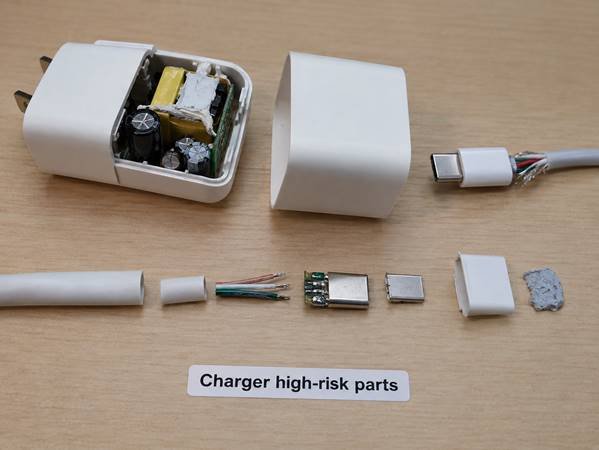
Take apart an ordinary USB-C charging cable, the soft PVC sheath from the outside to the inside, the internal insulation layer, the interface solder joints, the metal plating, plus the plastic shell of the charger and the internal thermal conductive adhesive, are all components that deserve priority attention during Prop 65 risk assessment. There are also two easy-to-miss places: the label ink on the packaging and the coating of the product storage bag. If sold to California, substances such as lead and phthalates involved in these places may also trigger Prop 65. Many sellers only check the product itself and end up falling into the pit on the packaging.
Clarification of Common Misconceptions
Finally, let us clarify a few most easily misunderstood misconceptions. Many people fall into pitfalls because of these wrong perceptions:
Misconception 1: Prop 65 is a federal regulation, and a warning means the product is toxic
Clarification: Prop 65 is only mandatory in California, not a federal regulation applicable to the entire US. Its warning indicates that the enterprise provides statutory risk notification for the possible exposure to listed chemical substances caused by the product; it does not necessarily prove the content of the substance in the product, the actual exposure level, or whether the exposure exceeds a certain safe harbor level.
Enterprises sometimes provide warnings for reasons such as avoiding litigation or lacking complete exposure data. A warning does not mean that the product violates any product safety standards, nor does it mean that consumers will definitely get sick as soon as they come into contact with it.
Misconception 2: TSCA only manages industrial chemical raw materials, not charging consumer electronics
Clarification: TSCA is indeed not only related to industrial chemical raw materials, and consumer electronics may be affected by certain TSCA rules. But complete chargers, cables, and adapters usually belong to articles, and it cannot be simply considered that all components of their internal plastics, metal plating, and adhesives need to be declared item by item by the finished product importer for Inventory or PMN.
A more accurate statement is: if an enterprise imports chemical substances or mixtures themselves, it needs to judge the TSCA inventory, notification and certification requirements; if it imports complete consumer electronics products, it should judge whether there are specific rules clearly applicable to the article, use, or substances in it.
Misconception 3: Complying with one regulation is enough, TSCA compliance = Prop 65 compliance
Clarification: The control logic of the two regulations is completely different. TSCA focuses on the requirements for the production, import and specific uses of chemical substances, and Prop 65 focuses on whether it causes exposure to listed chemical substances and whether a warning should be provided.
Even if a certain substance meets TSCA requirements, as long as the relevant exposure caused by the product in California requires a warning, the Prop 65 obligation must still be fulfilled. Conversely, providing a Prop 65 warning cannot replace the applicable requirements under TSCA. Therefore, the two regulations should be evaluated separately and cannot replace each other.
Misconception 4: If there are no California orders, you do not need to care about Prop 65 at all
Clarification: Even if your current customers are not in California, you cannot be completely careless: dealers may resell the goods to California, third-party warehouses may transfer goods to California, and the nationwide delivery of e-commerce platforms may also send goods to California buyers. As long as the product flows into California and causes relevant exposure, it may involve Prop 65 liability.
It is recommended to leave as much room as possible when selecting materials, for example, prioritize cables with low phthalates, so that you do not have to rework all of them when you expand the California market in the future.
Misconception 5: Test reports can directly prove compliance with both regulations
Clarification: Many people think that a harmful substance test report can prove compliance with both regulations at the same time, but that is not right. Especially for Prop 65, its core of judgment is “actual human exposure”, while ordinary test reports measure “total content in the material” — high total content does not mean high exposure. For example, lead is sealed in hard plastic, and may not form exposure requiring a warning under normal and reasonably foreseeable contact scenarios; conversely, if the total content is low, but it is easy to wear and shed debris or migrate, the exposure level may also require further evaluation.
Therefore, a content test report alone cannot directly prove Prop 65 compliance, and it must be combined with exposure assessment.
In addition, the test report is only responsible for the submitted samples. If the supplier changes the material or the production process changes, the previous report may not be able to represent subsequent products. Detecting harmful substances does not necessarily mean violation, and not detecting them does not mean permanent compliance. It must be judged in combination with the test method and sample representativeness.
Summary
Finally, we condense the core content of this article into 4 things you can use right away:
First, quickly judge the combination of regulations that charging products need to evaluate based on the sales region and product type — when selling to California, focus on the Prop 65 warning obligation; when TSCA is involved, first distinguish whether the imported goods are complete finished products, or chemical substances and mixtures themselves.
Second, always remember the core logic of the two regulations: Prop 65 is California’s “warning obligation”, and TSCA is the federal management of the production, import and specific uses of chemical substances. Do not confuse the compliance requirements of the two.
Third, when doing basic compliance self-inspection, first focus on high-risk components such as soft PVC cables, solder, interface plating, flame-retardant shells, and thermal conductive adhesives, and do not miss easy-to-ignore places such as packaging ink and storage bag coatings.
Fourth, when looking at supplier declarations and test reports, do not be fooled by empty words such as “compliant with US regulations” and “non-toxic and environmentally friendly”. You must confirm the specific regulations, covered substances and product scope, and conduct regular reviews in combination with material changes, regulation updates, and actual sales methods.