
If you sell chargers via cross-border e-commerce and are asked to provide a CE DoC when listing products on Amazon Europe sites, then asked for FCC authorization documents when expanding to the US site, you may feel confused: aren’t these both “certification certificates”? Why can’t they be used universally? Even many ordinary consumers, when buying USB-C cables or wireless chargers, see the CE and FCC marks on products and mistake them for “official quality certifications”, assuming that products with these marks are definitely good.
In fact, these two types of documents are completely different in nature, regulatory logic, and scope of application. Even the term “FCC certificate” is inaccurate — the FCC has two entirely distinct compliance pathways, and many people fall into pitfalls precisely because they do not understand these basic concepts. In this article, we will take commonly encountered products such as chargers, USB-C cables, data cables, power adapters, and wireless chargers as examples to thoroughly explain the differences between CE declarations of conformity and FCC authorization certificates. Whether you are an ordinary consumer, a new cross-border seller, or a novice in procurement, you will be able to understand the content and assess compliance risks on your own.
First, Understand Their Core Positioning: They Are Not the Same Type of “Certificate”
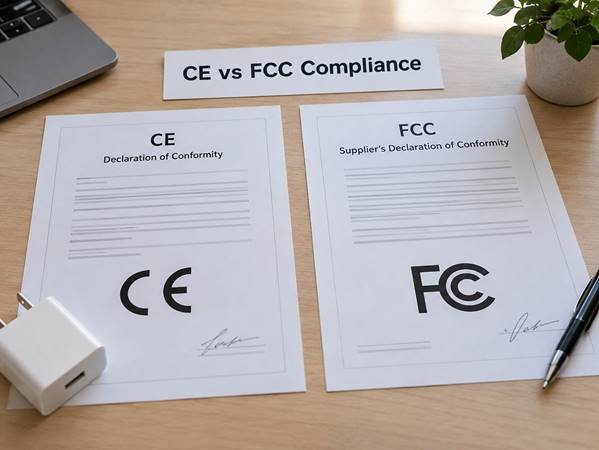
The first common misconception about these two types of documents is that they are both “officially issued certification certificates”. In reality, they are vastly different in nature.
First, looking at CE-related documents: their full name is EU Declaration of Conformity (EU DoC). It is not a certificate issued by EU authorities, but a compliance commitment document issued by the manufacturer under its sole responsibility, equivalent to the manufacturer vouching for itself that “my product complies with all applicable EU regulatory requirements”. The manufacturer may entrust its EU authorized representative to perform relevant obligations on its behalf through written authorization; the statutory obligations of responsible economic operators such as importers do not mean they can replace the manufacturer to issue the DoC on their own. The CE mark we usually see on products is a visual mark typically affixed to the product or its data nameplate; only when such marking is impossible or unnecessary due to the nature of the product may it be affixed to the packaging and accompanying documents. The DoC is the legal document behind this mark — affixing the CE mark arbitrarily without a DoC is illegal. For ordinary charging products such as wired chargers and passive data cables, most are self-certified for compliance by enterprises, and do not require unit-by-unit approval from EU authorities.
Now looking at the FCC side: never generically refer to relevant documents as “FCC certificates”, because there are two completely different compliance pathways:
The first is called SDoC (Supplier’s Declaration of Conformity), which is similar to the CE DoC. It is also a self-certification of compliance by the enterprise, with no unified public inquiry portal and no FCC ID. The enterprise only needs to keep test reports and declaration documents on file and produce them during regulatory spot checks.
The second is called Certification, which has stricter requirements. It requires review of materials by an FCC-recognized third-party certification body (TCB for short). After approval, a unique FCC ID will be generated in the FCC’s official database, which the public can directly query.
Some people may ask: why must charging products undergo these compliance procedures? Charging products with switching power supplies, digital circuits, wireless or other electronic functions often involve corresponding electromagnetic compatibility, radio, or safety compliance requirements; whether pure passive cables and some devices fall within the scope of specific regulations or device authorizations must be assessed on a case-by-case basis according to product attributes, applicable regulations, and exemptions. Corresponding compliance documents may be required during customs clearance, e-commerce platform audits, or local market regulatory spot checks; for products subject to mandatory requirements, this is not optional.
Scope of Application and Regulatory Boundaries: They Cannot Be Used Across Markets at All
After clarifying the essential differences, let’s look at their respective scopes of application and regulatory logic — this is also where beginners most easily fall into pitfalls. Many people assume that obtaining one of them makes it valid globally, which is completely wrong.
Scope and Regulatory Logic of CE
CE covers the 27 EU member states plus Norway, Iceland, and Liechtenstein in the European Economic Area, totaling 30 countries. Its regulatory logic is to match corresponding regulations according to product attributes; there is no unified “CE certification package” — not all products undergo the same CE procedures. Applicable regulations must be determined based on the product’s voltage, whether it has electronic circuits, and whether it has wireless functions. The two most common types of regulations for ordinary charging products are: one is the Low Voltage Directive (LVD for short), which governs electrical safety, such as electric shock protection and fire prevention; the other is the Electromagnetic Compatibility Directive (EMC for short), which ensures that products do not randomly emit electromagnetic signals that interfere with other devices when operating, and also do not malfunction due to interference from other devices.
Scope and Regulatory Logic of FCC
The scope of application of the FCC is only the United States (including its territories, such as Puerto Rico, Guam, etc.), and is not recognized by other countries. Its core regulatory focus is radio frequency (RF) interference from electronic devices, and it divides regulated devices into two categories: one is “unintentional radiators”, that is, products that are not designed to emit radio waves, but incidentally generate electromagnetic signals during operation, such as ordinary wired chargers; the other is “intentional radiators”, which intentionally emit radio signals to achieve their functions, such as smart chargers with Bluetooth. Not all electronic devices require FCC authorization; it is first necessary to determine whether the product falls within the scope of FCC-regulated devices.
Why Can the Two Not Replace Each Other at All?
CE and FCC are completely different in legal basis, testing standards, labeling requirements, and responsible parties. There is no such thing as a globally valid certification, and they absolutely cannot be used across markets — if you use CE documents to list products in the US, or use FCC documents to sell products in the EU, you will definitely fail the audit. However, there is one flexible point: if the test data of the same product meets the standards of both sides, the raw data of the test report can be reused, but the final compliance declaration and authorization documents must be issued separately.
Common Scenarios Where Applicability Conclusions Change
Compliance requirements are not static. When product attributes change, the compliance pathway must also be adjusted:
• If a product adds wireless communication functions such as Bluetooth, Wi-Fi, or cellular networks, the FCC SDoC pathway is no longer applicable; it must be upgraded to Certification, and compliance is only achieved upon obtaining an FCC ID.
• If selling to other countries and regions such as the United Kingdom, Canada, or Japan, it is also necessary to supplement the compliance requirements of the corresponding market according to the destination and product attributes: for the UK, regions must be distinguished. For many applicable products in Great Britain, CE or UKCA can be used; Northern Ireland generally applies CE, and in specific cases, CE plus UKNI is required. For Canada, ISED Canada requirements should be checked according to product attributes; for Japan, Radio Law certification and other applicable safety requirements should be checked. A single document cannot be applied indiscriminately based only on the country name.
Here we specifically mention the special situation of the UK market (not a core comparison item): currently, most products in Great Britain still recognize the CE mark, and the UKCA mark can also be used; Northern Ireland applies EU commodity rules, and the CE mark can generally still be used. However, regulations after Brexit have been constantly adjusted, and specific requirements shall be subject to the latest requirements at the time of sale.
Who Bears the Responsibility? Clarify Obligations of Different Roles
Compliance is not just about preparing documents and being done with it. It is crucial to understand who bears responsibility when problems arise, especially for cross-border sellers — do not take undue responsibility unknowingly.
CE Responsibility Division
The primary responsibility for CE compliance always lies with the manufacturer — no matter which country the manufacturer is from, as long as the product bears the CE mark and is sold in the EU, you are fully responsible for the product’s compliance.
If a non-EU product is sold in the EU, there must be an economic operator within the EU. This role can be an importer or an EU authorized representative (that is, an entity entrusted within the EU to handle compliance matters), and different roles have different obligations: importers must verify the validity of compliance documents; EU authorized representatives can only handle matters within the scope of written authorization; distributors must keep product traceability information to facilitate regulatory traceability.
Responsibility Division for the Two FCC Pathways
The two FCC pathways also have different responsible parties:
• Under the SDoC pathway, the US responsible party (which can be a US-based manufacturer or a US importer) declares compliance on its own and bears full responsibility. The regulatory method is post-market spot checks — you will not be proactively inspected normally, but once a non-compliance is found during a spot check, penalties will be severe.
• Under the Certification pathway, although the TCB reviews materials in advance, the ultimate responsible party is still the applicant. It is not the case that the TCB bears responsibility once it has reviewed the materials.
Responsibility Boundaries for Cross-Border E-Commerce Sellers
Many friends engaged in cross-border e-commerce have questions: I just sell goods, why does the platform require me to provide compliance documents? This is because platforms such as Amazon usually require sellers to provide compliance documents as the responsible party. Especially for sellers in the EU market, you must ensure that the DoC you hold is genuinely signed, the applicable standards are currently valid, and the marks on the product are correct.
Here is a special reminder for sellers engaged in dropshipping or reselling of existing listings: directly forwarding old documents provided by factories, documents for other models, or unsigned declarations will most likely be rejected by platform audits, and may even lead to delisting and fines due to non-compliance.
How to Determine the Compliance Pathway for Charging Products? 5 Steps to Avoid Pitfalls
Many beginners feel overwhelmed when they hear about compliance, thinking there are too many regulations to remember. In fact, there is no need for rote memorization. Just follow the logic of “first determine the market, then match layer by layer according to product attributes” in 5 steps, which can also avoid being misled by service providers into unnecessary procedures.
Step 1: First determine the target sales market. This is the most basic prerequisite. For sales to the EU/EEA, follow the CE compliance system; for sales to the US and its territories, follow the FCC system. For other markets, it is also necessary to supplement the compliance requirements of the corresponding region. Do not assume one set of documents works for all markets.
Step 2: Check the voltage and power supply method. This is the core basis for determining CE applicable regulations: if the rated input or output of the product is within the range of 50-1000V AC or 75-1500V DC, it usually needs to comply with the EU Low Voltage Directive (LVD); if it is a pure passive cable (without any electronic components inside, such as ordinary USB-A to USB-C cables), CE compliance requirements will be greatly reduced. It is necessary to assess one by one whether it falls within the scope of corresponding regulations, and do not blindly complete the full set of procedures.
Step 3: Check whether there are digital/electronic circuits. This is the basis for determining FCC applicability: as long as the product has electronic circuits or digital functions, it is first necessary to determine whether it is an FCC-regulated device; if it is a pure passive product without any electronic components, it usually does not fall within the scope of FCC mandatory authorization. Here, note a common misconception: for USB-C cables with E-Marker chips, certification is not mandatory just because there is a chip. It must be judged in combination with the function of the chip and the overall attributes of the product. Do not be misled into wasting money unnecessarily.
Step 4: Check whether there are active wireless communication functions. Functions that actively emit radio signals, such as Bluetooth, Wi-Fi, and cellular networks, will directly increase compliance requirements: for CE, compliance with the Radio Equipment Directive (RED) is required, and compliance documents for wired products cannot be used directly; for FCC, the pathway will be upgraded from SDoC to Certification, and an FCC ID is mandatory. There is also an easily overlooked boundary here: even if the wireless module you use has been pre-certified, after the finished product is assembled, it is still necessary to recheck whether the configuration of the final product meets the requirements. It is not the case that a pre-certified module makes the whole product automatically compliant.
Step 5: Special judgment for wireless power transfer (i.e., wireless chargers). If the product is only used to transmit energy and has no communication function, as long as the operating frequency is greater than 9kHz, it must comply with the requirements of FCC Part 18 and/or Part 15. Here, it is also necessary to distinguish: Qi is a compatibility certification for wireless charging, which solves the problem of whether wireless chargers and mobile phones of different brands can charge normally. It cannot replace the mandatory compliance requirements of CE and FCC. Do not confuse the two.
For your quick reference, I have sorted out the general compliance pathways for common charging products. Beginners can first refer to this table, but specific situations shall be subject to the actual parameters of the product:
| Common Charging Products | General CE Compliance Requirements | General FCC Compliance Requirements |
| Pure passive USB/USB-C cables | Assess corresponding regulations as needed, no mandatory unified requirements | Usually no mandatory authorization required |
| Wall-mounted wired chargers/power adapters | Cover LVD, EMC, RoHS when voltage is within the applicable range, DoC required | Need to determine whether it is an FCC-regulated device and whether exemptions apply; SDoC or other corresponding procedures may apply when it has regulated digital or RF functions |
| Smart chargers with Bluetooth/Wi-Fi | Must comply with the RED Directive, DoC required | Must follow the Certification pathway, with FCC ID |
How to Verify the Authenticity of Compliance Documents? Four-Layer Verification Logic Is Sufficient
When you get compliance documents from a supplier, do not just check the model and assume there is no problem. There are many pitfalls such as fraudulent certificate use and fake documents. Verifying according to the four-layer logic can avoid more than 90% of problems. Beginner users should at least verify the first three layers; the fourth layer is an advanced requirement, suitable for brand owners and large sellers for in-depth verification.
Before explaining the verification logic, let’s first compare the mandatory information of the three types of core compliance documents. When you get a document, first check if there are any missing items:
| Document Type | Core Mandatory Information |
| CE Declaration of Conformity (EU DoC) | 1. Product name, complete model/identifiable series number<br>2. Name and address of the manufacturer or its authorized representative; if required by other regulations, information of the corresponding EU responsible economic operator shall also be indicated on the product, packaging, accompanying documents, or distance sales information<br>3. List of compliant EU regulations, testing standards, name and position of the signatory, date of signing |
| FCC SDoC document | 1. Product identification information<br>2. Name and contact address of the US responsible party<br>3. Applicable FCC rules, compliance statement, corresponding testing basis |
| FCC Certification (FCC ID authorization) | 1. Unique FCC ID, applicant name, product model, device type<br>2. Technical parameters such as authorization date, frequency bands, power<br>3. Test report, product photos, label samples, usage restriction notes |
Next is the four-layer verification logic:
Layer 1: First verify the validity of the legal document or authorization record itself. The CE DoC must have a legal signing entity; it cannot be a randomly printed piece of paper or a document without traceable signing information. The DoC should include information such as the signatory’s name, position, place and date of issue, and signature; whether a company seal is affixed is not a unified statutory mandatory requirement. For FCC Certification, directly use the FCC ID to query in the FCC’s official database. If it cannot be found, there must be a problem.
Layer 2: Verify the supporting validity of the test report. The test report is the core evidence of compliance. It should correspond to the product or applicable series, version, and test sample configuration, and check whether the adopted standards or technical specifications are applicable to the product. Special attention should be paid here: the test report only proves that the submitted test samples meet the requirements under test conditions. It is evidence, not the market access document itself, and cannot be directly used as a compliance certificate. A document cannot be automatically deemed invalid just because the standard cited in the report is not the latest version; the key also depends on applicable regulations, standard transition status, and the actual compliance of the product.
Layer 3: Verify the consistency between the product and the document. The product’s model, nameplate, mark, as well as hardware and software configurations, must correspond to the coverage scope of the document and test samples. Different model suffixes do not necessarily mean fraudulent certificate use, but the supplier must be required to explain the series coverage relationship, equivalence, or change assessment evidence; model differences without reasonable evidence support are high-risk signals.
Layer 4: Verify evidence of mass production consistency. This is an advanced requirement: if key components (Bill of Materials, BOM), printed circuit boards (PCBs), wireless modules, rated power, software versions, etc. of the product change during mass production, it is necessary to assess whether the completed compliance judgment is affected. If the change affects compliance, supplementary testing shall be conducted and technical documents and DoC shall be updated, or corresponding change or new authorization procedures shall be handled in accordance with FCC rules. Changing factories, modifying enclosures, or adjusting parts and components does not necessarily automatically invalidate the original document, but it is also necessary to confirm whether production control and product configuration are still within the coverage of the original compliance assessment.
If you find the four-layer logic too complicated, beginners can first conduct quick verification according to these 5 steps, in descending order of priority:
Step 1: First check whether the product model, version, and document coverage correspond; when there are model variants, request evidence of series coverage, equivalence, or change assessment.
Step 2: Confirm that the document type matches the sales market and product attributes. For example, products sold to the EU must have a CE DoC, and Bluetooth-enabled products sold to the US must have FCC Certification — you cannot make do with SDoC.
Step 3: Check whether the responsible party information on the document is complete and traceable. It cannot just have a company name without even an address or contact information.
Step 4: If there is an FCC ID, check its authenticity in the official database; for CE documents, check whether the signing entity is a real and legal entity.
Step 5: Confirm that when the product, production control, or applicable regulations and standards change, the corresponding impact assessment has been completed; if compliance is affected, supplementary testing, document update, or corresponding change procedures shall be carried out. Do not directly draw a conclusion of “valid” or “invalid” based only on the document date, standard version, or model suffix.
Do Not Stick Product Labels Arbitrarily: Mistakes May Lead to Returned Shipments and Fines
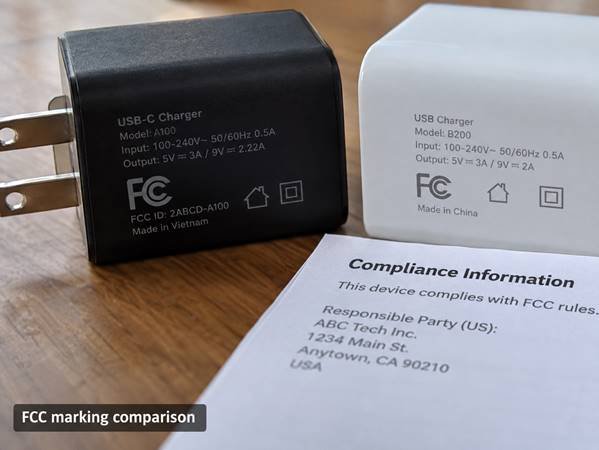
Many people think that compliance only requires having documents, and it doesn’t matter if the marks on the product are stuck casually. This is completely wrong — labels are the first checkpoint of regulatory spot checks. Incorrect labeling may directly lead to returned shipments and fines by customs, or rejection by the platform.
First, look at the rules for using the CE mark: the graphic proportions of the CE mark have official specifications, with a height of at least 5mm (small-volume products can be reduced according to exception clauses). It must be clear and indelible, and affixed to the product body or nameplate. Two situations are most taboo: first, the product does not comply with the corresponding CE regulations at all, and the CE mark is affixed without authorization; second, the mark has distorted proportions, is stretched and deformed, and looks like it was printed with a randomly found image.
Now look at FCC marking and information requirements, which differ between the two pathways:
• Products following the Certification pathway with an FCC ID must have the FCC ID marked on the product, and the mark must be clearly legible;
• Products following the SDoC pathway are not required to mark the FCC ID, but must provide compliance declaration information with the product that clearly points to the US responsible party, such as printed on the user manual or packaging.
For charging products, there are several points that require special attention:
• Products such as chargers and multi-port chargers shall be marked with necessary product identification and rated input and output information in accordance with applicable product safety standards, energy efficiency regulations, and local rules of the sales destination. Whether multi-port products must indicate per-port output capacity, combined output capacity, and total output capacity on the body, packaging, or user manual respectively shall be determined according to applicable standards and actual output modes;
• For small-volume products, such as data cables and mini chargers, that cannot print so much information on the product, the marks can be placed on the packaging or user manual according to the exception clauses of corresponding rules, and do not have to be forcibly printed on the product;
• The consequences of label errors are more serious than you think: they may lead to returned shipments and fines by US customs, detained goods during EU regulatory inspections, and rejection by e-commerce platform audits. Do not take it lightly.
Common Misconceptions and High-Risk Signals to Watch Out For
Finally, I have sorted out several of the most common misconceptions and high-risk signals of likely non-compliance. When you encounter them, you should be extra vigilant.
4 Most Common Misconceptions
1. Treating CE/FCC as quality certification: This is the most common misunderstanding. CE and FCC are essentially the minimum threshold for market access, that is, the minimum requirement for you to sell in this market. They do not represent fast charging speed, durability, or good quality. To judge product quality, it is also necessary to consider multiple dimensions such as specifications, brand, and after-sales service. Do not think a product is good just because it has a mark.
2. Equating the FCC mark with an FCC ID: Many products have the FCC logo printed on them, which does not mean they have an FCC ID — they may follow the SDoC pathway, or even be illegally printed. Especially for products with wireless communication functions such as Bluetooth and Wi-Fi, they are required to follow the Certification pathway and have an FCC ID. If you cannot find the FCC ID, you should be alert.
3. Treating test reports as market access documents: Test reports are supporting evidence for compliance, not the market access conclusion itself. They only cover the submitted samples and the test conditions at that time, do not directly prove that all mass-produced products are compliant, and cannot be used alone as market access documents.
4. Assuming a document is definitely valid if it is within its validity period: The “validity period” of compliance documents is based on the premise that the product remains unchanged. If the product is redesigned, such as changing the chip, replacing the wireless module, modifying the circuit, changing the power, replacing the enclosure, or even changing the production factory, it is necessary to re-assess whether these changes affect compliance; if they do, the original document may require supplementary testing, updating, or corresponding change procedures even if it has not expired.
High-Risk Signals of Likely Non-Compliance
When encountering the following situations, there is no need for further detailed inspection — they are most likely non-compliant:
• CE category: The CE mark on the product has distorted or deformed proportions, and a validly signed EU DoC and supporting technical documents cannot be provided;
• FCC category: There is no clear US responsible party information in the SDoC document, or products with wireless functions cannot produce an FCC ID;
• General category: A single document covers several unrelated product models, or the model does not match the actual product, and the product does not meet the requirements of applicable regulations at all but is arbitrarily affixed with CE/FCC marks.
How to Use This Guide for Different Roles? Quick Operation Manual
Different people focus on different points. Finally, I have sorted out quick operation points for different roles, which you can follow directly.
When ordinary consumers purchase charging products: First confirm that the plug, voltage, and power meet the usage requirements of your region. Do not buy the wrong product that cannot be used; for products with wireless communication or wireless charging functions, you can proactively ask the seller about the FCC authorization type; do not use the CE/FCC mark as the only purchasing criterion, after all, it is only the access threshold, not a quality certificate.
Before new cross-border sellers/importers list products: Be sure to prepare corresponding compliance documents according to the sales destination, and absolutely do not use them across markets; do not directly use old documents provided by suppliers, documents for other models, or unsigned declarations — they will most likely fail the audit; the platform may require compliance declarations, test materials, pictures of product or packaging labels, user manuals, responsible party information, or other documents. The materials listed in the specific site, category, and compliance request shall prevail, and preparing them in advance can save a lot of trouble.
When brand owners/procurement staff verify supplier compliance: Require suppliers to provide a complete document package that is traceable and corresponds to the model. Focus on verifying the coverage of wireless functions, rated power, and model variants, and do not miss key items; it is best to write the responsibilities for document update and mass production consistency into procurement agreements to avoid no one taking responsibility when problems arise later.
Overall, after reading this article, you should already be able to independently conduct many compliance judgments: you can distinguish the essential differences between CE declaration of conformity, FCC SDoC, and FCC Certification, and no longer generically call them “certification certificates”; you can also judge the compliance pathway of common charging products by yourself according to the logic of “market → voltage → electronic circuit → wireless communication → wireless power transfer”, without being misled by service providers into unnecessary procedures; you can also identify common risks such as fraudulent certificate use and fake marks through multi-layer verification logic, understand the applicability boundaries of CE and FCC, and will not make the mistake of using documents across markets; finally, you can quickly complete basic compliance verification and decision-making according to your own role.
Compliance seems complicated, but its core logic is actually very simple: different markets have different access rules. Match the corresponding requirements according to product attributes, and keep good evidence that can prove compliance, and you can avoid most pitfalls.