
Merchants doing business in the European market, whether in traditional foreign trade or cross-border e-commerce, almost always encounter the term “CE”. Some say it is the EU’s “entry pass”, some say it is a “high-end quality certification”, and others say you just need to spend a few hundred yuan to buy a certificate and affix the label — it is not until goods are detained by customs or products are removed from platforms that they realize all their previous understanding was wrong.
CE compliance seems to have a low threshold, but in fact it is full of pitfalls: ranging from being required to rectify due to incorrect mark size, to triggering criminal liability for forging documents, the risks of different misconceptions vary vastly. Starting from basic concepts, this article clarifies common cognitive biases, practical traps, responsibility division, and special scenario issues all at once, helping you go from beginner to being able to independently judge the vast majority of CE compliance issues and avoid unnecessary losses.
1. First Understand the Core Boundaries of CE: Avoid Fundamental Misunderstandings
Before sorting out specific misconceptions, we first explain the basic definition and applicable boundaries of CE thoroughly, which is the starting point for all compliance judgments.
1.1 Plain-Language Definition and Core Positioning of CE
The name CE comes from the French Conformité Européenne, which means “European Conformity”, and is by no means the “China Export” rumored online — this is the most common rumor encountered by beginners, and also the entry point for many invalid “CE certificate” marketing campaigns.
The essence of CE is a mandatory compliance requirement for EU market access, not an officially endorsed quality grade certification. Its core logic is that the manufacturer self-declares that the product meets the EU’s basic bottom-line requirements for safety, health, and environmental protection. Regulatory authorities carry out random inspections with the CE mark as the core identification mark, rather than directly endorsing product quality.
1.2 Three Core Dimensions of CE Applicability
To judge whether a product needs CE compliance, you only need to draw boundaries from three dimensions, but all boundaries need to be confirmed in combination with specific product regulations, and there is no absolute rule applicable to all product categories.
Geographical Scope
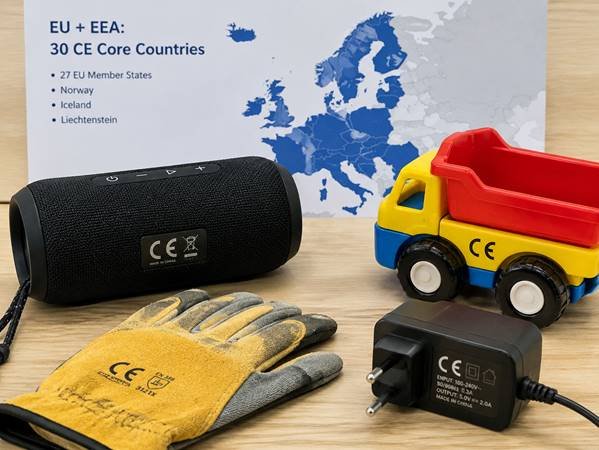
The core coverage area of CE is the 27 EU member states plus the European Economic Area (EEA, including Norway, Iceland, and Liechtenstein), totaling 30 countries, and it is not “universal across Europe”.
• Switzerland accepts CE compliance certificates that meet EU requirements for some categories, but it is still necessary to verify Switzerland’s own technical regulations, labeling requirements, and differentiated provisions, which cannot be directly equated with EU market access;
• Turkey accepts CE-related compliance certificates for some categories according to product categories and bilateral trade arrangements, and the specific local applicable systems need to be verified according to the target category;
• After Brexit, most categories in Great Britain have CE transition arrangements, but the specific deadline and scope of application shall be subject to the latest official rules of the UK government and corresponding product regulations; the applicable rules in Northern Ireland are different from those in Great Britain and need to be verified separately;
• Other non-EU European countries and non-European markets do not default to CE being universally applicable, and local access requirements need to be confirmed separately.
Product Scope
CE only covers categories regulated by corresponding directives/regulations, such as electronics, machinery, toys, personal protective equipment, etc.; food, pharmaceuticals, cosmetics, military products, civil aviation products, etc. are regulated by other special regulations, do not fall within the scope of CE coverage, and cannot be affixed with the CE mark at will, otherwise it will constitute a misleading mark.
Exemption Scenarios
CE has no exemption rules applicable to all product categories. All exemptions must meet the explicit conditions of the corresponding product regulations. Common possible exemption scenarios include:
• Small quantities of products for private personal use and non-commercial purposes: only refer to small quantities of items purchased by individuals from abroad for their own use only and not for sale or business operation; if used for commercial resale, even small parcels are not exempt;
• Second-hand/antique products: second-hand products that were originally compliant and have not changed their original design, safety functions, and intended use do not need to be re-assessed; the so-called “antique exemption” is only stipulated in some member states or specific regulations, and the age requirements are not uniform; there is no EU-wide “automatic exemption after 30 years” rule;
• R&D prototypes not placed on the market, samples only used for exhibition display and not for sale, and purely hand-made custom products for completely non-commercial purposes: may meet the exemption conditions of some regulations, but need to be checked against regulatory requirements category by category, and cannot be defaulted to full exemption.
1.3 General Process and Mode Classification of CE Compliance
CE compliance has a clear general process, which must be completed in sequence to form a closed loop: Identify applicable regulations and harmonized standards → Conduct risk assessment → Complete testing/conformity assessment → Prepare a full set of technical documents → Sign the Declaration of Conformity (DoC for short, a self-certification compliance document issued by the manufacturer) → Affix the CE mark in accordance with specifications. Labeling is the last step of compliance, which can only be carried out after all previous work is completed and compliance is confirmed. You cannot first affix the label and then supplement the documents.
Many people think that CE only has two modes: “self-declaration” and “third-party certification”, but this is not the case: the CE compliance mode is determined by the “conformity assessment modules” stipulated in the corresponding product regulations. The often-said “about 80% of categories can be self-declared by manufacturers” in the industry is only a general statement, not an official unified statistic of the EU. To judge whether the participation of a EU Notified Body (NB for short, a compliance assessment body authorized by the EU) is required, you must check the conformity assessment requirements of the corresponding product regulations, and cannot draw conclusions directly based on product labels such as “medical devices, pressure vessels” — some high-risk categories may also have different assessment paths, and the specific ones shall be subject to the modules stipulated in the regulations.
1.4 Core Division of Responsible Entities
The primary responsibility for CE compliance always rests with the manufacturer, regardless of whether the manufacturer is located within the EU. The specific obligations of importers, distributors, and EU authorized representatives (referred to as “EU reps”, which are the statutory responsibility liaison entities designated by non-EU manufacturers within the EU) within the EU are determined by the applicable product regulations and their roles in the sales chain. There is no “choose one between EU rep or importer” rule applicable to all categories:
• Some product regulations explicitly require non-EU manufacturers to designate an authorized representative within the EU. In this case, the importer cannot replace the statutory duties of the authorized representative;
• The importer bears joint and several compliance liability, rather than replacing the manufacturer’s primary responsibility;
• Ordinary warehousing and fulfillment service providers (such as Amazon FBA) only provide logistics and warehousing services, and will not automatically become authorized representatives or importers by providing delivery services. The duties of the three cannot be mixed.
2. Cognitive Misconceptions: The Most Common Directional Errors
Many people fall into CE pitfalls not because of operational errors, but because their fundamental cognition is biased. Such directional errors often cause the greatest losses.
2.1 Misconception: CE is a mandatory third-party certification, and you must find an institution to issue a certificate
Misconception manifestation: Thinking that all products need a “CE certificate” issued by a third-party institution to be compliant, and that you can just find any institution and pay for a certificate.
Correct explanation: The CE system takes manufacturer self-declaration as the core, and only categories or assessment modes required by some regulations need the participation of NB institutions. Third-party test reports for low-risk products are only technical supporting documents and cannot replace the legal effect of the DoC.
Judgment method: Check the conformity assessment modules of the corresponding product directives to confirm whether NB intervention is mandatory. Do not be misled by marketing slogans such as “guaranteed CE certification” and purchase invalid “CE certificates”.
2.2 Misconception: The CE mark is proof of high quality/absolute safety
Misconception manifestation: Treating CE as a quality grade certification, thinking that products with CE are high-end products and will absolutely never have safety problems.
Correct explanation: CE is the EU’s minimum safety compliance threshold, which only requires products to meet basic safety, health, and environmental protection requirements. It does not represent performance or quality grade, nor can it completely eliminate all risks.
Comparison of easily confused certifications:
• ISO9001: It is an enterprise quality management system certification, which is voluntary. It proves that the enterprise’s management process meets the standards, and does not directly prove that the product itself is compliant;
• GS: It is a German voluntary safety certification, with more detailed requirements for product safety than CE, but it is a voluntary certification and cannot replace the mandatory access requirements of CE.
Common pitfall: Merchants using “CE certification” to promote high-quality products is misleading to consumers.
2.3 Misconception: All products sold to Europe need CE compliance
Misconception manifestation: Doing CE compliance for all products regardless of type, or thinking that without CE you absolutely cannot enter the EU.
Correct explanation: Only products covered by CE directives/regulations need CE. Categories not covered do not need and cannot be affixed with CE at will, otherwise they will be punished as misleading marks.
Quick judgment method: Use the EU official product compliance classification tool to query the category attribution and confirm whether it is within the scope of CE regulation.
2.4 Misconception: With CE, you can enter all European countries
Misconception manifestation: Thinking that CE is a universally applicable access mark across Europe, and that with CE you can sell to any European country at will.
Correct explanation: CE only covers 30 countries (EU + EEA), and is not universal across Europe. Many European countries have their own mandatory access requirements.
Common exceptions: Great Britain in the UK requires UKCA (UK mandatory access mark), and only some categories can continue to use CE during the transition period, subject to the latest official rules; Switzerland does not default to CE being universal, and its own requirements need to be verified separately; some non-EU Eastern European countries have their own mandatory certification requirements.
2.5 Misconception: CE and certifications from other countries/systems are mutually recognized
Misconception manifestation: Thinking that with CE you don’t need to do certifications for other countries, or that certifications from other countries can replace CE.
Correct explanation: CE is a product access requirement unique to the EU. It is independent of and not mutually recognized with certifications from other countries/systems, and cannot replace each other.
Common easily confused comparisons:
• UKCA: The mandatory access mark for Great Britain in the UK. Only some categories can be replaced by CE during the transition period, subject to the official UK rules;
• FDA: The regulatory system for food and drug-related products in the United States, completely independent of CE, and cannot replace CE;
• CCC: China’s mandatory product certification, not mutually recognized with CE, and cannot replace CE;
• ISO series: Voluntary management systems or technical standards, not product access certificates, and cannot replace the compliance requirements of CE.
Common pitfall: Suppliers use other certifications as CE compliance certificates to mislead buyers.
3. Practical Misconceptions: Specific Pitfalls in Compliance Operations
Even if you understand the basic logic of CE, there are many easily overlooked details in practice, and you may fall into pitfalls if you are not careful.
3.1 Misconception: You only need to affix the CE mark, no need to prepare documents
Misconception manifestation: Just printing a CE label and sticking it on the product, thinking that it is compliant.
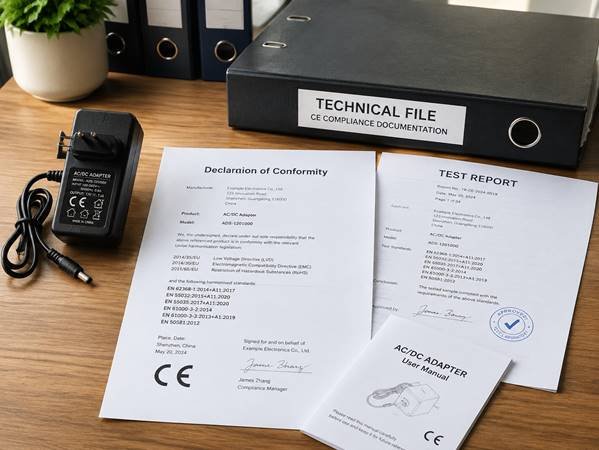
Correct explanation: During regulatory random inspections, technical documents and DoC will first be required. If they cannot be provided, non-compliance will be directly determined. Technical documents are not only test reports, but also include product design drawings, risk assessment reports, compliance judgment processes, user manuals, etc., which can fully prove how the product meets regulatory requirements. Most CE directives require technical documents to be kept for 10 years after the last batch of products is placed on the market, and the specific duration varies slightly by category.
Common pitfall: Casually modifying a DoC using an online template, where the product parameters and applicable regulations do not match the actual product at all, and it will be exposed as soon as it is checked.
3.2 Misconception: One “CE certificate” can cover all models/batches
Misconception manifestation: Using one “CE certificate” for the entire product series, regardless of differences in models and configurations.
Correct explanation: Test reports or NB certificates only correspond to the specific samples, models, configurations, and test conditions tested at that time, and cannot automatically cover all variants. As long as the product model, key components, or core functions change, compliance needs to be re-assessed.
Common pitfall: The certificate provided by the supplier only covers the 10W basic charger, and the actually sold 65W fast charging version is not within the scope of the certificate at all.
3.3 Misconception: CE is valid for life once done
Misconception manifestation: Thinking that once you get CE-related documents, they are valid forever and you don’t need to worry about them anymore.
Correct explanation: CE has no fixed “validity period”, and its compliance is dynamic: as long as the product remains unchanged, the applicable regulations and standards remain unchanged, and no new safety risks are discovered, it remains valid; but as long as the following situations occur, re-assessment is required:
• Changes in product design, structure, or key components;
• Updates to applicable directives or harmonized standards;
• Discovery of new safety risks or issuance of relevant notifications by regulators.
3.4 Misconception: “CE certificates” issued by institutions without NB qualifications are compliance vouchers
Misconception manifestation: Just finding a domestic laboratory to issue a report with a CE stamp and using it as a compliance voucher.
Correct explanation: Reports with the CE mark issued by non-EU NB institutions are only ordinary test certificates and do not have EU official validity. Only certificates issued by EU-authorized NB institutions have official validity in the statutory assessment procedures for high-risk categories. For low-risk categories, there is no need for any “CE certificate” at all; it is sufficient for the manufacturer to issue a DoC by itself, and there is no need to spend money on “CE certificates” from non-NB institutions.
Verification method: Query the institution’s qualifications and authorization scope through the EU’s official NANDO database (EU Notified Bodies database) to confirm that the institution does have authorization for the corresponding category, otherwise the certificate obtained is also invalid.
3.5 Misconception: CE only covers finished products, components do not need to be compliant
Misconception manifestation: As long as the finished product has CE compliance, components can be purchased cheaply at will.
Correct explanation: If key safety components have corresponding CE directives, then the components themselves also need to meet the requirements, otherwise the CE compliance of the finished product is invalid. Finished product manufacturers have the responsibility to verify the compliance of key components and cannot purchase based solely on price.
Common pitfall: Using power cords and plugs without compliance certificates, resulting in the entire batch of electrical products being detained.
3.6 Misconception: The CE mark can be printed and reshaped at will
Misconception manifestation: Just finding a printing factory to print CE marks, and changing the size and proportion at will.
Correct explanation: The CE mark has strict official specifications:
• The letter proportion of the mark has unified requirements; it cannot be deformed, cannot have patterns added, and cannot be mixed with other marks;
• The minimum height is usually not less than 5mm, unless the product is particularly small, in which case it must still be clearly legible;
• When the applicable conformity assessment procedure requires the participation of a notified body, and the regulations explicitly require the notified body number to be marked next to the CE mark, the four-digit number of the corresponding NB shall be marked; the number must be consistent with the institution’s qualifications and authorization scope registered in the NANDO database, and cannot be added at will.
3.7 Misconception: A product only needs to comply with one CE directive/standard
Misconception manifestation: Thinking that one product only needs to correspond to one CE directive, for example, electronic products only need to comply with the Low Voltage Directive (LVD, which governs electrical safety).
Correct explanation: The same product may be subject to multiple CE regulations at the same time. When judging, you cannot only look at the product name, but must identify it in combination with all the product’s functions, uses, and target user groups.
Case explanation: A small speaker with Bluetooth function first belongs to radio equipment and is subject to the RED (Radio Equipment Directive). RED itself already covers the basic safety and electromagnetic compatibility requirements for radio equipment; whether it also needs to separately comply with the LVD (Low Voltage Directive) needs to be judged in combination with the product’s input voltage range, power supply structure, etc. You cannot default that all Bluetooth-enabled products must meet three independent directives at the same time.
Supplementary note: Harmonized standards are technical standards officially recognized by the EU. Compliance with harmonized standards can directly presume that the product meets the basic requirements of the corresponding regulations, but they only cover specific risks and cannot replace all regulatory obligations; if the standard version is updated, the product’s compliance also needs to be re-assessed.
Common pitfall: Products with the same name may have different applicable requirements due to differences in power, use, and user groups (for example, requirements for industrial and household equipment are different, and products promoted for children require stricter risk assessment).
4. Responsibility Misconceptions: Pitfalls of Not Knowing Who Is Liable
Many people fall into pitfalls because they think the compliance responsibility lies with others, and they just need to “go through the process” — when a problem really occurs, they realize that they are the first responsible party.
4.1 Misconception: Once a third-party testing institution is hired, the responsibility is transferred
Misconception manifestation: Thinking that once a laboratory is hired to do testing, the laboratory is responsible if there is a problem.
Correct explanation: Third-party institutions are only responsible for the testing or assessment work you entrust, and are responsible for the test results of the test samples, but the primary responsibility for product compliance always rests with the manufacturer. Whether the product design is compliant, whether the production is consistent with the test samples, and whether the documents are authentic are all the manufacturer’s responsibilities, and will not be transferred just because a third party is hired.
4.2 Misconception: Importers only need to check if there is CE on the packaging
Misconception manifestation: Importers only check if there is a CE mark on the outer box, and do not verify other information.
Correct explanation: Importers within the EU bear joint and several compliance liability, and it is not enough to just check the outer box mark. Importers need to verify whether the product’s CE mark is standardized, whether the manufacturer and importer information is complete, whether the DoC is authentic and valid, whether the manual and warning labels meet the requirements, and ensure that the manufacturer’s technical documents can be provided when required by regulatory authorities. The responsibility for preparing and mainly maintaining technical documents still rests with the manufacturer, and importers do not need to hold or review complete technical documents under all regulations.
4.3 Misconception: Distributors have no compliance responsibility
Misconception manifestation: Thinking that distributors only sell goods, and if there is a problem, just find the manufacturer.
Correct explanation: Distributors have verification obligations within a reasonable range — if they find that the product is obviously non-compliant (for example, no CE mark, serious lack of packaging information, obvious safety hazards), they cannot continue to sell. If a product is found to have problems, distributors need to cooperate with regulatory authorities in tracing, rectification, and recall, and cannot evade responsibility by changing packaging or brands, but they do not bear the manufacturer’s responsibilities for design and technical documents.
4.4 Misconception: Doing private label (OEM/ODM) does not require bearing responsibility
Misconception manifestation: Thinking that the product is manufactured by a factory and labeled with your own brand, so all compliance responsibility lies with the factory.
Correct explanation: As long as the product is sold under your brand, you will be regarded as the “manufacturer” and bear the primary responsibility for compliance. If you have also changed the product’s safety functions, key components, or intended use, you even need to redo the compliance assessment and cannot directly use the factory’s original documents.
4.5 Misconception: The EU rep bears all compliance responsibility
Misconception manifestation: Thinking that once you hire an EU rep, all problems are the EU rep’s business.
Correct explanation: The EU rep is only the responsibility liaison entity of non-EU manufacturers within the EU, responsible for receiving notifications from regulatory authorities and cooperating with inspections, and does not replace the manufacturer’s primary responsibility at all. It is also necessary to distinguish the duties of EU reps, importers, and fulfillment service providers: importers bear joint and several compliance liability, and fulfillment service providers only bear corresponding obligations according to the service contract. The three cannot be mixed, and the statutory responsibilities of manufacturers or importers cannot be exempted by designating an EU rep.
5. Scenario-Based Misconceptions: Exclusive Pitfalls for Different Scenarios
In addition to common pitfalls, different business scenarios have their own exclusive misconceptions, which are easily overlooked.
5.1 Three Common Misconceptions in Cross-Border E-Commerce Scenarios
Among merchants doing cross-border e-commerce, the most people fall into these three pitfalls:
1. Personal parcels/self-shipping do not need CE: As long as it is commercial sales, even personal parcels for dropshipping need to be compliant if found by customs; only small quantities of parcels for private personal use and non-commercial purposes are exempt. Don’t think that small parcels won’t be checked; the frequency of random inspections for high-risk categories is not low.
2. FBA shipping does not need an EU rep: If the corresponding product regulations require non-EU manufacturers to designate an authorized representative within the EU, then no matter what shipping method is used, it must be designated as required. Without compliant responsible entity information, the platform will directly remove the product, and customs will also detain the goods.
3. Platforms only need to submit a “CE certificate” to pass the review: Compliance reviews on e-commerce platforms usually require a full set of documents, including DoC, test reports, model parameters, and information on the responsible entity within the EU. For high-risk categories, an NB certificate is also required. The most common reason for rejection is that the model on the document does not match the model on sale, and the institution issuing the report does not have the corresponding qualification.
5.2 Two Common Misconceptions for Second-Hand/Refurbished/Antique Products
Merchants doing second-hand and refurbished business often can’t figure out whether they need to redo CE compliance:
1. All second-hand products need to redo CE: For originally compliant second-hand products, if the original design, safety functions, and intended use have not been changed, no re-assessment is required; but if the safety structure, core functions, or intended use of the product are changed during the refurbishment or modification process, compliance needs to be re-assessed. Whether it constitutes a “major modification” needs to be judged based on the corresponding product regulations, and conclusions cannot be drawn directly based solely on the type of replaced parts.
2. Antique products also need CE: There is no EU-wide “automatic CE exemption for antique products” rule. Only specific regulations in some member states have exemption arrangements for antique products that reach a certain age, and the age requirements vary from country to country. “30 years old” cannot be used as a unified judgment standard, and the specific regulations of the target country need to be verified in advance.
5.3 Two Common Misconceptions for Custom/Small-Batch Products
Merchants doing custom and small-batch products often mistakenly think they can be exempted:
1. Custom products do not need CE: As long as the product is commercially placed on the EU market, even if it is custom-made by the customer, it must meet CE requirements. Only non-standardized industrial equipment that is completely designed according to the specific requirements of professional customers and not sold to ordinary consumers may enjoy exemption or simplified procedures under some regulations. The specific provisions of the corresponding directives need to be checked category by category.
2. Small-batch products can be exempted from CE: The vast majority of CE directives do not have “small-batch exemption” clauses. Even if you only produce 1 product, it must be compliant. Only a few directives (such as the Machinery Directive) have simplified procedures for small-batch professional equipment, but this is not a rule applicable to all categories. Don’t exempt yourself.
5.4 Three Common Misconceptions in Software/Combination/Promotion Scenarios
For merchants doing smart products and system combination products, these three pitfalls are very hidden:
1. Software updates do not affect CE compliance: If a software update changes the product’s safety control logic, power parameters, communication functions, or protection mechanisms, it will affect compliance. For example, updating the firmware of a smart socket to add a remote control function, or modifying the overload protection threshold, requires rechecking compliance.
2. If individual components are compliant, the combined product is compliant: When power supplies, main units, accessories, and software are combined into a new system, new safety risks may arise (such as electromagnetic compatibility problems, safety hazards of system linkage). If you sell it as a complete system, you are responsible for the overall compliance, and cannot just use the compliance certificates of individual components to make up the numbers.
3. Promoted functions exceeding the intended use do not affect compliance: Functions promoted on the sales page will be regarded by regulatory authorities as part of the product’s “intended use”. If the promoted functions exceed the scope of the original compliance assessment, the original compliance certificate may not apply. For example, if you sell an ordinary household desk lamp and promote it as “suitable for eye protection in baby rooms”, it may change the target user and intended use of the product. You need to re-assess whether it triggers requirements related to children’s products, photobiological safety standards, or additional warning obligations, and cannot directly follow the original compliance assessment conclusion of ordinary desk lamps.
6. Cost of Violations: Risk Levels and Typical Consequences of CE Violations
Many people have no concept of the consequences of CE violations, thinking that at worst it’s just some goods being detained. In fact, the consequences of different levels of violations are very different.
6.1 Corresponding Consequences of Three Risk Levels
| Risk Level | Typical Violation Scenarios | Typical Consequences |
| Mild (low risk) | Non-standard mark size, non-core information defects in documents (such as typos in contact addresses), incomplete label information | Rectification within a time limit, supplementary and corrected documents, generally no temporary measures of goods detention or fines |
| Moderate (medium risk) | Lack of DoC, mismatch between test report and product, no compliance basis for low-risk products, failure to designate a responsible entity within the EU as required | Goods detention, fines (the specific amount is determined according to member state regulations, violation circumstances, goods value, and degree of harm), return/destruction of goods, removal from platforms |
| Severe (high risk) | Forging CE marks, high-risk products without compliant NB assessment, products with major safety hazards, intentionally providing false documents | Prohibition of placing on the market, withdrawal from market/recall, inclusion in the key supervision list; serious intentional fraud may trigger criminal liability |
Note: The EU does not uniformly stipulate the amount of fines, random inspection ratio, and recall costs. The specific penalty measures and intensity are determined by the competent authorities of member states according to product categories, violation circumstances, degree of harm, whether there is subjective intent, and local current regulations. The above are only references for common risk scenarios, and formal judgment requires querying the official regulatory rules of the target country.
6.2 Four Scenarios with the Highest Risk
CE violations are not only investigated and handled by customs; the risks in these four scenarios are all very high:
1. Customs and border random inspections: The random inspection ratio for different ports and categories is dynamically adjusted by local regulatory authorities according to risk levels. The frequency of random inspections for high-risk categories such as children’s products and electrical products is significantly higher. If non-compliance is found, measures such as goods detention, requirement for correction, return, and destruction may be taken, and information on the responsible entity within the EU will also be required.
2. Market supervision random inspections: Implemented by the competent authorities of EU member states, which release key inspection categories from time to time. If a product is found to have safety hazards, it will be entered into Safety Gate (EU Rapid Alert System for Non-Food Consumer Products, formerly known as RAPEX), realizing the sharing of regulatory information among EU countries, which may trigger relevant member states to take measures such as restricting sales, withdrawing from the market, and recalling. The specific handling methods are determined by the competent authorities of each country in accordance with the law.
3. E-commerce platform review: The trigger may be the platform’s active random inspection, consumer complaints, or regulatory authority notifications. In mild cases, products are removed and funds are frozen; in severe cases, stores are banned, and multiple violations will be included in the platform’s blacklist.
4. Commercial and legal risks: In addition to regulatory penalties, you may also face commercial losses such as customer rejection, claims, recall costs, and damage to brand reputation; if the product causes personal injury or major property loss, you must also bear civil compensation liability, and intentional fraud may even trigger criminal penalties. If it is a problem in the upstream and downstream of the supply chain, the responsible parties can claim compensation from each other, but this will not reduce your direct responsibility in the face of regulation.
7. Pitfall Avoidance Tools: CE Compliance Self-Inspection and Decision-Making Process
Having talked about so many pitfalls, in fact, as long as you master a few basic judgment and self-inspection methods, you can avoid the vast majority of risks.
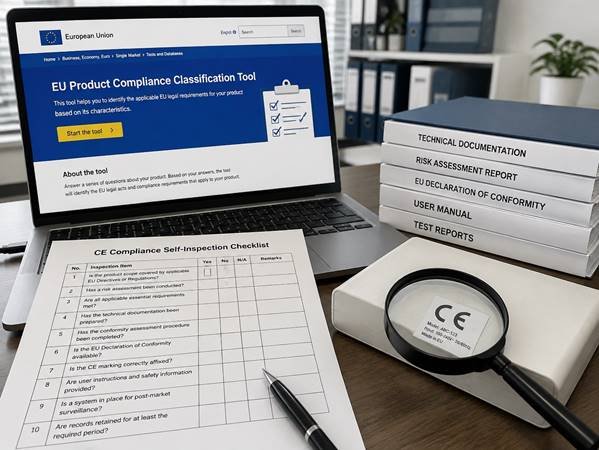
7.1 Three Steps for Basic Judgment: First Figure Out Whether to Do It and How to Do It
When encountering new products and new markets, first judge according to these three steps, don’t just go to an institution to get a certificate right away:
1. Judge whether the product needs CE compliance: First check whether the category is within the scope of CE directives (using the EU official product compliance classification tool), then check whether the target sales market recognizes CE. If the market does not recognize it and the category is not covered, there is no need to do it.
2. Judge whether you need to find an NB institution: First check the conformity assessment modules of the corresponding product regulations to confirm whether the participation of a notified body is mandatory. Do not draw conclusions directly based on the label of “high-risk category”. For low-risk categories, the manufacturer can complete the self-declaration, no need to spend wasted money.
3. Judge whether the responsible entities are complete: If the corresponding regulations require non-EU manufacturers to designate an authorized representative within the EU, it needs to be implemented in advance; at the same time, clarify the duty boundaries of roles such as importers and distributors to avoid finding that the responsible entity is missing only when going through customs or platform review.
7.2 Four Core Points for Compliance Document Self-Inspection: Judge Authenticity and Completeness
After getting the supplier’s compliance documents, don’t use them directly. Check them according to these four points, which can filter out the vast majority of fake and invalid documents:
1. Check the Declaration of Conformity (DoC): See if it includes manufacturer information, product model, applicable directives/standards, signature date, and whether all information is consistent with the actual product and sales page. If even the model does not match, it is directly invalid.
2. Check technical documents: Verify whether they include applicable risk assessment reports, product design and manufacturing materials, compliance descriptions of corresponding regulations and harmonized standards, test or calculation verification evidence, user manuals, production consistency related records, and all content must correspond to the actual product. The length of technical documents varies with product complexity and regulatory requirements, and compliance cannot be judged solely by the number of pages, but a separate test report cannot replace complete technical documents and DoC.
3. Check the CE mark: See if the height is not less than 5mm (except for special small products), whether the proportion is correct, whether it is clear and permanently affixed, and whether it is confused with other marks. If an NB number is marked, confirm whether it meets the requirements of the corresponding regulations, and the institution qualification corresponding to the number is verifiable.
4. Check the NB certificate (if any): See if the institution number can be found in the EU NANDO database, whether the authorization scope covers the corresponding product category and directive, and whether the model and version covered by the certificate are consistent with the actual product. Even if the institution is real, if the authorization scope does not cover your product, the certificate is still useless.
7.3 Quick Inspection Checklist for High-Risk Scenarios
If you encounter the following scenarios, be sure to check again, don’t find it troublesome:
• Typical high-risk categories such as medical devices, pressure vessels, and personal protective equipment: must check the qualification and authorization scope of the NB institution;
• Toy category: must check applicable harmonized standards, core safety requirements such as chemical/mechanical/combustion; only when harmonized standards are not fully adopted, standards cannot cover all risks, or regulations explicitly require third-party assessment, then check NB/third-party assessment requirements;
• Cross-border e-commerce sales: must check information on the responsible entity within the EU, platform review requirements, and consistency between documents and models on sale;
• Product has design/component/software changes: must check whether compliance needs to be re-assessed;
• Multi-market sales: must check the special access requirements of each market (such as UK UKCA, Swiss related certifications, etc.).
7.4 Basic Response Points for Being Randomly Inspected/Removed from Shelves
If you really encounter customs random inspection or platform removal, handle it according to the following points:
1. Sort out the full set of compliance documents as soon as possible: DoC, technical documents, test reports, and relevant agreements of the responsible entity within the EU, to ensure that the documents are authentic and consistent with the product;
2. Cooperate with the rectification requirements of regulators or platforms, do not conceal information, let alone provide false documents — the penalty for fraud is much more serious than non-compliance;
3. If safety defects are involved, timely assess whether a recall is needed. If you are unsure, be sure to consult a professional compliance consultant.
Summary
Mastering the core of CE compliance is never “buying a certificate”, but clarifying three basic judgments: whether the product is within the scope of CE coverage, whether the participation of a notified body is required, and whether the compliance documents and responsible entities are authentic and complete. All the cognitive biases, practical details, responsibility chains, and special scenario pitfalls mentioned in this article are essentially extensions of these three basic issues.
For entry-level practitioners, as long as you clarify the basic boundaries and avoid core pitfalls, you can deal with the vast majority of conventional scenarios; when encountering high-risk categories, regulatory updates, or product design/function changes, you should re-assess compliance in a timely manner, and consult a professional compliance consultant if necessary — the compliance cost invested in advance is far lower than the loss after falling into pitfalls.