
If you plan to sell charging products such as chargers, power adapters, USB charging cables, and plugs in India, BIS certification is unavoidable. Many people only know that they need to send samples to the laboratory for testing, but ignore the key link of “factory inspection” — at best, it delays the certification progress; at worst, the certification will be directly revoked, and the goods cannot even clear customs.
This article focuses on charging products and explains all core issues of BIS factory inspection thoroughly, from whether inspection is required, what to inspect, how to prepare, to how to avoid common pitfalls. Whether you are a novice just entering the Indian market or a practitioner looking to optimize compliance processes, you can find corresponding answers here.
First, understand: What exactly is BIS factory inspection?
First, two basic concepts need to be clarified:
The Bureau of Indian Standards (BIS for short) is the official Indian agency responsible for formulating national standards and implementing mandatory certification, similar to the standard certification regulatory authority in China.
Factory inspection is not a separate certification project, but a supporting link of BIS mandatory certification — to put it simply, BIS sends personnel (or authorizes third-party agencies) to the production factory site to verify whether mass-produced products can consistently meet the standards, rather than only relying on the submitted samples to “pass once”.
Many people confuse factory inspection with sample submission testing, but in fact, the two are completely different verification links:
Sample submission testing refers to sending the samples you submit to a BIS-recognized laboratory for testing to check whether the samples themselves are compliant, which belongs to “laboratory verification”;
Factory inspection is to visit the production site to check the entire production and quality control system to ensure that each batch of goods can reach the level of the samples, which belongs to “on-site verification”.
For products requiring ISI mark certification, the certification issuance process can usually only be entered after both sample submission testing and factory inspection meet the standards; for CRS registered products, initial registration usually focuses on testing by recognized laboratories and document registration, but after obtaining the certificate, they may still be subject to on-site verification due to complaints, safety risks or regulatory spot checks.
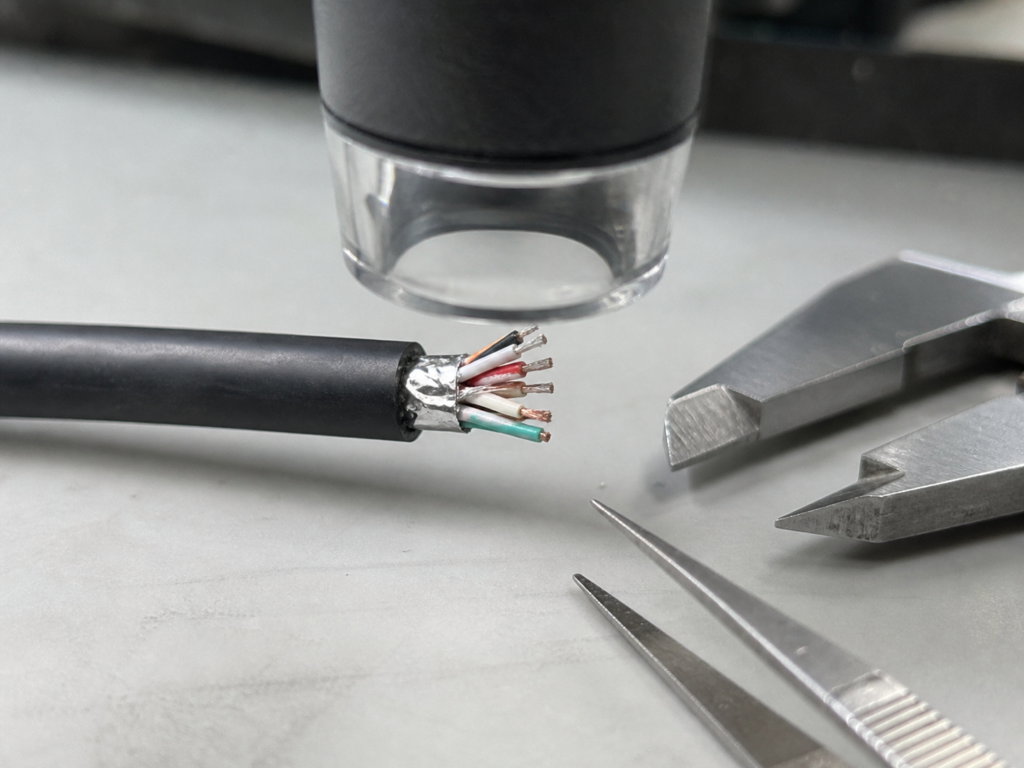
For charging products, factory inspection is of particular significance: chargers, plugs/power cord assemblies are usually directly connected to the power grid; although USB charging cables are not directly connected to the mains, they carry charging current and affect overheating, short circuit and fast charging safety. If you cut corners in mass production, for example, using thin copper wires to pretend to be thick wires, or using non-flame-retardant shells, it is very easy to cause fire and electric shock accidents. BIS controls the mass production pass through factory inspection, which is not only responsible for consumers, but also directly related to whether your products can clear customs smoothly, be listed on e-commerce platforms, and be sold legally in India.
Does your product need to undergo BIS factory inspection?
Whether factory inspection is required mainly depends on which BIS certification path the product takes and where the factory is located. Let’s start with the two core certification paths of BIS:
Inspection differences between the two types of certification paths
There are two main types of BIS mandatory certification, with completely different inspection requirements:
The first is ISI Mark Certification, which is a hard access category for high-risk products. Factory inspection is a necessary link for certification issuance, with no room for negotiation.
The second is CRS Mandatory Registration, whose full name is Compulsory Registration Scheme. It is a simplified certification for consumer electronic products. Regular factory inspection is not required for initial registration, but it does not mean that inspection will never be carried out — if there are quality complaints or safety risks, BIS may launch a surprise inspection at any time.
As for which category your product belongs to, the most accurate method is to compare it with the Quality Control Order (QCO for short) officially issued by India, which clearly lists all product categories requiring mandatory certification, as well as the corresponding certification types and implementation standards. Do not classify by your own feeling.
Quick reference for inspection requirements of common charging products
For your convenience in quick judgment, we have sorted out the certification paths and inspection requirements of common charging products for reference:
| Product Type | Common Certification Path | Is Regular Factory Inspection Required? | Remarks |
|---|---|---|---|
| Plugs/Power Cord Assemblies | ISI Mark Certification | Yes | They are high-risk electrical accessories, subject to mandatory ISI certification |
| Mobile Phone Chargers/Power Adapters | CRS Mandatory Registration | No (with risk of surprise inspection) | Most consumer adapters follow CRS; industrial adapters may require ISI |
| USB/USB-C Charging Cables | CRS Mandatory Registration | No (with risk of surprise inspection) | Whether they are included in CRS and the applicable standards need to be checked against the latest QCO/official list. In particular, situations such as ordinary cables, fast charging cables with E-Marker, and accessories sold with the complete machine should be distinguished. The specific classification shall be subject to the latest classification |
| Integrated Adapters with Indian Plugs | Need to meet the requirements of both plugs and adapters | Determined by certification type | The plug part must meet ISI requirements, and the adapter part must meet corresponding certification requirements |
Note: This table is a summary based on current common classifications. The final result must be subject to the latest QCO list. India’s certification catalog is occasionally adjusted, so do not directly use experience from several years ago.
Special rules for overseas factories: FMCS channel
If an overseas factory applies for ISI mark certification, it usually needs to go through the Foreign Manufacturers Certification Scheme (FMCS), which is a dedicated ISI certification channel set up by BIS specifically for overseas factories; if the product follows CRS registration, it shall be handled in accordance with CRS overseas application rules, and it is also necessary to designate an AIR and cooperate with possible spot checks/surprise inspections.
There are several special requirements for following the overseas certification path:
First, an Authorized Indian Representative (AIR for short) must be designated, who shall bear local compliance responsibilities in India and act as the local liaison entity to handle daily communication with BIS. The manufacturer still needs to cooperate in submitting technical documents, accepting inspections and implementing rectifications;
Second, factory inspection is carried out by BIS headquarters or its authorized third-party agencies. Because it involves outbound inspection, the cycle will be slightly longer than that of local Indian factories. You need to cooperate with the inspection personnel in visa processing and itinerary arrangement, and prepare professional translators to avoid communication barriers;
Third, even overseas factories following CRS must abide by the inspection rules of the corresponding certification path — for example, regular factory inspection is not required for initial registration, but they still have to cooperate in case of surprise inspections, and cannot refuse inspection just because the factory is overseas.
3 steps to judge whether factory inspection is required
If you are still unsure about your situation, follow these 3 steps to make a quick judgment:
Step 1: Check the latest QCO list to confirm whether your product is in the mandatory certification catalog and what the corresponding implementation standard is;
Step 2: Confirm the certification type according to the product category, whether it is ISI mark certification or CRS mandatory registration;
Step 3: Confirm whether the factory is located in India or overseas, and match the corresponding inspection rules.
Cycle and cost reference
Many people care about the time and cost of certification. Here is a general reference range, which will vary with product type, factory location and rectification situation:
- ISI certification (factory inspection required): The overall cycle is 3-6 months. The cost includes application fee, travel expenses of inspection personnel, laboratory testing fee, agency service fee, etc. Because on-site inspection is required, the cost will be higher;
- CRS registration (no regular factory inspection): The overall cycle is 1-3 months. The cost is mainly testing fee and registration fee, which is much cheaper than ISI.
When will BIS factory inspection be triggered?
BIS factory inspection is not only carried out once. The inspection purposes and requirements are different in different scenarios. There are 4 common trigger scenarios:
1. Initial inspection for first certification
This only applies to charging products applying for ISI mark certification, and is a necessary link before certification issuance.
The core purpose of the inspection is to confirm that the factory does have the ability to produce products that meet the standards. During the inspection, finished products will be directly sampled from the production line and sent to a BIS-recognized laboratory for testing, instead of using samples prepared by the factory in advance.
2. Supervision spot checks during the validity period
This is mainly for factories that have obtained ISI certification, and the purpose is to supervise whether they continue to be compliant after obtaining the certificate.
Charging products are medium-risk categories, and the frequency of supervision spot checks is usually once every 1-2 years. The specific frequency shall be subject to the official notice of BIS.
Don’t think that CRS products will not encounter this — if CRS registered products receive a large number of quality complaints or have safety accidents, BIS may also launch supervision spot checks and directly conduct on-site verification at the factory.
3. Re-inspection for renewal upon expiration
ISI certification has a validity period. Before the renewal upon expiration, BIS will arrange a re-inspection.
The focus of this inspection is not to check from scratch, but to check the compliance records during the past validity period, as well as whether the non-conformities found in previous inspections have been rectified in place and whether they continue to meet the requirements.
4. Surprise inspection under special circumstances
Surprise inspection is the one that requires the most attention, because it does not give any advance notice and comes without warning.
There are usually several situations that trigger surprise inspections: products receive a large number of complaints from consumers, safety accidents occur, or certification information changes (for example, key materials are replaced, new models are added without declaration).
Whether it is ISI or CRS certified products, they may be selected for surprise inspection, so don’t think that you can relax because CRS does not require regular factory inspection.
What exactly does BIS factory inspection inspect?
Many people get nervous when they hear about factory inspection and don’t know what to prepare. In fact, the core logic of BIS factory inspection is very simple: it is to check whether the entire process from raw material entry to finished product delivery can stably produce products that meet the standards, and all inspection items are carried out around this logic.
Basic qualifications and document system
First of all, the most basic “identity verification” and system documents:
- Legal business qualifications: such as business license, ownership certificate or lease certificate of the factory site, to prove that the factory exists legally;
- Control documents: production operation instructions, quality control documents, etc., and these documents must clearly correspond to BIS standard requirements, and cannot be generic versions written casually — for example, the charger production instruction must clearly mention that it must comply with the corresponding BIS safety standards, instead of only writing “produce according to requirements”.
Production facilities and process control
Next is to check the hardware and process management of the production site:
The general requirement is that the workshop layout should be clear and there should be measures to prevent material mixing — for example, qualified raw materials, finished products to be inspected, and unqualified products should be placed separately and cannot be mixed together; key processes must have control records, and production equipment must have regular maintenance records, and cannot be repaired only when they are broken.
Different products also have exclusive requirements:
- Chargers/adapters: There must be dedicated assembly areas and testing areas, and key processes such as SMT mounting and wave soldering must have clear operation specifications, because these processes directly affect the electrical safety of products;
- Charging cables/plugs: Processes such as wire cutting, terminal crimping, and injection molding must have control requirements — for example, the force of terminal crimping and the temperature of injection molding must have clear standards, otherwise problems such as poor contact and insufficient tensile strength are prone to occur.
Material and consistency control (core item)
This is the core of the entire factory inspection, and also the place where problems are most likely to occur. Many factories fail on consistency.
The general requirement is that key materials must have qualified supplier qualifications, incoming materials must have inspection records, and each batch of materials can be traced back to the source.
The most core is the consistency requirement: the appearance, rated parameters, and key materials of mass-produced products must be completely consistent with the documents submitted during certification application. For example, the Bill of Materials (BOM for short) of the charger you declared uses a certain brand of high-voltage capacitor with 400V withstand voltage, but in actual production, it is replaced with a cheaper 250V withstand voltage capacitor. Even if there seems to be no difference in daily use, it is a serious consistency non-conformity, and it is very easy to catch fire in case of voltage fluctuation.
If multiple models apply for certification together, the difference between the main model and the secondary model must not affect safety and performance before they can be included in the same certification scope — for example, if only the shell color is different and the internal circuit is exactly the same, it is okay; but if the power changes from 20W to 65W, they cannot be included in the same certification and must be reapplied.
Quality inspection capability
It is not enough to have only the production process; you must also have the ability to inspect whether the product is qualified:
The general requirement is that inspection records for the entire process from raw material entry, production process to finished product delivery must be complete; and all inspection equipment must be within the valid calibration period — for example, if the withstand voltage tester has not been calibrated for a year, the test results are invalid and directly counted as non-conformity.
The inspection requirements for different products are also different:
- Chargers/adapters: There must be 100% function test records, as well as sampling safety test records, such as insulation withstand voltage, leakage current, temperature rise, input and output parameters; products with protective grounding structure should also have grounding continuity/grounding resistance test records, and cannot only test whether they can charge;
- Charging cables/plugs: There must be test records of wire tensile strength, pin size, insulation resistance, etc., to ensure that both physical and electrical properties meet the standards.
Identification and traceability system
Product identification and traceability are also mandatory inspection items:
In terms of identification, standardized BIS marks, rated parameters, and manufacturer information must be printed on the product itself and the minimum sales package — the key point is that before obtaining the formal certification, you must never print the BIS mark in advance, otherwise it will be a violation, even if the sample has passed the test.
In terms of traceability, each batch of finished products must be traceable to the corresponding raw material batch, production process records, and inspection records. In case of problems, the cause can be quickly found and the scope of impact can be located.
Non-conforming product management
It is normal to have non-conforming products in the production process, but there must be a standardized management process:
Non-conforming products must have a dedicated isolation area and cannot be mixed with qualified products; rework, scrapping, and cause analysis must have written records and cannot be handled casually.
If there are customer complaints or product recalls, there must also be corresponding handling records and corrective action records — for example, if a batch of chargers had insufficient insulation before, you must clearly record what the cause was, how it was rectified, and how to avoid recurrence next time.
Differences in inspection focus for different products
Although the overall process is similar, the inspection focus of different charging products varies greatly. We have sorted out the core verification points of the three most common products, and you can focus on preparation according to your own products:
- Chargers/Power Adapters: Focus on checking the safety isolation design (such as whether the insulation distance between primary and secondary sides is sufficient), the flame retardant and heat resistance of the shell, and whether the parameters are falsely marked; the core is to verify whether key safety components such as transformers, capacitors, and fuses are completely consistent with the declared BOM. Special attention should be paid: if the power or shell material of products of the same series changes, it is likely to exceed the original certification coverage, and new models cannot be added casually.
- USB/USB-C Charging Cables: Focus on checking whether the cross-sectional area of the conductor is sufficient (whether thin copper wires are used to cut corners), whether the material of the insulating sheath meets the requirements, and whether the terminal connection is stable; the core is to verify the interface size and rated current. If it is a fast charging cable with E-Marker chip (that is, a cable with a built-in intelligent identification chip that supports high-current fast charging), it is also necessary to verify whether the chip model and parameters are consistent with the declaration. The most common problem is using low-specification cables to pretend to be high-current fast charging cables, for example, the actual current capacity is only 2A but marked as 5A, which will be found out as soon as inspected.
- Plugs/Power Cord Assemblies: Focus on checking whether the size and shape of the pins meet Indian standards, whether the insulation distance is sufficient, whether the mechanical strength is sufficient, and whether the material has good heat resistance and flame retardancy; the core is to verify whether the rated voltage and current match the Indian power grid (230V/50Hz) and whether the plug type meets Indian standards. Special attention should be paid: the connection tensile strength between the cable and the plug must meet the standard, otherwise the plug will fall out after long-term use, which is very likely to cause electric shock accidents.
What is the full process of BIS factory inspection?
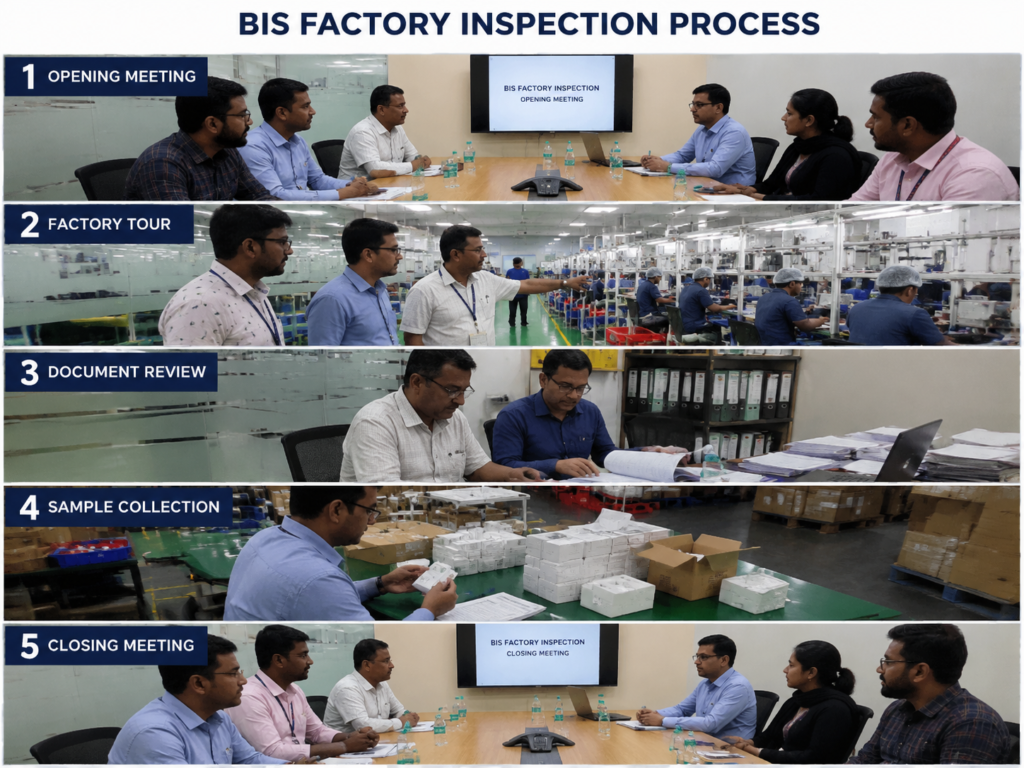
Knowing what to inspect, and then looking at the entire inspection process, you will have a clear idea. We will explain in the order of regular inspection. Except for no advance notice, the on-site process of surprise inspection is similar. In addition, special requirements for overseas factories will be supplemented.
Pre-inspection preparation
For regular factory inspections, BIS will issue a written notice 7-15 days in advance, telling you the inspection time, scope, and materials to be prepared. There is no notice for surprise inspections, and they come directly to the door.
General preparation materials include: factory qualification documents, production and inspection records over the past period of time, full set of certification application documents, and representative finished products.
If it is an overseas factory, additional preparations are needed: arrange the Authorized Indian Representative to coordinate the whole process, cooperate with the inspection personnel in visa application and itinerary arrangement, and find professional translators in advance to avoid misunderstandings caused by poor language communication.
On-site inspection implementation steps
On-site inspection can generally be completed in 1-2 days, and the process is very fixed:
- Opening meeting: After the inspection personnel arrive at the factory, they will first hold a short meeting to confirm the scope of this inspection, the corresponding product types and models, and the basic situation of the factory, to avoid wrong inspection.
- On-site tour: Then they will visit the production workshop, warehouse, and inspection area on site, focusing on safety-related processes, non-conforming product isolation areas, and inspection equipment, instead of just walking around casually.
- Document verification: After visiting the site, they will check whether the submitted production records, inspection records, and material procurement records are consistent with the declared documents, for example, whether the procurement records of key materials match the declared suppliers, and whether the inspection records correspond to the actual production batches.
- Finished product sampling: If it is initial certification or supervision spot check, representative samples will be taken from the production line or finished product warehouse, sealed and sent to a BIS-recognized laboratory for testing. The samples are randomly selected, not designated by the factory itself.
- Closing meeting: After the inspection, a closing meeting will be held to give oral feedback on the problems found on site and tell you which places do not meet the requirements, but the final judgment result will not be given on the spot, and the final result shall be subject to written notice.
Result judgment and follow-up processing
After the inspection, there are generally several results, corresponding to different handling methods:
- Compliant: If no non-conformities are found, or there are only some insignificant minor problems, the next step of certification issuance or renewal process will be entered.
- Minor non-conformity: If it is a minor problem that does not involve safety and core consistency, such as incomplete records or imperfect systems, a rectification period of 1-3 months will be given. As long as the evidence of rectification is submitted within the period, it can be passed without re-on-site inspection.
- Serious non-conformity: If it is a serious problem involving safety or consistency fraud, rectification is required first. After the rectification is completed, BIS will rearrange on-site verification. If the rectification is not in place, the certification may be suspended or even revoked.
Special attention should be paid here: During the rectification period, the corresponding products must never be shipped with the BIS mark, otherwise it will be a violation and the consequences will be more serious.
Common non-conformities and methods to avoid pitfalls in advance
Based on the past inspection situation of charging products, we have sorted out the most prone places to problems, and you can self-inspect in advance to avoid pitfalls.
High-frequency non-conformities exclusive to charging products
These types are unique to charging products and have the highest frequency of occurrence:
- Missing safety inspection: Finished products have not undergone insulation withstand voltage test, or the test records are incomplete, only testing functions but not safety, which is a high-incidence area;
- Interface/size non-conformity: The size of the USB-C interface does not meet the standard, or the pin size and shape of the Indian standard plug do not meet the requirements, so it cannot be inserted into an Indian socket, or is too loose after insertion;
- Consistency non-conformity: Key materials are different from those declared, for example, the brand and model of transformers or capacitors are changed, or the power is falsely marked, marked as 65W but actually only 45W;
- Incorrect identification: Mixing the ISI mark and CRS registration number, for example, CRS registered products are printed with the ISI mark, or the BIS mark is printed on products and packaging in advance before obtaining the certificate.
Common non-conformities in general management
These are management problems that all categories are prone to:
- Inspection equipment does not have valid calibration certificates, or is still used after the calibration has expired;
- Production records and inspection records are missing, or written too casually to match at all;
- Non-conforming products are mixed with qualified products, there is no dedicated isolation area, and there are no handling records;
- Changes in key materials are not declared, thinking that they can be replaced as long as the functions are the same. For example, if a capacitor is replaced, it is thought that there is no problem as long as it is 10μF. In fact, the safety levels of different brands may vary greatly. This is a consistency problem, and in serious cases, the certificate will be directly revoked.
3 steps to check the factory’s preparation status
In fact, you don’t have to wait for BIS to inspect. If you check it yourself in advance according to these 3 steps, 80% of the problems can be solved:
- Consistency self-inspection: Take out the full set of certification application documents, and check against the mass-produced finished products whether the appearance, rated parameters, and key materials are completely consistent, and whether materials have been secretly replaced;
- Inspection capability self-inspection: Check the calibration validity period of all inspection equipment to ensure that they are all within the validity period; then sample the safety test records of 3-5 batches of finished products in the past 3 months to see if they are complete and standardized;
- Identification self-inspection: Check whether the BIS marks and rated parameters on the product itself, the minimum sales package, and even the e-commerce sales page are consistent with those on the certification certificate, and whether there is any misuse or random use.
Judgment logic for the severity of non-conformities
Many people panic when they encounter non-conformities. In fact, there is no need, it depends on the severity:
- Minor non-conformity: It does not involve safety or core consistency, but is just a minor management problem, such as missing records or insufficiently detailed systems. Just complete the records and improve the systems, and it will not affect the certification;
- Serious non-conformity: It involves substandard safety performance or consistency fraud, such as unreported replacement of key materials or failure of safety tests. This kind of problem must be rectified, and after rectification, re-on-site verification is required. In serious cases, the certification will be suspended or even revoked.
Easily confused boundaries and misunderstandings
Finally, we clarify several most common cognitive misunderstandings, as well as the responsibility boundaries of different entities, to avoid you taking detours.
Correction of common cognitive misunderstandings
- Misunderstanding 1: If you find an Indian foundry, you don’t need to care about factory inspection
Many people think that if they find a local Indian foundry for production, factory inspection is the foundry’s business and they don’t need to care. In fact, it is not. The foundry does have to accept on-site inspection, but the brand applicant is the first responsible person for product compliance. If there is a problem with the factory, your certification will still be revoked and the products still cannot be sold, so you must supervise the compliance of the foundry. - Misunderstanding 2: Factory inspection is only done once
Don’t think that everything is fine after one inspection before obtaining the certificate. After obtaining the certificate, there are regular supervision spot checks, re-inspection upon renewal, and surprise inspections in case of complaints. Compliance is a long-term matter, not a one-and-done thing. - Misunderstanding 3: If the sample passes, the factory inspection will definitely pass
Many people think that since the submitted samples have passed, the factory inspection will definitely be no problem. In fact, it is not. A qualified sample only means that that one sample is fine. Factory inspection is to check the stability of mass production. If you cut corners during production, no matter how good the sample is, it is useless and you still cannot pass the factory inspection. - Misunderstanding 4: All charging products have the same inspection requirements
Don’t apply the factory inspection experience of chargers to charging cables or plugs. The inspection focus of different categories varies greatly. For example, plugs focus on size and mechanical strength, chargers focus on electrical safety, and charging cables focus on conductors and terminals. You should prepare according to your own products. - Misunderstanding 5: CRS registration does not require factory inspection at all
Many people think that CRS is a simplified certification and never requires factory inspection. In fact, it is not. Regular factory inspection is indeed not required for initial registration, but if the product is complained about, has a safety accident, or the certification information changes, BIS may conduct a surprise inspection at any time. If it is found that the requirements are not met, the registration will still be revoked.
Responsibility boundaries of different entities
Let’s clarify the responsibilities of different roles to avoid shifting blame to each other:
- Production factory: Responsible for accepting BIS on-site inspection, ensuring that the production process and inspection system meet the requirements, and cooperating in providing all required documents and samples;
- Brand applicant: Bears the main responsibility for product compliance, must supervise the factory to continuously meet the requirements, and cannot push everything to the factory;
- Overseas manufacturer: Must designate an Authorized Indian Representative (AIR), who is responsible for local liaison with BIS and bears local compliance responsibilities. The manufacturer still needs to cooperate in submitting technical documents, accepting on-site inspections and implementing rectifications.
Scope of application and exceptions
Finally, let’s clarify the applicable boundaries of these requirements:
- These requirements only apply to charging products included in the BIS mandatory certification catalog. The specific requirements shall be subject to the corresponding QCO and implementation standards, and products not in the catalog do not need them;
- If the same factory holds multiple BIS certificates, BIS may conduct combined inspections instead of inspecting every time, but the requirements of each category must be met separately. You cannot say that after passing the inspection of chargers, charging cables do not need to be inspected;
- In case of standard updates, factory address changes, key material changes, model expansion, etc., supplementary testing or rearranged factory inspection may be required, and you cannot secretly change them without reporting.
Final remarks
In general, the core logic of BIS factory inspection is very clear: it is to ensure that mass-produced charging products can continuously meet safety standards, rather than only relying on submitted samples to meet the standards. After reading this article, you should be able to independently judge the BIS certification path corresponding to your product and whether factory inspection is required, identify 4 common factory inspection trigger scenarios, clarify the core inspection focus according to the product type, avoid common non-conformities in advance through self-inspection, and at the same time distinguish the basic rectification directions for minor and serious non-conformities, and match compliance requirements according to the factory location.