
If you are in the business of electrical and electronic products for the EU market, you must have heard of terms like “RoHS” and “self-declaration”. Many people’s first reaction is “it must cost a lot of money to hire a third party for certification”, or “can I just find a template and sign it casually”? In fact, both ideas are wrong. RoHS self-declaration is a mandatory requirement for EU market access, but it is neither a “certification” that must be paid to an institution, nor a “formality” that can be perfunctorily handled — as long as you understand the rules and follow the steps, ordinary small and medium-sized enterprises and even small sellers can complete it independently, while avoiding unnecessary costs and risks.
I. Basic Knowledge: Core Understanding of RoHS Self-Declaration
1.1 Plain Explanation of Two Basic Concepts
RoHS is a hazardous substance restriction regulation formulated by the EU for electrical and electronic products. Its core is to control harmful substances such as lead, mercury and cadmium in products within safe limits, so as to reduce environmental pollution and health risks after products are discarded.
The official name of self-declaration is “Declaration of Conformity (DoC)”. Simply put, it is a legal document issued by the enterprise itself, which explicitly promises that “my product meets all RoHS requirements”, and the enterprise shall bear all legal responsibilities by itself. Key point here: RoHS self-declaration does not require certification by a third-party body, nor is it a voluntary act that can be done or not — as long as the product is to enter the EU market, it is a mandatory access document.
1.2 Core Differences Between 3 Easily Confused Concepts
People who are new to this topic easily mix up several related concepts. Here is a table to clarify the core differences to avoid detours:
| Concept A | Concept B | Core Difference |
|---|---|---|
| Third-party test report | RoHS Self-Declaration (DoC) | A test report is one of the compliance evidences, while DoC is a formal legal commitment document; the two cannot replace each other. A DoC can be issued based on a complete evidence chain even without a third-party report |
| CE marking | RoHS compliance | CE is a general marking covering multiple EU regulations, and RoHS is only one of the requirements; affixing CE does not mean that RoHS is necessarily compliant, and a separate assessment is required |
| Third-party certification | RoHS self-declaration | RoHS does not mandate the participation of notified bodies. Third-party reports are only optional evidence and not a necessary prerequisite for declaration |
1.3 Consequences of Non-Compliance and Common Trigger Scenarios
Many people think “I’m lucky and won’t be inspected”, but in fact, RoHS spot checks are not uncommon, and the cost of non-compliance can vary:
- Minor consequences: Customs detention of goods, requirement to supplement and correct compliance documents, imposition of fines (there is no unified EU standard for the amount of fines, which are determined by each member state according to its own laws and vary greatly)
- Serious consequences: EU-wide product recall, sales ban, enterprise being included in the list of dishonest entities, making it difficult to enter the EU market in the future
Scenarios that trigger inspections are not limited to customs entry:
- Random customs inspection upon entry
- Random inspection by market supervision within the EU
- Verification initiated by consumer or competitor complaints
1.4 5 Most Common Misconceptions for Beginners
People who are new to RoHS easily fall into cognitive pitfalls. Here is a one-time clarification of the 5 most common misconceptions:
- Misconception: You must find a third-party body to make the declaration
Wrong. RoHS does not mandate the participation of third-party bodies. As long as an enterprise has a complete compliance evidence chain, it can issue a self-declaration on its own; third-party testing is only an optional means to enhance the credibility of evidence. - Misconception: Having a RoHS test report = completing self-declaration
Wrong. A test report is only one of the compliance evidences, while self-declaration is a formal commitment document with legal effect. The two cannot replace each other. Even with a report, a DoC must be issued as required. - Misconception: Small-batch/low-value/sample products do not need RoHS
Wrong. As long as the product is sold, distributed or used for commercial purposes in the EU market, regardless of batch size, value, even commercial samples and trial sales products, in principle, compliance is required; only for very special situations such as internal testing not placed on the market, temporary display without sale/delivery for use, separate judgment is required in combination with the specific rules of member states. - Misconception: Affixing CE marking equals RoHS compliance
Wrong. CE is a general marking covering multiple EU regulations, and RoHS is only one of the applicable requirements. Affixing CE marking requires completing compliance assessment of all applicable regulations, and RoHS compliance cannot be judged solely by CE marking. - Misconception: If the supplier says it is compliant, you don’t need to worry about it
Wrong. Manufacturers and importers are the first responsible parties for product compliance. Oral promises or general statements from suppliers are not sufficient as compliance evidence. A complete evidence chain must be retained by yourself. When problems occur, regulators will first hold the responsible subject accountable.
II. Quick Judgment: Whether Your Product/Enterprise Needs to Make RoHS Self-Declaration
After clarifying the basic concepts, the first thing to judge is whether your product is within the scope of RoHS application, so as not to work hard for a long time and find that it is not needed at all.
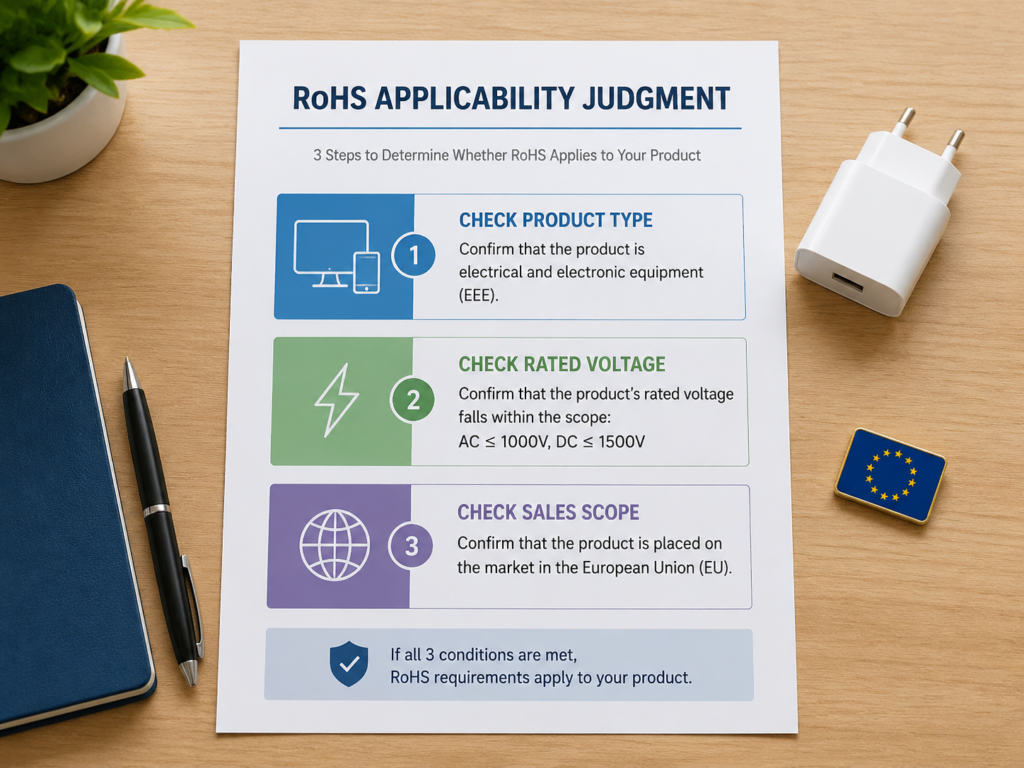
2.1 3-Step Judgment Method for Product Applicability Scope
You can quickly screen according to these three steps. If all three steps are satisfied, you need to make a RoHS self-declaration:
- Check product type: Is it an electrical and electronic equipment (EEE for short) that relies on electric current or electromagnetic fields to work? For example, plug-in products, battery-powered products, and products that work by electromagnetic induction basically count.
- Check rated voltage: The rated voltage of alternating current (AC) is below 1000V, and the rated voltage of direct current (DC) is below 1500V. High-voltage equipment exceeding this range is not within the conventional scope of RoHS application.
- Check sales scope: Whether it is planned to be placed on the EU market, including sale, import, distribution or put into use for commercial purposes.
2.2 Common Applicable/Non-Applicable Products and Boundary Rules
For ease of understanding, here are some common examples, but note: do not judge only by product name. The rules may be different for the same category due to different functions, installation methods and uses.
- Common applicable categories: Household appliances, 3C products such as mobile phones and computers, lighting fixtures, electronic toys, electric tools, IT equipment, cables, power adapters, etc.
- Completely excluded categories: Special categories such as military/aerospace equipment and large fixed industrial tools, subject to the exclusion list officially issued by the EU.
- Boundary product rules: Individually sold components, replacement parts, electronic modules (such as separately sold mobile phone batteries, replacement circuit boards, electronic components) also need to meet RoHS requirements.
2.3 Correct Understanding and Prerequisites for the Use of Exemption Clauses
You may have heard of the term “RoHS exemption”. Simply put, for some special materials or application scenarios (such as high-temperature solder, special parts for medical equipment), which temporarily cannot meet the limit requirements due to technical reasons, the EU will grant temporary exemptions, allowing them to be exempt from the limit constraints.
Regarding exemptions, there are several core rules that must be remembered, otherwise it is easy to use them incorrectly:
- Exemption clauses are uniformly issued by the EU official. They can be used directly as long as they meet the conditions of the clauses, and enterprises do not need to apply for them on their own.
- Exemptions have clear scope of application and validity period, and will be updated regularly. Never believe the statement of “industry-wide general exemption”.
- Before use, you must check the latest EU official exemption list to confirm that the number, application scenario and validity period all match before use.
2.4 Division of Responsibility Boundaries for Different Entities
RoHS has clear responsibility boundaries, and different roles bear different obligations:
- EU-based manufacturers: As the responsible subject of product design and production, they are responsible for ensuring product compliance, issuing DoC, and retaining technical documents, and are the first responsible party.
- Non-EU manufacturers/sellers: They shall not allow EU regulators to only contact non-EU subjects. They must ensure that when products enter the EU market, there is a clear economic operator established in the EU to bear corresponding compliance responsibilities. Usually, the EU importer performs the statutory obligations of the importer (including verifying DoC and technical documents, retaining compliance materials, cooperating with regulatory investigations, etc.); if an authorised representative is designated, it can only undertake designated compliance tasks within the scope of written authorisation, and cannot fully replace all legal responsibilities of the importer. If the seller itself has a registered entity in the EU, or sells directly to EU consumers under its own brand, it shall bear all compliance responsibilities according to the corresponding role (manufacturer/importer).
- Distributors/e-commerce platforms: They do not need to issue RoHS self-declarations on their own, but they must perform the duty of prudent inspection to ensure that the products on sale have valid compliance documents; those who sell products knowing that they are non-compliant shall bear joint and several liability.
- Special circumstances: Those who sell products under their own brand, or make substantial changes to the product (such as modifying the circuit board, replacing core components) shall bear all responsibilities of the manufacturer.
III. Preparations Before Operation: Rules, Standards and Evidence Basis That Must Be Clarified
Before officially starting the self-declaration, you must first understand several core rules and basic concepts, otherwise it is easy to work in vain, or even draw wrong conclusions.
3.1 Current RoHS Regulation Version and Limit Standards
For beginners, it is enough to remember two core judgment standards for daily use: first, all limits are calculated in homogeneous materials; second, the limit for cadmium is 100ppm (i.e. 0.01%), and the other 9 restricted substances are usually judged at 1000ppm (i.e. 0.1%). When formally drafting compliance documents, you can quote the official directive number accordingly.
The current effective RoHS regulation in the EU is based on Directive 2011/65/EU (i.e. RoHS 2), plus the restriction of 4 phthalates introduced by Directive (EU) 2015/863, restricting a total of 10 hazardous substances. When drafting a DoC, these two directives are usually cited. If there are subsequent revisions, they shall be checked against the applicable text when the product is placed on the market.
The specific limits of the 10 restricted substances are as follows (all are the maximum allowed concentrations in homogeneous materials):
- Cadmium (Cd): 0.01% (100 ppm)
- Lead (Pb), Mercury (Hg), Hexavalent chromium (Cr(VI)), Polybrominated biphenyls (PBB), Polybrominated diphenyl ethers (PBDE), Di(2-ethylhexyl) phthalate (DEHP), Butyl benzyl phthalate (BBP), Dibutyl phthalate (DBP), Diisobutyl phthalate (DIBP): a total of 9 types, all with a limit of 0.1% (1000 ppm)
Note: If exemption clauses are involved, the corresponding limits or exception requirements for exemptions shall be checked separately. EU member states will transpose the RoHS Directive into their national laws, and the implementation details (such as the amount of fines, spot check procedures) are slightly different, but the core limits and scope of application are unified across the EU.
3.2 Core Judgment Standard: What is “Homogeneous Material”
“Homogeneous material” is the most core judgment standard in RoHS, and 90% of compliance errors are caused by not getting this standard right.
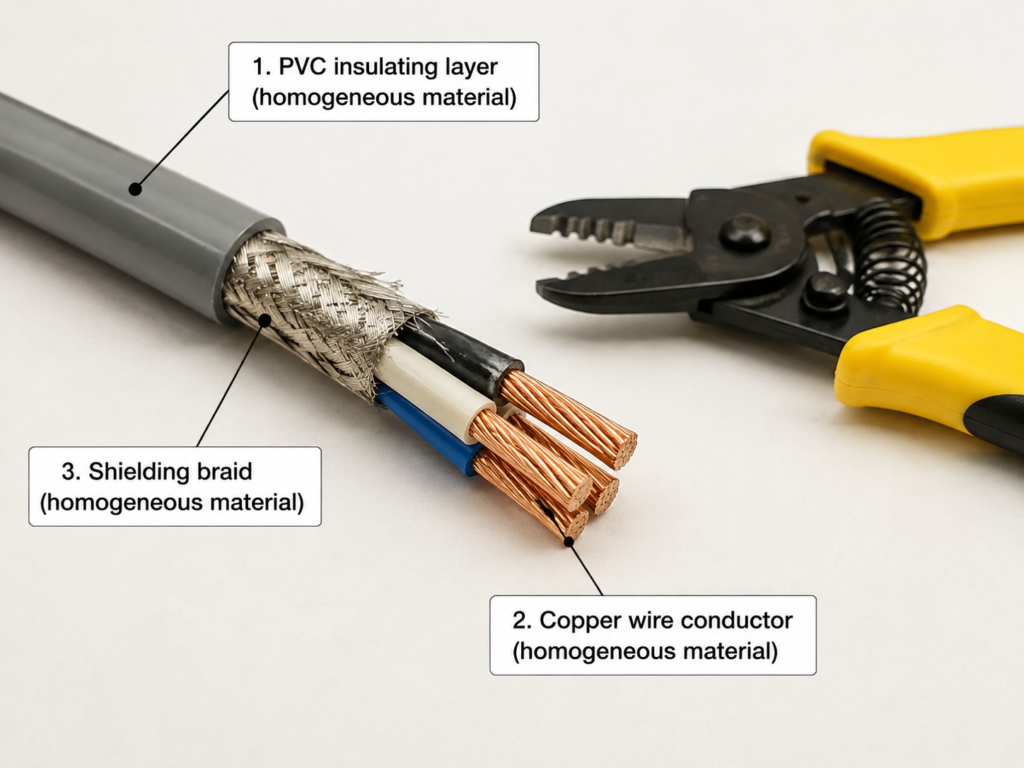
Simply put, a homogeneous material is a material of the same composition that cannot be further divided into different materials by mechanical means (such as breaking, scraping, disassembling, twisting). For example, a whole plastic shell, a piece of solder wire, and the insulating layer outside a cable are all homogeneous materials.
The most common misunderstanding is to calculate the proportion of hazardous substances by the total weight of the entire finished product. For example, if the entire product weighs 1 kg and contains 1 gram of lead, it is said that the proportion of 0.1% meets the requirements — this is completely wrong. The RoHS limit is for each homogeneous material. For example, if lead is in solder, it depends on whether the lead content in the homogeneous material of solder exceeds the limit, not the proportion of the entire product.
This standard is the basis for all testing and compliance assessment. Once it is wrong, all conclusions are invalid.
3.3 Common Types of Compliance Evidence and Usage Logic
RoHS self-declaration is not just a casual signature. It must be supported by sufficient evidence to support the commitment. There are three types of common compliance evidence, each with different functions:
- Supplier Material Declaration: RoHS compliance commitment issued by upstream suppliers for specific materials, which is the most basic and low-cost compliance evidence.
- Third-party test report: The result obtained by sending samples to a third-party laboratory for testing. Its function is to enhance the credibility of evidence, but it is not a mandatory requirement. You can judge whether it is needed according to your own risks.
- Supporting evidence: Material specifications, procurement records, change records, etc., which are used to prove that the actually used materials are consistent with the obtained declarations/reports, so as to avoid the situation of “qualified for inspection, unqualified for bulk goods”.
As for the testing frequency, there is no unified standard in the EU, which can be adjusted according to the risk level of materials and the stability of suppliers: for high-risk materials and new suppliers, the testing frequency can be increased; for low-risk, stable suppliers that have cooperated for many years, regular spot checks can be conducted.
3.4 Identify High-Risk Materials in Advance (Priority Verification)
Not all materials have the same risk. First pick out high-risk materials for priority verification, which can save a lot of time and energy. Common high-risk materials and corresponding risk points:
- Plastics: PVC and soft plastics are likely to contain phthalate plasticizers; pigment coatings are likely to contain lead and cadmium; plastics containing flame retardants are likely to contain PBB and PBDE.
- Metals/Welding: Solder and alloy materials are likely to contain lead; metal coatings and passivation layers (especially anti-corrosion treatment layers) are likely to contain hexavalent chromium.
- Others: Adhesives, seals, rubber products are likely to contain phthalates; fluorescent tubes are likely to contain mercury.
These materials are the hardest hit areas of RoHS exceeding the standard, and can be focused on during verification.
IV. Full Operation Process: Step-by-Step Operation from Material Sorting to Declaration Issuance
After understanding the basic rules, you can start to do it now. The whole process is divided into six steps, which can be advanced in order.
4.1 Step 1: Sort out the Product Material List (Disassemble to Homogeneous Units)
First, list all relevant materials in the product, and disassemble them to homogeneous material units.
The sorting scope shall cover all relevant parts: the finished product itself, internal components, parts, cables, and even electronic parts included in the packaging (such as complimentary small electronic lights, electronic gifts), as long as they are placed on the market together with the product, they must be included.
The disassembly does not require a professional BOM (Bill of Materials) format. A simple list is fine, whether handwritten or in an Excel spreadsheet, as long as it can correspond to each homogeneous material.
Each material should preferably be clearly marked with the corresponding supplier, material model, batch, and use, and high-risk materials should be marked separately for subsequent verification.
Pitfall reminder: Products with the same appearance do not mean the same internal materials. Products of different versions and batches must be confirmed separately, and previous conclusions cannot be directly applied.
4.2 Step 2: Collect and Verify Supply Chain Compliance Evidence
After sorting out the material list, next request compliance evidence from the corresponding suppliers, and verify them one by one.
(1) Basic Requirements for Requesting Evidence
Don’t just ask “do you have RoHS certification”, but clearly require the other party to provide RoHS declarations or test reports corresponding to specific materials. The general promise that “all our products comply with RoHS” has insufficient evidence value and cannot be used alone as the basis for final product compliance. Suppliers should be required to supplement specific material models, coverage of 10 substances, signing subject, date/version and responsibility commitment.
(2) 3 Key Points for Verification of Supplier Declarations
- Coverage: It must clearly cover all 10 restricted substances. Old declarations that only cover the original 6 substances and do not include 4 phthalates are invalid.
- Correspondence: It must correspond to the specific material model you purchase, and you cannot use declarations of other models to make up the number.
- Validity: There is no unified declaration validity period in the regulation, which shall be subject to the validity period marked on the document itself, the supplier’s annual update mechanism or the enterprise’s internal risk control period; if materials, suppliers, regulations or exemption clauses change, reconfirmation is required even if the document has not expired.
(3) 4 Key Points for Verification of Third-Party Test Reports
- Sample matching: The sample model on the report is consistent with the material model you purchase.
- Unit coverage: The testing covers all homogeneous materials of the material. For example, cables must be tested for insulating layer, copper wire, shielding layer, etc., not just the whole.
- Method and results: The test method can refer to the IEC 62321 series or equivalent recognized methods; the results shall list the limit of detection and unit, and the limit of detection shall be sufficient to judge whether it is lower than the RoHS limit; “not detected” means that the content is lower than the instrument’s detection limit, not that there is none at all, as long as it is lower than the limit, it is compliant.
- Credibility: If necessary, you can verify the authenticity of the report number through the laboratory’s official website to confirm that the laboratory has corresponding testing qualifications.
(4) When to Supplement Sampling Inspection
If high-risk materials do not have valid compliance certificates, or you have doubts about the supplier’s evidence, you can arrange third-party sampling inspection for confirmation, but this is not a mandatory requirement, but only a means to reduce risks, which can be judged by yourself according to cost and risk.
4.3 Step 3: Complete Product Compliance Assessment
After collecting all evidence, a comprehensive compliance assessment of the entire product shall be conducted:
- Correspond each homogeneous material with the corresponding compliance evidence one by one, and judge item by item whether it meets the RoHS limit requirements.
- For those using exemption clauses, check the exemption number, scope of application and validity period one by one, and record the corresponding official basis. You cannot use them based on impression or oral promises from suppliers.
- If there is insufficient evidence or the test result exceeds the standard, either replace the compliant material or supplement the verification. You shall not apply the evidence of other model products, nor shall you arbitrarily expand the scope of exemption.
After the assessment is completed, output a product RoHS compliance assessment form, which is one of the core documents of the evidence chain. For the convenience of subsequent traceability and regulatory inspection, it is recommended that the assessment form include at least the following fields: name of component/homogeneous material, supplier and corresponding material model, product batch/version, corresponding compliance declaration/test report number, limits and test results of 10 restricted substances, whether exemption is used and corresponding official number, compliance conclusion, assessment date and assessor.
4.4 Step 4: Organize and Archive the Full Set of Technical Documents (Evidence Chain)
After the assessment is completed, all relevant documents shall be organized into a complete set of technical documents (i.e. evidence chain) and archived for preservation.
- Technical documents include: Product description and structural information, material list, all compliance evidence provided by suppliers, third-party test reports (if any), RoHS compliance assessment form, description of exemption clauses (if used).
- Archiving requirements: Electronic or paper copies are acceptable. The core requirement is that they can be quickly retrieved and correspond to specific product models and batches to avoid confusion.
- Retention period: Calculated from the date when the product is last placed on the EU market, it shall be kept for at least 10 years.
- Requirements for non-EU enterprises: Non-EU enterprises shall ensure that the importer/authorised representative in the EU can obtain and submit the DoC and technical documents in a timely manner when required by regulators; copies can be kept or an retrievable mechanism can be established, but the responsibility chain must be clear.
4.5 Step 5: Draft and Sign the RoHS Self-Declaration (DoC)
After all evidence is complete and the assessment is passed, you can draft the formal RoHS self-declaration (DoC).
- Form selection: You can issue a standalone RoHS-specific DoC, or combine it with other applicable CE directives (such as Electromagnetic Compatibility, Low Voltage Directive) into a general DoC. Both are valid.
- Multi-model handling: For multiple similar product models (such as power banks of the same series, only differing in capacity, with the same material and structure), a series DoC can be issued to cover them, but the differences between different models must be stated in the document to ensure that all covered models meet the requirements; products with completely different structures and materials shall not be included in the same series DoC.
- Signing requirements: Signed by the authorized responsible person of the manufacturer or its authorised representative, with the position indicated, and no third-party body seal is required; RoHS self-declaration is the enterprise’s own legal commitment, and it is valid with self-signature.
- Mandatory core information: Product name/model/unique identifier (serial number/batch number), name and address of the manufacturer or authorised representative issuing the declaration, applicable RoHS directive and amendment numbers, compliance status of restricted substances, exemption items and corresponding official clauses, name/position/signature date of the authorized signatory, unique document number. Note that do not just generally write “compliant with RoHS”. It is recommended to explicitly state that “meets the applicable requirements of Directive 2011/65/EU and its amendments (including (EU) 2015/863, or marked as amended)”; if exemption clauses are used, the corresponding official annex clause numbers shall be listed one by one.
- Supplementary requirements for non-EU enterprises: It shall be ensured that the DoC or the accompanying information of the product clearly marks the name, address and contact information of the economic operator (importer/authorised representative) contactable in the EU, so that regulators can quickly connect with the responsible person.
4.6 Step 6: Complete CE Marking and Product Information Labeling
The last step is product labeling. Here are two important prerequisites and requirements:
(1) Rules for Affixing CE Marking
The CE mark can only be affixed after the compliance assessment of all applicable CE regulations is completed (not just RoHS) — affixing CE only after completing RoHS is a violation.
In principle, the CE mark shall be affixed on the product itself or a fixed nameplate, which shall be clear, visible and durable, with a height usually not less than 5mm; if it cannot be affixed on the body due to the nature of the product, it can be affixed on the packaging and accompanying documents.
(2) Product Information Labeling Requirements
The product or its packaging/accompanying documents shall be able to identify the product model/batch, and indicate the manufacturer’s name and postal address; imported products shall also indicate the information of the importer or EU responsible subject according to applicable requirements. Labeling priority: if it can be affixed on the product body, it shall be affixed on the body first; if it cannot be affixed on the body, it shall be placed on the packaging or accompanying documents.
You can voluntarily attach the DoC query channel (such as QR code, website) to facilitate regulators or consumers to verify and reduce communication costs.
V. Effectiveness Verification: Quickly Judge Whether the Declaration/Evidence Chain is Qualified
After finishing, you can quickly verify the compliance through the following methods to avoid being picked out by regulators.
5.1 Mandatory Core Information of RoHS Self-Declaration (DoC)
A qualified RoHS DoC requires complete information and clear expression, and missing items may lead to non-recognition by regulators. The core mandatory information can be divided into four categories:
- Product Information: Complete product name, model, unique identifier (serial number/batch number), which can accurately correspond to the specific product, and cannot be vague and general.
- Responsible Entity: Name and address of the manufacturer or authorised representative issuing the DoC, clarifying the issuing subject of the legal commitment; for non-EU enterprises exporting to the EU, the name, address and contact information of the economic operator (importer/authorised representative) contactable in the EU shall also be marked to ensure that regulators can quickly connect with the responsible person.
- Compliance Description: Applicable RoHS directive and amendment numbers, compliance status of restricted substances, exemption items and corresponding official clauses, the expression shall be specific and verifiable, and cannot only write “compliant with RoHS”.
- Signature and Traceability: Name, position, signature date of the authorized signatory, and unique document number to ensure that the declaration can be traced to the specific responsible person.
5.2 5 Characteristics of Invalid DoC for 5-Second Screening
When you get a RoHS DoC, you don’t need to read it word by word. First check if there are the following 5 characteristics. If any one appears, it is probably invalid or needs to be corrected:
- No information of the responsible entity contactable in the EU: If regulators cannot find a contact person in the EU, they will directly determine that the document is non-compliant.
- No information or signature of the authorized signatory: Missing the signature and position information of the legal representative or authorized responsible person, it does not have the effect of legal commitment.
- Wrong directive version or exemption basis: The applicable RoHS directive version is outdated, or the exemption items have no official basis or exceed the scope of application of the clauses.
- Not corresponding to specific product models: Generally declaring that “all products comply with RoHS”, without clearly specifying the specific models and batches covered, cannot correspond to the actual product.
- Only vaguely stating “compliant with RoHS”: No specific directive clauses are cited, nor is it explicitly stated that it meets all applicable requirements, and the expression is vague and has no legal effect.
5.3 Common Breakpoints in the Evidence Chain (Easily Judged Invalid by Regulators)
In addition to the DoC itself, breakpoints in the evidence chain will also lead to non-compliance. Common breakpoints include:
- The supplier’s declaration only has the words “compliant with RoHS”, without specific material models and substance coverage, which cannot prove that the corresponding material is compliant
- The third-party test report only covers some parts, or the sample model is inconsistent with the actually sold product, which is a case of substituting one thing for another
- After the material or supplier is changed, the evidence is not re-collected, and the old evidence cannot prove the compliance of the current batch
- The exemption number is real, but the actual product use does not meet the requirements of the exemption clause, which is misuse of exemption
- The technical documents are chaotic and cannot explain the corresponding relationship between the test results and the product parts
5.4 4 Core Questions for Completeness Self-Check
Finally, ask yourself four core questions. If you can give positive answers to all of them, the basic compliance is guaranteed:
- Have you confirmed that the product is indeed within the scope of RoHS application?
- Have you covered the compliance evidence of all key homogeneous materials?
- Is there a clear basis to support each limit judgment and exemption use?
- Have you completed the DoC signing, CE marking (if applicable) and product information labeling?
VI. Pitfall Avoidance and Cost Optimization: Common Risks and Reasonable Compliance Solutions
Many people either spend wrong money on RoHS or fall into pitfalls. In fact, as long as you master the method, you can completely control costs while complying with regulations, and avoid common risks at the same time.
6.1 3 Most Common Compliance Pitfalls and Avoidance Methods
There are three most common pitfalls. If you know them in advance, you can avoid 90% of the problems:
- Supplier-side pitfalls: Suppliers provide fake reports, expired reports, or the materials corresponding to the reports are inconsistent with the actual procurement. Pitfall avoidance method: After receiving the test report, verify the authenticity of the number through the laboratory’s official website; sign a formal compliance agreement with the supplier, clarify the违约责任 for non-compliant materials, and force the supplier to pay attention.
- Document-side pitfalls: Wrong use of exemption clauses, wrong information of responsible subjects, improper document preservation and loss. Pitfall avoidance method: Check the latest EU official exemption list every time you use an exemption, and do not judge based on experience; make at least double backups of documents (local + cloud storage) to prevent loss.
- Management-side pitfalls: Only test finished products regardless of upstream materials, or do not re-verify after changing materials or suppliers. Pitfall avoidance method: Establish compliance files for each material. As long as there is a change (material change, supplier change, design change), a re-assessment will be triggered, and production will be started after passing.
6.2 Compliance Cost Optimization Methods for Different Scenarios
RoHS compliance is not the more expensive the better. The one that suits your own situation is the optimal solution. Different scenarios can choose different solutions, but they need to meet the corresponding prerequisites:
- Small-batch, low-value products: Prioritize the scheme of supplier material declarations + sampling inspection of high-risk parts, without full finished product testing; the premise is that the material composition is clear, the supplier’s evidence is credible, and high-risk materials have sufficient compliance certificates.
- Multi-model, same-material products: Issue a series DoC and share the same evidence chain, without doing it separately for each model; the premise is that the key materials, structure and suppliers are consistent, and the different parts have been separately verified to be compliant.
- Long-term supply products: Sign long-term compliance agreements with upstream suppliers, requiring suppliers to regularly update compliance materials, without repeated verification for each purchase; the premise is that the supplier is stable and has a clear change notification mechanism.
- Low-risk, stable supply chain: Mainly based on supplier declarations, regular spot checks of high-risk materials are enough, without testing for each batch; the spot check frequency is determined by the enterprise according to risk assessment.
6.3 Easily Confused Concept Boundaries
There are several easily confused boundaries, which are clarified here again to avoid misuse:
- EU RoHS vs China RoHS: Two completely independent regulatory systems with different rules, markings and requirements. EU RoHS documents cannot be directly used to replace China RoHS, and vice versa.
- Component compliance vs whole machine compliance: Component compliance is the basis of whole machine compliance, but it does not mean that if all components are compliant, the whole machine must be compliant — all homogeneous materials of the whole machine must be comprehensively verified to avoid missing small parts, auxiliary materials and other parts not covered by component declarations.
- Series DoC vs single-model DoC: Series DoC is not omnipotent. The scope of covered products must be clearly defined. Different models’ different parts must be separately verified to be compliant before they can be included in the series DoC, and the scope shall not be arbitrarily expanded.
VII. Long-Term Maintenance: Continuous Compliance and Regulatory Response
RoHS self-declaration is not a once-and-for-all thing. Changes in products, supply chains, and regulations may affect compliance, so long-term maintenance is required.
7.1 Typical Changes That Trigger Re-Assessment
As long as any of the following situations occurs, the RoHS compliance of the product needs to be re-assessed, and the old conclusion cannot be used:
- Supply chain changes: Replacement of material/component suppliers, change of production location, which may affect material compliance
- Product changes: Modifying product structure, replacing core materials such as coatings/cables/solder, adding new product models or uses
- Regulatory changes: Update of RoHS restricted substance list, expiration of exemption clauses or adjustment of application scope
- Abnormal situations: Discovery of supplier declaration fraud, abnormal test results, customer complaints about compliance issues
7.2 Simplified Continuous Compliance Mechanism (Suitable for Small and Medium-Sized Enterprises)
Many small and medium-sized enterprises think that they need to establish a complex compliance system, but in fact, they don’t. A few simple actions can meet the basic continuous compliance requirements:
- Maintain a current list of material and evidence versions for each product model, update it in time when changes occur, and the latest situation can be checked at any time.
- Set up a reminder for the expiration of supplier compliance documents, such as notifying the supplier to update materials one month in advance to avoid expiration.
- Set up a compliance review node for major design changes or material changes. Those that fail the compliance review shall not be put into production to avoid problems from the source.
- Properly keep historical version documents. Old batch products may still be inspected by regulators, and shall not be discarded at will.
7.3 Core Points for Responding to Regulatory Sampling Inspections
In case of regulatory spot checks, don’t panic. Remember several core points:
- The core materials required by regulators usually include: DoC, product identification information, technical documents (evidence chain), change records. If they are organized in an orderly manner on weekdays, they can be directly retrieved.
- After receiving the regulatory requirements, immediately confirm the deadline, contact person and list of required materials, and submit consistent documents at one time within the specified period; if there is a gap in the materials, take the initiative to explain the correction plan, and do not delay.
- Never forge documents. The legal consequences of forging documents are far more serious than simple non-compliance. Do not take chances.
7.4 Handling Logic After Discovering Non-Compliance
If you really find that the product is non-compliant, don’t try to cover it up. Handling it step by step can minimize the loss:
- Locate the problem: First find the homogeneous material corresponding to the exceeding substance, the supplier, and the involved product batches, and clarify the scope of the problem.
- Investigate risks: Immediately suspend the use of suspicious materials and suppliers, check the inventory quantity, the quantity of sold products and the involved markets, and find out the scope of impact.
- Rectify and update: Replace compliant materials, re-do compliance assessment, update the full set of technical documents and DoC to ensure the compliance of subsequent products.
Special reminder: It is not allowed to cover up the problem of insufficient original evidence by retroactively signing the DoC. This is forgery of documents, and the consequences are far more serious than simple non-compliance.
VIII. Compliance Actions You Can Complete After Learning This Guide
After reading this guide, you have mastered the full-process capability of RoHS self-declaration from judgment to implementation. Specifically, you can complete the following compliance work:
- Quickly judge whether your product/enterprise needs to make RoHS self-declaration, and accurately identify the scope of application and boundary scenarios.
- Independently complete the whole process operation from material sorting, evidence collection, compliance assessment to DoC issuance.
- Quickly identify invalid RoHS declarations and evidence chain breakpoints, and avoid compliance risks caused by unqualified documents.
- Combine the scale of your own products and supply chain situation, choose the most cost-effective compliance solution, and avoid unnecessary expenses.
- Establish a basic long-term compliance mechanism and calmly respond to routine regulatory spot checks.