
Many enterprises or sellers newly entering the EU market have the first reaction of looking for the “RoHS certification mark” — preferably the type officially issued by the EU that can clear customs once affixed. But first, a core misunderstanding needs to be clarified: the EU has no mandatory official exclusive RoHS logo at all. Various green RoHS icons commonly seen in the supply chain are all designed by enterprises themselves.
First, Debunk the Biggest Misconception: The EU Has No Mandatory Official Exclusive RoHS Logo
What Exactly Is the “RoHS Mark” Usually Referred To?
The “RoHS mark” mentioned daily is a general term referring to all visual prompts related to RoHS compliance, not a legally mandatory pattern of the EU. Common related marks are divided into three categories: the first is the mandatory CE mark, which covers RoHS compliance requirements; the second is the mandatory WEEE crossed-out trash bin mark, which is often confused because it applies to most electrical and electronic products together with RoHS; the third is RoHS text or patterns produced by enterprises themselves, which fall into the category of voluntary use.
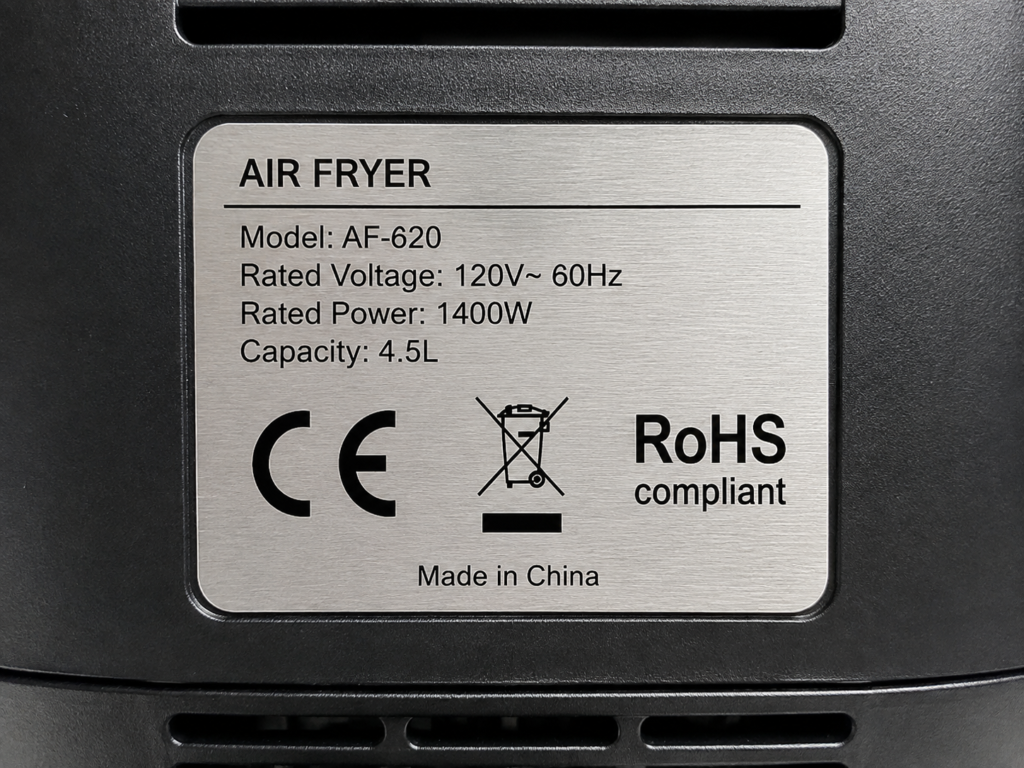
No matter which type of mark it is, it is essentially just a “prompt of compliance status” and cannot replace actual compliance evidence — affixing a mark does not mean the product is necessarily compliant, and not affixing a voluntary mark does not mean it is non-compliant. The core judgment standard is always whether the product itself meets the limit requirements for hazardous substances.
The Core Requirement of RoHS Has Never Been Labeling, but Meeting Hazardous Substance Standards
Many people equate RoHS with “labeling”, but in fact, this completely reverses the logic. The full name of RoHS is the EU Restriction of Hazardous Substances Directive, whose core is to control the content of 10 hazardous substances in electrical and electronic products, rather than requiring the affixing of specific marks.
These 10 substances include 4 heavy metals: lead, mercury, cadmium, and hexavalent chromium; two types of flame retardants: PBB and PBDE; and 4 phthalates (commonly known as plasticizers): DEHP, BBP, DBP, and DIBP. The limit requirements are: the content of cadmium shall not exceed 0.01%, and most of the remaining 9 shall not exceed 0.1% — it should be specially noted that the limits are calculated based on “homogeneous materials”, that is, the smallest material unit that cannot be further disassembled (such as plastic shells, copper wires, solder joints and solder), and each type of material is calculated separately, rather than the entire product meeting the standard on average.
The core voucher for RoHS compliance is the Declaration of Conformity (DoC) — a document issued by the manufacturer declaring that the product meets RoHS requirements, which together with supporting technical documents (such as Bill of Materials (BOM), supplier material declarations, hazardous substance test reports, etc.) constitutes the compliance evidence chain. As for various voluntary RoHS patterns, they are only designed by enterprises for the convenience of supply chain or customer identification, have no legal effect, and are not mandatory requirements of the EU.
3 Cognitive Misconceptions Most Easily Made by Beginners
Practitioners new to RoHS often fall into three types of cognitive misconceptions, and clarifying them in advance can effectively avoid risks:
First misconception: You need to obtain “RoHS certification” to enter the EU. RoHS adopts a self-declaration system, and the EU has no unified official RoHS certificate. The so-called “RoHS certification” on the market is mostly test reports issued by third-party testing institutions, which are only one type of technical supporting document, not a “pass” for market access — as long as you can provide complete self-certification documents to prove that the product meets the standards, even without a third-party report, it meets the compliance requirements.
Second misconception: Affixing a green RoHS icon means official EU recognition. The EU has no official exclusive RoHS pattern. Various marks with green leaves, checkmarks, or white text on a green background are all designed by enterprises themselves. They not only have no official effect, but also do not have a unified format.
Third misconception: Having a CE mark means RoHS compliance is guaranteed. CE is a “big framework” covering multiple EU regulations, and RoHS is only one of them. More importantly, CE is a mark of the manufacturer’s self-declaration, not an official test pass mark — if the manufacturer cannot provide the corresponding DoC and technical documents, the CE mark may be affixed illegally on its own, and RoHS compliance naturally cannot be guaranteed. For example, some low-cost power bank products have the CE mark printed on the surface, but the merchant cannot provide a DoC, so the compliance of the mark is questionable.
First, Figure It Out: Does Your Product Need to Consider RoHS-Related Marking Requirements?
After clarifying the essence of RoHS marking, the first step is to determine whether the product needs to consider RoHS-related marking requirements. Not all products with electronic components are subject to RoHS control, and not all products sold to Europe need to meet relevant requirements.
Core Applicable Objects: Electrical and Electronic Equipment Placed on the EU Market
The core applicable objects of RoHS are electrical and electronic equipment placed on the EU market. At the entry stage, a quick judgment can be made: whether the product relies on electric current or electromagnetic fields to achieve its main functions — for example, home appliances, mobile phones and computers, lamps, electric tools, toys with electronic functions, surveillance cameras, etc. all fall into the applicable scope.
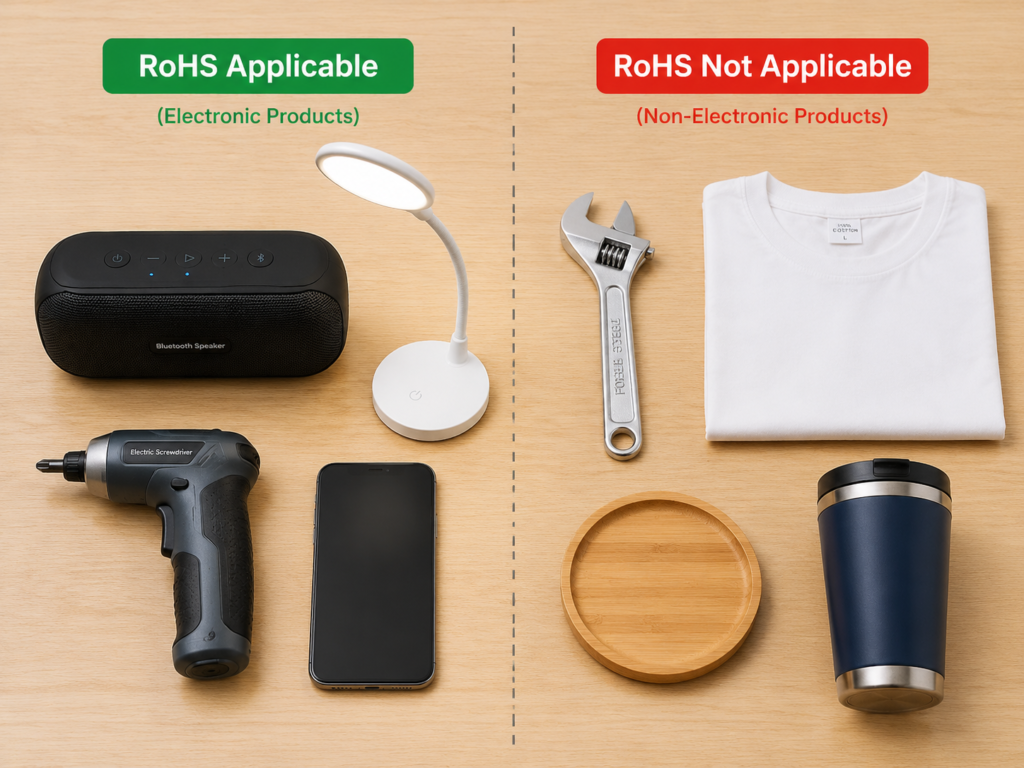
It specifically covers 11 categories of products, common ones include large and small home appliances, IT and consumer electronics, lighting equipment, electric tools, electronic toys, leisure and sports equipment, vending machines, etc. In addition to the above common categories, it also includes medical equipment, monitoring and control instruments, and other electrical and electronic equipment falling into the open categories of RoHS; in practice, judgment should be based on product functions and placement methods, rather than just applying according to example names.
In addition to finished products, electrical and electronic related components placed on the EU market separately (such as data cables with transmission functions, finished functional circuit board assemblies) may also fall into the applicable scope. It should be noted that whether ordinary components and basic raw materials need to bear CE/RoHS marking obligations should be judged based on whether they are independent electrical and electronic products, whether they are sold separately to the terminal market, and whether they fall into the applicable scope of the corresponding CE directive; components that are only used as supporting materials within the supply chain usually support the compliance of the whole machine with material declarations, test reports, and supplier compliance documents, and do not need to bear marking obligations separately.
The applicable regions are the 27 EU member states, plus Norway, Iceland, and Liechtenstein in the European Economic Area, totaling 30 countries. After Brexit, the UK adopts an independent UKCA mark, which does not fall into the scope of the EU CE system, and will be explained separately later.
Situations Where RoHS Marking Is Completely Unnecessary
The following types of situations completely do not need to consider RoHS marking, and no additional cost is required for handling:
The first category is fully exempt products: military and aerospace equipment, large fixed industrial installations, active implantable medical devices (such as pacemakers), and second-hand personal items for personal use — for example, individuals bringing old mobile phones for personal use into the country do not need to meet RoHS requirements.
The second category is non-electrical and electronic products: such as pure mechanical tools, ordinary furniture, clothing without electronic functions, etc., products whose core functions do not rely on electric current or electromagnetic fields are usually not subject to RoHS requirements. If the product is accompanied by a small number of electronic components, it needs to be judged in combination with the independence of the electronic components and the core promotional function of the product: if the electronic components are only detachable accessory decorations, and the product does not take electronic functions as the core selling point, RoHS will usually not be automatically applied due to the accompanying small number of electronic accessories; if the main function of the product relies on electronic modules (such as smart clothing with core functions of heating and lighting), compliance requirements need to be evaluated separately.
The third category is internal components only supplied to complete machine manufacturers: for example, if a circuit board manufacturer only supplies supporting circuit boards to home appliance factories and does not sell them separately to consumers, there is no mandatory requirement to mark the circuit boards, and only compliance documents need to be provided to the complete machine manufacturer. But if the circuit board is sold separately externally, it needs to be implemented in accordance with the corresponding requirements.
Quick Judgment Method for Boundary Products
If the product is at the applicable boundary and you are not sure whether it falls into the control scope, you can first screen it yourself through two standards:
First, look at the core function: Is electricity the main working power? For example, a thermos cup with electronic timing function, whose core function is heat preservation and electronic timing is only an additional function, usually does not fall into the core applicable scope of RoHS; but if it is a smart thermos cup focusing on water temperature display and APP interconnection, whose core functions include electronic modules, it needs to be included in the evaluation.
Second, look at the placement form: Is it sold directly to end consumers as a finished product? For example, internal parts supplied to complete machine manufacturers do not need to be marked separately, but accessories sold separately to consumers need to meet the requirements.
If it is still impossible to make a clear judgment, you can further verify it against the RoHS exemption list officially issued by the EU — it should be noted that all exemption clauses have clear applicable product categories, materials/uses, corresponding numbers and validity periods, and enterprises cannot expand the interpretation or apply the exemption scope on their own; when in doubt, it is recommended to consult an EU authorized representative (the compliance liaison entity within the EU) or a professional compliance consultant for confirmation.
Distinguish 3 Common Marks: Which Are Mandatory, and What Do They Cover?
If the product falls into the applicable scope of RoHS, the next most confusing thing is the function of various marks — many people take recycling marks as compliance marks and voluntary marks as official certifications, leading to unnecessary risks. The following breaks down the positioning of common marks, and you can quickly distinguish them after reading.
Mandatory Mark 1: CE Mark (Legal Embodiment of RoHS Compliance)
The CE mark is a mandatory requirement for entering the EU market, and its function is to declare that the product meets all applicable EU regulations — such as RoHS, Low Voltage Directive (LVD), Electromagnetic Compatibility Directive (EMC), etc. All regulations applicable to the product must be met before the CE mark can be affixed. CE is a manufacturer’s self-declaration of compliance, not an official quality certification.
The relationship between CE and RoHS is very clear: RoHS is one of the regulations covered by CE. As long as the product falls into the applicable scope of RoHS, RoHS compliance requirements are already included when affixing CE, and there is no need to additionally affix the so-called “RoHS official mark” — because such an official mark does not exist at all.
Mandatory Mark 2: WEEE Crossed-Out Trash Bin Mark (Most Easily Confused Recycling Mark)
The WEEE mark, which is a crossed-out trash bin pattern, is a requirement of the EU’s Waste Electrical and Electronic Equipment Directive. Its function is to inform consumers that this product cannot be discarded as ordinary domestic waste and needs to be recycled separately. WEEE controls “how to dispose after scrapping”, and is a completely independent regulation from RoHS, which controls “hazardous substances shall not exceed the standard during production”. They often appear together only because both apply to most electrical and electronic products.
It should be noted that the applicable scope of the WEEE mark highly overlaps with RoHS but is not completely equivalent. The specific judgment needs to be combined with the applicable categories of the WEEE directive and the producer responsibility requirements of the selling member state. Not all RoHS applicable products necessarily need to be marked with WEEE. The usage requirements of the WEEE mark are similar to those of CE, which need to be clear and durable, and are usually placed adjacent to the CE mark.
Voluntary RoHS Declaration: Compliance Prompt Used by Enterprises Themselves
In addition to the two types of mandatory marks, many enterprises will add RoHS-related prompts on their own, which is commonly referred to as the “RoHS mark”. Such declarations fall into the voluntary category, and the EU does not mandate or prohibit them, but their use must comply with the rules.
The most recommended form is a clear text statement, such as “RoHS compliant”. For the sake of rigor, the directive version can be marked, such as “Compliant with EU RoHS Directive 2011/65/EU and amendment (EU) 2015/863”, to facilitate relevant parties to clarify the applicable regulatory version. Vague or easily misleading expressions such as “RoHS 3 certification” and “latest version RoHS compliance” that may be mistaken for official certification shall not be used.
Enterprises can also use self-designed patterns (such as green leaves, checkmarks, etc.), but such patterns have no legal effect. The core requirement is: they cannot be designed to look like official certifications. For example, the EU emblem shall not be added, and “EU Officially Certified RoHS” shall not be marked, to avoid misleading consumers into thinking that it is a mark officially issued by the EU.
If the product relies on RoHS exemption clauses for compliance, the corresponding exemption clause number, applicable parts and validity period shall be clearly listed in the Declaration of Conformity (DoC) and technical documents. The external RoHS declaration shall not be stated as unconditional compliance of the entire product.
Do Not Mix Marks from Other Regions with EU Marks
RoHS-related marks in different regions have differences and cannot be mixed:
For example, China RoHS uses orange or green marks with a hazardous substance content table, which is only used to meet the information disclosure requirements of the Chinese market. It cannot be used as proof of EU RoHS compliance, nor can it replace CE, WEEE and EU DoC. The same product in multiple markets can retain corresponding market marks separately, but the layout should avoid making the China RoHS pattern be mistaken for an EU official mark.
Another example is the UKCA mark, which is a market access mark for Great Britain, UK, and cannot replace CE to enter the EU market. If the product is sold to both the EU and the UK, corresponding marks need to be prepared separately, and one set cannot be shared.
Basic Rules: How to Affix and Write Marks to Be Compliant?
The use of marks must comply with clear specifications, otherwise it may constitute a violation. The following describes the specific usage requirements of mandatory marks and voluntary declarations respectively.
Standard Usage Requirements for CE Mark
The use of the CE mark has clear official specifications, and the core requirements include three points:
First is appearance: the pattern officially specified by the EU must be used, and it shall not be stretched or deformed. The height is usually not less than 5 mm. If it is a very small product (such as the main body of a Bluetooth headset), it can be scaled down, but it must be clearly visible to the naked eye.
Second is position: it is preferred to affix it on the product body or product nameplate. If there is really no space on the body (such as very small electronic components), it can be moved to the smallest sales package or the accompanying manual. Note that it is the “smallest sales package” rather than the transport outer carton — if the smallest sales unit received by consumers has no mark, only the large outer carton has it, it is a non-compliant situation.
Third is prohibited behaviors: labels that are easy to fall off, easy to wear, and do not match the use environment shall not be used; if labels are used, it shall be ensured that they remain clear, visible and durable under normal transportation, storage and use conditions. Notified body numbers shall not be added at will — RoHS does not require the intervention of a third-party notified body, and only some special directives (such as the Medical Device Directive) require it. Adding numbers randomly is instead a violation; the CE mark shall not be mixed with complex decorative patterns, resulting in consumers being unable to clearly identify it.
Usage Requirements for WEEE Mark
The requirements for the WEEE mark are similar to those for CE:
The appearance must be a standard crossed-out trash bin pattern, clear and distinguishable. The position is also prioritized on the product body, and if there is no space on the body, it can be placed in the smallest sales package or manual.
In addition, attention should be paid to durability: the mark must be visible for a long time and conform to the use environment of the product — for example, for solar lamps used outdoors, the mark cannot fade and fall off in a short time due to sun exposure, otherwise it is also a violation.
Safe Usage Rules for Voluntary RoHS Declarations
Although voluntary RoHS declarations are not mandatory, they cannot be marked at will, otherwise they may be suspected of misleading and instead constitute a violation:
The recommended expression is “This product meets the limit requirements for restricted hazardous substances in the EU RoHS Directive”, and the directive version number can be added, which is both clear and rigorous.
The applicable scenarios are very wide. For example, it can be placed on product nameplates, packaging, manuals, official websites, e-commerce product detail pages, and supply chain documents provided to downstream customers.
But there are several red lines that must never be touched: expressions that are easily mistaken for official certification such as “RoHS certification” and “RoHS certificate” shall not be used; unverifiable content such as “100% lead-free”, “permanent compliance” and “completely non-toxic” shall not be claimed — because RoHS is a limit requirement, not that it does not contain hazardous substances at all, and regulations may be updated, so permanent compliance cannot be guaranteed.
Legal Prerequisite: Marks Must Correspond to a Complete Compliance Evidence Chain
The last and most important point: all marks, whether mandatory or voluntary, must be supported by a complete compliance evidence chain, otherwise they are false markings.
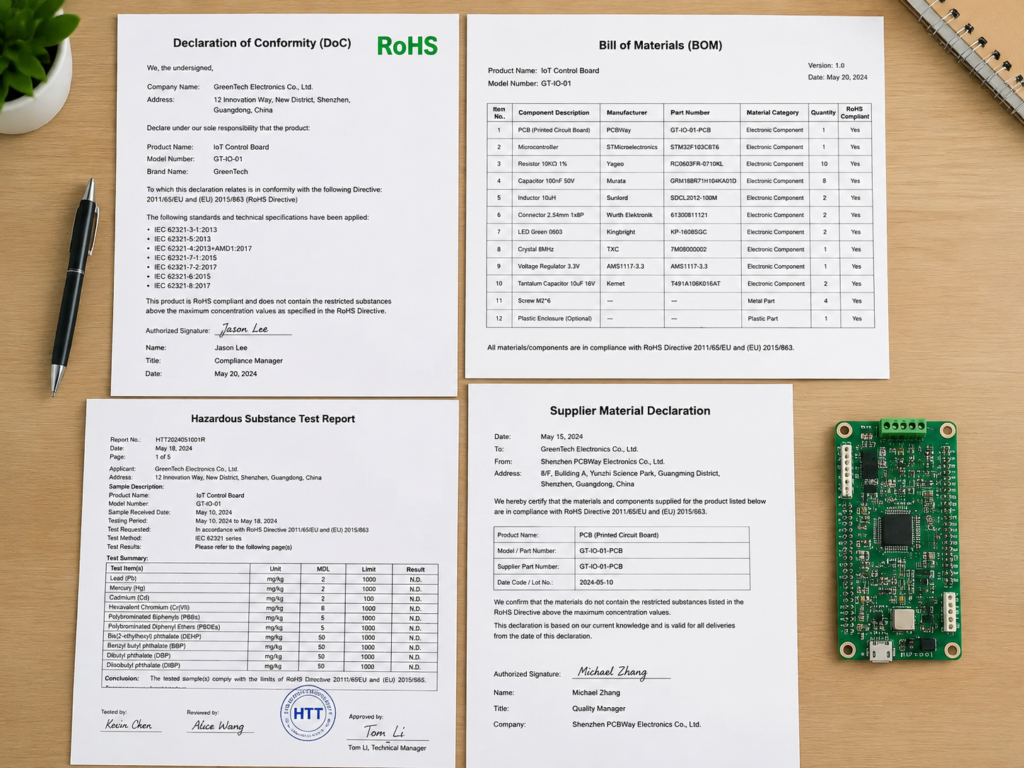
Necessary evidence documents include: Declaration of Conformity (DoC), Bill of Materials (BOM), supplier material declaration; hazardous substance test reports can be used as supporting materials, but are not mandatory — as long as the product can be proved to meet the standards through other methods. Of course, in practice, most enterprises reduce compliance risks through test reports.
At the same time, the consistency requirement must be met: the product model and batch marked on the mark must completely correspond to the information in the documents. If materials or suppliers are changed, or product functions are modified, compliance must be re-evaluated, and marks and corresponding documents must be updated. Old documents cannot be used to cover new products.
Scenario-Based Practical Operation: Marking Schemes for Different Situations
The rules are general, but the practical operation requirements for different products and different sales models vary. The following selects 5 most common scenarios and provides schemes that can be directly referenced.
Finished Electrical and Electronic Products (Exported to the EU)
This is the most common scenario, for example, small household appliances, consumer electronics and other products are exported to the EU and sold to end consumers.
Mandatory requirements: For finished electrical and electronic products subject to CE and WEEE requirements, CE should be marked on the body nameplate first; for those falling within the scope of WEEE producer responsibility and marking, the crossed-out trash bin mark should also be marked. The two can be placed adjacent to each other, but shall not overlap or block each other.
Voluntary supplement: RoHS compliance text (such as “RoHS compliant”) can be added near the nameplate to facilitate the supply chain and regulators to quickly understand the compliance status, without additional decorative patterns.
If it is a finished product with multiple components (such as a desktop computer), only the whole machine needs to be marked, and internal parts such as CPU, hard disk, and power supply do not need to be marked separately.
For example: for small household appliances (such as air fryers) that are usually subject to both CE and WEEE, the CE mark and WEEE mark are printed on the nameplate at the same time, and the manual supplements “This product meets the requirements of EU RoHS Directive 2011/65/EU and amendment (EU) 2015/863”, which is a standardized operation method.
Separately Sold Components/Raw Materials
If the sold electronic components are placed on the market separately, attention should be paid to distinguishing product attributes:
Mandatory requirements: If the product falls within the scope of CE applicable regulations, the CE mark needs to be marked on the product body or packaging.
Voluntary supplement: RoHS compliance text can be added to facilitate downstream customers to quickly identify during procurement and reduce communication costs.
For example, if a PCB assembly is sold separately as a finished module with independent functions and falls within the scope of CE applicable regulations, it needs to be marked with the CE mark as required, and the text “RoHS compliant” can be added to facilitate downstream identification; if it is only a bare board for assembly by complete machine manufacturers, the core compliance obligation is to provide RoHS material declarations, test reports or supplier compliance documents, and whether to use the text “RoHS compliant” can be decided according to customer needs, and there is no need to affix the CE mark at will.
Very Small Size/Special Shape Products
If the product is very small in size or special in shape, and the body really cannot be marked clearly and durably, alternative solutions can be adopted, but the premise must be met: it must be that the body really does not have enough marking space, and it shall not be deliberately not affixed for the sake of saving trouble.
The alternative solution is to print the mark on the smallest sales package or the accompanying manual, but it must be ensured that consumers or regulators can easily obtain it — the mark shall not be hidden in the corner at the end of the manual, nor shall it be marked only on the transport outer carton with no mark on the smallest sales unit.
Absolutely prohibited behaviors include: only affixing on the outer carton when there is obviously space on the body, or using temporary stickers that tear off immediately, all of which are violations.
For example, if the main body of true wireless Bluetooth earphones is too small to print marks, the marks can be printed on the charging case or the manual inside the smallest sales package, which all meet the compliance requirements.
Cross-Border E-Commerce Online Sales
Many enterprises entering the EU market adopt the cross-border e-commerce model (such as Amazon, AliExpress), and special attention should be paid: online declarations cannot replace physical marks.
Online requirements: The product detail page can display the RoHS compliance declaration, but the content must be consistent with the physical mark and actual compliance documents. It is not allowed to exaggerate the compliance status online without corresponding support for the physical product.
Offline requirements: The physical product still needs to be marked with CE and WEEE marks according to the rules — whether sold online or offline, as long as the product enters the EU market, the physical marking requirements are the same.
Only marking the compliance declaration on the online detail page, without the physical product being marked as required and supported by compliance documents, will constitute a violation risk.
Exempt/Partially Exempt Products
If the product falls within the RoHS exemption scope, special care should be taken in the use of marks to avoid misleading:
For fully exempt products, “RoHS compliant” should not be marked generally to imply that the entire product is applicable and fully meets the standards; if it is necessary to explain the material status due to customer documents or supply chain communication, it should be limited to specific parts, materials, limits or exemption clauses, and the basis shall be listed in the DoC/technical documents.
For products with partially exempt components (for example, specific parts of a product are exempt from cadmium limits for technical reasons), when making a RoHS declaration, the exemption scope must be clearly marked, and it shall not be claimed that the entire product meets RoHS requirements.
It should also be noted that the RoHS exemption list is not permanently valid. All exemption clauses have applicable conditions and validity periods, and the latest official EU list needs to be checked regularly to avoid continuing to use old declarations after the exemption expires.
Pitfall Avoidance: Common Misconceptions and Consequences of Violations
Even if the rules are clarified, it is easy to be confused by various specious marks, and even accidentally step into the trap of violations. The following sorts out the most common risk points to help practitioners avoid them in advance.
Quick Distinction of Easily Confused Marks
For quick distinction, the core information of common marks is organized into a comparison table below:
| Mark Type | Core Function | Relationship with RoHS | Mandatory in the EU |
|---|---|---|---|
| CE mark | Declares compliance with all applicable EU regulations | RoHS is one of the regulations covered by CE | Yes (for applicable products) |
| WEEE crossed-out trash bin mark | Prompts that the product needs to be recycled separately | Irrelevant, only a recycling requirement | Yes (for applicable products) |
| Lead Free mark | Declares that lead content meets requirements | Only covers lead in RoHS | No (voluntary) |
| Third-party testing mark (e.g. TÜV) | Proves that specific samples pass testing | Only a compliance supporting material, no legal effect | No (voluntary) |
| Enterprise-made RoHS pattern | Facilitates identification of compliance status | No legal effect, only a prompt | No (voluntary) |
Most Common Marking Violation Situations
Common marking violation situations are mainly divided into four categories:
The first category is false marking: affixing the CE mark before the product meets the standards, fraudulently using others’ compliance qualifications, and the model on the mark does not match the actual product — for example, using the test report of model A to correspond to the product of model B is false marking.
The second category is non-standard marking: wrong proportion of CE mark, blurriness, affixing in a position easy to fall off, and only affixing on the transport outer carton when it should be affixed on the product body, all fall into this category.
The third category is information misleading: claiming to have “RoHS certification”, randomly adding a notified body number next to the CE mark, and exaggerating the compliance scope — for example, only testing the lead content and claiming full RoHS compliance.
The fourth category is lack of evidence: the product is affixed with the CE mark and marked with RoHS compliance, but cannot provide a DoC, has no supplier material declaration, and the test report does not cover key materials, which is equivalent to empty words and also constitutes a violation.
Common Consequences After Violations
Some practitioners believe that “marking problems are only trivial matters with low rectification costs”, but in fact, the consequences of violations are more serious than imagined:
First is the customs link: if the EU customs finds that the marking is non-compliant, the light consequence is cargo detention, and the heavy consequence is return or even forced destruction, directly causing cargo losses.
Then is market supervision: the fine standards of EU member states are different, linked to the value of goods and the circumstances of the violation, there is no unified fixed amount, and some member states can impose high fines on serious violation cases.
There is also the platform level: if you engage in cross-border e-commerce and are found non-compliant by the platform, the product listing will be directly removed, and even store permissions will be restricted, which may affect normal operations.
The longer-term impact is damage to brand reputation, and subsequent products exported to the EU may be subject to key inspections, which is not worth the loss.
Advanced: Compliance Self-Inspection and Decision-Making You Can Do Yourself
If you already have certain experience in EU market operation and want to control compliance risks by yourself without relying on third parties for everything, you can master the following self-inspection and decision-making logic, which can be used for preliminary screening in most common scenarios; further confirmation is still needed when involving exemptions, medical devices, industrial equipment or multiple regulations superimposed.
5 Steps for Quick RoHS Marking Compliance Self-Inspection
You can quickly conduct self-inspection according to the following 5 steps, and you can first figure out the basic situation without third-party intervention:
Step 1: Confirm whether the product falls within the applicable scope of RoHS and whether there are exemption situations — if it is not within the control scope at all, subsequent steps do not need to be carried out.
Step 2: Check whether the appearance of mandatory marks (CE and WEEE) meets the specifications, whether the position is correct, whether they are clear and distinguishable, and whether there are problems such as deformation or falling off.
Step 3: Check the voluntary RoHS declaration for misleading expressions (such as “RoHS certification”, “permanent compliance”, etc.), whether it exaggerates the compliance scope, and whether the marked directive version is accurate.
Step 4: Check the evidence chain, whether documents such as DoC, bill of materials, supplier declaration, test report correspond to the product model and batch, and whether there are missing certification documents for key materials.
Step 5: Confirm whether the marking requirements of the sales region match — for example, use UKCA for sales to the UK and CE for sales to the EU, and do not confuse them.
Marking Decision Logic for Different Business Scenarios
Different business scenarios have different compliance priorities, and you can match the corresponding requirements according to your own situation without excessive configuration:
If you export finished products to the EU, prioritize affixing CE and WEEE marks on the product body, and voluntarily add RoHS compliance text, which can not only meet compliance requirements, but also facilitate relevant parties to quickly identify the compliance status.
If components are supplied to complete machine manufacturers and not sold directly to consumers, only compliance documents can be provided, and whether to mark is decided according to customer needs — because the product is assembled inside the complete machine, there is no need to bear marking obligations separately.
If you produce very small size products and really cannot affix marks on the body, you can print the marks on the smallest sales package or manual, and be sure to ensure that consumers and regulators can easily obtain them, and the marks shall not be hidden.
If you are an ordinary purchaser or consumer and want to judge whether a product is truly RoHS compliant, don’t just look at whether there is a green RoHS pattern, but focus on two core points: whether there is a CE mark, and whether a DoC (Declaration of Conformity) can be provided — these two are legal requirements and more credible than any self-made pattern.
Handling Logic for Common Marking Problems
If you encounter compliance problems, you don’t need to panic, and you can handle them according to the following logic:
If the customs questions the compliance of the mark, there is no need to argue. Directly provide a complete evidence chain (DoC, test report, supplier declaration, etc.) to prove that the product meets the requirements. As long as the evidence is sufficient, it can usually be solved smoothly.
If the mark is found to be blurry or falling off, this batch of products must never be allowed to enter the market. They need to be re-marked or repackaged before sale, otherwise it will constitute a violation if found.
If regulations or exemption lists are updated, it is necessary to re-evaluate the compliance of the product in a timely manner. Change the mark when it should be changed, and replace materials when they should be replaced. Old rules shall not be followed.
If you are not sure whether the product needs to be marked or how to mark it, the safest way is to compare with the official EU RoHS exemption list, or consult an EU authorized representative or a professional compliance consultant. Do not guess on your own to avoid bearing unnecessary risks.
Summary
The core logic of RoHS marking-related rules can be summarized into three points:
First, clarify the applicable boundary first: RoHS controls the limits of hazardous substances in electrical and electronic products. The EU has no mandatory official exclusive RoHS logo. The core of compliance is product compliance + complete evidence chain (DoC and supporting technical documents), rather than labeling.
Second, distinguish the attributes of marks: CE is a mandatory access mark for applicable products (covering RoHS), WEEE is a mandatory recycling prompt for applicable products, and enterprise-made RoHS declarations are only voluntary prompts and shall not be misleading; marks from different regions shall not be mixed.
Third, use in compliance according to scenarios: select the marking position and form according to product type and sales model. All marks must be consistent with the evidence chain, and self-inspection and update shall be carried out regularly to avoid violation risks.
Practitioners at the entry stage, as long as they can accurately distinguish the functions of CE, WEEE and voluntary RoHS declarations, can judge the marking obligations of their own products, and use voluntary declarations in compliance, can cope with most daily scenarios. On this basis, mastering self-inspection methods and risk avoidance logic can effectively reduce compliance risks and avoid being misled by false statements such as “official certification” and “exclusive mark”.