
Cross-border sellers and product manufacturers targeting the EU market almost always come into contact with the CE mark. Many people think the CE mark is just a random pattern printed on products, until they encounter customs spot checks or platform delistings, only to find that the size, graphic, and affixing position of the CE mark have clear rules, making it a high-incidence point for compliance pitfalls. This article systematically sorts out CE mark affixing specifications from basic cognition, general rules to special scenario judgment and practical self-inspection, to help you avoid common labeling compliance risks.
I. First, Understand the Basic Logic of the CE Mark
Before talking about specific size and affixing rules, we must first clarify the essence of the CE mark — the root cause of many people’s pitfalls is a deviation in their basic understanding of CE.
1.1 Meaning and Legal Attribute of the CE Mark
In plain terms, the CE mark is a “market access declaration” that manufacturers affix to products: I declare that this product complies with all applicable EU harmonized regulations that require the CE mark to be affixed (the EU’s regulation/directive system that sets unified safety, health, and environmental protection requirements for specific product categories). Note that it refers to “all applicable and CE-required” regulations, not all EU laws — the CE mark is not a unified certification for all EU regulations or general quality, it only corresponds to the requirements of harmonized regulations that mandate CE affixing.
For example, a desk lamp with Bluetooth function may be subject to multiple CE-required regulations such as electrical safety, electromagnetic compatibility, and radio frequency, and must meet all of them before the CE mark can be affixed. The specific applicable regulations need to be confirmed in combination with product parameters.
It is not a decorative pattern designed by enterprises themselves, but part of the EU’s mandatory access rules, with clear legal binding force. Also, pay attention to the priority of rules: if a certain type of product has special regulations (such as medical devices, explosion-proof products), and the special regulations have stricter requirements for the CE mark than the general rules, you must follow the special regulations instead of only abiding by the general rules.
1.2 First Clear Up Cognitive Misconceptions: What the CE Mark Does Not Mean
These points are the most easily misunderstood, let’s clarify first:
First, CE is not a quality grade certification issued by EU authorities. It is essentially a “self-declaration” by the manufacturer, not a “quality medal” issued by an EU agency.
Second, CE does not equal “made in the EU”, nor is it a certificate of origin. Products made in China can be affixed with the CE mark as long as they comply with relevant EU regulations.
Third, CE does not mean that EU agencies have inspected products one by one. In the vast majority of cases, the EU will not check products individually, but requires manufacturers to ensure compliance on their own, with supervision carried out through post-market spot checks.
Fourth, not all products sold in the EU need to be affixed with the CE mark.
1.3 How to Judge Whether Your Product Needs to Be Affixed with CE?
The core logic of judgment is to check layer by layer according to the actual situation of the product, do not blindly follow peers to affix it — peers may also have affixed it incorrectly. Specifically, you can judge according to this procedure:
1. First clarify the function, purpose, target sales market and specific version of the product;
2. Check against the product scope of EU harmonized regulations to confirm whether the product falls within the coverage of one or more regulations;
3. Then verify whether the corresponding regulations clearly require the affixing of the CE mark.
Common product categories that must be affixed with CE include: electronic and electrical appliances, toys, machinery, personal protective equipment (such as work gloves, safety goggles), medical devices, building materials, etc.
Common products that do not need to be affixed include: most ordinary food, cosmetics, general textiles (such as ordinary cotton T-shirts), etc.
If you are not sure, the best way is to check the original text of EU regulations for the corresponding product, or consult a professional compliance service agency, do not judge by intuition.
1.4 Compliance Responsibilities and Possible Consequences
The primary responsible entity for CE mark compliance is the manufacturer: regardless of whether the manufacturer is located within the EU, it is fully responsible for the product complying with all applicable regulations, preparing technical documentation, signing the EU Declaration of Conformity (DoC), and correctly affixing the CE mark.
If the manufacturer is outside the EU, it usually designates an EU authorized representative, but the authorized representative only performs specific tasks specified in the regulations according to written authorization (such as keeping technical documentation, receiving regulatory inquiries), and will not assume the manufacturer’s main compliance responsibility, nor is there a general “joint liability”.
Importers and distributors also have verification obligations: when purchasing goods, importers need to verify the CE mark, manufacturer and product identification information, instructions, and EU Declaration of Conformity, and ensure that technical documentation can be obtained or provided as required by regulation; distributors need to ensure that the labels of the products they sell meet the requirements, and cannot shirk responsibility on the grounds that they are “just selling goods”.
If the label is non-compliant, possible consequences include customs detention of goods, e-commerce platform delisting, market sales ban, and fines stipulated by member states. The specific severity depends on the nature of the violation, the law enforcement scale of member states and platform policies. Many novice cross-border sellers have suffered return losses due to non-compliant labels.
II. General Specifications for the CE Mark Itself
After figuring out whether to affix it, the next step is the general requirements for the CE mark itself, which the vast majority of products need to comply with, unless the corresponding product regulations clearly stipulate otherwise.
2.1 Graphic: The Standard Lettering Shall Not Be Modified Without Authorization
The lettering of the CE mark is a fixed style specified by EU authorities. The width, spacing, and arc ratio of the C and E have unified standards, and can only be scaled up or down proportionally, and shall not be modified without authorization.
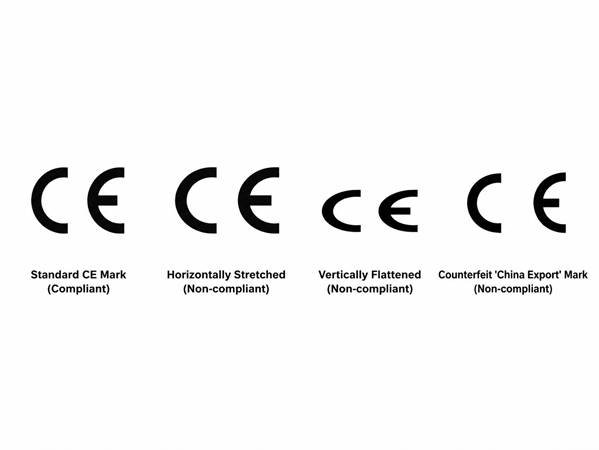
For example, flattening or stretching the CE mark to fit a position, changing it to artistic characters, bolding one of the letters, or cutting off a part, are all non-compliant. Special reminder: many CE mark images found randomly on the Internet have incorrect proportions, and there are even counterfeit “China export marks” (the spacing and radian of the two letters do not meet official standards). Using them is directly deemed non-compliant, so it is recommended to download the standard template from official EU channels.
2.2 Size: General Rules and Measurement Criterion
Many people know that the CE mark has a minimum size, but they easily get the measurement object and applicable prerequisites wrong.
Measurement Criterion: What is measured is the overall vertical height of the standard CE lettering; background color blocks, outer borders, decorative edges, surrounding white space or other additional patterns are not included in the size; do not mistake the horizontal width of the letters or the total height of the outer frame for the effective height of the CE mark.
General Rule: For conventional products with sufficient affixing space, the overall height of the CE mark shall usually not be less than 5mm; there is no maximum size limit, as long as it is scaled proportionally, any size is acceptable.
2.3 Exception Conditions for Size and Position
If the product is truly unable to accommodate a 5mm high mark due to its physical characteristics (such as too small volume, irregular curved surface), you need to pay attention to three independent exception issues, all of which must be checked against the applicable regulations of the corresponding product respectively. You cannot automatically apply all exceptions just because the product is small:
1. Whether size reduction is allowed, and what the minimum allowable size is;
2. Whether it is allowed to affix the mark on the minimum sales package instead;
3. Whether it is allowed to add the mark in the instruction manual.
It is forbidden to reduce the mark size or adjust the position without authorization for non-essential reasons such as aesthetics, cost, or crowded layout; regardless of whether exceptions apply, the mark must be clearly distinguishable to the naked eye, and cannot be shrunk so small that a magnifying glass is required to identify it.
2.4 Color: The Core Is Sufficient Contrast
The CE mark is not mandatory to be black; the core requirement is to form a clear contrast with the background so that it can be easily identified by the naked eye.
The most common compliant practice is printing black on a white background, and white on a dark background (i.e., reverse white). If the product is transparent or made of dark metal, and a directly printed mark cannot be seen clearly, you can add a light-colored background, or use a separate nameplate to ensure the mark is clearly visible. Try not to use colors similar to the background such as light gray, light pink, etc., as those with insufficient recognition are usually non-compliant.
III. General Requirements for Affixing and Production
It is not enough to make the CE mark itself correct; there are also clear general requirements for the affixing position and production method.
3.1 Priority of Labeling Position
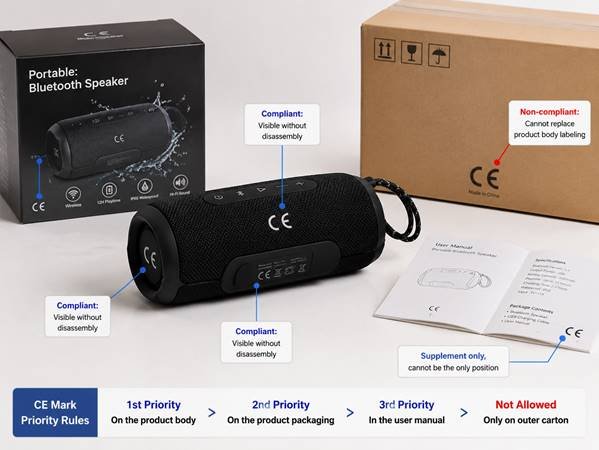
Under normal circumstances, the CE mark should be preferentially affixed to the product body or the fixed data nameplate of the product. The core requirement is visible, clear, easy to read, and locatable without disassembly during normal product inspection. As for whether it is affixed to the front, side, back or bottom, it is all acceptable, as long as the user can find it without disassembling anything after receiving the product — many people think that affixing it on the bottom is non-compliant, but that is a misunderstanding. As long as the bottom is visible without disassembly, it fully meets the general requirements.
Only when the physical properties of the product itself do not allow it, or the specific applicable regulations clearly permit, can the mark be affixed to the minimum sales package, and package labeling cannot replace the mandatory requirement on the product body.
Labeling on the instruction manual or accompanying documents is only a supplement when explicitly permitted by specific regulations, and cannot be the only labeling position.
Also note: shipping outer cartons are not the minimum sales package required by regulations, and usually cannot replace the labeling requirements of the product body or minimum sales package.
3.2 Production Method and Durability
Many people think the CE mark can only be affixed with stickers, but there are many compliant methods: directly printed on the shell, laser engraved, molded (such as integrally pressed into a plastic shell), fixed metal/plastic nameplates, permanent self-adhesive labels, etc., all are acceptable.
Which method to choose mainly depends on the material and use environment of the product. The core requirement is: during normal use, transportation, and storage, the CE mark must not fall off, fade, or become blurred.
Sticky notes, temporary stickers, and labels that are prone to falling off, fading, or being arbitrarily torn off in the product’s expected use environment shall not be used. Some merchants print the CE mark on the product’s protective film, so the user tears off the mark together with the protective film when unpacking. This also does not meet the durability requirement, which is equivalent to not affixing the mark at all.
During internal initial inspection, you can gently scrape the surface of the mark with a fingernail to preliminarily judge adhesion firmness, but formal durability compliance needs to be verified according to the requirements of applicable regulations or harmonized standards, combined with the product’s expected use, transportation, and storage environment. Compliance cannot be judged solely by fingernail scraping.
If the product itself has protection performance requirements such as waterproof, dustproof, and explosion-proof, the affixing of the mark shall not damage its original protection performance.
3.3 Rules for Coexistence of Multiple Marks
If there are also brand logos, other certification marks (such as energy efficiency marks, recycling marks), QR codes, or decorative patterns on the product, it is necessary to ensure that the CE mark is complete and not blocked by these items.
When placed side by side with other compliance marks, sufficient spacing must be left to ensure that each mark can be clearly identified, and they cannot be crowded together. In addition, products must not display marks that look very similar to the CE mark and are easy to confuse, to avoid misleading consumers and regulatory personnel.
IV. Special Rules for Different Product Categories
The above are all general rules, but some special categories of products may have dedicated adjustment rules due to their own form and risk profiles. Common special scenarios include:
4.1 Small/Micro Products
Trigger condition: The product is truly unable to be affixed with a CE mark meeting the general size requirements on its body due to physical size, shape, etc.
Possible adjustment directions: Reduce the mark size, affix the mark on the minimum sales package, add the mark in the instruction manual.
Regulatory conditions that must be verified: Whether size reduction is allowed, the minimum size limit, whether placement on the package is allowed, and whether instruction manual supplementation is required, all need to be confirmed against the applicable regulations of the corresponding product respectively, and all exceptions cannot be automatically applied; package labeling and instruction manual supplementation cannot replace each other, both require explicit regulatory support. The basis and reasons for the adjustment need to be recorded in the product’s technical documentation, and regardless of size, the mark must be clearly distinguishable to the naked eye.
4.2 Products with Protection Performance Requirements
Trigger condition: The product has protection grade requirements such as waterproof, dustproof, explosion-proof (such as waterproof watches, explosion-proof electrical appliances, outdoor lamps).
Possible adjustment directions: Prioritize production methods that do not damage the protective layer, such as laser engraving, integral molding, in-mold labeling, etc.
Regulatory conditions that must be verified: Any operation that changes the shell, nameplate or manufacturing process requires re-verification of whether the protection performance still meets the corresponding standards, and compliance cannot be judged solely based on process experience; after affixing the mark, the original protection performance of the product must not be damaged.
4.3 Products Sold as Sets/Combinations
Trigger condition: Multiple products or components are sold together.
Judgment steps:
1. First judge whether a single component is placed on the market as an independent product (i.e., it also needs CE compliance when sold separately): if yes, each independent component still needs to be affixed with the CE mark according to its own applicable regulations;
2. Then judge whether the combined whole set constitutes a new regulated product: if yes, the whole machine manufacturer needs to complete the overall conformity assessment and label it according to regulations applicable to the whole machine;
3. Finally, confirm the labeling requirements for the body, package and documents according to applicable regulations: if applicable regulations clearly require package labeling, the product body is not visible during sale, or the product body is truly unable to be affixed with the mark, the minimum sales package of the whole set of products shall also be labeled with the CE mark as required by regulations.
Precautions: You cannot assume the assembled whole machine is compliant just because individual components have the CE mark; the whole machine manufacturer still needs to complete the overall conformity assessment; shipping outer cartons are not the minimum sales package and cannot replace the labeling obligation of the product or minimum sales package.
4.4 Products Requiring Participation of a Notified Body
Trigger condition: Applicable product regulations require a notified body (a third-party compliance audit body designated by EU member states and officially recognized, which can perform specific conformity assessment procedures within its authorized scope) to participate in the conformity assessment, and the body has actually completed the corresponding procedure.
Possible adjustment direction: Append the four-digit identification number of the notified body after the CE mark. The number should follow the CE mark closely, with similar font size and clear distinguishability.
Regulatory conditions that must be verified: Whether specific product regulations require the participation of a notified body, and whether the notified body has the corresponding qualification; it is forbidden to fabricate or fraudulently use the number without audit by the corresponding notified body; not all high-risk products need to be affixed with a notified body number, and the specific requirement shall be subject to the conformity assessment module specified in applicable regulations.
4.5 Products with Special Forms
Disposable/Consumable Products
Trigger condition: The product body (such as disposable masks, medical gloves) is truly unable to be affixed with the mark.
Possible adjustment direction: Affix the mark on the package of the minimum sales unit.
Regulatory conditions that must be verified: Whether corresponding product regulations allow omitting body labeling, and this cannot be decided without authorization.
Software/Digital Products
Trigger condition: Software or digital products may involve requirements of EU harmonized regulations.
Possible adjustment direction: Need to be affixed with the CE mark, or participate in the overall conformity assessment as a component of a regulated product.
Regulatory conditions that must be verified: First judge whether the software is an independent product covered by a certain harmonized regulation, or whether it is a necessary component of the safety function of a regulated product — for example, ordinary office software usually does not need it, while safety-related software used to control medical devices or industrial machinery may need to participate in the overall assessment as part of the product; electronically displayed CE marks cannot automatically replace physical labels, and must be premised on explicit permission from corresponding regulations.
Components/Spare Parts Sold Separately
Trigger condition: Components or spare parts are placed on the market for separate sale.
Possible adjustment direction: May or may not need to be affixed with the CE mark.
Regulatory conditions that must be verified: Whether it falls within the product scope covered by one or more EU harmonized regulations. For example, industrial power modules sold separately and covered by the Low Voltage Directive need the CE mark; while ordinary structural parts that are only used as accessories of the whole machine and not sold separately to end users usually do not need separate affixing. The specific requirement shall be judged against the scope of applicable regulations, and whole machine rules cannot be directly applied.
V. Prerequisites and Timing for Affixing the CE Mark
Many people think that as long as the product is roughly up to standard, they can print the CE mark first and make up the test later — this is very dangerous. The CE mark cannot be affixed whenever you want; it must meet three prerequisites at the same time.
5.1 Three Necessary Prerequisites
First, the conformity assessment of all applicable EU harmonized regulations that require the CE mark to be affixed must be completed. Note that it is “all applicable”, not just one of them — for example, a headphone with wireless function may need to comply with multiple regulatory requirements such as radio frequency, electromagnetic compatibility, electrical safety, RoHS, etc. The specific requirements shall be confirmed according to the product’s function, parameters and scope of application, and the CE mark cannot be affixed after only completing one item. The conformity assessment mentioned here refers to a series of processes to prove product compliance, such as completing tests and document sorting according to regulatory requirements.
Second, the EU Declaration of Conformity (DoC) has been prepared and signed. This is a written document formally signed by the manufacturer, equivalent to a “compliance guarantee letter”, declaring that the product complies with all applicable EU regulations, and must bear an authorized signature and relevant information.
Third, the product’s technical documentation is complete, and can be produced within the specified time when required by EU regulatory authorities.
If any of these three prerequisites is missing, the CE mark cannot be affixed.
5.2 Situations Where Early Affixing Is Prohibited
Before the applicable conformity assessment is completed, the CE mark shall not be affixed for publicity, trial sale or batch shipment. The following common situations are all violations:
• The product has not completed testing and rectification, and the conformity assessment has not passed, but the CE mark is affixed in advance;
• The CE mark is printed on the product or package in advance just for publicity, to make the product “look formal”;
• Samples or prototypes have not completed the conformity assessment, but are placed on the market with the mark.
Whether samples or prototypes can carry the mark depends on whether they have completed all applicable conformity assessments and whether they will be placed on the market; subsequent supplementary tests cannot automatically eliminate the violation risk at the time of affixing.
5.3 Consistency Requirements for Mass Production
Manufacturers must ensure that the CE mark on mass-produced products is consistent with the label design scheme (size, style, position) of the product model that has passed the conformity assessment, and shall not be changed at will.
If the label supplier or printing process is changed, or the product’s shell material or structure is altered, it is necessary to re-evaluate whether the change affects the clarity and durability of the mark, or whether it touches the basis of the original compliance conclusion, and confirm that it still meets the requirements before mass production.
The final label/nameplate design drawings, and records of the mark’s position and size, must be properly kept. When regulations change in the future, it is also necessary to re-evaluate whether compliance is still maintained.
VI. Preliminary Self-Inspection Method for CE Mark Compliance
After mastering the previous rules, you can complete preliminary self-inspection according to the following steps to quickly check for common obvious risks:
6.1 Step 1: Confirm Whether the Product Needs to Be Affixed with CE
First clarify the product’s function, purpose, sales region and specific version, then make a preliminary judgment against common CE-covered categories, combined with the product scope of harmonized regulations. If you are not sure, don’t guess blindly; check the EU regulations for the corresponding product, or consult a professional compliance agency.
6.2 Step 2: Check Whether the Mark Itself Is Compliant
• Check the graphic: whether it is the official standard lettering, whether it has been stretched or flattened, whether it is a counterfeit mark with wrong proportions;
• Measure the size: whether the overall height of the CE lettering of conventional products is ≥5mm; if it is a small product, whether it meets the size requirements of the corresponding regulations;
• Check the color: whether the contrast with the background is sufficient, whether it can be seen clearly at a glance;
• Check the number: if there is a four-digit notified body number after the CE mark, first confirm whether your product really needs the participation of a notified body, then verify whether the number corresponds to a formal notified body with corresponding qualifications, not a randomly fabricated one.
6.3 Step 3: Check Whether the Affixing and Production Are Compliant
• Check the position: the formal judgment standard is “visible without disassembly of the product, clear and easy to read”; (Note: “can be found within 10 seconds without disassembling the product” is only internal rapid screening experience, not the compliance judgment standard specified in EU regulations)
• Test durability: the formal judgment standard is “remains clear and firm under the product’s expected use, transportation, and storage environment”; (Note: “no peeling after gentle scraping with a fingernail” is only internal rapid screening experience, not the compliance judgment standard specified in EU regulations; formal compliance needs to be verified according to applicable regulations)
• Check clarity: whether the mark is blocked by logos or QR codes, whether there are scratches or missing corners, and whether each mark can be seen clearly when placed together with other marks.
6.4 Step 4: Check Whether the Prerequisites for Affixing Are Met
Don’t just look at whether the mark is correct; also confirm: have all applicable regulations completed the conformity assessment? Is there a signed EU Declaration of Conformity? Is the technical documentation complete and accessible? If the prerequisites are not met, no matter how standard the mark is, it is still a violation.
6.5 Handling Methods When in Doubt
If you still have questions after self-inspection, the three most reliable channels are: the original text of EU CE regulations for the corresponding product category, qualified EU CE compliance service agencies, and CE mark usage guidelines issued by EU authorities.
VII. Quick Check of High-Frequency Compliance Misconceptions
The following are the most frequent high-frequency misconceptions that cause losses in practice, sorted into a quick check table for fast verification:
| Common Misconception | Correct Judgment | Quick Verification Action |
| As long as the CE mark is visible, it’s fine. 5mm is the height of a single letter, and it’s okay to flatten or stretch it randomly to fit the position | For conventional products, the overall height of the standard CE lettering needs to be ≥5mm; outer frames and decorative edges are not included; the official standard lettering must be used, and can only be scaled proportionally. Proportional deformation is directly non-compliant | Measure the overall vertical height of the CE letters with a ruler, check the lettering proportion against the EU official template, and do not use CE patterns of unknown origin |
| It’s enough to affix it on the package, instruction manual, or shipping outer carton. The CE mark cannot be affixed on the bottom of the product | Conventional products must be affixed on the body (or fixed nameplate), and positions visible without disassembly (including the bottom) are compliant; packages and instruction manuals are only used as supplements when explicitly permitted by regulations, and shipping outer cartons cannot replace body labeling | Take the product without disassembling the shell, directly locate the CE mark on the body, and confirm it is visible without disassembly |
| Ordinary stickers or printing on the protective film are fine, as long as the mark has been affixed | The mark needs to remain clear and firm during the product’s expected use, transportation, and storage. Marks on sticky notes, temporary stickers, and protective films that will be torn off are all non-compliant | For initial inspection, you can gently scrape the mark with a fingernail (only for rapid screening); formal durability verification shall be carried out according to regulations combined with the use environment |
| With a CE certificate, you can affix the mark casually, and adding a notified body number makes it look more formal | Before affixing CE, you must complete the conformity assessment of all applicable regulations, sign the DoC, and have complete technical documentation; the notified body number can only be added when required by regulations and the body actually participates in the assessment. Fabricating or fraudulently using the number is a serious violation | Check the DoC and conformity assessment records. If there is a number, query the corresponding qualification of the notified body |
| The CE mark is universal in all European countries, and the UK does not accept CE at all | The CE mark applies to products covered by relevant harmonized regulations in the EU and the European Economic Area (EEA) that meet the target market rules; whether CE is accepted in Great Britain depends on the product category, applicable UK transition/recognition rules and the time of sale; Northern Ireland needs to use CE or CE+UKNI marks according to applicable rules and conformity assessment routes | Confirm the latest labeling requirements of the target market in advance, and do not generalize |
Final Summary
After reading this content, you can independently complete most basic judgments and self-inspections related to the CE mark:
1. Can combine product function, purpose and target market to preliminarily judge whether it is covered by EU harmonized regulations that require CE affixing;
2. Can check whether the graphic, size, and color of the CE mark of conventional products meet general requirements;
3. Can check whether the affixing position, production method and durability of the mark are compliant;
4. Can confirm whether the three prerequisites for affixing CE (conformity assessment, DoC, technical documentation) are met;
5. When encountering special products or doubtful situations, know to check against corresponding product regulations, consult compliance agencies or refer to EU official guidelines.
It needs to be reminded again that general rules are the basis, but the applicable regulations for each type of product may have special requirements. Be sure to check the corresponding regulations according to the actual situation of your own products, and do not apply unified experience to all products. Laying a solid foundation for labeling compliance rules can help you avoid many unnecessary compliance losses.