
For those doing business in EU electrical and electronic products, most people will fall into the same pit when first encountering RoHS: they think that spending a few hundred yuan to buy a “RoHS certificate” from a third-party institution will be enough for customs clearance and platform review, only to end up with either goods detained by customs or products removed from the platform. In fact, RoHS compliance is a complete set of legally binding document chains, and we will break down the specific logic in detail later.
Many people think RoHS documents are complicated, but the logic is actually very simple: first figure out whether you need to comply, then prepare core documents and supporting materials as required, and finally learn to judge whether the documents are valid and do a good job of daily maintenance. In this article, we will sort out all required documents by priority and applicable scenarios, so that even if you are new to EU compliance, you can follow along.
First, Clarify: Do You and Your Products Need to Prepare RoHS Documents?
Which Products Fall Under RoHS Regulation Scope?
To determine whether a product needs RoHS compliance, it is not as simple as checking “whether it uses electricity”. It requires three steps of layer-by-layer confirmation:
Step 1: First check whether it is an electrical and electronic product (EEE for short) – in plain terms, it is a device that mainly relies on electric current or electromagnetic fields to perform at least one function, with an operating voltage below 1000V AC / 1500V DC.
Step 2: Then check whether it falls into the 11 major product categories listed in Annex I of the RoHS Directive. Common ones include large household appliances, small household appliances, 3C products such as mobile phones and computers, lighting fixtures, electronic toys, electric tools, IT and telecommunications equipment, etc.
Step 3: Finally, exclude categories that are clearly not within the regulation scope, and then verify whether there are applicable exemption clauses.
Many people tend to overlook the judgment of accessories: whether separately sold electronic accessories need RoHS compliance should be confirmed by category. Products that can independently perform electrical functions, such as external power supplies, remote controls, and adapters, are independent electrical and electronic equipment, and need to separately meet RoHS requirements when entering the EU market alone. Although cables and data cables may not be able to independently complete the functions of a complete machine, RoHS has clear coverage requirements for EEE-related cables placed on the EU market, so corresponding compliance evidence must also be prepared when sold separately. If they are original accessories sold together with the complete machine, they can be covered by the compliance documents of the complete machine. If they are spare parts specifically used to replace old equipment already on the market, they need to be judged in combination with specific exclusion clauses, and cannot be generalized.
There are also many easily confused boundaries: the regulation of batteries themselves, packaging materials, and general chemicals falls under the EU Battery Regulation, Packaging Regulation, and REACH Regulation respectively, and is not within the scope of RoHS documents. However, special attention should be paid: electrical and electronic products sold with batteries and packaging still need to have their RoHS obligations judged separately. You cannot exclude the RoHS responsibility of the complete machine just because the product contains batteries and packaging, and documents of different regulations cannot replace each other.
Exclusions and Exemptions: Do Not Judge Arbitrarily by Yourself
Many people confuse “exclusions that are completely not subject to RoHS regulation” with “situations that are regulated but eligible for specific exemptions”, and the requirements for the two are completely different:
Category 1: Products Clearly Excluded from RoHS (No Need to Prepare RoHS Documents at All)
Several types of products are clearly excluded from RoHS regulation due to their special purposes, but they all have strict definitions and cannot be applied arbitrarily:
- Military/space equipment: Only refers to equipment used for military and space purposes under the EU Common Security and Defence Policy. Ordinary civilian products with “military industry” or “space” promotional gimmicks do not count.
- Large-scale stationary industrial equipment: Usually refers to large equipment specially used in industrial production sites, fixedly installed and not easily movable, requiring professional personnel for installation and maintenance, and serving industrial production processes. Ordinary hand-held electric tools and small industrial electrical appliances do not fall into this category.
- Active implantable medical devices: Refers to medical devices that need to be implanted inside the human body through surgery or medical means and operate on electricity. Ordinary medical devices used outside the body (such as household blood pressure monitors and blood glucose meters) are not excluded and still need to meet RoHS requirements.
Category 2: Products Subject to RoHS Regulation but Eligible for Specific Exemptions
Some categories are within the RoHS regulation scope, but due to reasons such as technical limitations, certain components can be temporarily exempted from hazardous substance restriction requirements. For example, medical devices and monitoring equipment have their own exemption lists.
If your products fall into these special categories, you must verify four core pieces of information: the RoHS Annex category corresponding to the product, the specific exemption clause number, the scope of components/materials to which the exemption applies, and the validity period and implementation date of the exemption. You cannot generally say “medical devices are exempt from RoHS”. All exemptions must strictly correspond to the officially released RoHS clauses and can only be used if they meet the applicable conditions. If you are unsure, it is recommended to consult a professional institution for confirmation, as self-judgment can easily lead to pitfalls.
Compliance Responsibilities Vary by Business Entity
Not everyone needs to prepare a full set of RoHS documents. Different business identities have clear differences in legal responsibilities, and should not be confused:
- EU-based manufacturers / own-brand owners: They are the primary responsible entities for RoHS, bear full compliance responsibility, are responsible for drafting technical documents and signing the declaration of conformity, and must keep the full set of documents for at least 10 years after the product is last placed on the EU market.
- Non-EU manufacturers: The core responsibility for RoHS still lies with the manufacturer itself, which is responsible for drafting technical documents and declarations of conformity, and controlling product compliance. It should be noted that when non-EU manufacturers place products on the EU market, they must ensure that there is a responsible entity within the EU that can be directly contacted by regulatory authorities. If there is no EU importer to assume the corresponding compliance obligations, or if products are sold directly to EU consumers through cross-border e-commerce platforms or own brands, it is usually necessary to appoint an EU Authorised Representative (AR for short) and keep the written authorisation agreement and proof of the AR’s contact information. The AR can undertake work such as keeping copies of documents and liaising with regulators within the scope of authorisation, but the ultimate compliance responsibility still rests with the non-EU manufacturer. In practice, non-EU sellers should at least first confirm who will liaise with regulators and keep documents within the EU: whether it is the importer, the EU Authorised Representative (AR), or the responsible entity required by platform rules; the corresponding supporting documents should be archived together.
- EU importers: Their legal responsibility is to verify before the product is placed on the market whether the manufacturer has prepared the declaration of conformity and technical documents, confirm that the product bears the compliance mark, and at the same time keep a copy of the declaration of conformity for inspection to ensure that product traceability information is complete.
- Distributors / cross-border e-commerce sellers: If they only sell products of other brands, they are responsible for verifying whether the CE mark and declaration of conformity of the product are complete, and cannot sell obviously non-compliant products; if they sell products under their own brand, they must bear all the responsibilities of a manufacturer.
As for the relevant requirements of e-commerce platforms and fulfillment service providers, they fall under the scope of EU market supervision regulations, and are not the same as the main responsibilities of RoHS itself, so they should not be confused.
First Correction: RoHS Is Not a Single Third-Party Certificate
Many beginners tend to equate third-party test reports with the entirety of RoHS compliance. Here we first clarify the core logic: RoHS compliance is a complete set of legal document chains, with the core being the declaration of conformity issued by the responsible entity and the technical documents that can prove the authenticity of the declaration; third-party test reports are only one type of supporting evidence and cannot replace the obligations of legal declarations and complete technical documents. Once this logic is clarified, you will not go astray when preparing documents later.
Two Core Legal Documents Required for All Applicable Products
As long as your product falls within the RoHS regulation scope, you must prepare these two core legal documents; missing either one means non-compliance.
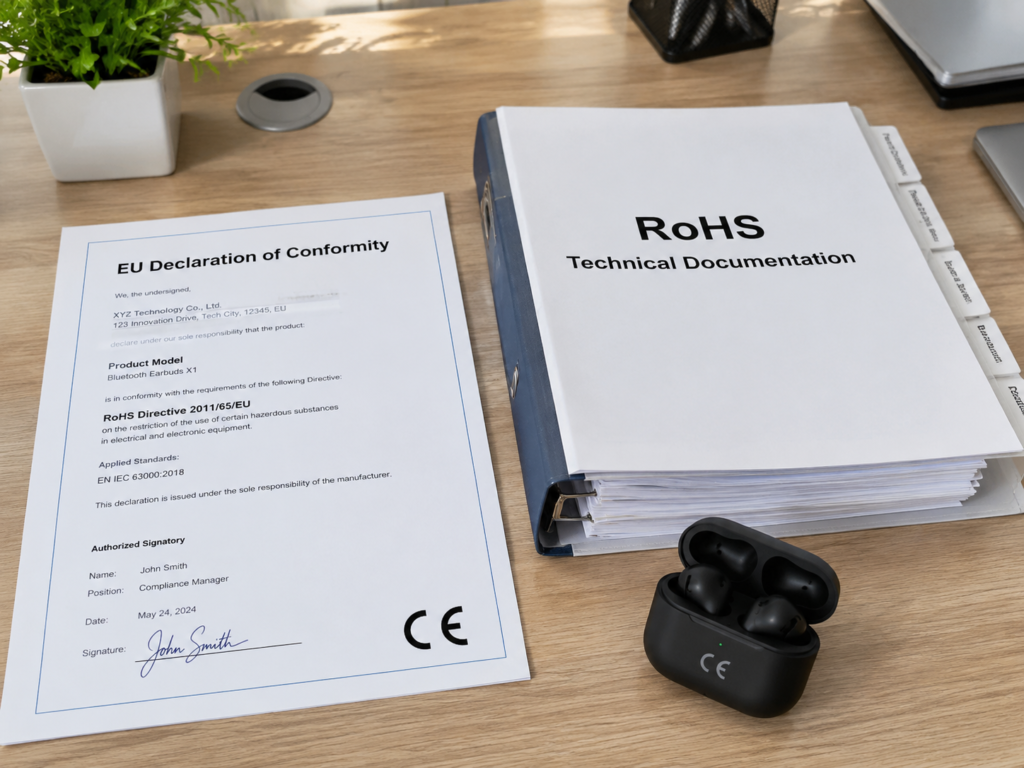
EU Declaration of Conformity (DoC): The Legal Compliance Commitment Letter You Sign
The EU Declaration of Conformity, commonly referred to as DoC, is simply a legal commitment letter signed by the responsible entity itself, guaranteeing in black and white that its products meet all RoHS requirements.
This document does not need to be stamped by a third-party institution; enterprises can issue it themselves, but it must be signed by an authorized person of the enterprise to be valid. A compliant DoC must include the following key information:
- Product identification: specific model/series number, corresponding RoHS product category
- Responsible entity information: name, address, contact information of the manufacturer; if an AR is appointed, the name, address, and contact information of the AR must also be indicated
- Responsibility statement: clearly stating that the manufacturer bears sole responsibility for the compliance of the product
- Declaration of conformity: clearly declaring that the product complies with the RoHS Directive (Directive 2011/65/EU) and all applicable amendments
- Referenced standards/technical specifications: if harmonized standards (such as EN IEC 63000) are adopted, they can be listed as compliance support
- Authorized signatory information: name, position, handwritten signature, as well as the place and date of signing
If the product also complies with other CE regulations (such as Radio Equipment Directive (RED) and Electromagnetic Compatibility (EMC)), the DoC can list all applicable regulations together, but it must be ensured that the requirements of each regulation are covered.
Many beginners tend to make several low-level mistakes when making their first DoC: for example, non-EU manufacturers appoint an AR but forget to indicate the AR’s information, or the product model on the document does not match the actually sold one, and some only reference the repealed old version of the directive and do not cover current amendment requirements – all of these will lead to insufficient legal basis for the DoC and cannot prove that the product meets current RoHS requirements.
Technical Documentation (TD): The Evidence Package Supporting the Authenticity of the DoC
Technical Documentation (TD for short) is the full set of evidence packages used to support the authenticity of the DoC – if you say your product complies with RoHS, you have to provide evidence. When these evidences are organized together, they form the technical documentation.
Its relationship with the DoC is very clear: the DoC is the final compliance conclusion, and the technical documentation is the basis for proving the conclusion. You must first collect all the technical documentation, confirm that the product actually meets the requirements, and then sign the DoC. You cannot do it the other way around by signing first and then supplementing evidence.
It should be specially noted here that the RoHS Directive only requires that technical documentation can “sufficiently prove that the product meets the hazardous substance restriction requirements”, and does not mandate which fixed-format documents must be included. Enterprises can choose different combinations of evidence to prove compliance based on the complexity of the product and the transparency of the supply chain – the supporting materials listed in the following sections are the most commonly used in the industry, and not every product must prepare all of them, as long as a complete evidence chain can be formed. The EN IEC 63000 standard commonly used in the industry is a reference to guide enterprises in preparing RoHS technical documentation, which can help you sort out compliance logic, but it is not a mandatory requirement.
The storage requirement for technical documentation is statutory: from the date the product is last placed on the EU market, it must be kept for at least 10 years, either in electronic or paper form, as long as it can be quickly produced during regulatory spot checks. As for the commonly mentioned “dual backup of electronic + paper” and “annual verification”, these are management suggestions for enterprises to reduce risks, not legal obligations.
List of Commonly Used Supporting Materials for Technical Documentation
Technical documentation is not just a random pile of papers; the materials inside must be able to fully prove the compliance of the product. The commonly used supporting materials in the industry are mainly divided into four categories.
Product Identification and Traceability: Allowing Regulators to Correspond to Physical Products
The first thing to include is the product’s “identity information” and traceability materials, the purpose of which is to allow regulators to correspond the documents to the actually sold products, and to find the cause along the chain if problems arise.
Commonly used materials include the product’s model, specification, version number, style drawings and physical photos of product labels and packaging. There is also a complete bill of materials (commonly known as BOM). It is recommended to list all components and raw materials in the product clearly, including the corresponding supplier names and material numbers. It is best to specifically mark high-risk materials – such as solder, plastic shells, cable sheaths, metal coatings, printing inks, etc. These are high-incidence areas for excessive hazardous substances, and regulators will also focus on them.
In addition, it is recommended to prepare batch traceability records, such as the production batch of each batch of products, contact information of upstream and downstream suppliers, and material source records, to ensure that problems can be quickly located to specific batches and suppliers. Traceability capability is an implicit requirement of RoHS compliance, but there is no mandatory regulation on the specific record format, and enterprises can adjust according to their own situation.
Supply Chain Compliance Declarations: Compliance Guarantees from Upstream
The components and raw materials of products all come from suppliers, so the compliance declarations issued by suppliers are the core supporting materials in technical documentation, mainly of two types:
One is the Material Declaration (MD for short), which is a hazardous substance content declaration issued by upstream suppliers for specific materials, and is required to be detailed down to the homogeneous material level – the so-called homogeneous material is the same material that cannot be further split into smaller units by mechanical means. For example, the PVC sheath of a data cable is a homogeneous material; you cannot calculate the entire cable including the sheath and core together, but must split it into the smallest units of the same material to calculate the hazardous substance content.
The other is the Supplier Declaration of Conformity (SDoC for short), which is a RoHS compliance commitment stamped by the supplier. It must clearly indicate the applicable material models and batches, and cannot be a general “all products of our company comply with RoHS”.
If the order volume is relatively large, you can also supplement supplier compliance questionnaires and compliance clauses in procurement contracts to clarify the responsibilities of both parties and hold each other accountable if problems arise. This is an optional supplement, not mandatory.
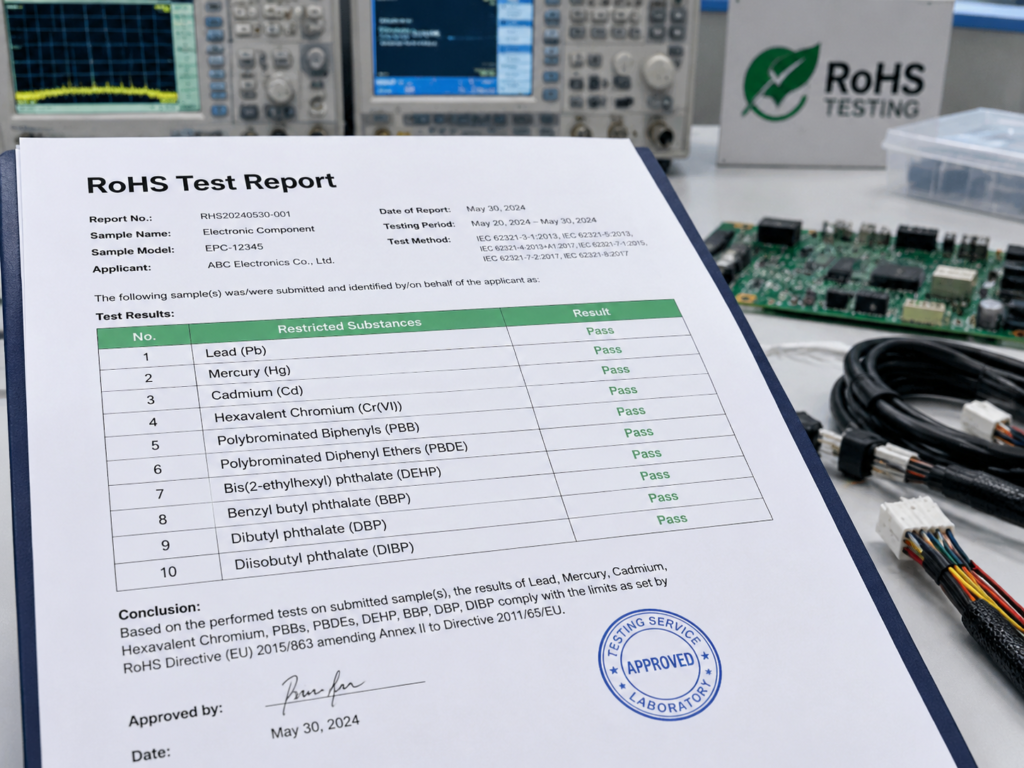
Testing and Verification: Basis for Verifying Hazardous Substances
The RoHS test report, which most people are most familiar with, is an important verification-type supporting material in technical documentation. It should be clarified first: RoHS does not mandate that all products must undergo third-party testing; enterprises can prove compliance through supply chain declarations, material data, and internal risk assessments. However, if supply chain material declarations are insufficient, there are high-risk materials, products are intended for children or human contact scenarios, or importers or platforms explicitly require it, test reports should be used as necessary supporting materials in such scenarios. Using third-party test reports as support can greatly enhance the credibility of evidence and reduce the risk of regulatory spot checks.
If third-party test reports are used, first you need to understand a basic logic: the “accreditation qualification” of a laboratory essentially proves that it has the ability to conduct certain types of testing, but it does not mean that all its items are accredited, nor is it a mandatory requirement of RoHS – it’s just that reports with mutual recognition qualifications are more credible and more easily accepted by regulators.
Currently, internationally recognized are accredited reports issued by member institutions of the ILAC MRA (International Laboratory Accreditation Cooperation Mutual Recognition Arrangement). For example, China’s CNAS (China National Accreditation Service for Conformity Assessment) and Germany’s DAkkS (German Accreditation Body) are members of this arrangement, and RoHS test reports within their accreditation scope are generally recognized in the EU. Here, pay attention to two easily confused qualifications: CNAS is a laboratory accreditation qualification, corresponding to the scope of international mutual recognition; CMA is China’s metrology accreditation, mainly used for domestic regulatory scenarios, and does not fall within the scope of international mutual recognition, so do not confuse them. Finally, you also need to verify: whether the specific accreditation scope of the laboratory covers RoHS testing items, and you cannot just use the report because there is an accreditation logo on it.
In addition to laboratory qualifications, the following core dimensions should also be focused on for verification:
- Sample matching: The tested samples must be consistent with the products or materials you actually sell, including model, configuration, material supplier, and production process. You cannot test samples of other models and then apply the results to your own products.
- Testing scope: It must cover all 10 restricted substances specified in Annex II of RoHS, namely: lead (Pb), mercury (Hg), cadmium (Cd), hexavalent chromium (Cr(VI)), polybrominated biphenyls (PBB), polybrominated diphenyl ethers (PBDE), bis(2-ethylhexyl) phthalate (DEHP), butyl benzyl phthalate (BBP), dibutyl phthalate (DBP), diisobutyl phthalate (DIBP). The limit requirements in homogeneous materials are: cadmium not exceeding 0.01% (100ppm), and the other 9 substances each not exceeding 0.1% (1000ppm), except for components to which exemption clauses apply.
- Report limitations: The test report can only prove that “the few samples sent for testing” meet the requirements, and does not mean that all products and all batches you produce are always compliant. If you later change suppliers, modify materials, or adjust processes, the original report can no longer be used as compliance evidence for new batches of products, and re-verification is required.
Special Situations and Change Records: Responding to Exceptions and Adjustments
Not all products need this part of the materials; only those that meet special situations need to prepare them:
If your product uses RoHS exemption clauses, you need to prepare exemption certificates, clearly stating the corresponding exemption clause number, applicable components, technical basis for meeting the exemption, and validity period of the exemption. You cannot just say “I used the exemption” and be done with it – this part is a legal requirement, because you need to prove that your use of the exemption meets the clause conditions.
For special categories such as medical devices and monitoring equipment, you also need to prepare product classification judgment records and supporting materials for exclusive exemptions to prove that you meet the requirements of special categories.
In addition, RoHS requires that products still meet compliance requirements after changes, so enterprises need to conduct compliance assessments on changes in materials, suppliers, and production processes to confirm that they still meet RoHS requirements after the change. There is no mandatory regulation on the specific format of change records, but it is recommended to keep documents before and after the change, assessment records, and archive old versions of documents, because different batches of products may correspond to different versions of documents.
Supplementary Documents Required for Different Scenarios (Prepare as Needed)
In addition to the core legal documents and commonly used supporting materials mentioned above, different business entities, product types, and sales scenarios also need to supplement some corresponding documents. These documents are not all legal requirements of RoHS; many are requirements at the market supervision, platform, or commercial level, so just prepare them as needed.
Supplementary by Business Entity
- Non-EU manufacturers: Supplement the authorisation agreement of the EU Authorised Representative and proof of contact information, to prove the authorisation scope and liaison information of the AR.
- EU importers: Supplement import customs clearance records and proof of their own information marked on the product label or DoC. Among them, keeping a copy of the DoC is a legal requirement of RoHS for importers, while customs clearance records and label marking are supporting rules of customs and market supervision, and it is recommended to keep them together for inspection.
- Cross-border e-commerce sellers: Supplement the compliance commitment letter required by the platform and screenshots of compliance information publicity on the product detail page. These are supporting materials required by the platform to fulfill regulatory responsibilities, and do not fall within the scope of RoHS legal documents. Just prepare them according to platform rules.
Supplementary by Product Type
- Finished electrical and electronic products: Supplement the complete machine hazardous substance risk assessment statement. Such materials are recommended supplementary evidence for technical documentation, not mandatory, but they can clearly demonstrate the enterprise’s control logic and improve the pass rate of regulatory spot checks, especially suitable for products with complex material compositions.
- Separately sold components/accessories: Supplement the description of applicable downstream finished product scope and detailed version of the material declaration. Such materials are mainly used to facilitate downstream customers to integrate into their own technical documentation, and are not mandatory requirements of RoHS, but can greatly reduce supply chain communication costs.
- Sets/combined products: Supplement the model correspondence of each component and respective compliance certificates. If each component in the set is an independent EEE, it must have its own compliance certificate; if it is a complete set of equipment sold as a whole, listing the composition can also improve traceability efficiency, and is a recommended supplementary material.
Supplementary by Sales Scenario
- Offline physical sales: Supplement CE mark compliance photos and local language version of the DoC. Among them, affixing the CE mark on products is a legal requirement of RoHS, and photos are supporting materials kept by enterprises; language requirements are determined by the competent authority or implementation rules of the target member state, and may involve the DoC or materials submitted to regulators. There is no unified general rule, and it is recommended to confirm with the importer or the competent authority of the target country in advance.
- Industrial supporting supply: Supplement supply chain compliance transmission records. Such documents are used to prove that compliance information is circulated and confirmed step by step in the supply chain, and are not mandatory RoHS documents, but they can clarify upstream and downstream responsibilities and reduce supply chain transmission risks.
- E-commerce platform sales: Supplement platform review approval records and AR information publicity proof. These are materials required by platform rules, and do not fall within the scope of RoHS legal documents. Just prepare them according to platform requirements.
How to Judge Whether RoHS Documents Are Valid
Many people, when getting documents from suppliers, don’t know whether they are real or fake, useful or not. Here we teach you a set of judgment methods: the beginner’s three-step method can filter out most problematic documents, and with some knowledge of versions and boundaries, you basically won’t fall into pitfalls.
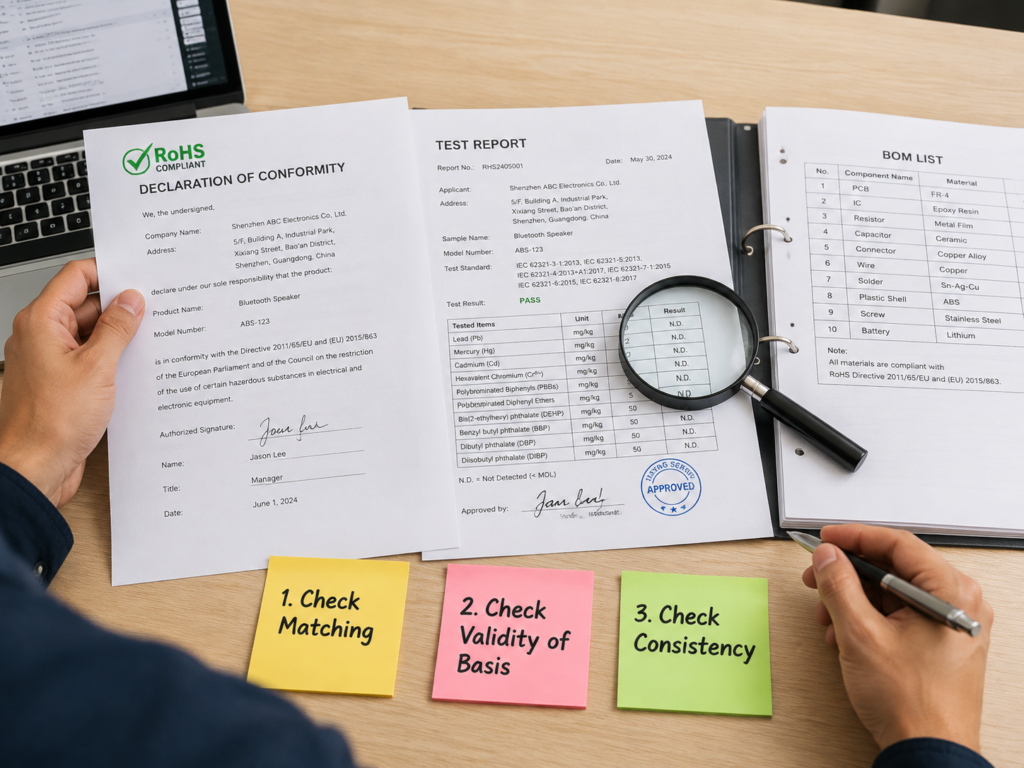
Beginner’s 3-Step Quick Judgment Method
Step 1: Check matching: Whether the documents cover the product model, material batch, and version you are currently selling. For example, if you sell Model A headphones but the report given by the supplier is for Model B, it is definitely useless.
Step 2: Check validity of basis: Whether the regulations referenced in the DoC are the currently effective RoHS Directive and its amendments, whether the test report or material declaration covers all 10 restricted substances (except exemptions), and whether repealed old version requirements are used.
Step 3: Check consistency: The product information and responsible entity information on all documents must correspond. For example, if the manufacturer name on the DoC is Company A, but the applicant on the test report is Company B, and there is no explanation of the entrustment relationship, there must be a problem.
These Documents Cannot Be Used as Valid Compliance Evidence, Avoid Pitfalls
There are several common document problems that will cause them to be unable to be used as compliance evidence. When you get them, you should focus on checking:
- Situations where the DoC has insufficient basis: no signature of the authorized person; only referencing the repealed Directive 2002/95/EC and not covering current amendment requirements; non-EU manufacturers appoint an AR but do not indicate AR information (if applicable).
- Situations where test reports cannot be used alone as current compliance evidence: only covering the old version of 6 substances (can be used as historical reference, need to supplement verification materials for the remaining 4 phthalates); test samples are inconsistent with actually sold products/materials; the laboratory’s accreditation scope does not include RoHS testing items (if supported by accreditation qualifications); corresponding to old BOM and no supplementary change assessment records.
- Situations where material declarations cannot be used as valid evidence: no corresponding specific material model and batch; no signature or seal of the supplier; the content is very general, only writing “this product complies with RoHS” without any specific data, which is equivalent to not providing anything.
Do Not Confuse Versions and Regulatory Boundaries
When judging validity, you also need to pay attention to the issues of versions and regulatory boundaries, and do not confuse them:
First is regulatory version evolution: What many people call RoHS 1.0 refers to the earliest Directive 2002/95/EC, which only regulated 6 hazardous substances at that time. This directive has been replaced and repealed by Directive 2011/65/EU (commonly known as RoHS 2). The currently effective RoHS requirements include Directive 2011/65/EU and its subsequent amendments. For example, the amendment passed in 2015 added 4 phthalate substances, bringing the total number of restricted substances to 10. At the same time, RoHS 2 also incorporated CE mark requirements into the compliance system.
Here is a special reminder: not all old version RoHS reports are completely useless. If your product was placed on the EU market during the effective period of the old version of the directive, the corresponding old report can be used as compliance evidence for that historical batch; but for products newly placed on the market now, they must meet the current requirements for 10 substances, and reports only covering the old version of 6 substances cannot be used as sufficient compliance evidence.
Then there are member state differences: The EU currently has 27 member states, and language requirements and specific regulatory procedures are stipulated by each member state itself. There is no unified EU-wide rule, and it is recommended to follow the requirements of the competent authority of the target member state, importer, or platform.
There are also regulatory boundaries: RoHS only regulates the restriction of hazardous substances in electrical and electronic products; the REACH Regulation regulates the registration, evaluation, authorisation, and restriction of chemical substances in all categories; the WEEE Directive regulates the recycling and reuse of waste electrical and electronic equipment; the Battery Regulation regulates battery compliance and recycling; the Packaging Regulation regulates the environmental protection requirements of packaging materials. These regulations are independent of each other, and documents cannot be mixed. For example, you cannot use a REACH test report as a RoHS document, nor can you use a WEEE registration certificate as evidence of RoHS compliance.
4 Steps for Beginners to Prepare RoHS Documents from Scratch
After talking about what documents are needed, here is a set of practical steps for beginners. Follow them and you can prepare the full set of documents without wasting effort.
Step 1: Sort Out Basic Information and Confirm Applicable Scope
First sort out the most basic information: what is your identity (manufacturer or seller, inside or outside the EU), what sales channels you use, which EU countries are your targets, and what are the corresponding compliance responsibilities.
Then confirm whether your product is within the applicable scope of RoHS: first judge whether it is EEE, then see if it falls into the RoHS Annex categories, then exclude clearly excluded categories, and finally verify whether there are applicable exemption clauses – if you are unsure, it is best to consult a professional institution or lawyer for confirmation, and do not judge arbitrarily by yourself.
Next, organize the product’s BOM, list all components and raw materials, clarify who the supplier of each component is, and mark high-risk materials, the more detailed the better.
Step 2: Collect Supporting Documents from the Upstream Supply Chain
After organizing the BOM, you can request Material Declarations (MD) and Supplier Declarations of Conformity (SDoC) from all component and raw material suppliers, requiring them to correspond to specific material models and batches.
After getting the documents, don’t just throw them into a folder and be done with it. You should verify the matching, validity of basis, and consistency of the documents according to the three-step method mentioned earlier, such as whether they correspond to the material models and batches you purchased, whether there is a seal and signature of the supplier, and whether the content meets the requirements. For unqualified ones, promptly ask the supplier to supplement or replace them, don’t wait until you need them to find out they don’t work.
Finally, you can sort out the compliance evidence of high-risk materials separately and establish a supply chain compliance file for future reference.
Step 3: Issue Core Legal Documents
When all supporting materials are collected and verified to be correct, and after confirming that the product meets RoHS requirements, you can draft the EU Declaration of Conformity (DoC), fill in all information as required, and have it signed by the enterprise’s authorized person.
Do you need to do additional complete machine testing? It can be judged according to the risk situation of the product: if the product has many types of materials, low supply chain transparency, uses exemption clauses, has a history of excessive records, or has recent material/process changes, it is recommended to do additional testing of the complete machine or high-risk components to further reduce compliance risks. It should be noted that children’s toys, medical devices, and electronic products that come into contact with the human body may also need to comply with other EU regulations such as toy safety, medical devices, and REACH in addition to RoHS. Do not confuse the risks of different regulations.
Finally, organize all supporting materials, assemble them into complete technical documentation, and classify them by category for easy lookup.
Step 4: Archiving and Daily Updates
Documents are not done once they are prepared; you also need to do a good job of archiving and daily maintenance:
Archive by product model, either in electronic or paper form, to ensure that they can be quickly found when needed – the legal requirement is to keep them for at least 10 years from the last placement on the EU market, and dual backup is an optional risk prevention and control measure for enterprises.
If the product’s materials, production processes, or suppliers change later, compliance must be re-evaluated, and the corresponding technical documentation and DoC must be updated. This is a legal requirement, because it is necessary to ensure that the product continues to meet RoHS requirements.
In addition, it is recommended to regularly check the validity of all documents once a year to see if there are any regulatory updates or if any documents have become invalid due to changes, and replace invalid documents in time. This is a management suggestion in practice, not a mandatory requirement.
Common Misconceptions and Pitfall Avoidance for Regulatory Spot Checks
Finally, let’s talk about several practical pitfalls that people often fall into, as well as coping skills for regulatory spot checks, to help you avoid detours.
4 Most Common Cognitive Mistakes
First misconception: Having a test report/third-party certificate equals compliance, or you must do third-party testing to be compliant. Many people either think that getting a third-party RoHS test report means everything is fine, or think that technical documentation must have third-party testing to be valid. In fact, RoHS does not mandate third-party testing for all products; enterprises can prove compliance through supply chain declarations, material data, risk assessments, etc. Third-party testing is only one of the ways to enhance the credibility of evidence, and test reports can only prove the results of the tested samples. They cannot replace legal documents such as DoC, technical documentation, and supply chain declarations, nor can they cover the change control requirements throughout the product life cycle – if the model and material batch corresponding to the report do not match the currently sold products, they cannot be used as compliance evidence at all.
Second misconception: If the supplier gives RoHS documents, I don’t have to take responsibility. Many people think that as long as the supplier says it’s compliant, they don’t need to verify it. In fact, as the responsible entity placing the product on the market, you bear the ultimate compliance responsibility. If something goes wrong, regulators and platforms will come to you first, so you must verify the validity of the documents yourself.
Third misconception: RoHS documents have a fixed validity period of 1 year/3 years. Many people think that the validity period of a RoHS report is 1 year or 3 years. In fact, the law does not stipulate a fixed validity period at all. As long as the materials, processes, and suppliers remain unchanged, and the regulations are not updated, the documents remain valid; once changes occur, or regulations update new restriction requirements, the original documents may become invalid. The industry convention of updating every 1-3 years is because most enterprises adjust their supply chains within this cycle, not a legal requirement.
Fourth misconception: A “RoHS compliant” sticker can replace documents. Some merchants think that just putting a RoHS compliant sticker on the product is enough. In fact, the legal requirement is to affix the CE mark and have a full set of compliance documents. Just putting a sticker is useless, and you may even be punished for false marking.
3 Pitfall Avoidance Tips in Practice
First tip: Don’t buy those “universal version” RoHS reports – that is, reports that can be applied to any model or product. Such reports cannot correspond to specific product models, BOM configurations, or material batches, so they cannot be used as valid compliance support. Pay attention to distinguishing the boundary between “insufficient documents” and “forged documents”: if the report is real but does not match, it is insufficient evidence; if the report number, laboratory information, and sample information are forged, it is fraud, and the punishment will be much heavier.
Second tip: For high-risk materials, give priority to suppliers with formal compliance certificates. For high-incidence areas such as solder, plastics, and cables, finding suppliers with complete material declarations and test reports can save a lot of subsequent trouble and also reduce the risk of exceeding limits.
Third tip: Documents must be classified and stored as required, and version records must be kept well. Don’t lose them, and don’t mix different versions of documents together. Otherwise, if you can’t find them for a long time during a regulatory spot check, or take the wrong version, there will be problems.
What to Do When Facing Regulatory Spot Checks
If you really receive a regulatory spot check notice, don’t panic. Follow these points:
First, submit documents strictly in accordance with the time limit and document list required in the notice. In practice, the document submission period usually given by the competent authority is mostly in the range of 1-4 weeks, but the specific period is subject to the official notice of the member state’s competent authority. Do not apply the so-called “general period” by yourself. Be sure to check the deadline in the notice and don’t be overdue.
If the documents are temporarily incomplete, do not refuse to submit them directly, let alone forge them. You can submit a statement of the situation as required by the notice and apply for a time limit to complete them. However, whether to approve the supplementary submission application depends on the legal provisions of the member state, the risk level of the product, and the nature of the case – if it is a high-risk product, has been launched on a large scale, or is suspected of false declaration, measures such as sales restriction and recall may be taken directly. Failure to complete within the time limit will also face penalties, and the specific situation is subject to the notice of the competent authority.
The most important point: It is strictly forbidden to submit forged or tampered documents. The EU’s penalties for compliance fraud are very severe. In minor cases, there will be fines and sales bans; in serious cases, criminal responsibility may be pursued according to the laws of the member state and the nature of the violation. What could have been a small problem of incomplete documents becomes a big problem if you forge, which must never be touched.
Summary and Quick Self-Check Checklist
Overall, although RoHS compliance documents seem numerous, the logic is actually very clear: first judge whether you and your products are subject to RoHS regulation, then prepare two core legal documents (DoC and technical documentation), use appropriate supporting evidence to prove that the product meets the requirements, then supplement corresponding supporting materials according to your own business identity, product type, and sales scenario, and usually do a good job of change assessment and document update, then you can meet the compliance requirements.
After reading this content, you should master four core competencies:
- Quickly judge whether your own products and business identity trigger RoHS document obligations;
- Clearly distinguish the different roles and legal status of DoC, technical documentation, and test reports;
- Verify the validity of RoHS documents by model, batch, and material configuration, and avoid common invalid document pitfalls;
- Complete the full set of document preparation according to the process of BOM sorting, supplier declaration collection, testing/risk assessment, and archiving update.
To facilitate everyone to quickly check their preparation status, here is a simple self-check list, just tick the boxes:
| Self-Check Dimension | Key Check Points | Tick if Compliant |
|---|---|---|
| Core legal documents | A compliant EU Declaration of Conformity (DoC) has been signed, and complete technical documentation that can prove compliance has been organized | □ |
| Matching | All documents correspond to the actually sold product model, material batch, and configuration version, with consistent information throughout | □ |
| Regulatory basis | The DoC references the currently effective RoHS Directive and applicable amendments, and tests/declarations cover all 10 restricted substances (except exemptions) | □ |
| Special requirements | Products eligible for exemptions have corresponding exemption certificates; supporting materials corresponding to the business entity and sales scenario are prepared | □ |
| Storage management | Technical documentation is kept for at least 10 years from the last placement of the product on the EU market and can be quickly retrieved | □ |