
Operators active in the EU market have most likely heard of the CE mark, but many have a misconception: they think that affixing the CE mark on a product equals compliance. In fact, the CE mark is a label for manufacturers to self-declare that their products meet the requirements of relevant EU regulations. The core material that truly supports compliance is CE technical documentation (hereinafter referred to as technical documentation). Many operators face risks ranging from goods being detained by customs and denied entry to product recalls and administrative penalties, because they have not prepared compliant technical documentation or the documentation has obvious defects. This article starts with the most basic definition, and explains step by step the preparation methods and archiving requirements for technical documentation. It can help beginner readers complete basic compliance preparations and avoid most common cognitive misunderstandings.
First, Understand: What Exactly Is CE Technical Documentation?
You can think of technical documentation as a “collection of compliance evidence” for products entering the EU market — it is not for ordinary consumers, but for EU border management authorities (responsible for border control verification) and market surveillance authorities (responsible for post-market surveillance) to access and verify in accordance with the law. It has two core functions: first, it serves as proof that the product meets the basic requirements of applicable EU regulations; second, it serves as one of the pieces of evidence to prove that the manufacturer has fulfilled its compliance obligations during regulatory inspections or compliance dispute handling.
Many beginners who are new to CE often confuse it with several other documents. We use a table to clarify the core differences at once:
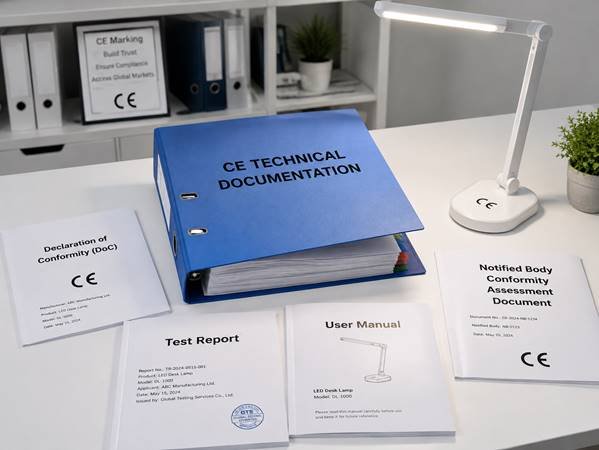
| Document Type | Nature | Can It Serve as a Complete Standalone Compliance Proof? |
| CE Technical Documentation | Complete set of evidence covering the entire product compliance process | Yes |
| Declaration of Conformity (DoC) | Unilateral compliance commitment letter signed by the manufacturer, a statutory component of the technical documentation | No |
| Test Report | Test results for a single sample, one piece of evidence for the technical documentation | No |
| Notified Body Conformity Assessment Document | Inspection, audit or assessment document issued by an EU-accredited notified body, only when applicable regulations require third-party participation in conformity assessment; it is part of the technical documentation | No (must be used with complete technical documentation) |
| User Manual | Usage guide for end users, a supporting annex to the technical documentation | No |
Two of the most common misconceptions for beginners need to be specially corrected here:
First, affixing the CE mark does not equal compliance. The CE mark is only a label for manufacturers to declare product compliance externally. Without corresponding technical documentation as support, arbitrarily affixing the CE mark is a violation.
Second, technical documentation does not need to be disclosed to ordinary consumers. Unless otherwise required by applicable regulations, only EU regulatory authorities have the right to access it in accordance with the law, and there is no need to publish it on consumer-facing channels such as online stores or product packaging.
What are the possible consequences if the technical documentation is non-compliant? At the border stage, customs may detain goods and prohibit product entry in accordance with the law; at the market surveillance stage, products may be required to be rectified, restricted or prohibited from being placed on the market, ordered to be withdrawn from the market or recalled, and the competent authorities of member states may impose administrative penalties in accordance with local regulations. The specific consequences depend on the nature of the violation, applicable regulations and the decision of the law enforcement agency, and there is no unified penalty standard.
Scope of Application and Division of Responsibilities: Who Needs to Prepare It and Who Is Responsible
Which Products Require Technical Documentation
The general judgment logic is: all products that need to bear the CE mark must prepare corresponding technical documentation in accordance with the requirements of applicable regulations. If the same product is subject to multiple CE regulations (for example, a desk lamp with Bluetooth function may involve low voltage safety, electromagnetic compatibility, and radio equipment-related requirements at the same time), the technical documentation must cover the requirements of all applicable regulations, and cannot only meet part of them.
There are also clear exclusions: products not regulated by the CE system, such as food and pharmaceuticals, do not need to prepare CE technical documentation, and must not arbitrarily affix the CE mark, otherwise they will be deemed to be in violation.
It should be noted that whether a specific product falls under CE regulation and which regulations apply cannot be judged solely by the product name. It is necessary to check the applicable scope and exclusion clauses of the corresponding regulations based on the product’s function, intended use, structure, etc. The final judgment shall be subject to the official EU regulatory texts and the implementation rules of member states.
Division of Responsibilities for Each Role
Many operators who are new to CE compliance often confuse the responsibilities of different entities. In fact, specific obligations shall be subject to applicable EU regulations and product categories. The common responsibilities of core roles are as follows:
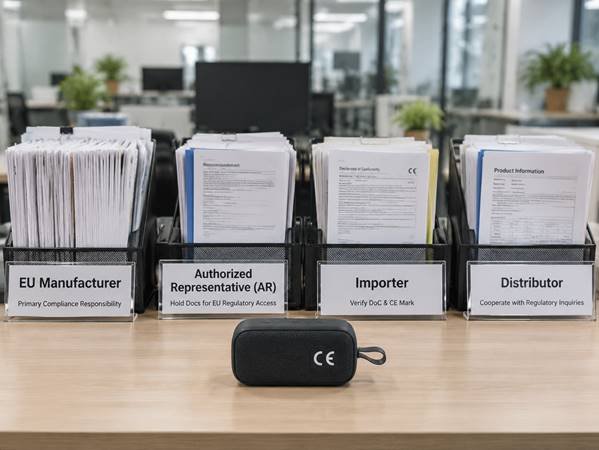
• Manufacturers established in the EU: Always the first responsible party for CE compliance, responsible for preparing, updating, and storing technical documentation, and ensuring that products meet the requirements of all applicable regulations.
• Manufacturers established outside the EU: In accordance with the requirements of applicable regulations, it is usually necessary to appoint an Authorized Representative (AR) in the EU, who shall hold the technical documentation and cooperate with regulatory access in accordance with regulations. For products requiring an EU-based responsible party, the AR or other EU responsible party cannot only provide a nominal address; they must actually hold the complete technical documentation, or at least have the authority and process to access the complete documentation within the regulatory time limit.
• Importers: Must verify whether the product bears the CE mark, whether the manufacturer has issued a Declaration of Conformity (DoC), and whether the information of the manufacturer or AR is marked as required; when required by applicable regulations, importers shall keep a copy of the Declaration of Conformity and ensure that technical documentation can be provided in accordance with regulatory requirements.
• Distributors: Do not need to prepare technical documentation, must verify the compliance marks of products in accordance with applicable regulations, cooperate with regulatory inquiries and investigations, and provide valid contact information of the document responsible party; some regulations may require distributors to undertake additional assistance obligations.
Non-negotiable Responsibility Boundaries
There are two core responsibility boundaries that all operators need to clarify:
First, regardless of whether a testing agency or compliance consulting firm is entrusted to assist in preparing technical documentation or completing tests, the final compliance responsibility always rests with the manufacturer and will not be transferred due to entrustment of a third party.
Second, ARs that undertake obligations in accordance with applicable regulations must actually perform statutory duties such as document holding and cooperation with regulation. Those who only act as a nominal contact to collect fees without performing obligations may result in both the manufacturer and the AR bearing corresponding legal liabilities.
First Step Before Preparation: Identify Applicable Compliance Basis
Before formally preparing technical documentation, the first thing is to identify the applicable compliance basis for the product — if the basis is wrong, all subsequent work will lose its compliance foundation.
How to Determine Applicable CE Regulations
The core dimensions for judgment are the product’s function, intended use, structure, energy type, and use environment, rather than just looking at the product’s name or category. For example, ordinary household flashlights and industrial flashlights for use in mines are subject to completely different regulations; those with built-in batteries and those that only use plug-in power also have different compliance requirements.
For specific judgment, you can proceed according to the following思路: first clarify the core function and intended use scenario of the product, then find all potentially applicable EU regulations, check the scope of application, exclusion clauses and definitions of each regulation one by one to confirm whether the product falls under CE regulation and which rules apply. For example, products with wireless transmission functions can easily miss the requirements of radio equipment-related regulations, which requires special attention.
The official EU CE product classification guide can be used as a reference tool, but the final judgment shall be subject to official regulatory texts and applicable member state implementation rules.
Role and Boundaries of Harmonised Standards
In the CE compliance system, you often hear the concept of “harmonised standard”. Simply put, a harmonised standard is a technical specification developed by European standardisation bodies and cited in the Official Journal of the European Union. If a product fully complies with the corresponding harmonised standard, within the scope covered by the standard, the product can be presumed to meet the basic safety and health requirements of the corresponding CE regulation, which can reduce a lot of additional compliance proof work.
Harmonised standards are not the only mandatory compliance path — if harmonised standards are not adopted, compliance with the basic requirements of the regulation can also be proved through other technical solutions, test data, calculation verification, etc., but the process will be more complex and more evidence is required.
A common misconception to correct here: only components meeting harmonised standards does not mean the whole product meets the requirements. For example, using a compliant power cord does not mean the safety design of the entire electrical appliance meets the requirements; the structure, assembly, and overall protection design of the whole machine will affect compliance.
Methods for Judging Regulation Versions and Transition Periods
Many beginners fall into the trap of “using expired standards”, but version judgment is not simply about “whether the release date is new or old”, it needs to be comprehensively confirmed in combination with multiple dimensions:
First, verify the effective date, official application date, repeal date of the old regulation, and the transition clauses specified in the regulation — transition arrangements vary greatly between different regulations, and it cannot be generally assumed that “both old and new rules can be used during the transition period”.
Second, verify the citation status, withdrawal date and corresponding transition arrangements of harmonised standards in the Official Journal of the European Union. After a harmonised standard is updated, test reports corresponding to the old standard will not become invalid immediately; it needs to be comprehensively judged based on factors such as the standard’s withdrawal time, transition period, whether the product has changed, and whether it is still within the scope of application of the old standard.
Operators are advised to regularly pay attention to the update status of regulations and standards to avoid using invalid rules as the basis for compliance. After a product is placed on the EU market, if there are retrospective requirements for regulatory updates, compliance documents must be adjusted as required.
Core Materials Usually Included in Technical Documentation
The specific content of technical documentation is stipulated by applicable EU regulations, and requirements vary for different products and different directives; there is no “fixed template” uniformly applicable to all CE products. The following are common material categories in most CE regulations, some of which are statutory mandatory content, some need to be provided according to product and regulatory requirements, and some are supplementary materials helpful to prove conformity; the specifics shall be subject to the annexes or relevant clauses of applicable regulations.
Category 1: Product Identity and Basic Information
This part is for regulators to quickly identify the corresponding product, and is basic material required by most regulations. Usually includes:
• Basic identification: product name, model, series, trade name, appearance photos, nameplate information;
• Use description: clarify the intended use scope, target users, use environment of the product — for example, whether it is for household users or professional users, whether it is for indoor or outdoor use, which directly affects the judgment of applicable regulations;
• Model difference description: if one document covers multiple models, it is necessary to clarify the structural and performance differences of each model, as well as the rationality of shared compliance evidence; for example, models that only differ in appearance color and packaging specifications with exactly the same core safety structure can share core technical documentation.
Category 2: Design and Technical Details
This part is used to explain the structure and safety design logic of the product, so that regulators can judge whether the product design meets compliance requirements. It is not necessary to provide core confidential drawings at the R&D level, as long as it can support compliance judgment, usually including:
• Structural drawings: such as general assembly drawings, key component drawings, circuit diagrams, etc.;
• List of key components: list core safety-related parts (such as power cords, fuses, thermostats, etc.), with corresponding compliance certification materials attached;
• Software/firmware description: if the product contains upgradable software or firmware, the version number and core function description related to safety must be marked — because software changes may affect the safety performance of the product.
The level of detail shall be sufficient to support compliance judgment.
Category 3: Risk Assessment and Control
Risk assessment is one of the core logics of CE compliance. Most regulations require manufacturers to proactively conduct risk assessments to prove that they have identified and controlled product safety risks in advance. Usually includes three parts:
• Risk identification: not only covers normal use scenarios, but also reasonably foreseeable misuse scenarios, such as accidental touch by children, wrong voltage insertion by users, accidental drop, violent operation, etc.; common risk types include electric shock, pinching, overheating, chemical leakage, etc.;
• Control measures: for each identified risk, explain the specific solution; for residual risks that cannot be completely eliminated, explain the warning methods adopted (such as affixing warning signs, manual prompts, etc.);
• Assessment basis: list the regulations and standards referenced in the risk assessment, as well as the specific judgment logic, not just a general statement that “risk assessment has been completed”.
Specific assessment rules shall be implemented in accordance with corresponding regulations.
Category 4: Compliance Verification Evidence
This part is the core material proving that the product actually meets regulatory requirements, usually including:
• Standard correspondence table: list all applicable harmonised standards or technical specifications; if a certain standard is not adopted, a gap analysis and a description of alternative solutions used to prove compliance must be attached;
• Test/calculation materials: such as third-party test reports, self-test records, safety calculation results, etc. — note that the test sample must be representative of the final mass-produced product, otherwise the test results cannot support the compliance of the mass-produced product;
• Component compliance certificates: component compliance certificates provided by suppliers are only auxiliary evidence and cannot be directly used to prove the compliance of the whole machine.
Specific verification requirements depend on applicable regulations and corresponding conformity assessment procedures.
Category 5: Declaration of Conformity (DoC)
The Declaration of Conformity (DoC) is a formal compliance commitment document signed by the manufacturer, and is a statutory component of the technical documentation. Its content and format must meet the requirements of applicable regulations, and usually include the following elements:
• Name and registered business address of the manufacturer;
• Product identification information (such as model, serial number or batch, whichever is sufficient to associate the declaration with the corresponding product);
• All applicable EU regulations and harmonised standards;
• Notified body information and relevant assessment document number (if applicable);
• Name, position, date of signing and signature of the signatory.
If applicable regulations require AR information to be marked, it must be added as required. It should be noted that every regulatory requirement listed in the declaration must be supported by corresponding evidence in the technical documentation, and cannot be listed arbitrarily.
Category 6: User and Labelling Documents
This part is compliance information for end users, specific requirements are determined by applicable regulations and implementation rules of the selling member state, usually including:
• Label/packaging drafts: must include the CE mark, warning information required by regulations, responsible party information, etc.;
• User manual: the statutory required content such as safe operation instructions and residual risk warnings shall be provided in accordance with applicable regulations and language rules of the selling member state (in most cases, the official language of the selling country is required).
Category 7: Mass Production Consistency and Change Control Materials
Manufacturers must ensure that mass-produced products continuously meet the declared compliance requirements. The specific materials to be provided depend on applicable regulations and conformity assessment procedures, and may usually include:
• Control methods of key processes: such as incoming inspection rules for key components, quality control methods for key processes such as welding/assembly, used to explain how the mass production process ensures that the product is consistent with the assessed design;
• Batch traceability rules: clarify the identification method of product batches to ensure that the corresponding compliance verification records can be associated through the batch number.
Practical Preparation: Basic Process and Organization Tips from Scratch
If you are preparing technical documentation for the first time, following the basic process below can avoid most directional errors:
Step 1: Confirm all applicable EU regulations, harmonised standards and their current valid status for the product, check the scope of application and exclusion clauses to avoid missing or misusing rules;
Step 2: Conduct product risk assessment in accordance with regulatory requirements, and sort out basic documents such as product identity information and design technical materials;
Step 3: Complete compliance verification work (can be done by yourself or entrusted to a third-party testing, specifically implemented per applicable regulatory requirements), and collect all verification evidence;
Step 4: Organize all materials according to the logic of “regulatory requirements – design measures – verification evidence”, ensure that each requirement has corresponding support, clearly state the reason for exclusion for non-applicable requirements, and finally sign the Declaration of Conformity as required by regulations;
Step 5: Establish a clear document directory, and clarify the responsible person for document management and archiving.
Organization Tips to Improve Verification Efficiency
Many operators prepare documents with complete content but chaotic logic and difficult to find, which instead increases the time cost of regulatory verification. Here are two practical organization tips:
First, establish a clear classification directory, such as classification by “applicable regulations, product information, risk assessment, test evidence, production control, user documents”, so that regulators can quickly locate when they need a certain type of material;
Second, strictly organize according to the corresponding logic of “requirements – measures – evidence”, do not pile up scattered materials for verifiers to associate by themselves; for non-applicable regulations or standard clauses, clearly state the reason for exclusion, for example, the product has no wireless transmission function, so radio equipment-related regulations are not applicable.
If a series of products share one document, clearly mark the model range to which the shared document applies, and mark the “most unfavorable configuration” model with the highest risk, as well as its exclusive certification materials.
Document Version and Format Requirements
• Version identification: all documents are recommended to be marked with version number, release date, reviser, revision reason, to facilitate tracing of change history;
• Language requirements: technical documentation must be in a language understandable by the regulatory authority; most EU countries accept English, and some member states may require local languages, specifics shall be subject to applicable regulations and member state implementation rules; statutory safety information on labels and manuals must be provided in accordance with the language requirements of the selling member state;
• Format requirements: there is no unified official template for technical documentation, as long as it covers all requirements of applicable regulations; electronic documents are recommended to be in tamper-proof formats such as PDF, with a searchable directory established for easy search and access.
Advanced Judgment: Whether a Notified Body Is Required
Many beginner readers wonder: why can some products complete CE compliance on their own, while others must find a third-party agency? This is not simply determined by “product risk level”, but depends on the conformity assessment procedure stipulated by applicable regulations, as well as the product classification and whether mandatory third-party assessment requirements are triggered.
Before explaining the specific judgment method, we can first make a preliminary distinction according to common product categories, to help beginner readers quickly establish awareness:
• Low-risk products allowed for self-declaration: such as ordinary small household appliances, simple machinery, ordinary stationery not for children, etc., usually can be assessed and technical documentation prepared by the manufacturer itself in accordance with applicable regulations, without notified body signature, but the manufacturer still bears full responsibility for the authenticity and compliance of the document content.
• High-risk products requiring third-party participation per regulations: such as medical devices, pressure equipment, some personal protective equipment, some dangerous machinery or high-risk children’s toys, etc., need to confirm whether a notified body must participate in conformity assessment according to the classification rules of the regulations.
The above examples are only for directional reference and cannot replace the formal classification judgment of regulations.
First, a concept needs to be clarified: a Notified Body (NB) is a third-party conformity assessment body designated by the competent authority of an EU member state and authorized with corresponding regulatory qualifications; not all testing companies are notified bodies. The work content of a notified body may include type examination, quality system assessment, production process audit, etc., depending on applicable regulations and conformity assessment modules; what it issues may be certificates, inspection reports or other assessment documents, and there is no uniformly named “CE certificate”.
3-Step Method to Quickly Judge Whether a Notified Body Is Required
If you are not sure whether your product requires notified body participation, you can confirm step by step according to the following approach:
Step 1: Find all applicable EU regulations for the product, check the chapters on conformity assessment procedures in the regulations to confirm whether self-declaration is allowed;
Step 2: According to the product classification rules in the regulations (such as risk classification of medical devices, hazard classification of machinery, etc.), confirm the conformity assessment module corresponding to the product, and judge whether a notified body must participate;
Step 3: If still unsure, you can consult the official EU competent authority or a professional body with corresponding qualifications, but the final compliance responsibility still rests with the manufacturer.
If it is confirmed that a notified body is required to participate, the technical documentation shall include the type examination report, certificate, quality system audit document or other assessment documents issued by the NB; when selecting an NB, you must check whether its notification number, authorized regulation scope, product category and conformity assessment module match, to avoid selecting an institution without corresponding qualifications.
Reference for Self-Preparation vs Entrusting a Professional Agency
As long as it meets the requirements of applicable regulations, manufacturers can prepare technical documentation and complete compliance assessment on their own (only applicable to products allowed for self-declaration).
Generally speaking, if the product has a simple structure, low risk, clear harmonised standards, and the manufacturer can understand the requirements of corresponding regulations and standards, technical documentation can be prepared by itself; if the product involves multiple applicable regulations, has complex functions, belongs to a high-risk category, or has frequent product changes, self-preparation is prone to rule omissions, and professional compliance agencies can be entrusted to assist in improving efficiency.
Archiving Requirements: Common Rules and Pitfall Tips
Many operators think that after the document is prepared, it is done; in fact, the compliance requirements of the archiving link are equally important, and many inadvertent details may lead to violations. It should be noted that the archiving obligation, storage period, access requirements, etc. of technical documentation shall be subject to applicable EU regulations; the following are common rules in most CE regulations, and specifics need to be confirmed in combination with the regulatory requirements of the corresponding product.
Archiving Obligations and Storage Requirements
First, clarify two core operation rules, which are also the most common pitfalls for cross-border operators:
First, technical documentation must not only be stored outside the EU — it cannot only be held by overseas manufacturers, suppliers or testing agencies; it must be ensured that regulators can access it in a timely manner by the EU-based subject responsible for compliance (manufacturer, AR, importer, determined per applicable regulations) or their designated compliance channel.
Second, the manufacturer/AR address marked on the DoC shall be consistent with the responsible address that regulators can contact and access documents from; even if the actual storage server or archive of the document is not at that address, it must be ensured that the responsible party at that address can provide complete documents within the specified time limit.
Distributors do not need to bear the archiving obligation of technical documentation, but must cooperate with regulation as required by regulations and provide valid contact information of the document responsible party.
Calculation Rules for Storage Period
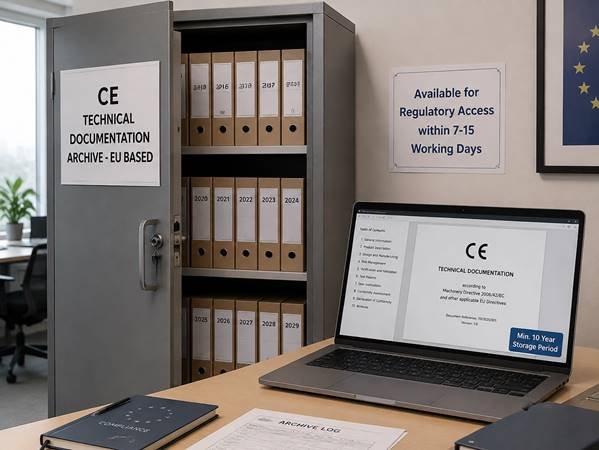
Many EU product regulations require manufacturers to keep technical documentation for 10 years, but this is not a unified requirement for all CE regulations; the specific period shall be subject to applicable regulations.
For example, under the Medical Devices Regulation (MDR), the storage period for ordinary medical devices is usually 10 years after the last batch of products is placed on the market, and for implantable medical devices it is usually 15 years. If the same product is subject to multiple regulations, the storage period shall be implemented in accordance with the longest statutory requirement.
The starting point of the storage period is usually the date when the last batch of products is placed on the EU market, not the production date or the date when the document is prepared; the starting rule shall be implemented in accordance with corresponding regulations.
Archiving Form and Access Requirements
Regarding archiving form and access, common rules and precautions are as follows:
• Archiving form: paper or electronic versions are acceptable, as long as they meet the requirements of applicable regulations. Electronic documents shall be readable, printable, verifiable, and backed up to prevent loss; version control shall be clear, and all changes can be traced. If encrypted storage is used, it must be ensured that a readable version can be provided in a timely manner when the regulatory authority requests access.
• Access requirements: when the regulatory authority requests access to technical documentation, it must be provided within the time limit notified by applicable regulations and the regulatory authority; access time limits may vary between different member states and different regulations; many practical scenarios require submission within a relatively short period, and the common internal preparation target can be set at 7-15 working days. It is recommended to store documents centrally for quick access.
• Valid version requirements: core materials such as the Declaration of Conformity and notified body assessment documents must retain the verifiable original version (such as the original paper copy with valid signature and seal, electronic signature document meeting regulatory requirements, etc.); controlled scanned copies can also be used as valid versions if their authenticity can be proved, specifics shall be subject to regulatory requirements.
Maintenance and Pitfall Avoidance: Update Rules, Common Issues and Self-Check List
CE compliance is not a one-time thing; product changes and regulatory updates may require adjustments to technical documentation. The following are common update rules, high-frequency issues, and a beginner-level self-check list.
Update Rules for Product/Regulatory Changes
Common scenarios that trigger technical documentation updates include: product design changes, replacement of core safety components, production process adjustments, updates of applicable regulations/standards, discovery of new safety risks, etc.
Not all changes require redoing the entire set of documents; it is necessary to first assess whether the change affects the identified risks, whether it changes the compliance status of the product, and whether it affects the validity of test results. If the change involves changes in compliance requirements, supplementary tests and updates of corresponding documents are required, and if necessary, the Declaration of Conformity shall be re-signed; if the change does not affect compliance, no adjustment is required.
At the same time, old versions of technical documentation must be retained in accordance with the storage period requirements and cannot be deleted arbitrarily — products of different production batches may be subject to different versions of regulations or standards, and old documents are used to prove the compliance of previous batches of products.
Common Issues in the Preparation Link
The following are the most common problems when beginners prepare technical documentation, which require special attention:
1. Only piling up test reports, lacking core materials: many beginners mistakenly think that test reports are enough; in fact, materials such as risk assessment, product information, and mass production consistency descriptions are mandatory content in most regulations, and missing items may cause the document to be deemed incomplete.
2. Document information is inconsistent with the actual product: for example, the model, parameters, and software version in the document are inconsistent with the actual shipped product; if the difference involves safety performance or compliance judgment, the original technical documentation cannot support the compliance of the corresponding product.
3. Applicable regulations/standards have expired: if the corresponding regulations or harmonised standards have exceeded the transition period and been repealed, and the product does not meet the new requirements, the original test report or technical documentation may not be sufficient to prove product compliance, and it needs to be reviewed in combination with the standard status, product change situation and transition clauses.
4. Risk assessment is too general: only a general statement that “risks have been assessed”, without clearly identifying specific risk scenarios and corresponding control measures, nor considering risks of scenarios such as reasonable misuse and transportation, which does not meet the risk assessment requirements of most regulations.
Common Issues in the Archiving Link
Problems in the archiving link are often easily overlooked, but they also cause compliance risks:
1. Documents are stored scattered and cannot be accessed in time: for example, some documents are with suppliers, some are with testing agencies, and some are stored in employees’ personal email boxes; when required by regulation, they cannot be collected within the specified time limit, which may be deemed as failure to perform the archiving obligation.
2. Electronic documents cannot be read normally: for example, using special formats or undecrypted versions, which the regulatory authority cannot open and view, which may be equivalent to failure to provide technical documentation.
3. Wrong starting point of storage period: mistakenly calculating the storage period from the production date or document preparation date, which may cause the document to exceed the statutory storage period in advance, leading to compliance risks.
Beginner-Level Self-Check List
If you have just finished preparing the technical documentation and are not sure whether it meets the basic requirements, you can quickly check according to the following 5 items:
1. All applicable EU regulations and harmonised standards for the product have been checked, confirmed to be currently valid, with no omissions or misuse;
2. The technical documentation contains all core materials required by applicable regulations, with no obvious missing items;
3. The product model, parameters, responsible party information, etc. in the document are completely consistent with the actual shipped product and compliance marks;
4. The EU-based responsible party or the responsible address that can be contacted by regulators has been clarified, the contact person is valid, and the complete technical documentation can be accessed within the specified time limit; it must not only be scattered stored with overseas suppliers, testing agencies or personal email boxes;
5. The storage period and version management meet the provisions of applicable regulations, and documents can be accessed in a timely manner as required by regulation.
The above is the core content of CE technical documentation from basic cognition to preparation and archiving, which can help beginner readers establish a complete compliance framework and master basic preparation methods and self-check paths. It should be noted that specific requirements vary for different products and different applicable regulations; compliance assessment for complex products or high-risk categories still needs to be finally confirmed in strict accordance with applicable EU regulations, conformity assessment procedures and member state implementation rules, and professional bodies with corresponding qualifications can be consulted if necessary. As long as the responsibility boundaries are clarified and document preparation and archiving management are done well in accordance with regulatory requirements, the compliance risks in the EU market can be effectively reduced.