
If you are in the electrical and electronic equipment business for the EU market, you have definitely heard of RoHS, and most likely have heard the term “exemption” — some suppliers say “our products have RoHS exemptions”, some compliance service providers say “using exemptions can save the cost of replacing materials”, but there are also people whose goods are detained or fined for using exemptions incorrectly. What exactly are RoHS exemptions? In what situations can they be used? How to judge whether your own products can use them? In this article, we start from the most basic concepts, and cover all core issues of RoHS exemptions thoroughly, up to being able to make independent judgments and avoid risks.
1. Basic Understanding of RoHS Exemptions (Must-Read for Beginners)
Let’s first clarify the most core concepts to avoid going astray at the very beginning.
RoHS itself is an environmental protection regulation formulated by the EU for electrical and electronic products, with the core of restricting the usage of 10 hazardous substances in products; products exceeding the limits cannot legally enter the EU market. And “exemption” does not mean “no need to abide by RoHS rules”, but an exception rule that allows hazardous substances originally restricted by RoHS to be legally used in excess of the limits under specific scenarios and specific conditions. Its essence is not to relax environmental protection requirements, but a transitional arrangement that balances technical feasibility and overall environmental benefits — to put it plainly, the EU only grants temporary exceptions because in some areas, harmless materials cannot be replaced for the time being, or replacement would be even less environmentally friendly.
The biggest misunderstanding many people have about exemptions is that they think “with an exemption, the entire product does not need to comply with RoHS”, which is not the case. There is only one thing exemptions can change: for specific homogeneous materials that meet the requirements of the clause, the content of hazardous substances can exceed the standard RoHS limits. All other rules remain unchanged: if the exemption entry itself stipulates an upper limit of concentration or quantity, it must still be complied with; it must strictly match the product category and purpose stated in the clause, not even a slight deviation is allowed; and exemptions only apply to RoHS, other EU environmental protection regulations such as REACH and WEEE still need to be complied with as usual.
There are three core reasons why the EU sets up exemptions: First, some application scenarios temporarily have no alternative materials with suitable performance and cost; forcing replacement would either make the product unusable or make it too expensive to sell. Second, some alternative solutions have greater environmental or health hazards than the original substances, which instead violates the original intention of environmental protection. Third, the total usage of hazardous substances in some niche applications is extremely small, and the overall environmental hazard is negligible, so there is no need to force enterprises to spend a lot of money on switching.
People who are new to this are most likely to fall into four cognitive pitfalls, which we will clarify in advance here:
First, exemptions do not mean the entire product does not need to comply with RoHS; they only apply to specific components, substances, and scenarios. For example, a lead exemption for the ceramic body of a capacitor does not mean that the plastic shell of the capacitor can also have excessive lead;
Second, exemptions are not permanently valid; each has a fixed validity period and will be re-evaluated upon expiration;
Third, enterprises cannot set exemptions for their own products; all legal exemptions are uniformly evaluated by the EU and the list is uniformly published. Enterprises can only check whether they can use them against the list, and cannot claim applicability just by having submitted an application;
Fourth, exempt substances cannot be used in unlimited quantities; many exemption entries clearly state the maximum limit requirements.
2. Core Prerequisites and Basic Criteria for Exemption Application
After understanding the basic concepts, the next thing to talk about is the basic rules for all judgments — many people fall into pitfalls because they even get the most basic judgment units and prerequisites wrong.
To use an exemption, three necessary prerequisites must be met at the same time, none can be missing: First, your product itself falls within the scope of the RoHS Directive, that is, it is electrical and electronic equipment that originally needs to comply with RoHS requirements; Second, the excess hazardous substance involved is exactly one of the 10 categories of substances clearly restricted by RoHS; Third, the application scenario of the component or material is completely consistent with the description of the exemption entry published by the EU, and no self-expanded interpretation is allowed.
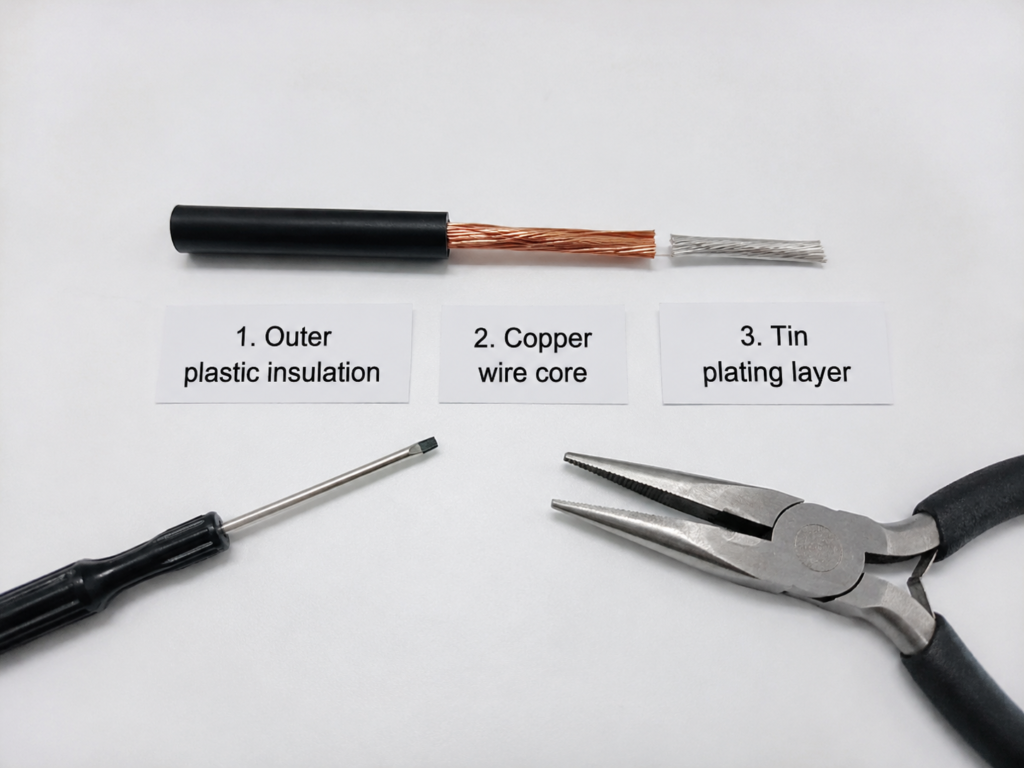
Here we must first clarify the core unit of RoHS judgment: homogeneous material. You can understand it as: the smallest unit with completely uniform material composition that cannot be further disassembled by mechanical means using ordinary tools such as screwdrivers, pliers, and scissors — professionally called “homogeneous material”. RoHS limit requirements and exemption judgments are all calculated based on this smallest unit; it is absolutely not allowed to use the average content of the entire product or entire component as a substitute. For example, for a wire, the outer plastic insulation is one homogeneous material, the inner copper wire body is another, and the tin-plated layer on the surface of the copper wire is a third; each must meet the standard (or comply with the exemption) individually. Common examples of homogeneous materials include solder alloys for solder joints, ceramic bodies of resistors, wire insulation, copper wire bodies, electroplated layers on the surface of parts, etc.
As for which substances are specifically restricted by RoHS and what the standard limits are, you can refer to the table below; you don’t need to memorize them by rote, just look them up when you need them:
| Restricted Substance Category | Standard Mass Percentage Limit | Corresponding ppm Value (parts per million) |
|---|---|---|
| Cadmium | 0.01% | 100ppm |
| The other 9 categories (lead, mercury, hexavalent chromium, polybrominated biphenyls (PBB), polybrominated diphenyl ethers (PBDE), 4 phthalates: DEHP/BBP/DBP/DIBP) | 0.1% | 1000ppm |
Special attention should be paid: exemptions are the only basis for legally exceeding the above standard limits; there are no other “shortcuts”.
The EU’s official exemption list is divided into two categories, with completely different scopes of application; don’t mix them up:
| List Type | Applicable Product Scope | Common Validity Period |
|---|---|---|
| Annex III | Vast majority of ordinary electrical and electronic equipment (general scenarios such as consumer electronics, industrial equipment) | Usually 3-5 years |
| Annex IV | Exclusive only for medical devices, in vitro diagnostic devices, monitoring and control equipment | Usually up to 7 years |
Don’t think that if a product belongs to the medical or monitoring category, you can directly use all clauses of Annex IV — you still have to check the application description of each clause word by word, not even a slight deviation is allowed.
Of course, there are three situations where there is no need to consider exemptions at all: First, the product is originally not within the scope of RoHS jurisdiction, such as military equipment, aerospace equipment, large fixed industrial installations, implantable medical devices, etc. These products do not need to comply with RoHS at all, so naturally there is no question of exemption; Second, the content of hazardous substances originally does not exceed the standard limits, so it can directly meet the requirements, and there is no need to bother with exemptions; Third, the application scenario does not completely match the description of the exemption entry, or the exemption has expired and there is no transition period — using it in this case is a violation.
3. Common Exemption Categories and Typical Application Scenarios
Knowing the basic rules, you may ask: in actual products, where are exemptions most common? What are the differences in available exemptions for different categories of products? We have compiled the most common exemption types and application scenarios to help you build a preliminary understanding.
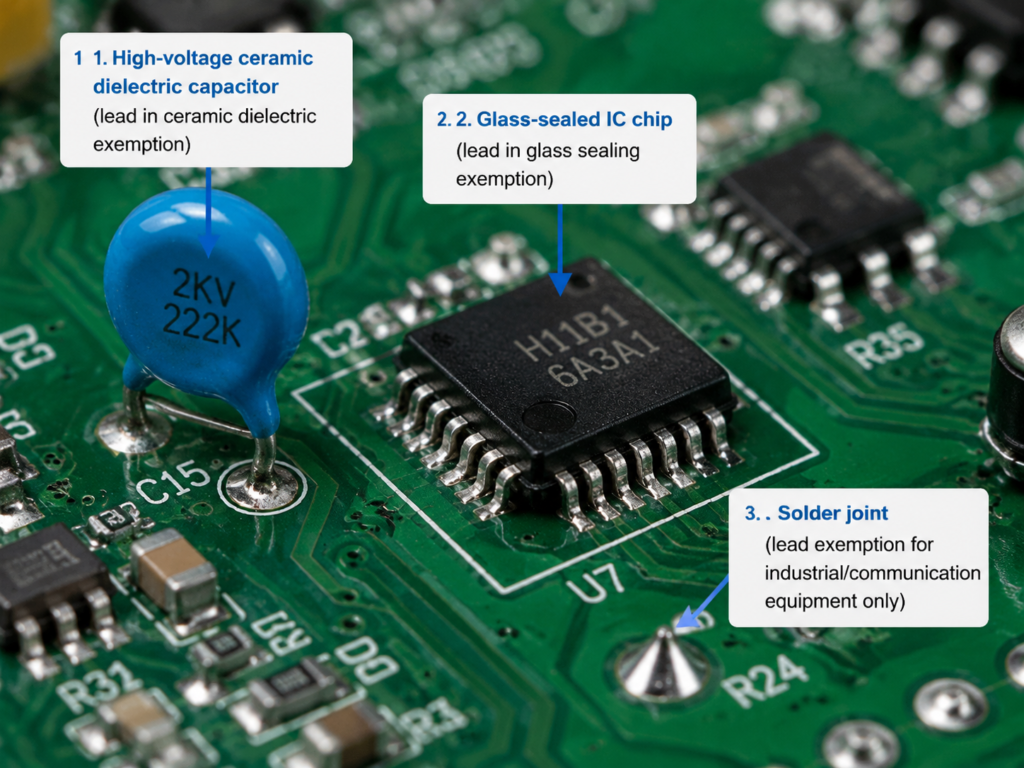
At present, the vast majority of common RoHS exemptions are related to lead, because lead has a wide range of applications and is difficult to replace. They are mainly divided into four categories:
The first category is ceramic dielectric capacitors, that is, high-voltage safety capacitors with a rated voltage ≥ 125V, and lead in their ceramic dielectric. This is also the most common exemption in consumer electronics. For example, high-voltage capacitors in mobile phone chargers and power adapters mostly use this exemption;
The second category is glass/ceramic sealing, such as lead in glass sealing terminals of electronic components and ceramic packaging materials, which is common in some high-temperature resistant, high-reliability chips or connectors;
The third category is solder. Special attention should be paid here: the lead exemption for ordinary solder in consumer electronics has long been abolished. Only the motherboard solder of high-reliability equipment such as servers, communication base stations, and industrial monitoring has corresponding exemptions. For the solder of ordinary mobile phones, chargers, and home routers, lead must be less than 0.1%, and exemptions cannot be used;
The fourth category is metal alloys, such as lead added as a processing element in steel, aluminum, and copper alloys. However, there are clear restrictions on the proportion of alloy components, and the upper limits are different for different alloys; specific details must be checked in official clauses.
Except for lead, exemptions for other hazardous substances are very rare: mercury exemptions are mainly concentrated in specific types of fluorescent lamps and ultraviolet disinfection lamps, and there are clear per-lamp dose limits; hexavalent chromium exemptions are only found in the anti-corrosion coating of steel pipes of specific absorption refrigeration equipment, which is very rare; exemptions for cadmium, harmful flame retardants, and phthalates are even rarer, almost only existing in a very small number of special optoelectronic devices and industrial materials, and are basically not seen in consumer electronics. If someone says there are exemptions for cadmium or phthalates in consumer electronics, it is most likely false.
For different categories of products, the application boundaries of exemptions vary greatly: for ordinary consumer electronics (mobile phones, chargers, wireless earphones, small household appliances, etc.), only a few components such as ceramic capacitors and glass packages may have lead exemptions, and solder absolutely does not; for industrial/communication equipment (servers, base stations, industrial monitoring equipment, etc.), the application scope of exemptions such as high-reliability solder and metal alloys is much wider; medical/monitoring equipment can refer to both Annex III and Annex IV, but still need to check the functional description of each clause word by word, and cannot directly apply them.
We give three judgment examples of typical scenarios to help you get a feel:
- Lead in server motherboard solder joints: need to check the lead exemption for solder, and confirm whether the equipment category of the clause includes servers/network infrastructure;
- Lead in the plastic shell of ordinary mobile phone chargers: usually there is no corresponding exemption, and the lead content must be reduced to below 0.1%;
- Mercury in ultraviolet disinfection lamps: need to check the mercury exemption for light sources, and confirm whether the lamp type, per-lamp mercury dose meet the requirements, and whether the exemption is within the validity period.
4. Correct Query Method for the Official Exemption List
Since all legal exemptions are in the EU’s official list, how to check them? Which channels are reliable? Many people use third-party old lists and end up falling into pitfalls. In this part, we will talk about the correct query method.
First is the issue of channels. The only reliable source is the latest version of the RoHS Directive and its amendments published in the Official Journal of the European Union (OJEU). Do not use old lists compiled by third-party platforms, especially historical materials more than 5 years old, which are basically outdated — exemptions are regularly updated, cancelled, or added, so you must use the latest valid version at the time of your query.
Many people like to use exemption numbers (such as Annex III 6(c)) to quickly find clauses. This number can indeed be used for preliminary positioning, but it should be noted that: preliminary retrieval can refer to the clause title, but the final judgment must be based on the complete description of the formal provisions, and conclusions cannot be drawn just by looking at the title. In addition, the status of the clauses must be distinguished: only clauses that have officially entered into force can be used; application clauses that are under revision or waiting for review cannot be used as a basis for compliance.
When checking exemptions, there are three details that must be verified, none can be missing:
First, check the applicable product category, whether it is general equipment or only for medical/monitoring categories; do not apply exclusive exemptions to ordinary products;
Second, check the applicable materials/components, whether it is ceramic dielectric or solder, and whether there is a restricted use position; do not apply the exemption of component A to component B;
Third, check additional restrictions, whether there are concentration limits, quantity limits, performance requirements, for example, whether it must meet a specific safety level to be applicable.
5. Five-Step Judgment Method: Whether Your Product Can Use a Certain Exemption
Knowing how to check the list, the next part is the most practical: how to judge step by step whether your product can use a certain exemption? Even if you are new to this, you can follow this five-step judgment method.
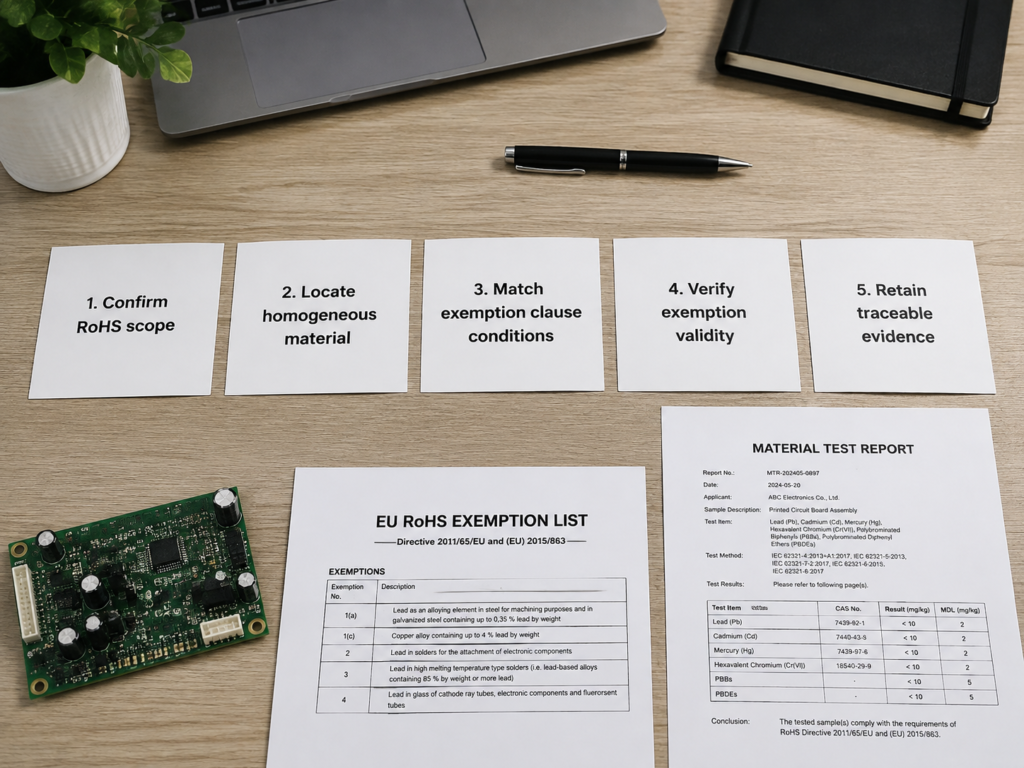
Step 1: First confirm whether the product is within the scope of RoHS jurisdiction. For quick judgment, electrical and electronic equipment with AC voltage below 1000V and DC voltage below 1500V are basically within the scope of RoHS jurisdiction; explicitly excluded categories such as military, aerospace, and large fixed industrial installations do not need to be considered. It should also be noted that different functional modules of the same product may be subject to different exemption rules. For example, the ordinary power supply module in a medical device and the special monitoring module may have different available exemptions.
Step 2: Locate the homogeneous material containing the restricted substance. First find the specific hazardous substance that exceeds the standard, then correspond to the smallest homogeneous material unit; absolutely do not use the average content of the entire product or entire component for judgment. It is also necessary to distinguish whether this hazardous substance is intentionally added in the design, or is a trace presence caused by supply chain pollution or detection deviation — if it is a trace impurity and does not exceed the standard limit, naturally there is no need to worry; if it exceeds, then consider the possibility of exemption. It is recommended that you establish a simple corresponding relationship: component → homogeneous material → restricted substance, to avoid confusion during judgment.
Step 3: Match the applicable conditions of the exemption clause word by word. Three verifications need to be done here: first, verify the substance type to see if it is a substance clearly listed in the exemption entry; second, verify the application scenario, the product type and material purpose must be completely consistent with the description of the entry, and self-expanded interpretation is absolutely not allowed. For example, if the clause says “server motherboard solder”, you cannot include home router motherboards; finally, verify additional conditions, such as whether there are voltage requirements, equipment category restrictions, technical function requirements, and the exemption cannot be used if even one condition is missing.
Step 4: Verify the current valid status of the exemption. First, check whether the clause is still within the validity period, including the transition period stipulated by the EU; second, verify whether the clause has been revised, split, narrowed in scope, or even deleted. Some old numbers may now be invalid or have changed content, and cannot be directly used; finally, it must correspond to the time when the product is placed on the EU market. For example, if the exemption expires at the end of this year, products you sell next year cannot use it, even if they were produced this year.
Step 5: Retain traceable judgment evidence. Don’t just know it’s applicable yourself; when the EU conducts regulatory spot checks, you need to produce evidence to prove that you meet the exemption requirements. The information you need to record includes: product category, involved components, homogeneous materials, restricted substances, corresponding exemption numbers, and also the specific purposes covered by the exemption, applicable conditions, and validity period; the retained certification materials include supplier written declarations, material test reports, component specifications, etc.
Finally, three quick pitfall avoidance tips: anyone who claims “full product exemption” is basically lying; the lead exemption for solder in consumer electronics has long been abolished, do not blindly trust the verbal promises of suppliers; if you are not sure, go check the exemption interpretation documents officially released by the EU, do not assume “it should be about the same” on your own.
6. Exemption Validity Period and Response to Regulatory Changes
Even if you confirm that a certain exemption can be used now, it does not mean it can be used forever — all exemptions have a validity period, and the EU will update them regularly. How to respond to regulatory changes and avoid finding out that it can’t be used only when it expires? In this part, we will clarify the rules and response methods.
First, make it clear: the vast majority of exemptions have a fixed validity period and are not permanent authorizations. Exemptions for ordinary electrical and electronic equipment in Annex III are usually 3-5 years, and exemptions for medical/monitoring equipment in Annex IV are usually up to 7 years, but this is only the general situation. The specific start and end time of each clause shall be subject to the officially published clauses of the EU, and there is no unified standard.
Before the exemption expires, the EU will organize a re-examination to evaluate whether it is still necessary to retain it: if there are already alternative solutions with suitable performance and cost, the exemption will be cancelled; if not, it will be renewed. If a renewal application has been submitted, some clauses may continue to apply temporarily during the review period, but it is necessary to confirm whether the scope of renewal is consistent with the original exemption, so as not to end up with only part of it renewed and the part you use not renewed. Some clauses will be split, their application scope narrowed, or directly deleted. In this case, the old number cannot be directly used, and the content of the new clause must be re-verified. After some exemptions are cancelled, the EU will give a 6-12 month transition period for enterprises to switch materials or designs; products can still be sold legally during the transition period, but not after the transition period ends.
To achieve long-term compliance, there are several basic response methods: check the latest version of the exemption list at least once a year, and pay attention to the EU’s revision announcements; for high-risk exemptions that are about to expire and already have mature alternative solutions, prepare for material switching in advance, don’t wait until the expiration to rush; if it is a product sold for a long time, it is best to establish a regular exemption review mechanism, checking at least once every six months, to avoid violations caused by regulatory updates.
7. Key Points of Compliance Risks and Evidence Management
Finally, let’s talk about the compliance risks and evidence management that everyone is most concerned about — many times it’s not that you don’t meet the requirements, but that the evidence is not retained correctly, or the exemption is used beyond the scope, resulting in fines. This part will help you avoid the most common pitfalls.
You must pay attention to the three most common types of compliance risks: The first type is using exemptions that have expired or been cancelled, resulting in products not meeting RoHS requirements, being penalized by EU regulators or even having goods detained; The second type is using exemptions beyond the scope, such as applying industrial equipment exemptions to consumer electronics, or applying the exemption of component A to component B; The third type is insufficient compliance evidence. Even if you actually meet the requirements, if you cannot produce proof during regulatory spot checks, you may still be judged as violating the rules. This is the point that many small sellers are most likely to ignore.
Regarding the management of compliance evidence, there are several clear requirements:
First, supply chain materials: you cannot just accept a verbal promise of “RoHS compliant” from the supplier; you must obtain a written declaration that clearly states the involved substances, components, corresponding exemption numbers, and applicable clause version — a declaration only marked “generally RoHS compliant” is invalid;
Second, test reports: they can only prove the content of hazardous substances in homogeneous materials, and cannot alone prove the applicability of exemptions. They must be judged in combination with the purpose requirements of the clause and the product category. It is not that a detected lead content of 2% can definitely use the exemption; it depends on where it is used;
Third, change review: if raw materials are replaced or component functions change, the applicability of the exemption must be re-verified. It is best to set up change approval nodes for key components, and do not replace them casually;
If there are many product models, it is recommended to create a product exemption application matrix to uniformly record the exemption clauses, validity periods, and evidence documents corresponding to each component, for the convenience of regular review.
As for the requirements for compliance documents in the EU market, they are also very clear: the product itself does not need to be marked with “RoHS exemption used”; but the CE conformity declaration must list all exemption clause numbers used; the technical documentation must explain the specific use positions and reasons for the exemptions, and be retained for inspection.
Summary
Generally speaking, RoHS exemptions are not a “get-out-of-jail-free card” given by the EU, but a transitional arrangement that balances technical feasibility and environmental benefits. They only apply to specific materials and specific scenarios, have a fixed validity period, and require you to keep complete compliance evidence.
After reading this article, you should be able to accurately understand the essence of exemptions, and not be misled by false statements such as “full product exemption”, “permanent exemption”, and “enterprises can apply for exemptions on their own”; you can follow the five-step judgment method to verify by yourself whether a component meets the requirements of a certain exemption; you know to check the latest exemption list through official EU channels to avoid the pitfalls of old versions and false information; and you can also do a good job in evidence retention and regular review to avoid the vast majority of core compliance risks.