
Many manufacturers and cross-border sellers who are new to the EU market are easily confused by various “certificates” and “declarations” when they first encounter CE compliance: sometimes they need the CE mark, sometimes test reports, and some say they must find a third party to issue a “CE certificate”. In fact, within the entire CE compliance system, the core document that is legally required and compiled by the responsible party on its own in the vast majority of cases is the CE Declaration of Conformity (DoC).
This article gradually covers basic concepts, judgment methods, key compilation points, and pitfall avoidance self-checks, balancing introductory understanding and practical operation specifications. For ordinary low-risk products with clear regulatory boundaries, you can directly refer to the operations here; for complex scenarios, it can also help you sort out your thinking and know where to start verification.
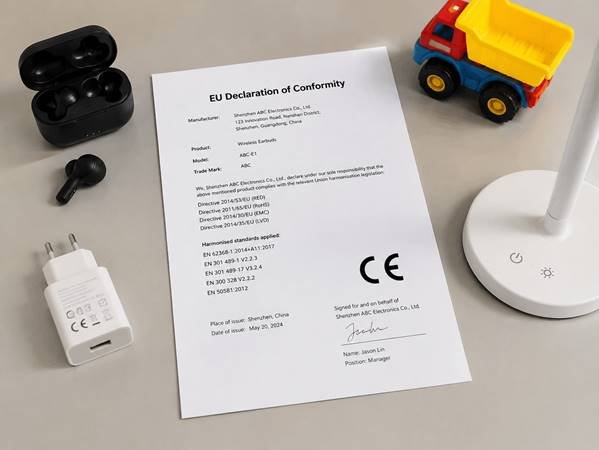
1. First, Understand: What a DoC Is and Whether You Need to Make One
Plain Language Explanation: A DoC Is a Statutory Compliance Guarantee Letter
In plain terms, the DoC (full English name: EU Declaration of Conformity, i.e., EU conformity declaration) is a written commitment issued by the product’s responsible party itself — you clearly tell EU regulators and consumers: my product meets all applicable CE safety requirements, and I will be responsible if there are any problems.
Its core function is to serve as an “access voucher” for products to legally enter the EU market: it is checked during customs clearance, must be uploaded for audits on EU e-commerce platforms such as Amazon and AliExpress, and you must be able to produce it during market surveillance spot checks. Products without a valid DoC cannot be legally sold in the EU.
Here, we must first clarify the most easily misunderstood point: the DoC is a self-declaration document from the manufacturer, not a “certification certificate” issued by a third-party organization. Many people ask for a “CE certificate” right away, but in fact, third-party certification for the vast majority of low-risk products is not mandatory at all; the DoC is the legally required core document.
Don’t Mix Them Up: Differences Between the DoC and Other CE-Related Documents
Many people confuse the DoC with the CE mark and test reports, but their functions are completely different and they cannot replace each other. This table clarifies it:
| Name of Document/Mark | Core Function | Relationship with DoC |
| CE Mark | A compliance mark affixed to the product’s exterior, allowing regulators and consumers to quickly identify that the product meets CE requirements | The DoC is the legal prerequisite for affixing the CE mark; a product cannot bear the CE mark without a valid DoC, and the two cannot replace each other |
| Test Report | A single-item performance test result issued by a laboratory, proving that a certain aspect of the product’s safety performance meets the standards | It is one of the core supporting materials for the DoC, and is not equivalent to the DoC itself |
| Technical Documentation | The full set of compliance materials stored internally by the manufacturer (design drawings, risk assessments, test reports, etc.) | The DoC is the external summary of compliance conclusions of the technical documentation, and the entire set of technical documentation does not need to be disclosed to the public |
| Third-Party Certification Certificate | A compliance assessment certificate issued by a third-party organization | Only required for high-risk products, it is a supplementary supporting material for the DoC and is not equivalent to the DoC |
Which Products Need a DoC? Quick Judgment Method
Not all products need a DoC. The judgment logic is divided into two steps:
First, confirm whether the product falls within the scope covered by EU CE-specific directives/regulations, then confirm the type of declaration required by that regulation — a DoC must be compiled only if the regulation requires the product to bear the CE mark and a DoC to be issued.
Common applicable categories include electronic products, toys, mechanical equipment, personal protective equipment, wireless devices with Bluetooth/WiFi, etc. Note: Some construction products are subject to the Construction Products Regulation (EU) No 305/2011, which adopts the Declaration of Performance (DoP) system. Whether a DoC needs to be compiled must be judged according to the regulatory requirements of the specific product, and general DoC rules cannot be directly applied.
There are also clear exceptions: products not under the jurisdiction of the CE system, such as food, pharmaceuticals, and cosmetics, do not need to compile a DoC, nor can they be issued arbitrarily for publicity, as this would constitute a violation.
If you are unsure, you don’t have to memorize all CE directives by rote. Just confirm the product’s function, intended use, and risk level first, and you will be clear after matching the corresponding specific regulations.
3 Common Cognitive Pitfalls for Beginners
People who are new to DoCs almost always fall into these pitfalls; avoiding them in advance can save a lot of money and time:
First pitfall: “A DoC is a CE certificate.” Many people think that they must find a third-party organization to issue a “CE certificate” with a red seal to be legal, but this is actually wrong. Third-party certification for the vast majority of low-risk products is not mandatory; the DoC is the legally required core document, and it is valid as long as you compile and sign it yourself in accordance with the requirements.
Second pitfall: “Having a DoC means the product is compliant.” The DoC is just your compliance commitment, not a get-out-of-jail-free card. It must be supported by corresponding technical documentation and evidence to have actual effect.
Third pitfall: “Just find a general template and fill it in.” The general templates online are just layout frameworks; the core is to match the corresponding regulations and standards according to the actual situation of your own product. If a toy seller uses a template for mechanical products, the filled content will be completely wrong, and no matter how good the template looks, it will be useless.
2. Make 4 Core Judgments Before Compilation
After understanding the basic concepts, don’t rush to write. First confirm these 4 things clearly, otherwise it’s easy to go in the wrong direction and waste your effort.
Who Is Qualified to Compile and Sign a DoC?
There are clear legal requirements for the entity issuing the DoC; not any organization or individual can compile it arbitrarily:
The primary responsible entity is the product manufacturer within the EU — the manufacturer here refers not only to the production factory, but also to the brand owner that sells products under its own brand. Even if you find a contract manufacturer to produce the products and affix your own brand, you are the manufacturer and must bear full compliance responsibility.
For overseas manufacturers (such as Chinese factories or sellers), whether it is mandatory to appoint an EU Authorized Representative (abbreviated as “Oudai” in Chinese) must be judged according to the specific regulations applicable to the product; it is not mandatory for all CE products. An authorized representative is an entity authorized in writing by the manufacturer to perform specific compliance obligations on its behalf within the EU, and can only work within the scope of authorization. The ultimate responsibility for the DoC still rests with the manufacturer; only when the specific regulations clearly require it and the manufacturer’s written authorization is obtained can the authorized representative sign the DoC on its behalf.
Importers and distributors may not compile or modify the DoC without the manufacturer’s written authorization, but importers bear the compliance verification obligation in accordance with the law: they need to confirm that the product has a DoC compiled as required and that compliance documents are complete, and are responsible for providing relevant materials when required by regulatory authorities. If an importer sells products under its own brand, or makes substantial modifications to the products, it must bear the manufacturer’s responsibility and compile the DoC on its own.
Finally, the signatory must be an authorized person of the responsible entity, such as the quality manager or legal representative, who has the authority to sign compliance documents on behalf of the responsible entity.
What Are the Legal Bases for Compiling a DoC?
The content and format of the DoC cannot be made up arbitrarily; they must be based on layered regulatory requirements, which can be divided into three core layers:
The first layer is category-specific CE directives/regulations, which are the direct basis for compiling the DoC. Different products correspond to different specific regulations, and the specific format, required fields, and signing requirements of the DoC are mostly written in the annexes of these regulations. For example, ordinary household appliances must comply with the Low Voltage Directive 2014/35/EU, toys must comply with the Toy Safety Directive 2009/48/EC, and products with wireless functions must comply with the Radio Equipment Directive 2014/53/EU (abbreviated as RED).
The second layer is Decision No 768/2008/EC, which is a reference rule for the unified conformity declaration framework issued by the EU. It provides a general structural template for DoCs of various CE products, and parts not specifically required by specific regulations can be implemented with reference to this framework.
The third layer is the Market Surveillance and Product Compliance Regulation (EU) 2019/1020. This regulation mainly stipulates the surveillance rules for the EU market and the obligations of economic operators. It is not a direct format basis for compiling the DoC, but the requirements for the preservation, provision, and responsible entities of the DoC must comply with the general rules of this regulation.
In addition to the regulatory level, specific compliance judgments usually use EU Harmonized Standards (abbreviated as EN standards) — these are unified safety standards published in the Official Journal of the European Union (OJEU). As long as a product passes testing according to the valid version of the harmonized standard, it is presumed to comply with the basic safety requirements of the corresponding directive (i.e., “presumption of conformity”).
Special attention should be paid here: harmonized standards are not the only basis for compliance. You can also use other technical specifications to prove that the product meets the requirements, but the presumption of conformity effect of harmonized standards makes the compliance process smoother. In addition, a newer standard version is not necessarily better. Whether a certain version of a standard can be used depends on its citation status in the Official Journal of the European Union, the withdrawal date of the old version, and the transition period; if the old version is still within the transition period, it can still be used to prove compliance. Only when using an old version that has been withdrawn and has no transition period will the presumption of conformity be lost. The reason for selecting the final standard version must be recorded in the technical documentation to ensure traceability.
Do You Need to Involve a Notified Body (NB)?
Many people struggle with whether to find a third-party organization for certification. In fact, there is only one core judgment criterion: whether the specific regulations applicable to your product require a Notified Body (abbreviated as NB) to participate in the conformity assessment.
Let’s explain in plain language first: a Notified Body is a third-party organization authorized by the EU that is qualified to participate in the compliance assessment of specific products. Each organization has a unique notification number, and not any random laboratory can be called a Notified Body.
If the conformity assessment module of the specific regulation corresponding to the product allows self-declaration, such as ordinary household small appliances only subject to the Low Voltage Directive, ordinary electronic accessories without wireless functions, etc., then no Notified Body is required to participate. You can complete the compliance assessment and compile the DoC on your own.
For high-risk products, such as some dangerous machinery, high-grade personal protective equipment, explosion-proof products, medical devices, etc., only when the conformity assessment module of the corresponding specific regulation clearly requires the intervention of a Notified Body must you find a Notified Body with corresponding qualifications to conduct the assessment and issue relevant documents. When compiling the DoC, you must also add the Notified Body’s information and certificate number.
The specific judgment steps are very clear: first find the CE-specific regulation corresponding to your product, then check the “conformity assessment modules” listed in the regulation. If it clearly requires the participation of a Notified Body, then it is needed; if not, it is not. Rules for different categories cannot be mixed. For example, for machinery, you need to refer to the product classification in the machinery regulations; for medical masks, you need to distinguish whether they are regulated as medical devices or personal protective equipment; for explosion-proof products, you need to compare with the requirements of the ATEX Directive. You cannot generalize.
First Clarify the Compliance Boundaries of the Product
Products with the same appearance may be subject to completely different regulations due to different intended uses and usage environments. Therefore, before compilation, you must first confirm the core information of the product clearly: including product name, function, intended use, usage environment, rated parameters, and target users.
For example: for flashlights, ordinary household ones are low-risk low-voltage products, and you can compile the DoC yourself; if it is an explosion-proof flashlight for underground coal mines, it is a high-risk explosion-proof product, and you need to judge whether a Notified Body is required according to the requirements of the ATEX Directive.
If it is a combined or modified product, for example, you put two separate CE products together, modify the circuit or structure, and change the original safety attributes, then the party that ultimately modifies or combines the products must bear the manufacturer’s responsibility, re-conduct the compliance assessment, and compile the DoC.
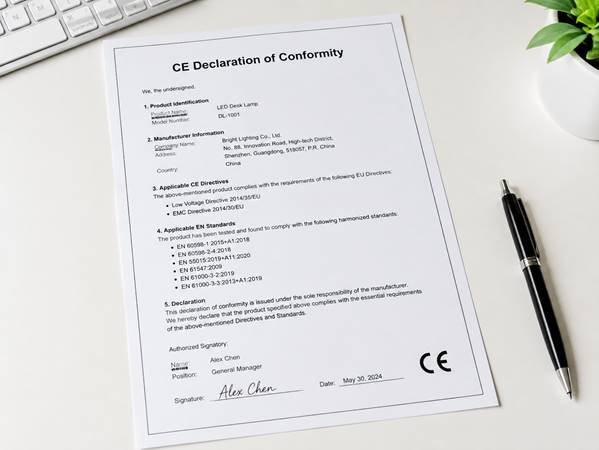
3. Item-by-Item Breakdown of Core Required Content for a DoC
Once all these are confirmed clearly, we can start compiling the DoC. Below, the required content is explained item by item; filling in according to the corresponding requirements will ensure nothing is missed.
Basic Identity Information: Must Be Sufficient to Identify the Product and Responsible Party
This part is the core information for regulators to identify the product and the responsible party, and must be accurate and traceable:
First is product identification information: it must include content sufficient to locate the specific product or product series, usually including product name, model/type. Batch numbers, serial numbers, or other unique identifiers can be added according to the requirements of specific regulations. The specific combination is determined according to the product traceability rules. It is not required that all products have both batch numbers and serial numbers, but vague descriptions such as “electronic products” cannot be used.
Second is responsible entity information: the full name, registered address, and contact information of the manufacturer must be completely consistent with the information on the product nameplate and packaging.
Third is other entity information: if applicable regulations require marking the information of importers or authorized representatives, the name, address, and contact information of the corresponding entities must be added. For example, if an overseas manufacturer has appointed an authorized representative according to the requirements of specific regulations, the complete information of the authorized representative must be written on the DoC.
Compliance Basis Information: Must Be Traceable and Corresponding to Supporting Documents
This part is the core content of the DoC. Each item must have corresponding supporting materials and cannot be written arbitrarily:
First is the responsibility declaration statement: it must clearly state that the entity issuing the declaration bears responsibility for the product’s compliance. The specific wording shall be subject to the requirements of the applicable specific regulations, and requirements may vary slightly for different products and different member states. A general structural reference is provided here (content needs to be replaced and adjusted to the official language of the target country according to the actual situation):
「This declaration is issued under the full responsibility of [full name of manufacturer/responsible entity], certifying that the product corresponding to this document complies with all applicable EU directives, regulations, and related requirements. The relevant conformity assessment has been completed, and all evidence has been stored in the technical documentation.」
It should be noted that vague expressions such as “may comply” or “basically comply” cannot be used. At the same time, the responsible entity of the declaration is the issuing party, which does not exempt other economic operators from their obligations under the law.
Then is the list of applicable CE directives/regulations: all applicable specific directives or regulations must be listed, with the full name and number clearly written, for example, “Low Voltage Directive 2014/35/EU”, not just “Low Voltage Directive”.
Finally is the list of applicable compliance judgment standards: if harmonized standards are used, all applicable EN standard numbers and version numbers must be fully listed, and must match the citation status in the Official Journal of the European Union; if other technical specifications are used as the basis for compliance, the name, version, and other information of the specifications must also be listed.
Take a common example: for wireless earbuds with Bluetooth, you cannot only list the Low Voltage Directive; you must also list the Electromagnetic Compatibility Directive and the Radio Equipment Directive (RED), and all corresponding compliance standards must be fully listed. Missing any of them means non-compliance.
Information to Be Added as Needed: Not Required for All Products
This part of the content is only required for specific products. Do not force it in, as it is prone to problems:
First is Notified Body (NB) information: only fill this in when the specific regulation requires a Notified Body to participate in the assessment. The NB’s name, notification number, issued certificate number, and corresponding conformity assessment procedure must be clearly written. Do not randomly add NB information for low-risk products; adding unnecessary details will instead make it easier to be subject to key verification by regulators.
Second is special usage restrictions: if the product has exclusive usage scenarios or rated parameter limits, they must be clearly marked, such as “for indoor use only”, “rated voltage 230V”, “for adult use only”, to avoid liability problems caused by out-of-scope use.
Third is multi-model coverage description: if a series of products share one DoC, all covered models and the scope of differences between models must be listed. Vague expressions such as “etc.” or “other models” cannot be used, so that regulators can clearly correspond to specific products.
Fourth is place of signing: some specific regulations require indicating the place where the declaration is signed, which can be added according to actual requirements.
Signing and Validity Information: Must Meet Authorization Requirements
The DoC must be signed by a person authorized to represent the responsible entity to be valid. This part is indispensable:
First is the date of issuance: a clear year, month, and day must be filled in. Before signing, it should be ensured that the product’s conformity assessment has been completed, and the technical documentation and necessary evidence are complete.
Then is authorized signatory information: the signatory’s name and position must be clearly written, confirming that they have the authority to sign compliance documents on behalf of the responsible entity.
Finally are signing requirements: handwritten signatures or compliant electronic signatures are acceptable, and the official seal of the responsible entity can also be attached. The specific form shall be subject to the requirements of applicable regulations.
Format and Language Requirements
The format of the DoC does not need to be fancy, but must comply with basic rules:
In terms of language, the official language required by the applicable regulations of the member state where the product is placed or made available must be used; English can only be used alone if permitted by the rules of the target member state. If sold to markets with clear local language requirements such as France and Spain, a local language version must be added as required. If there are multilingual versions, the regulation names, versions, product identification information, NB information, signing information, and responsible entity information must be completely consistent; the content of different language versions cannot be inconsistent.
In terms of carrier, both paper and electronic versions are acceptable. A signed PDF is a common practice that is easy to manage and transmit. The specific method of accompaniment (such as provided with the goods, attached to the manual, published on the webpage) and submission requirements shall be subject to the applicable specific regulations and regulatory requirements.
4. 5 Steps for Standard Compilation: From Preparation to Archiving
For ordinary low-risk products with clear regulatory boundaries that allow self-declaration, following these 5 steps will allow you to successfully complete a compliant DoC:
Step 1: Complete 3 Preparatory Tasks
Don’t rush to fill in the content first; make sufficient preliminary preparations:
First, confirm the compliance attributes of the product: clarify which CE-specific directive/regulation the product falls under, and whether a Notified Body is needed. Get the direction right first.
Second, organize supporting materials: prepare the product’s technical documentation, compliance assessment evidence (test reports, risk assessments, design calculations, etc.), and NB certificates (if any). These are the basis for you to fill in the DoC. Don’t rush to write without supporting materials.
Third, confirm the signing entity: clarify who the responsible party is, and whether the signatory has legal authorization, to avoid the signature being invalid after signing.
Step 2: Fill in Basic Identity Information
Fill in the product identification information and responsible entity information (manufacturer, importer/authorized representative, filled in as needed). After filling in, be sure to check once: is the information completely consistent with that on the product nameplate, packaging, and manual? For example, if the manufacturer on the nameplate is ABC GmbH, it cannot be written as ABC Ltd. on the DoC; even a single letter difference may cause problems.
Step 3: Fill in Compliance Basis and Supplementary Information
Against the technical documentation and assessment evidence you have, list all applicable CE directives/regulations and compliance judgment standards completely, without omission. If there is NB information, special usage restrictions, multi-model coverage descriptions, or place of signing that need to be added, fill them in together.
Note here: do not add standards or regulations as a matter of course. For each basis listed, there must be corresponding assessment evidence as support.
Step 4: Cross-Check Content Consistency
This step is the most easily overlooked but also the most important. Many non-compliant DoCs are due to inconsistent information.
You need to check every item on the DoC against the supporting documents: is the product model the same as that on the assessment report? Is the version of the standard number consistent with the one you use? Is the NB certificate number correct? Are there any missing required fields?
Even a small error in a standard version number may affect the validity of the DoC, so be sure to check carefully.
Step 5: Signing, Issuance, and Archiving
After verification is correct, the authorized signatory signs and fills in the date of issuance.
Then provide the DoC as required: for example, hand it over to the importer with the goods, or if the e-commerce platform requires upload, upload it to the backend as required (note that platform requirements are not equal to legal requirements, and the legal obligation to provide must still be fulfilled in accordance with specific regulations).
Finally, this DoC must be archived together with the corresponding version of the technical documentation, assessment evidence, and change records, so that it can be provided in a timely manner when required by regulators.
5. Compilation Rules for Special Scenarios
If you encounter the following complex situations, you cannot directly apply the rules for ordinary products; you must handle them in accordance with the corresponding requirements.
Rules for Sharing One DoC Across Multiple Regulations
Many products are subject to multiple CE directives at the same time. For example, an electric oven with WiFi must comply with the Low Voltage Directive, the Electromagnetic Compatibility Directive, and the Radio Equipment Directive. In this case, there is no need to write multiple DoCs; just list all applicable regulations in the same one.
But note: the requirements of each regulation must have corresponding supporting evidence, and cannot be omitted. If different regulations adopt different assessment procedures, for example, some are self-declaration and some require the participation of a Notified Body, the assessment basis and procedures for each regulation must be explained separately.
Prerequisites for Sharing a DoC Across Multiple Models/Series
Many sellers use the same DoC for multiple models in a series to save trouble. This is allowed, but several prerequisites must be met:
First, the specific regulations and conformity assessment paths applicable to all models are completely consistent;
Second, the differences between models are only adjustments to appearance, color, or non-safety-related parameters, which will not affect the safety conclusion and compliance judgment. For example, for ordinary household plug-in desk lamps of the same series, if only the appearance color and lampshade size are different, and the core circuit, light source, and safety structure are completely consistent, they can share one DoC;
Third, all models are covered by the compliance assessment; you cannot test only one lowest-configured model and cover all high-configured models;
Fourth, all covered models must be clearly listed; vague expressions such as “XX series, etc.” cannot be used, so that regulators can directly correspond to specific products.
If model differences involve changes in key components, rated parameters, software functions, wireless performance, or risk assessment conclusions, they cannot share the same DoC, and need to be compiled separately after individual assessment.
Compilation Rules for Products with External Components/Modules
Many product parts are purchased externally, such as power supplies, wireless modules, and batteries. At this time, note: you cannot directly use the DoC of the parts as the DoC of the complete machine.
The DoC of parts can only prove that the parts themselves are compliant, and does not mean that the complete machine is compliant. You need to verify the impact of these external components on the compliance of the complete machine, for example, whether the safety level of the power supply meets the requirements of the complete machine, whether the frequency of the wireless module complies with EU regulations, and whether electromagnetic compatibility between components will cause mutual interference.
Ultimately, the complete machine manufacturer must bear full responsibility for the overall compliance of the product, and cannot shift the blame to parts suppliers when problems arise. The compliance documents of parts can only be used as supporting evidence for the complete machine’s technical documentation.
Compilation Rules After Product Modification/Combination
If you modify the original product, or combine multiple products for sale, do you need to redo the DoC?
The core of judgment is: whether the modification/combination changes the product’s safety attributes, usage scenarios, or compliance scope.
If you only package and sell multiple compliant independent products without modifying the product structure or usage method, you cannot directly use the original DoC. You need to first assess the overall risk after combination, interface compatibility (such as electromagnetic compatibility, power supply matching), and whether the usage instructions are clear. Only on the premise that applicable regulations permit and the assessment proves that the combination does not form a new regulated product and does not change the original compliance scope can the compliance documents of the original products be cited.
If the modification or combination changes the original safety attributes, usage scenarios, or compliance scope of the product, for example, you buy a compliant motor and assemble it into a woodworking machine yourself, changing the original usage scenario and safety risks, the final responsible party must re-conduct the conformity assessment and compile a new DoC.
6. How to Judge Whether a DoC Is Truly Valid?
Many people think that a signed piece of paper is a valid DoC, but that’s not the case. The validity of a DoC is based on “accurate content, sufficient support, and compliance with regulatory requirements”.
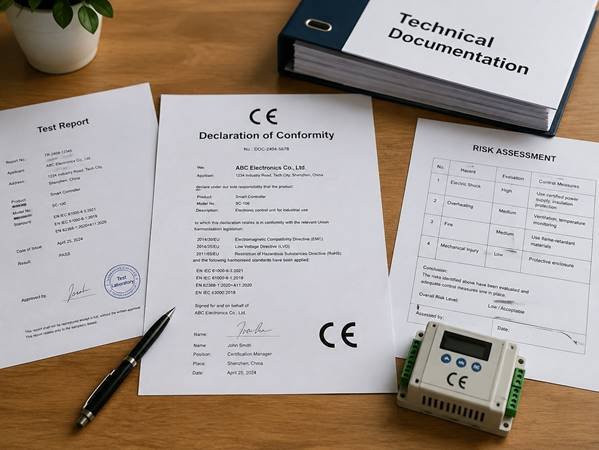
List of Core Supporting Documents for a DoC
The DoC is only a compliance conclusion; it must be supported by corresponding technical documentation and an evidence chain to be valid. The core supports include:
Required supports: First, product technical documentation, which must include design materials, risk assessment records, design calculation documents, etc., to prove that safety requirements were considered from the design stage; second, compliance assessment evidence, to prove that the actual performance of the product meets the corresponding requirements. Evidence types include test reports, software assessments, production consistency control records, etc. Different regulations require different types of evidence, and not every regulation or standard must correspond to a separate test report.
Supports added as needed: Notified Body certificates, compliance certificates for key parts, change assessment records, etc.
The core requirement is: for every compliance basis listed in the DoC, traceable evidence must be found in the technical documentation, forming a complete evidence chain.
Verification Requirements for DoC and Product Markings
The information on the DoC must completely correspond to the markings on the product itself:
First, the manufacturer’s name and address must be consistent with those on the product nameplate, packaging, and manual;
Second, the product’s model, serial number, and batch information must correspond one-to-one with the DoC. When regulators get the product, they can find the corresponding DoC by looking at the nameplate;
Third, the intended use and safety restrictions in the manual must not contradict the compliance conclusion of the DoC. For example, if the DoC says it is a household product but the manual says it can be used industrially, that is non-compliant.
Requirements for Preservation and Provision of DoCs
The DoC cannot be thrown away after signing; it must be preserved as required:
In terms of preservation period, many CE-specific regulations require the responsible entity to preserve the DoC and supporting technical documentation for at least 10 years after the last product is placed on the EU market. However, the specific period, responsible entity for preservation, and scope of documents shall be subject to the applicable specific regulations. For example, fields such as medical devices and construction products may have different document preservation requirements or systems.
In terms of preservation scope, you cannot only preserve the DoC; you must also preserve the corresponding version of the technical documentation, assessment evidence, change records, and NB certificates (if any) together. When regulators inspect, they will not only look at the DoC but also the supporting materials.
In terms of provision requirements, when regulatory authorities conduct verification, you must provide the DoC within the specified time, and cannot say it cannot be found. If it is an e-commerce product, it must also be uploaded to the backend according to platform requirements, but platform upload is only a platform rule and does not exempt the legal obligation to provide.
7. Common Pitfall Avoidance and Quick Self-Check
Finally, let’s talk about the most common compilation errors and how to quickly judge whether a DoC is valid, to help you avoid the vast majority of pitfalls.
4 Most Common Types of Compilation Errors
The first type is regulation/standard errors: the most common is omitting applicable directives, for example, for Bluetooth earbuds, only listing the Low Voltage Directive and omitting the Radio Equipment Directive (RED); there is also using an old version of a harmonized standard that has been withdrawn and has no transition period, which loses the presumption of conformity effect.
The second type is information consistency errors: the content on the DoC does not match the technical documentation and assessment reports, for example, the model on the test report is X1 but the DoC says X1 Pro; or the model on the product nameplate is different from that on the DoC.
The third type is entity qualification errors: for example, failing to mark the responsible entity within the EU as required by specific regulations; or an importer compiling the DoC without the manufacturer’s written authorization; or the signatory not having authorization authority.
The fourth type is Notified Body-related errors: for example, an ordinary laboratory that is not a Notified Body at all impersonates an NB to issue certificates; or filling in a false NB certificate number; or obviously low-risk products that do not need an NB but have NB information added, which instead makes them prone to key verification.
4-Step Quick Judgment Method for DoC Validity
Whether it’s a DoC you made yourself or one given to you by a supplier, checking according to these 4 steps will allow you to quickly judge the basic validity:
Step 1: Check the entity: whether a traceable responsible entity (such as a manufacturer within the EU, importer, or authorized representative) is clearly specified as required by applicable regulations, and the entity information is true and valid.
Step 2: Check the basis: whether all applicable CE-specific directives/regulations are fully listed, and whether the adopted harmonized standards or technical specifications have compliance effect. Omitted items or invalid bases will affect the validity of the declaration.
Step 3: Check the support: whether there is corresponding technical documentation and an evidence chain as the basis for compliance. A declaration alone without evidence has no actual compliance effect.
Step 4: Check the signing: whether there is a signature from the authorized signatory, a clear date of issuance, and whether the signatory has the corresponding authority.
Scenarios Where the DoC Needs to Be Updated
The DoC is not a once-and-for-all document. When the following changes occur and affect product compliance, declaration validity, or responsibility attribution, the DoC must be updated in a timely manner, and the basis for the change assessment must be retained:
First is product change: changes in the product’s function, structure, key parts, model, etc., that affect compliance judgment; if it is only a minor adjustment that does not affect safety, you can decide whether to update after assessment.
Second is regulation or standard update: changes in applicable directives, regulations, or harmonized standards that require compliance with new requirements after the transition period, or the original version has lost the presumption of conformity effect; if the new standard does not affect the completed assessment, or is still within the transition period, updating can be postponed for now.
Third is entity change: changes in the responsible entities listed in the declaration, such as the manufacturer or authorized representative, that require updating the declaration information; if it is only a change in the entity’s name and the responsibility is not transferred, adjustments can be made according to the actual situation.
Fourth is change in assessment documents: certificates issued by the Notified Body expire, have their scope adjusted, or become invalid, and affect the validity of the declaration; if the scope remains unchanged after the certificate is renewed, you can just update the corresponding information.
Common Scenarios and Consequences of EU Regulatory Checks on DoCs
Many people think “I can just make one casually, no one will check anyway”, but in fact, EU checks on DoCs are very common: customs clearance, e-commerce platform audits, market circulation spot checks, and consumer complaints all require the provision of a DoC.
If there is non-compliance, the competent authority will take corresponding measures according to the nature of the violation, the product risk level, the cooperation in rectification, etc. Possible measures include requiring supplementary materials within a time limit, restricting sales, product recalls, platform delisting, goods detention, and even administrative penalties. The specific measures shall be subject to the formal decision of the competent authority.
Final Summary
After reading this article, you should be able to accurately judge whether your product falls within the scope of CE regulations, whether you need to compile a DoC, distinguish the different roles of the DoC, CE mark, test report, and technical documentation, and also complete the DoC compilation for ordinary low-risk products with clear regulatory boundaries that allow self-declaration in accordance with the specifications.
At the same time, you can also quickly self-check the compliance of the DoC, avoid the 4 most common types of errors, judge the basic validity of a DoC, and know when it needs to be updated. If you encounter complex scenarios such as high-risk products, overlapping multiple regulations, or blurred compliance boundaries, you can also identify them, know that you need to combine the requirements of specific regulations or consult professional compliance personnel, and will not blindly fall into pitfalls.