
If you are engaged in electronic and electrical related business in the EU market, you have most likely heard of concepts such as the CE mark and EMC testing. Many people’s understanding of the EMC Directive stays at the level of “finding a laboratory to do a test and affixing a CE mark”, which easily leads to detours in scope judgment and compliance paths. This article systematically sorts out the core requirements of the CE Electromagnetic Compatibility Directive from introductory cognition to advanced pit avoidance, helping you build a clear compliance judgment framework. Specific compliance requirements shall be subject to the latest regulations, harmonized standards and actual product placement scenarios officially issued by the EU.
1. Introductory Cognition: What the CE EMC Directive Is, and Why It Matters to You
You can think of the EMC Directive as the “electromagnetic public order rules” set by the EU for electronic and electrical related products — equipment within the scope of the directive must not arbitrarily emit electromagnetic signals that interfere with other equipment, nor must it fail to operate normally when encountering external electromagnetic interference. This ability to “both resist interference and not interfere with others” is professionally called electromagnetic compatibility (EMC for short).
It is not an industry recommended standard, but a mandatory access rule at the EU legal level, and one of the core directives in the CE marking system. The currently valid version is 2014/30/EU, which applies to equipment and fixed installations within its scope. Specific applicability shall be comprehensively judged in combination with equipment attributes, intended use, placement method and other specialized regulations.
Core Relationship Between It and the CE Mark
Many people equate EMC compliance with the CE mark, which is the first core misunderstanding to correct: EMC compliance is only a necessary condition for affixing the CE mark to some electronic and electrical products, not the full condition. An electronic device may need to comply with several CE directives at the same time — for example, home appliances with plugs must also comply with the Low Voltage Directive (LVD) and the Restriction of Hazardous Substances Directive (RoHS). Only after all the conformity assessment requirements of the corresponding regulations are met can the CE mark be affixed. Conversely, products that are purely mechanical, purely hydraulic, purely pneumatic and have no electronic or electrical functions have nothing to do with EMC at all, even if they need to bear the CE mark.
It should also be particularly clear that the CE mark is a mark used by manufacturers to declare that products meet all applicable EU harmonized legislative requirements, and is not a “quality certification” or “safety certification” issued by a third-party institution. Depending on the requirements of different regulations, the conformity assessment procedure may only need to be completed independently by the enterprise, or may require the participation of an EU-recognized notified body. Manufacturers shall bear full legal responsibility for the CE mark they affix.
Core Reasons for the EU’s Mandatory Implementation of EMC Rules
The reasons are very practical, with three core points:
First, to ensure public safety. If hospital monitors are interfered with by nearby electronic equipment, or airport communication equipment is interfered with, the consequences would be unimaginable. EMC rules are designed to reduce such risks at the source.
Second, to unify market access. On the premise of meeting other applicable EU regulations at the same time, products that meet the requirements of the EMC Directive can circulate freely among EU member states. In principle, there is no need for each member state to set up repeated EMC access assessments, which greatly reduces the compliance costs of enterprises.
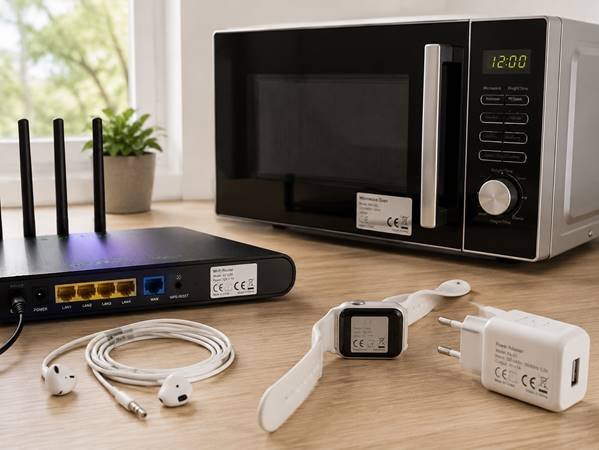
Third, to protect consumer rights and interests. A router you buy will not frequently disconnect from the network just because a microwave oven is turned on nearby, and a Bluetooth headset you buy will not have static noise as soon as it is close to your phone — these daily compatibility experiences are all backed by EMC rules.
3 Most Common Cognitive Pitfalls for Beginners
People who are new to this are most likely to make these three mistakes, and clarifying them in advance can save a lot of detours:
• It is not only large equipment that needs to meet EMC requirements: small electronic products such as Bluetooth headsets and smart watches need to meet the corresponding requirements as long as they fall within the scope of the directive; but not all products with electronic components are automatically applicable, which needs to be judged in combination with exclusion clauses and specialized regulations.
• Passing the EMC test does not equal having CE: testing is only one of the technical evidences. It is necessary to meet the requirements of other applicable CE directives, have a complete set of compliance documents, and ensure that the performance of mass-produced products is consistent with the test samples to be truly compliant.
• Having the CE mark does not mean EMC compliance: the CE mark for purely mechanical products does not involve EMC at all; even for electronic products, if other specialized regulations apply (such as the Radio Equipment Directive (RED) for wireless products), EMC requirements are also covered by the corresponding regulations, and cannot be directly equated with the general EMC Directive.
2. Quick Judgment of Applicable Scope: Whether Your Product Needs to Comply with the EMC Directive
Many people ask right away “does my product need EMC?” In fact, there is a three-step judgment method that you can directly apply to draw a preliminary conclusion:
Step 1: First check whether the product has electronic and electrical functions — as long as it has components that generate or process electrical signals, such as circuit boards, motors, and switching power supplies, and is intended to be placed on the EU market, it first enters the candidate scope;
Step 2: Then check whether it falls within the scope explicitly excluded by the directive. If it is a completely excluded product, there is no need to consider the general EMC Directive;
Step 3: Finally, check whether there are other specialized EU regulations that already cover the basic EMC-related requirements. If there are exclusive rules, there is no need to implement them separately in accordance with the general EMC Directive.
Typical Product Categories That Need to Comply
Most common electronic and electrical products fall within the scope of the general EMC Directive, such as home appliances, wired headphones, and desktop power adapters in consumer electronics, controllers, frequency converters, test and measurement equipment in the industrial field, as well as lighting fixtures, electric tools, electronic toys, etc. For commonly seen routers and smart watches with wireless communication functions such as Wi-Fi, Bluetooth, and cellular, it is usually necessary to first check the applicable scope of the Radio Equipment Directive (RED). Their EMC requirements are mostly covered by RED, and there is no need to separately apply the general EMC Directive.
Clearly Excluded / Not Separately Applicable Product Types
Such products can be divided into three categories. When judging, attention should be paid to checking in combination with specific conditions, and conclusions cannot be drawn solely based on product names or industry classification:
The first category is special-purpose equipment explicitly excluded by the directive, which must simultaneously meet the applicable conditions of the corresponding regulations:
1. Not all electronic equipment sold to the military or used in aviation scenarios is automatically exempt from the general EMC Directive; only military/aerospace special equipment that meets the explicit exclusion conditions of the EMC Directive and is covered by the corresponding specialized regulations will not be handled in accordance with the general EMC Directive. Even if general commercial electronic products are procured by the military, their compliance requirements still need to be judged based on the attributes of their initial market placement. Specific requirements shall be checked against the specialized regulations in the military/aerospace field.
2. Customized equipment specially used for research and development and not for commercial placement is only within the exclusion scope if it is not sold to the general commercial market.
The second category is products whose EMC requirements are covered by other specialized EU harmonized regulations and are not separately subject to the general EMC Directive — it is not that EMC is not required, but that it must be implemented in accordance with the requirements of the corresponding industry regulations, and it must first be confirmed that the product fully falls within the applicable scope of the corresponding specialized regulations:
1. For radio equipment within the applicable scope of the Radio Equipment Directive (RED), its basic EMC-related requirements are covered by RED, and it is still necessary to judge whether other regulations such as low voltage and RoHS apply at the same time;
2. For medical equipment, automobiles, railways, and ships, it is necessary to first check the applicable boundaries of the corresponding industry regulations. If they are not fully covered by specialized regulations, they may still involve the requirements of the general EMC Directive.
The third category is products without electronic and electrical functions: purely mechanical, purely hydraulic, and purely pneumatic equipment are not subject to the general EMC Directive only if they completely do not contain electrical/electronic functional components that generate or process electrical signals.
Applicable Rules for Special Scenarios
Components
Whether components need to separately comply with the EMC Directive can be judged in the following order:
Step 1: First confirm whether it is “equipment” as defined by the EMC Directive — that is, an electrical/electronic unit with independent functions that can be placed on the market independently;
Step 2: If it is an independent device and is sold separately to end users as an independent functional unit, EMC compliance needs to be assessed separately;
Step 3: If it is a component that is only used for internal matching of the complete machine and does not constitute an independent device, it usually does not need to undergo separate compliance assessment. However, the complete machine manufacturer still needs to include it in the complete machine EMC assessment to verify its impact on the emission and immunity performance of the complete machine.
Fixed Installations
Fixed installations (such as factory power distribution systems and production line control systems) are installations that are integrated from multiple types of equipment and installed in fixed locations for long-term use. They usually do not bear the CE mark as independent commodities, but the overall installed installation must meet the basic requirements of the EMC Directive. Therefore, the focus of judgment for fixed installations is not whether to affix the CE mark, but whether the on-site integrated installation meets the basic EMC requirements, and whether the installation/operation related parties retain technical data such as wiring, grounding, equipment layout, maintenance and changes.
3. Two Core Requirements of EMC: What Is Regulated and What Counts as Qualified
The core requirements of EMC are actually two major categories, which boil down to “not interfering with others” and “not being interfered with by others”.
First Type of Requirement: Electromagnetic Emission (EMI) — Do Not Interfere with Other Equipment
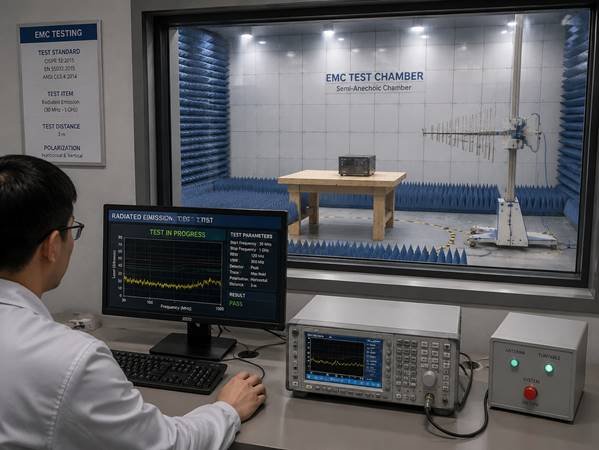
In plain terms: when the equipment is working, the electromagnetic signal “leaked” outward must not exceed the specified limit, otherwise it will interfere with the normal operation of nearby equipment.
There are two common paths for this “leakage”: one is conducted emission transmitted through power lines and signal lines — for example, when a low-quality charger is plugged into a socket, the radio on the same socket makes static noise, which is a typical manifestation of excessive conducted emission; the other is radiated emission propagated directly through space — for example, the “buzzing” sound made by early GSM mobile phones when they are close to speakers is the effect of radiated emission.
Don’t underestimate this problem. In mild cases, it affects daily user experience; in severe cases, if it interferes with key infrastructures such as medical care, transportation, and communications, it will directly threaten public safety. This is also one of the core reasons why the EU lists it as a mandatory requirement.
Second Type of Requirement: Electromagnetic Immunity (EMS) — Do Not Be Interfered with by Other Equipment
It’s the reverse: equipment must be able to work stably in the daily electromagnetic environment, and must not fail as soon as it encounters interference.
There are many types of common daily interference: for example, electrostatic discharge when touching the equipment shell in dry winter; radio frequency interference generated by someone using a walkie-talkie or turning on a microwave oven nearby; as well as surges and voltage fluctuations in the power grid when there is thunder or when high-power equipment is switched on and off. All of these may affect the normal operation of the equipment.
Compliance does not require equipment to be “completely free from any interference”, but to reach the performance baseline specified in the applicable standards. The type, degree, and recovery method of allowed performance changes must be based on the performance criteria and product functional requirements of the corresponding product standards, and cannot be judged solely based on daily experience. For example, if ordinary household consumer electronics experience short-term automatically recoverable performance fluctuations under specific interference, they will be judged as qualified only if they meet the criteria requirements of the corresponding standards; if functional interruption occurs and cannot be automatically recovered, it may not meet the requirements.
Judgment Logic for Performance Qualification
Many people think that EMC requires “zero interference” or “complete immunity”, but that’s not the case. The core is to control interference within an acceptable range. There is no universal unified limit or criterion, and specific requirements will vary with product type, intended use scenario, and applicable standards.
The following are examples of common performance criteria in general immunity standards, and are not unified requirements for all products. The specific criteria for each function and each port must be based on the applicable product standards:
| Performance Criterion Category | Specific Performance | Description |
| Category A | Performance remains completely within the specified range during interference, with no degradation | Mostly used in scenarios with extremely high reliability requirements, not mandatory for all products |
| Category B | There is short-term performance degradation during interference, which automatically recovers after the interference disappears | It is a common criterion for some ordinary consumer products, but not universal |
| Category C | Functional failure occurs after interference, requiring manual intervention to recover | Whether this criterion is allowed depends on the provisions of specific product standards for corresponding functions and ports, and varies greatly among different products |
| Category D / Unacceptable | Permanent loss of function, hardware damage, unrecoverable state, or dangerous state exceeding the allowable range of the standard | Usually directly judged as unqualified, specific details shall still be subject to the clear provisions of applicable standards |
If unrecoverable hardware damage, permanent loss of function, or faults exceeding the allowable range of the standard occur during testing, it is usually judged as not meeting the requirements. Specific details shall still refer to the clear provisions of the corresponding standards.
Key Conditions for Requirement Variations
Why are the requirements strict for some electronic devices but lenient for others, even though they are all electronic devices? The core influencing factors are the intended use environment of the product, functional risks, and applicable product standards. The strictness cannot be directly judged solely by industry name. Common influencing logic includes:
• Household/office scenarios: The electromagnetic environment is relatively simple, and most ordinary consumer electronics apply the standards for corresponding scenarios, but the specific level still needs to be determined according to product category;
• Industrial scenarios: There are usually more motors, frequency converters, and high-voltage equipment in factories, and the electromagnetic environment is more complex. The immunity requirements of many industrial products are higher than those of household products, but not all industrial equipment necessarily have stricter requirements than household products;
• Special scenarios such as medical care and transportation: If the normal operation of equipment is directly related to personal safety, both emission and immunity requirements are usually stricter, but specific details still need to be judged in combination with corresponding industry regulations and product standards.
Even for the same product, if the intended use scenarios are different, the applicable EMC standards and requirements may also differ. Before compliance, the placement scenario must be clarified first.
4. Compliance Implementation Path: Complete Steps from Standards to CE Mark
Now that the requirements are clarified, the next step is how to implement compliance. Compliance must strictly follow the EU-recognized rule path, covering multiple links such as technical verification, document system, and marking management.
Most Commonly Used Compliance Basis: Harmonized Standards
You can think of harmonized standards as the “unified technical ruler” officially recognized by the EU. These standards are listed in the corresponding list of the Official Journal of the EU (OJ for short), which is the authoritative channel for the EU to issue official regulations and lists of harmonized standards.
The biggest advantage of using harmonized standards is that as long as you fully apply the harmonized standards in the official valid list, you can directly presume that the product meets the basic requirements of the EMC Directive, and regulatory authorities generally will not question the technical compliance. There is a very easy pitfall here: you must check whether the standard version you use is in the official valid list. If the used standard version is removed from the valid reference list of the OJ, it usually no longer has the effect of “presuming compliance with the basic requirements of the directive”; however, existing test reports and technical data can still be used as technical evidence, but you need to recheck the replacement relationship, transition period, and application date of the standards, and evaluate whether the original data covers all currently valid basic requirements. You cannot directly assume that “once tested, it will always be valid”.
How to Choose Between the Two Compliance Assessment Modes
There are two main types of conformity assessment paths under the EMC Directive. Which one applies specifically needs to be judged in combination with whether the product has corresponding harmonized standards, the degree of standard coverage, and the manufacturer’s compliance choice:
The first type is Internal Production Control (Module A), which is the most commonly used path. It applies to situations where the product has corresponding valid harmonized standards and the manufacturer can prove that the product meets the requirements through internal control. This mode does not require the intervention of a Notified Body (an EU-recognized third-party conformity assessment body). Manufacturers can conduct tests on their own or entrust a third-party laboratory. As long as they can establish technical documents that meet the requirements and sign the EU Declaration of Conformity (DoC), they can affix the CE mark.
The second type is EU Type Examination (Module B), which is another assessment path that manufacturers can choose when the product does not adopt harmonized standards, or only partially adopts harmonized standards, and internal production control is insufficient to fully prove that the product meets all basic requirements. Under this path, an EU Notified Body is required to examine the technical design and type of the product, and issue a type examination opinion after confirming that it meets the requirements; the manufacturer still needs to establish complete technical documents as required, sign the EU Declaration of Conformity, and implement mass production consistency control to ensure that mass-produced products are consistent with the assessed type.
Regarding the Notified Body number next to the CE mark, it is necessary to strictly follow the legal requirements of the EMC Directive: the corresponding body number can only be affixed next to the CE mark when the Notified Body explicitly requires marking in accordance with the selected conformity assessment procedure; under the EMC Directive, the vast majority of ordinary products adopt the internal production control mode, which does not require the participation of a Notified Body, and no body number shall be marked next to the CE mark. It is strictly forbidden to apply the test report numbers of ordinary third-party laboratories or Notified Body numbers under other directives to EMC compliance marks, nor to fabricate or fraudulently use body numbers on your own to increase credibility, otherwise it will be a serious violation.
4 Core Steps for Compliance Implementation
No matter which path is used, the core steps of compliance are these four:
Step 1: Judge applicable regulations and harmonized standards — first determine whether the EMC Directive applies to the product, which standards to use, and which use scenarios correspond. If this step is wrong, all subsequent work will be in vain;
Step 2: Complete emission + immunity tests/technical assessment — cover both types of requirements according to applicable standards, with no missing items;
Step 3: Organize a full set of compliance technical documents — all design, test, and risk assessment data must be organized as core evidence of compliance;
Step 4: Sign the EU Declaration of Conformity and affix the CE mark — after completing the previous steps, the enterprise signs the declaration on its own, and then can legally affix the mark and place the product on the market.
5. Required Compliance Documents and Markings: Missing Any One Means Incomplete Compliance
EMC compliance has a set of required document and marking systems. Technical documents are the core evidence among them, and test reports alone are not sufficient to prove complete compliance.
Technical Documents: Core Evidence of Compliance
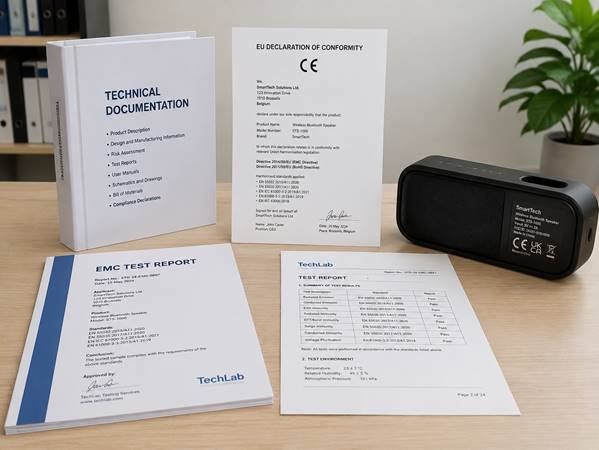
Technical documents are the core evidence to prove that the product meets the requirements. Their content must be sufficient to prove that the product meets the applicable basic requirements. The specific composition will vary with product complexity and applicable regulations, and usually includes the following: product design description, circuit diagram/PCB layout diagram, applicable harmonized standards and version information, risk analysis records, list of key components, test or technical assessment records, product user manual, etc.
According to the provisions of the directive, technical documents must be kept for 10 years after the product is last placed on the EU market, and shall be kept by the manufacturer or the responsible subject specified by regulations. EU regulatory authorities can retrieve them in accordance with the law, and failure to provide them may be judged as non-compliant.
EU Declaration of Conformity (DoC)
Many people call this a “CE certificate”, which is actually wrong — the EU Declaration of Conformity (DoC for short) is a legal document signed by the enterprise itself, not a certification certificate issued by a third-party institution. It is an official document in which the manufacturer declares that the product meets all applicable EU harmonized legislative requirements.
The DoC must include these core contents: model/series information that can uniquely identify the product, applicable EU directives and versions, applicable harmonized standards and version numbers, full name and contact address of the manufacturer, if an EU authorized representative is designated, list their full name and contact address, a statement that the manufacturer bears full compliance responsibility, name/position/signature of the authorized signatory, place and date of signing, and information of other responsible subjects required by applicable regulations. All information must be completely consistent with the content on the technical documents and product markings. A DoC with mismatched models, missing applicable regulations and standards, or no valid signature has no legal effect.
CE Mark and Product Marking Requirements
There are clear format requirements for the use of the CE mark: under normal circumstances, the height of the CE mark shall not be less than 5mm; if the product is extremely small in size or special in nature, it can be appropriately reduced, but must be clearly legible; if applicable regulations have special provisions on the mark size of specific products, those provisions shall apply.
The information requirements for product markings shall be determined in combination with applicable regulations and actual product conditions. The information marking rules for different responsible subjects are as follows:
1. Manufacturer information: All products must be marked with the manufacturer’s name and contact address; if the product size or nature does not allow direct printing on the product, the information can be placed on the packaging or accompanying documents.
2. Importer information: If the manufacturer is not located in the EU, the name and contact address of the EU importer must be marked; the marking position can also be placed on the product, packaging or accompanying documents according to product conditions, but must be clearly traceable.
3. EU authorized representative information: Non-EU manufacturers can designate an EU authorized representative to perform part of the compliance duties within the scope of written authorization (such as liaising with regulators, keeping documents, etc.); the information of the authorized representative can be marked as required by regulations, but the authorized representative cannot replace the manufacturer to bear the core responsibility for product compliance.
EMC-related precautions in the product manual shall be determined in combination with the actual needs of the product: the EMC Directive requires that equipment be accompanied by necessary usage information to ensure that users can use the equipment correctly in accordance with the intended use. Only when cable specifications, grounding requirements, installation distances, integration conditions and other content do affect the EMC compliance or safe use of the product do they need to be clearly listed in the manual. Not all products must include exactly the same EMC precautions.
Correct Use of Notified Body Numbers
The marking of Notified Body numbers must strictly meet the requirements of the EMC Directive. For specific rules, please refer to the relevant description of the conformity assessment path in Chapter 4. Common mistakes include: marking the number on your own without a Notified Body participating in the compliance assessment, using the test report number of an ordinary laboratory as a Notified Body number, and omitting the number when it should be marked. All of these may lead to compliance risks.
6. Division of Supply Chain Responsibilities: Who Is Responsible for EMC Compliance
EMC compliance is not the responsibility of a single party. Different roles in the supply chain have different legal responsibilities, and it is easy to fall into pitfalls if you are not clear about them.
Primary Responsible Subject: Manufacturer
The manufacturer is the primary responsible person for product compliance. It is responsible for ensuring that the design and production of the product meet the basic requirements of the EMC Directive, completing conformity assessment as required, preparing and keeping technical documents and the EU Declaration of Conformity, affixing the CE mark, and ensuring that mass-produced products are consistent with the assessed type and have stable performance that meets the requirements.
Division of Responsibilities Between Non-EU Manufacturers and Importers
If the manufacturer is not located in the EU, the EU importer shall bear the statutory obligations of pre-market verification and subsequent cooperation with supervision, specifically including: before the product is placed on the EU market, verifying whether the product has completed conformity assessment, whether the correct CE mark is affixed, whether technical documents and DoC are fully prepared, and whether product markings meet the requirements; marking the importer’s name and address on the product or packaging as required; keeping relevant compliance documents and cooperating with the investigation of regulatory authorities. When the product does not meet or cannot be confirmed to meet the requirements of the EMC Directive, the importer shall not place it on the EU market; if EMC compliance risks are found after the product has been placed on the market, the importer shall cooperate with the manufacturer and regulatory authorities to take measures such as correction, recall or withdrawal.
The manufacturer still bears the core ultimate responsibility for the product’s design, production compliance, and the validity of the conformity assessment. Non-EU manufacturers can designate an EU authorized representative through written authorization to perform part of the compliance liaison duties, but the scope of responsibility of the authorized representative is subject to the agreement in the authorization letter and regulatory requirements, and does not replace the core responsibility of the manufacturer.
Boundaries of Responsibility for Distributors and Cross-Border E-Commerce
The core responsibility of distributors is not to sell products that they know do not meet the requirements: if it is found that the product has no CE mark, no compliance information, or has obvious compliance defects, it shall not continue to be sold.
It should be noted that if an operator places a product under its own brand, private labels the product, or makes substantial modifications (such as modifying circuits or changing core functions), it will be regarded as the manufacturer and shall bear full compliance responsibility; simply replacing the outer packaging itself does not necessarily trigger the manufacturer identity, but if the brand and model information on the packaging are inconsistent with the original product, it may still be deemed to be placing the product on the market under its own name.
In cross-border e-commerce scenarios, the responsible subject can be preliminarily judged according to a three-step logic: first, see who places the product under their own name or brand — such subjects may be regarded as manufacturers and bear full compliance responsibility; second, see who first puts the product into the EU market — such subjects usually need to bear the importer’s verification and reporting obligations; finally, it is necessary to confirm whether there are additional responsibilities in combination with platform rules, overseas warehouse service agreements, and law enforcement requirements of specific member states. It should be noted that direct delivery from overseas warehouses cannot automatically be equated with a certain party bearing full responsibility, but any product placed on the EU market must have a traceable responsible subject within the EU.
Special Responsibilities for Fixed Installations
The EMC responsibility for fixed installations shall be determined in combination with the actual behavior of all parties and applicable laws, and cannot be generalized. Generally speaking:
• The manufacturer of the equipment used for the fixed installation shall be responsible for the EMC compliance of the equipment it supplies;
• Integrators and installers shall complete on-site integration work such as wiring, grounding, and equipment layout in accordance with the installation instructions, EMC requirements and good engineering practices provided by the manufacturer, ensure that the overall installation after installation meets the basic EMC requirements, and keep installation-related technical documents;
• The operator shall maintain the compliance status of the installation during daily use, and shall not arbitrarily modify structures or configurations that may affect EMC performance.
If the overall installation does not meet the requirements due to non-standard on-site integration, the integrator or installer shall bear the corresponding responsibility; if the problem is caused by the unqualified equipment itself, the equipment manufacturer shall bear the responsibility.
7. Advanced Skills: Know How to Judge, Verify Authenticity, and Avoid Pitfalls
Mastering the previous content is already sufficient to cope with most introductory scenarios. The following advanced content can help you independently judge the effectiveness of compliance and avoid most easily overlooked pitfalls.
4 Keys for Beginners to Understand EMC Test Reports
Many people only look at the word “qualified” on the last page when they get a test report. In fact, there is a lot of key information in it. As long as you focus on checking these four points, you can preliminarily judge whether the report is applicable to your product:
First, check sample information: Are the product model, hardware configuration, software version, and working mode during testing in the report consistent with the version you actually sell? For example, if a metal shell was used during testing but you sell a plastic shell, you need to evaluate the impact of structural changes on EMC performance, and supplement testing if necessary. You cannot directly assume that the report is fully applicable.
Second, check test items: Do the emission and immunity items all cover the requirements of applicable standards? Are there any missing items? For example, only testing conducted emission but not radiated emission, or only testing emission but not immunity, are both incomplete.
Third, check emission results: Is the measured value lower than the limit specified in the standard? Generally speaking, the smaller the margin between the measured value and the limit, the higher the risk of exceeding the limit during mass production due to component fluctuations and production process differences. The specific risk level needs to be judged in combination with product complexity and production control level.
Fourth, check immunity results: Does the performance during testing meet the criteria specified in the applicable standards? Have there been any unacceptable faults or damage? If performance degradation not allowed by the standard occurs during testing, even if the report says “qualified”, further verification is required.
Common Advanced Pitfall Avoidance Points
1. Holding only a test report does not constitute complete compliance: In addition to test technical evidence, a valid EU Declaration of Conformity, complete technical documents, and a mass production consistency control mechanism are also required. For relevant basic logic, please refer to the introductory misunderstandings in Chapter 1 and the compliance document requirements in Chapter 5.
2. Expired harmonized standard versions: The standards used by many enterprises during testing are valid, but by the time the product is launched, the standards have been removed or updated by the OJ. At this time, the old standards no longer have the effect of presuming compliance, and a re-assessment according to the new version is required.
3. Unfounded series model coverage: Many enterprises use the test report of one model to cover the entire series of products, but if there are differences in power modules, shells, cables, and core circuits between different models, EMC performance may be significantly different. There must be a clear basis for selecting representative models and difference analysis, and it is not allowed to directly claim that the entire series is compliant.
4. Lack of mass production consistency control: EMC testing is only for samples. If the component supplier is changed, the shielding design is simplified, or the PCB layout is adjusted during mass production, it may cause the product to fail to meet the requirements. Enterprises need to establish a corresponding production control mechanism to ensure that the EMC performance of mass-produced products is consistent with that of test samples.
5. Do not treat third-party “CE certificates” as legal proof: Under the EMC Directive, most ordinary products do not require a Notified Body to issue certificates. The core compliance evidence is technical documents and the DoC signed by the enterprise itself. For relevant explanations, please refer to the content of Chapter 5.
Judgment Logic for Whether Product Modification Requires Retesting
Product modification is common, and not all modifications require a complete retest. It can be judged at different levels according to the degree of impact of the modification on EMC performance:
• High-risk modifications (require re-assessment, usually require supplementary or complete testing): Replacing power modules, crystal oscillators, filters, adjusting the core PCB layout, replacing shielding materials — these are all core designs that directly affect electromagnetic emission and immunity performance. After modification, it is basically necessary to re-assess EMC performance, and complete corresponding test items if necessary.
• Medium-risk modifications (require impact assessment first): Replacing cables, shell materials, external accessories, adjusting software functions related to signal processing — these modifications may affect EMC performance, but the specific degree of impact needs to be judged in combination with product structure and principles. If the assessment deems the impact significant, supplementary testing is required; if the impact is negligible, the original test report can be retained and the assessment basis recorded.
• Low-risk modifications (usually do not require retesting, but impact assessment records must be kept): Modifications that do not involve circuits, shielding structures, installation methods, or cable routing at all, such as replacing purely decorative appearance parts or adjusting packaging design. If the modification of appearance parts affects ventilation, creepage distance, shielding effect, cable arrangement or grounding conditions, it cannot be directly classified as low risk, and the EMC impact needs to be re-assessed.
3-Step Method for Purchasers to Conduct Preliminary Authenticity Verification
If you are a purchaser and want to preliminarily verify the EMC compliance of a product, you can conduct a preliminary investigation according to the following three steps, but this is only a preliminary judgment and cannot replace a complete review of technical documents and mass production consistency:
Step 1: Check product markings: Is there a clear CE mark? Is there relevant information of the manufacturer or the responsible party within the EU marked? If there is not even the basic CE mark and responsible party information, the compliance risk will be very high.
Step 2: Check the EU Declaration of Conformity (DoC): Can a valid DoC be provided? Does the declaration clearly list the applicable EMC-related directives (or specialized directives that include EMC requirements, such as RED)? Are the product model and manufacturer information on the declaration consistent with the actual product?
Step 3: Check test/assessment reports: If there is a test report, you can check whether the standard applicable to the report is the official valid version of the EU, whether the sample configuration is consistent with the actually sold product, whether the test items are complete, and whether the conclusion meets the requirements.
Learning Summary: 3 Things You Can Now Judge Independently
The core content of the CE Electromagnetic Compatibility Directive has basically been sorted out. You don’t need to remember all the details. As long as you can independently complete the following three judgments, you have established a complete introductory compliance framework:
First, judge whether a product needs to comply with the CE EMC Directive: first confirm whether the product is a device with electronic and electrical functions, then check whether it falls within the scope explicitly excluded by the directive, and finally confirm whether there are other specialized regulations that already cover EMC requirements. A preliminary conclusion can be drawn in three steps.
Second, clarify the basic configuration of EMC compliance: emission and immunity performance meet the requirements of applicable standards, a full set of technical documents sufficient to prove compliance is prepared, a valid EU Declaration of Conformity is signed, the CE mark is affixed as required and relevant responsible party information is marked. Missing any one item means incomplete compliance.
Third, conduct preliminary authenticity verification of products claiming EMC compliance: by checking product markings, DoC information consistency, and the validity of applicable standards, obvious compliance risks can be quickly identified, and then in-depth verification of technical documents and mass production consistency can be carried out as needed.
Before officially placing a product on the EU market, it is recommended to establish a complete and traceable compliance technical document package by product model to ensure that all information is consistent with the actual state of the product.