
Friends who do cross-border business in electronic products such as charging cables and chargers have most likely heard of terms like REACH and Proposition 65 as long as they enter the European, UK, or California (US) markets. But many people get confused when they first encounter them: they all regulate chemicals, so why do some require testing while others require labeling? Aren’t EU REACH and UK REACH the same thing? Does Proposition 65 have to be complied with across the entire United States?
In this article, we will thoroughly explain the three most commonly encountered chemical regulations, covering the most basic jurisdictional scope and core logic, exclusive compliance points and practical steps for charging products, as well as common misconceptions and quick judgment methods. After reading it, you will understand what you need to do, and no longer have to worry about pages of professional terminology.
What are the operating logics of the three regulations respectively?
Once you know the core differences and have a brief understanding of the overall framework of each regulation, you will understand why these requirements exist.
EU REACH: A complete framework of access system
The full name of EU REACH is the . The four words in its name are its core framework: Registration – Evaluation – Authorization – Restriction.
However, for sellers of finished charging products, the first three links are basically the responsibility of chemical raw material manufacturers and importers. We only need to care about two obligations directly related to finished products: first, the communication and notification of SVHCs, and second, substances in the Restriction List (Annex XVII) must not be used in excess of the limits.
The core supporting tools of EU REACH are two public lists: the SVHC Candidate List (currently about 240 items, updated 1-2 times a year) and the Restriction List (more than 70 categories of substances). All obligations for finished products revolve around these two lists. In addition, there is the SCIP database, which is used by EU waste management authorities. It requires articles containing SVHCs with an annual import volume of more than 1 ton to submit relevant information to facilitate subsequent waste management.
UK REACH: A parallel operating access system
UK REACH almost replicates the framework of EU REACH, and the obligation logic for finished products is basically consistent with that of the EU, making it easy for sellers to understand.
It has two main special points: First, its SVHC Candidate List and Restriction List were completely copied from the EU at the initial stage, but will be independently updated by the UK HSE in the future, and the lists on both sides may gradually diverge; Second, unlike the SCIP notification required by the EU, UK REACH has no mandatory requirement for it, and the corresponding notification is called DUIN notification, which can be submitted directly to the UK HSE.
California Proposition 65: Litigation-driven notification system
Completely different from the previous two access-based regulations, the core of California Proposition 65 is “notification”, and its enforcement method is very special.
Its core requirement is simple: if a product contains carcinogenic or reproductive toxic substances listed by California, and the daily human exposure exceeds the safe harbor level, a warning label must be affixed in prominent positions such as product packaging and sales pages.
What is more noteworthy for sellers is its enforcement characteristic: there are very few official proactive inspections, and the vast majority of violation cases are initiated by private individuals or public welfare organizations, and most end with merchants paying settlement fees. That is to say, even if there is no consumer complaint, as long as someone finds that you are in violation, they may sue you. This is also why many sellers suddenly receive Proposition 65 lawyer letters.
The supporting tools of Proposition 65 include three parts: first, the list of regulated substances (there are about 1,000 items in total, updated many times a year, but only 30-50 items are related to charging products); second, the safe harbor level corresponding to each substance; third, the format specifications of warning labels, such as font size and content requirements, and non-compliance with the format is also considered a violation.
Exclusive compliance points for charging products
For sellers of charging cables and chargers, there is no need to focus on all regulated substances. As long as you keep a close eye on high-risk components, you can cover more than 90% of compliance risks.
High-risk components and corresponding regulated substances
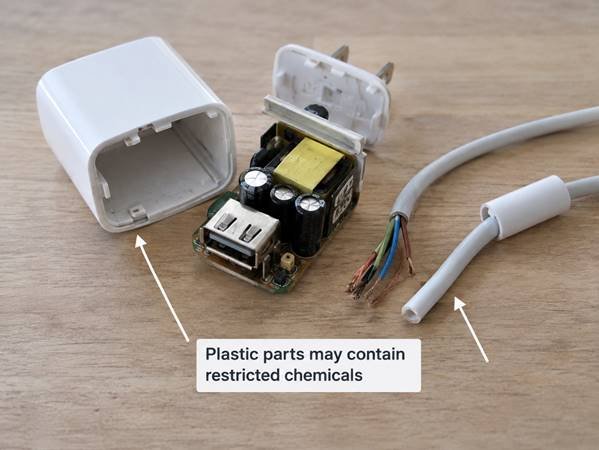
We have compiled the components and corresponding substances that are most likely to exceed the limits in charging products, covering all three regulations:
• **Plastic housings, PVC cable sheaths**: To increase flexibility or flame retardancy, manufacturers often add phthalates (plasticizers) and polybrominated diphenyl ethers (flame retardants). These two types of substances are the common regulatory focus of the three regulations, and are also the items with the highest violation rates.
• **Solder, brass contacts**: Heavy metals such as lead in solder, and lead, cadmium, and nickel in brass contacts are also common high-risk substances regulated by all three regulations.
• **Metal plating**: For example, the metal plating of USB interfaces may use hexavalent chromium, which is explicitly restricted in the Restriction Lists of EU and UK REACH, and is also listed as a regulated substance under Proposition 65.
• **Insulating materials**: Some internal insulating sheets, insulating films, etc. may have short-chain chlorinated paraffins added as flame retardants, which are restricted by EU and UK REACH and also listed under Proposition 65.
Practical suggestions for cross-market compliance
If your products are sold to multiple markets at the same time, you don’t need to do three separate sets of tests. The most cost-effective way in practice is: first do a total content screening of high-risk substances, such as testing high-frequency over-limit items like phthalates, heavy metals, and common flame retardants first. If the content is far below the thresholds of each regulation, it can basically meet both the concentration requirements of REACH and the exposure requirements of Proposition 65; if the content is close to the threshold, then conduct targeted supplementary tests for the corresponding items, which can save a lot of costs.
The core compliance priorities of different markets are also different:
• EU market: Focus on SVHC communication/notification, compliance with restricted substances, and SCIP notification when annual import volume exceeds 1 ton.
• UK domestic market: Focus on UK SVHC communication/notification, compliance with UK restricted substances; there is no mandatory SCIP requirement.
• California market: The core is to assess substance exposure to determine whether a warning label is required; there is no ban requirement.
Practical implementation: Compliance from 0 to 1
Now that you know the requirements, how to implement them specifically? We have compiled general compliance steps, as well as platform requirements and cost references that sellers are most concerned about.
General compliance steps
No matter which market you enter, there are basically these five steps:
1. **Determine the target market and obtain the latest list**: First clarify where your products are ultimately sold, then go to the corresponding official website to download the latest regulated list — for the EU, go to the ECHA official website; for the UK, go to the HSE official website; for California, go to the OEHHA official website. All are free to query, no need to buy the so-called “latest list” from third parties.
2. **Disassemble high-risk components and sort out the Bill of Materials (BOM)**: Disassemble the high-risk components of the product, such as plastic housings, cable sheaths, contacts, and solder, and sort out the material of each component. You don’t need to disassemble every part, just focus on the high-risk parts.
3. **Send to a qualified laboratory for testing**: Find a third-party laboratory with international mutual recognition qualifications, and select the corresponding test items according to your target market and product situation. At the beginning, you don’t need to do a full test directly; just test high-risk substances first, and do supplementary tests if there are problems.
4. **Fulfill corresponding obligations and retain compliance documents**: After passing the test, take corresponding actions according to the results: for example, if SVHC exceeds 0.1%, notify the buyer; if annual import volume exceeds 1 ton, submit the notification; for California, if exposure exceeds the limit, affix a warning label as required. At the same time, keep documents such as test reports, Declaration of Conformity (DoC), and notification receipts properly, so that they can be provided when the platform or authorities conduct inspections.
5. **Track updates regularly and conduct annual reviews**: The lists of the three regulations are updated regularly. For example, the SVHC list of EU REACH is updated twice a year. It is recommended to review compliance at least once a year to avoid violations due to list updates.
Additional requirements of cross-border e-commerce platforms
It should be specially reminded that the compliance requirements of mainstream cross-border platforms such as Amazon and eBay are often stricter than local regulations. For example, for many categories on the EU site, even if your annual import volume is less than 1 ton, the platform may require you to provide a full SVHC test report; for the California site, even if you believe the product exposure is below the safe harbor level, the platform may require you to affix a Proposition 65 warning on the product page.
The two most common reasons for platform review failure are: first, the laboratory that issued the test report is not qualified and not recognized by the platform; second, the format of the Proposition 65 warning label does not meet the requirements, such as too small font size or wrong position. Be sure to check carefully against the platform requirements before submitting.
Compliance cost reference
Many sellers are most concerned about how much it costs to do compliance. Here is a general reference range for you, and the specific price will vary with the product situation:
• EU REACH: The full SVHC test for a single charging product is about several hundred to more than 1,000 euros. If only a few high-risk items are tested, the cost will be much lower.
• UK REACH: Since EU REACH test data can be reused, there is no need to redo the test. You only need to pay an additional notification service fee, which is about several hundred to 1,000 pounds.
• California Proposition 65: If only the total content screening of high-risk substances is done, it can be done with a few hundred dollars; if exposure testing (that is, simulating actual use scenarios to calculate human exposure) is required, the cost will be higher, about 1,000 to several thousand dollars, depending on the complexity of the product.
There are four main factors affecting the cost: the number of product components, the number of test items, the qualification level of the laboratory, and whether an expedited report is required. You can choose according to your own needs.
Pitfall avoidance guide: Common misconceptions and quick judgment
Sellers who are new to compliance can easily fall into several common pitfalls. We have compiled high-frequency misconceptions and quick judgment methods to help you avoid detours.
Correction of 5 high-frequency misconceptions
1. **Misconception: REACH is an official mandatory certification**
Correct answer: REACH is a set of regulations. There is no unified official certification, and no official certificate issuance is required. Enterprises only need to complete testing and retain test reports and Declaration of Conformity (DoC) to meet the requirements. The so-called “REACH certification” on the market is mostly commercial propaganda of third-party institutions.
2. **Misconception: Proposition 65 is a US federal regulation**
Correct answer: Proposition 65 is only a state-level act of California, applicable only to products sold to California, and does not need to be complied with across the entire United States. Moreover, its enforcement does not rely on official inspections; private individuals or public welfare organizations can sue as long as they find violations, without the need for consumer complaints to trigger.
3. **Misconception: UK REACH and EU REACH are fully interchangeable**
Correct answer: The two have similar frameworks, but their lists and notification systems are independent. Currently, the UK list is consistent with the EU’s, but it will be updated independently in the future. Notifications for the UK domestic market must be submitted separately to the HSE and cannot be replaced by EU notification records.
4. **Misconception: Products containing SVHC cannot be sold**
Correct answer: SVHCs are Substances of Very High Concern, not prohibited substances. As long as the content exceeds 0.1% in homogeneous materials, products can be sold legally after fulfilling the communication and notification obligations. Only substances included in the Restriction List are prohibited or restricted from use.
5. **Misconception: Affixing a Proposition 65 warning = the product is unqualified**
Correct answer: Affixing a warning is only fulfilling the notification obligation, indicating that the exposure of listed substances in the product exceeds the safe harbor level, and does not mean that the product does not meet quality standards. Electronic products of many internationally renowned brands also carry Proposition 65 warnings, and they can be sold legally as long as they meet the regulatory requirements.
Quick judgment method
New sellers don’t have to go through the entire regulation at the very beginning. They can quickly judge their basic obligations in just three steps:
1. **First look at the final sales location**: For products sold to the EU + the three EEA countries, refer to EU REACH; for products sold to the UK domestic market (England/Scotland/Wales), refer to UK REACH; for products sold to California, refer to Proposition 65.
2. **Confirm the product type**: As long as it is a finished product (article) such as a charging cable or charger, you don’t need to worry about the registration obligations for chemical raw materials, just look at the requirements for finished products.
3. **Distinguish the two types of REACH requirements**: SVHC is a communication obligation, and if the limit is exceeded, you must inform the buyer; the Restriction List is a prohibition and restriction requirement, and if the limit is exceeded, the product cannot be sold. The latter is much stricter than the former, so be sure to view them separately.
Special boundary conditions
There are several special situations where you don’t need to fulfill the corresponding obligations if they apply, so don’t do compliance work for nothing:
• Products sold only to Northern Ireland are subject to EU REACH and do not need to comply with UK REACH.
• For California orders, if the actual shipment is outside California and the seller does not actively direct the product to the California market, Proposition 65 obligations are not triggered.
• If the SVHC concentration of the product is lower than 0.1%, SVHC communication and notification obligations are not triggered, but the requirements of the Restriction List must still be met.
• If the exposure under Proposition 65 is below the safe harbor level, no warning label is required.
Final summary
Overall, the three chemical regulations look complicated, but their core differences are easy to remember: EU and UK REACH are access-based systems, where compliance must be achieved before sale, and the judgment standard is the substance concentration in homogeneous materials; Proposition 65 is a notification system, where consumers must be warned if the safe line is exceeded, and the judgment standard is exposure during actual use.
For sellers of charging products, there is no need to pursue understanding all provisions at the very beginning. As long as you can distinguish the core differences of the three regulations, judge the basic obligations of the target market, identify high-risk components such as plastic housings, cable sheaths, contacts, and solder, and avoid the 5 common misconceptions mentioned above, you can handle the vast majority of daily compliance scenarios. It is sufficient to slowly follow up on list updates and gradually improve the compliance system later.