
Practitioners who bring charging products to the North American market almost always encounter needs related to “UL” — some clients require UL test reports, some platforms require UL certification, and quotes range from a few thousand to tens of thousands of yuan, with gaps of several times. Many novices are easily confused when first exposed: What is the difference between UL testing and UL certification? Why is the price difference so big? Which one should I choose to avoid wasting money?
This content starts from the most basic conceptual boundaries, explains all the cost composition, cycle differences, and influencing factors of the two, and finally attaches practical selection methods and pit-avoidance tips. After reading it, you can independently judge needs, compare quotes, and avoid common traps.
Beginner’s Literacy: First Clarify the Core Boundaries of UL-Related Services
Before comparing costs, it is necessary to clarify the boundaries of several core concepts first, otherwise all comparisons are meaningless.
Basic Understanding of UL Organization
We often refer to UL, whose official name is now UL Solutions. It is not a government agency, but one of the widely used independent testing, inspection and certification bodies in North America.
The UL mark is usually not the only mandatory mark specified by U.S. federal regulations; however, in certain product categories, workplace installation scenarios, local Authority Having Jurisdiction (AHJ) enforcement scenarios, and retail and platform procurement rules, NRTL certification, UL certification or test documents that meet specified safety standards may be required. Which documents and which certification bodies are accepted by channels such as Amazon and Best Buy shall be subject to the specific product category and current written requirements, and it cannot be assumed that UL is always required.
It should be specially noted that the UL standards applicable to charging products are not fixed and unified, and shall be determined according to product use, parameters, and target markets. UL 62368-1, which everyone often hears, is only a common standard for audio-visual, information and communications technology (ICT) products, and is not applicable to all charging products.
What is Testing According to UL Standards
Many people think this is a fixed official service of UL, but it is not. Its essence is a service of “testing submitted samples according to the safety standards issued by UL”, which is usually divided into three categories: preliminary testing in the R&D stage, testing carried out by third-party laboratories, and testing included in UL official certification projects. The test results usually correspond to the submitted samples, the adopted standards and test conditions, and will not automatically endorse the entire product series.
The content of the report is subject to the scope of entrustment and laboratory procedures, and usually lists samples, test conditions, results and non-conformities; rectification suggestions are not a mandatory deliverable of all reports.
Whether existing test data can be used by UL for subsequent certification, and whether it can reduce repeated testing or related fees, shall be determined by UL according to the specific certification project and data acceptance arrangements. In addition to samples, structure, technical documents and standard applicability, it may also involve whether the laboratory is included in the UL data acceptance program, whether the test method and original data meet the requirements, and UL’s technical review.
There are three common uses of this type of testing: identifying safety hazards in the R&D stage, supplier incoming material quality control, and providing temporary compliance certificates to customers for small-batch orders.
For charging products, the core items of UL safety testing have different focuses: chargers mainly test dielectric strength (whether there will be leakage breakdown), temperature rise (whether it overheats during normal use), abnormal operation (whether it catches fire during short circuit/overload), effectiveness of protection devices, creepage distance and clearance (whether the safety distance between live parts is sufficient).
For USB-C cables, the specific use and applicable standards should be determined first, and then test items such as electrical, material, flame resistance, mechanical or rating should be determined. Requirements such as 5A capacity and electronic marking marked on cables shall also be separately confirmed in accordance with USB Type-C and USB-IF specifications, and cannot be generally regarded as items that all UL safety tests will verify.
There is a very easy pitfall here: USB-C/PD protocol conformance, EMC (electromagnetic compatibility), energy efficiency, and chemical compliance are all independent test items, which are not covered by UL safety testing itself. Don’t think that doing UL testing covers all compliance requirements.
What is UL Certification
UL certification is a compliance certificate officially issued by UL Solutions. Its essence is that UL provides safety endorsement for products, proving that they meet the corresponding UL safety standards. Its deliverables are not just a certificate, but a certification file for the corresponding category plus authorization to use the UL mark.
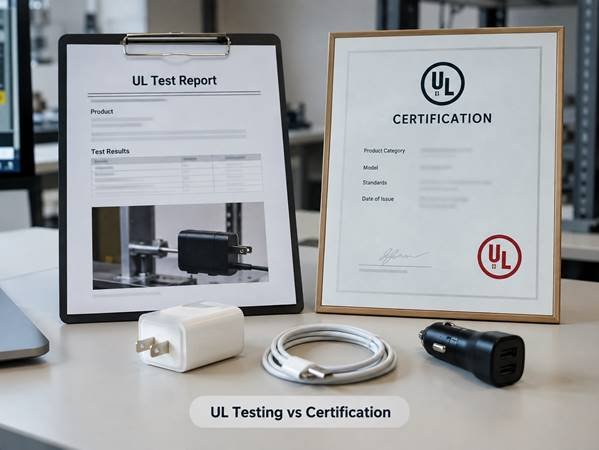
UL Product iQ can be used to search for a large amount of UL certification information, and usually requires registering a free account and logging in. For disputes over specific documents, models, production locations or the current validity of certification, they should be confirmed with UL Solutions or the document issuer in combination with Product iQ records, marks and file information.
The core value of UL certification is that the UL mark can be legally used on products and packaging, and it meets the access requirements of some North American channels or procurement projects. It is necessary to distinguish here: UL Recognized for components cannot replace UL Listed for complete machines. For example, a UL Recognized fuse inside a charger does not mean the entire charger has UL certification; the complete machine must complete the overall safety assessment separately.
4 Common Conceptual Misconceptions for Novices
These are experiences summed up by many practitioners after wasting money:
1. Misconception 1: Passing UL standard testing allows use of the UL mark. Only those who have obtained UL certification have the authorization to use the mark. A simple test report only proves that the submitted sample has passed the test. Unauthorized marking will face seizure or even fines.
2. Misconception 2: UL certification is valid for life with a one-time payment. UL certification requires continuous compliance with requirements. UL will conduct regular follow-up inspections at the factory. When standards are updated, assessments and supplementary tests must be completed within the transition period. Certifications that do not meet the requirements will be suspended or revoked.
3. Misconception 3: All UL standard testing is for obtaining certification. Many enterprises conduct UL standard testing only for internal R&D preliminary testing, supplier quality control, or to meet temporary customer requirements, and do not need to obtain certification, so there is no need to spend several times more money.
4. Misconception 4: UL Recognized core components mean the complete machine has certification. UL Recognized components can at most reduce part of the assessment links of complete machine certification. The complete machine still needs to complete separate structural and overall safety assessments, and can never be directly replaced.
Relationship Between UL-Related Services and NRTL Certification
Many people also hear the term NRTL, so let’s clarify the boundaries here. NRTL (Nationally Recognized Testing Laboratory) is a national third-party testing laboratory recognized by the U.S. Occupational Safety and Health Administration (OSHA). UL is one of the more well-known ones, but not the only one; ETL, CSA, etc. also belong to NRTL.
Several core boundaries need to be clarified: test reports issued according to UL standards, UL certification, UL mark authorization, and other NRTL certifications — the effectiveness of these four is not equivalent to each other, and cannot be equated at will.
In workplace scenarios where OSHA applies, products that fall within the corresponding NRTL recognition scope and are correctly certified and labeled can usually meet the corresponding NRTL requirements. Private purchasers, retail platforms and specific AHJs may still put forward requirements for specific marks, certification bodies or documents. When involving transaction or installation access, written confirmation of their applicable requirements should be obtained.
Many people ask: If I do UL standard testing first, can I deduct the fees when applying for certification later? The answer is not that it will definitely work if several fixed conditions are met. Whether existing data can be used by UL for certification projects, and whether it can reduce repeated testing or fees, shall be determined by UL according to the specific certification project and data acceptance arrangements; it may also involve the laboratory’s data acceptance qualification, test methods, original data and UL technical review.
Reports from laboratories not in the UL data acceptance program usually cannot automatically replace UL certification test data, but whether they can be used for customer or platform access shall be subject to the other party’s requirements for laboratory qualifications, report scope and document rules.
Finally, the difference in validity period: UL standard test reports are for specific samples, standards and test conditions. If subsequent standards are updated or products are changed, the report may not be accepted, but it will not automatically become invalid; UL certification requires continuous compliance with certification requirements. When standards are revised, assessments must be completed within the transition period specified by UL, which may require supplementary testing or even re-certification. The specific details shall be subject to UL’s official notice.
Set a Benchmark Before Comparison: Unified Criteria Make Sense
Many people make the mistake when comparing costs by directly comparing quotes for different products and different services, and the results are naturally very different. Before referring to specific values, it is necessary to clarify the premise of the comparison first.
First Clarify the Required Service Type
Different service types have completely incomparable costs and cycles. For example, the price difference between preliminary testing and full certification may reach 10 times, so the first step is to match your own needs first, and then compare with the same criteria.
All cost and cycle references below are based on the following default benchmarks. If they do not meet the benchmarks, the values will fluctuate accordingly:
• Sample benchmark: Regular consumer-grade 20W single-port USB-C charger, 1-meter ordinary USB-C fast charging cable
• Factory benchmark: Located in mainland China, no bad records of UL follow-up inspection
• Channel benchmark: Regular laboratory officially authorized by UL, excluding fake reports and copycat institutions
• Exclusion scope: Special situations such as high-power customized products, overseas factories, dual US-Canada markets, multi-model series, etc.
Cost and Cycle Statistical Rules
To avoid being scammed by “low-price bait” when comparing prices, we unify three cost statistical criteria:
• One-time direct cost: The direct service fee for the first application, excluding indirect costs such as samples, logistics, rectification, and listing delays
• First-year Total Cost of Ownership (TCO): One-time direct cost + first-year follow-up inspection/file/mark-related fees. Total cost of ownership refers to including all related fees for maintaining service effectiveness, which reflects the real cost better than just looking at the initial quote
• Long-term TCO: In addition to the first-year fees, it also includes fees for product changes, new models, standard revisions, and subsequent annual services, suitable for long-term product planning
Cycle statistics follow the following rules:
• The statistical premise is the regular situation without rectification or expedited processing, excluding enterprise internal R&D and rectification time
• The cycle is generally divided into four stages: document freezing and pre-review, sample submission and testing, rectification closure, certification decision/mark authorization (including factory scheduling)
• Special reminder: The test working days marked by the laboratory are not equal to the total product launch cycle. Enterprises need to reserve time in advance for internal sample preparation, document sorting, and rectification.
Core Variables That Change Conclusions
The values of cost and cycle are not fixed, and are mainly affected by three types of factors:
• Product side: Power level, structural complexity, number of models, whether key components have UL qualifications
• Service side: Target market, scope of testing/certification items, service type (testing/certification)
• Factory side: Factory location, compliance foundation, number of rectifications
Item-by-Item Comparison of Core Cost Composition
After clarifying the benchmarks, let’s break down the cost differences between UL testing and UL certification.
Comparison of One-Time Direct Cost Composition
The charging items for testing according to UL standards and UL certification shall be subject to the project agreement and quotation. In addition to testing and retesting, it may also involve application, engineering or report, document review, labeling, on-site service, travel or other fees.
The one-time direct cost of UL certification usually includes more service content, such as testing services, application fees, file review fees, and the first factory assessment fee depending on the project.
In addition to the explicit costs, there are also hidden cost differences: the rectification of UL testing is relatively flexible, as long as the sample can pass the test after modification; in addition to sample testing, UL certification usually involves technical documents, certified structure and subsequent follow-up service requirements, and the cost of rectification and retesting may be higher.
UL mark certification usually also involves Follow-Up Services, which are used to verify whether mass-produced products, components and mark use comply with the certification file and related procedures. This should not be interpreted as a general quality management system certification, nor can it be simply equated with a comprehensive certification of the factory’s production process.
Reference for Cost Differences of Products with Different Complexity
UL has not issued a unified certification and testing price or fixed cost multiple applicable to all types of chargers and cables. Ordinary USB-C cables, 20W single-port USB-C chargers, and 65W multi-port GaN chargers may have very different quotes due to different applicable standards, product structures, model coverage scopes, sample quantities and project requirements, and cannot be directly judged by a set of fixed multiples.
When comparing different solutions, service providers should be required to list applicable standards, model coverage, sample quantity, testing and engineering fees, subsequent service fees, retesting rules and estimated schedule according to the same scope, and then make a judgment.
Unique Ongoing/Follow-Up Fees for UL Certification
UL testing is usually a one-time service, and there is generally no fixed ongoing service fee after the test is completed; but UL certification is a long-term valid qualification, which may require continuous payment of maintenance fees:
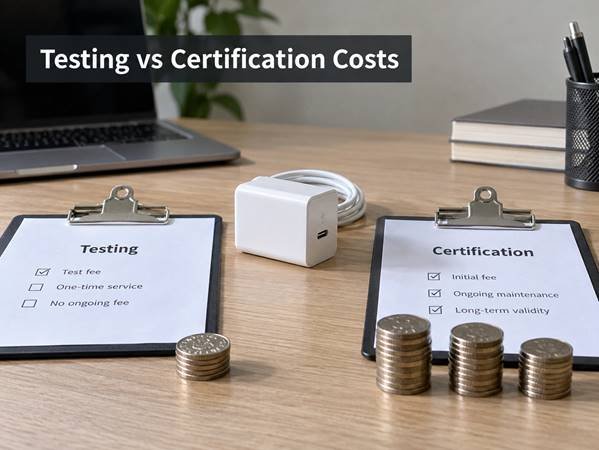
• Follow-up inspection service fee: UL will regularly inspect the factory to ensure that mass-produced products are consistent with those at the time of certification. The fee is determined according to the product category and factory location. The inspection frequency and settlement method shall be subject to the UL project agreement
• File/mark usage fee: This fee for some projects is included in the follow-up inspection fee, and some need to be charged separately
• Change assessment fee: If you subsequently replace core components, modify the product structure, or add new models, you need to notify UL for a change assessment, and the fee is charged according to the size of the difference
• Standard revision fee: If UL updates the corresponding safety standard, supplementary testing or assessment must be completed within the transition period, resulting in corresponding fees
Indirect Costs Common to Both Types of Services
This part of the cost is easily overlooked, but the actual proportion may be not low:
• Sample/logistics fee: Many UL tests are destructive tests, which may require multiple samples, but the required quantity shall be determined by the applicable standards, model coverage strategy, test items, whether sample reuse is allowed, and the laboratory’s test plan; a written sample list should be obtained at the quotation stage
• Rectification/delay cost: When the test fails, it costs money to modify the structure and replace materials. More importantly, if the delivery date is delayed or the promotion season is missed due to rectification, the potential loss may be much higher than the test fee itself
Quotation Comparability Checklist and TCO Calculation Template
Many bad institutions use low prices to attract customers, and then add various fees later. You can avoid such pitfalls by using the following methods to compare prices.
When quoting, be sure to check 9 core contents. If any one is missing, there may be hidden fees:
1. Specific standards for testing/certification
2. Required sample quantity
3. Retesting fee charging rules
4. Whether application fees and file fees are included
5. Whether the first factory assessment fee is included
6. Follow-up inspection fee standard
7. Rules and charges for change assessment
8. Handling rules for standard revision
9. Service cycle
Two commonly used TCO calculation formulas. When comparing prices, please use TCO calculated on the same basis for comparison; do not only look at the initial quote:
• First-year TCO = One-time direct cost + first-year follow-up inspection/file fee + sample logistics fee + estimated rectification fee
• Three-year TCO = First-year TCO + follow-up two years’ follow-up inspection fees + estimated change/additional model fees + estimated standard revision fee
The core principle of price comparison: compare the total cost of ownership on the same basis plus the total cycle. Only looking at the initial test fee will most likely lead to pitfalls.
Time Cost (Cycle) Comparison
Besides money, time is also a very important cost, especially for products that are rushing to meet delivery dates or promotion seasons. The loss from cycle delay may be much higher than the test fee.
Reference for Regular Cycle of UL Standard Testing
The cycle of UL testing usually covers three stages: document pre-review, sample submission testing, and rectification closure. The actual cycle will be affected by factors such as test standards, sample quantity, test items, laboratory scheduling, document completeness and whether rectification is required.
If you are in a hurry, you can consult the laboratory whether they provide expedited arrangements, to what extent it can be shortened, and whether the expedited fee and schedule are written into the quotation. If there is rectification, the retest time should also be confirmed according to the failed items, retest scope and laboratory scheduling.
Reference for Regular Cycle of UL Certification
The cycle of UL certification is usually longer, because in addition to sample testing, it may also involve links such as document review, certification decision and factory services. The stages cover document pre-review, sample submission testing, rectification closure, certification decision/factory services.
The actual cycle depends on applicable standards, model and sample scope, test failures and rectification, data acceptance path, production location, Follow-Up Services arrangements and current schedule. UL has not issued a unified total certification cycle or unified expedited rate applicable to all types of chargers and cables, so the quotation cycle of a certain laboratory cannot be regarded as a general rule.
For the convenience of comparison, the following contents should be confirmed when quoting:
| Service Type | Cycle Contents to Confirm |
| UL standard testing | Document pre-review, sample submission arrangement, test scheduling, report issuance, rectification and retest rules |
| UL certification | Testing and document review, certification decision, factory service arrangement, mark authorization, rectification and supplementary test rules |
Core Influencing Factors of Cycle Fluctuation
The actual cycle may be different from expected, mainly affected by three types of factors:
• Client side: Samples need rectification and missing documents will increase the time for supplementary documents, sample modification and retesting
• Factory side: Factors such as factory service arrangements, auditor scheduling and overseas travel may extend the overall cycle
• Institution side: During the peak period of standard revision, when there are many test items or tight scheduling, the cycle will be extended accordingly
Key Variables Affecting UL Fees and Cycles
Understanding these variables will help you understand why quotes vary greatly for different products and different factories.
Impact of the Product Side
• Power/complexity: Power, number of ports, structure, model differences and key component status may affect the test scope, sample quantity, engineering assessment and cycle, but cannot be used to infer a fixed increase or inevitable increase in test items
• Series/multi-model coverage: For products of the same series with similar core components, structure and ratings, you can consult whether they are suitable for series assessment, main model testing and difference assessment; whether they can be covered and the coverage scope must be confirmed by the certification body
• Key component qualifications: Components that have obtained UL Recognized approval may help with subsequent assessments, but there is no guarantee how much workload, cost or cycle will be reduced. It still needs to be judged in combination with the rating, use conditions and certification category of the final product
Impact of Service Scope
• Testing/certification standards: If additional items such as EMC, energy efficiency, material flame retardancy, USB-IF conformance are tested, the cost will increase and the cycle will also be extended
• Market coverage: The cost and cycle differences between the dual US-Canada market and a single market depend on the specific standards, certification scope and service arrangements, and cannot be applied with a fixed ratio
• Service type: The quotation logic of pre-testing, formal testing, and full certification is completely different. Do not directly compare quotations of different types
Impact of Factory and Supply Chain
• Factory location: Overseas factories have higher assessment fees and auditor travel expenses, and the cycle is also longer
• Factory compliance foundation: Factories that already have UL follow-up inspection records or have a good compliance foundation may help with project communication and continuous compliance, but whether they affect audit speed, re-audit risk or fees still depends on the specific project and UL engineering judgment
• Supply chain stability: Before changing key components such as wires, chips, and connectors, you should first check the certification file and Follow-Up Services procedures, and confirm with the certification body whether revision, assessment or supplementary testing is required. Not every replacement necessarily requires a separately charged change assessment
Operation Guide: Decision-Making Methods, Authenticity Verification and Contract Pitfall Avoidance
After understanding the basic differences, the next is practical methods that can be directly implemented.
Service Selection Decision Logic (Two-Step Method)
The core of choosing a service is not to choose the cheapest one, but to choose the one that just meets the requirements and has the highest cost performance.
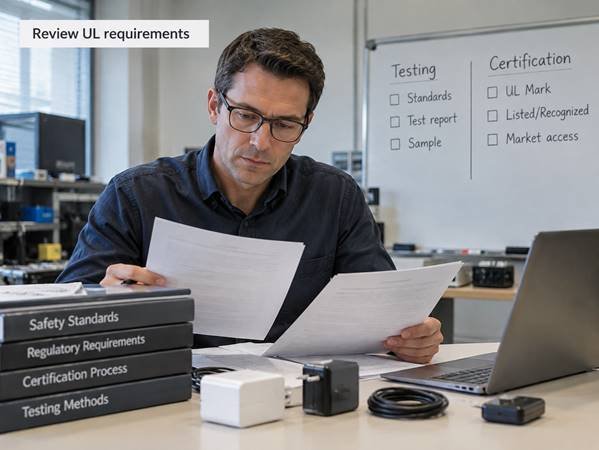
Step 1: Confirm Mandatory Requirements (Must Do)
First, collect the written compliance requirements of the target country’s regulations, local regulatory authorities (AHJs), retail platforms, and customers, and clarify what exactly the other party needs: is it a UL standard test report, UL mark use right, UL Listed/Recognized, or other NRTL certification. Be sure to get written requirements, otherwise if the other party does not recognize what you have done, it is a waste of money.
Step 2: Match Cost-Effective Solutions
• R&D preliminary testing/internal quality control: Choose UL standard preliminary testing, which is cheap and efficient
• Only need UL standard test report: First confirm the customer, platform or regulation’s requirements for laboratory accreditation qualifications, report content and standard version, and then choose a laboratory that meets the requirements; if you plan to use the data for UL certification later, you should also confirm the UL data acceptance path in advance
• Need UL mark/channel access: Apply for UL certification; if the channel accepts other NRTL certifications, you can compare prices from multiple parties to reduce costs
• Supporting components: According to the end use, purchaser’s requirements and target certification category, determine whether UL Recognized, Listed, Classification, test report or other compliance documents are required, which cannot be generalized
Compromise Solution: Applicable Scenarios of Pre-Testing
If you are worried that you will not pass the direct application for certification and the rectification cost is too high, you can choose pre-testing as a compromise solution.
The essence of pre-testing is a preliminary test before formal certification, to find high-risk problems and rectify them in advance. It is suitable for products that are prone to problems such as newly developed high-power/multi-port chargers and fast charging cables with complex structures. Its value is to reduce the cost and time of large-scale rectification during formal certification, but it should be noted that passing pre-testing does not mean that certification will definitely pass, because certification also includes links such as technical document review and factory assessment.
Four Steps to Verify the Authenticity of UL Certificates/Reports
There are many fake reports and fake certifications on the market now. You can accurately verify them with these four steps:
1. Check basic information: Check whether the number, product model, and factory name on the document match the actual product and manufacturing factory. Many fake reports are modified by copying information from other models, and will be exposed immediately upon verification.
2. Verify through official channels: UL Product iQ can be used to search for a large amount of certification information, and usually requires registering a free account and logging in. If you have questions about specific documents, models, production locations or the current validity of certification, you should confirm with UL Solutions or the document issuer in combination with Product iQ records, marks and file information; for test reports, you should check the qualification scope of the issuing laboratory and the authenticity of the report.
3. Check detailed requirements: Check whether the standard version, certification category (Listed/Recognized), and mark authorization form meet the needs. For example, if the other party requires UL Listed, Recognized certification is invalid.
4. Confirm the validity of changes: If core components have been replaced or the structure has been modified during product production, it is necessary to confirm that the certification/report is still valid after the change. Many people think that having a certificate is once and for all, and do not notify the institution after modifying the product, and finally do not know that the certification has become invalid.
Be sure to remember: you cannot judge authenticity only by PDF files, laboratory logos or sales pitches; you must verify through official channels.
Practical Tips to Reduce UL-Related Costs
These are proven effective cost reduction methods:
1. Do preliminary testing first before applying for certification: Don’t go straight to formal certification. If there is a problem with the design, the cost of rectification plus retesting is much higher than the preliminary testing fee. Spending a small amount of money first to check risks can save a lot of trouble.
2. Apply for products of the same series in a package: If multiple models of products have the same core components, structure, and ratings, actively apply for series assessment to share costs, which is much cheaper than doing each model separately.
3. Choose local UL-authorized laboratories: Domestic factories should prioritize domestic UL-authorized laboratories, which saves cross-border logistics fees and eliminates the need for cross-time-zone communication, with higher efficiency.
4. Assess before making changes: When subsequently replacing core components or modifying product structure, consult the certification body in advance to confirm whether it affects the certification and whether supplementary testing is required. Don’t find out that it does not meet the requirements after the modification, as the rework cost is higher.
Common Traps of Low-Price UL Services
Be sure to be vigilant when encountering the following situations:
• Fake reports/fake certifications: Abnormally low prices should trigger further verification, but authenticity cannot be judged by a fixed price ratio. For claimed UL certifications, check the product model, document number, certification category, mark and production location, and confirm through Product iQ and UL Solutions; for test reports, verify the authenticity of the report, samples and report scope with the issuing laboratory.
• Low-price bait: At the beginning, only the basic test fee is quoted, and after signing the contract, high audit fees, file fees, and follow-up inspection fees are added, resulting in a higher total fee. Be sure to use the previous 9-item checklist to check whether there are missing items.
• Misleading concept substitution: Passing off national standard or IEC testing as UL standard testing, or marketing “testing according to UL standards” as “UL certification”. The two are completely different things. Certification is officially issued by UL with mark authorization, while testing only provides a report.
• Qualification fraud: Reports from laboratories not in the UL data acceptance program usually cannot automatically replace UL certification test data; but whether they can be used for customer or platform access shall be subject to the laboratory qualifications, report scope and document rules required by the other party.
Required Materials for Obtaining Comparable Formal Quotations
The more complete the materials provided, the higher the accuracy of the quotation, and the lower the probability of additional fees due to missing items later. The materials to be provided are divided into three categories:
• Product side: Complete parameters (power, interface, structure), key component list, sample quantity
• Demand side: Target market/channel, service type (testing/certification, Listed/Recognized)
• Factory side: Factory location, whether there is UL follow-up inspection record
Quick Summary
After reading this content, you should have mastered the following core competencies:
• Can accurately distinguish the definitions, cost and cycle differences between UL standard testing, UL certification, and NRTL certification, and will no longer be confused by concepts
• Can match suitable UL-related services according to product type and target channel requirements, avoiding wasting money
• Can understand the composition differences of UL quotations, use the TCO total cost of ownership template to compare the cost performance of different solutions, and avoid low-price bait traps
• Can identify fake UL certificates/reports through the four-step verification method, and will not buy fake compliance services
• Can control UL-related costs and cycles through methods such as preliminary testing in advance, package applications, and pre-change assessments, to avoid budget overruns and schedule delays
For compliance in the North American market, the core is not to choose the cheapest solution, but to choose the solution that just matches the needs and has the highest cost performance. I hope this content can help you avoid detours.