
CE vs. FCC Certification Cost Comparison
Sellers of charging cables and chargers looking to enter the European and American markets often ask first: How much do CE and FCC certifications cost? But many people receive quotes that differ by several times—some say a few hundred dollars, others say thousands—with no idea who to trust. In fact, the problem is that CE and FCC are fundamentally not the same thing, cover different requirements, and even the comparison criteria are not aligned, so naturally the more you compare, the more confused you get.
In this article, we start from the most basic concepts: first understand the essential differences between the two, then align the unified rules for cost comparison, then provide reference budget ranges by common charging product types, and finally clarify the core variables affecting costs, pitfall avoidance methods, and money-saving tips. We will help you advance from the beginner stage of “only knowing how to ask for quotes” to a semi-proficient level where you can judge the reasonableness of quotes yourself and choose a cost-effective compliance solution.
Align Unified Criteria Before Comparing Costs
The reason many quotes are chaotic is that everyone calculates costs with different scopes: some include rectification fees, some only count testing fees, and some mix in other market access requirements. To compare, you must first unify the rules, otherwise it is an invalid comparison.
Unified Criteria for Cost Classification
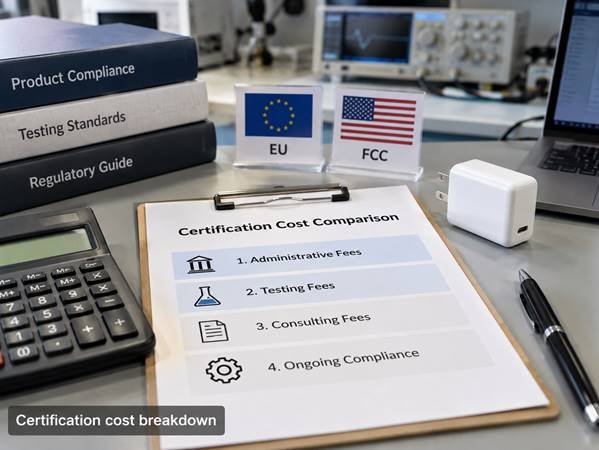
We divide costs into four categories. For this comparison, only the basic part of the first two categories is counted, and the latter two are not included:
1. Statutory administrative fees: Registration and application fees charged by the government or official agencies. The EU has no unified compliance administrative fee; FCC only involves official fees for the certification level (FCC ID).
2. Commercial service fees for compliance evidence: Testing fees from third-party laboratories, document preparation fees, third-party audit fees (NB/TCB), etc. This is the main cost for most products, not set by the government, and prices vary greatly between different laboratories and different service contents.
3. Rectification and change risk costs: Additional expenses for rectification when testing fails, or retesting due to product changes. They are not fixed and are not included in the basic budget.
4. Excluded costs: For example, EU REACH, WEEE, packaging regulations, US UL safety certification, Energy Star energy efficiency, state-level requirements, as well as additional platform requirements, logistics fees, etc., are all not included in this comparison.
Cost Boundaries for This Comparison
For a fair comparison, we only count the most core statutory basic costs of both:
• EU side: Only the core CE compliance requirements (LVD/EMC/RED/RoHS/applicable ecodesign energy efficiency) are counted, excluding other market launch costs such as REACH, WEEE, GPSR, packaging, and battery regulations.
• US side: Only the basic cost of FCC equipment authorization is counted, excluding product safety (UL/ETL, etc.), energy efficiency (Energy Star), state-level requirements, and additional platform requirements.
Rules for the Comparable Matrix
To compare, we must first align the “statutory mandatory items”:
• CE is a multi-regulatory framework, while FCC only manages electromagnetic/radio frequency. The core of the cost difference is the different scope of regulation. You cannot directly compare the full set of CE requirements with FCC’s single-domain requirements to say “which is more expensive and which is cheaper”.
• Before comparison, it must be clear: which statutory regulations CE needs to comply with, and which clauses FCC applies to. Align the statutory mandatory items before comparing.
• Additional commercial requirements raised by platforms or customers should be listed separately and cannot be counted in the statutory basic cost.
A Report with ISO 17025 Is Not Necessarily Valid
Many people think that if a laboratory has ISO 17025 accreditation, the report will definitely be valid. In fact, this is not necessarily the case. Whether a report can be recognized depends on four elements:
1. Laboratory capability verification: ISO/IEC 17025 accreditation and whether its scope covers the corresponding test methods and frequency bands is an important verification item for selecting laboratories and improving the credibility of evidence, but it is not a unified statutory prerequisite for all CE or FCC SDoC projects. For test laboratories used for FCC Certification, they shall meet the FCC-recognized laboratory requirements.
2. CE supplementary requirements: Using harmonized standards that are listed in the Official Journal of the European Union (OJEU) and cover the product and applicable essential requirements can give rise to a presumption of conformity within their coverage; when harmonized standards are not used, the manufacturer can still prove compliance with essential requirements through other sufficient technical solutions and technical documentation. The report should also cover all configurations of the product and all applicable regulations.
3. FCC supplementary requirements: Testing must comply with FCC-specified procedures; FCC SDoC shall comply with current rules such as applicable test procedures, record-keeping, and prohibited entities. For certification level, it must also be audited by a TCB, and the information can be found on the FCC official website.
4. Final validity: At the end of the day, whether you can pass customs and platform spot checks is subject to the actual requirements of the regulatory authorities and platforms in the target market.
Break Down the Costs: Where Does the Money Go?
After understanding the paths, let’s break down the costs to see where every penny is spent.
General Logic of Cost Composition
According to the unified criteria we established earlier, the basic cost mainly consists of two parts: statutory administrative fees and commercial service fees for compliance evidence; rectification and other additional costs are not counted as part of the basic budget.
• EU side: There is no unified government compliance administrative fee, and the basic cost is almost entirely commercial service fees.
• US side: Only the certification level (FCC ID) has statutory administrative fees (such as FCC Grantee Code registration fee and application fee, implemented according to the official fee schedule), and SDoC has no official fees.
Cost Composition of CE Compliance (Charging Products)
The cost of CE is mainly divided into two parts:
1. Testing service fees: Testing fees corresponding to applicable regulations, such as LVD safety testing, EMC testing, RoHS testing, RED radio frequency testing, applicable energy efficiency testing, etc. The specific items depend on the product type.
2. Document and audit service fees: Technical documentation preparation fee, EU DoC preparation fee; if NB participation is required, NB audit service fees will also be added.
3. Statutory administrative fees: There is no unified EU government compliance fee.
Cost Composition of FCC Equipment Authorization (Charging Products)
The cost of FCC is also divided into two parts, with an additional official fee for the certification level:
1. Testing service fees: Testing fees corresponding to applicable rules, such as Part 15/Part 18 testing, RF exposure assessment, wireless communication testing, etc., depending on the product type.
2. Document and audit service fees: SDoC document preparation fee; for the certification path, TCB audit service fees will also be added.
3. Statutory administrative fees: Only involved in the certification level, including FCC Grantee Code registration, application fees, etc., implemented according to the FCC official fee schedule.
Why Are Quotes So Different: Core Variables Affecting Costs
For the same 65W charger, some laboratories quote $1,500, others $4,000, the difference is not small. We rank the core variables affecting costs by importance to help you judge where the quote difference lies.
Biggest Variable: Compliance Path Selection (Price Difference Can Be Several Times)
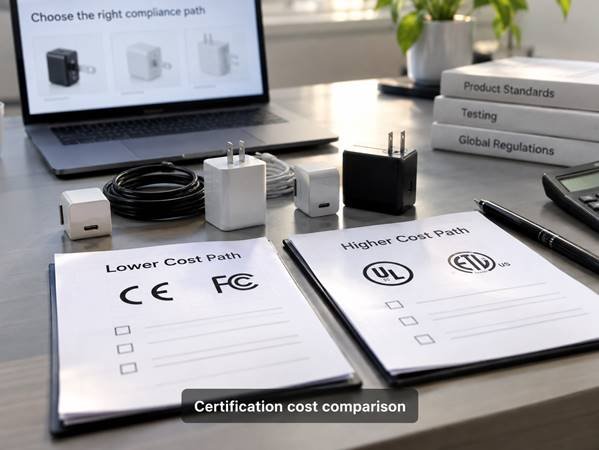
If you choose the wrong path, you will either waste money or be non-compliant. The path is determined by the product type and regulations, not whichever you want to choose.
CE Conformity Assessment Paths
• LVD/EMC/RoHS: Usually can follow internal production control. Using harmonized standards that cover the product and applicable essential requirements can give rise to a presumption of conformity within their coverage; even if harmonized standards are not fully adopted, the manufacturer can also prove compliance with essential requirements through other sufficient technical solutions and technical documentation. When ordinary wired chargers comply with LVD, EMC, and RoHS, NB is not a statutory regular cost item.
• RED: If harmonized standards are fully adopted, you can also sign the DoC yourself; if harmonized standards are not fully adopted, or it falls under special circumstances required by regulations, NB may be required to conduct type examination, which will cost much more.
• Misconception reminder: There is no statutory statement that “NB certificates are more effective”. The two only have different applicable conditions, and the final responsibility is borne by the manufacturer. Don’t be fooled into spending extra money on unnecessary NB audits.
Two Authorization Paths of FCC
• First conduct applicability determination, confirm that it falls within the regulatory scope before choosing a path. You cannot choose SDoC right away.
• SDoC path: The manufacturer completes the conformity determination on its own and keeps the required records, no official certification is required, the cost is low, and it is applicable to eligible ordinary wired charging products.
• Certification path: TCB audits and issues certificates, requires registration of FCC ID, the cost is higher, and products with wireless communication transmission functions usually need to follow this path.
• Note: The path selection is determined by the product type and FCC rules, and you cannot arbitrarily downgrade to choose a cheaper one, otherwise it will be non-compliant, and if found, it will be directly removed from shelves and fined.
Core Principles of Path Selection
Choose according to the product type and applicable regulations, just choose the one that meets the statutory requirements—don’t choose the expensive one, and can’t choose the cheap one either. If the requirements of the platform or customer are higher than the statutory requirements, that is a commercial demand, not a statutory obligation, and the cost should be calculated separately.
Second Largest Variable: Product Parameter Differences
The complexity of the product itself directly determines the number of test items, and the cost difference is also large:
• Power and number of ports: The higher the power and the more ports, the more test conditions, and the cost will increase, which is a medium-high risk factor.
• Functional complexity: Products with PD fast charging, multi-protocol, data transmission, and wireless functions will have significantly more test items and higher costs, which is a high-risk factor.
• Number of models: If the key circuits of products in the same series are the same, they can be certified together to share the basic testing fee, and the cost per model will decrease; if the key circuits are different, they must be tested separately, which is costly.
• Structure and materials: GaN small-size and metal-shell products have high risks of EMC and temperature rise rectification, and hidden costs will increase significantly, which is a high-risk factor.
Third Largest Variable: Laboratory and Service Selection
Quotes from different laboratories vary a lot, and the core depends on three points:
• Laboratory qualification: ISO/IEC 17025 accreditation and whether the accreditation scope covers the corresponding test methods and frequency bands is an important capability verification item, but it is not a unified statutory prerequisite for all CE or FCC SDoC projects. For FCC Certification, it should also be confirmed whether the testing laboratory meets the FCC recognition requirements.
• Value-added services: Pre-testing, rectification support, and technical documentation drafting all require additional fees. Don’t assume they are all included in the quote.
• Expedited service: Expedited testing requires additional payment, and the cycle can be shortened by about half (reference for domestic laboratories in 2026). The specific price increase is subject to the laboratory’s quote.
Easily Overlooked Money-Saving Point: Reuse Space of Existing Reports
If you have done CE or FCC before, or used already compliant modules, can you reuse reports to save money? The answer is: not necessarily, you have to do a difference analysis first.
• Prerequisite for reuse: First make a difference matrix. Automatic mutual recognition is not guaranteed. After the laboratory issues the difference matrix, decide how much can be reused.
• Core dimensions of the difference matrix: Regulatory clauses, test standards and versions, limit values, frequency/operating modes, port combinations, product structure, etc.
• Mutual conversion between CE and FCC: If EMC/RF test data meets the requirements of the target market, you can only make up the difference items to reduce costs. However, there is no conclusion that “doing CE first and then supplementing FCC is definitely more efficient”, which must be judged based on the difference matrix.
Hidden and Long-Term Costs (Most Easily Overlooked)
Many people only count the immediate testing fees, ignoring long-term hidden costs, and end up spending more money instead:
• Rectification and retesting costs: CE has medium to high rectification risks because it has more test items; FCC only involves electromagnetic/radio frequency related items, so rectification risks are medium. If the product design is unreasonable, the rectification fee may be higher than the testing fee.
• Post-market change costs: If you later replace key components such as the main controller, wireless module, transformer, EMI components, housing, firmware, or rated power, you must re-evaluate compliance, which may require retesting and incur additional costs.
• Document retention requirements: On the EU side, technical documents are usually required to be retained for 10 years starting from the date the product is placed on the market; on the US side, SDoC records are kept by the US-based responsible party, and the retention period is implemented in accordance with FCC rules.
• Compliance entity requirements:
• EU: When a non-EU manufacturer places products on the market, it needs to have a compliant EU-based economic operator. It is not mandatory to purchase third-party authorized representative services; you can also find a local partner.
• US: SDoC products need a US-based responsible party, and you can also purchase third-party agent services. This is a commercial fee, not a government-mandated one.
• Commercial maintenance fees: Laboratory document storage, annual audits, etc., are all commercial services, not government statutory fees. You don’t need to buy them if you don’t need them.
Costs and Cycles Are Linked: How to Calculate Time
Cost and cycle are always linked: if you want it fast, you have to pay more; if you want to save money, you have to wait. We first clarify the calculation logic of the cycle, then talk about how to judge whether expedited service is worth it.
Core Logic of Cycle Differences
The following cycle references are all based on the premises of domestic ISO 17025 charging product laboratories, complete documentation/delivery of mass-produced samples/start of scheduling, and passing the test in one go:
• Ordinary wired charging products: The CE cycle is longer than FCC, the core reason is that CE has more test items, including safety, RoHS, energy efficiency, etc., while FCC only does electromagnetic-related tests.
• Products with wireless communication functions: The cycles of the two are similar, because FCC certification level requires TCB audit, which also takes a lot of time.
Sign of Compliance Completion (Don’t Get It Wrong)
Many people think that compliance is completed when the laboratory issues a report, but that’s actually wrong:
• CE: After completing the conformity assessment, technical documentation, production consistency, and applicable obligations such as labels and instructions required by applicable regulations, the manufacturer signs the EU DoC and affixes the CE mark; the laboratory report itself does not equal the completion of CE compliance.
• FCC: For the SDoC path, compliance is completed when the US-based responsible party completes the conformity determination in accordance with applicable rules, retains the required records, and provides the required compliance information statement when the product is marketed or imported; the test report is only part of the supporting records. For the certification level, completion is when the TCB issues the certificate and the FCC ID can be queried on the official website.
Common Factors That Lengthen the Cycle and Push Up Costs
As long as any of the following is hit, both the cycle and cost will increase:
• The sample is not the final mass-produced version, and the structure and materials need to be changed after testing
• The first test fails, requiring rectification and retesting. Each round of rectification and retesting adds about 1-3 weeks (2026 reference), and the cost will also rise
• Technical documentation, labels, and key component lists are incomplete and require repeated revisions
• The differences between multiple models are not explained in advance, and additional testing is required later
Cost-Effectiveness Judgment of Expedited Service
When is it worth paying for expedited service?
• Scenarios where expedited service is worth it: Extremely tight launch time, platform entry countdown, already got a large order and just waiting for compliance
• Expedited rules: Additional payment is required, the cycle is shortened by about half, but it only includes expedited testing scheduling and report issuance
• Pitfalls of expedited service: Does not include rectification expedited. If the test fails, the expedited service will be directly invalidated, and the already paid expedited fee will not be refunded
Pitfall Avoidance Guide: Common Misconceptions and Quote Verification Methods
High-Frequency Beginner Misconceptions (Stop Stepping on Them)
1. ❌ CE must be more expensive than FCC: Wrong. For products with multi-band and complex wireless functions, FCC may be more expensive.
2. ❌ The lower the quote, the more cost-effective: Wrong. If you don’t look at qualifications, test items, and service scope, the losses from subsequent retesting and fake certificates will be greater.
3. ❌ “Guaranteed pass” services don’t cost extra: Wrong. Most “guaranteed pass” only guarantee passing the test, excluding hardware rectification costs. You still have to pay for changing materials and circuit boards yourself.
4. ❌ CE/FCC are quality certifications: Wrong. They are just compliance marks for market access, and do not represent good product quality.
5. ❌ FCC compliance equals full US compliance: Wrong. FCC does not manage safety, energy efficiency, etc. Platforms and customers may have additional requirements.
3-Step Method for Quick Judgment of Quote Reasonableness
After getting the quote, check according to these three steps to quickly judge whether it is reliable:
1. Step 1: Match product parameters: Confirm that the power, number of ports, whether there is wireless function, number of models, and sales form in the quote are completely consistent with your own product, otherwise the quote is useless.
2. Step 2: Confirm compliance path: Clarify whether CE is self-DoC or NB intervention, and whether FCC is SDoC or certification level—different paths can have prices several times different.
3. Step 3: Check included items: Find out whether the quote includes all mandatory test items, what type of report/document it is, and whether official fees are included. Don’t miss key items, as adding them later will be expensive.
Low-Cost Trap Identification
When encountering an extremely cheap quote, be sure to be wary of these three traps:
• Fake certificate trap: The price is only about 1/3 of the regular quote, there is no official queryable record, and it will not pass spot checks directly, resulting in greater losses from fines and shelf removal.
• Missing test trap: Deliberately omitting mandatory test items, such as CE missing safety tests, FCC missing conduction tests. The quote looks low, but it is not compliant at all.
• Misleading trap: Using self-declaration to impersonate official certification, such as calling CE DoC an “NB certificate”, or calling FCC SDoC “FCC certification”, to fool you into paying extra for an upgrade.
Quote and Report Verification Checklist
If you want to verify carefully, check according to these five points:
1. Regulations and standards: Check whether the regulation version, effective date, and applicable standard version are currently valid. Don’t use expired standards.
2. Laboratory qualification: Check whether the ISO 17025 accreditation scope covers the corresponding test methods/frequency bands; although this is not a unified statutory prerequisite for all CE or FCC SDoC projects, it is still an important item for judging laboratory capability and evidence credibility. For FCC certification level, it should also be checked whether the laboratory meets the FCC recognition requirements.
3. Product consistency: Check whether the model, BOM, firmware version, test configuration/port combination in the report are completely consistent with your actual mass-produced product. If not, the report is useless.
4. Authorization validity:
• FCC certification level: Check whether the FCC ID can be found in the FCC official database, and whether the TCB qualification is valid.
• CE: Check whether the signing entity of the EU DoC is compliant, and whether the information of the EU economic operator is complete.
5. Service scope: Check whether the quote includes all agreed tests, documents, and official fees, and whether there are hidden charges.
Official Verification Channels for Regulations and Standards (September 2026 Edition)
For all time-sensitive regulations, standards, and fee rules, be sure to verify the latest status through official channels, and don’t trust the one-sided words of service providers:
• EU regulation verification: EUR-Lex (check regulation texts), Official Journal of the European Union (OJEU, check harmonized standard lists)
• US regulation verification: FCC eCFR (check current FCC rules)
• Authorization validity verification: FCC Equipment Authorization Database (check FCC ID), FCC TCB List (check TCB qualifications)
How to Save Money and Be Compliant: Cost-Effective Decision-Making Suggestions
Finally, we summarize a few practical cost-effective solutions to help you spend your money where it counts.
Optimal Cost Solution for Single Market Access
• EU market: When ordinary wired charging products adopt applicable harmonized standards, they can obtain a presumption of conformity within their coverage; if they meet the conditions for internal production control, they can sign the DoC themselves, and there is no need to spend extra money to find an NB for ordinary LVD, EMC, and RoHS paths.
• US market: First conduct product applicability determination. If it meets the SDoC rules, choose SDoC, no need to force the certification level; if products with wireless communication functions must follow the certification level, then choose the certification level.
Money-Saving Tips for Simultaneous Certification of Both Markets
If you do CE and FCC at the same time, you can use these methods to save money:
1. Test data reuse: First make a difference matrix. If EMC/RF test items meet the requirements of both sides, data can be shared to reduce the cost of repeated testing.
2. Package at the same laboratory: Doing CE+FCC at the same laboratory usually comes with a package discount.
3. Series model packaging: Multiple models of the same platform and same circuit are done together to share the basic testing fee, which can significantly reduce the cost per model.
Balance Judgment of Cost and Risk
It’s not that the cheaper the better, nor the more expensive the better. You should choose based on your own risk tolerance:
• Scenarios where you can’t be greedy for cheap: Strict platform entry requirements, high product sales volume, high unit price—under such circumstances, the losses from being investigated, fined, and removed from shelves are far higher than the compliance costs. Be sure to find a regular laboratory to do all items.
• Beginner solution for small and medium sellers: For ordinary charging cables and low-power chargers ≤20W, just choose the self-DoC/SDoC path from a regular laboratory, no need to waste money on unnecessary services.
• The most cost-effective method for new product development: Consider EMC and safety requirements at the design stage, do pre-testing in advance, and solve problems at the design stage, which is much cheaper than later rectification.
Quick Summary of Core Decisions
Finally, we extract the core conclusions for everyone to facilitate quick judgment:
• Passive charging cables sold separately: CE does RoHS + self-DoC ($100-300, 1-2 weeks), FCC usually requires no authorization ($0)
• ≤20W wired charger: CE does LVD+EMC+RoHS+energy efficiency+self-DoC ($800-2000, 2-4 weeks), FCC follows SDoC ($500-1500, 1-3 weeks)
• ≤100W multi-port adapter: CE same as above ($1500-4000, 3-6 weeks), FCC follows SDoC ($1000-2500, 2-4 weeks)
• Single-band wireless communication charging products: CE applies RED and RoHS, safety, EMC and radio frequency/spectrum requirements are evaluated according to applicable RED clauses ($2500-6000, 4-8 weeks), FCC follows Certification ($2000-5500, 3-6 weeks)
• Pure WPT wireless charger: There is no universal path and price, parameters must be submitted first for case-by-case determination
Remember one core principle: All FCC paths require product applicability determination first, and the final responsibility for all CE compliance lies with the manufacturer. Don’t choose a non-compliant path to save money, and don’t be fooled into spending unnecessary money. The one that suits your product and sales scenario is the best.