
Merchants exporting wireless chargers to South Korea almost always encounter the threshold of “KC compliance”. Many people think KC is a unified certificate that can be obtained just by paying fees, but that is not the case. The KC mark covers compliance systems under different laws, with detailed product classifications and numerous rules. A slight oversight may lead to pitfalls: in mild cases, goods are detained by customs or removed from e-commerce platforms; in severe cases, fines are imposed or even import qualifications are affected. Today, we will thoroughly explain KC compliance for wireless chargers, from basic concepts to practical pitfall avoidance.
First, Understand the Core Logic of KC Compliance
The first common misunderstanding about KC is that “it is a single certificate”. In fact, KC is the national unified mark used in South Korea’s electronic product compliance system, and the specific applicable rules are entirely determined by product classification.
For wireless chargers, usually you should first confirm whether they are subject to the suitability evaluation of broadcasting and communication equipment managed by the Korea Radio Research Agency (RRA for short). In plain terms, this means confirming whether the product’s wireless, electromagnetic compatibility and other aspects need to complete suitability certification or suitability registration in accordance with the Radio Act, and the specific category shall be determined based on the product and the official catalog.
Whether the product itself, bundled AC adapters, batteries, etc. are also subject to the product safety system under the Act on the Safety Management of Electrical Appliances and Household Goods, shall be determined separately in accordance with the current safety management catalog. Safety certification, safety confirmation, and supplier conformity confirmation are different safety management systems under this Act; Safety Korea is a South Korean product safety information inquiry platform, not a single certification authority or “safety certification institute”. Safety certification or confirmation is handled by institutions designated in accordance with the law.
A principle must be firmly established here: the specific applicable system and whether compliance is required must be determined against the item catalog officially released by South Korea, and conclusions cannot be drawn solely based on power or power supply method. For example, for two 15W wireless chargers, the applicable requirements for a standalone desktop model and a furniture-embedded model may be different.
Why is KC Compliance Mandatory?
For merchants operating in the South Korean market, the value of KC compliance is reflected in three levels:
First, legal market access: For products that are subject to RRA suitability evaluation or product safety management in accordance with the law, corresponding statutory compliance must be completed before manufacturing, sale, or import; e-commerce platforms may also require submission of compliance materials in accordance with their own rules.
Second, risk prevention and control: Non-compliant products may be detained by customs or forcibly removed from platforms; in severe cases, they may be fined in market spot checks, and even affect subsequent import qualifications.
Third, trust endorsement: When South Korean consumers choose charging products, the KC mark is an important reference mark. Charging products involve electricity and usage safety, and clear, verifiable compliance information is more likely to gain user trust.
Several Easily Confused Concepts, Clarified Once and for All
Many people confuse KC with other certifications, so we clearly draw the boundaries here:
• KC vs CE/FCC: CE is the EU compliance requirement, and FCC is the US compliance requirement. They apply to different regions and have different rules, so they cannot replace each other. CE or FCC certificates cannot replace South Korean suitability evaluation; however, if existing reports are issued by RRA-accredited laboratories, or by laboratories with corresponding scope under the MRA framework in accordance with South Korean technical regulations, they may be used for South Korean applications, and whether they are admissible shall be confirmed by the application agency.
• KC vs Qi Certification: KC compliance is related to South Korea’s statutory access requirements; Qi is the wireless charging standard and voluntary certification of the Wireless Power Consortium (WPC), and certification testing involves WPC specification requirements such as interoperability, safety, and energy efficiency. The two are not the same thing, and Qi certification cannot replace South Korea’s RRA suitability evaluation or applicable South Korean product safety obligations.
• Three types of management methods under the product safety system: Many people think that the higher the power, the stricter the requirements, but that is not the case. Whether safety certification, safety confirmation, or supplier conformity confirmation applies depends on the official item catalog, and there is no absolute correspondence with power or power supply method. Do not guess arbitrarily.
Does Your Wireless Charger Need KC? 6-Step Decision-Making Method
Many people ask right away “does my wireless charger need KC?” In fact, by going through 6 steps, you can make a preliminary judgment by yourself, and finally confirm with a professional institution:
Step 1, Determine function type: Only the wireless charging transmitter, that is, the wireless charger itself, falls within the scope of our discussion. The wireless receivers in mobile phones and earphones belong to the compliance category of terminal products, and do not need to be applied for separately as wireless charging transmitters.
Step 2, Determine product form: Is it a standalone desktop model, embedded module, in-vehicle model, or model with a built-in lithium battery? Different forms correspond to different management catalogs and have different requirements. For example, for models with batteries, it is also necessary to confirm whether the battery and the whole product are subject to relevant South Korean safety management requirements, and they cannot be judged by the same rules as ordinary plug-in models.
Step 3, Determine power supply and standard accessories: Is it powered by USB, directly plugged into the wall with an AC plug, or powered by a car charger? Are the standard power adapter and charging cable sold together with the product? You should check item by item whether these accessories themselves are subject to regulation under the RRA or product safety management catalog, and you cannot assume that all accessories must obtain a separate KC number just because they are “bundled for sale”.
Step 4, Determine additional wireless functions: If the wireless charger has additional wireless functions such as Bluetooth, WiFi, NFC, etc., the corresponding radio wave requirements must be additionally evaluated. Even if the Bluetooth module used has relevant compliance certificates itself, the whole product cannot be automatically exempted, and it is necessary to confirm whether the certificates can be accepted or offset part of the testing.
Step 5, Determine sales purpose: As long as it is for commercial use, whether it is imported for sale, sold on e-commerce platforms, or used as a gift in promotions, you should confirm whether it falls within the scope of mandatory management. If it is a direct purchase for personal use or a scientific research test sample that meets the quantity and purpose requirements, exemption may apply, but it must never be sold.
Step 6, Determine the applicant entity: If you are an overseas manufacturer, you need to confirm whether the corresponding system requires a local South Korean applicant entity. Some systems may require a local South Korean company as the applicant, and confirming in advance can save later trouble.
Which Components Should Be Included in Compliance Evaluation?
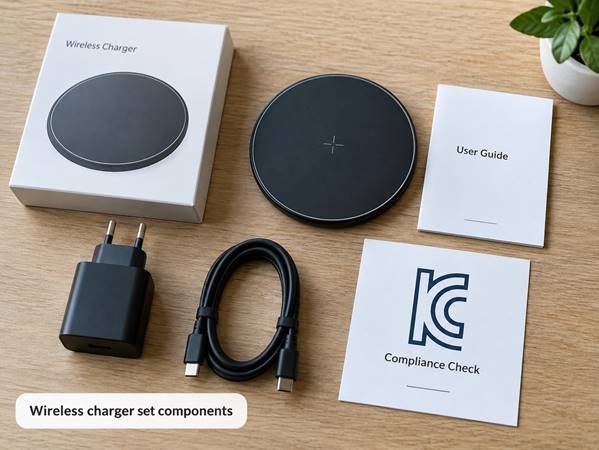
KC compliance is not only about the main unit of the wireless charger. The boundary of the entire set of bundled products must be clarified first, and these components in the BOM (Bill of Materials) must be checked:
• Wireless charging transmitter main unit: It is the key object of RRA suitability evaluation; whether its main body is also subject to product safety management shall be determined item by item based on conditions such as the safety management catalog, product structure, and rated power supply.
• Standard power supply (AC adapter, car charger): You should check whether they are regulated items in South Korea’s RRA or product safety management catalog; if they are applicable items, you should confirm their independent compliance and the labeling and documentation requirements when sold in combination with the whole product.
• Standard charging cable: You need to check whether it is in South Korea’s safety management catalog. Cables do not automatically require a separate KC number just because they are bundled for sale, but they must be checked.
• Built-in lithium battery: For wireless chargers with built-in batteries, it is necessary to additionally confirm whether the battery and the whole product are subject to relevant South Korean safety management requirements.
• Communication modules (Bluetooth, WiFi, etc.): You need to confirm whether the compliance certificate of the module can be used for the whole product application or offset part of the testing. It is not always possible, and it depends on specific rules.
• South Korean plug adapter: If a plug adapter is provided with the product for South Korean users, you should confirm whether it is an applicable safety management item and meets relevant requirements.
These Situations May Be Exempt (Final Subject to Official Rules)
Not all wireless charger-related products need KC. There are several types of typical exemption scenarios:
• Terminals with only wireless receiving function, such as mobile phones and earphones, do not need to be applied for as wireless charging transmitters.
• Non-commercial use: Overseas direct purchases for personal use and scientific research test samples that meet the quantity and purpose requirements may be exempted. For example, scientific research samples must not exceed the specified quantity and must not be used for sale.
• Embedded modules that are only exported as components and for which the South Korean importer is responsible for the whole product compliance: For example, if you sell wireless charging modules to a South Korean furniture factory that installs them in desks for sale and is responsible for the whole product compliance, then your export as components may be handled accordingly; but if you sell modules directly to South Korean consumers, evaluation is still required.
• For other special circumstances, all shall be subject to the official announcement on the date of application, or the written reply from the accepting agency or competent authority. Do not make arbitrary decisions on your own.
What Does KC Test? Core Test Items and High-Risk Points
Many people do not know what KC testing covers, and easily confuse quality issues with compliance issues. For wireless chargers, first of all, confirmation should be made separately according to the RRA suitability evaluation category and the product safety catalog.
RRA Radio Wave/Electromagnetic Assessment
This set of evaluations mainly focuses on requirements such as wireless and electromagnetic compatibility. Whether specific items related to wireless parameters, EMI (Electromagnetic Interference), EMS (Electromagnetic Susceptibility), or human exposure are required must be confirmed according to the catalog the product belongs to and applicable technical standards, and it cannot be assumed that all items are mandatory tests.
Radio transmission characteristics mainly focus on whether the equipment operates within the applicable frequency bands, conditions, and limits; EMI is to confirm that the equipment does not emit excessive electromagnetic interference that affects surrounding electronic products; EMS focuses on the performance of the equipment in an external electromagnetic interference environment.
The human electromagnetic exposure item cannot be judged solely by “high power”. Whether relevant human protection evaluation applies depends on the product category and applicable technical standards, and it cannot be deduced that ordinary mobile phone wireless chargers must undergo SAR or human exposure testing as long as their power is relatively high.
Whether charging stability and charging speed are part of the statutory evaluation content shall also be judged according to applicable RRA technical standards and other product regulations, and should not be simply considered as purely product quality or Qi certification matters.
Test conditions should cover representative and most unfavorable usage scenarios required by applicable standards or agencies, such as maximum rated output or simultaneous use of multiple devices, but the specific configuration shall still be subject to actual applicable requirements.
Product Safety Assessment
If the wireless charger main unit or its accessories are included in the product safety management items, the specific items of the safety assessment depend on the applicable system and product standards, and usually focus on electric shock protection, structural reliability, abnormal operation, temperature rise, etc.
The testing depth and subsequent management requirements of different safety systems are different. The applicable items, procedures, and ongoing obligations of safety certification, safety confirmation, and supplier conformity confirmation are different, and it cannot be simply understood that the higher the power, the stricter the requirements.
High-Risk Points Most Likely to Fail
During pre-testing, problems are more likely to be exposed in these areas, and paying attention in advance can save a lot of rectification costs:
• Safety category: Failure of abnormal protection, unqualified insulation or structure may all bring risks of electric shock, overheating, or other usage risks. Foreign Object Detection (FOD) is also a common safety function in wireless charger design, but whether it is a mandatory test item shall be confirmed according to applicable Qi specifications or specific product safety standards, and it cannot be regarded as a universal mandatory item for all KC wireless chargers.
• Wireless/EMC category: Excessive electromagnetic interference, wireless parameters not meeting applicable limits, and non-compliant immunity are common reasons for failure.
• Labeling and documentation category: Inconsistency between the parameters on the product label and the actual declared and tested information, such as marking 15W but the actual configuration has changed, may lead to correction or compliance risks.
General Requirements for Labeling and Documentation
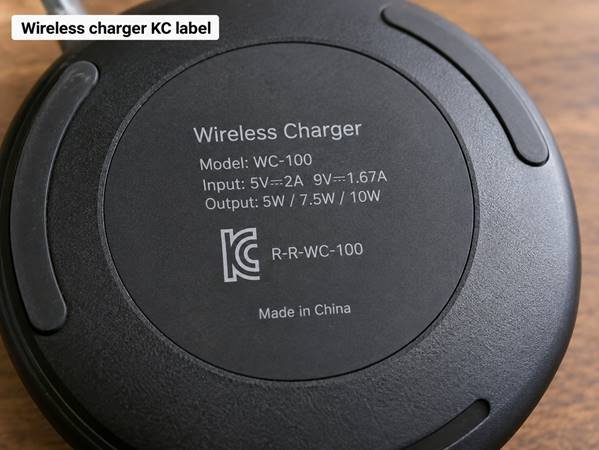
In terms of labeling, KC is the national unified certification mark. For products subject to RRA suitability evaluation, the KC mark, model number, and certification or registration number shall be marked in accordance with RRA rules; if the product itself or accessories are also subject to a product safety system, safety information shall be marked in accordance with the corresponding system. During verification, the number and coverage of each applicable system shall be confirmed separately. Information must not be mixed, and accessory records must not be used to replace whole product records.
In terms of documentation, manuals, labels, and safety information shall be prepared in accordance with RRA application requirements, the safety system applicable to the product, and product standards; when selling to South Korean consumers, applicable Korean labeling and instruction requirements shall also be checked, and this cannot be generalized as a single KC general clause for all wireless chargers.
How to Handle KC Compliance? Full Process from Pre-Evaluation to Mass Production
Many people think that handling KC is just sending samples for testing and getting a certificate. In fact, the classification judgment in the early stage and the mass production control in the later stage are the links where problems are most likely to occur.
Step 1: Conduct Pre-Evaluation First to Reduce Classification Risks
Pre-evaluation can be used as a practical measure to reduce classification risks, but it is not a statutory prerequisite for all applications. When there is a dispute over classification, a retrievable written opinion shall be obtained from the RRA, designated agency, or competent authority.
The materials, samples, and testing requirements for formal applications shall be subject to the actually applicable evaluation category and acceptance requirements. Do not make judgments solely based on peer experience or online posts. For example, if a friend’s 15W wireless charger is handled under a certain category, your product may have completely different applicable rules due to different forms and functions.
Preparation of Application Package
Four types of materials shall be prepared before formal application:
• Technical materials: Circuit diagram, BOM (Bill of Materials), list of key components, coil/antenna specification sheet, firmware description.
• Configuration materials: If there are multiple models in the same series, a model difference table, a list of standard accessories, a rated parameter table, and product photos shall be provided.
• Compliance support: South Korean compliance certificates for key components. For example, if the adapter has applicable compliance materials, it can be provided for reference. CB reports cannot be directly “converted to KC”; if the product is also subject to the South Korean product safety system, CB certificates or reports that meet conditions such as the issuing agency, consistency of models and components, report validity period, and same test methods may be recognized and used to exempt part of the same safety tests. RRA wireless and EMC suitability evaluation must still be confirmed separately in accordance with South Korean technical regulations and accredited report rules.
• Documentation materials: Draft manual, draft product label/tag, as well as Korean materials and safety information required by the applicable system.
Four Core Steps of Formal Handling
After the materials and samples are prepared, the formal process usually follows four steps:
1. Submit application and materials: The agency will first check whether the materials are complete and whether the samples are consistent with the declared product. After meeting the acceptance requirements, the formal procedure will be entered.
2. Sample testing: Test according to corresponding standards, and rectification is required if it fails. If the rectification involves changes in product structure, components, functions, or parameters, it shall be confirmed whether it is necessary to update materials, conduct supplementary tests, or re-evaluate. After passing the test, a corresponding test report will be issued.
3. Compliance confirmation: The accepting agency will check whether the declared information is consistent with the actual product, and complete suitability certification, suitability registration, or other compliance procedures in accordance with the applicable system.
4. Mass production preparation: After completing the procedure, confirm the labeling plan, and archive the model, key materials, application materials, and change management requirements.
Description of Cycle and Cost
To be honest, there is no unified fixed cycle and cost for KC. The cycle depends on product classification, number of test items, number of material corrections and rectifications. A smooth pass at one time will be faster, while multiple rectifications may cause delays.
The cost mainly depends on the applicable system, evaluation category, test items, model coverage method, samples, and rectification situation; power, additional functions, and accessories may affect the cost only when they change the applicable standards or test scope. For example, a 3-in-1 wireless charger with Bluetooth and battery usually has a more complex applicable scope than an ordinary single charger, and all need to be evaluated separately.
There are three common reasons for delays: unqualified samples requiring rectification, incomplete materials requiring correction, and wrong initial classification requiring re-running the process. Therefore, doing classification confirmation and pre-testing in advance can save a lot of time.
Attention After Completing Compliance: Mass Production Consistency Control
Many people ignore it after completing the application, which is a big mistake. Mass-produced products should continuously comply with the approved model and its application materials:
• Key material control: For key components such as adapters, coils, chips, and wireless modules, if you want to change the supplier or model, you must first conduct a compliance evaluation and cannot change them arbitrarily.
• Production control: When purchasing, check key components to ensure that mass-produced products meet the requirements of application materials and approved models. You cannot use one configuration for testing and arbitrarily change to another configuration during mass production.
• Change control: Any change shall be judged item by item in accordance with RRA’s change declaration rules, as well as the basic model, derivative model, and change rules of the applicable product safety system. Whether supplementary testing, change declaration, or re-application is required cannot be determined solely based on internal experience. For example, if the maximum power is increased from 15W to 20W, the impact on applicable standards, application materials, and test scope shall be confirmed first.
How to Verify the Authenticity of KC? Label Usage and Inquiry Methods
Whether it is the compliance materials provided by the supplier or your own products that need to use the mark, you must get the rules right, otherwise it is easy to fall into pitfalls.
Correct Usage Rules for KC Mark
• Mark composition: KC is the national unified certification mark. For products subject to RRA suitability evaluation, the KC mark, model number, and certification or registration number shall be marked in accordance with RRA rules; if the product or accessories are also subject to a product safety system, the corresponding safety information shall be marked in accordance with that system.
• Labeling requirements: It shall be marked on the product body, packaging, or designated position in accordance with the requirements of the applicable system to ensure that the information is clear and durable.
• Prohibited acts: It is absolutely forbidden to use materials of other models or products, use beyond the scope, commit fraud, or continue to sell when the record is revoked, suspended, or the product has been changed but the corresponding procedure has not been completed. These may result in penalties if found out.
Inquiry Methods for the Two Systems
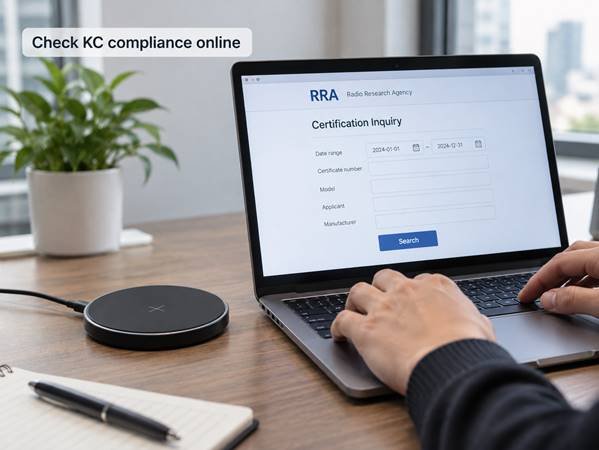
• RRA system inquiry: Go to the official inquiry system of the Korea Radio Research Agency (RRA). When inquiring, you usually need to first fill in the certification or registration date range, and then search by combining fields such as certification or registration number, model, applicant, manufacturer, etc. When checking, pay attention to: whether the applicant or manufacturer is correct, whether the model is correct, and whether the rated parameters and applicable scope are consistent with your product.
• Product safety information inquiry: If the product or accessories are also subject to a product safety system, you can search for information related to safety certification, confirmation, or supplier conformity confirmation through the official Safety Korea inquiry system. Key points for checking include applicant, model, applicable safety system type, record status, applicable scope, and whether there are revocation, suspension, change, or other ongoing management issues.
Common Reasons for Not Finding Records
Many people cannot find compliance records, usually for the following reasons:
• Wrong inquiry fields: For example, there are spaces in the model, the suffix is not fully entered, the number is entered incorrectly, or the name of the applicant entity is misspelled. For example, it is “ABC Co., Ltd.” but you enter “ABC Company”.
• Incomplete RRA inquiry conditions: RRA public inquiry usually requires filling in the certification or registration date range first. You cannot assume that you will definitely find the record just by entering the model or management number.
• Wrong system or platform for inquiry: RRA suitability evaluation records and product safety system records are not the same set of data. If you use an RRA number to inquire on the product safety platform, or vice versa, you may not find the record.
• Product not included in the scope: For example, the corresponding compliance has not been applied for at all, or only the accessories have compliance records but the whole product does not. For example, the adapter has applicable records but the wireless charger itself does not, then of course you cannot find the record when checking the wireless charger main unit.
• Record status issues: If the application is still being processed and not made public, or the record has been revoked or suspended, it will affect the inquiry results.
Advanced Pitfall Avoidance: Common Misconceptions and Cost-Saving Tips
There are many pitfalls in KC compliance. We have sorted out the most common misconceptions and practical tips to help you avoid detours.
Four High-Frequency Cognitive Misconceptions, Don’t Fall for Them Again
1. Low-power wireless chargers don’t need KC? Wrong. As long as the product is included in South Korea’s mandatory catalog, regardless of power level, the corresponding compliance must be completed. Even for very low-power products, you must check the regulations to confirm, and you cannot assume it is unnecessary just because the power is low.
2. KC is valid for life once handled? Wrong. Do not generalize all KC compliance documents as a unified renewal system upon expiration. During verification, you should confirm the record status, model, applicant or manufacturer, applicable scope, and whether there are revocation or change issues; and check regular inspections, change declarations, or other ongoing obligations according to the specific system.
3. It’s all good as long as the test sample passes? Wrong. Mass-produced products must continuously comply with the approved model and application materials. During spot checks, if the actual product is inconsistent with the application materials or approved scope, even if there was a real compliance record, problems may still arise.
4. Embedded modules don’t need compliance? Wrong. If they are sold separately to consumers, or used as core components of products, applicable requirements must be evaluated, and not all modules are exempt.
Product Change Compliance Evaluation Checklist
Many people do not know whether re-testing is required after modifying something. The following content can only be used as an internal troubleshooting direction, and the final shall be subject to institutional confirmation and applicable system rules:
| Change Situation | Common Change Content | Judgment to Be Made |
| Material or appearance change | Text modification of packaging/manual, appearance color adjustment, minor changes to non-electrical components | Confirm whether it affects the identification of labels, models, application materials, basic models or derivative models, and whether a change declaration is required |
| Accessory or configuration change | Replacing standard adapter, adjusting coil position, adding/removing gears, replacing electrical components | Confirm whether it affects circuits, performance, applicable standards, test configurations, and product safety management scope; conduct supplementary tests or handle changes if necessary |
| Core design change | Modifying main structure, adding wireless communication functions, increasing maximum power, replacing core chips/coils, changing applicant entity | First confirm with the accepting agency whether a change declaration, supplementary test, or re-application is required; do not make judgments on your own |
Core principle: Any change involving circuits, coils, PCB, firmware, power, or heat dissipation must be confirmed with the agency first. Do not modify secretly on your own, otherwise the loss will outweigh the gain if found out.
Practical Tips for Low-Cost Compliance
These are common practices in actual operation, which can help you control unnecessary costs:
1. Choose accessories and key components that already have applicable South Korean compliance materials, such as adapters and batteries with corresponding compliance records. However, you must confirm in advance whether these materials can be used for your whole product application or reduce part of the testing. They cannot be offset in all cases.
2. For multiple models with the same core structure in the same series, you can confirm whether they meet the conditions for basic model, derivative model, or series application, and reasonably share the cost. For example, three wireless chargers only differ in appearance color, with the same core circuit and coil, so they may not need to be treated as completely independent products for each model, but this must be subject to the judgment of the applicable system.
3. Conduct pre-testing before formal testing, and find and rectify problems in advance. This is much cheaper and saves time than rectifying after failing the formal test.
4. Conduct classification pre-evaluation before the design is finalized, know which requirements must be met, and design them in advance. For example, foreign object detection may be an important item in applicable Qi specifications or specific product safety standards. It should be confirmed according to actual applicable requirements during design, which is better than modifying after the mold is made.
5. If you already have a CB report, do not use it directly as a “KC certificate”; if the product is also subject to the South Korean product safety system and the report meets South Korean recognition conditions, it may be used to reduce part of the same safety tests. The RRA wireless and EMC parts still need to be confirmed separately.
Action Points for Different Roles
Find your role and do what you should do:
• Brand/manufacturer: Confirm the compliance path before the product is finalized, fix the suppliers and models of key materials, and conduct a compliance evaluation before any change.
• South Korean importer/distributor: When goods arrive, verify the consistency between the products and compliance materials, establish a mechanism for material archiving and regular spot checks, and do not just believe the supplier when they say there are records.
• Purchasing/product selection staff: When selecting products, prioritize checking compliance marks and numbers, confirm that models, parameters, and standard accessories are within the applicable compliance scope, and do not only look at the price.
30-Second Compliance Checklist Before Sales
Spend 30 seconds checking before listing to avoid being removed from the shelf:
Step 1, Check the mark: Whether the product is marked with the KC mark, model number, and corresponding certification, registration or safety information in accordance with the applicable system, whether it is clear, and whether the marking position meets the requirements.
Step 2, Check records: According to the actually applicable system of the product, check in the corresponding official system such as RRA or Safety Korea to confirm that the record status is normal.
Step 3, Verify scope: Check whether the model, rated parameters, and standard accessories are all within the applicable compliance scope. For example, if the certificate or record only covers the main unit, and the AC adapter you provide is itself a regulated item, you also need to confirm that the adapter has corresponding compliance materials.
Frequently Asked Questions
Do USB-powered wireless chargers need KC?
It shall be determined according to South Korea’s official catalog. Wireless charging transmitters usually should first confirm whether they are subject to RRA suitability evaluation; safety requirements depend on whether the wireless charger body and related accessories are specific safety management items. You cannot judge by yourself that it is unnecessary just because it is USB-powered.
How to handle KC for a 3-in-1 wireless charging station with Bluetooth?
It is necessary to simultaneously evaluate the RRA suitability evaluation requirements of the wireless charger itself, the radio requirements corresponding to the Bluetooth function, and whether the product body, adapter, battery, etc. are also subject to the product safety system. Only after all applicable requirements are met can it be sold compliantly.
Do standard adapters/charging cables need separate compliance verification?
They shall be verified item by item. If accessories such as AC adapters, batteries, and plugs are applicable items in the RRA or product safety management catalog, their independent compliance and labeling and documentation requirements when sold in combination shall be confirmed; cables and other items not in the catalog do not automatically require a separate KC number.
Does replacing the wireless charger coil require re-evaluation of compliance?
The coil is an important component of the wireless charger. Whether supplementary testing, change declaration, or re-application is required after replacement must be confirmed with the accepting agency, and mass production cannot be carried out directly after replacement on your own.
Can overseas manufacturers directly apply for South Korean compliance?
It depends on the requirements of the corresponding system. Some systems may require a local South Korean applicant entity. It is recommended to obtain written confirmation from the RRA, designated agency, or competent authority in advance to avoid being unable to apply at that time.
In general, KC compliance for wireless chargers looks complicated, but the core is to first confirm whether RRA suitability evaluation applies, then judge item by item whether the product body and accessories are also subject to the product safety system, and keep design, application, and mass production consistent. As long as you do not act based on experience, confirm the classification in advance, and follow the official rules, you can avoid many pitfalls and successfully enter the South Korean market.