
Friends who sell charging products to the EU have probably been confused by two new environmental regulations in the past two years: one governs batteries, the other governs packaging, both are titled “EU regulations”, and each has a pile of requirements. It is hard to figure out which one applies to your products, whether they overlap, and if you make a mistake, the light consequence is goods detention and the heavy one is fines. Today we will compare the EU New Battery Regulation and the PPWR New Packaging Regulation (the upgraded version of the original Packaging Directive) together, from the most basic jurisdictional boundaries to the practical self-inspection process, and explain everything clearly at one time.
First, Understand What the Two Regulations Govern
First of all, we need to clarify the identity and scope of jurisdiction of the two regulations, otherwise the more we compare, the more confused we will be.
The first one is the **EU New Battery Regulation (EU 2023/1542)**, a regulation uniformly applicable across the EU, which applies in phases from 18 February 2024; Directive 2006/66/EC is repealed as of 18 August 2025, but its Article 11 applies on a transitional basis until 18 February 2027. It governs the full life cycle environmental requirements of batteries from production, use to end-of-life, and the core object is “batteries” as defined by the regulation – that is, sources that generate electrical energy through the direct conversion of chemical energy. Whether batteries are sold separately or built into products, the relevant batteries are subject to this regulation; but specific obligations also depend on categories such as portable, light means of transport, electric vehicle, industrial, or starting ignition.
The second one is the **PPWR New Packaging Regulation**, the upgraded version of the original Packaging Directive, also a regulation uniformly applicable across the EU, which generally applies from 12 August 2026. The Packaging and Packaging Waste Directive 94/62/EC is repealed by the PPWR as of that date; but Article 70 of the PPWR provides for item-by-item transitional arrangements for specific provisions and existing national measures, which must be checked against specific provisions and dates, and cannot be generally understood as some provisions of the old directive will be transitioned to 2028 to 2029. It governs the environmental requirements for all packaging placed on the EU market and packaging waste, and the core object is “packaging materials” – retail, combined, transport and e-commerce packaging are usually subject to the PPWR; however, it is still necessary to determine item by item whether an article is packaging in accordance with Article 3 of the PPWR, and exclude articles that form an integral part of a product and perform a necessary function during the life cycle of the product.
Speaking of which, someone will definitely ask: which regulation applies to the charging products I sell? We directly draw the line according to the common situations of charging products:
• Subject to the Battery Regulation: power banks, built-in batteries of wireless chargers, button batteries of luminous data cables, backup batteries of fast chargers, and separately sold rechargeable batteries, all count as long as they are batteries defined by the regulation.
• Subject to the PPWR: product outer boxes, inner trays, plastic sealing films, dust bags, express boxes for e-commerce delivery, buffer bubble films, etc., usually belong to packaging; however, small items such as data cable ties, storage bags, and small envelopes for instruction manuals should still be judged in combination with their use and the PPWR’s definition of packaging, and cannot be automatically regarded as packaging just because they are delivered with the goods.
• Subject to both: sales/transport packaging of products with batteries, outer packaging of separately sold batteries, these scenarios have both batteries and packaging, and must meet the requirements of both regulations at the same time, you cannot choose one or the other.
People who are new to this are most likely to fall into three basic pitfalls, we will explain them clearly in advance to avoid detours:
First, not only large batteries need to comply with the Battery Regulation, small consumer batteries such as button batteries in luminous data cables are also within the scope of jurisdiction, do not ignore them just because the battery is small.
Second, not only paper boxes count as packaging, retail boxes, buffers for e-commerce transport, etc. usually belong to packaging; but individual articles that form an integral part of the product and perform a necessary role throughout the life cycle of the product may not be packaging, do not judge only by “whether it is delivered with the goods”.
Third, it is not enough to choose one of the two regulations to comply with, the overlapping scope must be compliant at the same time, and they cannot replace each other – for example, a power bank with a battery, if only Battery Regulation compliance is done, and the packaging does not meet the PPWR, it will still be detained.
Unify the Caliber Before Comparison
Before formally comparing the specific requirements, we first clarify the boundaries of the comparison to avoid getting more confused later:
• **Comparison scope**: Only for the EU New Battery Regulation and PPWR, applicable products are consumer charging products (chargers, data cables, charging accessories with batteries), excluding industrial and medical special batteries, the requirements for such products vary greatly.
• **Time caliber**: Covers the clarified mandatory effective provisions from 2024 to 2040. If the EU has updates later, the official announcement shall prevail.
• **Compliance boundary statement**: Today we only compare these two environmental regulations. For products to be fully marketed in the EU, they also need to comply with other regulations such as RoHS, REACH, WEEE, etc. Do not think that complying with these two is enough.
Next, we will compare item by item from 7 core dimensions, and each dimension will clarify what the requirements are, where the differences are, and what impact it has on you who operate charging products.
Item-by-Item Comparison of 7 Core Dimensions
For your quick reference, we first organize the core differences into a brief table, and then elaborate on the details later:
| Comparison Dimension | EU New Battery Regulation | PPWR New Packaging Regulation | Core Difference |
| Applicable boundary | Jurisdiction applies if the product contains a battery as defined by the regulation | Jurisdiction applies if the packaging meets the definition of packaging | Jurisdiction object: batteries vs. packaging materials |
| EPR requirements | Register country by country in member states where batteries are first placed on the market and fulfill EPR obligations | Judged according to the definition of producer and first placement of packaging in member states | Different liability identification and registration logic |
| Market access | CE mark required, documents usually kept for 10 years | No CE mark required, documents for single-use packaging kept for 5 years, documents for reusable packaging kept for 10 years | Different CE requirements and retention periods |
| Restricted substances | Separate limits for each heavy metal | Total limit for four heavy metals | Different limit logic and test standards |
| Design for recycling | Batteries are easy to disassemble and replace | Packaging reduction, recyclability, plastic recycled content | Different design directions and accounting logic |
| Labeling requirements | Priority to label on the battery body, phased implementation from 2025 | Label on packaging materials, harmonized labels from 2028 | Different positions, contents and effective times |
| Enforcement and rectification | High rectification difficulty, high recall risk | Low rectification difficulty, most can be repackaged | Different violation costs |
1. Applicable Boundary and Judgment Logic
The applicable rules of the Battery Regulation cannot be simply understood as “as long as it can store electricity, it counts”. As long as the product contains a battery as defined by the regulation, that is, a source that generates electrical energy through the direct conversion of chemical energy, regardless of the size of the battery, whether it is built-in or external, the relevant battery is subject to the Battery Regulation. For example, the small button battery in a luminous data cable, the built-in lithium battery in a wireless charger, even if you cannot see it, you have to meet the requirements as long as it exists; but different types of batteries may have different specific requirements.
The applicable rules of the PPWR also cannot be judged only by whether it is “delivered with the goods”. As long as an article is used to contain, protect, handle, deliver or display a product, it usually belongs to packaging subject to the PPWR, including retail color boxes, express boxes and buffers. For example, the plastic sealing film outside the charger, the bubble column in the data cable express, usually count as packaging. But if an article forms an integral part of a product, and is used to contain, support or preserve the product throughout the life cycle of the product, and is usually used, consumed or disposed of together with the product, it may not be packaging, and needs to be judged item by item.
The core difference between the two is very clear: the objects of jurisdiction are completely different, and the core of judgment is the difference between “batteries as defined by the regulation” and “packaging materials”. As long as the product is split into these two parts, it can be corresponded. We will specifically talk about the judgment method for specific overlapping scenarios later.
2. Economic Operators and Country-by-Country EPR Requirements
First, let’s explain a term: **EPR (Extended Producer Responsibility)**. In plain language, if you sell products to the EU, the recycling and treatment costs after the product is scrapped must be borne by you (producer/seller), and you must register and report locally, you cannot pass the cost on to consumers or the local government.
First, let’s talk about the general logic of the responsible subject: the identity of “producer” in EPR is determined according to the member state where you sell, and it is related to your brand ownership, who first places the product in the EU, sales model (local warehouse delivery or cross-border direct mail), and company registration location. The roles involved include brand owners, importers, distance sellers (cross-border direct mail sellers), authorized representatives, and PROs (Producer Responsibility Organizations, that is, local organizations that help you handle EPR payment and recycling declarations). Each role has different responsibilities, and the same company may have different identities in different member states.
EPR Requirements of the Battery Regulation
Battery producers shall complete producer/EPR registration in each member state where they first place batteries on its market, and fulfill the EPR payment, declaration and recycling responsibilities of that country. When selling across member states, it is usually necessary to handle it country by country; but producer registration and EPR registration in the same member state should not be mechanically understood as two sets of independent and cumulative statutory registrations.
As for whether you need to find an EU authorized representative, and whether the importer can bear the responsibility, it depends on the company’s establishment location, sales model and specific regulations of each member state. Special attention should be paid: importers and authorized representatives are two completely different roles and cannot be interchanged at will.
For example: if you sell wireless chargers with built-in batteries to Germany, you need to complete registration, payment and related recycling responsibilities in accordance with the applicable German battery producer/EPR system, rather than understanding it as two independent German registrations.
EPR Requirements of the PPWR
Under the PPWR, it cannot be generally understood as “register in the country where you sell”. It shall be determined who needs to register and bear EPR responsibilities in accordance with the legal definition of “producer” and “first placement of packaging or packaged products” in each member state. National systems are independent, and in actual cross-border sales, it is often still necessary to handle it country by country.
Whether a third-country producer must appoint an EPR authorized representative in the territory of the member state depends on the requirements implemented by the member state in accordance with the PPWR, and is not a mandatory option uniformly stipulated by the PPWR for all situations.
For example: if you sell ordinary chargers to France, you should confirm the responsible subject and fulfill relevant obligations in accordance with France’s specific rules on packaging producers, first placement and EPR registration.
Here is a supplement on cross-border direct sales: if you ship directly from China to EU consumers (self-delivery), you should confirm whether you need to appoint a local EPR authorized representative according to the rules of the selling country, and the requirements vary from country to country.
The key differences between the two are: first, the Battery Regulation clearly requires producer registration in each member state where batteries are first placed on the market; second, under the PPWR, packaging responsibility is more dependent on the specific legal definitions of producer and first placement of packaging or packaged products in member states. The impact on you is very direct: the more member states you sell to, the higher the EPR cost; different sales models have different responsibilities, and you cannot use one set of materials for the entire EU.
3. Market Access and Conformity Assessment
Requirements of the Battery Regulation
All batteries and products with built-in batteries placed on the EU market must comply. There are three core requirements: conformity assessment (checking whether the product meets all requirements of the regulation), complete technical documentation, and **EU DoC (EU Declaration of Conformity, a product compliance certificate signed by the enterprise itself)**. Batteries subject to the conformity assessment of this regulation shall be affixed with the CE mark in accordance with the regulations before being placed on the market or put into use. The manufacturer shall keep the technical documentation and EU DoC for 10 years from the date each battery is placed on the market or put into use.
For example: a power bank with a lithium battery must have the CE mark on its body, and also have corresponding technical documentation and declaration of conformity, which must be available when the regulatory authority inspects.
Requirements of the PPWR
All packaging placed on the EU market must comply. The core requirements are also three: conformity assessment, technical documentation, and declaration of conformity, but **no CE mark is required**, which is a big difference from the Battery Regulation. The technical documentation and EU DoC for single-use packaging shall be kept for 5 years from the date the packaging is placed on the market; for reusable packaging, they shall be kept for 10 years.
For example: for the outer box of a charger, the entity that places the packaging on the EU market (brand owner or importer) can issue a declaration of conformity, and there is no need to print the CE mark.
The key differences between the two are: different CE mark requirements, different assessment objects, and different document retention periods. The impact on you is: different battery categories have different complexity of conformity assessment (for example, large-capacity power banks are more complex than small button batteries); the more complex the packaging (such as paper-plastic composite structure), the greater the assessment workload.
4. Restricted Substances and Evidence Requirements
Let’s make it clear in advance: the restricted substance requirements of the Battery Regulation are parallel to RoHS and REACH, and cannot replace each other – if you meet the substance requirements of the Battery Regulation, you still need to meet RoHS and REACH, do not think that doing one is enough.
Substance Requirements of the Battery Regulation
These limits in the Battery Regulation are calculated by battery weight, not the “homogeneous material” limits common in RoHS:
• Mercury ≤ 0.0005%: The mercury content of all batteries by weight must comply.
• Cadmium ≤ 0.002%: The cadmium content of all portable batteries by weight must comply.
• Lead ≤ 0.01%: From 18 August 2024, the lead content of portable batteries by weight must comply; portable zinc-air button batteries are exempt before 18 August 2028.
Evidence can usually include cell declarations or third-party testing, but it should be ensured that the materials and test objects can correspond to the batteries and limits specified in the regulation.
Substance Requirements of the PPWR
• Total of lead/cadmium/mercury/hexavalent chromium ≤ 100mg/kg: In packaging or packaging components, the total concentration caused by these four substances shall not exceed 100mg/kg. Evidence shall be prepared according to the statutory objects of packaging or packaging components, as well as applicable testing and calculation methods.
• Restrictions on specific packaging forms: Specific packaging forms listed in Annex V of the PPWR shall, in principle, not be placed on the market from 1 January 2030; but this shall be judged in combination with Annex V, exceptions such as micro-enterprises, and existing measures that member states are allowed to retain.
The key differences between the two are: different restriction objects (battery body vs. packaging materials), different limit logic (limits for individual substances vs. total limit for four heavy metals), and completely incompatible test standards.
Special attention should be paid to the evidence boundary: you can put the two types of evidence in the same technical folder, but they must correspond to the test objects and test standards of batteries and packaging respectively, and must never be mixed – for example, you cannot use the lead content test report of the battery to prove that the packaging meets the PPWR requirements, and vice versa.
5. Design and Recycling Cycle Requirements
Relevant Requirements of the Battery Regulation
Divided into two parts:
The first part is the **battery detachable/replaceable requirement**. Note that not all products with batteries need to comply, only electrical products with built-in portable batteries need to comply, and separately sold batteries do not count. This requirement will be mandatory on 18 February 2027. The core requirement is: end users can disassemble and replace the battery with ordinary commercially available tools, and battery spare parts are available for at least 5 years after the last placement of the product.
Of course, there are exceptions: only when the specific exceptions and necessity conditions listed in Article 11 are met, the product can be designed so that the battery is replaced by independent professionals. For example, the regulation has specific conditions for medical use, data integrity, continuous power supply, etc., as well as specific products that are often exposed to splashing water, water flow or immersion and are intended to be cleaned or rinsed. The waterproof rating itself is not sufficient to prove that the exception applies.
For example: ordinary power banks should in principle be designed with a structure that allows end users to disassemble and replace the battery; whether the battery of a wireless charger can be replaced by a professional cannot be judged only by whether it is marked IPX7, but must be confirmed item by item whether it meets the exception conditions listed in the regulation.
The second part is **battery cycle and information obligations**, which are divided according to battery category (portable/light means of transport/electric vehicle/starting ignition) + capacity threshold. For example, the “digital battery passport” that everyone often hears about is only mandatory for industrial batteries with a capacity >2kWh, electric vehicle batteries, and light means of transport batteries. Consumer rechargeable batteries (in power banks, wireless chargers) do not need it, so do not spend wrong money. The general requirement is that producers bear the recycling and treatment fee of waste batteries, which is already included in the EPR fee.
Design and Cycle Requirements of the PPWR
There are three main points:
• Reduction: Excessive packaging is prohibited. The rule of 50% upper limit of void ratio only applies to combined packaging, transport packaging and e-commerce packaging; the applicable date is 1 January 2030, or 3 years after the entry into force of the relevant implementing act, whichever is later.
• Recyclability: All packaging must meet recyclability requirements from 12 August 2026; the requirement to reach grade A, B or C applies from 1 January 2030 or 24 months after the entry into force of the relevant delegated act, whichever is later. Single-material packaging is usually conducive to recycling design assessment, but it is not a universal mandatory structural requirement stipulated by the PPWR, nor can paper-plastic composites be simply regarded as non-compliant.
• Recycled content: The mandatory requirement only applies to the plastic part of packaging, and the proportion shall be distinguished according to the type and format of packaging. For general non-contact-sensitive other plastic packaging, the targets are 35% in 2030 and 65% in 2040; contact-sensitive PET packaging, other contact-sensitive plastic packaging and single-use plastic beverage bottles are subject to different targets and exceptions, and the trigger date of the implementing act shall also be checked at the same time.
The general requirement is also that producers bear the recycling and treatment fee of waste packaging, which is included in the EPR fee.
For example: data cables packaged in pure paper boxes are usually conducive to meeting the recyclability design requirements, and do not involve the proportion of plastic recycled content; but the plastic sealing film of the charger belongs to plastic packaging, and its recycled content proportion needs to be calculated according to the specific type, applicable date and target value of the packaging.
The key differences between the two are: different design directions (batteries are easy to disassemble and recycle vs. packaging reduction/easy to recycle), different accounting logic (batteries are based on material type/weight vs. packaging is based on overall weight/material type). The impact on you is: different battery categories have very different cycle obligations; the recycled content requirements for plastic packaging should also be judged according to the specific packaging type, and you cannot apply one set of proportions to all packaging.
6. Labeling and Information Disclosure Requirements
The labeling of both regulations is phased in, let’s talk about them separately:
Battery Labeling Requirements
• Separate battery collection symbol: Mandatory on 18 August 2025. In principle, it should be marked on the battery body; if the size of the battery makes the symbol smaller than 0.47×0.47cm, it can be not marked on the battery, but the symbol of at least 1×1cm must be printed on the packaging, and cannot be replaced by the product body or accompanying documents.
• Capacity/basic information label: Applicable on 18 August 2026 or 18 months after the entry into force of the implementing act (whichever is later).
• QR code: From 18 February 2027, all batteries must be marked with a QR code in accordance with regulations. Among them, for light means of transport batteries, industrial batteries with a capacity of more than 2kWh and electric vehicle batteries, the QR code is connected to the battery passport; the QR code of other batteries is connected to applicable label information, EU DoC and waste battery information, etc.
• Chemical composition/recycled content proportion label: Not mandatory for ordinary consumer rechargeable batteries for the time being.
• Digital battery passport label: Not required for consumer charging products, but this does not mean that consumer batteries do not need QR codes.
PPWR Packaging Labeling Requirements
• Before 2028: There is no EU unified recycling code. Note that commercial symbols such as the “Green Dot” are not statutory mandatory labels, do not think that printing the Green Dot means compliance.
• Harmonized material composition label for packaging: Applicable from 12 August 2028, or 24 months after the entry into force of the relevant implementing act adopted in accordance with Article 12(6) or (7) (whichever is later). Its purpose is to provide information on material composition to facilitate consumer sorting.
The key differences between the two are: different labeling positions (batteries prioritize the body vs. packaging labels on packaging materials), different labeling contents (battery attribute information vs. packaging material classification information), and different effective times of unified labels. The impact on you is: different launch times have different labeling requirements; different selling countries may have different language/format requirements for labels.
7. Time Nodes and Enforcement Rectification
First, let’s list the key time points applicable to charging products for your reference:
• Battery Regulation: Phased implementation in 2024 → separate battery collection symbol in 2025 → capacity label in 2026 → detachable requirement and QR codes for all batteries in 2027.
• PPWR: Generally applicable in August 2026 and recyclability requirements begin to apply → harmonized material composition label in 2028 → from 2030, recyclability grades, some packaging void ratio rules and the first phase of plastic recycled content requirements will be gradually applied in accordance with regulations.
The general consequences of violations are product detention and prohibition of marketing. The specific penalty amount is formulated by member states in accordance with their own laws, and there is no unified standard.
Let’s talk about the difference in rectification difficulty:
• Violation of the Battery Regulation: If it is a body design/substance exceeding the standard, the rectification difficulty is extremely high, and sold products may be recalled; labeling problems for products not yet placed on the market can be re-labeled and re-examined.
• Violation of the PPWR: For packaging labeling/structural problems of products not yet placed on the market, most can be repackaged/re-labeled, no need to modify the product itself, and the loss is relatively small.
The core difference between the two is: battery violations have higher overall rectification difficulty and greater recall risk, so when operating battery products, you must strictly control the design and substance levels in advance.
How to Judge Overlapping Scenarios? Follow These Three Steps
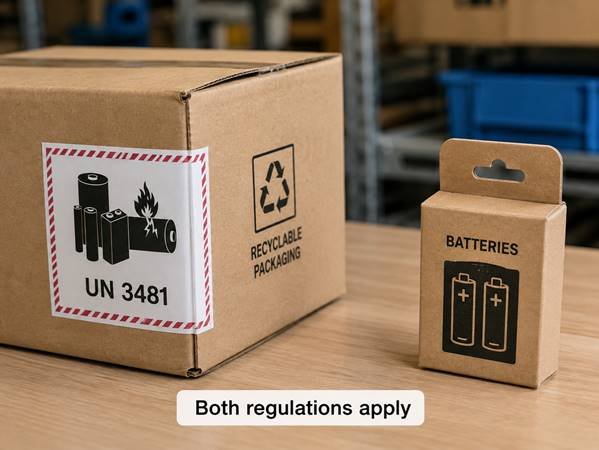
Many people will still ask: how many regulations do the products I have need to comply with? Just follow these three steps in order, no need to guess blindly:
Step 1: Determine whether the product has a battery, be sure to look carefully, including hidden button batteries, backup batteries (such as small batteries in luminous data cables, backup batteries in fast chargers, many people will miss them).
Step 2: Determine whether the product has sales/transport packaging. Retail boxes, express boxes and buffers usually count; but small items such as ties, dust bags, etc., should be judged in combination with whether they meet the PPWR’s definition of packaging, not just whether they are delivered with the goods.
Step 3: Match the number of corresponding regulations.
We have listed the common scenarios of charging products, just match them directly:
• **Only PPWR required**: Ordinary data cables, ordinary chargers (no batteries, only with packaging).
• **Need to comply with both**: Power banks, wireless chargers with batteries, luminous data cables, fast chargers with backup batteries (with batteries + with packaging).
• **Only Battery Regulation required**: Almost non-existent in consumer retail scenarios – even if you sell batteries separately, there are outer packaging and express boxes, which must meet the PPWR; only industrial bulk situations without any packaging can be exempted from PPWR, but consumer retail basically does not encounter this.
Also note that the conclusion is not static: if the product adds a battery function (for example, an ordinary data cable adds a luminous button battery), it changes from only requiring PPWR to dual compliance; only industrial bulk without any packaging can be exempted from PPWR (not applicable to consumer retail).
Five-Step Self-Inspection for Dual Regulation Compliance
After figuring out which regulations apply, the next step is how to conduct self-inspection. Follow these five steps, and you basically will not miss any items:
Step 1: Role and Boundary Determination
First, identify your “producer” identity according to the selling member state, and clarify who bears the compliance responsibility – whether it is the brand owner, the importer, or you need to find an authorized representative, which shall be determined according to the sales model and national regulations.
Then, check whether the product has a battery, including hidden button batteries and backup batteries, do not miss them.
Finally, split all packaging layers: check from the outside to the inside the outermost e-commerce express box, filling bubble column, product color box, plastic inner tray, etc. Cable ties for bundling data cables, dust bags for accessories, small envelopes for instruction manuals, etc., should also be judged item by item in combination with the PPWR’s definition of packaging, to avoid omissions, and do not automatically classify them as packaging just because they are delivered with the goods.
Step 2: Match the Mandatory Requirement List
• With batteries → match Battery Regulation requirements: producer registration, substance restrictions, conformity assessment, labeling, QR code, EPR, detachable design (only applicable to products with built-in portable batteries).
• With packaging → match PPWR requirements: EPR registration, substance restrictions, conformity assessment, reduction/recyclable/recycled content design (advance according to time nodes, no need to do requirements that are mandatory in 2030 in advance, but plan ahead).
Step 3: Match Time and Sales Region
First confirm the launch time, and clarify the current requirements against the phased effective time. You do not need to do the later requirements in advance, but you also need to plan ahead – for example, the detachable requirement to be implemented in 2027 should be considered when opening the mold in 2026, otherwise the mold modification cost will be very high.
Then confirm the member states you sell to, match the EPR, labeling, and enforcement requirements of each country. The specific implementation may vary from country to country (for example, some countries require packaging to be labeled in the local language).
Step 4: Organize the Compliance Evidence Package
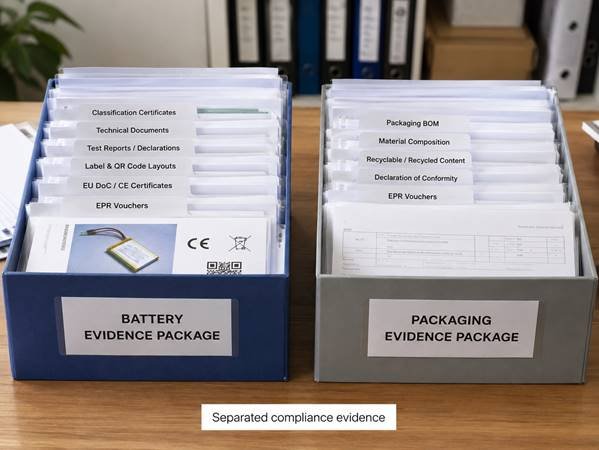
Sort out the compliance evidence by category, so that you can quickly take it out when the regulatory authority inspects:
• Battery evidence package: classification certificates, technical documents, substance tests/declarations, label and QR code layouts, EU DoC/CE certificates, EPR vouchers, etc.
• Packaging evidence package: packaging bill of materials (BOM), material composition, reduction/recyclable/recycled content documents, declaration of conformity, EPR vouchers, etc.
The two types of evidence can be placed in the same folder, but they should be clearly separated and not mixed together.
Step 5: Handling of Doubtful Situations
First, verify the responsibilities of service providers: EU authorized representatives, EPR representatives, PROs, testing/documentation institutions have different responsibilities. Do not think that finding one service provider can handle all compliance, different responsibilities require different qualifications.
If you encounter complex boundary issues (for example, whether your product meets the exception condition that the battery can be replaced by a professional), be sure to consult a qualified compliance agency, and do not make your own judgment, otherwise the loss of making a mistake will be great.
Avoiding the Most Common Practical Misconceptions
Finally, we have sorted out several types of the most common practical misconceptions, all of which are pitfalls that many people have stepped on, you can check against them:
Registration and Responsibility Category
• “One country’s EPR registration is valid for the entire EU” → Wrong, EPR registration/fees/enforcement are independent in each country, and need to be handled separately according to the selling country.
• “The same EU responsible person can cover all compliance responsibilities” → Wrong, authorized representatives, EPR representatives, and PROs have different responsibilities, and their qualifications need to be confirmed separately.
• “Either the importer or the authorized representative can be chosen as the domestic responsible person” → Wrong, the two have different identities/responsibilities and cannot be interchanged at will, they shall be determined according to the sales model and member state rules.
Labeling and Time Category
• “The EU unified recycling code needs to be printed now” → Wrong, there is no EU unified recycling code before 2028, and local requirements need to be checked country by country.
• “All products with batteries must print the waste symbol on the product body” → Wrong, in principle, it should be marked on the battery; only when the size of the battery makes the symbol smaller than 0.47×0.47cm, can it be changed to print the separate battery collection symbol of at least 1×1cm on the packaging.
• “The old Packaging Directive will be completely invalid in 2026” → Inaccurate, Directive 94/62/EC is indeed repealed by the PPWR from 12 August 2026, but the PPWR has item-by-item transitional arrangements for specific provisions and existing national measures, which need to be implemented in comparison.
Testing and Evidence Category
• “The same material declaration can meet the substance requirements of both regulations” → Wrong, they need to correspond to the test standards and objects of batteries/packaging respectively, and cannot be mixed.
• “Having a recycling symbol means compliance” → Wrong, the recycling symbol is only a labeling requirement, and does not mean that the requirements for recyclability, recycled content, registration, etc. are met.
Rule Cognition Category
• “All batteries need a digital battery passport” → Wrong, only industrial batteries (>2kWh), electric vehicle, and light means of transport batteries are mandatory, consumer rechargeable batteries do not need it; but ordinary consumer batteries still need to be marked with a QR code in accordance with regulations from 18 February 2027.
• “PPWR recycled content requirements apply to all packaging” → Wrong, the mandatory recycled content requirement is for the plastic part of packaging, and the proportion will vary with the type and format of packaging; paper and other non-plastic packaging are not subject to this plastic recycled content proportion.
Core Summary
In fact, these two regulations are not difficult to distinguish, just grasp the core logic:
First, there are only two steps to judge the applicable regulations: check whether the product has a battery as defined by the regulation, and whether it has packaging that meets the PPWR definition. Comply with whichever one it has, and comply with both if it has both, there is no option to choose one or the other.
Second, the obligations of the two regulations are completely independent, and they must be implemented separately from the 7 dimensions of applicable boundary, EPR, market access, restricted substances, design for recycling, labeling, and time enforcement, and cannot replace each other.
Third, follow the five-step self-inspection process, match the phased requirements in combination with the launch time and selling country, and prioritize checking the high-risk misconceptions we listed, and you can basically avoid most pitfalls.