
If you run a charging product business in the EU market, whether you sell chargers, USB-C cables or wireless chargers, you will almost always encounter the threshold of “CE certification”. Many people are confused when they first come into contact with it: Is CE one certificate or several? Why do some suppliers say LVD is required, while others say EMC and RED are also needed? Is it enough just to affix the CE mark?
In fact, CE is not a single “certification”, but a compliance system composed of multiple directives. Among them, the three core directives most relevant to charging products are LVD (Low Voltage Directive), EMC (Electromagnetic Compatibility Directive), and RED (Radio Equipment Directive). In this article, we will thoroughly explain the differences, applicable rules, and key pitfall avoidance points of these three directives, from entry-level judgment to advanced verification. After reading it, you will be able to judge which requirements your products must meet on your own, without being led by suppliers.
If you are in a hurry to find the conclusion, you can first look at the core comparison table below to quickly locate the corresponding directive in 10 seconds. We will talk about more detailed judgment rules and precautions later.
| Comparison Dimension | LVD (Low Voltage Directive) | EMC (Electromagnetic Compatibility Directive) | RED (Radio Equipment Directive) |
| Applicable Trigger Conditions | Rated voltage AC 50-1000V / DC 75-1500V | Independently sold active electrical/electronic equipment that may generate or be affected by electromagnetic interference | Equipment with intentional radio communication/control/detection functions |
| Core Control Scope | Electrical safety (electric shock prevention, fire prevention, mechanical failure) | Electromagnetic compatibility (does not interfere with others, not damaged by interference) | Safety + EMC + radio spectrum; for equipment falling under the categories listed in the authorizing regulation (EU) 2022/30, relevant cybersecurity requirements will also apply from August 1, 2025 |
| Notified Body Requirements | Not required for ordinary consumer charging products, self-declaration is allowed | Not required for ordinary consumer charging products, self-declaration is allowed | Self-declaration is allowed if harmonized standards covering all requirements are fully adopted; otherwise, a Notified Body (NB) is required to participate |
| Common Applicable Products | Wired chargers and power adapters with 220V input | Car chargers, independently sold USB-C cables with E-Marker | Smart chargers with Bluetooth/WiFi, wireless chargers with wireless control |
The Underlying Logic of CE Compliance: What Is the Relationship Between Directives, Standards, Testing, and DoC?
Many people can’t figure out the various terms in CE, sometimes directives, sometimes standards, sometimes test reports. In fact, you can understand it as a four-layer logical chain, from top to bottom is the relationship from requirements to implementation:
1. **EU Directives/Regulations**: These are the top-level rules, which only stipulate the “essential requirements” that products must meet. For example, the LVD only says “products must be sufficiently safe and must not cause electric shock risks”, but does not specify how to test to be considered safe.
2. **EU Harmonized Standards**: These are commonly used test method standards officially recognized by the EU. For example, EN 60335-2-29 may apply to specific battery chargers that directly charge batteries; products such as USB power adapters should determine applicable standards based on their design, purpose, and the list of LVD harmonized standards, and cannot be generalized. If you test and pass completely in accordance with harmonized standards, you can “presume” that your product meets the essential requirements of the directive — note that this is not the only compliance path. If you have other technical methods to prove that the product meets the essential requirements, that is also acceptable, but using harmonized standards is the most convenient.
3. **Test Report**: This is a report issued by a laboratory after testing according to standards. It is only one of the evidences to prove that your product meets the requirements, and is absolutely not equivalent to a “CE certificate” — many suppliers say “I have a CE certificate”, but in fact it is just a test report, which are two different things.
4. **DoC (Declaration of Conformity)**: This is the core certificate of CE compliance, a formal document signed by the manufacturer itself, declaring that the product meets all applicable directives and standards.
Common Misconception Clarification
Here we will clarify three most common pitfalls:
First, it is not necessary to use harmonized standards to be compliant. As long as you can provide sufficient technical evidence to prove that the product meets the essential requirements of the directive, it is acceptable even without harmonized standards, but the risk is higher, and generally no one does this.
Second, having a test report does not mean having CE compliance. A test report is only part of the technical documentation, and it is only valid when paired with a DoC signed by the manufacturer. A single laboratory report proves nothing.
Third, CE is not mandatory third-party certification. The vast majority of ordinary consumer products, including most charging products, can be self-declared compliant by the manufacturer, without the need to find a third-party organization to issue a certificate. Only a few special cases require the participation of an EU-authorized Notified Body.
Practical Selection Method for Harmonized Standards
How to select applicable harmonized standards? The steps are very simple: first confirm which directives apply to your product, clarify the essential requirements, then find the currently valid harmonized standards under the corresponding directives in the Official Journal of the European Union (OJEU). Here is a reminder: test standards are only the proof path of compliance and cannot replace risk assessment — even if you have tested all standard items, you must also conduct a product risk assessment to ensure that no hidden safety hazards are missed. There is no fixed “test package” for charging products. What to test specifically depends on the actual design and function of the product, as well as the latest valid standard version in the OJEU.
Quick Judgment Method for Applicable Directives for Charging Products (Ready to Use for Beginners)
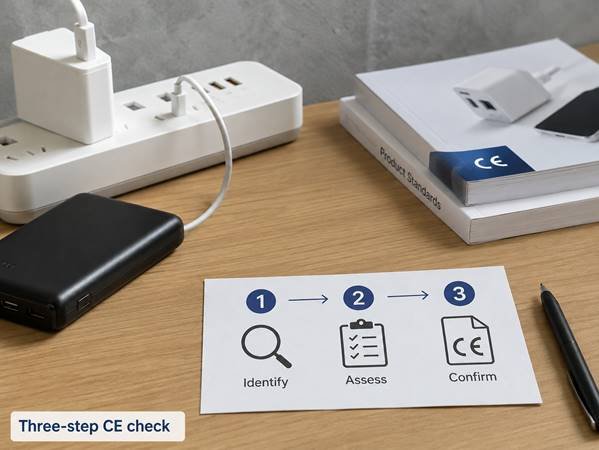
After talking about so many rules, you may still feel a bit confused. Don’t worry, we have sorted out a three-step judgment method for you, in order of priority, to ensure that you will neither miss nor overjudge:
1. **Step 1: First check if there is intentional radio communication/control/detection function**. If yes, RED applies first, and safety and EMC are both under the management of RED, so there is no need to consider LVD and EMC separately.
2. **Step 2: Check if the rated operating voltage is within the scope of LVD** (AC 50-1000V / DC 75-1500V). If yes, it involves safety requirements — if there is no wireless function, follow LVD; if there is wireless function, follow the safety requirements in RED.
3. **Step 3: Check if it is an independent functional unit that may generate/be affected by electromagnetic interference**. If yes, it involves EMC requirements — if there is no wireless function, follow EMC; if there is wireless function, follow the EMC requirements in RED.
Product Boundary and Compliance Split Principles
When actually selling products, you often encounter situations such as sets, accessories, and modules. How to judge? Remember several split principles:
• **Complete product**: For example, a wireless charger set with a power adapter is judged according to the function of the whole machine. It is sufficient to issue a DoC and technical documentation for the whole machine, as long as all internal components are covered by the assessment of the whole machine.
• **Detachable and separately sold components**: For example, separately sold chargers and separately sold USB-C cables need to be judged for applicable directives independently, and cannot follow the whole machine, because they are placed on the market independently.
• **Non-separately sold components included as free gifts**: For example, an ordinary charging cable given as a gift when buying a wireless charger. If this cable is not sold separately and its risks have been covered by the technical documentation of the whole machine, it can be assessed together with the whole machine without separate compliance.
• **Built-in or retrofitted wireless modules**: The module itself must definitely meet the requirements of RED, but if the whole machine integrates this module, the compliance of the whole machine must be re-evaluated. You cannot say that since the module has passed RED, the whole machine does not need to be considered.
Typical Charging Product Directive Matching List (For Direct Reference)
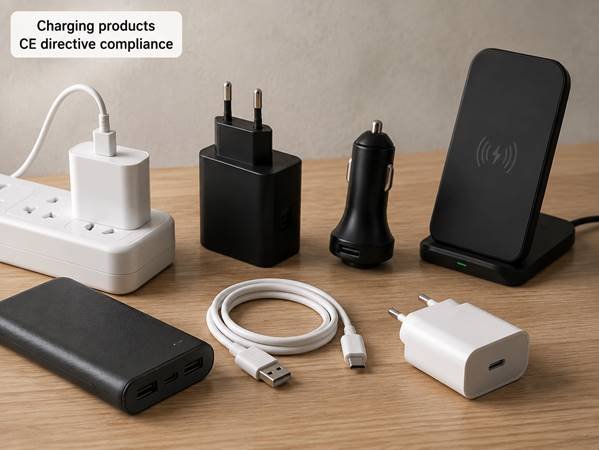
We have sorted out the directive matching situation of the most common charging products, which you can directly refer to:
Wired Charging Products
• Ordinary wall-mounted chargers/power adapters (220V input, no wireless function): LVD + EMC
• USB-C fast charging cables with E-Marker chip (independently sold): EMC applicability needs to be confirmed in combination with actual functions
• 12V car chargers (no wireless function): EMC only (because the 12V DC input is lower than the 75V threshold of LVD, but they have switching power supplies and are active devices)
• Ordinary passive charging cables (without any chips): None of the three directives are mandatory (but they must comply with other regulations such as RoHS and the General Product Safety Directive)
Wireless Charging Products
• Smart chargers with Bluetooth/WiFi (220V input): RED
• Pure energy transmission inductive wireless chargers (no communication/control wireless transmission): LVD + EMC
• Wireless chargers with wireless pairing/control functions: RED applicability needs to be assessed
RED Exclusive: Spectrum and Information Verification in the Country of Placement on the Market
If your product falls under the scope of RED, there is one more thing you must do before placing it on the market: confirm one by one the wireless interfaces, frequency bands/channels, power, and duty cycle limits of the target member states. Don’t think that the whole EU is the same. In addition, the product manual must indicate the applicable frequency, maximum radio frequency power, and necessary usage restrictions. Some countries may have additional access requirements for specific frequency bands, so be sure to verify in advance, otherwise it will be troublesome if the product is detained at customs.
Compliance Document and CE Mark Verification Method (Semi-Proficient)
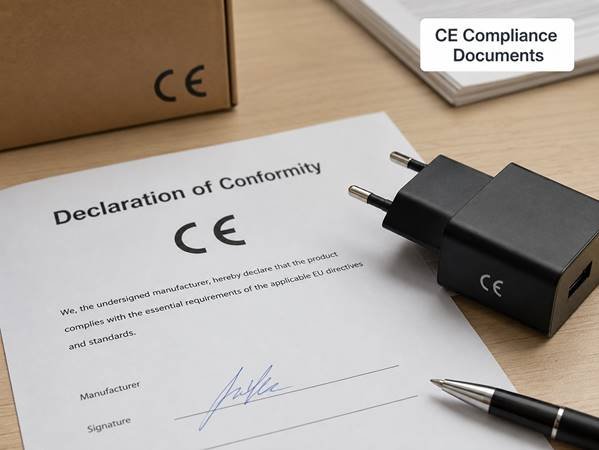
Whether you are purchasing products or making products yourself, you must know how to verify whether the compliance documents are really valid, otherwise you won’t even know if you are cheated by suppliers.
Mandatory Check Items for EU Declaration of Conformity (DoC)
The DoC is the core of compliance. A valid DoC must have at least the following contents, and missing any one may make it invalid:
1. **Signing entity**: In principle, it must be signed by the manufacturer. If it is signed by an authorized representative, there must be written authorization from the manufacturer, and the importer cannot sign arbitrarily.
2. **Unique product identification information**: It must cover the models, versions and configurations actually placed on the market. It is not mandatory to indicate the batch, but it must correspond to the specific product.
3. **Full name and number of applicable EU regulations**: It must match the function of the product. For example, for an ordinary wall charger without wireless function, the RED directive cannot be listed in the DoC, and if it is listed, it is fake.
4. **Number, version/issue date of the EU harmonized standards used**: The DoC should accurately list the actually adopted harmonized standards or other technical specifications and their version/citation information. It should be verified whether the standard still provides presumption of conformity at the relevant time point; if the standard has been replaced and the termination date of the presumption of conformity has expired, you cannot rely solely on its presumption of conformity, and need to re-evaluate and supplement evidence sufficient to prove compliance with the essential requirements.
5. **Authorized signatory, signing date and signing location**: There must be the specific name and position of the signatory, and it cannot be just a stamp.
In addition, there is a special case for RED products: some wireless devices can use a simplified version of the DoC, but complete compliance information must be provided with the product or through online channels, otherwise it is also non-compliant.
Basic CE Mark Verification Points
Don’t think that affixing the CE mark is correct. The CE mark on many products is itself non-compliant. Check these points when verifying:
1. **Size requirements**: The minimum height of the CE mark is usually 5mm. If the product is particularly small and really cannot print 5mm, there can be an exception, but it must be clearly visible.
2. **Position and visibility**: In principle, the CE mark should be affixed to the product or its nameplate, and kept visible, clear and indelible; only when it is impossible or cannot be guaranteed to be affixed to the product due to the nature of the product, can it be affixed to the packaging and accompanying documents.
3. **Style requirements**: It should be scaled according to the officially specified proportion, cannot be deformed, and the C and E cannot be placed separately.
4. **Additional markings**: It is not allowed to only affix the CE mark. Identification information such as product type, batch or serial number, as well as the manufacturer’s name, registered trade name or trademark and postal address should also be marked in accordance with applicable regulations; if the product is placed on the market by an importer, the importer’s information should also be provided as required. Electrical parameters such as rated input, output and power should be marked according to the nature of the product, applicable safety standards and other applicable rules, and should not be expressed as unified fields that are exactly the same for all products under the three directives.
5. **NB numbering rules**: The NB number needs to be marked after the CE mark only when mandatory third-party conformity assessment is required and the NB has participated in the production control phase. Almost all ordinary consumer charging products do not require NB participation, so if you see an NB number printed on an ordinary charger, you should be alert instead, as it is most likely printed randomly by the supplier.
Technical Document Validity Verification (Entry-Level Understanding)
Technical documentation is the basis supporting the DoC. Entry-level users only need to know the core content and basic requirements:
The core content of technical documentation includes product design description, key component list, test report, and risk assessment. According to EU requirements, technical documentation must be kept for 10 years after the last batch of products is placed on the market, and must be provided in a timely manner during regulatory spot checks. When verifying, note that the test report must correspond to the product’s model, configuration and test conditions, and you cannot use reports of other models to make up the number, otherwise it is invalid.
Label and Manual Verification Points
Product labels and manuals are also part of compliance, and must include the following contents:
• Basic information: Identification information such as product type, batch or serial number, as well as the manufacturer’s name, registered trade name or trademark and postal address should be marked in accordance with applicable regulations; if the product is placed on the market by an importer, the importer’s information should also be provided as required. Electrical parameters such as rated input, output and power should be marked according to the nature of the product, applicable safety standards and other applicable rules.
• Additional requirements for RED products: necessary information such as wireless frequency band and maximum transmission power.
• Safety warnings: There must be safety warnings and instructions for use that meet EU requirements, and cannot only be in Chinese.
Common Misconceptions and Pitfall Avoidance List
We have sorted out the most common pitfalls, divided into entry-level and advanced categories, to help you avoid detours.
Entry-Level High-Frequency Judgment Misconceptions
1. **Misconception: All charging products need to comply with the three directives**
Cause of error: Failure to judge hierarchically according to the product’s function, voltage, and wireless attributes, and defaulting that all electrical products have the same requirements.
Pitfall avoidance: Use the three-step judgment method we mentioned earlier, first screen the core attributes, then correspond to the directives. Don’t just say “I need to do the three CE directives” at the beginning.
2. **Misconception: Low output voltage means no need for LVD**
Cause of error: Confusing the judgment logic of input and output voltage, thinking that low final output voltage means no need to comply with LVD.
Pitfall avoidance: When judging LVD, prioritize the rated input or operating voltage of the product design, not the output voltage. For example, a mobile phone charger with 220V input must comply with LVD even if the output is 5V.
3. **Misconception: All products with the word “wireless” need RED**
Cause of error: Equating “wireless energy transmission” with “wireless communication/control”, and confusing the definition of “intentional transmission”.
Pitfall avoidance: Verify whether the product has intentional radio communication, control or detection functions. Don’t just look at whether the word “wireless” is in the product name. Pure inductive wireless chargers do not need RED.
4. **Misconception: Data cables with chips must require EMC/RED**
Cause of error: Equating “having a chip” with “having electromagnetic emission/wireless function”, ignoring the actual function of the chip.
Pitfall avoidance: First judge whether the chip will generate intentional radio transmission, then judge the applicability of EMC in combination with the product’s function. For example, a cable with an E-Marker chip is only used for power negotiation and has no wireless function, so it will not trigger RED.
5. **Misconception: CE must be issued by a third-party organization**
Cause of error: Equating the CE self-declaration system with mandatory third-party certification, and confusing the main responsibility for compliance.
Pitfall avoidance: LVD and EMC usually allow manufacturers to adopt internal production control. For RED products, internal production control alone can only be used under applicable conditions; when harmonized standards covering all applicable essential requirements are not adopted or not fully adopted, the RED conformity assessment procedure with the participation of a Notified Body must be used. A Notified Body certificate cannot replace the manufacturer’s DoC, but it is a necessary document in procedures where regulations require its participation.
Advanced Practical Pitfall Avoidance Tips
• **Product selection and procurement**: Don’t just look at whether the product has a CE mark. Be sure to require the supplier to provide the DoC and test report, and check whether the directives and standards in them match the product functions, and whether the model on the report is consistent with the one you are purchasing.
• **Set products**: Don’t just check the compliance of the main unit. If the accessories in the set are sold separately, be sure to confirm that the accessories also meet the corresponding directive requirements.
• **Product revision**: When a product is revised, evaluate whether supplementary testing or DoC update is needed according to the level of change. Don’t take it for granted to directly use the old version of the documents, otherwise there will be problems during spot checks.
• **RED products**: Be sure to verify the spectrum requirements of the target member states before placing on the market. Don’t default that the whole EU is the same, otherwise the goods may be detained due to non-conforming frequency bands.
Common Consequences of Non-Compliance
Finally, let’s talk about the consequences of non-compliance to remind everyone:
In minor cases, the regulatory authority will require you to rectify and make up for the test, and you can re-enter the market after passing; in serious cases, the product will be removed from the shelves, fined, or even permanently banned from the EU market. Especially for safety-related non-conformities, the punishment will be more severe.
Study Summary and High-Frequency Decision FAQ
Memory Mnemonic for Core Differences of the Three Directives
Finally, we have sorted out a simple memory mnemonic for you to facilitate quick recall:
• LVD: Governs electrical safety, depends on voltage range
• EMC: Governs electromagnetic compatibility, depends on whether it is an active independent functional unit
• RED: Governs wireless functions, covers three types of requirements: safety, EMC, and spectrum
Things You Can Do Independently After Learning
After reading this article, you should be able to do the following things:
1. Distinguish the core functions and applicable boundaries of LVD, EMC, and RED
2. Use the three-step method to quickly judge the CE directives that common charging products need to comply with
3. Able to verify the basic compliance of DoC and CE marks, and avoid high-frequency cognitive misconceptions
4. Know how to re-evaluate compliance requirements when product functions, sales forms, and sales regions change
5. Able to judge whether to update compliance documents according to the level of change
High-Frequency Decision FAQ
1. **When purchasing charging products, how to quickly verify the validity of the supplier’s CE documents?**
First check whether the DoC is complete: whether there is a manufacturer’s signature, whether the applicable directives match the product functions, whether the citation information of harmonized standards or other technical specifications is accurate, and whether the presumption of conformity is still provided at the relevant time point. If the standard has been replaced and the termination date of the presumption of conformity has expired, you cannot rely solely on the presumption of conformity of the old standard. Then check the test report: whether the model and configuration are consistent with the one you are purchasing, whether there are corresponding test items, and whether the qualification of the testing institution is reliable. Don’t just look at whether there is a CE mark, nor just look at a so-called “CE certificate”.
2. **For wireless charger + charger sold as a set, do separate DoCs need to be issued?**
If they are sold as a complete set and not sold separately, only one DoC for the whole machine is needed, as long as the technical documentation covers all components. If the charger in the set can be purchased separately and placed on the market independently, then the charger also needs separate compliance documents.
3. **The product has been revised and the power chip has been replaced. Do all CE tests need to be redone?**
After replacing the power chip, a written change impact analysis and risk assessment should be conducted. According to its impact on safety isolation, protection functions, temperature rise, failure modes, EMC, software and (if applicable) radio frequency performance, determine the supplementary tests and document updates required; when the impact is large, it may be necessary to expand the test scope or re-conduct relevant conformity assessment.
4. **For smart wireless chargers with Wi-Fi, is it mandatory to make up RED cybersecurity tests after 2025?**
It depends on the product category and the scope of application of the authorizing regulation (EU) 2022/30. Cybersecurity requirements will be triggered in batches by device category from August 1, 2025. Smart charging devices with Wi-Fi are networked consumer electronics, and most likely need to comply. Specifically, it should be compared with the official device classification list and the latest implementation rules. It is recommended to prepare in advance.
5. **Is UKCA mandatory for selling chargers in the UK market?**
For regulations subject to the UK’s indefinite CE recognition policy, the CE mark can continue to be recognized; regulations related to low-voltage electrical, EMC and radio equipment are usually within the scope of this policy, but should still be verified according to the product and the latest official UK requirements. CE rules usually apply in Northern Ireland; if a UK approved body is used for mandatory third-party conformity assessment in accordance with the law, both CE and UKNI marks are usually required. If your product’s main market is the UK, you can prepare UKCA in advance, but it is not mandatory now.
6. **Is a CE certificate issued by a Notified Body more effective than a manufacturer’s self-declaration?**
This cannot be simply compared. LVD and EMC usually allow manufacturers to adopt internal production control; for RED products, internal production control alone can only be relied on under applicable conditions. When harmonized standards covering all applicable essential requirements are not adopted or not fully adopted, the RED conformity assessment procedure with the participation of a Notified Body must be used. A Notified Body certificate cannot replace the DoC signed by the manufacturer, but it is a necessary document in procedures where regulations require the participation of a Notified Body. During regulatory spot checks, authorities will look at both the DoC, technical documentation and applicable conformity assessment evidence.
Overall, CE compliance looks complicated, but in fact, as long as you figure out the trigger conditions and core requirements of each directive, judge step by step, and avoid common misconceptions, there will be no major problems. Remember that EU regulations are updated from time to time. When doing compliance, you must follow the latest official rules, and do not rely on old experience.