
Charging product brands and cross-border sellers operating in the Indian market have most likely heard of BIS and WPC certifications, but many still cannot tell them apart: both are India market entry certificates, so what is the difference between them? Is it enough to apply for just one? Which certification do I need for the chargers, data cables, and wireless chargers I sell?
All conclusions in this article are based on current official rules such as BIS’s official compulsory registration list, IS standards, and WPC frequency band notifications. If rules are updated, please refer to the latest official requirements. Next, we will explain these two certifications in detail, starting from the most basic definitions, moving to judgment methods for specific products, application processes, and key points to avoid pitfalls. Even if you are new to the Indian market, you can quickly understand them and even judge your certification needs on your own.
First, Understand the Core Boundaries of the Two Certifications (Beginner Basics)
Many people easily confuse the two certifications, but in fact they regulate completely different matters and are issued by different departments.
The first is BIS CRS, full name Bureau of Indian Standards Compulsory Registration Scheme. It is a compulsory registration system under BIS Scheme-II: products included in the list must comply with applicable Indian standards and, where applicable, the basic requirements in the notification. For categories such as power adapters and power banks covered in this article, relevant requirements mainly include electrical safety, such as reducing risks of electric shock, fire, and overheating. After passing the certification, a registration number starting with “R” will be issued.
Note that it is not the same as the ISI Mark Certification that people occasionally hear about: ISI Mark Certification and CRS belong to different conformity assessment schemes of BIS. For charging products, you should verify item by item whether they are included in the CRS list, Scheme-I/QCO, or other applicable systems, and cannot generalize them only as “consumer electronics” or “charging products”.
The second is WPC ETA, full name Wireless Planning & Coordination Wing Equipment Type Approval. It regulates “whether wireless signals will cause interference” — as long as your product has wireless transmission functions, whether it is Bluetooth, WiFi, NFC, or a wireless charging transmitter coil, it must undergo its review to avoid signal interference with local legitimate wireless services such as communications and broadcasting. The wireless functions of charging products basically belong to unlicensed frequency bands, so most follow the ETA route; if they do not comply with the rules for unlicensed frequency bands, you need to apply for other types of WPC authorization or import licenses.
Trigger Logic and Overlap Rules
Once you understand what they regulate, the trigger logic is easy to understand:
- The trigger for BIS is very straightforward: as long as your product is in the compulsory registration list officially published by BIS and meets the definition of the corresponding product, regardless of whether it has wireless functions, you must apply for BIS CRS.
- The trigger for WPC requires one more step: first identify all parts of the product with wireless transmission functions (do not miss easily overlooked ones such as wireless charging coils and NFC), then check item by item whether the frequency band, power, standard, and purpose of these functions are within the regulatory scope of WPC. Those that comply with the ETA rules for unlicensed frequency bands should apply for ETA; those that do not should follow other WPC application routes.
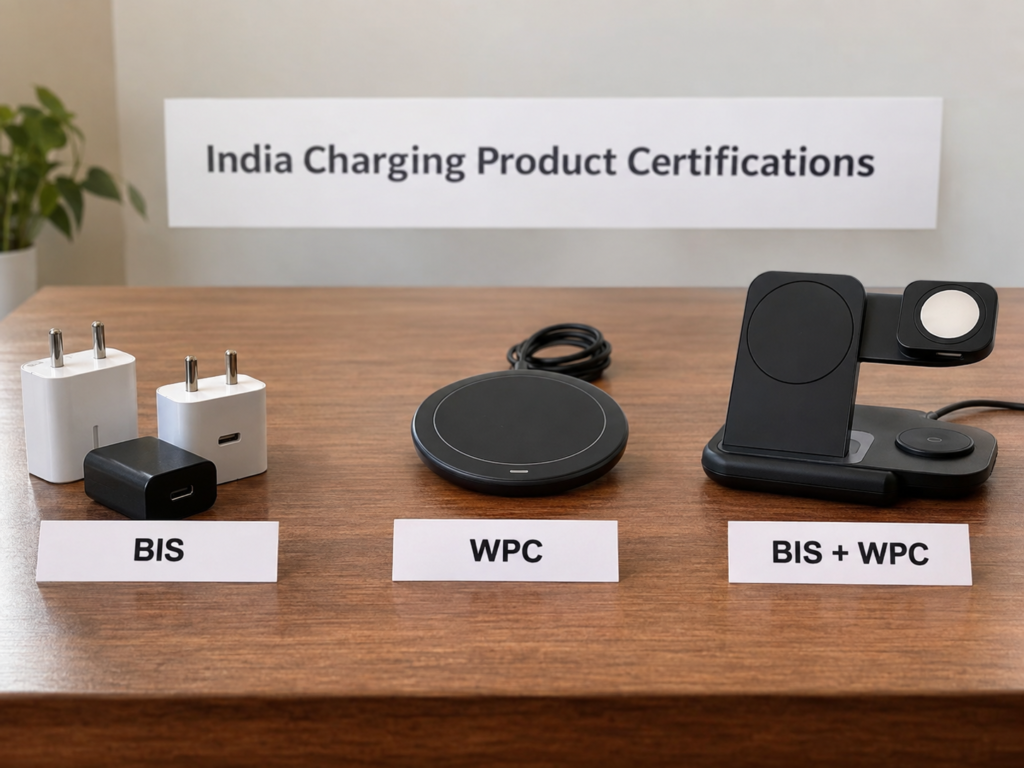
A key point must be emphasized here: the two certifications have no substitution relationship. If your product meets the trigger conditions for both, you must apply for both — for example, a smart wireless charger with Bluetooth control must comply with applicable BIS requirements as well as WPC wireless signal requirements; you cannot legally launch the product with either one missing.
Quick Overview of Core Differences for Charging Products
For your quick comparison, we have compiled the core differences exclusive to charging products:
| Comparison Dimension | BIS CRS | WPC ETA (Wireless Certification) |
|---|---|---|
| Regulatory Area | Compliance of listed products with applicable IS standards and relevant basic requirements; for power products covered in this article, it mainly involves electrical safety | Radio frequency (signal transmission) compliance, to prevent interference with other wireless devices |
| Trigger Logic | Depends on whether the product is in the BIS compulsory registration list and meets the corresponding product definition | Depends on whether the product has regulated wireless functions and whether the parameters comply with ETA rules |
| Core Assessment | Whether the product complies with corresponding IS Indian standards and applicable basic requirements | Whether wireless signal parameters comply with India’s frequency band regulatory requirements |
| Covered Products | Products in the compulsory list including wired and wireless charging products | Only covers products with regulated wireless functions |
Does Your Charging Product Need Certification? Category-Based Judgment Guide (Beginner Core)
Before making specific judgments, first clarify the scope of application of this article to avoid wasting your effort:
- Applicable Scenarios: Cases where finished products are imported into India, sold online/offline, or brands officially enter the market;
- Covered Products: Chargers, power adapters, USB/USB-C data cables, power banks, wireless chargers, smart charging accessories;
- Content Not Covered: Other Indian regulatory requirements such as MTCTE telecommunications certification, import licenses, and battery EPR will not be discussed in this article for the time being.
Judgment Methods for Five Common Types of Charging Products
Next, for the five most common types of charging products, we will explain the key verification points for BIS and WPC respectively, as well as the ambiguous boundaries that are easily confused:
1. Wired Power Products (Wall Chargers, Adapters, Car Chargers)
For BIS, the main check is: whether your product belongs to categories such as “power adapters for IT equipment” and “independent switching power supplies of 48V and below” in the CRS list. As long as it is in the list and meets the definition, you must apply for certification.
For WPC, it is simpler: check whether there are built-in wireless signal transmission modules such as Bluetooth, WiFi, and NFC. If there are, then verify whether the corresponding frequency band and power comply with ETA rules; if not, WPC is not triggered.
Ambiguous Boundary: The classification of car chargers requires verification of input and output parameters, and cannot be directly classified as adapters; in addition, whether it is 20W fast charging or 100W fast charging, the fast charging function itself does not change the regulatory category of the product, and the product remains in its original category.
2. Power Banks / Battery-Powered Charging Accessories
For BIS, check whether it belongs to the “power bank for portable applications” category in the CRS list, and whether the internal circuit structure meets the corresponding product definition.
For WPC, it is the same as wired power products: check whether there is a built-in wireless module. If yes, check the parameters; if not, it is not triggered.
Ambiguous Boundary: You cannot judge applicability solely because the product has a battery or has a small capacity; you should verify whether it belongs to notified product categories such as “power bank for portable applications”, and judge based on applicable standards, product definitions, and exemption clauses. Capacity may affect model series coverage or test materials, but cannot be independently regarded as a threshold for exclusion from the list.
3. Ordinary Passive USB Data Cables, Adapters
For BIS, first check whether the product is in the CRS compulsory list — the compliance requirements for ordinary cables are quite special. You need to distinguish between CRS and other Indian Quality Control Order (QCO) systems; not all cables require CRS.
For WPC, it is even simpler: conventional passive data cables and adapters have no wireless transmission function, so WPC is not triggered at all; but if it is a smart cable with Bluetooth anti-loss function or a built-in chip, you need to verify the wireless parameters.
Ambiguous Boundary: Many people think that USB-C cables, PD fast charging cables, and cables with E-Marker chips must require BIS certification, or definitely do not require it — in fact, both are wrong. You cannot judge solely based on interface type, power, PD protocol, or whether there is an E-Marker; you must be based on the product definition in the official list.
4. Wireless Chargers, Charging Docks
For BIS, the power supply part and the whole product are checked: it depends on whether the power supply module belongs to the power category in the CRS list, and whether the whole product meets the definition of the corresponding product category; not all wireless chargers are in the compulsory list.
For WPC, special attention should be paid: you cannot only check whether there is Bluetooth or WiFi; you need to verify all wireless functions in layers: first, whether there are RF communication modules (such as Bluetooth, WiFi), and second, whether the frequency, power, and purpose of the wireless power supply coil itself are within the regulatory scope.
Ambiguous Boundary: Many people think that as long as it is called a “wireless charger” and has a transmitter coil, it must require WPC ETA. In fact, this is not the correct way to judge — pure inductive wireless power supply should be verified item by item according to the actual operating frequency band, field strength or emission limit, antenna, purpose, and whether it meets the relevant unlicensed notification. You cannot judge exemption from ETA solely based on “low power”. If the device complies with applicable unlicensed inductive application rules, you still need to apply for ETA according to the rules; if not, you must confirm with WPC the applicable other authorization or license routes.
5. Smart Chargers, Connected Charging Sockets
For BIS, the power supply part and the whole product are also checked: see whether they belong to the corresponding categories in the CRS list, such as compulsory requirements for power adapters and socket products.
The verification logic for WPC is “find all first, then check one by one”: first list all wireless functions of the product, then verify the parameters item by item to see which comply with ETA rules and which require other routes.
Ambiguous Boundary: Do not directly assume that products with App control require WPC — first confirm the connection method. If it is a wired connection with an Ethernet cable and has no wireless transmission function at all, WPC is not triggered; only those with wireless connections need verification.
Typical Product Judgment Examples
If you are still unsure, you can quickly match your product with the conclusions of the following common products:
Ordinary passive USB-A to USB-C cables and adapters without any wireless functions definitely do not trigger WPC; as for whether BIS is required, you need to check the latest CRS list and product definitions.
Ordinary wired chargers and power adapters without wireless functions such as Bluetooth and WiFi also do not trigger WPC; as long as they meet the definition of power products in the CRS list, BIS certification must be applied for.
Power banks without wireless functions also do not trigger WPC; those that meet the definition of “power bank for portable applications” in the CRS list require BIS certification.
For wireless chargers and multi-function charging stations, first check whether the power supply part and the whole product are in the CRS list. If yes, BIS certification is required; for WPC, you need to separately verify the actual frequency band, field strength or emission limit, antenna, purpose, and applicable rules of the wireless power supply coil and RF communication module, then determine whether certification is needed and which type to apply for.
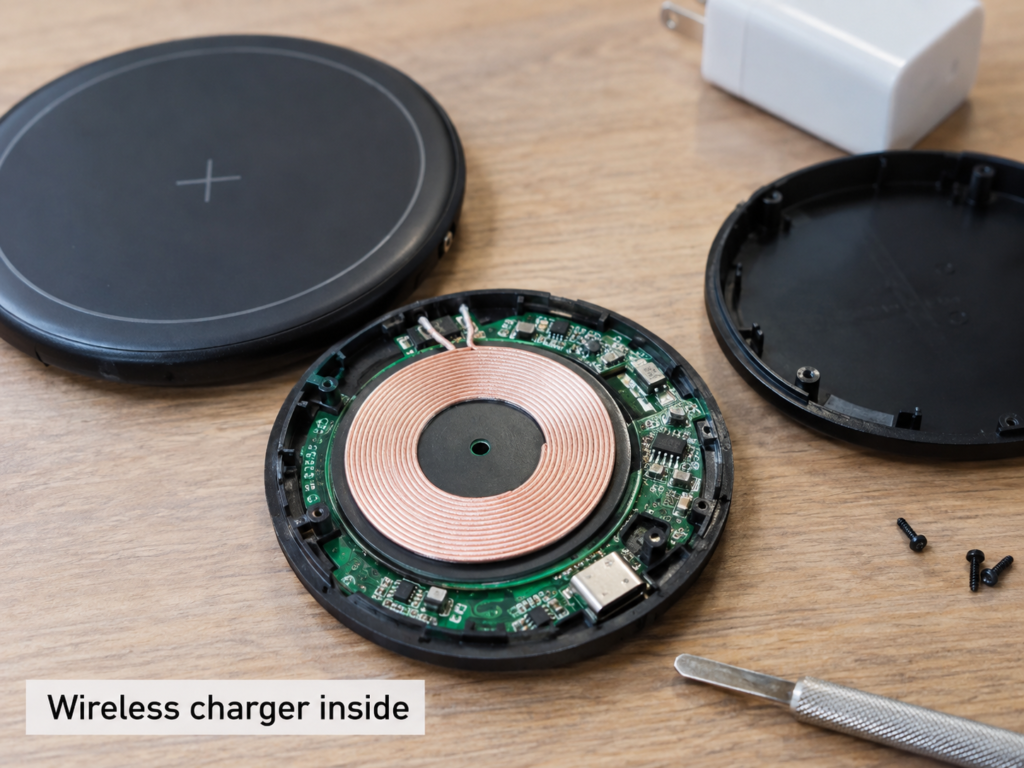
For smart chargers and connected charging sockets, if the power supply part meets the list requirements, BIS certification is required; if they connect to mobile phone Apps via Bluetooth or WiFi and the wireless parameters comply with ETA rules, WPC ETA is also required.
Dual Certification Overlap and Certificate Coverage Boundaries
Now that you understand the judgment for individual products, next we will talk about two common pitfalls: under what circumstances do you need to apply for both certifications? How to check the coverage of a certificate?
Boundaries of Dual Certification Overlap
Dual certification is only required when both BIS CRS compulsory requirements and WPC wireless equipment regulatory requirements are met. Here are three common boundary issues that many people get wrong:
First, for USB-C cables with only an E-Marker chip, as long as there is no wireless transmission function, WPC will absolutely not be triggered — E-Marker is just a protocol chip for wired transmission, and has nothing to do with wireless.
Second, for set products, you need to identify whether each component is a regulated product separately and verify the actual license scope. For example, for a “charger + data cable” set, if the data cable itself is also sold separately, it must separately meet the corresponding certification requirements; even if it is not sold separately, you cannot take it for granted that the whole product certificate will cover this component, and you should verify according to the specific BIS license scope, product category, and notification requirements.
Third, when wireless functions are turned off, locked, or removed, you should not independently determine exemption. You should retain evidence of hardware and software configurations, and confirm whether it still falls within the scope of ETA or other WPC requirements according to the actual operable frequency band, transmission capability, import status of the device, and current WPC rules; without WPC confirmation, software disabling should not be used as a basis for exemption from certification.
Certificate Coverage Boundary Verification Rules
Many sellers think everything is fine once they get the certificate, but in fact, the coverage of the certificate has strict limits. The core principle is: the coverage relationships of whole products, components, modules, and sets must be verified separately, and you cannot take it for granted that “having a certificate covers everything”.
For products of different forms, the verification focuses are different:
- Finished whole products: mainly check whether the model, brand, and manufacturing factory on the certificate are consistent with the actual product, and whether the certificate covers the product you sell.
- Detachable components: such as replaceable charging cables and external power adapters, you need to separately identify whether they are regulated products and whether the actual license covers their sales form; they cannot be automatically treated under the whole product certificate.
- Built-in RF modules: For finished products containing RF modules that are manufactured overseas and imported, even if the module already has ETA, you still need to obtain ETA for the imported finished product according to WPC requirements. Only in specific circumstances such as when modules manufactured in India and already having ETA are installed in finished products without modification, the official FAQ states that the finished product does not need to obtain separate ETA.
- Set products: You should separately verify the applicable requirements and actual license scope of all independent regulated components. You cannot generally assume that one whole product certificate will necessarily cover all set components, nor can you assume without verification that certificates of each component can definitely replace each other.
As for the core coverage fields of a single certificate, BIS CRS mainly depends on brand, model, factory address, corresponding IS standard, and product category; WPC ETA mainly depends on RF module model, operating frequency band, transmission power, and product model range. After getting the certificate, first check these core fields, and you can quickly know whether it covers your product.
Factors Affecting Judgment and Classification Evidence Chain
The certification requirements for products are not static. There are four factors that affect the judgment result:
First is official rule updates: BIS’s compulsory list is adjusted regularly, and WPC’s frequency band and power exemption rules may also change. Every time there is a new product or rule update, you need to re-verify.
Second is product parameter changes: Even for the same product, as long as the core circuit, rated power, wireless function parameters, or structure change, you need to re-evaluate the certification requirements. It is possible that a product that did not require certification before will require it after changes.
Third is different sales forms: The compliance requirements for finished products sold separately may be different from those sold as set accessories, spare parts, or repair parts, and cannot be directly applied.
Fourth is different functional states: When wireless functions are turned off, locked, or removed, you cannot independently determine exemption from certification. You should re-judge according to the actual operable frequency band, transmission capability, import status of the device, and current WPC rules.
Then what is the basis for judgment? You cannot rely on intuition; you must rely on verifiable technical materials, that is, the classification evidence chain:
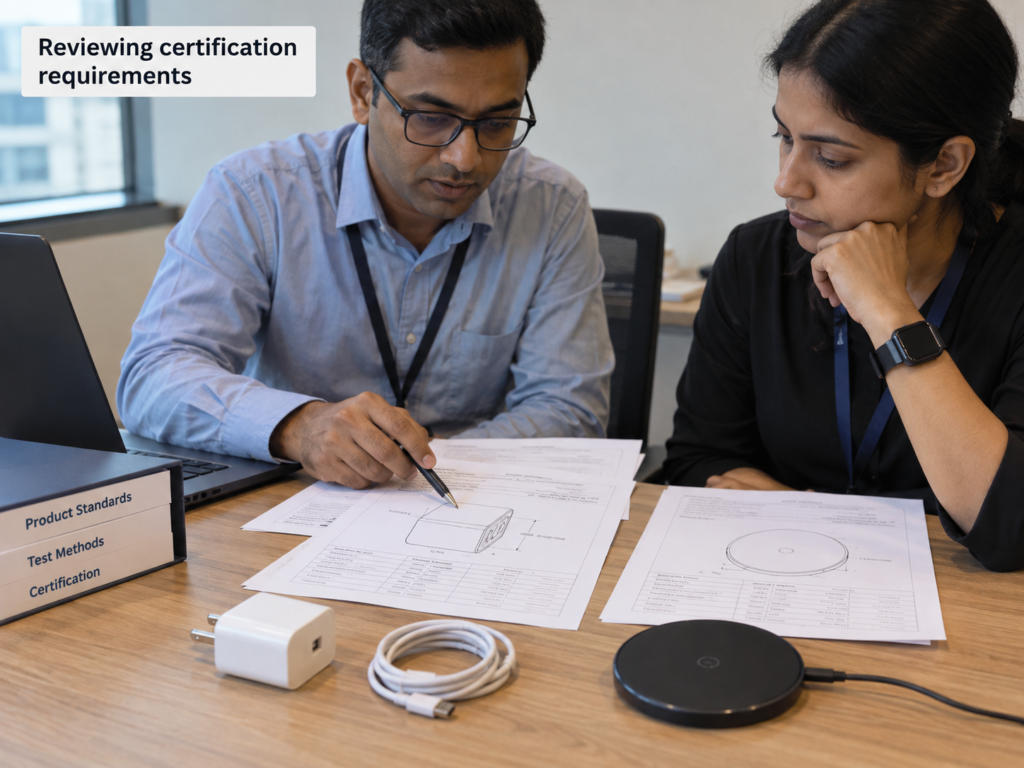
- Materials required for safety category (BIS) include: product nameplate, AC/DC circuit topology diagram, bill of materials (BOM) for key components, independent sales certificate, purpose statement, user manual.
- Materials required for wireless category (WPC) include: wireless module datasheet, RF test report.
Remember one principle: you must never draw conclusions solely based on marketing names, interface types, or advertised functions; you must be based on verifiable technical materials — for example, a product called “smart fast charger” that is actually wired and has no wireless functions does not require WPC certification, and you cannot make blind judgments just by looking at the name.
What Do the Two Certifications Assess? What Are the Differences in Standards?
Many people ask: are the test contents of the two certifications the same? Can reports be shared? The answer is completely different, because the core of assessment is fundamentally different.
BIS CRS Assessment Logic
The assessment logic of BIS CRS is to confirm whether listed products comply with corresponding IS standards and, where applicable, the basic requirements in the notification. For products such as power adapters and power banks discussed in this article, the focus usually includes electrical safety, with the purpose of reducing risks of electric shock, fire, overheating, etc. during normal use and reasonable misuse. Test items are not determined arbitrarily; they must be based on the version of the corresponding IS standard, official test report format, key components, and structural differences.
Common assessment items are all related to safety: for example, electric shock protection is to see whether users can touch live parts; leakage current limit is to see whether the electricity leaked from the product after power-on will hurt people; fire resistance and flame retardancy are to see whether the fire will spread if the product catches fire; there are also overheating protection, short circuit protection, and consistency between product labeling and certificates — for example, whether the parameters on the nameplate and the R number are the same as those on the certificate.
WPC ETA Verification Requirements
The core assessment of WPC ETA is wireless signal compliance, that is, to ensure that the signals emitted by your product will not interfere with other local legitimate wireless services in India, such as mobile communications, broadcasting, and aviation communications.
The requirements for technical materials shall be based on the WPC rules corresponding to the applicable frequency band and standard, as well as the acceptance requirements of the official portal. The core parameters to be verified are radio frequency parameters such as frequency range and output power; as for requirements such as EMC (Electromagnetic Compatibility), bandwidth, and spurious emissions, they shall be based on the current WPC notification, and requirements vary for different frequency bands.
There is a common misunderstanding here: many people think that WPC ETA, like BIS, requires the certification number to be printed on the product. In fact, this is not the case. WPC does not have a unified mandatory requirement to print the “WPC certification number” on the product. You only need to verify the ETA document, import/sales documents, and official labeling obligations; labeling requirements may vary for different products.
Differences in Applicable Standards and Materials
Simply put, BIS CRS corresponds to exclusive IS Indian standards by product category; different products (such as chargers and power banks) use different standards, and versions may also be different; WPC ETA corresponds to exclusive test rules by wireless frequency band, and different products in the same frequency band may use the same rules.
How to Apply? What Is the Approximate Cycle and Cost?
The following are references for conventional scenarios of the same qualified charging product, excluding expedited processing, supplementary materials, and rectification. The actual cycle and cost will vary depending on the product.
Conventional BIS CRS Application Route
There are several hard requirements for the BIS CRS application process that you should know in advance:
First, Applicant Entity: Overseas manufacturers can be CRS applicants, but they must appoint a qualified Authorized Indian Representative (AIR). The application and test report must still be based on the actual manufacturer and its manufacturing address, and the AIR is responsible for countersigning and performing corresponding compliance duties.
Second, Core Process: First, samples must be sent to a BIS-recognized laboratory for testing. After passing the test, submit the test report and self-declaration of conformity. After BIS’s document review is passed, an R-number certificate will be issued.
Third, Factory Inspection: The CRS model is centered on registration, test reports, and self-declarations. Not all products require factory inspection; factory inspections and supervision sampling are implemented in accordance with current BIS rules. Some categories may be sampled, and some may not.
Also note that if your product is subject to other BIS certification schemes, such as ISI Mark Certification, the process is completely different and requires separate evaluation. Do not directly apply the CRS process.
Conventional WPC ETA Application Route
The WPC ETA application process is relatively simpler, but there are also several key points:
First, Applicant Entity: The eligibility of the applicant must be confirmed through the current page of WPC’s official Saral Sanchar portal. Not all overseas entities can apply directly, and a local Indian entity may be required to handle it.
Second, Core Process: ETA is a self-declaration route. You should submit the application, required technical materials, and fees online according to the current DoT portal process, and obtain or download the ETA. The applicant is still responsible for the authenticity of the declaration and materials. The RF test report must be issued by a recognized laboratory that meets current WPC requirements. In addition to the technical content of the report, you should also verify the laboratory’s qualifications and portal requirements.
Third, Special Note: ETA is based on self-declaration of conformity, and there is no mandatory factory inspection requirement, which is simpler than BIS in this regard.
Cycle Range and Influencing Variables
Many people are most concerned about the cycle, but official rules do not promise a unified processing time. The time required for CRS depends on testing by BIS-recognized laboratories, completeness of materials, application processing, and possible corrections; ETA self-declaration shall be based on the current portal process, completeness of materials, and payment status. Listing plans should be confirmed case by case with laboratories, AIR, and official WPC/BIS channels.
No matter which certification you apply for, the sample pass rate, completeness of materials, product complexity, laboratory scheduling, and official processing will all affect the actual progress. Do not rigidly schedule your listing plan based on a certain reference number of weeks.
Cost Composition and Reference
As for cost, many people ask “which is more expensive, BIS or WPC?” In fact, there is no absolute answer, and it must be calculated based on the actual product.
BIS CRS has more cost components: including testing fees, official registration fees, service fees for the Authorized Indian Representative (AIR), factory inspection fees if factory inspection is required, and agency fees, etc.
Among the costs of WPC ETA, the official fee for ETA self-declaration is ₹10,000. The billing unit and scope of application should be confirmed according to current DoT rules. The official FAQ states that this fee applies to each product containing one or more built-in RF modules, and the product can be a finished product model or an RF module. There are also testing fees, agency fees, etc.
Simply put, for a simple wired charger, the cost of BIS may be higher than that of WPC; but for a complex product with multiple wireless functions, the testing cost of WPC may exceed that of BIS, so it cannot be generalized.
Common Misconceptions and Compliance Verification Methods (Intermediate Level)
The previous content is all beginner-level judgment and application knowledge. Next, we will talk about some advanced content — pitfalls that many sellers have encountered, and how to verify the authenticity of certificates and rules by yourself to avoid being scammed.
High-Frequency Misconceptions About Scope of Application
These are the most common ones, and almost every beginner will ask:
- “Charging products only need BIS, not WPC”: Correction — as long as the product has wireless functions that comply with regulatory rules, WPC must be applied for. For example, smart chargers with Bluetooth and connected sockets with WiFi cannot only have BIS.
- “All USB charging cables do not need certification” / “All USB-C cables need BIS”: Correction — both statements are wrong. You cannot judge solely based on interface type, power, PD protocol, or whether there is an E-Marker; you must be based on BIS’s latest compulsory list and product definitions.
- “Anything called ‘wireless charger’, ‘fast charger’, or ‘with App’ must require WPC”: Correction — pure wired fast chargers and App-enabled products connected via Ethernet cable do not need WPC as long as they have no wireless transmission function. The key is whether there is actual wireless function.
- “All wireless functions require WPC ETA”: Correction — only those that comply with the ETA rules for unlicensed frequency bands require ETA; those that do not need to apply for other types of WPC authorization or import licenses. Not all wireless functions follow the ETA route.
High-Frequency Misconceptions About Application Process
- “BIS and WPC can share test reports”: Correction — completely impossible. BIS tests applicable IS standards and related requirements, while WPC tests wireless signals. The test dimensions are completely different, and reports cannot be shared; however, if you need to apply for both certifications, you can send samples for testing at the same time, which can shorten the total cycle.
- “CE/FCC/CB reports can directly replace Indian certifications”: Correction — these reports can only be used as technical references. India has its own safety standards and frequency band requirements, which cannot be directly replaced. You must follow Indian rules.
- “Products of the same brand with different models and different factories can share certificates”: Correction — different manufacturing locations usually require separate applications; whether different models can be included in the same CRS license must be judged according to the current series guidelines, key difference conditions, and license scope of the corresponding product category. You cannot completely deny it just because the models are different, nor can you share them without verification. WPC ETA also depends on the model range and module model, and cannot be shared arbitrarily.
- “WPC ETA must be tested by an officially recognized laboratory”: Correction — RF test reports must be issued by a recognized laboratory that meets current WPC requirements; in addition to the technical content of the report, you must also verify the laboratory’s qualifications and portal requirements. It is not enough that the report content seems to comply with technical specifications.
High-Frequency Misconceptions About Compliance Maintenance
- “Certification is valid for life”: Correction — the validity period of BIS CRS is subject to the official rules on the day of application. The validity period rules have been revised many times in recent years, and it is not valid for life; the current DoT page lists the validity period of ETA as “valid for life unless revoked by WPC”, and there is usually no renewal at a fixed term. However, when the product model, RF module, frequency band, power, or other approved technical parameters change, you should still re-evaluate whether a new ETA or other compliance actions are required.
- “Once you get the certificate, you are fully compliant”: Correction — after listing, BIS will conduct market spot checks, and WPC and customs will also verify wireless compliance; if the key parameters of the product change, you need to re-evaluate the certification coverage. It is not that everything is fine once you get the certificate.
- “Changing the appearance or packaging does not require re-evaluation”: Correction — if the change involves model, core components, wireless module, or manufacturing factory, you must re-verify the coverage of the certificate, and re-apply if necessary. You cannot change it without authorization.
Regulation and Certificate Verification Methods
Then how to avoid these pitfalls? How to confirm that the certificate given to you by the agent is real? How to know if the rules have changed? You can verify through official channels by yourself, in the order of “check the rules first, then check the certificate”. Do not check the certificate first; first confirm whether the rules are correct.
BIS Verification Sources and Core Fields
- CRS Compulsory Product List: Mainly check product categories, definitions, effective dates, and exemption scopes. First confirm whether your product is within the compulsory scope.
- IS Standards / Implementation Guidelines: Mainly check the applicable product scope, test items, and standard version number to confirm whether the test basis is correct.
- CRS Registration Query System: You can query by entering the R number. The core verification fields include: R number, manufacturer name, factory address, product name, corresponding IS standard, validity period, covered brands, and model range.
WPC Verification Sources and Core Fields
- Saral Sanchar Portal ETA Page: Mainly check applicant entity requirements, material list, and latest process to confirm whether the application rules are correct.
- Unlicensed Frequency Band / NFAP Notification: Mainly check applicable frequency bands, power limits, device types, and exemption rules to confirm whether your wireless functions meet the requirements.
- WPC Certificate Query System: Mainly check the validity of ETA documents and the scope of covered devices/modules to confirm whether the certificate is real and whether it covers your product.
Self-verification is very useful: it can not only avoid getting fake certificates, but also confirm whether the certificate coverage is sufficient, and you can know in time whether the rules have been adjusted, without waiting for the agent’s notification.
Market Entry Certification Decision Process and Pre-Launch Verification (Intermediate Level)
After talking so much, we have finally compiled a set of directly applicable market entry decision processes and a pre-launch verification checklist. Even if you are entering the Indian market for the first time, you can judge step by step by yourself.
Preparations
Before starting the judgment, first prepare all technical materials of the product according to the classification evidence chain list mentioned above, and confirm that all information is the latest version — if there are changes in product parameters or official rules, you need to re-evaluate the certification coverage, and cannot apply old conclusions to new situations.
Step 1: Determine BIS CRS Application Requirements
There are two check items:
- Does your product belong to common charging categories such as chargers, power adapters, power banks, data cables, wireless chargers, and smart charging accessories?
- Is your product in BIS’s latest CRS compulsory list, meets the definition of the corresponding product, and is not within the exemption scope?
If both are met, you must apply for BIS CRS; if not, you do not need to apply.
Step 2: Determine WPC Application Requirements and Route
There are also two check items:
- Does your product have any wireless transmission functions? Include easily overlooked ones such as wireless power supply coils, RF communication modules, and NFC.
- Verify the frequency band, power, standard, and purpose of each wireless function item by item to see whether it is within the regulatory scope of WPC and whether it complies with ETA rules.
If there are regulated wireless functions and they comply with ETA rules, apply for WPC ETA; if they do not comply with ETA rules, apply for corresponding other WPC authorizations or import licenses; if there are no regulated wireless functions, you do not need to apply for WPC.
Step 3: Plan the Application Scheme
According to the previous judgment results, plan in four situations:
- Only BIS CRS Required: Take the actual manufacturer as the application basis, appoint a qualified Authorized Indian Representative (AIR), select a laboratory with BIS recognition qualification and familiarity with charging product testing, prepare samples and quality materials, then proceed with the application process.
- Only WPC ETA Required: First go to the Saral Sanchar portal to confirm the requirements for the applicant entity, prepare RF technical materials that comply with WPC specifications and are issued by a recognized laboratory, and at the same time prepare local entity materials required for customs clearance in advance to avoid customs clearance delays.
- Dual Certification Required: It is best to send samples for testing at the same time, unify the information of model, brand, and manufacturer, and try to avoid the official review peak, which can shorten the total cycle, instead of waiting for one certificate to be issued before applying for the other.
- General Pitfall Avoidance: Verify the laboratory’s testing capabilities and familiarity with Indian rules in advance. Be wary of agents who confidently say “guaranteed pass” with ridiculously low prices. It is very likely that the certificate is fake or the test is unqualified, and you will be the one who suffers in the end.
Final Pre-Launch Verification Checklist
Be sure to check again before the product is launched:
- Certificate Coverage: Confirm that the model, brand, factory, and wireless module (if any) on the certificate are completely consistent with the actual product. Sets, external adapters, cables, and built-in RF modules should be separately verified whether they are regulated products and their actual license scope; for finished products containing RF modules manufactured overseas and imported, the module ETA cannot replace the ETA required for the finished product.
- Labeling Compliance: The labels on the product itself, packaging, and e-commerce detail pages must meet the corresponding requirements of BIS and WPC. For example, whether the BIS R number is printed as required, and whether wireless-related labels comply with regulations.
- Document Retention: All certificates, test reports, authorization documents, and official query records must be kept for future reference. They can be produced whether for market spot checks or customs verification.
Summary
So far, the comparison of India’s BIS and WPC certifications is finished. If you have read it carefully, you should have mastered these core capabilities:
First, you can distinguish the core boundaries between BIS CRS and WPC ETA, and know that the two certifications regulate completely different fields. When both requirements are met, you must apply for both, and cannot choose one or the other.
Second, you can quickly judge the certification requirements of common charging products through the product classification matrix and classification evidence chain, and will no longer be stumped by questions such as “do USB-C cables need certification” or “do wireless chargers need WPC”.
Third, you can avoid more than 10 common certification application and compliance misconceptions, and you can also use official databases to verify the authenticity, coverage, and latest rules of certificates, so you don’t have to be afraid of being scammed by unreliable agents.
Fourth, you can plan the certification path for entering the Indian market by yourself according to the decision process, as well as pre-launch verification actions. Even if you are entering the Indian market for the first time, you can have a clear idea.
Although the compliance rules of the Indian market seem complicated, as long as you clarify the boundaries and follow the rules, it is actually not difficult — the key is not to take things for granted, and everything shall be based on official rules and verifiable technical materials.