
If you sell power banks to mainland China via cross-border e-commerce, source power banks from China, or even bring power banks into China for personal use, you have most likely heard the term “CCC certification”. Some say it is the “entry ticket” to the Chinese market, while others claim that having it guarantees product quality — in fact, many of these statements are not entirely accurate. This article starts with the most basic concepts, covers how to verify authenticity and how to apply for certification, and thoroughly explains the core issues of power bank CCC certification. Whether you are an individual buyer or a cross-border seller, you can find the information you need.
Must-Know Basics: Fundamental Rules of CCC Certification
First, let’s clarify the most core concept: CCC stands for China Compulsory Certification, also commonly referred to as 3C certification, which is the mandatory safety access threshold for the mainland Chinese market. Simply put, as long as a product is in the CCC catalog, it cannot be manufactured, sold, or imported in mainland China without a CCC certificate, and cannot even be used as a gift or a matching item for bulk procurement — as long as it falls within the scope of business activities, it must comply with regulations.
Many people regard CCC as a “quality rating” and think that having a certificate means it is a “high-quality product”, which is a common misunderstanding. CCC only proves that the product meets the minimum safety requirements stipulated by China. It does not represent good performance or high quality, let alone a “high-end certification”. CCC certification is uniformly managed by CNCA, the official Chinese certification regulatory authority, and only designated institutions authorized by it are qualified to issue certificates. You cannot get a certificate just by finding a random laboratory for testing.
The core reason why power banks are included in CCC mandatory management is their high safety risk. The built-in lithium-ion batteries have high energy density, and inferior products are prone to bulging, fire, or even explosion; in addition, current power banks generally have functions such as fast charging, multi-port output, and wireless charging, which have more complex electrical structures and more risk points, requiring unified access rules to maintain the safety bottom line.
Power banks were officially included in the CCC catalog on August 1, 2024 — starting from this date, power banks in the catalog that have not obtained CCC certification and are not marked with the CCC mark as required shall not be manufactured, sold, imported, or used in other business activities. For individual cases involving historical inventory, special-purpose imports, etc., you should confirm with the certification body, customs, or local market supervision department whether specific policies apply.
People who are new to CCC can easily confuse several related concepts, so let’s clarify them all at once:
• CCC mark: The logo with three overlapping “C”s on the product, which is the compliance mark for certified products. The CCC mark must correspond to a valid CCC certificate and be applied in accordance with the management requirements for certification marks. Certified enterprises may apply the mark by printing, molding, etc. in accordance with regulations.
• CCC certificate: The official compliance certificate for specific model products, which is the core basis for CCC compliance — having only the mark without the corresponding certificate is useless.
• Test report: It is only the test result of the laboratory on the submitted samples, which can only show that those few samples passed the test. It cannot replace the CCC certificate, nor can it prove that the entire batch of products is compliant.
• Overseas certifications (CE/FCC/UL, etc.): CE, FCC, and UL have different natures and scopes of application: CE is a conformity mark under relevant regulations of the EU/European Economic Area, FCC applies to relevant US radio or electromagnetic compatibility requirements, and UL is usually a third-party safety certification. None of them can replace China’s CCC certification — even if a product has passed UL certification, it still needs to undergo CCC certification again to be sold in China.
Scope Judgment: Which Power Banks Need CCC Certification
After understanding the basic concepts, the most practical question next is: Does my power bank need CCC certification? You cannot judge only by the product name or sales method, but by the actual product attributes. Generally speaking, devices that weigh no more than 18 kg, have a rated output voltage of no more than 60V DC, are composed of lithium-ion batteries or battery packs, have DC input/output ports, and are intended to provide external power for portable electronic products fall within the scope of power bank CCC certification. The product name and whether it is sold separately can only be used as auxiliary clues and cannot replace judgment based on implementation rules.
Core Judgment Criteria
The core judgment of the mandatory scope mainly depends on three dimensions:
The first is product use: the intended use is to provide external power for portable electronic products.
The second is structural characteristics: composed of lithium-ion batteries or battery packs, with DC input and output ports, such as common USB-A and USB-C interfaces.
The third is parameter requirements: the rated output voltage does not exceed 60V DC, and the whole machine weight does not exceed 18 kg — this scope basically covers all consumer-grade power banks.
Typical Products Requiring Certification
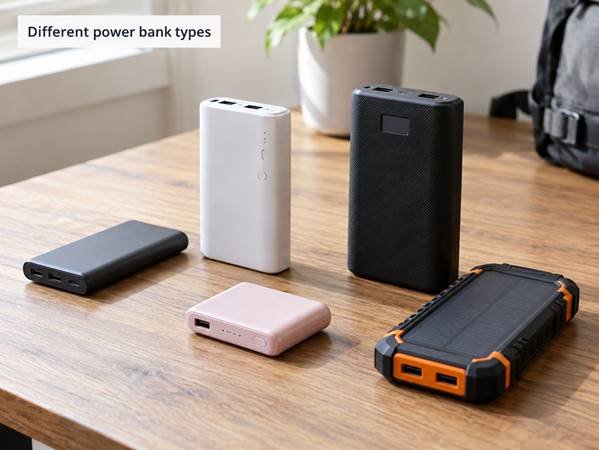
Specifically for product types, in addition to the most common ordinary USB and PD fast charging power banks, those with built-in cables and magnetic wireless charging are all included; products with non-core additional functions such as small night lights, if they meet the scope of power banks, usually still need to meet the power bank CCC requirements.
For composite products such as wall-plug 2-in-1 devices, more attention should be paid: in addition to the power bank function, they may also have AC power supply, power adapter, or charger functions. You should confirm whether they also apply to other CCC product categories or other mandatory requirements based on the actual structure and functions.
There are also some light portable camping energy storage products that may also fall within the CCC scope as long as their parameters meet the above requirements.
Products and Scenarios That Do Not Require Certification
There are several types of products that generally do not fall within the scope of power bank CCC certification, so don’t waste money:
One type is non-consumer-grade products, such as industrial backup power supplies, car emergency start power supplies, and professional equipment with an output voltage exceeding 60V, which are not within the CCC scope of consumer-grade power banks.
The second type is non-independent components, such as built-in batteries of equipment, bare cells, and pure solar panels without energy storage functions, which are not considered power bank products.
The third type is personal use scenarios. For example, if you bring a few power banks from overseas for your own use and not for sale, you do not need to obtain CCC certification as required for business sales.
3-Step Practical Method for Quick Judgment
If you are still unsure, you can use these three steps to make a quick judgment:
Step 1: Don’t just look at whether it is called “power bank” or “portable charger”, but look at the actual product structure and use;
Step 2: Verify whether it is composed of lithium batteries or battery packs, has DC input and output ports, and is mainly used to power portable electronic products;
Step 3: Check whether the weight does not exceed 18 kg and the rated output voltage does not exceed 60V DC. If you are still unsure, directly ask the supplier for the corresponding CCC certificate and confirm that the actual product model is within the scope of the certificate.
Common Misconceptions About Scope Judgment
Regarding scope judgment, there are several particularly common misconceptions that must be avoided:
• Misconception: “Power banks with small capacity do not need CCC”: Correct answer: As long as the product falls within the CCC scope, regardless of whether the capacity is 1000mAh or 20000mAh, CCC certification is required. The capacity size does not affect the mandatory scope.
• Misconception: “If the cell has CCC, the whole machine does not need it”: Correct answer: CCC is for the whole machine product. Even if the cell itself has certification, the assembled power bank still needs to undergo CCC certification separately. Cell certification cannot replace the whole machine certification.
• Misconception: “Power banks that can be bought on e-commerce platforms must have CCC”: Correct answer: Platforms may have missed reviews. You cannot default to having a certificate just because it can be listed on the shelf. You still need to verify it yourself.
• Misconception: “Gifted power banks do not need CCC”: Correct answer: Gifts with purchases and activity giveaways are all part of business activities and still need to meet CCC requirements. Otherwise, you will be fined if found out.
Core Requirements: What Does CCC Certification Check
You may be curious: what exactly does CCC certification check? Can it really block inferior products? Let’s break down the core inspection content into several parts in plain language. After reading, you will know what CCC guarantees and what it does not guarantee.
Battery Body Safety Test (Corresponding to Fire/Bulging Risk)
This is the most core test item, directly related to the most serious safety risks. CCC will conduct safety tests on cells, battery packs, and the whole machine under specified conditions in accordance with applicable standards, such as abnormal charging, short circuit, thermal abuse, and some mechanical strength tests.
For example, it will simulate abnormal charging, over-discharge, short circuit of positive and negative electrodes, etc., to check the safety performance of the product under specified test conditions; it may also involve related tests such as high temperature, mechanical shock, or extrusion. Different test objects, test conditions, and qualification judgments are not exactly the same. The specific shall be subject to the applicable standards, and cannot be simply understood as “never thermal runaway” or “never leak” under any circumstances.
In addition, the effectiveness of the protection circuit must be verified, that is, when an abnormality occurs, whether the protection circuit can limit or cut off the current in time to avoid danger.
Whole Machine Electrical and Structural Safety Test (Corresponding to Daily Use Risks)
This part addresses common risks in daily use:
For example, charging and discharging safety: whether it is normal charging, specified abnormal test conditions, or multi-port simultaneous output, the product needs to meet the safety requirements of applicable standards;
There are also interface and structural strength: the standard will stipulate the mechanical strength, drop, etc. related to portable equipment, aiming to reduce the risks of loose interfaces, short circuits, or exposure of internal components;
In addition, the shell material must also meet corresponding safety requirements such as flame retardancy to reduce the risk of fire in unexpected situations.
Additional Test Requirements for Additional Functions
If the power bank has additional functions, the applicable requirements may also be different, but you cannot make a general judgment just based on “having wireless function”:
Ordinary power banks with only charging function are mainly certified in accordance with the CCC rules and standards applicable to power banks;
When equipped with functions such as wireless charging and Bluetooth finding, whether to add CCC test items shall be subject to the CCC implementation rules applicable to the product and the product classification of the certification body, and cannot be judged generally just by “wireless charging” or “Bluetooth”;
If the product contains radio transmission modules such as Bluetooth and Wi-Fi, it is also necessary to confirm whether type approval is required in accordance with the radio transmission equipment type approval catalog and applicable frequency bands. Although this is not part of CCC certification itself, it may also be a mandatory requirement.
Content Not Covered by CCC Certification (Avoid Over-Expectation)
At this point, it is important to remind that CCC is not a “universal insurance”. There are many contents it does not cover, so don’t have excessive expectations:
| Safety Requirements Covered by CCC Certification | Content Not Covered by CCC Certification |
| Safety tests such as abnormal charging and short circuit under specified conditions | False capacity labeling (falls under the supervision of false publicity) |
| Thermal safety and some mechanical strength tests specified in applicable standards | Performance such as fast charging compatibility, charging speed, and conversion efficiency |
| Whole machine charging and discharging safety and structure-related requirements | Service life indicators such as cycle life and long-term aging |
| Safety requirements such as shell flame retardancy | Safety and performance guarantees under arbitrary drop, water ingress, sun exposure, or long-term use |
Simply put, CCC only manages the “safety bottom line”, not “whether it is easy to use” or “whether it is durable”. For example, if the power bank you bought is labeled 20000mAh but actually only has 10000mAh, this is false publicity, which is under the control of the market supervision department and is not within the assessment scope of CCC certification; another example is that it charges slowly and does not support your phone’s fast charging. These performance issues are not managed by CCC.
2025-2026 Rule Updates: New Version Standard and Traceability Information
If you are in the power bank business for a long time, you should also pay attention to the new version of safety standards and certificate conversion requirements, so as not to step into pitfalls because you don’t keep up with the rules.
Core Changes of the New Version Safety Standard
GB 44278-2024 will be implemented on August 1, 2025. The new version of the standard adds a special safety specification for power banks, and the requirements will be more in line with the product characteristics of power banks; the relevant safety requirements of the whole machine and batteries still need to be met at the same time, which means the standard is more detailed and stricter.
Key Time Nodes for Switching Between Old and New Standards
There are several key time points for the switching between the old and new standards, which must be remembered:
• Starting from August 15, 2025, certification bodies shall implement certification in accordance with the revised implementation rules and the new version of the standard, and issue new version certificates;
• Valid CCC certificates obtained under the old version of the rules shall be converted before August 14, 2026;
• Old certificates that have not been converted after the deadline will be suspended;
• Old certificates that have not been converted by November 15, 2026 will be revoked.
CCC Traceability Information Requirements
Another direction that needs attention is CCC mark traceability information. Some products may be included in relevant pilots, and information such as certificates, models, and certificate status can be queried by scanning the code, making verification more convenient.
However, the application scope, applicable objects, and specific time of traceability information shall be subject to the current pilot announcements of the National Certification and Accreditation Administration and the requirements of certification bodies, and cannot be simply applied with unconfirmed fixed dates. The absence of a QR code does not directly mean that the product is fake. It still needs to be judged based on whether the product falls within the applicable scope, the certification time, and the official certificate query results.
Actual Impact of Rule Updates
The impact of this rule update varies for different groups of people:
For ordinary consumers, when encountering products with traceability information, you can scan the code to assist in verifying the certificate; but for products without a QR code, don’t directly deem them as fake. It is best to check the official certificate information.
For sellers or purchasers, new applications for certification should be prepared in accordance with the current implementation rules of the certification body; those who have already obtained old certificates should remember to complete the conversion before August 14, 2026, don’t wait until the certificate is suspended or revoked to worry.
Full Application Process: From Preparation to Obtaining the Certificate (Including Overseas Entities)
If you are a seller or brand owner and need to apply for CCC certification for your power bank, you should read the following content carefully — especially for overseas entities, the application process is different from that of domestic entities.
Pre-Application Preparation Work
Before the formal application, you should do sufficient preparation work first, which can save a lot of time:
First is product information, including product specifications, cell parameter descriptions, circuit design descriptions, as well as design drafts of nameplates and manuals. These should be prepared in advance. The more complete the information, the faster the review.
Then is entity qualification: if applying as a domestic company, you need a business license; if it is an overseas entity, you must designate a domestic agent or importer to handle the domestic certification process.
There is also institution selection: you must choose a CNCA-designated institution with experience in power bank certification. Don’t look for unqualified intermediaries, otherwise you will spend money but not get a real certificate.
Core Steps of Regular Application
After preparing the materials, the regular application process is roughly divided into four steps:
Step 1: Submit the application and full set of materials to the designated certification body you choose;
Step 2: After the institution accepts the application, you need to send the test samples to the designated laboratory for testing. If the test fails, you need to rectify and retest until you pass;
Step 3: If it is the first time to apply for CCC certification, you also need to accept a factory on-site inspection — that is, auditors go to the production factory to verify and confirm that the mass-produced products are consistent with the submitted samples, not “one sample for testing, another for mass production”;
Step 4: After both the test and factory inspection are passed, the certification body will issue you a CCC certificate.
Description of Cycle and Cost
Many people care about the cycle and cost, here is a reference for everyone:
In terms of cycle, the regular situation is about 3 to 6 months. The specific time depends on whether your materials are complete, whether the test can pass at one time, and how tight the schedule of the factory inspection is. If the materials are missing and the test fails repeatedly, the time will definitely be longer.
In terms of cost, CCC certification is calculated by “certification unit” — simply put, products of the same series with the same core design scheme can be combined into one unit for application, which can save a lot of money; but if they are products with different schemes, they need to apply separately. CCC does not have a unified public quotation, and the specific cost shall be subject to the official quotation of the certification body. Don’t believe the “one-price” online.
Special Rules for Overseas Entity Applications
If an overseas company applies for CCC certification, there are several special rules to note:
First, overseas entities can entrust domestic agents, importers, or subsidiaries to apply. The certificate holder can be the overseas entity itself, not necessarily a domestic company.
Second, even if the factory is overseas, it must cooperate with the on-site inspection of the certification body. The inspection process and requirements are the same as those of domestic factories.
Third, imported power banks within the catalog shall meet CCC requirements and be subject to customs supervision in accordance with the law. For goods that do not meet the requirements, the customs may take technical treatment, return, destruction, or other disposal measures in accordance with applicable laws and regulations; the specific treatment method shall be subject to the actual supervision decision.
Maintenance and Change Rules After Obtaining the Certificate
Obtaining a CCC certificate is not a once-and-for-all matter. You also need to do a good job in maintenance and change management:
CCC certificates are valid for 5 years, and annual supervision and audit are required, which may be sampling testing or factory inspection, depending on the arrangement of the certification body.
If the product undergoes changes in design, materials, key components, production premises, producer information, etc., you should first apply to the certification body for change or confirmation. The certification body will determine whether technical evaluation, supplementary testing, factory inspection, and certificate change are required based on whether the change affects product consistency and compliance; you cannot continue production and sales under the original certificate without confirmation.
In addition, when the certificate is about to expire, you should apply for renewal in advance. If it is not renewed after the deadline, the certificate will become invalid and the product can no longer be sold.
Authenticity Verification: Method for Checking CCC Certificates and Marks
Whether you are buying a power bank individually or purchasing in bulk, the biggest worry is encountering fake CCC certification. In fact, it is not difficult to check the authenticity. As long as you follow the steps, you will basically not step into pitfalls.
Entry-Level Quick Judgment: Check Whether Product Identification Is Compliant
The most basic thing is to first check whether the product’s own identification is compliant:
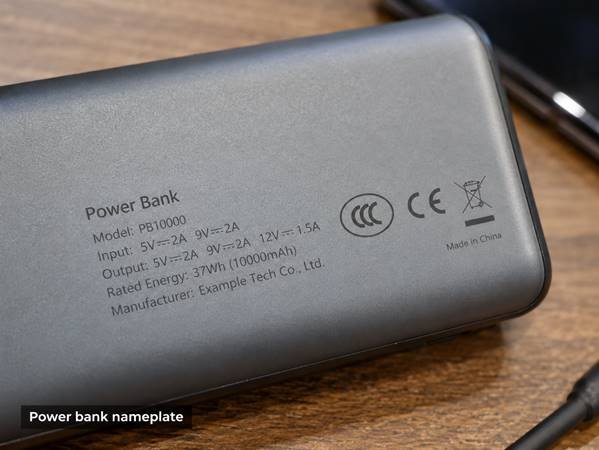
First, look at the CCC mark. The formal CCC mark is a fixed pattern of three “C”s, which must correspond to a valid CCC certificate and be applied in accordance with regulations. Certified enterprises can apply it by printing, molding, etc. on their own in accordance with regulations. Therefore, you cannot judge the authenticity only by the printing method, pattern clarity, or whether it is easy to wipe off. You still need to check the corresponding certificate and verify the product information.
Then look at the marking position. In principle, the CCC mark should be applied to the obvious position of the product body; if it cannot be applied to the body due to the particularity of the product, it can be applied to the minimum packaging or accompanying documents and other appropriate positions in accordance with the management requirements for certification marks.
Then look at the product nameplate. The nameplate of a formal product must have the complete model, brand or manufacturer name, input and output parameters, and the rated energy of the battery (unit is Wh) — if these information are missing, it must be non-compliant.
By the way, let’s talk about the reading of capacity: many people look at mAh, which is the capacity of the cell, while the rated energy Wh is used to judge whether it can be carried in air transport. The two are not the same thing, don’t confuse them.
Official Free Query Channels
Just looking at the mark is not enough. The most reliable method is to check the certificate on the official platform:
Priority is given to CNCA’s official certification information public service platform, which is the most authoritative and the results are correct. When querying, you can enter the certificate number, product model, producer or manufacturer name, any of which can be searched.
There are many third-party certification databases on the Internet, which can only be used for auxiliary verification and cannot replace official queries. Ultimately, the results of the official platform shall prevail.
Core Verification Points of Query Results
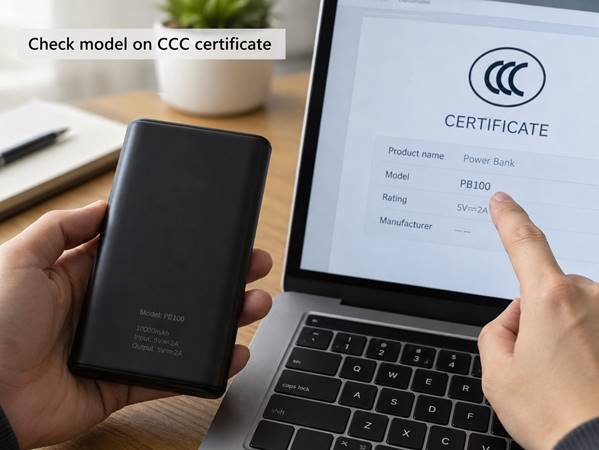
After finding the certificate, don’t just look at “having a certificate” and be done. You also need to check these key points, otherwise it is easy to encounter cases of certificate fraud or information inconsistency:
First, check the certificate status: it must be in “valid” status. If it is suspended, revoked, or expired, it is useless.
Second, check product information: you should confirm that the actual product model and its suffix are included in the certificate and its attachments or the covered model range. Many certificate frauds use certificates of other models in the same series to impersonate, so you can’t just check if the main model is correct.
Third, check entity and identification information: the producer, manufacturer, brand, and product identification on the certificate should correspond to each other, and there should be no unexplainable inconsistency.
Fourth, check the coverage scope: some certificates are shared by multiple models of the same series. You must confirm that the model you bought is in the coverage list of the certificate, and you can’t just check if the main model is correct.
Fifth, pay attention to the applicability of the new version of the rules: the application of the new version of the standard and the conversion of old certificates shall be implemented in accordance with the time specified in the 2025 revised implementation rules, and shall not be simply divided by the production date of a certain product.
Common CCC Fraud Methods
There are four main common CCC fraud methods. Understanding them can help you avoid most pitfalls:
The first is fake mark: that is, the CCC mark is applied to the product, but there is no corresponding valid certificate at all. This can be detected by checking the model.
The second is certificate fraud: that is, using certificates of other models or even other categories of products to impersonate, for example, using the certificate of model A for model B. In this case, you need to carefully check whether the model is within the coverage of the certificate.
The third is invalid certificate: that is, the certificate has expired, been suspended, or revoked, but is still used. This can be found by checking the certificate status.
The fourth is information inconsistency: that is, the parameters and entity information on the certificate are different from the actual product. For example, the output written on the certificate is 18W, but the actual product is 65W. This must be non-compliant.
Pitfall Avoidance Guide and Capability Summary
Finally, we have sorted out the common pitfalls and the skills you can master after learning, so that you can use them as needed.
Identification of Common High-Risk Statements
First of all, there are several common high-risk statements. You must be vigilant when you hear them, and they are basically deceptive:
• “This is the export version, it can be sold in China without CCC” — Correct answer: As long as the product is operated and sold in the Chinese market, whether it is the domestic sales version or the export version, CCC certification is required.
• “The certificate is being processed, it’s okay to sell first” — Correct answer: Products that have not obtained certification must not be put on the market for sale, even if the application is already in progress.
• “Random delivery of the same series, all have certificates” — Correct answer: Each model must be within the coverage of the certificate. You can’t say that all models in the same series have certificates.
• “We have CE/FCC/UL certification, which is the same as CCC” — Correct answer: CE, FCC, and UL have different legal natures and applicable systems, and none of them can replace China’s CCC; products within the catalog sold in China must still meet China’s applicable mandatory requirements.
• “Paid expedited service, guaranteed pass” — Correct answer: CCC does not have an official expedited channel. It must be tested and inspected in accordance with the formal process. Those who say “guaranteed pass” are either liars or rely on illegal operations, and in the end, you will be the one who suffers.
Key Points for Pitfall Avoidance in Different Scenarios
Different scenarios have different key points for pitfall avoidance:
If you are buying individually, try to choose regular channels. After receiving the goods, check whether the product and certificate information are consistent, and avoid products with exaggerated parameters and ridiculously low prices — after all, safety comes first.
If you are purchasing in bulk or doing e-commerce sales, you must verify the certificate for each model you actually sell. It is best to build a correspondence table between models and certificates, and verify with the platform in advance before listing, don’t wait until you are inspected to find problems.
If you are doing OEM or private label products, you should note that you cannot directly use certificates of other brands from the foundry. You must confirm that the certificate covers your current brand and model, otherwise even if the foundry has a certificate, your product is not compliant.
Additional Reminders for Use and Transportation (Limitations of CCC)
Finally, let’s add two reminders about the limitations of CCC. Don’t think that with CCC everything is fine:
First, CCC certification is not equal to air carry permission, but on domestic flights in China, power banks must have a clear CCC mark and must not be a recalled model or batch; at the same time, you must comply with civil aviation regulations on rated energy, quantity, carry-on, and prohibition of checked baggage. Generally speaking, power banks with a rated energy of no more than 100Wh can be carried with you, those exceeding 100Wh but not exceeding 160Wh must be approved by the airline, and those exceeding 160Wh are not allowed to be carried.
Second, even with CCC, you should use it in a standardized manner. Usually, don’t put the power bank in a place exposed to the sun, don’t immerse it in water, don’t cover it with anything when charging. If you find bulging or abnormal heating, stop using it immediately. Don’t take it lightly just because there is certification.
Skills You Can Master After Learning
After reading this article, you can roughly master these levels of skills:
• Entry level: Able to judge whether a power bank falls within the CCC mandatory scope, understand the basic identification on the product, and distinguish the difference between CCC and overseas certifications such as CE and UL, so as not to be fooled by basic statements.
• Intermediate level (semi-proficient): Able to use the official platform to query CCC certificates, check whether the certificate matches the actual product, and also understand what CCC manages and what it does not manage, so as not to have excessive expectations for certification.
• Application level: Able to quickly screen out compliant products when buying power banks personally, clarify compliance requirements when doing cross-border sales or procurement, and even avoid most pitfalls when applying for certification by yourself.
Generally speaking, CCC certification is the first safety threshold for power banks to enter the Chinese market. Whether you are buying or selling, understanding its rules can help you avoid many risks. It is not some profound professional knowledge. As long as you follow the methods mentioned above step by step, even a beginner can understand it.