
Whether you are buying a charger in the U.S. or running a cross-border business in the U.S. market, you have most likely seen labels such as “DOE certification” and “Level VI energy efficiency”. Many people are confused about what it actually is: Is it a safety certification like UL? What is the difference between it and ENERGY STAR? Is it mandatory? How to check the authenticity? This guide explains the DOE energy efficiency requirements for external power supplies thoroughly from entry-level concepts to practical judgment, which can be directly used by ordinary consumers, cross-border sellers, and procurement personnel.
First, Understand What DOE Energy Efficiency Is — Basic Entry-Level Knowledge
Core Definition: Not a “Certificate-Issuing Certification”, but a Mandatory Energy Efficiency Access Requirement
Many people hear “certification” and think it is a model where a third-party institution issues certificates and provides official endorsement, but DOE energy efficiency is completely not the case.
It is a federal mandatory energy efficiency access requirement issued by the U.S. Department of Energy (DOE), commonly known as “certification”, and essentially a combined rule of “energy efficiency standard + testing + declaration + record-keeping”: DOE sets power consumption limits for various external power supplies, enterprises conduct self-testing or entrust testing in accordance with official test methods, then file records in the DOE system, and are responsible for the authenticity of the declared information. DOE does not issue “certification certificates” for any product, nor does it pre-approve or endorse filed products.
The core function of this set of rules is to control the useless power consumption of external power supplies and reduce energy waste in the whole society. For the statutory definition under EPCA/DOE product energy efficiency regulations, “United States” includes the 50 states, the District of Columbia, and Puerto Rico; whether other U.S. territories are subject to it shall be verified separately against local laws and the scope of application of specific federal regulations. Its positioning is the minimum mandatory threshold for sales in the U.S. market — products that fail to meet the requirements cannot be sold legally. It is not an energy conservation excellence award, but only a passing line.
Practical Value for Different Groups
For ordinary consumers, chargers that meet DOE requirements have extremely low standby power consumption when plugged in and not in use, and will not quietly waste too much electricity even if they are plugged into the wall socket all year round.
For merchants or importers doing business in the U.S. market, this is a hard requirement for U.S. customs clearance and e-commerce platform listing; lacking it may lead to cargo detention or product removal.
For procurement personnel, confirming DOE compliance in advance can avoid rework, port detention, and even fines due to compliance issues in the later stage.
Several Most Easily Confused Concepts
Many people confuse it with other similar concepts when they first contact DOE. Here is a clear explanation at once:
• DOE EPS Regulations vs Level VI: DOE is the entire energy efficiency regulatory system. “Level VI” is a common Roman numeral identifier in industry energy efficiency labeling agreements, not a certification grade or official approval mark issued by DOE. DOE regulations specify the average efficiency and no-load power consumption limits for specific EPS categories, and the two cannot be directly equated.
• DOE Energy Efficiency vs Safety and Electromagnetic Regulatory Requirements: DOE only regulates “how much power is consumed”, not “whether it will cause electric shock” or “whether it will interfere with other devices”. It is independent of safety and electromagnetic regulatory requirements and cannot replace each other — passing DOE does not mean safety, and meeting safety requirements does not mean meeting energy efficiency requirements. Take FCC as an example: its rules mainly involve radio frequency and electromagnetic emissions, and applicable devices may adopt different device authorization procedures such as certification or Supplier’s Declaration of Conformity (SDoC), which should not be generally referred to as “FCC electromagnetic compatibility certification”.
• DOE vs ENERGY STAR: DOE is a mandatory minimum access requirement. ENERGY STAR is a voluntary labeling program implemented by product category and specification version; the applicable ENERGY STAR eligibility specifications and DOE coverage for the product shall be verified item by item; ENERGY STAR cannot be generally stated as a unified grade higher than DOE for all products.
• DOE vs EU ErP/UK Energy Efficiency: The applicable regions, test methods, and limit requirements are all different, and they cannot replace each other at all. Chargers that have passed EU ErP cannot be sold directly to the U.S., and vice versa.
Several Most Common Misunderstandings for Beginners
• It is not globally applicable. For the statutory definition under EPCA, the applicable “United States” includes the 50 states, the District of Columbia, and Puerto Rico; other countries, regions, and U.S. territories need to verify applicable rules separately.
• It is not a voluntary energy conservation selection, but the minimum threshold for market access; products that fail to meet the requirements cannot be sold commercially in the U.S.
• The Level VI mark printed on the product is an industry mark, not a certificate issued by DOE. Whether the product can use this mark shall be confirmed by its compliance with the applicable conditions of the corresponding marking agreement and DOE regulatory requirements; whether it is truly compliant needs to be verified in combination with the certification report and the actual situation of the product.
Corresponding Core Regulatory Documents (Advanced Reference)
If you need to check the original text of the regulations, the corresponding U.S. Code of Federal Regulations numbers are:
• Terminology definition: 10 CFR 430.2 (contains statutory definitions of core terms such as EPS and battery charger)
• Energy efficiency limits: 10 CFR 430.32(w) (specifies energy efficiency requirements for different categories of external power supplies)
• Filing and record rules: 10 CFR Part 429 (clarifies filing procedures and record-keeping requirements)
• Test procedure: Appendix Z (DOE official unified test method appendix for external power supplies)
There is a very important date judgment principle: energy efficiency standards and certification reports shall be viewed according to different statutory time points respectively. Energy efficiency standards usually apply according to the manufacturing date and compliance date specified in 10 CFR 430.32 and related final rules; certification reports must be submitted before the basic model is first put into commercial circulation in accordance with the requirements of 10 CFR Part 429. The import or sales date itself is not a unified version judgment rule that replaces the manufacturing date.
Does Your Product Need to Comply with DOE? Scope of Application Determination
Many people think that as long as it is called a “charger”, it is subject to DOE EPS rules, but this is not the case at all. Different charging products belong to different rule systems, and some do not even need to comply. The first step is to clarify the rule diversion.
Rule Diversification Principle for Charging Products
To determine which set of rules a product is subject to, you cannot just look at whether it is called a “charger”, whether it has a USB interface, or whether it can supply power to the terminal — none of these can be used as a separate basis. It shall be judged comprehensively based on regulatory definitions, product structure, intended use, and sales method.
Reference evidence for determination includes product manuals, rated input and output parameters, whether it is sold as a complete system with the battery/terminal, and typical uses. If the boundary is blurred, the actual function and nominal use shall be taken as the core judgment.
Rule Attribution of Common Charging Products
For several types of most common charging products, the attribution shall be understood as follows:
• Standalone External Power Supply (EPS): A standalone device that plugs into the wall to convert low-voltage power and can directly supply power/charge the device, such as ordinary mobile phone chargers and laptop power bricks, are subject to the DOE EPS rules described in this guide.
• Universal USB-C Adapters: Can directly drive terminals such as laptops and monitors, and can also charge devices, belong to EPS and are subject to this rule.
• Docks or adapters only for battery-containing products: For example, a dedicated charging base for a certain electric toothbrush, whether it is subject to DOE battery charger rules or EPS rules, cannot be judged only by whether it can run the terminal without a battery. Whether it can run the terminal without a battery can be used to distinguish between direct-operation and indirect-operation EPS, but it still must be determined based on the definitions of EPS and battery charger in 10 CFR 430.2, as well as product structure and function.
• Built-in charging modules: Charging circuits integrated inside the device, such as power boards in TVs and desktop power supplies, are not subject to EPS rules.
What Exactly is the EPS Regulated by DOE?
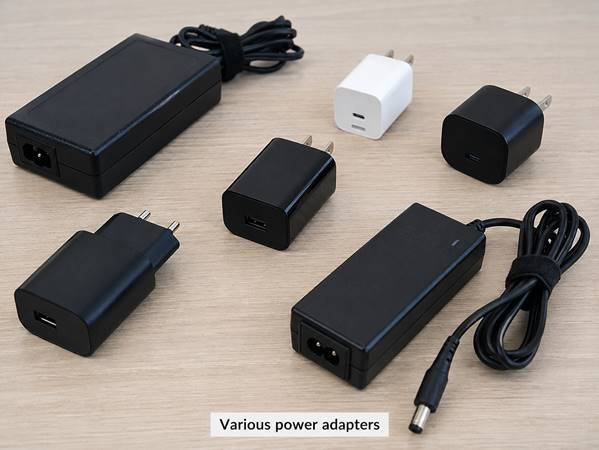
In plain language, it is an independent power supply placed outside the device, plugged into the wall to convert household alternating current into low-voltage power, to supply power or charge other devices.
Typical forms include wall-plug USB-A/USB-C chargers, laptop power bricks, and wired desktop adapters; the core feature is that they are independent of the terminal device, either sold separately or sold commercially together with the terminal device.
5-Step Quick Preliminary Screening Method (For preliminary judgment only, does not constitute a legal conclusion)
If you have a product in hand and want to quickly judge whether it needs DOE EPS compliance, you can first screen it in these 5 steps:
1. Is it a consumer product?: If yes, proceed to the next step; those for industrial/commercial use need to first check the applicable definitions and exclusion clauses.
2. Is it an external independent power supply circuit?: If yes, proceed to the next step; built-in power supplies are not applicable.
3. Is the input household AC mains?: If yes, proceed to the next step; car chargers with DC input are not applicable.
4. Can it directly operate at least one terminal product without a battery?: “Yes” can be used as a clue for judging direct-operation EPS; “no” can be used as a clue for judging indirect-operation EPS. This classification will affect the subsequent energy efficiency limits, but cannot alone determine whether the product is an EPS or a battery charger.
5. Does it fall into clearly excluded/exempt categories?: If no, compliance is required; if yes, follow the exemption clauses.
It should be noted that this method is only suitable for preliminary screening and data preparation, and cannot be used as a legal judgment conclusion. Direct/indirect operation types need to be comprehensively judged in combination with the manufacturer’s intended use, rated output, and manual; if it is a medical/industrial special product, repair spare part, combined sales product, wireless charging system, or product with special output that is doubtful, be sure to find a professional institution to check the specific clauses.
Common Products That Clearly Require Compliance
The following types of charging EPS are clearly within the jurisdiction of DOE: USB-A/USB-C wall chargers for mobile phones/tablets/headphones, laptop power adapters (including PD fast charging models), multi-port USB/USB-C fast chargers (including GaN gallium nitride models), and external DC power supplies for household small appliances.
What Situations Can Be Exempted?
The general principle of exemption is: must simultaneously meet the definition, technical conditions, use conditions and applicable date of current regulations, you cannot just claim to be “for industrial use” to be exempt.
Common situations include:
• Industrial or medical use: Industrial or medical use is not automatically exempt. It shall first be determined whether it is a consumer product and EPS covered by EPCA, and then the applicable definitions, exclusions and compliance dates in 10 CFR 430.2 and 430.32(w) shall be verified item by item; exemption shall not be self-identified on the grounds of “only for industrial/medical use” or “not for civilian use”.
• Car chargers: Those not connected to wall mains and only with DC input are not subject to EPS rules.
• Personal use carry-in/private idle non-commercial transfer: Non-commercial sales scenarios do not require compliance.
• Repair spare parts: Need to meet regulatory conditions such as original factory and specific sales methods, specific details need to be checked, not all repair parts are exempt.
Determination of Several Types of Special Products
• Multi-port chargers: The test configuration shall be determined according to the specific provisions on rated output, output voltage, port status and load settings in the applicable version of Appendix Z, and cannot only look at the power of a single port.
• USB-C PD/PPS fast charging: Changes in output protocols do not automatically exempt, and are still judged by the definition of EPS; compliance is required as long as they meet the definition of EPS.
What Are the Core Requirements? Understand Two Energy Efficiency Indicators
The core of DOE’s energy efficiency requirements depends on two indicators: average efficiency and no-load power consumption, and then corresponds to different limits in combination with product classification.
First Indicator: Average Efficiency (Active Mode Efficiency)
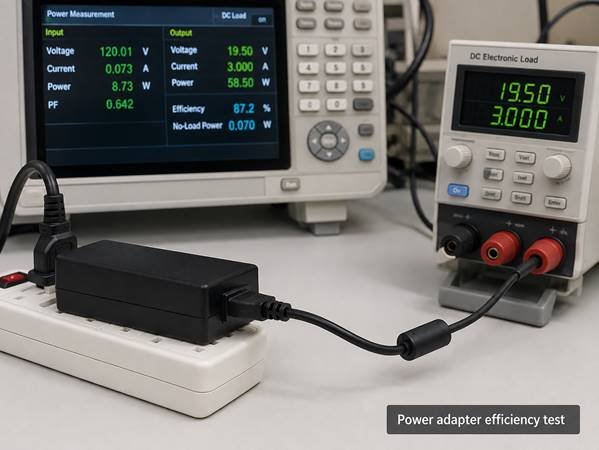
In plain language, it is the proportion of the power output by the charger to the device to the total power it draws from the grid. For example, if 100Wh of electricity is taken from the grid and 88Wh is actually output to the mobile phone, the average efficiency is 88%, and the remaining 12% is wasted as heat.
Its practical significance is very straightforward: the higher the ratio, the less wasted power, and the less heat the charger generates.
It should be specially noted that this efficiency is a weighted average of multiple load points, not the single-point maximum efficiency under a specific voltage and current. Many merchants promote “95% ultra-high efficiency”, which is often only a value at a certain point, not the average efficiency required by DOE, so don’t be misled.
There is no universal “pass line” for qualification judgment, and it shall be calculated according to the category of the product and the statutory limits of DOE.
Second Indicator: No-Load Power Consumption (Zero-Load Power Consumption)
It is the hidden power consumption when the charger is plugged into the wall but not connected to any device. Many people are used to leaving the charger plugged into the wall for a long time, and this power consumption is the source of “power theft” over the years.
The lower the value, the less waste from long-term wall plugging. Qualification judgment is also implemented in accordance with the regulatory limits corresponding to the product category; if the charger has an indicator light or display screen, the test boundary shall be determined according to the test rules, and you cannot turn off the indicator light before testing.
Here is an empirical reference for you: for common low-power Class A AC-DC civilian products, the measured no-load power consumption is mostly between 0.1W-0.5W, which can give you an intuitive concept.
EPS Product Classification Rules
DOE divides EPS into different categories, and different categories correspond to different limits, test procedures and declaration requirements. There are four classification dimensions:
1. Operation mode: direct-operation type / indirect-operation type
2. Current type: AC-DC (alternating current to direct current, such as mobile phone chargers) / AC-AC (alternating current to alternating current, such as some old router power supplies)
3. Output characteristics: basic voltage / low voltage / multi-voltage / high power
4. Class: Class A / non-Class A
The common “Level VI” is not a statutory EPS grade in DOE regulations, but a common Roman numeral identifier in industry energy efficiency labeling agreements. DOE compliance itself depends on the average efficiency, no-load power consumption limits, testing and certification report requirements of the applicable product category, and Level VI cannot be regarded as a statutory conclusion applicable to all EPS.
It should also be noted that category names and limits may be adjusted with the regulatory version, and the specific judgment shall be based on the manufacturing date and compliance date specified in the regulations.
Compliance Judgment Sequence for Energy Efficiency Limits
Don’t just apply a random formula at the beginning. The correct judgment sequence is:
1. Confirm whether the product is EPS and its category.
2. Confirm the manufacturing date, compliance date and corresponding standard requirements specified in applicable regulations.
3. Complete testing in accordance with the provisions of Appendix Z and obtain valid test values.
4. Compare the average efficiency and no-load power consumption with the applicable limit formulas or tables to check whether they meet the standards.
5. Form statutory certification values, and complete the certification report submission before the basic model is first put into commercial circulation.
A reminder: do not directly apply the general formulas found on the Internet. Different categories of EPS have different limits and cannot be compared horizontally — for example, 10W and 100W chargers have different limits, and you cannot say that a 10W charger is unqualified just because its efficiency is low.
Full Compliance Process: From Testing to Continuous Management
After confirming that the product needs to comply, the entire process is not finished after testing. It also requires filing and continuous management, and no link can be missed.
Who is the Primary Responsible Party?
The certification and compliance subject shall be determined in accordance with the statutory definition of “manufacturer” in EPCA and 10 CFR Part 429; this definition can cover manufacturers, importers, and private labelers. When import, OEM, or sales relationships change, it shall be verified who submits the certification report and whether the report information is accurate, and it cannot be determined simply by whether it is a U.S. domestic entity or whether it is an importer alone.
Domestic suppliers and cross-border sellers usually need to cooperate in providing product materials and samples. E-commerce platforms do not replace the compliance obligations of the responsible party, so don’t think that passing the platform listing means everything is fine.
Don’t Confuse Three Types of Compliance Materials
Many people don’t know what materials to prepare. In fact, it is clear to divide them into three types according to their uses:
1. CCMS system declaration fields: That is, the information filled into the DOE official filing system, including product model, rated parameters, manufacturer/importer information, certification values, etc. There is no need to submit the core circuit design, so there is no need to worry about technical confidentiality.
2. Materials required for laboratory testing: Materials provided to the laboratory during testing, such as product parameter sheets, interface configurations, user manuals, etc., shall be prepared according to the requirements of the testing institution.
3. Internal enterprise retention materials: They do not need to be submitted to DOE, but must be kept in accordance with regulatory requirements and must be provided during spot checks, including original test data, design change records, batch correspondence, etc.
What is a Basic Model? Can Save a Lot of Money
Many people think that each sales model needs to be tested and filed separately, but this is not the case. DOE has the concept of “basic model”: a collection of products with consistent energy efficiency characteristics, one basic model can correspond to multiple sales models.
Only when products of the same manufacturer meet the statutory definition of basic model, all differences do not affect energy consumption characteristics, and representative samples and certification values are still representative, can they be included in the same basic model. For example, for chargers with the same circuit scheme, rated power and interface configuration, even if only the shell color is different, a change assessment record shall still be formed; changes in pins, wires, shells and heat dissipation cannot be automatically deemed as requiring no assessment just based on appearance nature.
Here we also need to clarify the relationship between three key terms:
• Basic model: A product group with consistent energy efficiency characteristics, which is the basic unit for testing and filing.
• Certification value: A statutory representative value used for official declaration, which must meet the requirements of test procedures and cannot be marked arbitrarily.
• Rated value: Parameters marked on the product nameplate (such as rated power, output voltage), which must match the test and filing information; you cannot have the nameplate marked 65W while the actual test and filing are both 60W.
The corresponding chain of the entire compliance data is: responsible party → basic model → sales model → representative sample → test data/certification value → CCMS filing → mass production batches and changes, and each link must correspond.
Do You Need to Re-file When the Product is Revised?
Not all revisions require retesting. It depends on whether the change affects energy efficiency characteristics. The assessment dimensions include: whether it affects energy efficiency characteristics, certification values, model mapping, and test representativeness.
Handling methods for common changes:
• Usually low risk, but still need to assess and file: Non-core changes that are unlikely to affect energy efficiency, such as appearance color.
• Need supplementary assessment: Pin style, number of output ports, wire specifications, shell or heat dissipation design, minor control firmware adjustments, etc. Decide whether retesting is required after assessment.
• Usually require retesting/updating certification: Changes that directly affect energy efficiency, such as rated power, core energy efficiency components (transformer/main control chip/rectifier), output architecture, etc.
It should also be noted that the filing of OEM, different brands, and different importers shall be confirmed according to the actual responsible party and CCMS declaration rules, and the filing of other entities cannot be directly applied. The fact that the importer is a certain company does not automatically exclude the manufacturer or private labeler as the certification subject; the key is to confirm who has the obligation to submit the certification report and whether the report information is accurate. As long as the core energy efficiency-related components of the revised product have changed, the old compliance conclusion cannot be directly used.
What Are the Testing Requirements?
Testing can be entrusted to commercial laboratories, or enterprise-owned laboratories can be used, but must strictly follow DOE official test procedures, minimum sample size and statistical sampling rules, and cannot be tested casually by oneself.
Test conditions must be strictly implemented in accordance with the applicable version of Appendix Z. Especially for multi-port and variable output products, the test configuration shall be determined according to the specific provisions on rated output, output voltage, port status and load settings in the appendix. Testing institutions shall not choose favorable conditions that deviate from the regulations on their own, nor can they generally require testing all output combinations.
Here is a reminder for ordinary users: household power meters have insufficient accuracy, and the measurement results are only for daily reference and cannot be used as a basis for compliance judgment. They must be tested with professional equipment in accordance with official test procedures.
The test cycle for conventional civilian chargers is about 1-2 weeks (excluding rectification time). There are three common reasons for failure: low efficiency of old circuits, excessive no-load power consumption, and unqualified efficiency of multi-port products under applicable test configurations.
How to Do the First Filing?
There is a clear time requirement for filing: certification report submission must be completed before the basic model is first put into commercial circulation in the U.S., and you cannot sell first and then supplement.
The declaration channel is DOE’s official CCMS (Compliance Certification Management System). The filing information is publicly available, but DOE does not approve or endorse it, and the authenticity is the responsibility of the declaring responsible party.
Is It Done After Filing? There Are Also Ongoing Compliance Obligations
Many people think that filing is once and for all, but there are still many ongoing obligations:
• Annual certification: Submit an annual certification statement in accordance with regulatory requirements to confirm that the product still meets the requirements.
• Certification value update: If test data proves that the original certification value is no longer valid, the filing shall be updated in time.
• Production discontinuation/delisting management: After the product stops production or is delisted, the status in CCMS shall be updated as required.
• Record keeping: Materials such as test reports and original records, basis for selecting representative samples, certification submission records, basic model/sales model mapping table, etc. shall be retained. The retention period shall be subject to the current DOE regulations, and shall not be discarded at will; they must be provided during DOE spot checks.
How to Mark the Nameplate and Label Correctly?
Products can be marked with industry energy efficiency labels that meet the corresponding conditions, or a manufacturer’s self-compliance declaration can be made.
But note: “Level VI” is a common Roman numeral identifier in industry energy efficiency labeling agreements, not an official DOE approval certificate. Whether the product can use this mark shall be determined after confirming that it meets the applicable conditions of the marking agreement and the corresponding DOE regulatory requirements. Whether it is mandatory to mark and the format specifications need to be verified separately against applicable DOE regulations, industry labeling agreements, and customer/platform requirements.
The label is only the manufacturer’s self-declaration and cannot replace the verification of the certification report and the actual consistency of the product — printing Level VI does not mean it is truly compliant.
How to Verify Whether the Product is Truly Compliant?
Whether consumers buy chargers or purchasers stock goods, they want to confirm whether the product really meets DOE requirements. One of the most practical ways is to check the CCMS public certification information.
CCMS Official Database Query Steps
1. Go to the official website of the U.S. Department of Energy’s external power supply energy efficiency filing database.
2. Enter the product brand, model or filing number to search.
3. Verify whether the filing information is consistent with the physical product.
These Points Shall Be Verified for Filing Information
Don’t directly think that the product is compliant just because you find a record. You also need to check several key points:
• Whether the mapping relationship between the basic model and the sales model is valid: Many times you can’t find the sales model because the certification report is submitted in units of basic models. You need to confirm whether the sales model you have is covered by this basic model.
• Whether information such as brand, manufacturer, importer or private labeler is consistent with the product’s commercial arrangement and product labeling.
• Rated input and output parameters and interface configuration match the physical product — for example, the filing is dual USB-C port 65W, but the physical product is single port 65W, it is necessary to further verify whether it belongs to the same basic model.
• Information such as annual reports and production discontinuation status shall be specifically judged according to CCMS field definitions and Part 429 requirements, and the final compliance or non-compliance of the product cannot be directly presumed based solely on a certain status field.
DOE certification reports are in units of basic models, and whether sales models are listed separately depends on their relationship with basic models and declaration information. CCMS can be used to verify the public information of certification reports, but it is not a DOE approval or final compliance ruling; it is also necessary to verify whether the product is regulated, the basic model coverage relationship, applicable standards, representative values, and the consistency between physical products and mass-produced products.
Nameplate Quick Preliminary Judgment Method (For preliminary screening only)
If it is inconvenient to check the database for the time being, you can first check the product nameplate for preliminary screening, but note that this cannot be used as a basis for compliance:
• Products may be marked with industry energy efficiency grade labels or self-compliance declarations.
• You can compare the marked parameters with the actual configuration of the product to preliminarily check for obvious fraud — for example, the nameplate is marked 65W dual C port, but there is actually only one C port, there must be a problem.
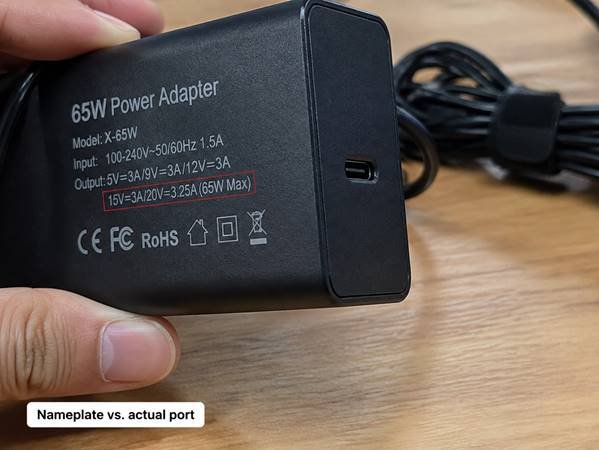
Final compliance cannot be judged solely by CCMS records or nameplates, but also needs to be verified in combination with applicable regulations, certification reports and actual product consistency.
Two Common Verification Misconceptions
• Misconception: No record found means it’s a fake: Not necessarily. Maybe you searched for the sales model, and the certification report is submitted with the basic model, so you need to check the mapping relationship; it is also possible that the product is an exempt category and does not need to submit relevant certification reports at all. When you can’t find a record, first rule out these reasons before drawing a conclusion.
• Misconception: Big brand, GaN technology, high price means it must be compliant: No. DOE certification reports are in units of basic models, and even big brands may have risks of information mismatch or improper handling of product changes; GaN is only a technology to improve efficiency and does not mean it automatically meets DOE requirements; price has no direct relationship with compliance. CCMS records can be used to verify public certification information, but they also need to be judged in combination with the basic model coverage relationship, applicable standards, certification values, and the consistency between physical products and mass-produced products.
Advanced Pitfall Avoidance: Common Risks and Precautions
After understanding the basic requirements, you should also pay attention to some easily overlooked pitfalls to avoid unnecessary losses.
Regulatory Updates Shall Be Proactively Monitored
DOE EPS rules do not have a fixed revision cycle, and they are not updated once a year or every few years. They need to be monitored proactively.
Several key monitoring nodes: new product project initiation, sample testing, product manufacturing, first commercial circulation, and major design changes. At these nodes, it is necessary to confirm whether the current regulations have changed.
Official monitoring channels include the DOE official website, eCFR (Electronic Code of Federal Regulations), and Federal Register.
It should also be noted that there is no default transition period for regulatory updates. The specific compliance date shall be subject to the time specified in the final rule published in the Federal Register. Don’t take it for granted that there is a half-year or one-year buffer period.
Differences in Requirements for Different Sales Scenarios
• Mandatory scenarios: All commercial sales scenarios such as U.S. offline retail, cross-border e-commerce platforms, and brand official websites must meet DOE requirements.
• Non-mandatory scenarios: Personal use carry-in to the U.S. and private idle non-commercial transfer do not require compliance.
• Additional requirements for California: California has its own energy efficiency management regulations. It is necessary to separately determine whether the product is federally regulated EPS, federally regulated battery charger, or California state-regulated category. You cannot just meet the federal requirements, and those doing the California market need extra attention.
Potential Risks of Non-Compliance
The following are possible risks, which are not inevitable, and the specific situation depends on the actual situation:
• Import link: It may trigger customs data verification, cargo detention or return. Moreover, DOE compliance obligation is not equal to CBP (U.S. Customs and Border Protection) pre-approval. It is not that having a filing will definitely clear customs, and the customs may still verify materials.
• Platform link: It may be required to provide compliance documents, and in serious cases, products will be removed from the shelves and account permissions will be restricted.
• Regulatory link: It may be spot-checked by DOE. If non-compliance is found, civil fines will be imposed, and in serious cases, entry into the U.S. market will be prohibited.
Common Types of Compliance Fraud
• Forged test reports: The absence of a corresponding basic model record in CCMS is an important risk signal, but it cannot alone prove that the test report is forged. The certification subject, basic model, sales model mapping, product category and applicability shall be verified, and the report number, sample and report authenticity shall be verified with the laboratory that issued the report.
• Model misappropriation: Use the filing of model A to impersonate model B. For example, A is 65W dual-port, B is 65W single-port, and use A’s filing to muddle through. It can be found by checking the basic model and parameters.
• Old report applied to revised products: After the core energy efficiency components (such as transformers and main control chips) are replaced, there is no retesting and filing, and the old report is still used. This is relatively hidden and requires checking change records and test time.
Take an Example: Compliance Path for a 65W Dual USB-C Wall Charger
So much mentioned earlier may be a bit abstract. Let’s go through the full process with a common product. Note that this is a conditional case, and specific products need specific analysis.
Case Premise Assumptions
Assume that this 65W dual USB-C wall charger is sold independently, the manual clearly states that it can directly power consumer electronics such as laptops and mobile phones, and does not fall into regulatory exclusions. If the product is only part of a specific battery charging system, has a different output architecture, or falls into exclusions, it needs to be re-diversified and judged.
Rule Attribution and Compliance Judgment
This product converts wall power to multi-stage DC output, can directly power laptops, and can also charge mobile phones. It belongs to a standalone external power supply (EPS) and is subject to DOE EPS rules. Judged by the 5-step preliminary screening method: it is a consumer product, external, with AC input, can directly operate the terminal, and has no exemption, so compliance is required.
Product Classification and Test Preparation
The product is classified as: direct-operation type, AC-DC, multi-voltage, Class A, corresponding to DOE statutory limits, official test procedures and declaration requirements. Prepare the product parameter sheet, interface configuration description, and mass production prototype before testing.
Testing and Filing
In accordance with the requirements of Appendix Z, complete the test according to the applicable rated output, output voltage, port status and load settings, and confirm that it meets the corresponding category limits.
Basic model division: Only when products of the same manufacturer meet the statutory definition of basic model, the differences do not affect energy consumption characteristics, and representative samples and certification values are still representative, can they share the same basic model. Changes such as shell color and pin style are usually low risk, but still need to complete the change assessment, and cannot be deemed as requiring no separate handling as a matter of course.
Submit the certification report through the CCMS system before the basic model is first put into commercial circulation, and fill in the corresponding fields.
Verification and Marking
During verification, check whether the basic model, parameters, and certification subject information in the CCMS records are consistent with the product. Whether the product can be marked with the Level VI label shall be confirmed that it meets the applicable conditions of the industry marking agreement and the corresponding DOE regulatory requirements; the mark itself is not an official DOE approval certificate.
Continuous Management and Revision Assessment
Submit the annual certification statement as required. If the transformer or main control chip is replaced during the revision, retesting and filing update are required; only changing the shell color is usually low risk, but the assessment still needs to be completed and records kept.
Practical Checklists for Different Scenarios
Finally, three checklists for different scenarios are sorted out for quick reference.
Ordinary Consumer Purchase Checklist
1. First confirm that the output power and interface match your own device. This is the foundation. No matter how high the energy efficiency is, it is useless if it cannot be used.
2. Check that the product has a clear model, manufacturer information and corresponding energy efficiency label.
3. For important products (such as high-power laptop chargers), you can check the public certification information in the CCMS database.
4. Note: Energy efficiency grade is not equal to charging speed, nor equal to product quality. Energy efficiency only represents low power consumption, and has no direct relationship with charging speed and safety.
Cross-Border Seller/Procurement Personnel Material Checklist
1. Request a complete model list and CCMS certification information, don’t just look at the cover of the test report — also check the coverage relationship between basic models and sales models.
2. Verify that the power, number of interfaces, and core energy efficiency scheme of the test sample are consistent with the actual purchased product, to avoid the sample and bulk goods being different schemes.
3. Confirm that special functions such as multi-port and PD/PPS have been included in the applicable compliance assessment, don’t miss them.
4. Clarify the re-filing mechanism after product revision, such as who is responsible for re-filing after the factory replaces core components and who bears the cost.
U.S. Import Customs Clearance Checklist
1. In accordance with the statutory definition of “manufacturer” in EPCA and 10 CFR Part 429, confirm who is responsible for submitting the certification report; the subject may be the manufacturer, importer or private labeler, and you cannot just look at whether the import subject has exactly the same name as the report subject.
2. Verify that the parameters on the product nameplate, packaging, and sales page are consistent with the certification report information, to avoid the situation where the sales page is marked 65W but the filing is 60W.
3. Confirm that the applicable energy efficiency standard of the product matches the manufacturing date and compliance date specified in the regulations; the certification report shall be submitted before the basic model is first put into commercial circulation.
4. Retain materials such as test reports, filing records, and batch correspondence, which can be provided in time when customs or DOE conduct spot checks.
Summary
After reading this guide, you should be able to independently complete these DOE compliance-related judgments: you can diversify charging products and determine whether DOE EPS rules or battery charger rules apply; you can preliminarily judge whether external power supplies need to meet DOE energy efficiency requirements; you can understand the two core indicators of average efficiency and no-load power consumption and not be misled by publicity; you can preliminarily verify product information through the CCMS database and nameplate; you can distinguish the differences between DOE and Level VI, safety and electromagnetic regulatory requirements, and energy efficiency of other regions; you can avoid common DOE compliance pitfalls when purchasing, procuring, and importing.
This guide is for entry-level reference only and does not constitute legal advice. Specific compliance judgments shall be subject to the current valid regulations of the U.S. DOE and the opinions of professional institutions.