
If you often buy electronic accessories via cross-border e-commerce, select products for cross-border e-commerce sales, or have a pile of chargers from different eras at home, you have most likely seen marks like “IEC 60950” and “IEC 62368”. Some say 62368 is an upgraded version and safer, some say products under the old standard are more reliable, and others confuse standards with certification, thinking that printing the IEC mark means compliance. Today we will thoroughly explain these two most common safety standards for charging products, from basic concepts to practical verification. After reading, you will be able to judge by yourself and not be fooled by merchants.
First, Get the Basics Right: Standards, Regulations, and Certification Are Not the Same Thing
Before talking about the two standards, let’s first clarify the concepts that many people easily confuse: safety-related requirements are actually divided into four levels, progressing step by step from technical reference to legal enforcement. Once you understand them, you won’t be confused by various terms:
The first level is international standards, such as the standards issued by the IEC (International Electrotechnical Commission). They are technical reference manuals jointly formulated by global industry experts, completely voluntary, with no legal enforceability, equivalent to “globally recognized reference answers for safe operation”.
The second level is regional/national standards, such as EU EN standards, Chinese GB standards, and standards issued or adopted by standard-setting bodies such as UL in the United States; some of these standards adopt IEC standards identically or with modifications, and many are not transformed from IEC standards. If cited by local regulations, they may be mandatory.
The third level is regulations/certification systems, which are hard rules set by governments of various countries, such as China’s CCC certification and the EU’s LVD Low Voltage Directive. Products that do not meet the requirements cannot be imported or sold, which is the real “legal red line”.
The fourth level is certification marks/documents, such as CE and CCC marks, or CB reports. Each has different legal effects and different query methods, which cannot be generalized.
Identity and Current Status of the Two Standards
Now that we have clarified the levels, let’s look at the two protagonists of today:
IEC 60950-1 is an old safety standard specially formulated for traditional IT equipment. Its last version was released in 2005, and two amendments were added later. It stopped updating after the A2 amendment in 2013. Most ordinary mobile phone chargers and laptop power adapters in the past were produced according to this standard. At present, the IEC has officially withdrawn this standard, but whether old products can continue to be sold and repaired depends on the transition period regulations of various countries and regions, and it does not become invalid immediately.
IEC 62368-1 is the current mainstream new standard, which merges the original safety requirements for audio-visual (AV) equipment and information and communication technology (ICT) equipment, and adopts the “hazard-based safety engineering” approach (we will explain it in detail later, no need to memorize the terminology). It covers external chargers and power adapters for audio-visual and IT equipment. As for accessories such as charging cables and charging docks, whether they are implemented according to this standard depends on the product use and local regulations. At present, major regions around the world have incorporated it into their compliance systems, and the commonly used versions are the 3rd edition in 2018 and the 4th edition in 2023.
Why Compare These Two Standards?
You may ask, since it is a replacement of old and new, why not just use the new standard? There are three main practical reasons:
First, we are currently in the transition period of the alternation of old and new standards. Many product labels are confusing, some print 60950, some print 62368, and ordinary users are easily confused.
Second, when doing cross-border procurement or sales, different regions have different transition periods and standard adoption requirements. If you make a mistake, you may face goods detention or fines.
Third, new products such as fast charging and gallium nitride (GaN) iterate rapidly. The design framework of the standard directly affects whether the product can be compliant. The fixed parameters of the old standard may limit products with new structures, while the new standard provides different evaluation paths.
Align the Scope Before Comparison: No Irrelevant Products, No Generalized “Which Is Stricter” Claims
Before the formal comparison, let’s clarify the comparison rules first, otherwise it is like comparing the safety of mobile phone chargers and electric vehicle chargers, which has no reference significance at all.
First is the comparison product scope: the core comparison objects are external AC-DC chargers and power adapters for audio-visual/IT equipment (that is, wall-mounted chargers for charging mobile phones, tablets, and laptops in daily life); we will also mention accessories such as USB/USB-C charging cables and charging docks in passing; special power supplies for medical, industrial, automotive, and household appliances are not within the comparison scope, as they have exclusive standards.
Many people care about “how to judge whether a charging product is applicable to IEC 62368-1”, which can be judged according to this logic:
- Directly applicable: external chargers and power adapters matched with audio-visual/IT equipment, such as original chargers for mobile phones and laptops.
- Need to be combined with other standards: separately sold USB charging cables and powered charging docks. Such products may also need to comply with relevant standards for cables and power strips, and cannot only look at 62368.
- Not directly applicable: special-purpose power supplies, such as power supplies for refrigerators, medical equipment, and industrial equipment, all have their own exclusive standards.
The final judgment shall be subject to the product use, target market regulations, and professional opinions of the certification body, and you cannot guess randomly.
Let’s also clarify the standard versions used for our comparison today: IEC 60950-1 uses its final version (2005+A1:2009+A2:2013), and IEC 62368-1 uses the current mainstream 2018 3rd edition and 2023 4th edition. Which version the target market adopts, and whether it is identical adoption, modified adoption, or has other national differences, must be confirmed item by item; you cannot assume that the technical requirements or compliance conclusions are the same just because the standard number prefix is similar.
Finally, the comparison principle: the content is for ordinary users and entry-level procurement, without talking about complex laboratory engineering details. The core comparison is made in dimensions closely related to everyone: design framework, electric shock protection, fire and heat resistance, mechanical strength, abnormal testing, and labeling requirements. Moreover, we will not generally say “which is stricter”. Strictness depends on specific products and scenarios and cannot be generalized.
Core Framework Difference: From “Answering by Rules” to “Guarding Against Risks”
The most essential difference between the two standards is not that a certain parameter has changed, but that the design ideas are completely different.
IEC 60950-1: Prescriptive Safety Framework
The old standard mainly organizes safety requirements according to equipment categories and preset clauses, including a large number of prescriptive structure and test requirements, which can be understood as “standard answer exams”. However, it does not completely fix all structures, materials and parameters: specific limits and test conditions still depend on components, materials, working conditions and clause applicability conditions.
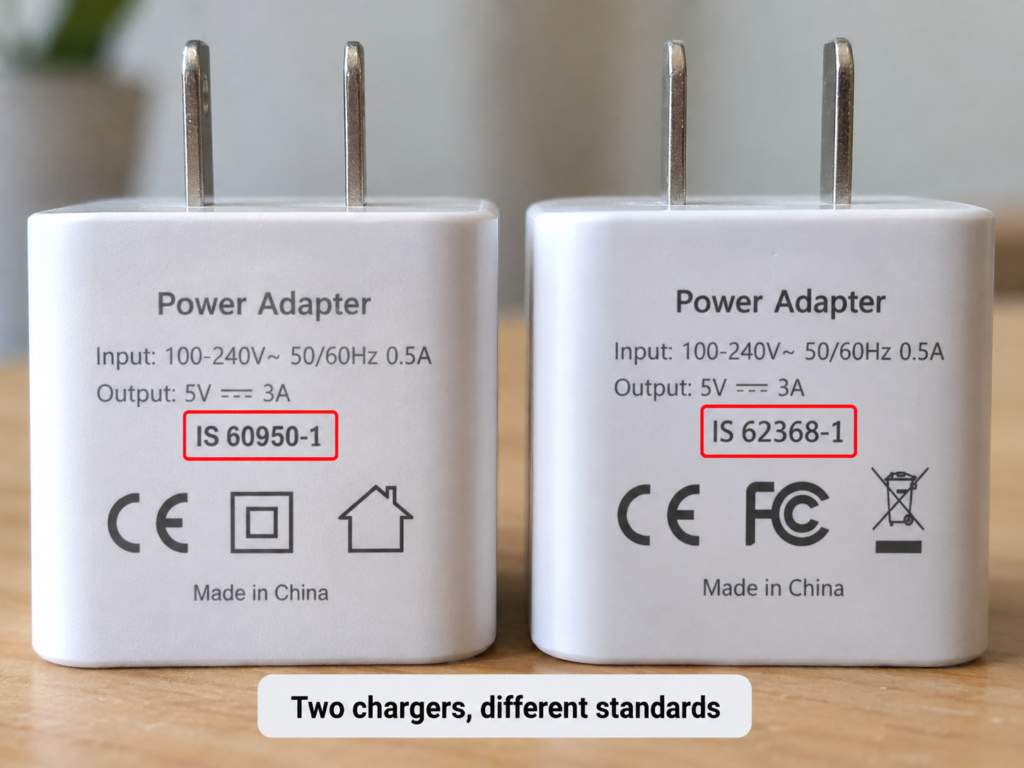
Take a charging product as an example: the insulation design in an old charger needs to evaluate the insulation, clearance, material properties and related test results according to applicable clauses. Even if new materials with better performance are used, compliance cannot be judged independently without the conditions specified in the standard.
IEC 62368-1: Hazard-Based Safety Engineering (HBSE) Framework
The logic of the new standard is to first identify what hazardous energy sources are in the product, such as high-voltage electricity and high-temperature components; then see whether the user of the product is an ordinary person or a professional; then judge whether the hazardous parts can be touched by the user; finally, adopt appropriate protective measures in a targeted manner.
IEC 62368-1 takes energy sources, personnel categories and protective measures as the organizational framework; under this framework, applicable structure, insulation, clearance, material and test requirements are still specified. Design flexibility can only be achieved within the protective measures and verification methods allowed by the standard. It is not that any structure or material can be qualified as long as it self-proves that “the risk is controllable”.
There are several core concepts that you don’t need to memorize, just understand the logic:
- Energy source classification: hazardous energy such as electric energy and thermal energy will be graded according to rules. The higher the grade, the stricter the protection requirements usually are. The energy source grade cannot be judged directly by the nominal 65W or 10W of the whole machine, but must be determined according to the classification rules of IEC 62368-1 for specific energy sources and their normal and abnormal conditions.
- User classification: divided into three categories: ordinary persons, instructed persons, and skilled persons. Ordinary persons usually need the most sufficient protection — after all, ordinary people do not understand electricity and should not be injured even if they touch it by mistake.
- Accessibility: that is, whether hazardous parts can be touched by users. For example, the high-voltage circuit board inside the charger is not accessible to users during normal use; but the metal parts of the USB port belong to the area that users can touch, and protection needs to be designed according to applicable requirements.
- Protective measures: hazards are blocked through structural design, insulating materials, and protection circuits. Each type of protection has corresponding requirements and tests, not just verbal statements.
Take insulation design as an example: when a new GaN charger uses a new type of insulating material, it cannot only look at whether the material thickness is thinner, but must confirm whether it meets the applicable insulation, fire protection and test requirements according to the corresponding clauses.
Practical Impact of Framework Differences
The impact of this change in thinking is very intuitive: for manufacturers, 62368-1 may provide different compliance evaluation paths for new designs such as fast charging and miniaturization, without having to judge only from the perspective of traditional fixed structures; but the reason why GaN chargers can be made smaller mainly depends on GaN device characteristics, circuit topology, magnetic components, thermal design and overall design, and cannot be simply attributed to standard changes.
For users, the new framework emphasizes more whether the energy sources, accessible parts and protective measures in the product match the actual risks.
Here we must clarify one of the most common misunderstandings: HBSE does not mean looser requirements. It only changes the logic of proving safety, not reducing safety requirements. Products still have to pass a large number of tests and meet structural and material requirements. Moreover, the more complex the function and the higher the energy level of the product, the more risk points need to be identified, and the more comprehensive the protection requirements.
As for how big the difference in requirements between the two standards is, it cannot be judged only by the nominal total power of the product or a single voltage; but the standard still includes specific voltage, current, power thresholds and conditions for energy source classification and protection judgment. For products with low energy and simple structure, the requirements of the two standards may have a lot of overlap; for products with high energy and new structures, they need to be judged item by item according to the actual design and applicable clauses.
Core Review Points for Converting Old Products to New Standard (Must-Read for Entry-Level Procurement)
If you are engaged in procurement or cross-border sales, and old products need to be converted to new standard certification, you should focus on checking the following aspects:
- Insulation and key components: re-evaluate according to the new energy grade, and cannot directly apply the parameters of the old standard.
- Energy source and protection classification: re-identify the energy grade of the product, applicable user type, and accessibility of hazardous parts. If the classification changes, the protection requirements will also change.
- Charging ports: evaluate the accessibility of output ports and the risks under abnormal conditions, such as whether there is a risk of electric shock when fast charging outputs high voltage.
- Abnormal operating conditions: identify applicable abnormal operation, fault and protection tests item by item according to the new standard. It cannot be assumed that 60950-1 does not cover situations such as blocked ventilation, nor can it be assumed that 62368-1 requires testing for all misuses.
- Materials and enclosure: re-evaluate according to the new fire and heat resistance requirements, and cannot directly use the flame retardant grade of the old standard.
- Documents and labeling: update safety justification documents and product labels to meet the requirements of the new standard.
Core Requirement Comparison: See Differences from User-Perceivable Dimensions
The difference in the framework will eventually fall on specific safety requirements. Let’s first put a general table of core dimension comparison for quick understanding, and then explain them one by one in detail later:
| Comparison Dimension | Core Logic of IEC 60950-1 | Core Logic of IEC 62368-1 | Typical Scenario for Charging Products |
|---|---|---|---|
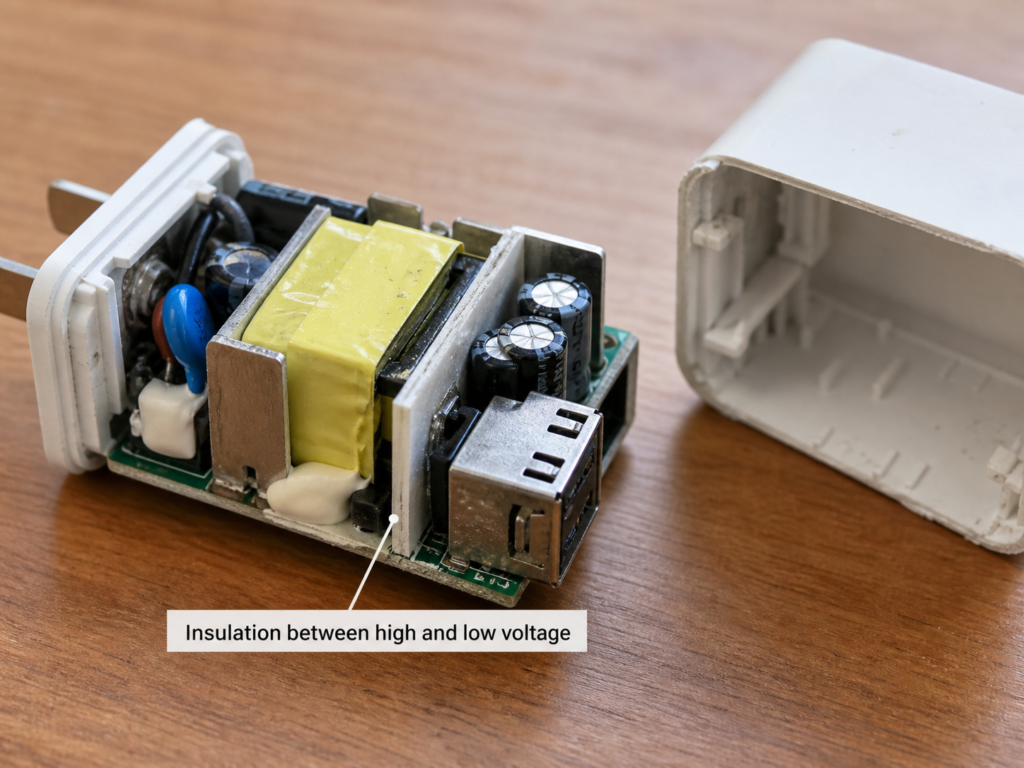
| Electric Shock Protection | Specifies insulation, clearance and test requirements per equipment and component conditions | Determines applicable requirements per energy grade, accessibility and protective measures | Insulation of USB port metal parts, isolation between high and low voltage sides |
| Fire and Heat Resistance | Specifies material, temperature rise and fire protection requirements per applicable clauses | Determines applicable requirements combined with energy sources, protective measures and fire risk | Temperature rise under full load fast charging, internal fire protection |
| Mechanical Strength | Determines test conditions per equipment category, mass, installation method etc. | Also determines requirements per specific equipment classification, risks and clauses | Pin tensile force, protection of live parts after drop |
| Abnormal Operation Test | Verifies abnormal operation and fault conditions per applicable clauses | Verifies abnormal operation and faults per energy sources, protective measures and applicable conditions | Protection against blocked cooling holes, multi-port overload protection |
| Labeling Requirements | Has conditional requirements for rated values, identification information, warnings and manuals | Also specifies labeling, warnings and manual requirements per product and applicable conditions | Multi-gear fast charging parameter labeling, high power accessory warnings |
Electric Shock Protection: From “Checking Dimensions” to “Checking Effects”
The old standard 60950-1 will put forward specific requirements for insulation, air distance between high-voltage components (electrical clearance) and distance along the insulating surface (creepage distance), etc., but the specific values and test conditions depend on the equipment, components, materials and working conditions.
The new standard 62368-1 determines applicable requirements according to the hazard level of energy sources, accessibility of components and protective measures. It does not cancel the provisions on insulation, clearance and materials, but puts these requirements into the framework of energy sources and protective measures for judgment.
Corresponding to charging products, it mainly affects three aspects: isolation requirements between the high-voltage side (the side connected to the mains) and the low-voltage output side (the side connected to the mobile phone); insulation or grounding design of user-accessible conductive parts (such as USB port metal pieces); electric shock risk of the output port under abnormal conditions, such as whether the 20V fast charging output will leak to the parts that users can touch.
As for which is stricter, it depends on factors such as input voltage level, output energy level, accessible metal component design, insulating material type, and the standard version adopted by the target market, and cannot be generalized.
Fire and Heat Resistance: From “Checking Limits” to “Combining with Risks”
The old standard 60950-1 will put forward applicable requirements for enclosure materials, operating temperature rise and fire risk.
The new standard 62368-1 also determines relevant requirements in combination with energy level, fire risk, usage scenarios and protective measures, and pays attention to whether overheating may cause risks such as electric shock, fire or thermal burns.
Here is a little common sense: the marks such as UL 94 V-0 and V-1 that you often see on material data are material combustion performance test and grading standards formulated by UL of the United States. V-0, V-1, and V-2 are vertical combustion grades, and HB is a horizontal combustion grade. Whether UL 94 material data can be used as evidence in 62368-1 or 60950-1 compliance shall be determined by specific clauses and certification schemes; UL 94 grade cannot be regarded as content that is uniformly and naturally applicable to the two IEC standards.
Corresponding to charging products, it mainly affects two scenarios: the temperature rise of the enclosure under full load fast charging, which should not burn users or affect the life of internal components; the fire protection requirements of the enclosure corresponding to the internal fire risk, which should not allow fire to escape to the outside.
The strictness of fire protection requirements depends on conditions such as maximum output power, heat generation of internal components, enclosure materials, heat dissipation structure, use environment, and the standard version adopted by the target market.
Mechanical Strength: Judge Item by Item Per Product Conditions
Mechanical strength cannot be simply summarized as “60950-1 has unified tests, 62368-1 tests according to energy grade”.
In fact, both standards set mechanical requirements for equipment category, portability, mass, installation method and specific risks. When converting standards, applicable mechanical tests should be compared item by item, rather than concluding only based on the “portable” or “fixed” label.
Note: The plug-in and pull-out and tensile tests of USB charging cables are regulated by cable standards and USB-IF specifications, not uniformly specified by 62368. Don’t confuse them.
Corresponding to charging products, it mainly affects two aspects: the tensile force and bending resistance requirements of the charger pins; the insulation performance of the portable charger after falling, and whether the live parts will be exposed. The difference in mechanical strength requirements depends on conditions such as use scenario, product weight, enclosure material, structural design, and the standard version adopted by the target market.
Abnormal Operation Test: Not “Testing All Misuses”
The old standard 60950-1 does not only test a few fixed items. It itself includes requirements for abnormal operation and fault conditions, which may involve specific situations such as short circuit, overload, and blocked ventilation.
The new standard 62368-1 requires verifying the effectiveness of protection under reasonably foreseeable use, abnormal operation and fault conditions according to applicable clauses. It does not require testing all possible misuses or faults one by one, but determines the test items according to energy sources, protective measures and specific clauses.
After the test, the equipment may fail or be unusable, but must not cause unacceptable hazards such as electric shock, fire, and thermal burns. For example, after the overheat protection is triggered, the equipment does not necessarily have to resume normal function, but it cannot leave a risk that will cause injury.
Corresponding to charging products, there are mainly two scenarios: overload and short circuit protection of fast charging chargers; overheat risk protection after the cooling holes are blocked. The number of abnormal test items depends on output power, number of protocols, protection circuit design, product structure and applicable clauses.
Labeling Requirements: Can’t Simply Say Which Is Stricter
Both the old standard 60950-1 and the new standard 62368-1 specify conditional requirements for the labeling and manuals of applicable equipment. What input and output rated values, warning words or identification information need to be marked on the charger body must be confirmed according to specific product clauses, applicable versions and target market regulations, and cannot be generally compared as 62368-1 being stricter.
Supplementary note: It is not mandatory in all regions to print the standard number on the product. It depends on the regulations of the target market. You cannot say that the product is non-compliant just because it does not print the standard number.
Corresponding to charging products, common ones are the output parameter labeling of multi-gear fast charging chargers, and the rated current and power labeling of high-power charging accessories. Requirements may vary from region to region and product to product.
Global Compliance and Verification Methods: Don’t Be Fooled by Fake Certifications
It is not enough to know the differences between standards. When buying things or doing cross-border business, the ultimate goal is to implement how to check compliance and how to meet the requirements of different regions.
Compliance Requirements for Charging Products in Major Regions
Let’s first sort out the compliance requirements of major regions around the world to avoid pitfalls:
- EU: It is necessary to meet the LVD Low Voltage Directive, EMC Electromagnetic Compatibility Directive, RoHS Restriction of Hazardous Substances Directive, etc. For harmonized EN standards cited in the Official Journal of the European Union (OJEU) and fully applied, manufacturers can obtain the presumption of conformity with the basic safety requirements of the LVD within their coverage; however, they must still fulfill applicable technical documentation, EU Declaration of Conformity, CE marking and other regulatory obligations.
- China: The current mandatory standard is GB 4943.1-2022, which is a modified adoption of IEC 62368-1:2018 (MOD). It has been officially implemented and replaced the old standard corresponding to 60950.
- United States: There is no unified federal safety certification covering all consumer chargers. NRTL listing is often required by workplace rules, local competent authorities, channels or contracts; NRTL is a laboratory system accredited by OSHA. The FCC mainly regulates radio frequency emissions and related equipment authorizations, and cannot be simply equated with complete EMC safety or immunity compliance.
Reminder: The mandatory scope, transition period, and adopted standard version of each region may change. Be sure to refer to the latest local official documents, and don’t take it for granted.
Common Compliance Verification Methods
How do ordinary users and procurement personnel verify whether a product is truly compliant? There are three common methods:
First, check the product body label: whether there is a certification mark for the corresponding region, and whether the rated parameters are complete; some products will print the implementation standard number, but this is not a mandatory requirement and can only be used as a reference.
Second, check public certification information: certifications such as CCC, UL, and ETL can be queried through official channels for the certificate coverage to see if the model you bought is in the certification list.
Third, request compliance documents: for bulk procurement, you can ask the supplier for formal documents such as certification reports and EU Declaration of Conformity (EU DoC).
Pitfall tip: If the merchant only promotes “compliance with international standards” but cannot produce any verifiable information, it is basically a scam and cannot prove that the product is truly compliant.
Verification Boundaries of Authoritative Databases
Many people don’t know what different authoritative databases can check, and often use them wrong. Let’s clarify the boundaries of each database:
- IEC Webstore: You can check the version and status of IEC standards, for example, to confirm whether 60950 is really withdrawn, but you cannot check whether a specific product has certification.
- IECEE CB Scheme: You can check CB certificate information. CB certificates can be used to convert to certifications in other regions, but they cannot directly prove that the product meets the compliance requirements of the target market — additional testing for local special requirements may be required during conversion.
- Official website of CNCA / certification bodies (China): You can check the status and covered models of CCC certificates, which is the most authoritative query channel in China.
- Official Journal of the European Union (OJEU): You can query whether an EN standard is cited as a harmonized standard and its scope of presumption of conformity; this citation does not make the EN standard itself a naturally mandatory legal provision, nor can it query specific products.
- UL Product iQ / ETL Database: You can check the product models and scope of UL and ETL certifications. Some functions require a registered account to use.
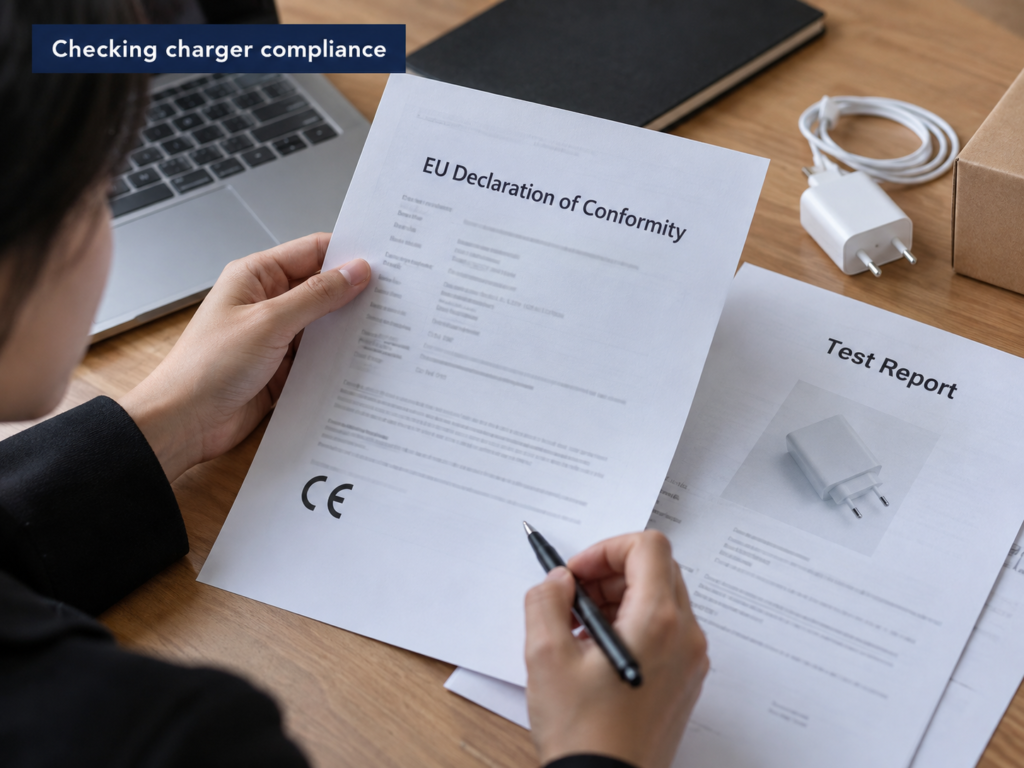
Special reminder: There is no unified official CE certification database! Because CE is a manufacturer’s self-declaration, not an officially issued certificate. Most of the so-called “CE certification query official websites” on the Internet are third-party and unreliable. To truly verify, you need to ask the manufacturer for the EU DoC and corresponding technical documents.
Compliance Boundaries of Charging Products
There are several compliance boundaries for charging products that many people can’t figure out. Let’s clarify them all at once:
- AC-DC chargers and power adapters for audio-visual/IT use: Safety requirements and required documents shall be confirmed according to product use, rated input and output, sales method and target market regulations.
- USB/USB-C charging cables: They need to meet applicable cable safety requirements, but whether 62368 applies depends on product positioning and target market regulations, and regulations may vary from region to region.
- Charging kits (charger + cable): They need to be compliant as a whole. It is not allowed that only the charger has passed the certification while the cable is unqualified.
Notes for Cross-Border Procurement/Sales
If you are engaged in cross-border procurement or sales, there are three key points to note:
First, safety requirements and required documents shall be confirmed according to product use, rated input and output, sales method and target market regulations. If regulations, certification systems, customs or customers explicitly require 62368-related compliance certificates, corresponding documents covering the model shall be provided.
Second, for old inventory with 60950 certification, be sure to first confirm whether it can continue to be sold during the transition period of the target market. Don’t wait until the goods are shipped to find out that they cannot be sold.
Third, when the product is modified (such as changing power, port, enclosure material, key components), it must be evaluated by the certification body, and may require supplementary testing or even re-certification. You cannot secretly modify it and sell it, even if the appearance is exactly the same.
Common Misconceptions to Avoid: Don’t Be Fooled by Publicity
After talking so much, you may still be confused by various publicity on the Internet. We have sorted out 12 of the most common misconceptions to help you avoid pitfalls.
Standard Cognition Misconceptions
- Misconception: 62368 is a simple upgrade of 60950 — Wrong. The core frameworks of the two standards are completely different. It is a replacement relationship, not a version iteration, which is equivalent to changing from “judging compliance by size” to “judging compliance by risk”, not as simple as changing a few parameters.
- Misconception: Products with 60950 certification are unsafe — Wrong. 60950 certification does not mean that the product itself is necessarily unsafe, but compliance with applicable requirements in history does not mean that it is naturally safe after years of use. Old chargers should be stopped immediately if there is damage, odor, abnormal heating, intermittent operation, loose plug or recall information; even if there is no obvious abnormality, it cannot guarantee its safety status.
- Misconception: Products passing 62368 must be better than those passing 60950 — Wrong. Standards are only the bottom line of safety. The specific safety also depends on the manufacturer’s workmanship and component quality. Some small factory products have passed 62368 but use inferior components, which are less reliable than the old products of big factories that have passed 60950.
- Misconception: IEC standards are globally mandatory — Wrong. IEC is only a voluntary technical reference. Whether it is mandatory depends on whether the target country adopts the standard. Some small countries do not adopt 62368, and products with 60950 can still be sold.
Product Cognition Misconceptions
- Misconception: Safety standards can prove fast charging performance — Wrong. Safety standards only manage safety risks, not charging speed, protocol compatibility, or data transmission capability. A charger that has passed 62368 may not support your mobile phone’s fast charging, and charging may be very slow.
- Misconception: Data cables do not need to meet safety requirements — Wrong. High-power USB-C cables shall have a rated capacity matching the actual current and protocol; applicable cable safety, material and flame retardant requirements depend on the specific product and market. Don’t take 65W as a general safety regulation dividing line.
- Misconception: Low-voltage output products are absolutely safe — Wrong. Although the output is low voltage of 5V and 20V, if the current is large and the contact is poor, it will also cause overheating and fire. For example, a loose charging cable interface may heat up and burn out.
- Misconception: All charging products are applicable to 62368 — Wrong. Whether 62368 is applicable shall be determined in combination with product use and target market regulations. For example, electric vehicle chargers and electric toothbrush chargers may be applicable to other standards, not 62368.
Certification Verification Misconceptions
- Misconception: Printed standard number/certification mark means true compliance — Wrong. Many small factories will print fake certification marks by themselves. It is true compliance only when the certification body, product model and official query results are consistent.
- Misconception: Products with the same appearance can share certification — Wrong. Even if the appearance is exactly the same, as long as the internal components, power, and ports are changed, it may affect safety. The certification change process must be followed, otherwise it is non-compliant.
- Misconception: One certification mark represents all compliance — Wrong. Safety, electromagnetic compatibility, and energy efficiency are different compliance dimensions and cannot replace each other. For example, the UL mark only represents safety qualification, does not mean that it meets FCC-related requirements, nor does it mean that energy efficiency meets the standards.
- Misconception: There is a unified CE certification database to check — Wrong. CE is a manufacturer’s self-declaration, and there is no unified official database. You must request the EU DoC and technical documents from the manufacturer to verify.
Practical Judgment Methods: No Need to Memorize Standards, Just Follow Along
Finally, we have sorted out practical judgment methods for people with different needs. You don’t need to memorize complex standard clauses, just follow along.
Ordinary Users: 3-Step Quick Judgment Method
Step 1: Check the compliance certification mark of the corresponding region. For domestic purchases, look for CCC, for the EU look for CE, for the US look for UL/ETL. Be cautious to buy those without marks.
Step 2: Check the clarity of the product label. The rated parameters should be complete. Those with rough printing that can be scraped off with a fingernail are mostly inferior products from small factories. Don’t buy them.
Step 3: Prioritize brand products with reliable sources and verifiable compliance information. Don’t buy unbranded, no-name “three-no” products. Saving a few dollars is not worth the loss.
The selection logic for different usage scenarios is also different:
- Daily home high-power fast charging: choose products with rated parameters matching the equipment and verifiable compliance certification. For example, for a 65W laptop, buy a charger with 65W or above and formal certification.
- Old chargers for old equipment: if there is damage, odor, abnormal heating, intermittent operation, loose plug or recall information, stop using them. Even if there is no obvious abnormality, it cannot be concluded that it is still safe only based on historical certification or intact appearance.
- Portable use on the go: choose portable models with sturdy enclosures, firm pins and compliance certification, such as GaN chargers. But don’t just look at the small size, be sure to check the certification.
Entry-Level Procurement / Cross-Border Sellers: 4-Step Verification Method
Step 1: First clarify the applicable regulations, mandatory standards and implementation time of the target market. Don’t wait until the products are made to find out that they do not meet the requirements.
Step 2: Check the certification report or declaration of conformity provided by the supplier to see if the standard version is correct and whether the covered model is the model you want to purchase.
Step 3: Confirm that the key components of the product (enclosure, transformer, interface) are consistent with those in the certification report, to prevent suppliers from secretly replacing components.
Step 4: For high-power, multi-port, new-structure products, additionally check whether the risk coverage meets the requirements. For example, for 120W multi-port fast charging, confirm that abnormal tests, fire protection and other items are fully done.
General Pitfall Avoidance Reminder
Don’t buy “three-no” charging products with no brand, no rated parameters, and no verifiable compliance information; don’t believe exaggerated publicity such as “exceeding national standards” and “meeting all standards”, be sure to look at verifiable compliance materials; if the equipment requires USB PD 100W (20V, 5A) gear, use a USB-C cable that supports 5A, has a corresponding electronic marker and is of qualified quality. The actual charging power is negotiated by the charger, equipment, protocol and cable together, so don’t judge only by the maximum power on the charger nameplate.
Summary
Finally, let’s summarize the core difference between the two standards in one sentence: IEC 60950-1 is an old prescriptive safety standard for IT equipment, which mainly relies on preset clauses and conditional requirements to judge compliance, and has been withdrawn by the IEC; IEC 62368-1 is a new generation of hazard-based safety standard covering audio-visual and ICT equipment, which organizes requirements according to energy sources, accessibility and protective measures, and is the current global mainstream compliance framework.
After reading this article, you should be able to distinguish the meaning of the two standards, and not be fooled by publicity such as “simple upgrade” and “absolutely safer”; be able to initially judge whether a charging product is applicable to 62368, and not misapply the scope; be able to verify the authenticity of certification through official channels and compliance documents; be able to choose charging products that meet safety requirements according to usage scenarios and target markets; and be able to avoid common standard and certification publicity traps.
Charging safety is no trivial matter. Spending one more minute checking the certification can reduce one more risk.