
Have you ever had these experiences: a power bank you bought via overseas online shopping gets detained by customs right after arrival, or a power bank you purchased from an e-commerce platform swells up not long after use, but you find the product source is unclear when you want to ask the seller to handle it, or even when you take a flight, your power bank is obviously not large in capacity but is stopped by security check due to unclear labeling? These problems are often related to whether the product meets the requirements of the place of sale, place of transportation, or the airline.
Many people’s impression of certification is a bunch of incomprehensible marks printed on products, either thinking they are useless, or assuming that a product with a mark is a good product. In fact, compliance marks are an important threshold for power banks to enter local markets, and also help you confirm the product source and responsible party. In this article, we will start from the most basic concepts, cover how to verify authenticity and how to avoid pitfalls, to help you thoroughly understand everything about global certifications for power banks.
Foundation: Core Logic of Certification
What is Power Bank Certification
Simply put, the compliance proofs required for power banks to enter the market are not necessarily all the same type of “certification certificate”.
Mechanisms vary across countries and regions, and may include third-party certification, third-party test reports, manufacturer’s declarations of conformity, and statutory marks, among others. Whether testing, audit or certification issuance by a third-party body is mandatory depends on product functions and the specific regulations of the target market.
Here are three key points to remember first, which can help you avoid many promotional traps:
First, compliance is usually only a minimum requirement. It does not mean that a product with a compliance mark is necessarily of the best quality; it only indicates that it has completed the corresponding conformity assessment in accordance with applicable rules.
Second, it is completely different from the “High-Quality Product” or “Safety Certification” stickers printed by manufacturers themselves. Formal market compliance should be supported by bases such as regulations, standards, test documents, declarations of conformity, or responsible entities; self-proclaimed promotional slogans from manufacturers do not have the same legal effect in themselves.
Third, do not confuse several related concepts: the “standards” we often talk about are like exam syllabuses, which specify which items need to be tested; “testing” refers to sending samples for testing and finally issuing a test report; while “certification” is a procedure in some markets or product categories where a designated body confirms that requirements are met. For example, the EU CE mark, some UKCA rules in the UK, and many FCC Supplier’s Declaration of Conformity (SDoC) in the US are usually not certification certificates issued item by item by the government, but are completed by manufacturers, importers or other responsible parties who conduct assessments, keep documents and make declarations.
Scope of Covered Products
Which power banks do these rules we mentioned apply to? From a daily understanding, portable products with built-in energy storage batteries that can supply power to external devices usually involve compliance issues such as battery transportation, safety, electromagnetic compatibility, or environmental protection.
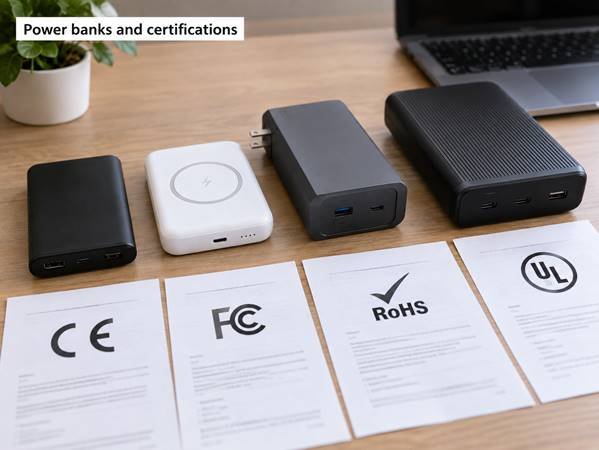
Specifically, they include ordinary USB/USB-C wired models we use daily, models supporting wireless charging or magnetic attraction, 2-in-1 charger + power bank models with AC plugs, high-power models for laptops, etc. However, product classification and compliance paths cannot be determined solely by the name “power bank”; they also depend on factors such as target market regulations, rated parameters, intended use, and whether they have AC input or output.
For example, built-in phone batteries, disposable emergency charging products, large outdoor energy storage power supplies, and car jump starters may not be handled according to the rules for ordinary power banks; but this does not mean they are unregulated. They may still be subject to rules on lithium battery transportation, batteries, electrical safety, EMC, etc., but the applicable requirements may be different.
A special reminder: for products of the same brand with different capacities, interfaces, cell solutions or functional configurations, you cannot take it for granted that they share the same set of documents. The fact that a 10,000mAh wired model of a certain brand has a certain compliance document does not mean that the 20,000mAh magnetic model automatically has it too. Whether models can share certificates, test results or technical documents shall be judged based on the applicable system, the scope of the model series, and the assessment of key differences.
Why Overseas Users Should Care About Certification
For overseas users, compliance is directly related to whether you can receive the product smoothly, use it with confidence, and take it on a plane.
First is the customs link: if the product does not have documents or marks that meet local requirements, it may be detained, returned, or even unable to enter the local market.
Second is safety and traceability: for products without clear source, model and responsible party information, if problems such as fire, swelling, or device burnout occur, it is often more difficult for consumers to confirm the responsible entity, collect documents, or file complaints for handling. However, it should be noted that whether you can return the product, file a claim or obtain compensation depends on the consumer protection rules, product liability rules of the place of sale, the identity of the seller or importer, evidence of damage, and transaction terms; uncertified products do not mean that consumers cannot claim statutory rights as a matter of course.
Third is platform requirements: platforms such as Amazon, eBay, and Shopee may require sellers to submit test reports, declarations of conformity, certificates or other documents based on the site, category, product functions, random inspections, complaints or compliance audits. Specific requirements shall be subject to the current policies and product requirements of the target site; not all products must upload the same type of “certification certificate” before listing.
Finally, travel needs: when taking a power bank on a plane, security checks usually look at the capacity and parameter marks on the product. If the mark is unclear, the model is unknown, or the capacity cannot be determined, even if the product seems to have a small capacity, it may be refused to be carried.
Four Core Categories of Certification
Certification sounds complicated, but in fact it can be divided into four categories according to their functions. As long as you know what each category covers, you won’t be confused by a bunch of terms.
The first category is safety. This is the most intuitive category, mainly focusing on problems that directly threaten personal and property safety, such as fire, electric leakage, overcharging, short circuit, and abnormal temperature rise.
The second category is electromagnetic compatibility (EMC). To put it simply, it limits the electromagnetic interference generated by products during operation, and verifies performance under the anti-interference conditions specified in applicable standards. For example, products should not cause interference exceeding the limit to surrounding equipment, and should maintain basic functions in the specified electromagnetic environment. It does not guarantee that the product will never be interfered with in any complex environment.
The third category is environmental protection and recycling-related rules. Such requirements usually involve restricting hazardous substances such as lead and mercury, as well as the responsibility for recycling waste electronic products and waste batteries. But it should be clarified: restriction of hazardous substances, e-waste recycling and battery recycling are often independent regulatory obligations, not necessarily a unified “certification”. Who bears the responsibility and whether registration is required also vary by market, product category and sales method.
The fourth category is transportation. Special attention should be paid here: it is for the logistics link, with the purpose of ensuring that lithium batteries meet the dangerous goods transportation requirements during transportation, it is not an access requirement for products to be sold on the market. Do not be fooled by merchants who use transportation documents as sales certification.
Conversion Rules Between mAh and Wh
When we buy power banks usually, the most commonly viewed parameter is mAh (milliampere-hour), but the rules for carrying on planes commonly use Wh (watt-hour). Many people cannot tell the difference between the two, but it is actually very simple: mAh is a unit of capacity, which refers to how much charge a battery can store; Wh is a unit of energy, which refers to how much energy a battery can release.
The conversion formula is not complicated either: Wh = nominal voltage × mAh ÷ 1000.
Take the most common example: the nominal voltage of an ordinary power bank is 3.7V. For 10,000mAh, it is 3.7×10000÷1000=37Wh, and for 20,000mAh it is 74Wh, both of which do not exceed the common 100Wh threshold for civil aviation.
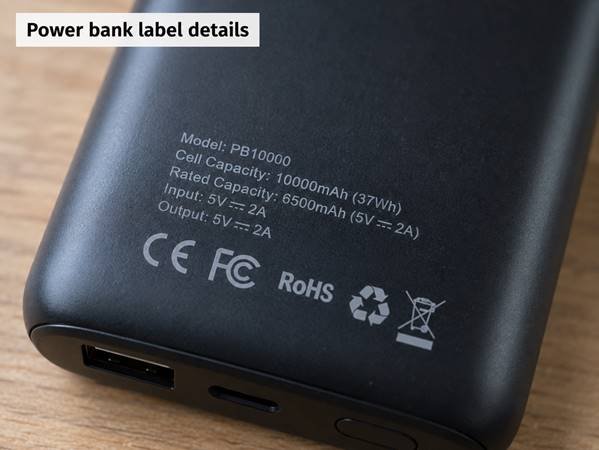
Here we also want to remind you of a common false labeling pit: the “cell capacity” marked by merchants is not the same as the “rated capacity” that can actually be output — because there is loss in circuit conversion, a 10,000mAh cell may only have an actual output of about 6,500mAh. The Wh, rated capacity and input/output parameters on the product label should be clear and consistent; it is not reliable to only look at an exaggerated mAh figure.
Universal Underlying Rules Globally
After understanding the basic concepts, you may ask: there are so many countries around the world, each with its own requirements, do I have to memorize them one by one? Actually, no. There are several types of underlying rules that often appear in the transportation, testing and compliance documents of power banks. Understanding them first will make it much easier to look at the requirements of different regions later.
UN38.3: Mandatory Test for Lithium Battery Transportation
UN38.3 is the type test requirement for lithium-ion cells and battery packs in the United Nations Recommendations on the Transport of Dangerous Goods. When lithium batteries in power banks are subject to UN transport rules, they usually need to have type test records and test summaries that comply with UN38.3.
It should be noted that it is not necessary to redo the test before every air, sea or land transport. Generally, test documents are formed after the design model of the cell, battery pack or product meets relevant conditions; specific transportation also needs to be judged in combination with the mode of transport, packaging, quantity, built-in status of the equipment, and whether special provisions or exemptions apply.
UN38.3 items include altitude simulation, thermal test, vibration, shock, external short circuit, impact or crush, overcharge and forced discharge, etc. However, the applicable objects of different items are different: for example, not all battery products undergo the same type of impact or crush test, and overcharge is mainly applicable to rechargeable battery packs.
A common misconception must be clarified here: UN38.3 is only transportation compliance document, which only indicates that the product meets the corresponding requirements under applicable transportation conditions. It does not mean at all that it can be sold legally in the local market, let alone replace the compliance documents required for market access.
IEC 62133-2: International Lithium Battery Safety Benchmark
IEC 62133-2 is a commonly used safety standard for portable sealed secondary lithium-ion cells and batteries, which can be understood as one of the important testing foundations in the field of lithium battery safety.
It mainly focuses on the safety performance of lithium-ion cells and batteries in scenarios such as overcharge, short circuit, drop, and high temperature. Some national standards, procurement specifications or certification projects will cite or refer to it, but it is not a globally unified safety certification standard for complete power banks.
Complete power banks may also involve requirements such as electrical safety, EMC, wireless functions, chargers, plugs and sockets, and battery regulations. Especially for products with AC input or output, communication modules, or special wireless functions, the applicable rules may be significantly different. Therefore, IEC 62133-2 cannot be regarded as the sole basis for the certification of all complete power banks.
It should be noted that this standard has different versions, and the test requirements of different versions may vary. When conducting tests or preparing documents, you should confirm which version is specified by the target market, channel or customer.
CB System: Basis for Multi-Country Certification Conversion
The full name of the CB System is the IECEE CB System. Simply put, it is a mechanism under which member countries can refer to and accept CB test certificates and test reports.
If you want to enter multiple markets, you do not necessarily need to repeat all tests from scratch in each country. After a qualified body completes the CB test and obtains the documents, when applying for local certification in countries that accept the CB System, repeated testing may be reduced; but usually, local national difference requirements still need to be supplemented.
However, CB documents are not a universal pass. It does not guarantee automatic local certification, nor can it replace the registration, labeling, responsible party, factory supervision or other procedures required by the target market.
In particular, it should be noted that CE is not a local certification obtained through “conversion”. For systems like CE that are mainly based on the manufacturer’s self-conformity assessment, CB test certificates and reports can be used as one of the technical document evidences, but there is no such thing as “converting to a CE certificate”.
Four Core Risk Categories Prevented by Certification
In fact, no matter which country’s rules or which type of standard, the core revolves around several types of risks. Understanding these will help you understand why power banks need so many assessments.
The first category is thermal runaway risk, which is to prevent batteries from catching fire or exploding due to overcharge, short circuit, excessive ambient temperature, etc. This is the core prevention and control point of lithium battery safety.
The second category is mechanical damage risk, which is to prevent products from leaking or catching fire after being dropped, crushed or collided in daily use. Power banks are often carried around, so such risks are not uncommon.
The third category is electrical safety risk. For example, abnormal output, excessive current, or failure of protection functions may damage the mobile phone, tablet or laptop being charged.
The fourth category is environmental tolerance risk. For example, environments such as extreme cold, extreme heat, and humidity may cause product performance degradation or abnormality. The specific test conditions for different markets and different products are not exactly the same.
Quick Reference to Mandatory Certifications in Major Global Markets
After understanding the universal rules, let’s look at what everyone is most concerned about: what usually needs to be paid attention to in each major market? The table below is for quick understanding of the direction. Before actual sales, confirmation should still be made based on the product model, functions and the latest local regulations.
| Market/Region | Common Compliance Paths or Marks | Key Precautions |
| EU/EEA | CE and related regulatory obligations | Judge EMC, RoHS, WEEE, battery regulations, etc. item by item; whether RED applies depends on radio functions |
| United States | Applicable FCC rules | Many products are subject to SDoC; whether an FCC ID is required depends on the authorization path |
| United Kingdom | CE or UKCA, depending on regulations | Many product regulations in Great Britain continue to accept CE; Northern Ireland usually uses CE |
| Japan | PSE, depending on product classification | When including radio transmission functions, the requirements of the Radio Law shall also be assessed |
| South Korea | KC, depending on the conformity assessment path | Requirements and procedures for safety, EMC, etc. may differ |
| Australia/New Zealand | RCM is used when applicable safety, EMC or wireless rules apply | RCM is a compliance mark, not a unified certification; paths may differ for battery-only products and products with AC functions |
| Chinese Mainland | CCC | Applications will be accepted from August 1, 2024; from August 1, 2025, products that have not obtained certification and are marked with the CCC mark shall not be released from the factory, sold, imported, or used in other business activities |
| India | BIS CRS | Usually required to complete applicable mandatory registration before sale |
| Eurasian Economic Union (including Russia) | EAC | Applicable requirements for member states within the Union need to be confirmed item by item |
| Brazil | INMETRO | Whether it is mandatory and the scope of application shall be confirmed by product category |
There are also some detailed requirements to note for several key markets:
• The CE mark in the EU/EEA usually needs to be clearly legible; when the applicable regulations do not provide otherwise, the height of the CE mark is generally not less than 5mm. Power banks may involve EMC, RoHS, WEEE and battery regulations, but these are not “uniformly covered” by a single CE. Ordinary battery-only power banks are usually not within the voltage range of the Low Voltage Directive; whether the Low Voltage Directive applies depends on the rated voltage. Whether the RED applies also depends on whether the product has regulated radio functions, and cannot be assumed solely because it has wireless charging function. When non-EU manufacturers place products on the market, they should also meet the requirements for economic operators within the EU, which may be undertaken by roles such as authorized representatives, importers or fulfillment service providers.
• For the US, the FCC path needs to be determined based on product functions. Many unintentional radiators are subject to the Supplier’s Declaration of Conformity (SDoC) under FCC Part 15, which is not “FCC certification” in the traditional sense. Only devices for which regulations require Certification will use an FCC ID. Wireless power transmission products need to be judged according to applicable FCC rules, technical parameters and possible exemption conditions. UL and ETL are usually safety document requirements that may be proposed by retailers, platforms, insurers or local competent authorities, and are not unified federal mandatory certificates for power banks. When selling in California, it should also be assessed whether the product will cause exposure to chemicals listed under Prop 65 and whether exemptions apply; Prop 65 is not a unified power bank certification.
• Japan’s PSE marks are divided into two types: when ordinary power banks are within the applicable scope, they usually use the circular PSE as “non-specified electrical appliances”; for 2-in-1 products with AC plugs or AC power supply functions, it is necessary to confirm whether they belong to “specified electrical appliances” and whether to use the diamond PSE according to the actual classification. Products with radio transmission functions such as Bluetooth, Wi-Fi, and cellular communication usually should also assess the requirements for technical conformity certification under Japan’s Radio Law. Whether products with only wireless charging function need relevant procedures depends on radio characteristics, frequency bands and exemption rules, and cannot be generalized.
• In the Great Britain market of the UK, namely England, Scotland and Wales, many product regulations currently continue to accept the CE mark. Whether CE can be used and when UKCA needs to be used shall be confirmed according to specific product regulations. Northern Ireland usually uses CE; if regulations require third-party conformity assessment and a UK body is used to participate in the assessment, the combined CE and UKNI mark shall be used, and UKNI cannot be used alone.
• For Australia and New Zealand, it is necessary to judge respectively whether electrical safety, EMC and wireless communication rules apply. RCM is a compliance mark that can be used after the product meets relevant requirements, and is not a unified “RCM certification”. Battery-only power banks and products with AC chargers, AC input or AC output functions may be subject to different paths.
• Power banks in Chinese Mainland have been included in the CCC catalog. CCC applications will be accepted from August 1, 2024; from August 1, 2025, power banks that have not obtained CCC certificates and are marked with the CCC mark shall not be released from the factory, sold, imported, or used in other business activities. This CCC requirement focuses on safety; whether EMC applies separately shall be judged based on specific products and regulations.
There are also two general precautions: First, other regions such as Southeast Asia, the Middle East, and Latin America mostly have their own local requirements, which need to be confirmed separately, and you cannot take it for granted to apply European and American rules; Second, 2-in-1 power banks with AC plugs or sets may also involve local power supply, plug and socket, or electrical safety rules in addition to the requirements for the battery and the power bank itself.
Advanced: Certification Validity and Identification Methods
Now that you know what each market requires, the next more important thing is: how to judge whether the marks and documents you see are credible? Which promotions are misinterpreting concepts? In this part, we will talk about how to identify compliance information to help you avoid the pitfall of fake certification.
3-Step Method to Verify the Authenticity of Certification Marks
First, let’s teach you a universal “3-step method for verifying certification authenticity”. But remember first: the label content and public query methods of different systems vary greatly, and you cannot use one set of rules to judge all markets.
First step, check whether the applicable information is complete: first verify whether the product has the required marks, model, responsible party or importer information according to the target market regulations. The specific label requirements for different products are different, and not all marks must have the same content in the same position; but if the product only has vague marks, no model, and no source information, the risk is usually higher.
Second step, check the standardization: formal marks usually have fixed proportions and usage rules, and the printing should be clear, not blurred or deformed. For example, the letter proportion of the CE mark is regulated; if it is printed crookedly and the size is obviously wrong, it at least indicates that the product’s mark management is unreliable.
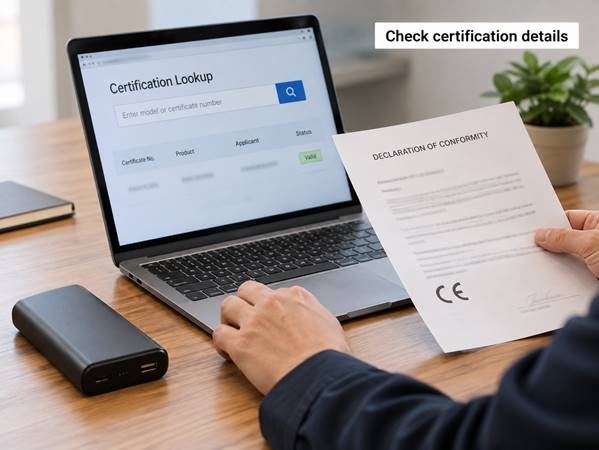
Third step, cross-verify with available information: for systems with public query mechanisms such as CCC and KC, you can check the model, applicant or certificate information through the database of the competent authority; for UL, you can query based on product category, control number or related file materials. For CE products, a more practical approach is to request the EU declaration of conformity for the corresponding model and necessary technical documents. You cannot directly conclude that the product must be fake just because you cannot find a certain number; but if the model, responsible party, documents and the information on the product itself do not match, you should be vigilant.
Core Differences Between Easily Confused Certification Concepts
Many merchants deliberately confuse different compliance concepts for promotion. Here we clarify the most easily confused groups.
• Complete product certification vs cell certification: Many merchants will say “we use Grade A certified cells”, but the fact that cells have test or certification documents does not mean the entire power bank is qualified. The complete product also needs to consider components such as protection circuits, interfaces, enclosure, heat dissipation, charge and discharge control, etc. For consumers, the correspondence between the complete product’s compliance documents and the model is more important.
• Mandatory certification vs voluntary certification: Mandatory requirements are the market bottom line stipulated by law, and non-compliance may result in inability to sell; voluntary certification or channel requirements, such as some UL and ETL programs, may be safety assessments voluntarily completed by enterprises, or may be access requirements of retailers or platforms. Their legal status and scope of application are not the same.
• Safety certification vs compatibility certification: MFi and USB-IF related conformity or mark programs mainly verify ecosystem compatibility and protocol conformity, and may also include some related technical requirements; but they are not equivalent to the complete product safety conformity assessment required by the target market, and cannot alone prove that the product meets all electrical safety, EMC or battery regulations. The so-called “PD certification” is also not a unified statutory certification name; it usually means that the product complies with the USB Power Delivery specification, or has passed the USB-IF related conformity program.
• Market compliance vs transportation compliance: Documents such as UN38.3 mainly serve lithium battery transportation and cannot replace the market access documents required for sale on the market.
• Test report vs certification certificate or declaration of conformity: Test reports usually only reflect the results of the tested sample under specific conditions; the nature of certification certificates, registrations or declarations of conformity varies by market. Some systems require continuous supervision, while others focus on the responsible party keeping technical documents and maintaining continuous conformity. You cannot simply say that a certain type of document is definitely “more valuable” than another.
Certification Differences for Different Product Forms
Power banks with different functions have different requirements to pay attention to, but you cannot mechanically draw conclusions based on the product name or a single function.
Ordinary wired models usually need to be judged from the aspects of battery safety, product safety, EMC and environmental protection obligations; which of these belong to testing, certification, declaration, registration or recycling responsibility depends on market regulations.
High-power laptop models, such as products above 65W or 100W, usually need to pay more attention to temperature rise, protection functions and component adaptability under high output conditions. The higher the power, the more risks that often need to be paid attention to in design and assessment.
Wireless charging or magnetic models cannot be directly equated with “must undergo radio frequency certification”. Whether wireless regulations apply depends on whether there is a wireless communication function, wireless power transmission parameters, and the rules of the target market for related technologies.
2-in-1 models with AC plugs, AC input or AC output may have additional requirements such as low voltage, power supply, plugs and sockets; sometimes they are assessed as a combined product as a whole, and sometimes involve multiple applicable regulations or standards, which is not necessarily simply “passing two sets of standards”.
Smart models with Bluetooth or App may also involve requirements for data collection, privacy and cybersecurity in addition to wireless communication rules, depending on the functions, data types and regulations of the place of sale.
Full Certification Process
If you are a new seller, or want to understand how compliance documents come about, you can understand the process as the following stages. But the procedures of different systems are not exactly the same, and you cannot regard it as a globally unified process.
The first step is preliminary preparation: first determine the target market, sales channels and product specifications, including cells, interfaces, AC functions, wireless communication functions, etc. Different markets and channels have different requirements, so don’t do it blindly.
The second step is confirm applicable rules and conduct testing: depending on the product and market, it may be necessary to send samples to a capable laboratory for testing to obtain a test report; it may also be necessary to prepare risk assessments, technical documents or other conformity materials.
The third step is complete applicable procedures: different systems may include technical document review, declaration of conformity, registration, third-party certification, factory inspection, post-certification supervision or market supervision, etc. The specific paths of systems such as CCC and KC will vary depending on the product category and conformity assessment method, and cannot be simply understood as each product is subject to fixed on-site factory inspection.
The fourth step is produce compliance labels and documents: according to market requirements, use the corresponding marks on the product, packaging, manual or online page, and retain the declaration of conformity, test documents, responsible party information, etc.
The fifth step is maintain continuous conformity: when the product is redesigned, key components are changed, regulations are updated, or market random inspections are conducted, it is necessary to reconfirm whether the documents are still applicable. CE and FCC SDoC usually focus on the responsible party continuously maintaining conformity, maintaining and updating documents, and there is no unified “regular renewal after obtaining the certificate” process.
If you want to enter multiple countries, CB test documents can sometimes reduce repeated testing in local certification, but only if the target country or body accepts the relevant documents and completes the necessary national difference assessment.
Certificate Validity and Change Rules
Many people think that certification is valid for life once done, but in fact it cannot be generalized.
The validity rules of certificates, registrations and declarations of conformity vary from system to system: some certificates may require annual supervision, regular renewal or fee payment to maintain; others have no fixed expiration date, but the responsible party must continuously ensure that the product meets applicable requirements.
More importantly, if the product undergoes changes such as cell, capacity, circuit design, interface, enclosure structure, or new functions, it is necessary to re-evaluate whether the original documents are still applicable. Whether the change requires supplementary testing, change filing or re-certification depends on whether it affects conformity, as well as local regulations and the rules of the issuing body.
When standards or regulations are updated, you cannot simply assume that old certificates will automatically become invalid. Usually, you need to pay attention to the effective date of the new rules, transition period, time when the product is placed on the market, and requirements of the body, and then decide whether difference testing, document updating or re-application is needed.
Guide to Avoiding Certification Pitfalls in Common Scenarios
After talking about so much theory, let’s talk about several scenarios that people most commonly encounter in daily life, and how to avoid compliance-related pitfalls.
Purchasing on E-commerce Platforms
Many people only look at capacity and price when buying power banks. In fact, with just three steps, you can avoid most fake certifications and products of unknown origin.
First step, first check whether the product detail page has the compliance information that may be required in your region. For example, if you are in Germany, you can pay attention to CE, responsible party information and model; if you are in South Korea, pay attention to applicable documents such as KC. Products with no model, source and compliance instructions at all should be purchased with caution.
Second step, ask customer service for documents corresponding to the specific model, such as certificate number, declaration of conformity, test report number or responsible party information, and then verify through the competent authority, certification body or official brand channel. Don’t just look at the pictures on the detail page.
Third step, after receiving the goods, check whether the model, capacity, responsible party or marks on the product itself are consistent with those on the detail page. For example, if the detail page advertises that a certain model has CE-related documents, but the actual product has a different model, no responsible party information, or unclear Wh parameters, you should consider returning the product or complaining to the platform.
Also note: the platform’s document requirements may be stricter than the minimum legal requirements, and may also vary by site and product category. Don’t think that meeting a certain federal rule will definitely allow you to sell or pass the audit on all platforms.
Pitfall Avoidance for Overseas Online Shopping/Proxy Shopping
The biggest pitfall of buying power banks via overseas online shopping or proxy shopping is the claim of “global universal”.
There is no such thing as a certification or mark that is automatically valid in all countries. For example, if you are in the EU and buy a power bank with UL-related marks from the US via overseas online shopping, UL documents cannot replace the applicable CE compliance requirements and responsible party requirements in the EU.
Therefore, when shopping overseas, prioritize products that clearly state they meet the requirements of the target market and have clear model and responsible party information. Don’t trust promotions that only write “foreign trade overstock” or “global universal certification” but cannot provide specific model documents.
Misconceptions About Carrying on Planes
Many people have the deepest misunderstandings about carrying power banks on planes.
According to the general rules of IATA, power banks are usually treated as spare lithium batteries, should only be carried with you, and cannot be placed in checked luggage. Products with a rated energy not exceeding 100Wh usually do not require operator approval; products exceeding 100Wh but not exceeding 160Wh require operator approval, and usually each person can carry a maximum of two; spare lithium batteries exceeding 160Wh shall not be carried on passenger aircraft.
In addition to capacity, you must also comply with the airline’s requirements on quantity, terminal short-circuit prevention, usage methods, etc. Rules may vary among different airlines, airports and departure locations. It is best to check the latest regulations of the operating airline before traveling.
In addition, air capacity requirements and product market compliance requirements are two different things. It is not that if the Wh meets the standard, you can definitely take it. If the product parameters are vague and the capacity cannot be determined, security check may still refuse to let it pass.
Pitfall Avoidance for New Sellers’ First Certification
New sellers are most likely to step into these pitfalls when preparing compliance documents for the first time.
First, don’t go for “global certification” right away. First lock in the core target market, then plan the requirements accordingly, otherwise you will spend a lot of wasted money.
Second, don’t use the cell test report as the complete product compliance document. Cell documents cannot automatically prove that the entire power bank meets the requirements.
Third, before product redesign, first find a body or responsible party with relevant experience to assess whether re-testing, document updating or change filing is needed. Don’t continue to use the old model documents after changing the cell or circuit.
Fourth, if you want to enter multiple countries, you can assess whether CB documents can support subsequent local certification to reduce repeated testing; but don’t mistake CB reports for automatically obtaining sales qualifications in all markets.
Debunking Common Certification Misconceptions
Finally, let’s debunk several of the most widely circulated certification rumors to help you thoroughly sort out your thinking.
Misconception: Having CE/UL Mark Means It’s Globally Universal
CE is mainly used in the EU, EEA and some markets that recognize relevant rules; UL is a common voluntary safety assessment or channel requirement in North America. Neither is globally universal.
Moreover, just printing the mark on the product is not enough. The product should be supported by conformity documents, test documents, responsible party information or applicable certification records corresponding to the specific model. Especially for CE, which usually does not correspond to a unified official “CE certificate”, more attention should be paid to whether the EU declaration of conformity matches the product documents.
Misconception: Low-Capacity Power Banks Don’t Need Certification
The requirements in most regions do not simply take capacity as the only threshold for compliance. As long as power banks are placed on the market for sale, they usually need to meet the corresponding requirements according to product functions and local rules.
Only a few regions or specific products may have exemptions, which need to be checked against local regulations. It should be emphasized once again: the capacity requirements for carrying on planes and the requirements for product sale on the market are two different things and cannot be confused.
Misconception: Having MFi/PD Certification Means It’s Safe
MFi is an authorization and technical specification program in Apple’s accessory ecosystem; USB-IF’s related conformity testing or mark programs mainly focus on USB specification and protocol compatibility. They may involve some related technical requirements, but cannot replace the requirements of the place of sale for complete product safety, EMC or battery regulations.
To judge whether a product has applicable safety compliance documents, you should still look at the target market requirements, not just the “MFi” or “PD” promotions.
Misconception: Certified Power Banks Will Never Break
Compliance only means that the product has completed the corresponding assessment in accordance with applicable rules, and does not mean that it will 100% not malfunction. If used improperly, such as being dropped, getting wet, being exposed to high temperature environments, or using a charger of unknown origin, problems may still occur.
Compliance marks and traceable responsible parties help confirm the product source, contact the seller or responsible entity, and file complaints or protect rights, but they do not automatically guarantee compensation. Returns, compensation or product liability after damage occurs shall be handled in accordance with the consumer protection and product liability rules of the place of sale.
Misconception: If the Cell Is Certified, the Complete Product Is Compliant
The cell is only a core component of the power bank. The safety of the entire product is also related to many factors such as protection circuits, interface design, enclosure material, heat dissipation structure, charge and discharge control, etc.
Therefore, the fact that the cell has test documents or certification information does not mean that the complete product has met the target market requirements. Using only cell documents to claim that the complete product is compliant is often a vague concept, so don’t believe it easily.
Summary
By now, you should have a more complete understanding of the global compliance requirements for power banks. It’s actually not that complicated. The core is the three principles: “corresponding market, corresponding model, verifiable documents”.
In the future, whether you are buying a power bank for yourself or doing cross-border sales, you can first confirm the applicable requirements of your region, then check the product model, responsible party and related documents; you can also judge which additional rules may need to be paid attention to based on whether the product has AC functions, wireless communication functions or high-power output.
Remember, transportation documents are not equal to sales compliance, compatibility programs are not equal to complete product safety, and marks printed on the enclosure are not equal to the product being truly compliant. First look at the market, then the model, and finally verify the documents, so as to avoid common pitfalls in purchasing, overseas online shopping, air carriage and sales.