
For those in the South Korean charging product market, most have probably heard of KC certification, but many people get confused when they first encounter it: why do some say safety certification is required, some say EMC is required, and others say just sticking a KC mark is enough? What is the relationship between these two types of compliance, and what troubles will you face if you miss one? Today we will break down and explain clearly the safety compliance and EMC compliance under the KC system, from basic concepts to practical judgment. After reading this, you will be able to make basic judgments on your own and avoid many pitfalls.
First, understand the basics: why distinguish between the two types of compliance
What exactly is the KC mark
Many people think KC is “a single certification”, but it is not — it is a market entry mark shared by multiple types of product compliance in South Korea, with a status similar to China’s 3C certification and the EU’s CE mark. Only after completing the compliance requirements of the corresponding category and affixing the KC mark as required can products be legally produced, imported and sold in South Korea.
Scope and caliber of this comparison
Today we only talk about the comparison of two types of mandatory compliance requirements under the KC system: one is safety compliance, and the other is electromagnetic compatibility (EMC) compliance. Applicable products are charging-related products that everyone often deals with, such as chargers, power adapters, USB/USB-C charging cables, and charging connectors. Other categories such as radio frequency certification, separate battery certification, and voluntary KC are not within the scope of this comparison.
Necessity of distinguishing between the two types of compliance
These two types of requirements are the core compliance prerequisites for charging products to enter the South Korean market. Missing any required category may lead to customs detention, removal from e-commerce platforms, and even fines, which is definitely not a trivial matter.
Item-by-item comparison of core rules
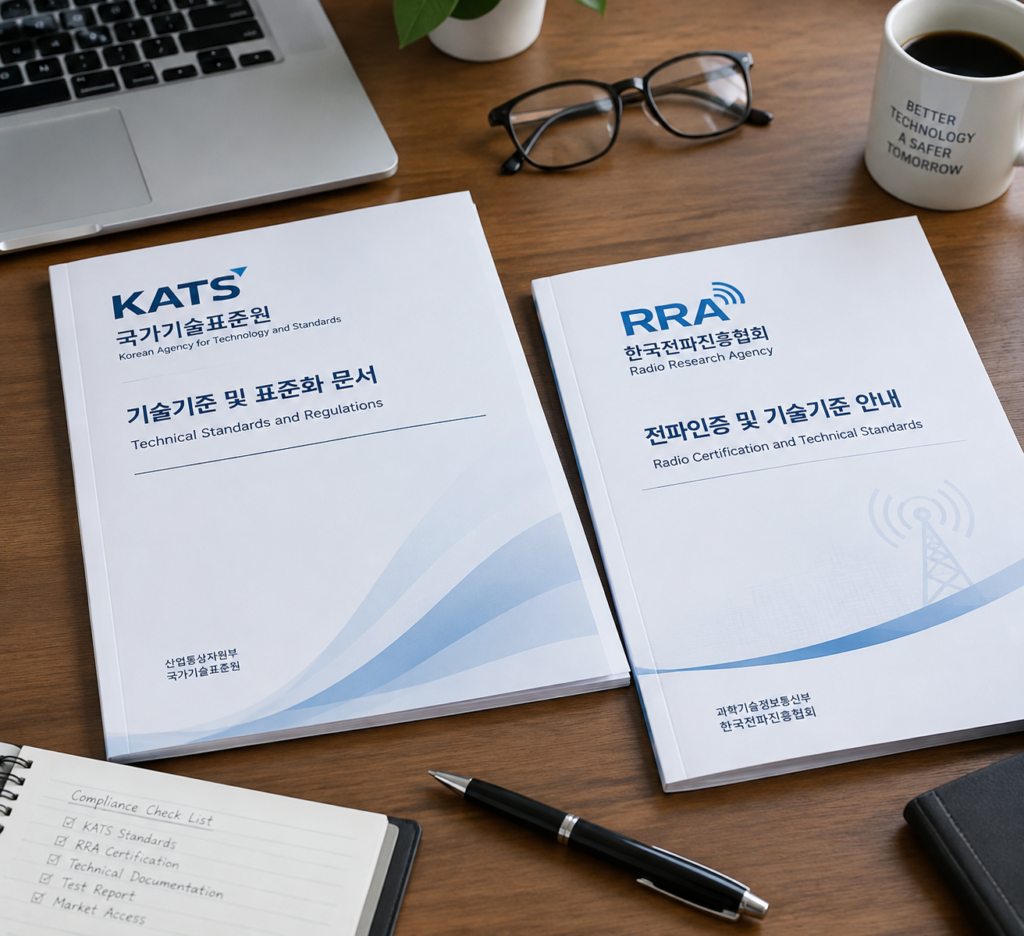
To help everyone quickly see the differences, we have organized the core rules of the two types of compliance into a comparison table:
| Comparison Dimension | KC Safety Compliance | KC EMC Compliance |
|---|---|---|
| Competent Authority | Korea Agency for Technology and Standards (KATS) | Korea Radio Research Agency (RRA) |
| Legal Basis | Act on Safety Management of Electrical Appliances and Household Goods | Radio Waves Act |
| Certification Path (divided by statutory items) | Safety certification, safety confirmation declaration, supplier conformity confirmation; electrical appliances subject to supplier conformity confirmation must also apply for supplier conformity confirmation declaration | Conformity certification, conformity registration, self-conformity confirmation, provisional certification |
| General Process | Application → sample testing → factory inspection (required for some items) → certificate issuance/confirmation → follow-up supervision | Conduct testing or conformity confirmation according to the applicable path, certification/registration application or self-conformity confirmation and document management, marking and post-market management |
| Factors Affecting Cost and Cycle | Applicable path, designated body, factory status, sample rectification, number of models, etc.; there is no general fixed difference | Consistent with safety compliance; there is no fixed rule of “which is more expensive, which is faster” between the two types |
Common rules for both types
In addition to the differences in the table above, there are two rules that both safety and EMC compliance must abide by:
- Change rule: As long as the change involves core performance — such as safety-related structural adjustments, EMC-related circuit modifications — a re-evaluation must be conducted to confirm whether supplementary testing or re-certification is required. You cannot directly continue using the original certificate after making changes on your own.
- KC marking requirements: Safety marking and RRA conformity assessment marking must be implemented in accordance with their respective regulations, and the two cannot be treated as exactly the same rules. In principle, the RRA conformity assessment mark shall be affixed to the surface of each device or its packaging, and shall be durable and easy to identify. The mark, number, additional Korean information of the safety marking, and whether packaging marking can be used, shall be confirmed in accordance with safety management regulations and specific item requirements. The instruction manual cannot be regarded as a general alternative marking position for both systems.
Practical judgment: which type does your product need
After talking about so many rules, the most practical thing is how to judge the compliance requirements of products by yourself. As long as you follow the steps, even entry-level users can make basic judgments.
Prepare 3 types of information before judgment
Before checking the catalog, organize this information about the product first, otherwise you will get stuck repeatedly during the check:
- Electrical parameters: Whether it is directly connected to South Korea’s 220V mains, input/output interface/plug type, rated power/voltage/current, supported output protocols.
- Structure and accessories: Whether it has a built-in circuit/chip, whether it comes with a battery/wireless module, whether it supports data communication, specifications of the included cable.
- Sales and entity: Whether it is sold independently at retail, whether it is a set accessory, differences between the product model and products of the same series, manufacturing factory, brand/applicant information.
Entry-level step-by-step judgment logic
After preparing the information, follow these three steps:
- Step 1: Check KATS’s latest mandatory safety item list to confirm whether the product is within the scope of safety control and the corresponding certification path.
- Step 2: Check RRA’s latest Radio Waves Act mandatory item list to confirm whether the product is within the scope of EMC control and the corresponding path.
- Step 3: If it falls into both categories, complete compliance for each respectively; if it only falls into one category, only complete the corresponding category.
It must be noted that all judgments are subject to the latest official catalog, and conclusions cannot be drawn directly based solely on the product’s functional name.
Key conditions affecting the judgment conclusion
There are several special situations that are easy to misjudge, which require special attention:
- Mains access attribute: For products directly connected to Korean standard mains, safety control requirements are usually stricter, but products not connected to mains (such as car chargers) may also require safety compliance, which cannot be directly excluded.
- Wireless function attribute: If the product has controlled wireless transceiver functions (such as Bluetooth, WiFi), it must also be handled in accordance with the applicable fields, items and evaluation types of wireless and EMC in the Radio Waves Act conformity assessment. Relevant requirements may be handled in the same RRA conformity assessment, and it is not necessarily necessary to apply for a separate EMC certificate. However, wireless power supply coils are not equivalent to radio transmitting equipment and cannot be confused.
- Sales form attribute: Whether accessories need to be separately compliant depends on three conditions: whether they are sold independently, whether they are independent controlled items, and whether the whole machine certificate covers the accessory, which cannot be generalized.
- Parameter and structure attribute: Changes in rated power and internal circuits may change the product’s item classification and testing requirements, so the original certificate cannot be directly used.
Judgment points for common charging products
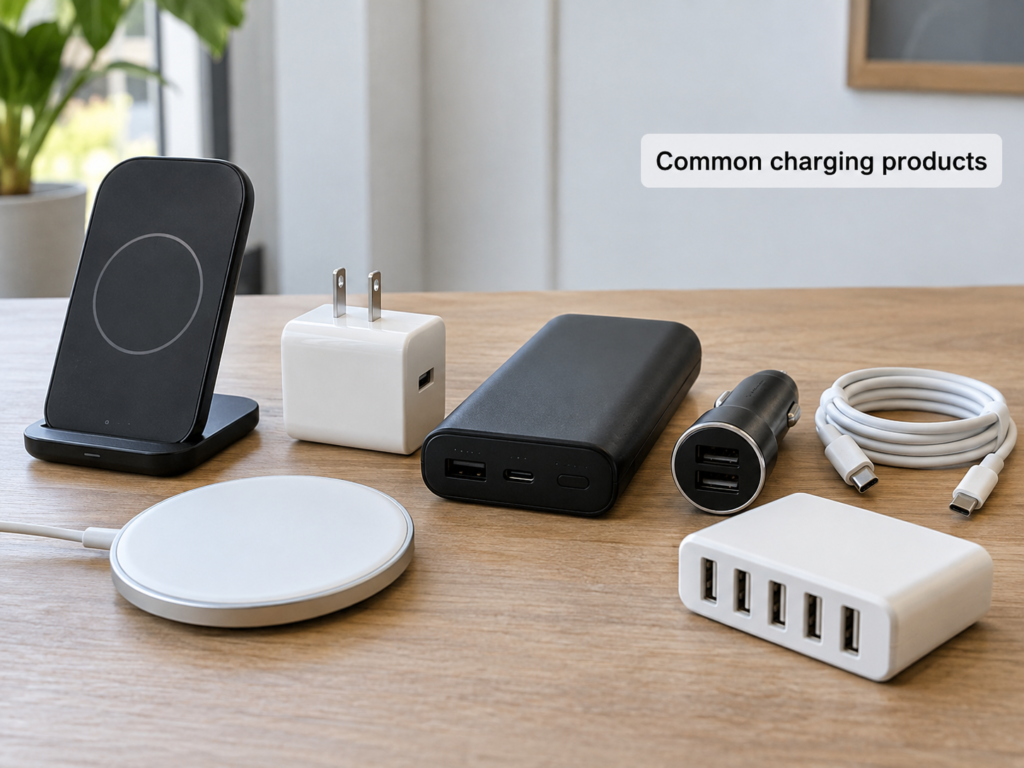
We have sorted out the judgment points of 7 types of the most common charging products to help you avoid one-size-fits-all mistakes:
| Product Type | Compliance Judgment Points | Common Misconception Reminder |
|---|---|---|
| Wall-plug charger | May require both safety and EMC compliance | Do not assume that the two types of certification follow the same path by default |
| Desktop power adapter | May require both safety and EMC compliance | Do not judge the control level solely based on power |
| Car charger | May require both safety and EMC compliance | Do not directly exclude safety control just because it is not connected to mains |
| Ordinary passive USB charging cable | Whether it involves safety or RRA conformity assessment needs to be confirmed based on the actual structure, rated parameters and the detailed scope of the catalog | Do not draw conclusions directly based solely on “passive” or being used for charging |
| USB-C cable with E-Marker | Whether it involves safety or RRA conformity assessment needs to be confirmed based on the actual structure, rated parameters and the detailed scope of the catalog | Do not directly presume that safety or EMC is required solely based on “with chip” |
| Charger + cable set | Each component shall be judged whether it is an independent controlled item, and the corresponding compliance requirements and model coverage scope shall be confirmed | Whether it can be applied for at one time as a whole machine or composite equipment must be confirmed in accordance with the applicable system and product definition |
| Charging equipment with Bluetooth/wireless function | May involve both the safety system and Radio Waves Act conformity assessment | Wireless and EMC requirements may be handled as the same RRA conformity assessment, and shall not be preset as two sets of independent procedures |
Two special rules
- Set rule: Each component in the set shall be separately judged whether it is an independent controlled item; if so, it shall be ensured that the corresponding compliance requirements and model coverage scope are met. Whether it can be applied for at one time as a whole machine or composite equipment must be confirmed based on the safety system or RRA composite equipment rules, product definition and certification body, and cannot be preset as separate applications in all cases.
- OEM/ODM private labeling rule: When the brand or applicant entity changes, the coverage scope of the original certificate must be confirmed first, and the original certificate cannot be directly used.
Summary
In general, it is actually not difficult to distinguish between KC safety and EMC compliance. The core is to grasp the two different control directions: the safety system mainly assesses personal and property safety risks such as electric shock and fire; RRA EMC mainly assesses electromagnetic emission and immunity. The two types of statutory requirements cannot replace each other, but the same product or design change may affect both types of compliance at the same time, which need to be evaluated separately in accordance with applicable rules.
For entry-level users, as long as you can do these points, you can basically avoid most risks: be able to distinguish the core differences between the two types of compliance, know how to collect the 3 types of product information required for judgment, query the official catalog step by step to confirm requirements, avoid one-size-fits-all mistakes by referring to the judgment points of common charging products, be able to verify the authenticity of the two types of compliance through the official system, and identify 6 types of high-frequency misconceptions and 5 types of compliance failure triggers. If you encounter particularly complex or uncertain products, you can then confirm with a certification body officially recognized by South Korea.