
If you travel frequently or have many desktop devices, you have most likely heard of GaN chargers — with the same 65W power, GaN components help chargers achieve higher power density, and some products can be smaller than silicon-based designs of the same power, but the actual size difference depends on the overall device design, so you can just put it in your pocket and go. But whether you buy it yourself, use overseas shopping and forwarding services, or run a cross-border business, you must have seen various marks printed on chargers: CCC, CE, FCC, UL, PSE… Which ones are mandatory? Which are marketing gimmicks of merchants? Are there exclusive advanced certifications for GaN chargers? In this article, we will thoroughly explain the certification requirements of major global markets, methods to distinguish genuine from fake, and selection logic for different scenarios. From beginner knowledge to pitfall avoidance, you will be able to judge easily after reading.
First, Understand the Basics: What Is Certification for GaN Chargers
First of all, it should be clear that the GaN chargers we refer to here are external switching chargers/power adapters using gallium nitride (GaN) semiconductor materials, that is, the charging heads you usually plug into the wall to charge mobile phones, tablets, and laptops. Common types include USB-A/C single-port or multi-port wall chargers, desktop adapters, and travel chargers with interchangeable plugs, with power mostly ranging from 20W to 140W.
It should be noted that power banks, car chargers, wireless charging pads, as well as non-consumer dedicated power supplies for industrial, medical and other purposes, are not within the scope discussed here. They may be subject to additional or different product standards and regulatory requirements, and cannot be directly judged according to the scope of external mains chargers in this guide.
What Does Certification Cover? Four Core Dimensions
Many people think certification is just “sticking a label”, but in fact it covers four dimensions closely related to your use:
First is safety, which is also the most core — to prevent electric shock, fire, and overheating, and avoid personal injury.
Second is electromagnetic compatibility, commonly known as EMC. Simply put, there are two requirements: first, the charger will not interfere with nearby electronic devices such as headphones, routers, and TVs when operating; second, when there is external electromagnetic interference, the charger can still work normally, without power jumping or charging interruption.
Third is energy efficiency, that is, controlling standby power consumption and improving power conversion efficiency. Simply put, it wastes less electricity, saves electricity bills in the long run, and is more environmentally friendly.
Fourth is environmental protection, which mainly has two requirements: first, restricting toxic and harmful substances such as lead and mercury in chargers (professionally called RoHS), and second, requiring manufacturers to bear recycling responsibility after product scrapping (professionally called WEEE). The “crossed-out trash bin” mark you see on many European version chargers indicates that the product should be collected separately from unsorted domestic waste.
Key Reminder: There Is No Official GaN-Exclusive Certification
This is the marketing pit that many people are most likely to fall into: merchants boast about “GaN-exclusive safety certification” and “GaN level certification”, which sounds more advanced than ordinary chargers, but in fact, there is no official GaN-exclusive certification at all.
The object of certification is the entire charger, not the GaN chip inside. Whether it uses GaN or traditional silicon chips, the certification standards, processes, and effectiveness applicable to chargers are exactly the same. To put it bluntly, GaN is just an internal material technology, it will not make certification special, nor is there an additional “advanced certification”.
Four Types of Certification Attributes, Clarified at Once
There are many certifications on the market, but in fact, they can be divided into four categories according to their nature. Once you understand them, you won’t be confused:
| Certification Type | Core Nature | Common Examples |
| Mandatory Access Category | Legally mandatory, cannot be legally sold or imported without obtaining it, must be tested and issued by a third-party institution | China CCC, Japan Diamond PSE, South Korea KC |
| Mandatory Self-Declaration Category | Legally mandatory, but the manufacturer promises to comply with standards on its own, no mandatory third-party testing and certification is required, and the manufacturer can print the mark by itself | EU CE, US FCC SDoC |
| Third-Party Voluntary Safety Category | Not legally mandatory, but highly recognized in the market, requires third-party institution testing + regular factory supervision, strong credibility | US UL, Germany GS/TÜV |
| Voluntary Performance/Compatibility Category | Only proves the performance or compatibility of the product, cannot replace mandatory compliance requirements | USB-IF certification, Energy Star |
What Certifications Are Required for Major Global Markets Respectively
After understanding the basic classification, let’s take a look at the specific requirements of each major market. Whether it is for your own use or for selling goods, you can quickly find the corresponding rules.
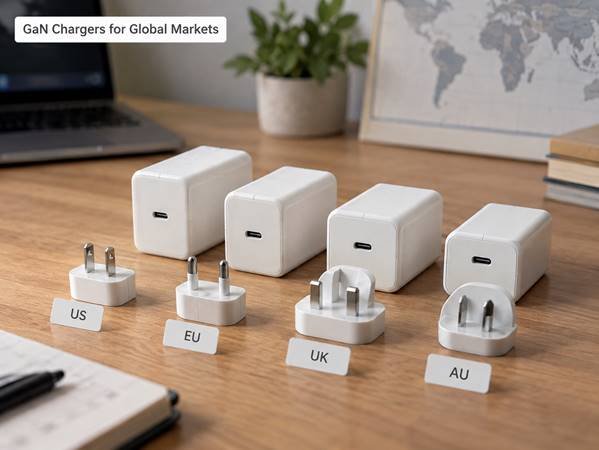
North American Market (United States, Canada)
North America is one of the main markets for GaN chargers, and the requirements are divided into several parts:
First is the mandatory EMC (electromagnetic compatibility) requirement: the US uses FCC, and Canada uses ISED. Ordinary wired products, such as those subject to FCC Part 15 unintentional radiation rules, usually adopt SDoC: no FCC certification or submission for approval is required, but the responsible party must complete applicable compliance assessment, keep records and bear responsibility; the FCC mark is usually not a mandatory label. If it is a charger with wireless transmission function (such as an all-in-one product with wireless charging), it usually also requires FCC Certification and an FCC ID, with a stricter process.
Then is safety certification: UL/ETL in the US, CSA/cUL in Canada. Note that this is not a mandatory requirement of federal law, but mainstream e-commerce and offline retailers such as Amazon and Best Buy almost all require it, and products cannot be listed without it, so it is regarded as a “must-have certification” at the sales end.
There are also mandatory requirements for energy efficiency: external power supplies sold nationwide in the US usually need to comply with applicable DOE federal energy efficiency standards; when sold to California, you should also check California energy efficiency regulations and database/filing requirements according to specific product categories, and cannot generally assume that all products have stricter independent CEC limits.
In addition, there is an easily overlooked detail: when selling in Canada, you should confirm English/French information requirements according to applicable federal packaging labeling rules, product safety certification requirements and the language regulations of the selling province; Quebec may have additional French requirements.
European Market (EU, UK)
The core certification of the EU is CE. Many people think CE is a certificate issued by a third party, but in fact it belongs to the mandatory self-declaration category — as long as the manufacturer confirms that the product complies with applicable safety, EMC, RoHS and some ecodesign requirements, it can print the CE mark, and no mandatory third-party testing is required. WEEE separately stipulates producer registration, recycling responsibility and the crossed-out trash bin mark, which is not covered by the CE mark.
The situation in the UK is a bit special: in Great Britain (England, Scotland, Wales), many product regulations currently accept the CE mark indefinitely, and UKCA can still be used; you should verify whether there are exceptions or special periods according to the specific UK regulations applicable to the product. In addition, UK plugs must have a built-in fuse, which is a mandatory requirement.
If you want higher consumer trust, you can choose products with GS/TÜV marks. This is a German third-party voluntary safety certification, which requires third-party testing + annual factory audits, with high credibility, and European consumers generally recognize it.
Major Asia-Pacific Markets
Most of the certifications in the Asia-Pacific region are mandatory access categories, with relatively clear requirements:
• China: CCC mandatory certification (covering safety + EMC). From August 1, 2024, chargers for telecommunication terminals (that is, USB port chargers commonly used for mobile phones, tablets, etc.) that have not obtained CCC certification shall not be produced, sold, or imported.
• Japan: PSE mandatory safety certification. Most switching power supply products belong to “specified electrical appliances”, and need to obtain the diamond PSE certification with stricter requirements. The rated voltage of Japan’s mains is 100V, and the rated input range of the product must cover actual power supply conditions; 100—240V wide-voltage products can also be applicable, but they must still meet requirements such as PSE and Japanese labeling.
• South Korea, Australia and New Zealand: all must separately check applicable safety and EMC compliance requirements. Australia’s RCM/EESS involves responsible suppliers and product risk level requirements; New Zealand should confirm according to its own electrical safety and EMC rules, and the registration requirements of the two countries cannot be generalized.
Emerging Markets and CB Mutual Recognition
If you do business in emerging markets such as India, the Middle East, and Southeast Asia, you should note that regulations in these regions are updated relatively quickly. For example, India’s BIS, Saudi Arabia’s SABER, and GCC certification for Gulf countries may have their requirements adjusted every year. Before selling, be sure to confirm the latest rules and do not follow old experience.
If you want to expand into multiple markets at the same time, you can first apply for CB certification — this is an international mutual recognition system launched by the IEC (International Electrotechnical Commission). CB certificates and reports can be used as the testing basis for applying for local certification in multiple member countries, which can usually reduce repeated testing; however, it must still be evaluated by the NCB of the target country according to national differences and local administrative requirements, and additional testing or supplementary materials may be required.
But note: CB itself is not a sales license, and you cannot directly sell goods with the CB mark. When converting to local certification, you still have to meet local special requirements such as plugs, labels, and languages. For example, when converting to Japan’s PSE, the rated input range of the product must cover the local 100V power supply, and meet requirements such as Japanese standard plugs and Japanese labeling. It is not that everything is fine with a CB certificate.
What Exactly Does Certification Test? Special Difficulties of GaN Chargers
Many people are curious: what exactly is tested in certification? Why do some small manufacturers’ GaN chargers always fail to pass certification? In fact, the core tests cover four dimensions, and GaN has several special difficulties due to its material characteristics.
Safety Test: The Most Core Bottom Line
The core of the safety test is to check four aspects: insulation against electric shock, temperature rise control, abnormal protection, and structural safety. For example, put the charger in a high-temperature environment and operate at full load to see if the shell temperature exceeds the standard; simulate abnormal situations such as short circuit and overvoltage to see if it will catch fire; check whether the insulation distance between internal live parts and the shell is sufficient to prevent electric shock.
The special difficulty of GaN chargers lies in their high power density and small internal space — with the same 65W power, some GaN chargers may be made smaller, and internal parts are closer together, which increases the design difficulty of heat dissipation and insulation distance. A little cutting corners may cause failure in the safety test.
EMC Test: The Most Likely Item to Get Stuck
The core of the EMC test is two points: do not interfere with other devices, and can resist external interference. For example, put the charger next to a router to see if it will cause WiFi disconnection; simulate external electromagnetic pulses to see if the charger will stop charging.
GaN devices are often used at higher switching frequencies, and faster switching edges may increase EMI design challenges, requiring higher standards for filter circuits and shielding designs. The actual emission level still depends on the overall topology, layout, filtering, shielding and control methods, and cannot be judged solely by whether GaN is used. Many small manufacturers, in order to reduce costs, omit components such as filter capacitors and shielding covers, resulting in direct exceeding of standards in EMC tests, which is also one of the most common pitfalls for cross-border sellers.
Energy Efficiency Test: Not All GaN Chargers Are More Power-Saving
The energy efficiency test mainly checks two indicators: standby power consumption (that is, the power consumed when plugged into the wall without charging) and conversion efficiency (how much electricity is actually used by the device during charging, and how much is wasted as heat).
Here we need to correct a common misunderstanding: not all GaN chargers are more power-saving than silicon-based ones. Energy efficiency is affected by many factors such as output power, ambient temperature, and multi-port usage. Some small manufacturers’ GaN chargers have poor circuit design, and their conversion efficiency is not as good as well-made silicon-based chargers. Don’t assume GaN must save power just because it is GaN.
Environmental Protection Test: Requirements Related to Recycling
The environmental protection test mainly includes RoHS hazardous substance restriction and WEEE recycling responsibility requirements, and most regular manufacturers can meet the standards. The “crossed-out trash bin” mark on the product indicates that the product should be collected separately; whether it complies with WEEE producer registration and recycling responsibility still needs to be verified through producer registration or compliance materials of the selling country.
How to Check the Authenticity of Certification? Methods from Beginner to Advanced
There are many fake certifications on the market. Learning to distinguish can avoid most risks. We will explain it in two steps: beginner and advanced.
Beginner Level: 3 Steps to Quickly Judge the Validity of Marks
You don’t need to check the database, first look at these three points, you can eliminate 80% of fake certifications:
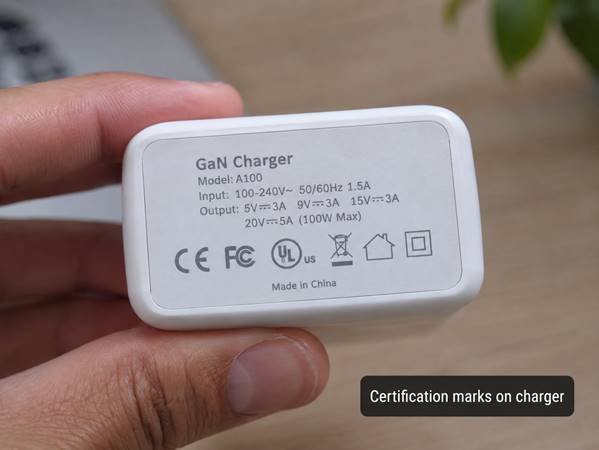
Step 1 Find the location: The certification mark is usually printed on the label of the charger body (usually at the bottom), and will also appear on the minimum sales package or the manual. If there is no proper label on the body, you can basically rule it out.
Step 2 Check the requirements: Confirm that the product has the mandatory certification mark of the region where you use/sell. For example, if you use it in China, check if there is CCC; if you use it in Europe, check if there is CE. If there is no local mandatory mark, it must be non-compliant.
Step 3 Basic verification: The mark should be clear, no blurring or paint peeling; the product model or variant should be clearly listed in the coverage of the certificate, report or certification file. You cannot conclude non-compliance just because the main model is not exactly the same word for word, nor can you presume coverage just because of the same brand or similar appearance.
Advanced Level: Verify Authenticity through Official Databases
If you want to further confirm, you can check in the official database or the materials of the issuing agency, the method is also very simple:
First, prepare the query information: it is best to have the certification number. If not, the complete product model and manufacturer name are also acceptable.
Then go to the official or issuing agency database of the corresponding region to query: for example, for CCC certification, check the database of the Certification and Accreditation Administration of China; for UL certification, check the database on UL’s official website. For CE products, you should request the EU Declaration of Conformity from the manufacturer, and check the manufacturer, model, applicable regulations and standards; the information of the authorized representative itself cannot prove CE compliance, and there is no unified CE certificate validity database.
When querying, note that you should check the brand, model or variant, applicable region, and the coverage of the certificate or file. For example, the certification is for a 65W single-port US standard charger of brand A, and the one you bought is a 120W multi-port UK standard charger of brand B. Even if the number is real, it has nothing to do with the product in your hand.
4 Typical Characteristics of Fake Certifications
If you encounter any of the following situations, be careful that it is a fake certification:
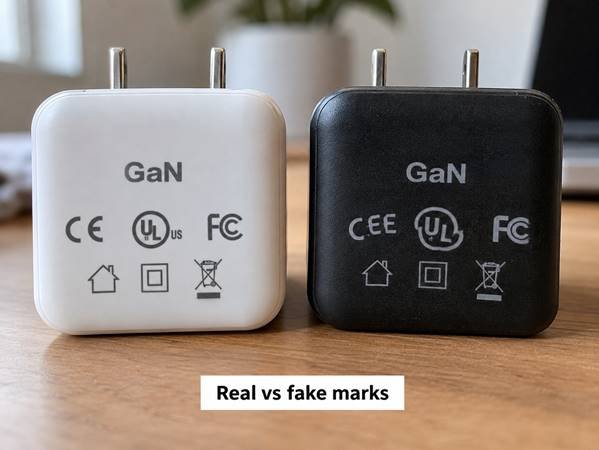
1. Fake mark: The mark has spelling errors and distorted patterns, such as writing CE as CEE, the UL mark is drawn crookedly, or even a “certification” made up by the manufacturer itself, which does not exist at all.
2. Inconsistent information: The model, power, number of interfaces, and plug type marked on the certification do not match the actual product. For example, the certification is for a single-port 30W, but the actual product is multi-port 65W; the certification is for US standard pins, but the actual product is UK standard.
3. No traceability: It should be verified according to the specific mark. For example, UL, ETL, CCC and FCC ID for applicable FCC Certification are usually queryable; CE and FCC SDoC do not necessarily have a queryable number. The lack of a number or document that should be available is a risk signal.
4. Seller prevarication: When you ask the seller for the certification number or official query channel, he makes various excuses to shirk, such as “trade secret”, “we have certification but can’t show it to you”, this kind is basically fake.
How to Choose for Different Scenarios? Choose Certification According to Needs Without Wasting Money
More certifications are not always better, the one that suits you is the right one. We will talk about four common scenarios.
Personal Daily Purchase
The core principle is very simple: just meet the mandatory certification of your place of use, no need to pay a premium for extra certifications. For example, if you have been living in China, it is enough to buy one with CCC certification, no need to pay extra for versions with UL and GS certifications. Those certifications are useless to you and only increase the cost.
For purchase channels, give priority to official brand stores or regular authorized platforms, don’t be lured by low prices to buy no-name uncertified products, after all, safety comes first.
Overseas Shopping/International Travel
Many people get confused when shopping overseas or traveling abroad, let’s make it clear here:
First of all, personal carrying for self-use is usually different from commercial sales, but it may still be subject to the destination’s import, transportation and safety rules. Even for self-use, it is not recommended to buy products without any certification, which is unsafe.
Secondly, avoid a misunderstanding: wide-voltage design or using an adapter only solves the physical adaptation problem of “can be plugged in and can charge”, it does not mean that the product meets local certification requirements. For example, if you take a US standard 100-240V charger and plug it into a UK socket with an adapter, it can charge, but it does not have UKCA or CE certification and does not meet local safety standards.
Usage suggestions: for short-term travel, just focus on voltage and plug compatibility; if you live abroad for a long time, it is best to buy a local compliant version. In addition, note that if the charger has been dropped, flooded, or disassembled and repaired by unauthorized personnel, it may no longer meet the original evaluated configuration or safety requirements, and should be stopped from use and evaluated or replaced by qualified personnel.
Cross-Border E-Commerce Small Sellers Listing
If you are doing cross-border e-commerce, pay attention to these points:
Major platforms (such as Amazon, AliExpress) require the provision of mandatory certification documents for the corresponding site, and some also require safety certification reports. If not, products will be directly removed from the shelf, or even the store will be closed.
In terms of cost control, you can first apply for CB certification, and then convert to local certification in each target market, which can save a lot of repeated testing costs.
The three most common failure reasons for GaN charger listing are: EMC interference exceeding the standard, temperature rise not meeting the standard, and insufficient insulation distance. When developing products, you must focus on optimizing these three points, otherwise failing the test will waste time and money.
High-Power/Multi-Port GaN Chargers
If you buy a high-power, multi-port or interchangeable plug GaN charger, you should also pay attention to several points:
First of all, the nominal total power is not equal to the maximum power of a single port — for example, a four-port charger marked with 120W total power may have a maximum of 65W per single port, not every port can run at full 120W. High-power and multi-port products should be evaluated for declared capacity of each port, total output limit, representative normal working conditions and abnormal working conditions according to applicable standards of the target market; whether a specific combination needs to be covered depends on applicable standards, product control logic and the evaluation plan of the certification body, rather than a unified 65W threshold.
Secondly, multi-port products should be evaluated according to applicable standards and their rated output, normal and abnormal working conditions, such as power and safety performance when two ports are used at the same time, or three ports are used at the same time, not just looking at the single-port situation.
If it is a travel charger with interchangeable plugs, each plug must separately meet the plug safety requirements of the corresponding region. It is not that a general certification covers all plugs. For example, US standard plugs must meet US plug standards, and UK standard plugs must meet UK standards.
Pitfall Avoidance Guide: Avoid 90% of Certification Misunderstandings
Finally, we have sorted out the four most common certification misunderstandings to help you avoid fewer pitfalls.
Misunderstanding 1: Having CE/FCC Marks Means Passing Third-Party Certification
Many merchants will use “has CE/FCC certification” as a selling point, implying that they have passed third-party testing. In fact, CE belongs to the mandatory self-declaration category system, and manufacturers can print the mark by themselves without third-party institution testing and certification. FCC usually adopts SDoC for applicable ordinary wired products, no FCC certification or submission for approval is required, but the responsible party still must complete applicable compliance assessment, keep records and bear responsibility; the FCC mark is usually not a mandatory label. Having a mark does not mean that it really meets the standards.
Pitfall avoidance method: if you want more reliable safety guarantee, give priority to products with third-party mandatory or voluntary safety certification, such as CCC, UL, GS, etc., which all require third-party testing.
Misunderstanding 2: GaN Has Exclusive Advanced Certification
It has been mentioned before, but it should be emphasized again: there is no official GaN-exclusive certification at all, and all chargers, no matter what materials they use, apply the same standards. The so-called “GaN safety certification” and “GaN level certification” are marketing rhetoric made up by merchants, just to sell at a higher price.
Pitfall avoidance method: don’t pay for any “exclusive certification” bound to GaN, only look at formal general certifications.
Misunderstanding 3: More Certifications Are Better / One Certification Is Valid Globally
Some people think that the more certifications, the safer, or think that one certification can be used all over the world, but in fact both are wrong.
Certifications are divided by region, and regulatory requirements of each region are different, there is no certification that is valid globally; and as long as there is mandatory certification for the target market, it is enough, extra certifications are useless to you and will only increase costs.
Pitfall avoidance method: check the corresponding mandatory certification according to the region where you actually use or sell, no need to pursue “the more certifications, the better”.
Misunderstanding 4: A Brand Has Certification = All Series of Products Have It
Many people think “this brand is a big brand, it must have certification”. In fact, whether the certification is applicable depends on the coverage of the specific certificate, report or certification file. Versions with different power, different interfaces, and different plugs cannot automatically share certification; but certification materials may also cover model series, derivative models or evaluated variants. For example, a 65W single-port charger of the same brand has CCC certification, which does not mean that its 120W multi-port charger also has it; the US standard version has UL certification, which does not mean that the UK standard version also has it.
Pitfall avoidance method: be sure to check whether the product model or variant in your hand is clearly listed in the coverage of the certification certificate, report or file, not just look at whether the brand or main model is the same.
Quick Pitfall Avoidance Checklist
You can quickly check against these 4 points, which can basically avoid 90% of certification pitfalls:
1. Mandatory certifications for the target use/sales region are complete, and can be verified through applicable official channels or issuing agency materials
2. The product model or variant is clearly within the coverage of the certification mark, certificate, report or file
3. The certification mark is clear and undistorted, and parameters match the actual situation of the product
4. The declared port capacity, total output limit and representative usage scenarios of high-power/multi-port products have been evaluated according to applicable requirements, and the plug type meets requirements
At this point, you should have a complete understanding of the global certification system for GaN chargers: you can accurately distinguish which products are within the scope of certification, and will not confuse the technical characteristics of the internal GaN chip with the certification of the entire product; you can quickly correspond to the mandatory and necessary certification requirements of major global markets; you can understand common certification marks, and can also verify through official databases or compliance documents; whether it is personal daily purchase, overseas shopping travel, or cross-border e-commerce, you can choose products that meet the requirements according to the scenario; you can also easily avoid common pitfalls such as fake certifications, marketing rhetoric, and model mismatch; for high-power, multi-port, and interchangeable plug GaN chargers, you also know how to judge whether the certification covers actual usage scenarios.
Certification is essentially the bottom line of charger safety and compliance. You don’t need to pursue more and more certifications, but you must ensure that the products you use or sell meet the mandatory requirements of the region — after all, charging safety is the first priority when choosing a charger.