
For those working with EU charging products, you have most likely heard of the terms ErP and RoHS. Some say both are environmental requirements and you only need to comply with one; others say that if a product has the CE mark, it means both requirements are met. In reality, these are two completely independent mandatory EU market access regulations with vastly different scopes of control. Missing either one can result in customs detention of goods, fines, or even market access bans. Today, we will use common products like chargers, USB-C cables, power adapters, and connectors as examples to clearly explain the core differences, applicable boundaries, and compliance judgment methods between the two, from beginner level to being able to assess pitfall risks on your own.
Beginner’s Basics: Core Differences and Relevance to Charging Products
Let’s start with the most basic bottom line: these two regulations are not an either-or choice. Their control directions are completely independent. Products that meet the conditions must comply with both, and neither can replace the other.
Put simply, ErP governs “whether a product consumes too much electricity and whether its design is eco-friendly enough” — its full name is the Eco-design Directive for Energy-related Products, and its core requirement is that products consume as little energy as possible throughout their entire life cycle. For example, the no-load power consumption of a charger plugged into the wall when not charging a device must be low, and the power conversion efficiency during charging must be high. RoHS, on the other hand, governs “whether a product is toxic” — its full name is the Restriction of Hazardous Substances Directive for Electrical and Electronic Equipment, and its core is to restrict the content of toxic and hazardous substances in product materials. For example, cable jackets must not contain excessive phthalates, and lead in plug solder must not exceed the limit.
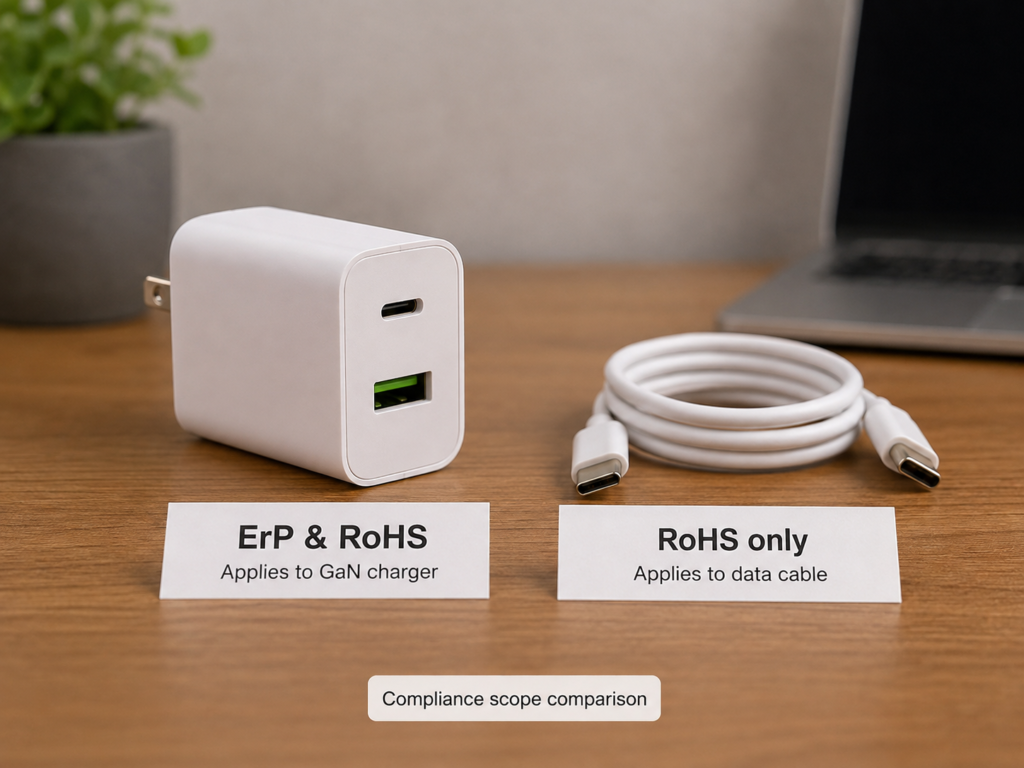
Take the most common example: a GaN charger may have extremely high energy efficiency and fully meet ErP requirements, but if its housing plastic uses unqualified materials with excessive hazardous substances, it still cannot pass RoHS. Conversely, a data cable made of fully environmentally friendly materials does not need to comply with ErP at all because it has no energy conversion function.
Many people confuse the CE mark with these two regulations, so let’s clarify this in advance: CE is not a single certification, but a “uniform compliance declaration mark” required by the EU — as long as a product complies with all applicable EU regulations (such as low voltage, EMC, ErP, RoHS, etc.), the manufacturer can affix the CE mark on its own. Therefore, you cannot assume that a product has passed ErP or RoHS just by seeing the CE mark. You must check whether the accompanying Declaration of Conformity (DoC, a document issued by the manufacturer that clearly lists which regulations the product complies with) covers both.
The reason why charging products require special attention to these two regulations is that, on the one hand, both are mandatory market access requirements for the EU market with high violation costs; on the other hand, chargers, power adapters, USB/USB-C cables, and connectors themselves are key categories under EU supervision, with a higher random inspection rate than many other electronic products.
Let’s quickly sort out the basic framework of the two regulations so you don’t get confused about versions when you get reports:
- ErP is not a single directive, but is based on the “Framework Directive 2009/125/EC”, with specific implementing regulations issued separately for each product category. Requirements for different products are in the corresponding implementing regulations.
- RoHS is based on “Directive 2011/65/EU” (including subsequent amendments), with supporting exemption annexes, and currently controls 10 restricted substances uniformly.
There is a very important verification point here: RoHS evidence should match the restricted substances, exemptions, actual model, and bill of materials (BOM) applicable when the product is placed on the market. Early reports that do not cover the four phthalates applicable from July 22, 2019, or cannot prove consistency with the current BOM, cannot be used alone as sufficient compliance evidence; however, you cannot also assume that a report is completely invalid just because its year is early.
Applicable Boundaries: Compliance Judgment for Charging Products
After clarifying the core differences, what everyone is most concerned about must be: does the charging product I have need to comply with ErP? Is it enough to only do RoHS? Next, we will talk about the specific applicable judgment rules and the corresponding requirements for common products.
ErP Applicability Judgment Rules
The judgment logic of ErP is very clear: first confirm the date when the product is placed on the EU market, then check the product definition and use in the corresponding implementing regulation, and finally check whether there are exemption situations.
Currently, there are two ErP implementing regulations related to charging products, with very clear time nodes:
- For conventional standalone external power supplies (commonly known as wall chargers, desktop adapters) placed on the market between 2026 and December 13, 2028, Regulation (EU) 2019/1782 applies.
- From December 14, 2028, the new Regulation (EU) 2025/2052 will officially take effect, adding eco-design requirements for wireless charging devices and USB-C cables in addition to external power supplies.
There are several types of products that cannot directly apply the rules and need separate review for applicability: for example, car chargers, charging devices with special functions, and low-power custom power supplies. These must be checked one by one against the product definitions in the implementing regulations. Ordinary passive data cables, adapters, connectors and other products that do not have energy conversion or active energy consumption functions are explicitly not subject to ErP.
RoHS Applicability Judgment Rules
The core of RoHS judgment depends on two points: first, whether the product is an electrical and electronic equipment, and second, whether it is placed on the market separately; its minimum test unit is “homogeneous material” — that is, a single material that cannot be split into smaller parts by mechanical methods (such as cutting, scraping, grinding). For example, the PVC jacket of a charging cable is one homogeneous material, and the plating on the surface of the pins is another; you cannot test the entire cable mixed together.
From the perspective of regulated objects:
- Products that are placed on the market separately and fall within the definition of electrical and electronic equipment or “cables” within the scope of RoHS need to bear corresponding DoC and CE obligations under RoHS. Externally sold cables usually fall into this category; bare connectors, pure passive adapters, etc. need to be judged item by item based on function, rated voltage, intended use, and whether they constitute electrical and electronic equipment or cables, and cannot be generally considered to require independent CE and DoC.
- If they are accessories bundled with the whole machine (such as a charging cable included with a laptop purchase), they do not need separate RoHS compliance, and are covered by the DoC of the whole machine.
- Raw materials in the upstream supply chain (such as plastic pellets, PVC/TPE materials, solder, plating raw materials) are supply chain control objects and do not need separate CE, but must ensure that the materials meet RoHS requirements, otherwise the finished product will still be unqualified.
RoHS currently controls 10 restricted substances. The limit for most homogeneous materials is 0.1% (i.e., 1000 ppm), only cadmium has a stricter limit of 0.01% (i.e., 100 ppm), except for cases that meet the exemption clauses. For charging products, high-risk parts are mainly concentrated in cable jackets/insulation layers, plug plastics, metal plating, solder, connector contacts, etc., which will be the focus of testing.
Quick Compliance Check for Common Charging Products
For your quick reference, we have compiled the compliance requirements for common charging products (only for ErP and RoHS, excluding other EU regulations such as low voltage and EMC):
| Product Type | ErP Requirement | RoHS Requirement | Remarks |
|---|---|---|---|
| Conventional wall charger/desktop adapter | Required (corresponding regulation version based on placement date) | Required | Specific energy efficiency indicators correspond to total rated power |
| Ordinary passive USB/USB-C cables, adapters, connectors | Not required under current rules; USB-C cables need to be checked against new regulations after 2028 | Cables usually required; adapters and connectors need to be judged based on whether they are EEE or cables within RoHS scope | No active energy consumption/energy conversion function |
| Car chargers, wireless charging pads | Need to be reviewed based on product definition, use, and placement date | Required | Not within the scope of conventional external power supplies, need separate judgment |
| Fast charging cables with E-Marker/LED | Not required under current rules; need to be checked against new regulations after 2028 | Required | Low-power functions are not yet included in the current ErP scope |
| Multi-port fast charging charger | Required (requirements correspond to total rated power) | Required | Power is calculated as the total rated power of all ports |
| Adapter with fixed output cable | Main body required; fixed cable not required | Required as a whole (including cable) | Fixed cable is an accessory and is not separately subject to ErP |
| Second-hand/refurbished products | Judged based on the date of first market placement and whether the product is modified/rebranded | Same as left | Cannot directly apply rules for new products |
Boundary Scenarios Prone to Misjudgment
There are several boundary situations that are particularly prone to errors, so everyone must pay attention:
- Charger + data cable set: The charger needs to comply with both ErP and RoHS, and the data cable only needs to comply with RoHS; the model of the set sold as a whole must be exactly the same as the model on the compliance document, and you cannot randomly combine two bulk products into a set.
- Low-power chargers: It is not that low power automatically exempts from ErP. You must check the coverage of the implementing regulation. Many low-power chargers are also within the scope of supervision, and because of their large shipment volume, they may instead be the focus of random inspections.
- Individually sold cables: Must meet RoHS requirements on their own and provide an independent DoC, which cannot be replaced by test reports of upstream raw materials — qualified raw materials do not mean that no pollution is introduced during the finished product assembly process, and products placed on the market separately must have their own Declaration of Conformity.
Item-by-Item Comparison of Core Dimensions (Charging Product Scenarios)
Some people may ask, since both are EU environmental protection-related regulations, apart from different control directions, what are the differences in specific requirements, testing, and costs? We will break them down for you from several core dimensions, all targeting actual scenarios of charging products.
Regulatory Objectives and Intervention Stages
The goal of ErP is to reduce the energy consumption of products throughout their life cycle, so it must intervene from the design stage — for example, which power chip to choose and how the circuit is laid out directly determine the energy efficiency level. If you modify it after the product is molded and mass-produced, the cost will be very high. The goal of RoHS is to limit the exposure risk of hazardous substances, so it must intervene from the material stage — for example, which plastic raw material to choose and which solder to use. If you don’t choose the right one at the beginning, changing materials later will not only cost money but also delay the production schedule. For passive accessories, because they have no energy consumption function, you only need to pay attention to RoHS and do not need to consider ErP.
Core Assessment Indicators
For external power supplies within the scope of (EU) 2019/1782, the main energy efficiency indicators are average active efficiency (that is, the ratio of grid power converted to output power during charging, the higher the more power-saving) and no-load power consumption (that is, the power consumption when plugged into the wall without connecting a device, the lower the better). The specific requirements will vary according to the product’s power range and regulation version. Regulation (EU) 2025/2052, which will apply from December 14, 2028, will also add low-load efficiency, interoperability, information and other eco-design requirements by product category, which cannot be generally understood as only two indicators. The core indicator of RoHS is the concentration limit of 10 restricted substances in homogeneous materials. Different substances have different limits: cadmium is 0.01%, and most of the rest are 0.1%. The specific situation also depends on whether there are applicable exemption clauses.
Testing Verification and Evidence Chain Requirements
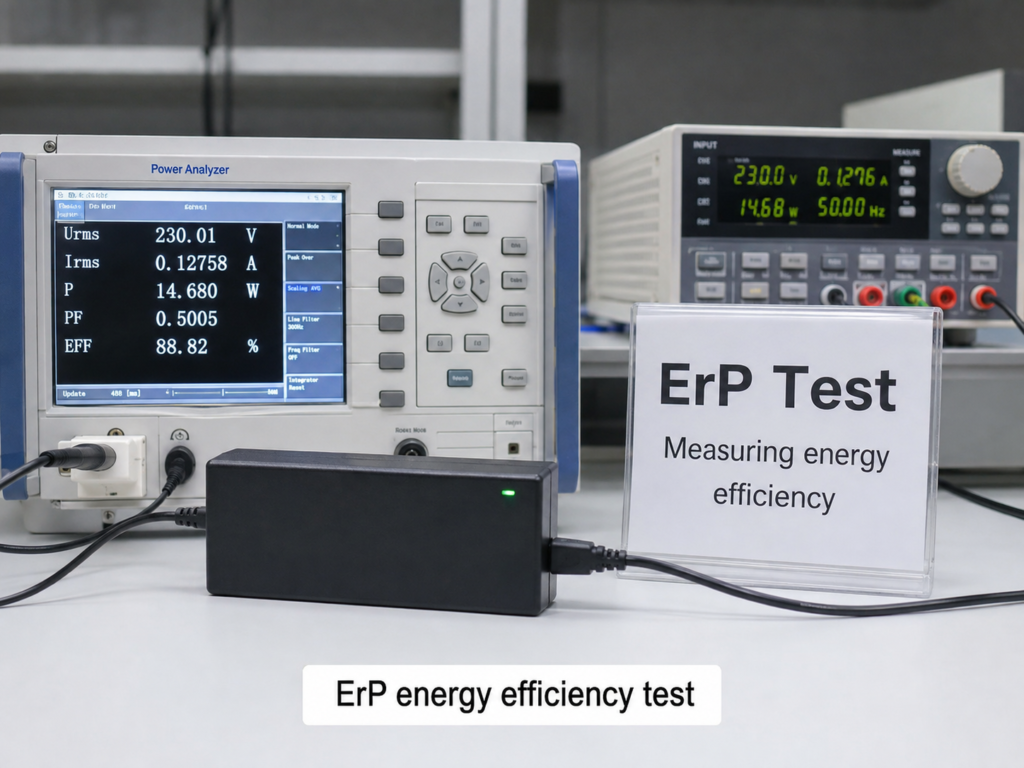
ErP testing mainly uses a power analyzer to measure energy efficiency. The test conditions must match the rated power and standard load of the product, and you cannot just measure a random value and count it; the evidence chain is generally established based on representative models and input/output specifications. Whether representative models or worst-case models can support multiple models depends on whether the manufacturer can prove in the technical documentation that the design, key components, output configuration and energy efficiency performance of each model can be fully covered by the tested model; you cannot default that other models do not need evaluation just because they are in the same series, same circuit or same power range.
RoHS testing generally uses an X-ray fluorescence spectrometer (commonly known as XRF) to screen elements such as lead, cadmium, mercury, chromium, and bromine, which is fast and low-cost. However, XRF cannot directly quantitatively confirm organic restricted substances such as phthalates; if verification of such substances is required, appropriate chemical analysis methods should be used. The test strategy should be determined based on material risk, supply chain evidence and technical documentation. RoHS does not stipulate that all products must adopt the fixed process of “XRF initial screening followed by chemical confirmation”; the RoHS evidence chain is established based on the risk level of the bill of materials (BOM), with high-risk materials under key control.
Here is a special reminder: test reports are only part of the compliance evidence and cannot replace applicability judgment, supply chain control and DoC. For example, you first have to determine that the product is indeed subject to ErP before doing the test, otherwise no matter how good the report is, it is useless if the product is not within the scope of supervision; conversely, relying only on a test report without supply chain control, if materials are changed during mass production, it is still non-compliant.
Labeling and Compliance Documents
The common requirement of both is: both need to be affixed with the CE mark, and provide DoC and complete technical documentation. RoHS usually requires manufacturers to keep technical documentation and EU DoC for ten years after the electrical and electronic equipment is placed on the market. The retention obligation and starting point of ErP-related technical documentation and Declaration of Conformity should be checked against the framework directive, specific implementing regulations and other applicable harmonized regulations, and should not be uniformly understood as “10 years after the last placement of the product on the market”.
ErP-specific documents include energy efficiency test reports and eco-design documentation; there is a common pitfall here: many people think that ErP compliance requires sticking that colorful energy efficiency label, but that’s not the case — the energy efficiency label is a separate EU regulation, and ErP compliance for most charging products does not require additional energy efficiency labels, so don’t increase costs unnecessarily. RoHS-specific documents include hazardous substance test reports and supply chain material declarations. If exemption clauses are used, there must also be corresponding exemption clause descriptions. Of course, the specific documents required depend on the product category and sales form. For example, ordinary data cables do not need any ErP-related documents.
Violation Consequences and Compliance Costs
The violation consequences of the two are similar: both may lead to customs detention of goods, market access bans, and fines. The specific penalty intensity depends on the rules of EU member states, the nature of the non-conformity and the degree of risk. Specific enforcement measures and penalties are determined by the laws of member states, case risks, and violation circumstances, and you cannot presuppose that RoHS non-conformity will necessarily result in heavier penalties than ErP non-conformity.
The difference in compliance costs is quite obvious: the cost of ErP mainly comes from circuit design optimization and selection of high-energy-efficiency solutions. For example, using a GaN solution has higher energy efficiency, but the chip cost will be slightly higher; the cost of RoHS mainly comes from material replacement and supply chain control. For example, replacing leaded solder with lead-free solder, and replacing phthalate-containing PVC with environmentally friendly TPE, may increase material costs.
Exemption Rules
ErP exclusions or exceptions must be based on specific implementing regulations, usually related to product definition, use or technical type, and cannot be generalized as low-power products are mainly exempt. For example, (EU) 2019/1782 still covers external power supplies that meet the definition and have a rated output power of no more than 250W; among them, products of 10W and below are only exempt from some low-load efficiency requirements, not completely inapplicable.
RoHS exemptions are mainly for materials or uses that are temporarily difficult to replace technically. Exemptions have a time limit, and will be re-evaluated after expiration, which may be cancelled or extended. There is a common point of attention for both exemptions: exemptions are not permanent exemption from inspection. You must clearly check the applicable parts, validity period and product use, and cannot apply them randomly.
Practical Judgment: Quickly Determine Compliance Requirements
After talking about so many rules, you may still feel a bit confused. Next, we will give you a set of practical methods that can be used directly, from quick judgment to document verification, and then pre-launch preparation, step by step.
3-Step Quick Judgment Method (Dual Dimensions)
This method can help you initially determine which requirements the product needs to meet within 1 minute:
The first step is to confirm three basic pieces of information: the specific type of product, the sales form (sold separately, sold as a set, or as accessories bundled with the whole machine), and the specific date when it is placed on the EU market.
The second step is to determine the applicable ErP implementing regulation according to the market placement date, then check the product definition, input and output characteristics, rated power, intended use and exclusions item by item. Having an energy conversion function does not automatically fall within the scope of ErP; not falling within a certain ErP implementing regulation does not mean that the product is only subject to RoHS, and other applicable EU regulations must still be judged separately.
The third step, if you are unsure (such as boundary products like car chargers and custom power supplies), don’t guess blindly. Either check the corresponding regulation text in the Official Journal of the European Union, or consult a reliable compliance service provider.
Key Points for Quick Verification of Compliance Documents
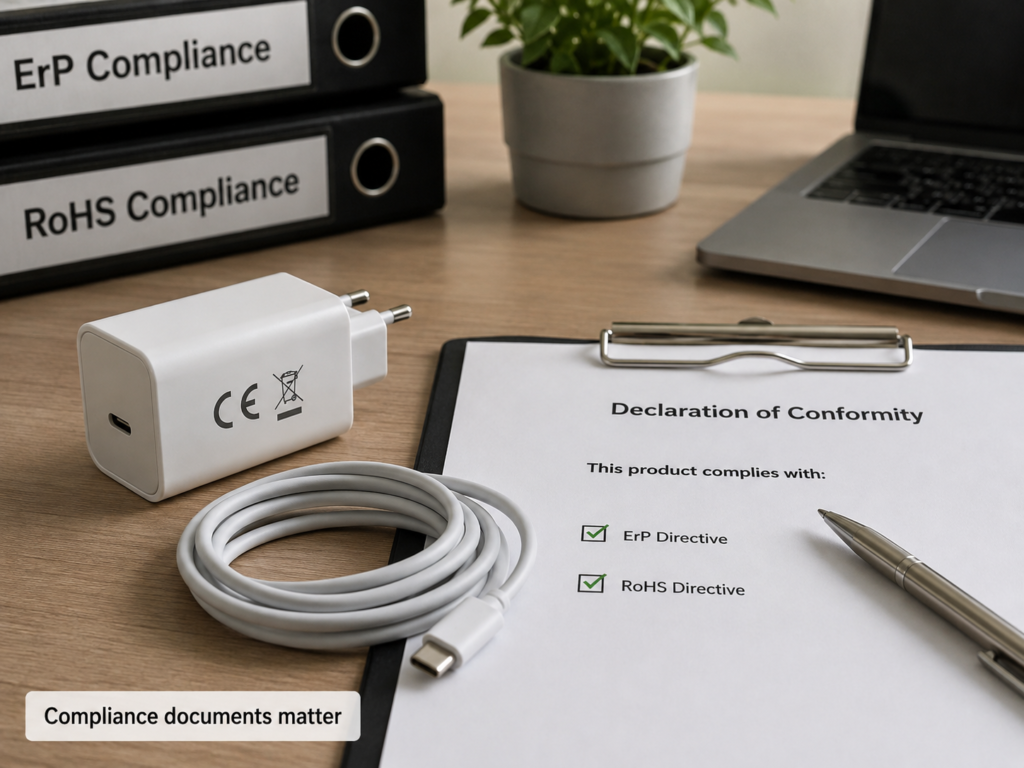
Whether it is a report given to you by a supplier or a report you made yourself, you can check against these:
- 4 key items to check for ErP documents: First, the product model on the report is exactly the same as the model you actually sell; second, the regulation version matches the date when the product is placed on the market; third, the report covers core indicators such as average active efficiency and no-load power consumption; fourth, the test conditions match the rated power of the product. You can’t sell a 65W charger but the report tests a 20W one.
- 4 key items to check for RoHS documents: First, there is a formal DoC, not just a test report; second, the report covers all 10 restricted substances, not just lead; third, the scope of controlled materials is clearly listed, covering high-risk parts such as cable jackets, plating, and solder; fourth, if exemption clauses are used, there must be clear exemption clause numbers and applicable parts.
There are several types of typical invalid documents, and you can just reject them directly when you see them: for example, general certificates with only vague “CE certification”, “environmental protection”, “lead-free” claims, no specific model and date; reports whose models do not match the actual product; and general statements claiming that one regulation can replace another.
Method for Querying the Latest Requirements
If you want to confirm the latest regulatory requirements by yourself, ordinary users can directly ask the supplier for compliance reports and DoC of the corresponding model; users with a certain foundation can query the corresponding implementing regulation text in the Official Journal of the European Union. No matter which method you use, the core verification principle is: the report model, regulation version, and market placement date must all match completely — missing any one is not valid.
12-Item Pre-Launch Compliance Checklist
If it is a new product ready to be launched, you can confirm one by one against these 12 items to avoid omissions:
- Confirm product identity information, including model, specification, intended use, to avoid judging special-purpose products as ordinary products.
- Confirm the sales form of the product: sold separately, sold as a set, or sold as bundled accessories with other products.
- Confirm the specific date when the product is placed on the EU market, to match the corresponding regulation version.
- Complete ErP applicability judgment, confirm the corresponding regulation version and specific requirements.
- Complete RoHS applicability judgment, confirm the scope of materials to be controlled.
- Check whether there are applicable exemption clauses and the validity period of the exemptions.
- Confirm that the product model and bill of materials (BOM) version are exactly the same as those on the test report, to avoid using old reports after changing materials.
- Confirm that the ErP energy efficiency test report covers all core indicators.
- Confirm that the RoHS material evidence covers all high-risk parts.
- Ensure that all technical documents are fully prepared before launch, don’t wait until you are randomly inspected to make up for them.
- Confirm that the EU DoC and CE mark meet EU requirements, don’t affix the mark randomly.
- Establish a change control mechanism for mass production, for example, re-evaluate compliance when changing suppliers or materials.
Guide to Avoiding Common Compliance Misconceptions
We have compiled 6 of the most common compliance misconceptions, which many sellers who have been in the business for several years are prone to fall into. You can check if you have fallen for them.
Misconception 1: Complying with one regulation can replace the other
Correct answer: The two have independent control directions, and independent energy-consuming charging products need to meet both. For example, a GaN charger with up-to-standard energy efficiency has passed ErP, but if the phthalates in the cable jacket exceed the standard, it still does not meet RoHS and cannot be sold in the EU.
Misconception 2: RoHS only checks finished products, not components
Correct answer: In principle, all homogeneous materials without applicable effective exemptions should meet the limits of Annex II; any material that exceeds the limit and has no applicable exemption will cause the finished product to fail RoHS. When judging lead in pins or solder, you should also check whether the specific use is subject to effective exemptions in Annex III or Annex IV.
Misconception 3: ErP necessarily requires recyclability/energy efficiency labels
Correct answer: Specific requirements depend on the product implementing regulation. The core of charging products is energy efficiency and specified labeling, which is not the same as energy efficiency labels for home appliances. Most charging products do not need additional energy efficiency labels.
Misconception 4: Affixing the CE mark equals passing ErP/RoHS
Correct answer: CE is the general mark for compliance with multiple regulations. You need to check the DoC to confirm the coverage. Some products may only comply with the low voltage and EMC directives, not covering ErP or RoHS, so affixing CE is not considered compliant.
Misconception 5: Low-power products don’t need to care about ErP
Correct answer: Power is only one of the influencing factors. Low-power products may also be within the scope of supervision, and because low-power products have large shipment volumes, they are instead a key focus of supervision, so you cannot let your guard down.
Misconception 6: “Lead-free” “environmental protection” claims equal RoHS compliance
Correct answer: RoHS controls 10 substances, and lead-free only covers one of them. Specific reports/declarations are required to confirm compliance, and you cannot just listen to claims.
Scenario-Based Compliance Priority Decision-Making (For Product Selection/Launch)
Compliance priorities are different at different stages, and the focuses are also different during product selection, R&D, trial sales, and response to random inspections. Here we have compiled priority suggestions for different scenarios.
New product R&D stage: ErP should be prioritized for intervention, because energy efficiency indicators must be considered when designing circuits and selecting chips. If you modify the energy efficiency after the board is prototyped and molded, the cost will be very high, and you may even have to redesign the entire solution. RoHS should be followed up simultaneously, and strictly vet at the stage of raw material selection and supplier access, requiring suppliers to provide compliant material declarations, to avoid discovering unqualified materials before mass production and delaying the production schedule due to temporary material changes.
Small-batch trial sales/before listing: Compliance documents for both regulations must be fully prepared before the product is placed on the market. EU competent authorities and platforms may request them at any time, so you can’t wait until you are checked to make up for them. In particular, pay attention to arranging ErP testing in advance, because the ErP testing cycle is relatively long, and you need to reserve enough time to avoid delaying the launch plan.
Response to customs/platform random inspections: Just provide the corresponding documents as required. Different EU member states and different platforms may have different inspection focuses. For example, some platforms focus on RoHS hazardous substances, and some customs focus on ErP energy efficiency. Technical documents should be organized so that they can be retrieved quickly. Don’t delay providing key materials, otherwise the goods may be directly detained or removed from the shelves.
Cost control stage: The cost of RoHS is mainly controlled from the supply chain end. Try to choose suppliers that already have compliance reports, so you don’t have to test each material separately, which can save a lot of testing costs. The cost of ErP is mainly controlled from the design end. Try to use mature high-energy-efficiency solutions, don’t choose low-energy-efficiency solutions to save a little chip money, the cost of later rectification will be much higher than the money saved.
Response to regulation updates: For ErP, focus on the implementation progress of Regulation (EU) 2025/2052, adjust the planning of USB-C cables and wireless charging products in advance, don’t wait until the new regulation takes effect in 2028 to cram. For RoHS, focus on the expiration time of exemption clauses, find alternative materials in advance, to avoid having no suitable materials available after the exemption expires, which affects production.
Learning Summary
So far, we have explained the comparison between EU ErP and RoHS very clearly. After learning this content, you should have mastered these core abilities: you can quickly distinguish the core positioning and control directions of ErP and RoHS; you can judge the ErP/RoHS applicable requirements of common charging products, including the boundaries of the 2028 new regulation; you can quickly verify the validity of compliance documents and judge whether the model, regulation, and scope match; you can avoid 6 common compliance misconceptions and will not confuse the functions and applicable boundaries of the regulations.
If you already have charging products being sold in the EU market, you might as well take action now: first use the 3-step judgment method to check the applicable regulations for each product, then use the 12-item checklist to take stock of the current compliance gaps, then ask the supplier for the DoC and test report of the corresponding model, and check whether the version and content are valid. Only by solidifying compliance in advance can you avoid unnecessary losses later.