
If you have ever bought a laptop power adapter or a desktop multi-port USB-C fast charging station, you have most likely seen marks like CE, UL, and FCC printed on the body — what exactly do these symbols mean? Does having them printed mean the product is safe and compliant? Why do some sellers use certifications for phone fast chargers to pass off as certifications for desktop power supplies?
Many people have only a smattering of knowledge about desktop power supply certifications, either thinking “as long as it can charge, it’s fine” or getting confused by a pile of unfamiliar marks. This guide starts with the most basic product differentiation, then covers mandatory requirements in different regions, how to read the nameplate, how to check authenticity, and tips for avoiding pitfalls. It covers everything from entry-level knowledge to practical decision-making, so you won’t be fooled by merchants after reading it.
Entry-Level Clarification: What Exactly Is a Desktop Power Supply
Many pitfalls of certification confusion are essentially caused by mixing up product types first. The desktop power supply referred to in this article is an external AC-DC power supply usually placed on a desk or the floor — that is, it converts alternating current (AC) from the wall into direct current (DC) that electronic devices can use. Such products are commonly power supplies with an independent AC input cord or a detachable AC cord.
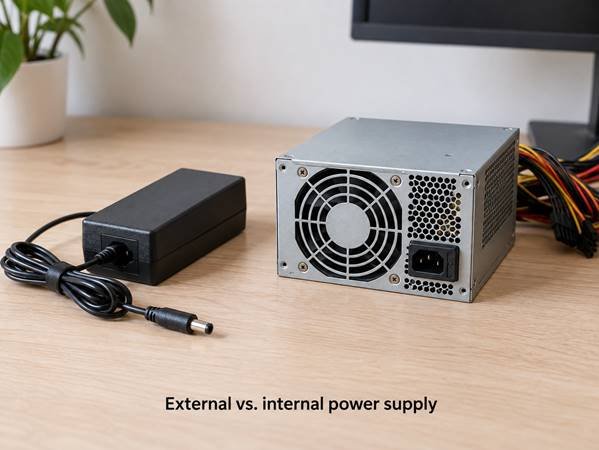
There are many such common products in daily life: the bulky power adapters included with laptops, desktop multi-port USB-C fast charging stations, and corded power supplies for monitors/docking stations/routers all fall into this category.
But note that the following types of products are not the desktop power supplies we are talking about, and their certification requirements and applicable standards may be different:
First, fast chargers with prongs integrated directly into the body that can be plugged directly into the wall (such as 20W phone fast chargers) belong to wall-plug chargers;
Second, ATX internal power supplies inside desktop computer cases belong to internal power supplies;
Third, industrial adjustable power supplies are industrial-grade products, and their applicable requirements may be different.
Here you must remember a core conclusion: You cannot directly use the certification documents of another product for this desktop power supply. Even if both supply power to USB-C devices, whether existing certification or conformity documents can be used depends on whether the documents cover the actual product’s model, rating, structure, key components, and manufacturing factory, not just the name “desktop” or “wall-plug”.
What Is the Use of Certifications?
Some people may say: “I just need a power supply that can charge, what do I need certifications for?” In fact, certifications are not useless “stickers”; they have three core functions:
The first and most important is safety guarantee. Desktop power supplies usually have higher power than phone fast chargers, and many people keep them plugged in all year round, placing them on desks near books and cables. If something goes wrong, the light consequence is damaged equipment, and the serious consequence is electric shock or fire. The safety requirements of certifications set the bottom line in terms of insulation, fault protection, materials, etc., focusing on reducing safety risks to users and equipment.
The second is compliance threshold. Whether it is import customs clearance, sales on e-commerce platforms such as Amazon, or sales in offline physical stores, it is necessary to comply with applicable regulations and channel requirements in the corresponding region. If relevant requirements are not met, problems such as cargo detention, e-commerce listing removal, fines, and even liability after safety accidents may occur.
The third is performance reference. Compliance with safety, EMC, and energy efficiency mainly indicates that the product meets relevant requirements in corresponding regulations or standards; but they do not guarantee output stability under all loads, nor do they automatically mean compatibility with USB fast charging protocols. For output performance and USB fast charging protocol compatibility, you should also check product specifications, protocol test documents, or applicable USB-IF certification information.
What Do Certifications Regulate? 3 Core Control Categories
Don’t be fooled by the many certification marks; the core things they regulate are actually three categories: electrical safety, electromagnetic compatibility, and energy efficiency.
Most Core: Electrical Safety (Preventing Personal Harm)
This is the top priority of all certifications, which in plain terms means “don’t shock people, don’t catch fire”. Safety assessments usually require products to prevent electric shock, overheating, and fire risks under normal use and specified fault conditions, mainly focusing on the following aspects:
• Insulation and electric shock protection measures: Appropriate protective design is required between live parts and accessible parts. Products can achieve this through protective grounding, double insulation, reinforced insulation, etc.; which one to use specifically depends on the product structure and applicable standards.
• Abnormal condition protection: When encountering abnormalities such as overcurrent, short circuit, or over-temperature, the product needs to adopt appropriate measures to control risks. The protection methods of different products may vary, such as current limiting, protection shutdown, temperature protection, or other designs; it cannot be simply understood that all products must achieve this through “automatic output cut-off”.
• Mechanical and material requirements: The enclosure, insulation structure, and materials need to meet the requirements of applicable standards for mechanical strength, heat resistance, flame retardancy, or other safety risks. Whether a specific flame retardant grade, drop test, or flame test is required should be judged according to the product structure, materials, and use environment.
Electromagnetic Compatibility (EMC): No Mutual Interference
Many people have not heard of this term, but it is actually easy to understand: the electromagnetic performance of the power supply during operation must not affect surrounding equipment, and at the same time, in some markets, it must be able to withstand the specified electromagnetic environment.
EMC requirements vary by market:
• Emitted interference: The power supply must not emit excessive electromagnetic interference during operation, and must not excessively affect nearby devices such as WiFi, speakers, and radios — for example, avoiding slowing down WiFi or causing obvious noise in speakers.
• Immunity: In markets with relevant requirements, products must also be evaluated for their performance when affected by the surrounding electromagnetic environment, to avoid situations such as unstable output or abnormal power failure.
It should be noted that the EU’s EMC framework covers both emission and immunity; US FCC Part 15 mainly involves unintentional radiated emission requirements for most external power supplies, and for Canada, the applicable requirements of ISED should be additionally checked. You cannot infer that a product has completed immunity evaluation solely based on the FCC mark.
Energy Efficiency Category: Power Saving Requirements
Simply put, it is “don’t waste electricity”, and there are two main indicators:
• No-load power consumption: This is the standby power consumption when the power supply is plugged in but not connected to any device. In markets where energy efficiency regulations for external power supplies are implemented and the product falls within the applicable scope, no-load power consumption and average efficiency may be subject to limit requirements; they should be checked according to the current regulations of the target market and product exemption clauses.
• Conversion efficiency: During the process of converting AC to DC, part of the energy is lost as heat. Conversion efficiency is the ratio of useful power to input power. Power supplies of different power levels may have different efficiency requirements; higher efficiency usually means lower heat generation and energy consumption.
Mandatory Certification Requirements for Major Global Markets
Requirements vary across different countries and regions. If you do cross-border sales or buy power supplies through overseas shopping, you must understand this part clearly. To facilitate your quick comparison, a core requirement comparison table is compiled:
| Target Market | Main Compliance Requirements | Core Notes |
| EU/EEA | CE-related regulatory requirements, usually involving safety, EMC, and applicable ErP energy efficiency requirements | Conformity assessment, technical documentation, and EU declaration of conformity are usually completed by the manufacturer; CE ≠ third-party certification |
| US/Canada | For the US, check FCC equipment authorization and local safety requirements at the place of sale; for Canada, check ISED and electrical safety requirements of the selling province/region | UL, ETL, CSA, etc. are certification bodies or certification marks; whether they are accepted and mandatory depends on regulations, regions, and sales scenarios |
| UK (England/Scotland/Wales) | Check UKCA or still recognized CE mark rules according to applicable regulations | CE marks can still be used for many electrical equipment and EMC products at present; different arrangements apply to Northern Ireland, and the UKNI mark may also be involved if necessary |
| Australia/New Zealand | Check electrical safety, EMC, and energy efficiency systems separately | Products subject to EESS in Australia shall handle requirements such as certificates, registration, and RCM according to risk levels; energy efficiency may be separately managed by GEMS |
| Japan | Diamond PSE | Whether an external power supply belongs to specified electrical appliances and the specific requirements shall be checked according to the product structure and local catalog |
| South Korea/India/Mexico | KC / BIS / NOM | Implemented according to the specific requirements of local regulatory authorities |
Here are a few points that are easy to fall into pitfalls, explained in detail:
• The EU CE mark is thought by many to be issued by third-party institutions. In fact, for external power supplies that are usually subject to the Low Voltage Directive, EMC requirements, and ErP requirements, the manufacturer is generally responsible for technical documentation, conformity assessment, and the EU declaration of conformity. Whether a notified body is required to intervene must be judged according to the conformity assessment modules of the specific applicable regulations, and cannot be divided by “low power/high power”. Seeing the CE mark does not mean that the product has necessarily undergone third-party testing.
• For the US, FCC equipment authorization requirements and local electrical safety requirements at the place of sale should be checked separately. The FCC Part 15 requirements involved in most external power supplies are mainly related to unintentional radiated emissions, and different procedures may apply specifically. Canada has independent ISED electromagnetic interference requirements, and electrical safety approval usually depends on the system of the selling province or region. Marks such as UL, ETL, and CSA represent different certification bodies or schemes; whether they are required and accepted by channels cannot be generalized.
• The UK market cannot be simply understood as “CE cannot be used at all, must be changed to UKCA”. Before selling in Great Britain, you should check UKCA or CE mark rules recognized by the UK for continued use according to applicable regulations; for many electrical equipment and EMC products, the CE mark can still be used at present. Different arrangements from the EU apply to Northern Ireland, and the UKNI mark may also be involved if necessary.
• Australia and New Zealand cannot be simply summarized as “SAA safety certification + RCM”. SAA is one of the certification bodies or trademarks, not a unified statutory certification name for Australia and New Zealand. In Australia, products subject to EESS need to handle matters such as certificates, registration, and RCM according to risk levels; if the external power supply falls within the scope of GEMS energy efficiency, it must also comply with the corresponding energy efficiency registration and labeling rules. New Zealand should also be checked according to its own applicable rules.
Read the Nameplate: Check These Parts First When You Get a Power Supply
Whether you are buying a power supply or verifying certifications, the first step is to look at the nameplate on the power supply body — that label printed with parameters. A formal power supply should have product marks, product identification information, and responsible party information required by the applicable market. Focus on the following types of content:
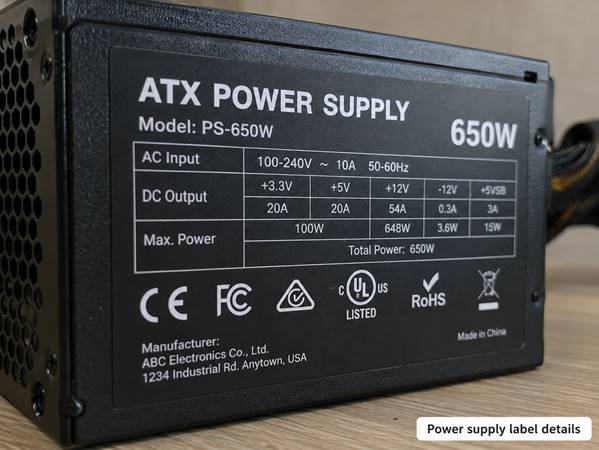
1. Input Parameters
It is usually marked with something like “Input: 100-240V~ 50/60Hz”. If it is a wide voltage of 100-240V, it means it can adapt to the mains range of many countries and regions around the world; if it is only marked with a single voltage such as 120V or 230V, it should only be used under the corresponding input voltage conditions, and cannot be arbitrarily connected to an unmatched power grid.
2. Output Parameters
This is the place where problems are most likely to occur. For fixed-output adapters, the voltage, polarity, interface, and minimum power specified or clearly compatible by the device manufacturer should be used; you cannot replace it by yourself just because the numbers on the label look similar.
The rated current or power should not be lower than the device’s demand under expected use conditions. For example, if a device requires 19V, 3A, which is 57W, in addition to the correct voltage, polarity, and interface, the replacement power supply’s rated output capacity should also meet at least 57W. When the output capacity is insufficient, the device may not work normally, the voltage may drop, or the protection mechanisms of the power supply and device may be triggered. This does not mean that the power supply will definitely burn out, but it is obviously not suitable as a long-term replacement solution.
If it is a USB-C PD product, you cannot just stare at numbers like “20V” and “100W”. USB-C power supply requires the power supply end and the power receiving end to negotiate the power supply level, and it is also necessary to consider whether the cable supports the required current and power. A more reliable approach is to use power supplies and cables that meet USB-C/PD requirements and can negotiate the required level with the device.
3. Certification and Traceability Information
Check product marks, product identification information such as model or batch, manufacturer or responsible party information, and corresponding conformity documents specified by the applicable market. Whether certificate numbers, control numbers, or file numbers must appear shall be judged according to the specific certification scheme; not all compliant power supplies must have such numbers printed on their bodies.
Also note that marks should usually be placed on the product or nameplate as required by regulations; but when the nature of the product does not allow or is not suitable, some schemes also allow marks to be placed on packaging or accompanying documents. Therefore, you cannot directly conclude non-compliance solely based on “it’s on the packaging but not on the product”, but should judge in combination with the specific labeling rules of the target market.
How to Check Certification Authenticity? From Preliminary Screening to Official Verification
Many merchants print fake certification marks. How can you avoid being fooled? You can follow the steps of “preliminary screening first, then check documents and official information”.
Step 1: 3 Preliminary Screening Methods to Quickly Identify Risk Clues
Don’t rush to check websites first. Looking at these points first can help you find suspicious points:
• Check nameplate completeness: Is there a product mark for the applicable market? Is the product model, manufacturer, or responsible party information complete? If the printing is blurry, missing information, or the model information is unrecognizable, you should be vigilant.
• Check for word games: For example, it only says “compliant with UL standards” or “compliant with CE standards”, but cannot provide certification or conformity documents corresponding to the actual model. Such statements themselves cannot replace verifiable certification records, declarations of conformity, or test documents.
• Auxiliary judgment: Abnormally thin and light body, unreasonably high rated power, obvious abnormal heat generation during use, etc., can all be used as risk clues. However, weight, volume, and temperature perception alone cannot prove that the product has false labeling, fake certification, or is definitely unsafe, because power density and enclosure temperature may vary with different designs.
For example, a power supply with a very small size but marked with very high power is indeed worth further checking the rating, heat dissipation design, and certification documents; but you cannot conclude that it must have false labeling or fake certification just because “it looks like 65W but is marked 200W”.
Step 2: Check Documents and Official Information to Verify if They Cover the Physical Product
After the preliminary screening is okay, then query certification bodies, regulatory databases, or supplier documents. Official inquiry is an important step, but it cannot alone achieve “100% confirmation of the authenticity of the physical product”: the database may only show certificate status, certified models, or authorization scope, and you still need to compare the physical product with the documents item by item.
Verification methods vary by region:
• US region: First confirm whether the product is a device that requires FCC Certification. Most external power supplies usually involve procedures such as SDoC, and do not necessarily have an FCC ID; for such products, you can ask the supplier to provide FCC conformity documents and check the responsible party information. Only if the product is indeed subject to FCC Certification can you query the corresponding records through the FCC ID. For safety marks such as UL, ETL, and CSA, you can use the public query tools of the corresponding certification bodies to check files, models, or mark authorization information.
• EU region: CE is not a unified “product certificate query system”. You can ask the manufacturer or importer to provide the EU DoC (Declaration of Conformity) and corresponding technical document summaries, and check the model, responsible party, and applicable regulations. The NANDO database can be used to verify the identity and designated scope of notified bodies, but it is not a CE product certificate database, nor can it prove that a certain power supply has obtained CE certification.
• Australia-New Zealand region: You should check the corresponding registration, certificates, responsible party, or regulatory information according to the electrical safety, EMC, and energy efficiency systems applicable to the product, instead of only checking a “SAA certificate number”.
When querying, you must remember a core principle: You must compare the physical product’s model, rating, manufacturer, production location or factory, version, and accompanying cables with the coverage scope of the certificate or conformity documents item by item. You cannot only check the brand name. The same brand may have dozens or hundreds of models, some of which are compliant and some are not covered by the same document; counterfeit certificate products often have mismatched models, manufacturers, or configurations. If you still have questions, you can confirm with the certification body or the brand.
3 Common Fake Certification Scams
Knowing these scams in advance can help you avoid many pitfalls:
• Certificate misappropriation: Using the certification number of another brand or another model without authorization. It can be found when querying, but the model and manufacturer do not match the product you bought.
• Fake certification marks: No certification has been done at all, and a certification mark is printed and pasted on by oneself. When querying, the corresponding information cannot be found, or the certification body cannot confirm the mark authorization.
• Certificate confusion: Using certification documents of another product, a low-power version, or a different configuration to pass off as the documents of the current desktop power supply. Whether it can be covered shall be based on document records such as model, rating, structure, key components, cables, and factory.
How to Choose Certifications for Different Scenarios? No Need to Blindly Pursue More
More certifications are not always better; the one suitable for your own scenario is the most cost-effective. Let’s talk about three situations:
Personal Daily Use
Prioritize products that comply with applicable regulations, plug, and rated input conditions at the place of sale, and verify applicable safety and EMC documents. For example, products sold in the EU should comply with applicable CE-related requirements; when used in the US and Canada, they should be checked according to local applicable rules, and for Canada, attention should also be paid to locally recognized electrical safety approvals.
If you buy a desktop power supply with a USB-C interface, you can additionally pay attention to whether it has USB-IF certification. This is a certification program of the USB Implementers Forum, which can be used as one of the USB compliance information; but it cannot replace the compatibility confirmation of your own laptop, mobile phone, cables, and actual power supply needs, nor can it guarantee that all devices will not have compatibility problems or damage.
There is no need to blindly buy products with a bunch of certifications from unpopular regions — for example, if you are in Europe, buying one with certifications from Brazil and South Africa is completely useless, and the cost of these certifications may be added to the selling price, making you spend extra money for nothing.
Cross-Border E-Commerce Sales (Sellers)
If you are selling on Amazon’s European and US sites, you shall prepare test, certification, or conformity documents corresponding to the actual model based on the current compliance policies of the target site, platform notifications, and local regulatory requirements. Under different sites, product categories, regulations, and risk audit situations, the documents required by the platform may be different, and you cannot simply assume that all products must submit the same set of “safety + EMC certification documents”.
Be sure to note: you cannot directly apply the certification documents of another product to a desktop power supply; for products of different models in the same series, you must also confirm the coverage scope of the certification or conformity documents — for example, if a document only covers a specific rated power, enclosure, cable, or factory, other versions cannot be directly used.
Special Scenarios
If used in places that may be exposed to water splashes, condensation, or outdoor exposure, you should select products with appropriate IP protection ratings and clearly allowed for use in such environments according to the product manual, installation rules, and actual environment.
For example, IPX4 means that the enclosure has splash-proof capability according to the test conditions specified in IEC 60529, but this does not mean that the product is necessarily suitable for use in all outdoor, bathroom, or humid environments. Whether it can be used in a specific location also depends on the installation method, power cord and socket position, ventilation conditions, and the restrictions of the product manual.
Advanced Pitfall Avoidance: Certification Rules and Misconceptions You May Not Know
Many people’s understanding of certification stays at “as long as there is a mark, it’s fine”, but in fact, there are many rules for certification, and you may fall into pitfalls if you are not careful.
Certifications Are Not Valid for Life
Many people think that certification is “processed once, valid for life”, but that’s not the case. The way to maintain certification or conformity status varies by scheme:
• Third-party safety certifications may have ongoing factory supervision and change control. Certification bodies will arrange supervision or follow-up inspections according to their certification schemes, and the specific frequency and method are not the same for all bodies and all products.
• CE self-conformity does not have a general mechanism of “annual factory audit” conducted by certification bodies; instead, the manufacturer is continuously responsible for maintaining product conformity, technical documents, and declarations.
• When regulations, mandatory technical requirements, or applicable standards are updated, it does not automatically make the certifications of all old products “invalid” on the day of update. You should check the transition arrangements, implementation dates, obligations for continued placing on the market, and whether tests, technical documents, declarations, or certifications need to be updated.
These Changes Require Reassessment
Even if the product originally had formal certification, any of the following changes may affect the original conformity status:
• Replacement of core components: For example, changing the model of transformers or power supply main control ICs may affect safety and EMC performance.
• Structural changes: For example, openings in the enclosure or changes in insulation layer thickness may affect insulation, temperature rise, or mechanical strength.
• Parameter changes: For example, increasing the rated power from 100W to 120W, or adjusting the output voltage, may change the original assessment conditions.
• Changes to supporting cables: For example, replacing detachable AC cords, plugs, or cord sets may also affect the safety assessment configuration of the whole machine.
These changes do not necessarily mean “full re-certification” under all systems, but they cannot be ignored on your own. For third-party certified products, you should first obtain written confirmation of the change from the issuing body, which will decide whether supplementary tests, change reports, or new certificates are needed; for CE products, the manufacturer shall re-complete the necessary conformity assessment and update the technical documents and DoC.
General Boundaries of Certifications
Not all products of the same brand can share one certification or conformity document. Whether series models are covered depends on the specific models, structures, ratings, key components, factories, and configurations listed in the certificate, test report, and certification body authorization, not just “the circuit structure is the same” or “the power difference is within a certain range”.
Also, certification or conformity marks from different regions cannot be simply mutually recognized — for example, having a CE mark does not mean that all requirements of the UK, South Korea, or other markets have been met; having FCC-related documents does not mean meeting the requirements of Canada’s ISED or KC. Whichever market you want to sell to, you should check according to the current rules of that market.
Also note that certification or conformity documents usually only cover the products and configurations specified in the documents. Detachable AC input cords, plugs, and cord sets provided with the product may often be part of the whole machine safety assessment, and it cannot be generally considered that “the body certification does not include cables”. Whether they are covered shall be based on certificates, test reports, and specific configuration records. When the manufacturing factory changes, it should also be reconfirmed whether the documents are still applicable.
4 Most Common Certification Misconceptions
Finally, let’s clarify a few concepts that people most easily get wrong:
1. Having a CE mark = having third-party safety certification: Wrong. For external power supplies that are usually subject to low voltage, EMC, and ErP requirements, CE conformity assessment is mostly completed by the manufacturer itself and a declaration is signed; the CE mark itself does not represent third-party certification.
2. More certifications mean better quality: Wrong. Certification or conformity marks mainly indicate that the product meets relevant requirements of a specific market. More marks usually only mean that the product may be targeted at more markets, and does not mean that the quality is necessarily better; prioritize the applicable requirements of your own region or target sales region.
3. Wide voltage = global universal: Wrong. Wide voltage only means that the input voltage range may adapt to the mains of multiple regions; you also need to consider plugs, cables, local regulations, energy efficiency requirements, and product manual restrictions, otherwise it may not be pluggable, cannot be sold legally, or is not suitable for local use conditions.
4. Certification marked on e-commerce page = product has certification: Wrong. Many merchants’ pages randomly mark certifications, and the actual product or actual model may not have corresponding documents. It shall be based on the physical product model, responsible party information, relevant conformity documents, and queryable certification records.
Conclusion
So far, the core content about desktop power supply certifications has been covered. After reading this, you should be able to master these 6 practical skills:
First, you can accurately distinguish desktop power supplies from wall-plug chargers, built-in ATX power supplies, and industrial adjustable power supplies, and will no longer be fooled by merchants using documents of different products;
Second, whether for personal use or cross-border sales, you can quickly clarify the applicable requirements for desktop power supplies in the target market and avoid compliance risks;
Third, when you get a desktop power supply, you can understand the input and output parameters, product marks, and traceability information on the nameplate, and know whether it can be used and how to verify it;
Fourth, you can judge whether certification or conformity documents correspond to the physical product through preliminary screening skills, document checking, and official channel inquiries, and will not easily buy products with misappropriated certificates or fake marks;
Fifth, you can choose compliant and cost-effective products according to different needs such as personal use, cross-border sales, and special scenarios, without spending extra money on useless certifications;
Sixth, you can identify common certification misconceptions and change risks, and avoid non-compliant products.
Although desktop power supplies are inconspicuous small accessories, whether for daily use or business, compliance is a bottom line that cannot be ignored — it is related to safety, as well as sales and use risks. Next time you choose a desktop power supply, you might as well spend two minutes looking at the nameplate and checking the model and documents, which can save a lot of subsequent troubles and risks.