
If you run a power adapter business targeting the Australian market, or shop for charging products in Australia, you have most likely seen the RCM mark composed of three arcs on products. Many people think it is just a casually printed logo, and only realize that it involves compliance requirements for electrical products when their products are ordered to be removed from shelves, recalled, or supply is stopped.
This article starts from the most basic definition, covering the entire process of whether certification is needed, how to apply, how to verify, and how to maintain it later. Whether you are a new cross-border small seller or an ordinary consumer who wants to identify product compliance, you can understand and use this guide.
1. First, Understand What RCM Is: It Is Not a Logo, But a Compliance System
The full name of RCM is Regulatory Compliance Mark, which is a compliance mark under the Australian regulatory framework used to indicate that products meet applicable electrical safety, electromagnetic compatibility, or radiocommunications requirements. Unlike what many people think—”just print the mark”—it involves requirements such as product conformity evidence, supplier responsibilities, and registration where applicable; the specific steps to complete depend on the product category, risk level, and applicable regulations.
RCM does not mean that every product is necessarily subject to both electrical safety and EMC obligations. Whether a product needs to meet safety, EMC, or radiocommunications requirements should be judged according to the product category and applicable regulations. Australia’s electrical safety part is usually related to the EESS system, while electromagnetic compatibility and communications equipment requirements are managed by the Australian Communications and Media Authority (ACMA).
It should be particularly distinguished that New Zealand’s electrical product safety, EMC, product approval, and supplier declaration systems are not exactly the same as Australia’s. Whether RCM is acceptable in New Zealand and what local obligations products still need to fulfill should be separately confirmed in accordance with New Zealand regulations. The “SAA certification” often mentioned in the market in the past should not be simply understood as an old Australian government safety mark uniformly replaced by RCM; “SAA” is often used as a term for certification bodies or commercial certifications.
Why Must We Attach Importance to RCM?
It has three irreplaceable core functions:
First, it is a compliance requirement for market supply. Power adapters that do not meet applicable electrical safety, EMC, and other product regulatory requirements shall not be legally supplied in the corresponding market; regulatory authorities may take measures such as removal from shelves, sales ban, recall, or penalty. Whether the product is inspected or released at the import stage cannot be used as a standard for judging compliance.
Second, it provides safety guarantee. The applicable safety requirements focus on ensuring electricity safety, which can effectively reduce risks such as electric shock, fire, and abnormal output, and is a protection for both sellers and consumers.
Third, responsibility is traceable. Relevant systems usually require qualified responsible suppliers to bear responsibility. Once a product has a problem, the regulatory authority can trace the corresponding responsible party, and there will be no situation where the responsible party cannot be found.
Does Your Product Need RCM? You Cannot Only Look at 3 Simple Conditions
What many people are most confused about is how to judge whether their products are within the scope of control. For the Australian market, you cannot draw conclusions only based on “connected to mains power, low-voltage output, consumer scenarios”, but should confirm item by item in the following directions:
1. Whether the rated input voltage of the product falls within the applicable low-voltage range;
2. Whether the product is a regulated electrical device in the EESS equipment list;
3. What risk level corresponds to the specific structure and category of the product;
4. Whether the product is an EMC or radiocommunications device regulated by ACMA.
Products such as plug-in mobile phone chargers, desktop laptop power adapters, and AC chargers for household power banks often need to be checked against these requirements. However, industrial, medical, vehicle-mounted, PoE-specific power supplies, bare modules, and complete machines with built-in power supplies cannot be automatically excluded just because of their purpose or structure. They may still be subject to electrical safety, EMC, medical device, or other special regulations, but the applicable standards and compliance paths may be different.
If you sell a set of charger plus charging cable, the charging cable does not necessarily need to be treated as an independent power adapter, but the labeling, instructions, and actual supply method of the entire set of products should still meet applicable requirements.
In addition, the EESS risk level of power adapters cannot be generally determined. Plug-in type power supplies or chargers and non-plug-in type power supplies or chargers may be subject to different levels. For Level 3 products, the responsible supplier usually needs to hold a valid conformity certificate and complete equipment registration before supply; the testing and certification path should meet EESS accreditation requirements.
4 Common Misconceptions for Beginners
People who are new to RCM are easily misled by wrong information. Here are the common pitfalls clarified in advance:
First misconception: If the plug has SAA certification, it means the whole machine has RCM.
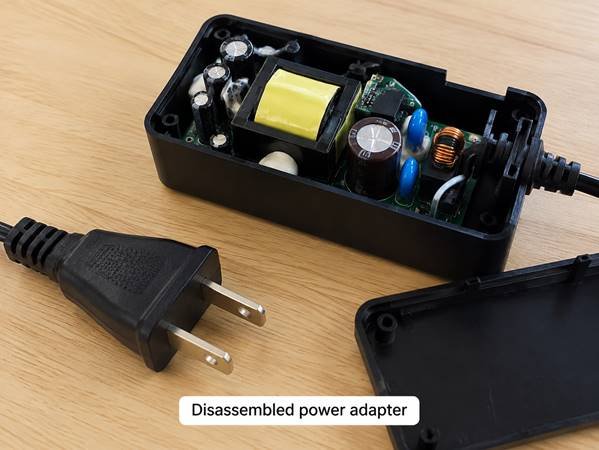
RCM or related compliance requirements assess the compliance of the entire power adapter. A single qualified part does not mean the whole machine is qualified—even if the plug meets the requirements, if the transformer insulation does not meet the standard, the entire product may still not meet the requirements.
Second misconception: Having CE, CB, or FCC reports can be used directly. There are differences in regulations and standards between different markets. CE is the EU compliance mark system, FCC mainly involves US requirements for radio frequency emission, unintentional radiation equipment, and equipment authorization, and CB is the international safety test report system. They cannot directly replace the applicable compliance obligations of Australia or New Zealand. Among them, CB reports can be used to assess the differences between Australian and New Zealand standards when applicable, which may save time and cost, but local applicable supplier, certificate, or registration requirements still need to be completed.
Third misconception: RCM is a logo that can be printed casually. RCM can only be used legally after meeting applicable rules. Printing it on the product without completing the necessary compliance steps may constitute a serious violation.
Fourth misconception: Low-power chargers do not need certification. Low power does not automatically exempt from compliance obligations; however, whether a conformity certificate, equipment registration, and RCM mark are required must be confirmed item by item according to the sales location, EESS applicable scope, equipment list, and risk level.
2. What Does RCM Assess? There Are 4 Core Requirements
Many people think RCM is just “testing whether it is safe”, but in fact, it involves more than just a single safety test. For power adapters, there are four main common areas of concern:
1. Electrical Safety Assessment: Electric Shock Prevention and Fire Prevention
This is the most basic core requirement, and its essence is to reduce electricity risks to a safe range:
• Electric shock prevention: During normal use, the human body should not be exposed to internal live parts to avoid the risk of electric shock.
• Reliable insulation: The high-voltage mains input terminal and low-voltage output terminal need to meet applicable isolation and insulation requirements to prevent electric shock to users or damage to charged devices caused by current leakage.
• Fire and high temperature resistance: When operating at full load, the temperature of internal components and the enclosure shall comply with applicable safety limits to avoid hazards such as melting and fire.
• True parameters: The output voltage, current, and power shall be consistent with the product labeling and actual declaration, and shall not be falsely marked, otherwise it may damage charged devices such as mobile phones and tablets.
• Compliance of key components: Core safety components such as Australian standard plugs, transformers, and fuses shall meet corresponding standards and the requirements of the whole machine certification assessment.
2. Electromagnetic Compatibility (EMC) Assessment: Focus on Whether It Causes Interference
Simply put, EMC focuses on whether the electromagnetic interference generated by the product during operation meets applicable limits:
• Emission requirements: When the charger is operating, the generated electromagnetic interference shall not exceed applicable limits, to avoid affecting the normal operation of nearby devices such as radios, routers, and TVs.
• Conformity evidence: General power products shall confirm emission requirements and conformity evidence in accordance with ACMA applicable EMC standards.
Immunity, that is, whether the product can maintain normal operation after being subjected to external electromagnetic interference, is not a unified mandatory EMC assessment item applicable to all ordinary chargers. Whether an immunity assessment is required shall be subject to specific product standards, product safety standards, contract specifications, or other special regulations.
Multi-port fast chargers and high-power switching power supplies may face higher interference control risks in design and testing, but power and number of ports do not automatically make the statutory EMC test level stricter. If the adapter also has functions such as wireless charging, Bluetooth, or WiFi, it may also involve radiocommunications or radio frequency related requirements, and cannot be treated only as an ordinary power product.
3. Easily Overlooked GEMS Energy Efficiency Registration
A special reminder here: GEMS energy efficiency requirements and RCM are two different systems and cannot replace each other—RCM involves applicable safety, EMC, or communications requirements, while GEMS involves energy efficiency.
Some external power supplies may be subject to the GEMS External Power Supply rules, but whether they apply must be judged item by item according to the definitions, scope, exemptions, and testing requirements in the current GEMS External Power Supply Determination. USB interface, desktop structure, output power, or general use cannot alone determine whether registration is required.
When applying for RCM or preparing to enter the Australian market, it is best to confirm GEMS issues at the same time to avoid affecting sales due to missing energy efficiency obligations.
4. Mandatory Requirements for Labeling and Responsible Entities
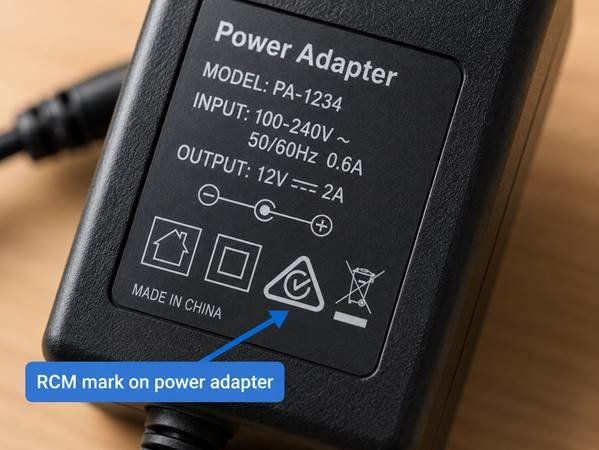
This part is a major area where many products fail random inspections, and the requirements need to be checked against applicable rules:
Products shall be marked with RCM (if applicable), model or identifiable model, rated input and output parameters, and traceable supplier identification information in accordance with applicable safety standards, EESS and ACMA labeling rules. Whether a certain registration number must be marked cannot be generalized, and shall be confirmed according to specific regulatory requirements.
There are also requirements for the label itself: printing, nameplate, or durable label can be used, the key is that it is clear, visible, and durable under normal use conditions. You cannot conclude that it is non-compliant just because a label is used; similarly, if the label is easy to fall off, blurry, or unrecognizable, it will also bring risks.
For multi-port or fast charging products, the necessary output ratings shall be clearly marked in accordance with applicable safety standards and their rated output declarations. If there are port combination restrictions, power statements that may mislead consumers shall be avoided. Whether every port combination and all PD and PPS levels must be listed shall be confirmed according to applicable standards, and it cannot be directly determined that the product is definitely non-compliant just based on the expression “maximum 65W”.
Finally, the most critical requirement for responsible entities: in cases where the responsible supplier is required to perform obligations, the supplier must meet local system requirements. Whether overseas sellers can complete relevant registration or registration on their own depends on the applicable system and their local legal identity, and the responsible entity arrangement shall be confirmed before actual operation.
3. How to Apply for RCM? Process, Cycle, and Cost Explained Clearly at Once
If you are sure that the power adapter needs to be compliant in accordance with applicable Australian requirements, figuring out the process and cost in advance can save you a lot of detours.
What to Prepare Before Applying?
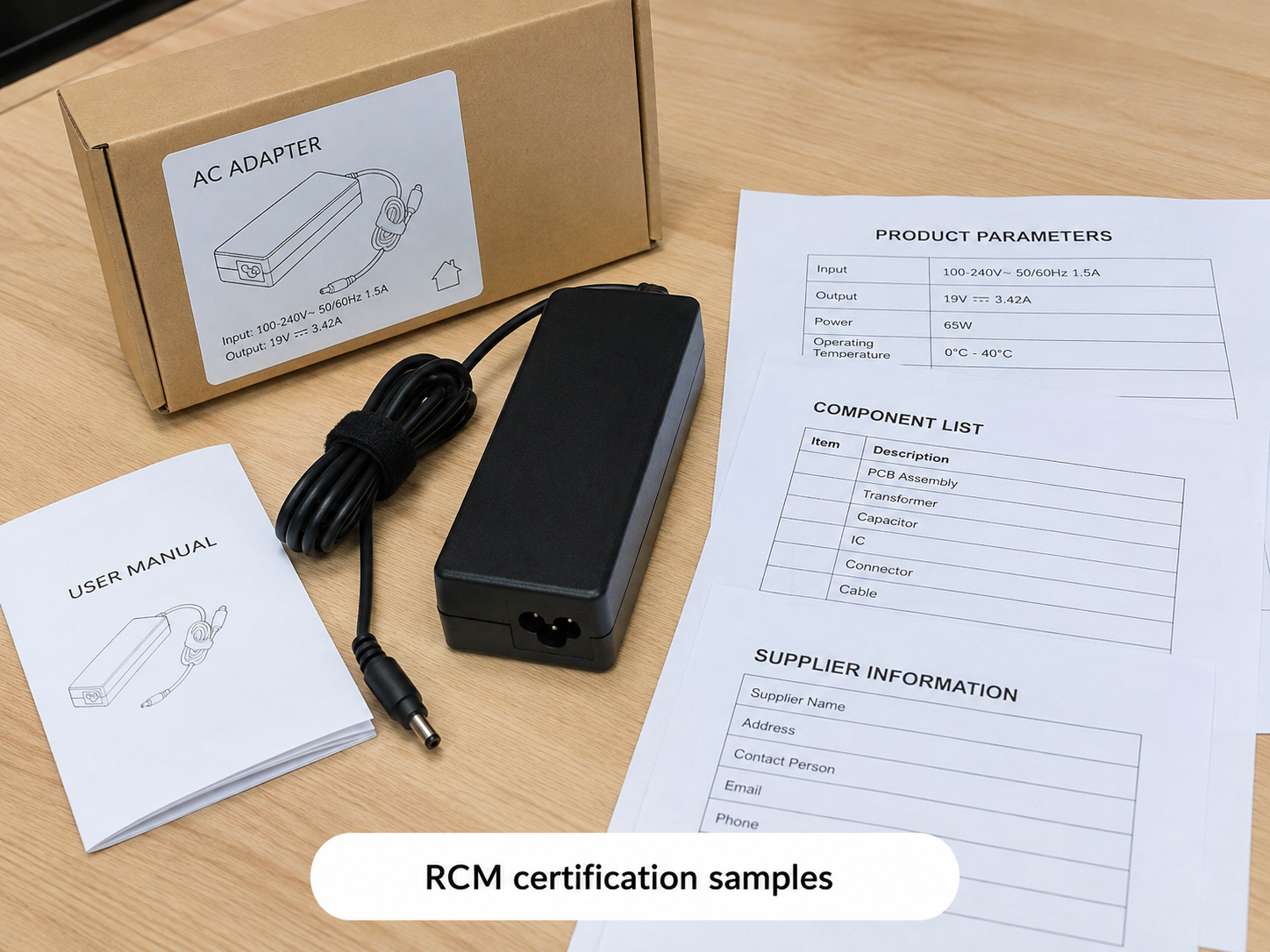
Preparing these materials in advance can save a lot of time:
First, samples: Usually, finished products of the mass production version with packaging and instructions are required, and they shall be consistent with the final sales version; engineering prototypes with different structures from mass production cannot be used.
Second, documents: including product parameter sheets, key component lists, and responsible supplier information. If there are previous overseas test reports, such as CB or CE related materials, they can also be provided together.
Third, pre-sorting: If there is an applicable and valid CB report, the differences between Australian or New Zealand standards can be assessed based on it, which may save part of the testing cost and time; other CE and FCC reports can also be used as technical references, but cannot directly replace local compliance documents.
Fourth, model sorting: Whether model series can share certificates or test materials cannot be mechanically judged only based on whether the power, number of interfaces, chip, or transformer are the same. The responsible supplier shall conduct a difference assessment based on applicable standards, the scope of existing certificates, and the certification body or technical responsible person.
5 Core Steps for Application
After the preparation work is done, the entire application process can be advanced according to the following ideas:
The first step is classification confirmation: First verify the product’s EESS risk level, applicable standards, ACMA EMC compliance level, and whether it is necessary to confirm GEMS energy efficiency requirements at the same time, to avoid going in the wrong direction from the start.
The second step is to prepare conformity evidence: According to applicable standards and risk levels, prepare test reports, technical documents, key component materials, and other supporting evidence. Whether testing institutions, reports, and certificates are acceptable shall be confirmed in accordance with applicable standards and the accredited certificate system, and it is not limited to being completed by local laboratories in Australia and New Zealand.
The third step is to obtain a conformity certificate: For products that require a certificate, such as EESS Level 3, the responsible supplier shall usually hold a valid conformity certificate as the basis for subsequent supply and equipment registration.
The fourth step is to fulfill supplier obligations: For EESS Level 3 products, the responsible supplier must complete equipment registration as required; for other risk levels, obligations such as supplier registration and conformity documents shall be fulfilled in accordance with EESS regulations. For EMC, registered suppliers shall obtain and retain conformity evidence and declarations in accordance with ACMA rules, rather than understanding it as completing product registration model by model at ACMA.
The fifth step is labeling and sales: Only after completing the applicable compliance steps can the RCM mark be used in accordance with specifications and the product be supplied to the market.
Reference for Cycle and Cost
For the cycle and cost that everyone is most concerned about, we take the most common 5-100W consumer power adapter as an example:
In terms of cycle, if there is no ready-made compliance report, the whole process takes about 4-8 weeks; if there is a CB report that meets the requirements and the product differences are small, only supplementary assessment, difference items, and related procedures are needed, which may be completed in 2-4 weeks.
In terms of cost, for conventional 5-100W products, the comprehensive cost of testing, certificates, and related registration may range from several thousand to more than 10,000 RMB. This range does not include GEMS related costs that may apply; if energy efficiency matters are to be handled simultaneously, the cost will increase.
The specific cost will be affected by several factors: the product’s power, number of interfaces, whether there is an available CB report, the initial compliance of the product itself, whether rectification is needed, the scope of the certificate, and whether GEMS requirements are handled simultaneously.
Avoid Common Failure Reasons
Many people stumble on the same problems during the application process, and they can be avoided by paying attention in advance:
First, incomplete key component materials, such as lack of applicable certification, specifications, or test materials for core components such as Australian standard plugs, transformers, and fuses, resulting in the failure of the whole machine assessment.
Second, false marking of output parameters, or inconsistency in structure and components between the submitted test samples and the mass production version. Even if the submitted samples pass, if the mass production version does not meet the requirements, there will still be problems in subsequent random inspections.
Third, failing to arrange a qualified responsible supplier, resulting in the inability to complete applicable supplier obligations or equipment registration.
Fourth, unclear model boundaries, forcing products with large structural differences into one series for application, resulting in the certificate scope not covering the actual sales models.
Fifth, wrong risk level judgment. Obviously belonging to the category that requires a conformity certificate or equipment registration, but handling it according to a lower risk path will bring greater compliance risks later.
4. How to Check the Authenticity of RCM? Two-Step Method to Identify Risks
Whether you are sourcing products from suppliers or buying charging products yourself, it is important to learn to verify RCM related information. However, it should be clarified first: appearance can only help find risk clues, and you cannot directly judge “fake certification” by appearance alone.
Step 1: 30-Second Quick Preliminary Judgment by Appearance
Without checking the database, first check several key points by appearance:
First, check whether the mark is clear. If applicable, RCM shall be clear and legible, and shall not be blurry or obviously easy to fall off.
Second, check durability. The mark can be printed, a nameplate, or a durable label, and shall not be deemed non-compliant just because it is a sticker. What really matters is whether the label can remain clear, visible, and identifiable under normal use conditions.
Third, check basic information. Verify whether the product model, rated input and output parameters, and supplier traceable information meet applicable rules. The absence of a certain registration number is not sufficient to alone prove that the certification is fake, because the supplier identification method is not necessarily equivalent to printing the registration number on the product.
Fourth, check whether the power statement is clear. Multi-port fast charging products shall avoid misleading users about output capability. For example, only writing “maximum 65W” without explaining whether it is the total output or the capability of a specific port may cause usage misunderstanding; however, whether it violates specific labeling rules still needs to be judged according to applicable standards.
Step 2: Verification of Official Records and Supplier Documents
After there are no obvious problems in the preliminary appearance judgment, then check the public records and documents provided by the supplier.
For applicable EESS Level 3 equipment, the EESS public database can be used to check equipment registration and conformity certificate information. However, the inability to find a certain model cannot alone prove that the product violates EMC or all regulations, because not all risk levels of equipment require public registration model by model.
ACMA’s EMC system usually requires suppliers to keep conformity declarations and supporting evidence, and there is no public EMC product registration database for consumers to query by all specific product models. Therefore, when verifying EMC compliance, a more practical approach is to require the supplier to provide the conformity declaration and corresponding supporting documents.
For New Zealand products, corresponding records shall be queried according to its specific electrical safety, EMC, and energy efficiency systems, or relevant documents shall be obtained from the supplier. MBIE cannot be simply understood as a unified query entry for “New Zealand RCM registration information”.
When querying or verifying, try to use the complete product model, brand name, certificate number, or supplier information, and do not only use general terms such as “charger” or “power adapter”.
After getting the results, interpret them according to three principles:
First, if the relevant records of Level 3 equipment cannot be found, it is worth further verifying with the supplier, but you cannot conclude that all regulations are non-compliant based solely on this point.
Second, finding the corresponding supplier does not mean that all products of this supplier meet the requirements, and the specific model and certificate coverage scope should still be checked.
Third, finding a similar model does not mean that the current product is necessarily covered. The model, power, key structure, and certificate scope all need to be consistent or have undergone effective difference assessment. For example, a supplier’s information for a 20W single-port model does not automatically cover a 30W dual-port model.
Common Fake Certification Tricks
There are several other typical risk methods that require special vigilance when encountered:
For example, using the SAA certification of a single part or other component materials to impersonate the RCM or safety compliance of the whole machine; in fact, a qualified part does not mean the whole machine is qualified;
For example, using documents from other markets such as CE and FCC to replace the compliance documents that should be available in Australia or New Zealand; in fact, the applicable regulations and standards are not the same;
For example, providing supplier, certificate, or registration information that cannot be verified;
There is also using certificates of old models to cover new models; the product has changed its circuit, power, or key structure, but has not completed appropriate assessment, updated certificates, or registration. This type of “certificate misappropriation” also has high risks.
5. Is It Done After Getting Certification? These Points Should Be Noted for the Use and Maintenance of RCM
Many people think that RCM is a one-time and forever thing, but that is not the case. Subsequent use and maintenance are equally important, and doing it wrong may also be a violation.
Correct Usage Specifications for the RCM Mark
First, it can only be used for specific products and models that meet applicable requirements, and cannot be applied across models—for example, the certificate or compliance materials of Model A cannot automatically cover Model B that has not been assessed.
Second, RCM shall be used clearly and identifiably in accordance with the specified pattern and proportion; usually the minimum height is 3mm, and if it is impractical due to the size or nature of the product, a smaller size can be used according to the rules. The pattern or proportion of the mark shall not be changed; the color shall ensure that the mark is clearly visible.
Third, do not mix the RCM mark with other certification marks to the extent that it is easy to mislead consumers. Marks from different markets have different applicable scopes, and the information shall be kept clear.
Do Product Modifications Need Retesting? First Conduct a Change Assessment
Product upgrading is common. Whether to retest, update certificates, or re-register cannot be mechanically judged only based on “what parts have been replaced”.
Model series and product changes shall be assessed by the responsible supplier based on applicable standards, the scope of existing certificates, and the opinions of the certification body or technical responsible person. Any change that may affect safety, EMC, ratings, key structure, mandatory labeling, or certificate scope shall be subject to document review before supply, and supplementary testing, certificate update, or registration update shall be carried out as needed.
For example, replacing transformers, main control chips, fuses, insulating materials, increasing output power, adding ports or fast charging functions, changing Australian standard plugs, enclosure safety structures, or production factories may all affect compliance and shall be assessed first.
Changes in color, non-safety related printing, or packaging usually have lower risks, but if the changes affect mandatory labeling, instructions, safety materials, rated parameters, or certificate scope, it cannot be automatically assumed that no handling is needed.
4 Must-Do Things for Daily Maintenance
First, keep conformity declarations, test or technical documents, conformity certificates, and registration records. The retention period and starting point shall be checked against the specific regulations of ACMA, EESS, New Zealand, and GEMS respectively; ACMA conformity records usually need to be kept for a specified period after supply is stopped.
Second, if the conformity certificate is marked with a validity period, before it expires, the product shall be re-assessed to see if it still meets applicable requirements, and the certificate shall be updated or supplementary testing shall be carried out if necessary.
Third, before product modification, first assess whether it affects safety, EMC, ratings, mandatory labeling, or the scope of existing certificates, and then decide whether supplementary testing, certificate update, or re-registration is needed.
Fourth, if the information of the responsible supplier changes, the relevant registration, registration, or document arrangements shall be updated in time according to the applicable system to avoid the break of the responsibility chain.
Market Random Inspections and Consequences of Violations
Both Australia and New Zealand carry out market supervision. Relevant authorities may verify whether products meet applicable safety, EMC, energy efficiency, and labeling obligations.
Common risks include: selling without completing applicable supplier or registration obligations, non-compliant labeling, false parameter marking, using unverifiable or inapplicable certification materials, etc. Once a violation is found, it may face consequences such as product removal from shelves, sales ban, fines, and mandatory recall, and in serious cases, it will also affect subsequent market access.
6. Common Confusion Points and Entry-Level Decision-Making Suggestions
Many people confuse RCM with the systems of other countries or regions. Here is a table to clarify the core boundaries:
| Certification Type | Coverage | Core Requirements | Relationship with RCM |
| CE (EU) | Multiple requirements such as safety and EMC | Usually based on manufacturer’s conformity assessment and EU declaration of conformity; when manufacturers from third countries place applicable products on the EU market, they usually also need an economic operator within the EU to undertake the responsibilities stipulated by regulations | There are differences in standards and systems, and it cannot directly replace the applicable requirements of Australia or New Zealand |
| FCC (US) | Matters such as radio frequency emission and equipment authorization for radio frequency equipment and unintentional radiation equipment | Whether SDoC or Certification applies depends on the specific equipment category | It cannot replace the applicable compliance obligations of Australia or New Zealand |
| CB (International Mutual Recognition) | Mainly safety testing | Test reports under the international laboratory mutual recognition system, not market access certification | When applicable, it can be used to assess the differences between Australian and New Zealand standards, which may save time and cost |
If you are a beginner who is new to RCM, just remember these quick decision-making points:
First, do you need to do it? Don’t just look at the product power, nor just look at whether it is connected to Australian or New Zealand mains power. First confirm the sales location, then check the EESS applicable scope, equipment category, risk level, and the applicable requirements of ACMA and New Zealand.
Second, who to do it with? Choose an institution or laboratory that understands the applicable regulations of Australia or New Zealand and has experience in power adapter compliance. Don’t just look at the quotation, but also confirm whether its test reports, certificates, and compliance paths can be accepted by the actual system.
Third, red lines that must never be touched: using the RCM mark without meeting applicable requirements, using CE or FCC materials to impersonate local compliance documents, and applying certificates or registration materials across models. These will all bring serious risks.
In general, RCM is not a casually printed logo, but an important mark in the electrical product compliance system of the Australian market. For power adapters, the real key is to first determine whether the product is within the applicable scope, then prepare evidence and fulfill the obligations of the responsible supplier according to the risk level, applicable safety standards, EMC requirements, and possibly involved GEMS rules, and continuously maintain the compliance status after product changes.
Whether you are a seller doing cross-border business or an ordinary consumer, understanding these basic logics can not only avoid compliance risks, but also help you more rationally judge whether charging products are safe and reliable.