
If you often buy charging accessories from the US via cross-border shopping, or run a small business targeting the North American market, you must be familiar with the term “DOE Level VI energy efficiency”. Which products exactly need to meet this requirement? Do charging cables, wireless chargers, and power banks count? Many people get confused when they first encounter this.
First, here is a quick conclusion:
DOE Level VI mainly applies to **direct operation external power supplies (EPS) manufactured on or after February 10, 2016**. Consumer-grade adapters that plug directly into the wall, such as phone and tablet chargers and laptop power bricks, may fall into this scope under common circumstances, but it is still necessary to confirm whether they are direct operation EPS and whether there are statutory exemptions. Products without AC power conversion functions, such as charging cables, passive adapters, and ordinary power banks themselves, are usually not within the scope of external power supply energy efficiency rules; for combined products such as wireless chargers and wall charger power banks, they must be split into the main body and the supporting power supply for separate judgment, and cannot be judged only by whether they have “charging function”.
Next, we will break it down step by step, from basic definitions to practical judgment, to help you fully understand this rule.
What is DOE Level VI Energy Efficiency
Simply put, DOE Level VI energy efficiency is a mandatory energy efficiency rule issued by the U.S. Department of Energy (DOE) for External Power Supplies (EPS, which are what we commonly call some power adapters and charging heads). The corresponding regulation is 10 CFR 430.32(w) (Title 10, Section 430.32(w) of the Code of Federal Regulations of the United States), and “Level VI” is the efficiency grade label for one category of applicable products.
However, **external power supplies do not necessarily mean they are subject to Level VI**. The regulation distinguishes between “direct operation” and “indirect operation”:
• **Direct operation EPS**: Can directly supply power for product operation without battery assistance. Such products are usually subject to Level VI;
• **Indirect operation EPS**: Mainly charge the battery, and then the battery drives the product to operate. Class A indirect operation EPS are usually subject to Level IV; non-Class A indirect operation EPS currently do not have this external power supply energy efficiency standard.
Therefore, when you see a charger or adapter that plugs directly into the wall, you cannot directly assume that it must comply with DOE Level VI just because it is an EPS.
It has two core assessment indicators: one is **average conversion efficiency**, that is, the proportion of input AC power that is converted into low-voltage power usable by devices; the higher the proportion, the more power-saving. The other is **no-load power consumption**, that is, the power consumed when the power supply is plugged into the wall but not connected to a device; the lower the value, the less power is wasted.
An important reminder here: you cannot conclude that a product is fully compliant just because it has the “VI” mark printed on it. The final standard shall be based on the effective rules officially issued by the DOE, and proposed rules that are still in the discussion stage have no legal effect.
Why Should Ordinary Users Care About This?
Some people may say that energy efficiency rules are for merchants, and ordinary users do not need to understand them. That is not the case. For ordinary consumers, DOE Level VI has at least three practical functions:
First, it is an important basis for judging the compliance of some regulated external power supplies in the US market. When buying a charging head, a quick glance can help you initially screen out obviously suspicious products;
Second, power supplies with better energy efficiency performance can usually reduce unnecessary standby power consumption when plugged into the wall for a long time;
Third, if you buy charging products from the US via cross-border shopping, understanding this set of rules can help you initially judge whether the products sold by merchants may meet local requirements.
Comparison Table for Judgment of Common Charging Products
Just looking at definitions and classifications may still be a bit confusing. We have compiled the most common charging-related products in daily life into a comparison table, which you can directly refer to for preliminary judgment.
First, let’s explain the judgment rules: all combined products must be split into the main body and the supporting power adapter for separate judgment; the judgment results are divided into three categories: **usually applicable**, **usually not applicable**, **requires case-by-case verification**; the final conclusion must be confirmed in combination with whether the product is an EPS, direct or indirect operation attribute, specific parameters, statutory exclusion conditions and regulations, and cannot be directly applied by the table.
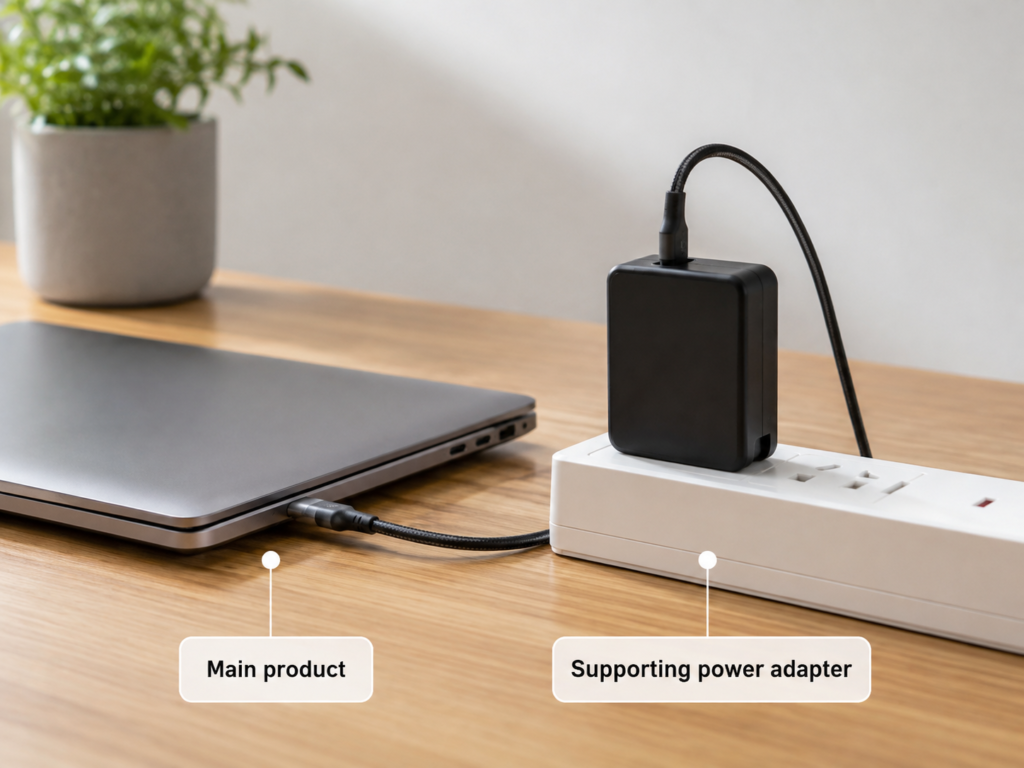
| Product Category | Judgment Result | Brief Description |
| Charging cables/data cables/passive adapters/power strips | Usually not applicable | The main body is only a passive transmission device, without the function of converting AC to low-voltage power |
| All-in-one wireless charger (with built-in AC plug) | Requires case-by-case verification | Conclusions cannot be drawn only by splitting the internal power module and wireless transmitting part; it is also necessary to confirm the classification of the external power supply and the direct/indirect operation attributes |
| Split wireless charger (requires external power supply) | The main body is usually not applicable, and the supporting adapter requires case-by-case verification | The main body of the wireless charger is usually a power transmitting end; for the external adapter, it is necessary to separately confirm whether it is an EPS, whether it is a direct operation EPS, and whether there are relevant exemptions. It cannot be assumed that Level VI applies just because it is an external adapter |
| Ordinary power bank (USB output only) | The main body is usually not applicable, and the supporting adapter requires case-by-case verification | The power bank itself is an energy storage device; whether the supporting adapter is subject to Level VI still needs to confirm its EPS classification, direct or indirect operation attribute and exemption conditions |
| Wall charger power bank (with built-in AC pins) | Requires case-by-case verification | It integrates the functions of a charging head and a power bank at the same time, and needs to be judged according to the internal structure and product operation mode |
| Built-in power module of equipment | Usually not applicable | It cannot be separated independently and connected to the mains alone, and usually does not meet the definition of an external power supply |
| PoE power supply module/power injector | Requires case-by-case verification | It is necessary to confirm whether it fully meets all definitions of consumer-grade external power supplies, as well as the direct or indirect operation classification |
| Spare adapter for after-sales maintenance | Requires case-by-case verification | It needs to be confirmed in combination with the circulation scenario, product positioning and specific external power supply classification |
Practical 6-Step Verification Method
If you have a product in hand and want to initially verify whether it meets the DOE Level VI requirements by yourself, you can follow the 6 steps below, checking step by step from simple to complex. For ordinary users, the first 5 steps are basically enough.
Step 1: First exclude clearly inapplicable categories
Referring to the comparison table for judgment of common charging products above, first exclude clearly inapplicable categories such as pure cables, passive adapters, and built-in power modules, and there is no need to check further.
Step 2: Use preliminary screening elements to initially judge the type
First confirm whether the product falls into the category of external power supply (EPS). It can be initially judged from the following 5 elements:
1. Whether it is a power supply device for consumer products;
2. Whether it converts household AC power into DC power or low-voltage AC power;
3. Whether it has an independent shell, can be separated from the terminal product and connected to the mains alone;
4. Whether it is a direct operation or indirect operation external power supply;
5. Whether it is a medical device, or a statutory exclusion or exception specially designed for loads such as LED, OLED lighting, DC motor ceiling fans, etc.
If it is a combined product, it must be split into the main body and the supporting power supply for separate judgment. Even if the external adapter is an EPS, it is still necessary to confirm its direct or indirect operation attribute, and it cannot be directly equated with a Level VI subject.
Step 3: Confirm the sales region and circulation scenario
For products in commercial circulation in the continental US, it is necessary to confirm whether they are covered by the federal DOE rules, and whether Level VI, Level IV or other rules apply; if they are sold in other countries or for personal use, the corresponding scenario requirements must be confirmed first; for special scenarios such as overseas territories and government procurement, the corresponding rules must be checked separately.
Step 4: Check the core parameters on the product nameplate
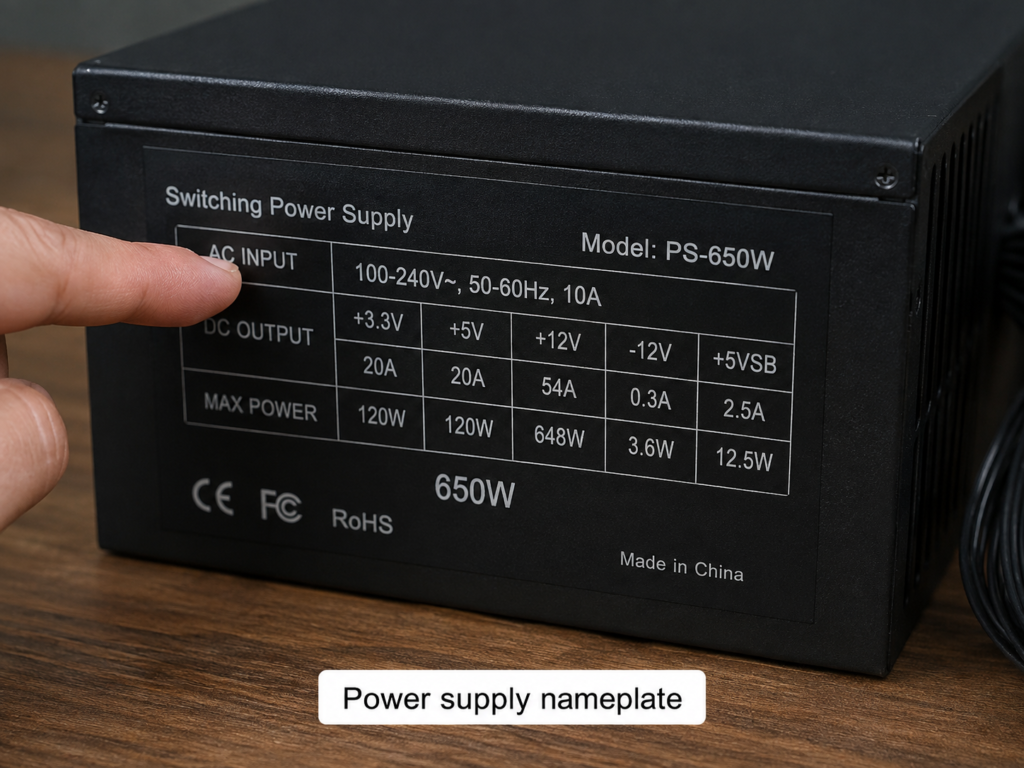
Find the nameplate on the back of the product and check several key pieces of information: whether the rated input is household AC power, what the rated output power, voltage and current types are, as well as the brand and model, to confirm whether the product belongs to the consumer-grade category.
Step 5: Check the mark and public compliance records
If it is initially judged that it may meet the Level VI requirements, you can first check whether there is a “VI” or “DOE Level VI” mark on the product nameplate or manual, but this is only a preliminary screening, and the presence of the mark does not mean it must be compliant.
If you want to further verify, you can go to the DOE’s official CCMS (Compliance Certification Management System) database to query the corresponding certification records by brand and model. Note here: CCMS is a platform for manufacturers to submit information independently, which does not mean that the DOE has approved the compliance of this product, and the absence of records cannot directly conclude that the product is non-compliant.
Step 6: Advanced verification (requires cooperation from the responsible party)
If merchants or importers need to formally confirm compliance, they need to ask the responsible party for the product’s test data and technical documents, check whether the test complies with the test procedures of Appendix Z of 10 CFR 430, and also check whether the basic model classification and compliance supporting materials are complete. This step is generally done by professional compliance personnel, and ordinary consumers do not need to go into depth.
Summary of Core Competencies
After reading this content, you should have mastered these basic judgment abilities:
1. Clarify that the core target of DOE Level VI is not all charging peripheral products, but eligible direct operation external power supplies;
2. Know that external power supplies are also divided into direct operation and indirect operation, and EPS cannot be equated with Level VI in general;
3. Be able to initially judge by yourself whether a product may be within the regulatory scope according to the logic of “excluding clearly inapplicable categories → preliminary screening of EPS definition, operation attribute and exception conditions → scenario/parameter/mark verification”;
4. Be able to distinguish the different functions of energy efficiency standards, fast charging protocols, safety requirements and FCC radio frequency rules, and will not confuse them;
5. Know that for boundary products such as all-in-one wireless chargers, wall charger power banks, PoE modules, and industrial/medical power supplies, conclusions cannot be drawn casually and require case-by-case verification;
6. Understand that both the VI mark and CCMS database query have limitations, and will not make absolute judgments based solely on a single piece of information.
Finally, we would like to remind everyone: this article is only introductory popular science content and does not constitute formal legal advice. If you need to make a formal compliance judgment of a product, be sure to check the latest effective regulations issued by the DOE, and confirm it in combination with the specific product information, EPS classification and applicable exception conditions.