
Sellers or purchasers of cross-border charging products have most likely encountered this headache: you already have a test report and technical documentation for a 65W USB-C charger supporting compliance assessment with applicable EU regulations, and now you want to enter the US market or launch on Amazon Japan. Do you have to redo all the tests? This would not only cost thousands or even tens of thousands of yuan in extra testing fees, but also take one or two months, delaying the launch timeline.
The answer is actually not so black and white: test reports can indeed be reused, but you cannot just take any report and use it as a market access certificate for multiple markets. Whether you can save costs, and how much you can save, depends on several specific conditions.
Core Conclusion: Reports Can Be Reused, But Cannot Directly Replace Access Certificates
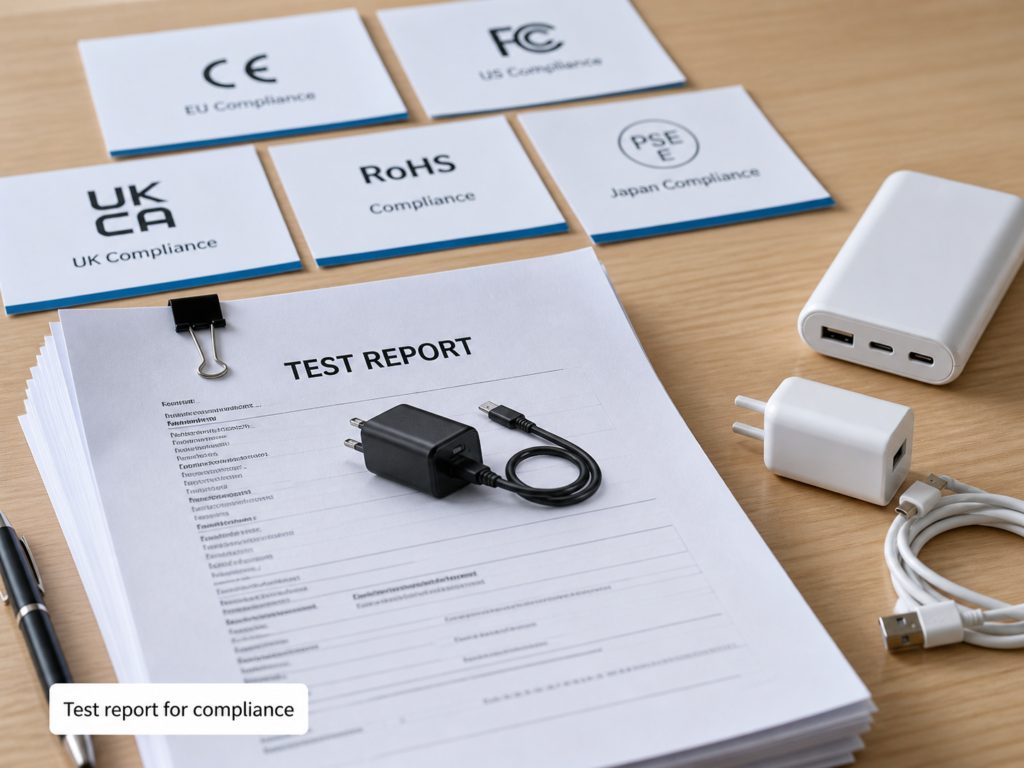
Let’s put the most critical conclusion first, so you don’t have to scroll for a long time:
The same test report can be used as technical supporting material for multiple compliance applications and platform audits. The overlapping test items can be used as technical evidence for gap analysis and applications; whether repeated testing can be waived must still be confirmed by the target certification body, regulatory rules, or platform; differing items usually require supplementary testing or supplementary documentation.
But special attention should be paid: a test report is only an “application material”, not an “access certificate” itself. A test report supporting compliance assessment with applicable EU regulations cannot replace Japanese statutory requirements, nor can it automatically replace all compliance documents required by the platform; whether the platform accepts test reports as upload materials, and whether DoC, certificates, registration, or other documents are still required, shall be subject to the specific compliance requirements of that site and category.
If you want to quickly judge whether a report can be reused, you can remember the “5 true/false questions” method – if all 5 questions are checked, there is usually a good basis for reuse; as long as one is not met, you need to do supplementary testing, supplement materials, or even go through the process again. These 5 questions are:
1. Is the product submitted for testing the same as the product you want to sell?
2. Can the content tested in the report cover the requirements of the target party?
3. Does the laboratory issuing the report have the corresponding capability, and is it recognized by the target party?
4. Is the report still valid now?
5. Does the target party accept this test report?
This judgment method is applicable to products such as charging cables, USB-C cables, chargers, and power adapters. It can be used whether you are doing cross-border platform compliance, multi-market access, or verifying supplier reports.
First Understand Two Basics: What Your Product Is, and Where You Want to Sell It
Before judging whether it can be reused, you must first clarify two basic questions, otherwise it is easy to work in vain.
First question: What category does your product belong to?
Charging products all seem to be used for charging, but compliance requirements vary greatly by type. We can divide them into several categories according to product attributes:
• **Passive cable category**: Ordinary charging cables and data cables that usually have no active electronic circuits, mainly consisting of conductors and insulating shells, without chips such as E-Marker. However, applicable safety, chemical substance, and other requirements shall still be determined based on rated parameters, materials, structure, intended use, regulations of the sales region, and whether they are part of a complete set of products.
• **Active cable category**: Fast-charging cables with E-Marker chips (smart chips in fast-charging cables used to negotiate power with chargers and devices) have electronic components, so there are more requirements.
• **Performance claim category**: If your product claims to support USB-PD fast charging, a specific power, or a certain Gbps data rate, even cables may require additional compatibility testing.
• **Mains input category**: Chargers and power adapters with AC plugs that are directly plugged into wall outlets usually require key assessment of safety and other requirements due to connection to high-voltage mains electricity.
• **Wireless function category**: Products with communication wireless functions such as Bluetooth and Wi-Fi usually need to be evaluated for radio regulations according to the target market; for wireless charging/wireless power transmission functions, EMC, equipment authorization, and human exposure requirements shall be evaluated separately according to their frequency, power, whether they simultaneously transmit communication information, and local rules, and they cannot be uniformly regarded as the same type of radio product.
In addition, pay attention to accessory differences: for example, whether your charger comes with a power cord and plug, these accessories will also affect the test scope and cannot be omitted.
Different types of products have different core test items, and there is no unified test list globally – it all depends on where you want to sell. For example:
• Pure passive charging cables generally only need to undergo safety, mechanical performance, and hazardous substance testing according to the requirements of the sales region. For RoHS (Restriction of Hazardous Substances Directive), chemical testing is not necessarily required; combined methods such as material declarations and XRF fluorescence screening can also be used, depending on the risk level.
• For fast-charging cables with protocol chips, whether USB-C/USB PD compatibility or performance testing is required shall be judged separately for statutory compliance, USB-IF compliance or trademark programs, and platform and customer requirements. Use of the USB-IF certification mark must meet its compliance program and trademark licensing conditions; even if no relevant claims are made, the statutory requirements corresponding to product functions shall still be evaluated.
• AC chargers/power adapters usually need to be evaluated for electrical safety, EMC, energy efficiency, and hazardous substance requirements separately according to the target market; whether safety certification is statutorily mandatory and what authorization path applies to EMC must be determined based on the specific country, product use, and sales channel.
• Products with wireless/Bluetooth/wireless charging may also require additional RF (radio frequency testing, which tests whether wireless signals meet requirements) and human exposure assessment (such as SAR, which tests whether the amount of electromagnetic radiation absorbed by the human body exceeds the limit, depending on the specific situation).
Second question: Which market, which platform, and which category do you want to enter?
Never believe vague statements like “global certification” – compliance requirements are specific to the market, platform, and category. Moreover, compliance requirements can be stacked – the same product may require both a manufacturer’s self-declaration, registration, and third-party certification, not a one-out-of-three relationship. For example, if you sell a charger with wireless charging to Australia, you may need to make a self-declaration for safety and EMC, complete RCM supplier registration, and meet the platform’s energy efficiency requirements.
Don’t Confuse: Test Reports Are Not Certifications
Many people can’t tell the difference between a test report and a certification, which is a common area for mistakes. Let’s first clarify these two concepts.
What is a test report?
Simply put, it is the “test report card of the submitted sample”: a test report is a result document formed after testing samples according to specified methods, and can be issued by internal laboratories, third-party laboratories, or certification system laboratories. Whether a report is acceptable as compliance evidence depends on applicable regulations, laboratory capability, test methods, traceability, and the requirements of the target party.
Its core attribute is: it is only responsible for the submitted samples and the covered models listed in the report, and is not an access permit – just like getting a CET-4 (College English Test Band 4) transcript does not mean you can directly work in a foreign company, it only proves that your English level at that time met the CET-4 standard.
Common test reports have different reuse effectiveness
Not all test reports can be reused casually. Different types of reports have very different effectiveness levels. Let’s rank them from most universal to least universal:
1. **CB report/certificate**: This is a mutual recognition document under the IECEE (International Electrotechnical Commission System for Conformity Testing and Certification of Electrotechnical Equipment and Components) system. National certification bodies that participate in the system and have the corresponding scope can use it as the basis for applying for national certification. But note that it still cannot be used directly as an access certificate; it may only reduce repeated testing when applying for national certifications in various countries.
2. **Ordinary type test report**: Usually a test result issued for submitted samples or product types according to specified standards; the scope of models it can cover and its acceptability shall be subject to the models listed in the report, series difference descriptions, and the rules of the target party.
3. **Key component report**: Test reports for key components such as transformers and power chips. Whether finished products can use these reports requires a complete machine assessment; they cannot be directly used as test reports for finished products.
4. **Platform-specified laboratory report**: For example, reports issued by Amazon-designated laboratories can only be used for compliance audits of the corresponding platform; whether they can be used across platforms must be reconfirmed.
5. **Factory inspection/outgoing inspection report**: This is a quality control report made by the factory during its own production. Generally, it cannot be directly used to apply for compliance, and can only be used as evidence of internal quality control.
4 paths for compliance access (can be stacked)
Many people think “certification” is just one type, but there are actually several paths for compliance access, and they can be required simultaneously – you don’t just choose one:
The first is **manufacturer’s self-declaration category**: No official certificate issuance is required, and the enterprise itself is responsible for product compliance. As long as there is test evidence, a risk assessment has been conducted, a declaration is signed, and the corresponding mark is affixed, it is sufficient. For example, the EU’s CE DoC (Declaration of Conformity) and the US’s FCC SDoC (Supplier’s Declaration of Conformity, depending on equipment category) fall into this category. For non-specified electrical products under Japan’s PSE, the declaring supplier confirms compliance with technical requirements on its own, but must declare in accordance with the law before starting manufacturing or import business; self-inspection must also be implemented, records kept, and the PSE mark affixed before sale.
The second is **third-party certification/conformity assessment category**: A third-party body is required to review and issue a certificate or assessment proof. For example, specified electrical products under Japan’s PSE require assessment by an RCAB (Registered Conformity Assessment Body); US NRTL (Nationally Recognized Testing Laboratories, such as UL and ETL) are mostly required by buyers or platforms, and are mandatory for some products. This category generally requires review of test reports and factory quality systems, and some also require factory inspections.
The third is **registration/supplier declaration category**: Materials need to be submitted to the regulatory authority for filing, and the product can only be marketed after registration is completed. For Australia, the requirements of ACMA and EESS shall be judged separately. RCM is a label; whether the responsible supplier must register on the EESS platform, whether the product must be registered, and whether a conformity certificate is required depends on the product’s applicable scope and EESS risk level, and cannot be uniformly summarized as “can only be marketed after registration”.
The fourth is **industry/brand program category**: This is exclusive access for the brand ecosystem, not a statutory requirement. For example, Apple’s MFi certification and USB-IF certification only prove that your product meets the brand’s compatibility or performance requirements, and cannot replace statutory compliance requirements such as safety and EMC.
Value and misconceptions of report reuse
The most direct benefit of reusing reports is saving money and time – you don’t have to repeat the same tests, which can save thousands to tens of thousands of yuan in testing fees, and shorten the compliance and launch cycle by weeks or even months.
But special attention should be paid: not all test reports can be universally used casually. Whether they can be reused depends on the 5 conditions we will talk about next.
Usable for Beginners: 5 Conditions to Judge Whether Reuse Is Possible
These 5 conditions are the core of judging whether a report can be reused. We will talk about them one by one, each with a plain language explanation and specific checkpoints for charging products.
Condition 1: Target requirements are covered, and the report type matches
In plain language: the content tested in your report, the standard version used, and the test level must be able to cover the requirements of the target party; and the type of report and who issued it must also meet the other party’s requirements.
Specifically, check the following points:
• **Standard version and transition period**: For example, if the target party requires the use of a new version of the safety standard, and your report is of the old version, you need to check whether the old version is still within the transition period and whether it can be presumed to meet the new version requirements.
• **Test level and worst-case sample**: During laboratory testing, was the sample with the highest risk in the same series used? For example, for chargers of the same series, was the model with the highest power tested? If the lowest power model was tested, then high-power models cannot be covered.
• **National/regional differences**: Different countries have different plug, voltage, and grid requirements. Does your report cover these differences? For example, a report tested with EU plugs definitely cannot directly cover products with US plugs.
• **Report type matching**: Ordinary reports, CB reports, and certification reports cannot replace each other. If the other party requires a certification certificate or registration number, a test report alone is not sufficient.
• **Complete additional documents**: For example, are additional requirements such as labels, manuals, and registration documents ready?
Take a counterexample for charging products: you only have a fast-charging cable report tested according to the PD2.0 standard, and now you need to do compliance for PD3.1 high-power products with EPR (Enhanced Power Output). Then this report cannot cover it, because PD3.1 has higher requirements.
Condition 2: The submitted sample is consistent with the actual product
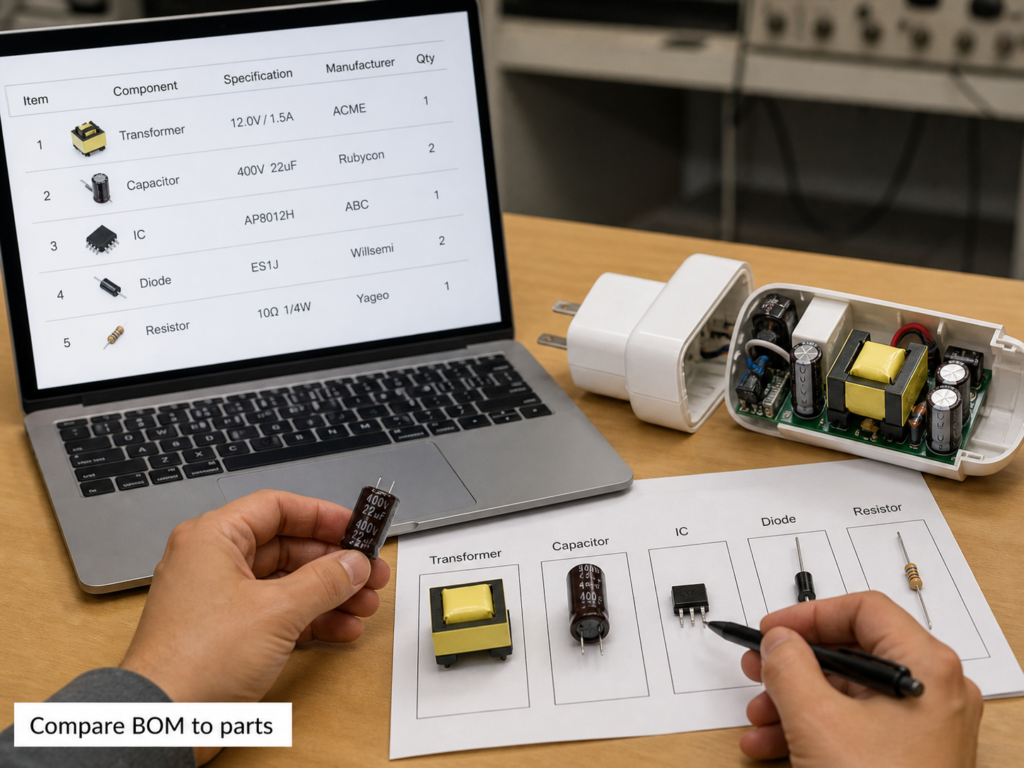
In plain language: the product you are applying for compliance with now must have no differences in core structure and performance from the sample sent to the laboratory for testing at that time.
How to prove consistency? There are four required documents, which we call the “four-piece set”: report model page, series difference table, worst-case sample description, and key components/BOM (Bill of Materials).
Core checkpoints vary for different products:
• **Charger**: Focus on the shell flame-retardant material, PCB board, transformer, pin type, and rated power – if these change, both safety and EMC performance will change.
• **Charging cable**: Focus on interface type, cable length, wire diameter, core wire configuration, and E-Marker chip model – these affect current-carrying capacity and fast-charging compatibility.
For products of the same series, three prerequisites must be met to share a report: consistent key structure and performance, differences that do not affect compliance, and confirmation by the reviewing party.
As for non-performance differences such as color, silk screen printing, and packaging, they generally do not affect the test conclusion, but they must match the coverage relationship of labels, models, and manuals in the report, and cannot be applied arbitrarily.
Condition 3: The laboratory’s capability meets the requirements and is accepted by the target party
In plain language: the laboratory issuing the report must have the accreditation qualification for the corresponding test items, and this qualification must be recognized by the target party.
Many people think that as long as there are CNAS or A2LA marks on the report, there is no problem, but that’s not the case. Here, three levels need to be clarified:
• **Accreditation body**: CNAS is China’s national accreditation body; A2LA is one of the laboratory accreditation bodies in the United States. Neither is the laboratory itself, and it is necessary to further verify whether the specific laboratory and specific test standards are within their valid accreditation scope.
• **Accreditation scope**: You need to check whether the laboratory has valid accreditation for the test standards and product categories you need to use. You can’t just see a CNAS mark on the report and think it’s okay. If the laboratory only has accreditation for toys and not for chargers, the report is useless.
• **Mutual recognition arrangement**: ILAC-MRA (International Laboratory Accreditation Cooperation Mutual Recognition Arrangement) is a mutual recognition agreement between various accreditation bodies, but this does not mean that all target parties accept it – whether it can be used specifically must be confirmed with the target party in advance.
There are also some special requirements, such as some projects requiring designated laboratories, witnessed testing (that is, personnel from the certification body must watch the laboratory conduct the test), and factory inspections. These must be carried out according to specific rules, and cannot be taken for granted.
Condition 4: The report is in a valid and usable state
Many people think that test reports have a unified validity period, such as 1 year or 3 years, but that’s not the case – there is no unified statutory validity period globally. Whether a report can be used depends on three factors:
1. Whether the product is consistently consistent with the submitted sample – if the product is modified, the report will naturally be useless.
2. Whether the standards and regulations used for testing are still recognized by the target party – if the standard is updated, the report of the old standard may become invalid, depending on the transition period.
3. Whether the target party has set a time window for the issuance of the report – some platforms or certification bodies require the report to be issued within 1-3 years, but this is only their own requirement, not a legal provision.
There are three common situations where a report becomes invalid in advance: product revision, standard update, and compliance rule change.
Take an example for charging products: after the new EU EMC standard takes effect, reports of the old standard do not become invalid immediately. It depends on how long the transition period of the new standard is; if it is within the transition period, the old report can still be used.
Condition 5: The target party accepts external laboratory reports
The last point, which is also the most easily overlooked: does the target party you are submitting to accept reports issued by external laboratories?
Different compliance paths have different requirements:
• **Self-declaration category**: Third-party testing is not mandatory. Whether the report can be used depends on the test method, traceability, and the rules of the target party. For example, for CE self-declaration, you can use test data from your own factory, but you must prove that your testing capability and methods are reliable.
• **Third-party certification/registration category**: The certificate-issuing or registration body needs to review the report. Some require designated laboratories, and some require supplementary local difference testing.
• **Industry/brand program category**: Most only recognize test reports issued by brand-authorized laboratories. For example, for Apple MFi, you have to go to its authorized laboratory for testing.
• **Cross-border platforms**: Requirements change frequently, and policies may vary across different sites, categories, and periods. Everything shall be subject to the compliance requests in the seller’s backend.
Advanced Cost Saving: How to Judge the Reuse Potential
If you want to plan the test plan in advance and maximize cost savings, you can judge the reuse potential from three dimensions. This part is semi-proficient content, which is particularly useful when doing procurement or compliance planning.
By compliance path: Reuse threshold from low to high
Different compliance paths have different thresholds for reusing reports, ranked from low to high:
1. **Self-declaration category**: The lowest threshold. As long as the test requirements can be covered and the target party recognizes the report, it can be used.
2. **Registration/supplier declaration category**: The threshold is also relatively low. As long as the test data meets the requirements, it is sufficient, just an additional registration process is required.
3. **Third-party certification category**: Medium threshold. The certificate-issuing body needs to review the report, but if you have a CB report, you can reduce a lot of repeated testing.
4. **Industry/brand program category**: The lowest reuse rate. Most compatibility and performance tests have to be done separately, because each brand has different requirements.
By regional/standard overlap: The higher the overlap, the more reuse

Standards in different regions have different technical overlap degrees. The higher the overlap, the more content can be reused:
• **High reference value: EU CE technical documentation ↔ Australian RCM materials**
Both are based on the standard systems of CISPR (International Special Committee on Radio Interference) and IEC (International Electrotechnical Commission), with high technical overlap, and some EMC and safety test data can be reused. However, they cannot be directly mutually recognized. It is still necessary to check the Australian and New Zealand standard versions, supplier registration requirements, labeling requirements, electrical safety paths, and local differences (such as plugs and voltage).
• **Medium reference value: US NRTL (UL/ETL) ↔ EU CE-LVD (Low Voltage Directive)**
The core safety principles of the two are consistent, and some test data can be used as the basis for gap analysis. However, they cannot be directly reused. Supplementary US national difference testing, verification of plug and grid conditions, and compliance with local certification rules are required.
• **Low reference value: Japan PSE ↔ Brazil INMETRO**
There are great differences in test standards, plug specifications, certification processes, and factory requirements between the two. Only basic material testing may be universal, and most have to be retested.
Here is a practical tip: CB test certificates and CB test reports can be used as the basis for applying for national certification by national certification bodies that participate in the IECEE CB system and have the corresponding product category and standard scope; national differences, document review, and specific procedures of the certification body still need to be handled.
By charging product type: Standard convergence ≠ direct acceptance
Different types of charging products have different reusability. Note: even if global standards converge, it does not mean that the other party will directly accept your report; you still have to go through the review process.
• **Charger/power adapter**:
• Safety: Global standards converge, with high reusability, but national differences must be checked.
• EMC: Core test items have high overlap, and differences in frequency bands and limits must be checked.
• Energy efficiency: Requirements vary by region, with very low reusability.
• Plug/power cord: There are usually many national differences and local approval requirements, and existing conclusions cannot be automatically accepted directly; however, existing test data or CB documents for the same component may still be used for difference assessment or application basis, and must be checked against target country standards, plug specifications, markings, and certification rules.
• Wireless function: Requires separate assessment, with very low reusability.
• **Charging cable/data cable**:
• Mechanical and safety items: Medium reusability, depending on wire gauge and interface type.
• Compatibility/fast-charging performance: Testing is only required when relevant performance is claimed, and reusability depends on target requirements.
• **Connector/interface**:
• USB-C interfaces adopt relatively unified technical specifications, but whether specific test evidence can be reused must still be judged item by item according to the cable’s data rate, power level, whether E-Marker is used, connector and cable structure, and target regulations or USB-IF program requirements.
• Proprietary interfaces (such as Apple Lightning): Low reusability, because they are brand-exclusive standards.
Practical Implementation: 5-Step Pitfall Avoidance Method for Procurement/Platform Compliance
After talking about so many judgment methods, let’s finally get to practical operation. Whether you are verifying supplier reports or doing multi-market compliance planning, you can conduct verification according to these 5 steps to reduce common compliance risks caused by unverified report coverage, product consistency, and recipient requirements.
Step 1: Sort out all compliance requirements and mark overlapping items
First, list out the specific compliance requirements of all your target markets, platforms, and categories. Never use vague descriptions like “global certification” or “European certification”.
Then extract the test items and document items corresponding to each requirement, and mark the overlapping parts – these overlapping parts are the parts that can be used as the basis for reuse.
Special attention should be paid to charging products: sort them out separately by product type. Don’t mix chargers and charging cables together; their requirements are very different.
Step 2: Use 5 conditions + checklist to initially verify existing reports
Against the 5 judgment conditions mentioned earlier, check the existing reports one by one, and mark the satisfied items and items to be supplemented.
When checking, you can use the following key field list to avoid missing items:
| Information Category | Core Check Fields |
| Product Information | Model, specification, applicant/manufacturer, sample photo |
| Test Information | Standard number + version, test method, test date, test conclusion, key components/BOM |
| Coverage Information | Worst-case sample description, covered model range, deviations and exemptions |
| Qualification Information | Laboratory seal, accreditation mark, accreditation scope for corresponding test items |
In addition to checking the content, you also need to verify the authenticity of the report, don’t get a fake report without knowing it:
• If the laboratory has a public query system, directly go to the official website and enter the report number for verification.
• If there is no public system, send a formal email or letter to the issuing laboratory for verification. You need to find out: whether the report was actually issued, whether it has been revised or revoked, whether the authorized signatory is correct, and whether the sample information is consistent.
• Also check whether the perforation seal, signature seal, and the information filed by the laboratory are consistent.
A verification tip for charging products: compare the sample parameters and BOM list in the report with the products you actually purchase one by one, especially the core components we mentioned earlier, such as the transformer of the charger and the E-Marker chip model of the charging cable – none can be wrong.
Step 3: Confirm in writing with the target party in advance, do not judge by yourself
Even if you think all conditions are met, don’t make the decision yourself that it can be used. Be sure to confirm with the target party in advance.
The parties to confirm with include: certification bodies, platform compliance customer service, and the responsible importer in the target market.
The content of confirmation should be specific: whether the existing report meets the requirements, what materials or tests need to be supplemented, and what the process is.
Pitfall avoidance reminder: Be sure to ask for a written reply, such as an official email or platform ticket, and don’t believe verbal promises – otherwise, if the other party denies it later, you will be the one who suffers.
Step 4: Supplement missing items instead of full testing to maximize cost savings
If there are items that do not meet the requirements, you only need to supplement the testing of the unsatisfied parts, without re-testing all of them. This can save a lot of money and time.
Common supplementary test items for charging products include: national difference testing, compatibility testing of new interfaces, difference items of new version standards, and RF radio frequency testing.
Practical tip: You can first ask the original laboratory about supplementary testing or difference assessment plans; but you should first confirm that it has the accreditation scope or designated qualification required by the target party, and compare the quotation, cycle, sample requirements, and acceptance by the certification body before making a decision.
Step 5: Keep relevant vouchers to cope with spot checks
Compliance is not a one-and-done thing. There may be regulatory spot checks and platform audits later, so be sure to keep all relevant vouchers properly.
Documents that need to be kept include: test reports, compliance certification documents, the four-piece set for model coverage, supplementary test records, and supplier material consistency commitments.
Three things that must never be done: tampering with reports, mixing reports of different products, and promoting “test passed” as “certified” – these are all serious violations, ranging from product removal to fines.
Exclusive reminder for charging products: Key material and change records shall be kept in accordance with applicable regulations, certification programs, and own production consistency control procedures; if the target certification or platform requires batch traceability, factory inspection, or continuous compliance control, corresponding batch records shall be kept as required.
Compliance responsibility boundaries
Finally, you need to figure out who is responsible for what, don’t take the blame for no reason:
• **Manufacturer/brand owner**: Bears ultimate responsibility for product compliance.
• **Importer/authorized representative**: Responsible for compliance in the import market, such as the importer in the EU and the FCC responsible party in the US.
• **Platform seller**: Responsible for the platform’s compliance requirements, and needs to keep complete compliance documents.
• **Laboratory**: Only responsible for the samples, test items, test conditions, and results stated in the report, and does not bear responsibility for the continuous compliance of the product.
3 typical charging product decision cases
Just talking about methods may be a bit abstract. Let’s look at three common practical cases:
Case 1: 65W USB-C charger has test reports and technical documents supporting CE conformity assessment, wants to enter the US market
• Reusable: Core test data for safety and EMC, but only as a basis for gap analysis.
• Need to confirm first: Whether NRTL certification is required, DOE energy efficiency requirements, and FCC authorization path (specifically depending on product definition, sales channel, importer and other factors).
• Items to be supplemented (if applicable): US national difference testing, plug testing, FCC-related testing, energy efficiency testing.
• Parties to confirm with: US importer, target platform, NRTL body (if required).
Case 2: USB-C fast-charging cable replaces E-Marker chip/wire gauge, can the original report be used
• Reusable: Shell, interface structure, general safety test data (if the wire gauge remains unchanged).
• Items to be supplemented (if applicable): Fast-charging protocol compatibility testing (if PD performance is claimed), temperature rise/voltage drop testing (if the wire gauge changes), and updating the covered model range.
• Parties to confirm with: Original report-issuing laboratory, target certification body/platform.
Case 3: Ordinary 5V2A charger adds Bluetooth function, can the original report be reused
• Reusable: Only the unchanged structure and material parts, cannot be directly used as the conclusion of the whole machine being qualified.
• Need to implement: Re-complete applicable wireless, EMC, and safety assessments on the final assembled whole machine product.
• Human exposure assessment/SAR: Whether to do it is determined according to the target country’s regulations, transmission power, frequency band, and usage distance; it is not mandatory to test.
• Parties to confirm with: Target market certification body, platform compliance department.
Appendix: Procurement Reuse Decision Matrix
If you often need to verify supplier reports or do multi-market compliance planning, you can use the following decision matrix directly as a standard operating procedure:
| Target Market/Platform | Product Attribute | Required Compliance Documents | Existing Report Coverage Items | Difference Items | Written Confirmation Status of Recipient | Supplementary Testing/Material Plan |
This matrix has a wide range of usage scenarios: supplier report verification, multi-market compliance planning, and platform audit appeals can all use it. Fill in each item clearly, and there will be no confusion.
Don’t Step into Pitfalls: Common Misconceptions and Red Lines That Must Never Be Crossed
Finally, let’s talk about the common misconceptions that friends who do charging product procurement and cross-border business are most likely to step into, as well as the reuse red lines that must never be crossed – stepping into them will result in losing money at best, and product removal or fines at worst.
6 common misconceptions
1. **Misconception 1: Test report = compliance certificate, can be used directly as an access certificate**
Correction: A test report is only a material for applying for compliance, not the access certificate itself. You have to go through the process of the corresponding market or platform and obtain the corresponding access document.
2. **Misconception 2: Products of the same series can share a report casually**
Correction: Only products of the same series with consistent key structure/performance, differences that do not affect compliance, proof from the four-piece set, and confirmation by the reviewing party can share a report. Chargers with the same appearance but different powers, and USB-C cables with the same length but different wire diameters cannot automatically share a report just because of the series or appearance relationship; the worst-case sample, key structure and performance differences shall be evaluated, and confirmation of the coverage relationship from the target certification body or platform shall be obtained.
3. **Misconception 3: Reports with CNAS qualification are recognized by all certifications**
Correction: CNAS is an accreditation body, not the qualification of the laboratory itself. You need to verify the laboratory’s accreditation scope for the corresponding test items and product categories, and the target party must accept this accreditation chain.
4. **Misconception 4: A report will definitely be usable if it is within the target party’s time window**
Correction: Product revisions, standard updates, and compliance rule changes will all cause the report to become invalid in advance. For example, if your charger has replaced the core power chip, even if the report was only issued half a year ago, it cannot be directly reused.
5. **Misconception 5: The report given by the supplier must be real and usable**
Correction: Be alert to situations such as report tampering, model mismatch, and fraudulent use of qualifications. Be sure to verify the authenticity according to the process, and don’t believe everything the supplier says.
6. **Misconception 6: Internal test/outgoing inspection reports are completely unusable / all compliance requires third-party reports**
Correction: Internal testing is not inherently invalid. Whether it can be used depends on regulations and the requirements of the target party. For example, for self-declaration paths like CE, internal or external test evidence can be used, but the manufacturer must prove that its testing capability and methods are reliable.
Reuse red line list
In the following situations, you must never directly use the old report, and must immediately assess supplementary testing:
| Red Line Situation | Core Reason | Next Action |
| Change in product core circuit or rated power | Directly affects safety and EMC performance | Suspend use of old report, submit samples for assessment and supplementary testing |
| Replacement of interface type, fast-charging protocol, wire gauge/E-Marker chip | Affects key performance such as compatibility and current-carrying capacity | Assess the scope of differences, supplement testing of corresponding items |
| Change of plug/pins, key safety components (transformer, flame-retardant material, etc.) | Involves key safety items, may change safety level | Suspend reuse, submit samples for safety difference testing |
| Addition of radio communication functions such as Bluetooth and Wi-Fi | Radio, whole-machine EMC, and human exposure requirements may change | Re-complete applicable whole-machine compliance assessment |
| Addition of wireless charging/wireless power transmission function | Applicable requirements depend on target market, operating frequency, power, and whether communication functions are included | Evaluate EMC, equipment authorization, and human exposure requirements separately |
| The standard used for testing has been abolished by the target party with no transition period | The standard on which the report is based becomes invalid | Supplement testing or retest according to the new standard |
| Report type/issuing entity does not meet the target party’s requirements | Different reports have different effectiveness levels and cannot meet access requirements | Replace with a compliant testing or certification path |
Summary: 3 Things You Can Now Judge Independently
After reading this article, you should already be able to do these 3 things independently:
First, you can use the 5 judgment conditions, plus report type and authenticity verification, to initially judge whether a test report can be used for target certification or platform audit, without having to ask around everywhere.
Second, you can judge the reuse potential of the report according to the compliance path, regional standard overlap, and product type, plan the test plan in advance, and save unnecessary testing fees and time.
Third, you can follow the 5-step practical process, plus the decision matrix, to verify supplier reports, avoid common misconceptions and red lines, achieve compliant reuse, and avoid risks.
One final reminder: report reuse is a good way to save money, but the core of compliance is responsibility – regardless of whether third-party reports are used, manufacturers usually bear core responsibility for product design, conformity assessment, and continuous consistency; the specific responsibilities of importers, authorized representatives, distributors, and platform sellers shall be determined separately according to the target market’s regulations, their actual roles, and platform rules. Don’t step on the compliance red line just to save a little money.