
If you sell chargers in the Japanese e-commerce market, or have bought power adapters for Japanese-version mobile phones or laptops, you have most likely seen the PSE mark on products. Many people think it is just a randomly printed sticker, others cannot tell the difference between the diamond-shaped and circular marks, and some even face product delisting or fines due to compliance issues. This article starts from the most basic concepts, covering the entire process of judgment, application, verification, and pitfall avoidance. Whether you are an ordinary consumer, cross-border seller, or brand owner, you can find useful information here.
I. Basic Understanding of PSE Certification
What is Japan’s PSE Certification?
PSE is a mandatory safety access system stipulated by Japan’s (abbreviated as DENAN), under the jurisdiction of the Ministry of Economy, Trade and Industry (METI). Its core function is to prevent electrical risks such as electric shock, fire, and overheating. Many people think PSE is just a certificate, but in fact it is a complete compliance process: from category judgment, safety testing, government notification to marking, all links must meet the requirements to be considered compliant, not just referring to a single document.
Why Power Adapters Are a Key Regulated Category
Power adapters are directly connected to Japan’s mains power supply, and carry risks such as electric shock, overheating, and fire, so they are a product type that the PSE system focuses on. Common AC-DC adapters for the Japanese market that fall within the legal scope of “DC power supply devices”, such as some mobile phone PD fast chargers, GaN gallium nitride chargers, and laptop power adapters, usually belong to specified electrical appliances and need to fulfill corresponding PSE obligations.
However, you cannot draw a conclusion just because the product “connects to mains power”. You should also check the rated input voltage, frequency, capacity, and legal exclusions. DC power supply devices usually involve conditions such as a rated voltage of more than 100V and less than 300V, a rated frequency of 50Hz or 60Hz, and a rated capacity of less than 1kVA. Products with special structures or special uses may also be subject to different judgments. Whether the product is sold separately or sold as a set with devices such as mobile phones or computers does not automatically exempt it from PSE obligations.
Core Differences from Other Common Certifications
Many people who are new to the Japanese market confuse the functions of different certifications. Here are three core differences clarified:
First, PSE is an access requirement exclusive to the Japanese market. Certifications from other countries and regions, such as the EU’s CE and the US’s FCC/UL, cannot replace PSE at all.
Second, interface or performance certifications such as USB-IF and Qi only verify functional attributes such as interface compatibility and charging efficiency. They are not equivalent to PSE safety certification and cannot be used to prove that products meet Japanese safety requirements.
Third, ordinary overseas test reports themselves usually cannot replace the obligations of notification, confirmation of compliance with technical standards, product inspection, and marking under DENAN; however, specified electrical appliances can be subject to conformity inspection by foreign registered inspection bodies with corresponding scope qualifications in accordance with the law. The registration qualification of the body and the applicable scope of the certificate should be verified.
II. Quick Judgment of Applicable Scope
After understanding what PSE is, what everyone is most concerned about must be: does the power adapter I have need PSE certification? We can quickly sort it out with a clear set of logic.
Three-Step Method for Applicability Judgment
Step 1: First determine whether the product is a regulated electrical appliance — products with purely mechanical structures that do not use electricity at all definitely do not need PSE.
Step 2: Confirm whether the product falls into legally regulated categories such as “DC power supply devices”, which are what we often call AC-DC adapters that convert alternating current to direct current.
Step 3: Check the exclusions in the catalog or special rules for combined products. For example, some power products with special uses or special structures cannot be simply judged by appearance or use.
It should be noted in advance that most common civilian AC-DC adapters fall into the category of diamond-shaped PSE. The final judgment shall be based on Japan’s legal catalog, and cannot be determined by experience on your own.
Exceptions That Do Not Require PSE
There are several types of products that usually do not need to apply for PSE according to the power adapter category, but the specific situation should still be judged in combination with the product:
First, products sold only outside Japan naturally do not need to comply with Japanese regulations.
Second, power modules used inside industrial equipment and not sold separately are not automatically exempt from PSE. Whether they are regulated still needs to be judged on a case-by-case basis based on the specific product structure, input conditions, installation method, and sales form, combined with METI’s category interpretation. It cannot be simply assumed that they are automatically covered by the overall compliance of industrial equipment.
Third, products that only support DC input, such as car chargers (connected to the DC power supply of a car cigarette lighter) and USB-input charging devices, are usually not within the PSE regulatory scope of DC power supply devices because they are not directly connected to mains power.
Boundaries of Related Products That Are Easily Misjudged
There are several types of products used with chargers whose compliance requirements are easily confused:
• USB-C/USB data cables: Do not need PSE according to the adapter category, and have separate category rules.
• Detachable AC power cords: These are the figure-8 cords or cloverleaf cords that plug the adapter into the wall. Whether they need separate notification and marking depends on whether they are sold separately, whether they are universal, and whether they are only bundled accessories that are not universal. Bundled non-universal power cords that meet METI conditions do not need to bear separate notification and marking obligations, but must still comply with applicable technical standards; other situations should be judged separately according to the category of wires or power cord assemblies.
• Power banks: The core regulatory requirement is lithium battery safety, which is not the same as the PSE for adapters.
• Travel adapters, power strips, extension cords: All have their own independent category regulatory rules, and the PSE requirements for adapters cannot be applied to them.
• Products marked with 100-240V global voltage: This only indicates that the product can be used under Japan’s mains power supply, and does not mean that it has passed PSE certification. These are two completely independent matters.
4 Pieces of Information Needed for Quick Judgment
If you want to find a professional body or compliance agent to judge PSE applicability, preparing these 4 pieces of information in advance can save a lot of time: first, the input type, whether it is AC input, DC input, or dual input; second, the rated input voltage, power, and output voltage and current; third, the plug structure, whether it is fixed pins, detachable power cord, or USB input; fourth, the sales method, whether it is sold separately or sold as a set with the main device.
III. How to Distinguish Between Diamond-Shaped and Circular PSE
After confirming that PSE is needed, the next high-frequency question is: why do some products have a diamond-shaped mark and some have a circular mark? What is the difference between the two? In fact, the classification logic is very simple: it is divided according to the risk level of legal categories.
Core Logic of Classification
Japan divides regulated electrical appliances into two categories: high-risk ones are called “specified electrical appliances”, which must be evaluated by a third-party body and affixed with a diamond-shaped PSE mark; medium and low-risk ones are called “non-specified electrical appliances”, which do not require the conformity inspection by registered inspection bodies applicable to specified electrical appliances, and are affixed with a circular PSE mark.
However, circular PSE does not mean that “manufacturers can just make a self-declaration”. The notification business operator may be a manufacturer, importer, or specified importer, and must still confirm that the product meets technical standards, conduct product inspections in a legal manner and keep records, and at the same time complete the notification and legal marking obligations.
It should be particularly emphasized here: which category a product belongs to and which mark it uses are completely determined by Japan’s legal catalog, and cannot be judged by factors such as civilian/industrial use, power level, or charging protocol. Many people think that low-power chargers can use the circular mark, which is completely wrong.
To facilitate comparison, we have sorted out the core differences between the two types of PSE:
| Comparison Item | Diamond-Shaped PSE | Circular PSE |
| Corresponding Regulatory Category | Specified electrical appliances (high risk) | Non-specified electrical appliances (medium and low risk) |
| Mark Style | PSE characters printed inside a diamond-shaped border | PSE characters printed inside a circular border |
| Evaluation Requirements | Must undergo conformity inspection and be issued a certificate by a Japan-registered conformity assessment body | Does not require conformity inspection by a registered inspection body, but the notification business operator must still confirm compliance with technical standards, conduct product inspections, and keep records |
| Applicability to Civilian Adapters | Usually applicable to common mains-connected civilian adapters within the legal scope | Rarely applicable to civilian power adapter categories |
| Document and Management Requirements | Conformity certificates are managed according to legal categories, and the validity period for DC power supply devices is 5 years | The notification business operator shall retain technical documents and product inspection records |
Core Features of Diamond-Shaped PSE
The diamond-shaped PSE mark has the three letters “PSE” inside a diamond-shaped border. Common civilian mains-connected adapters that fall within the legal scope of “DC power supply devices” usually belong to the category that requires diamond-shaped PSE. Such products must be tested and structurally evaluated by a conformity assessment body registered with the Japanese government, which issues an official certificate.
The validity period of the conformity certificate for specified electrical appliances is determined by the legal category, not entirely decided by the body on its own. Taking DC power supply devices as an example, the validity period of their conformity certificate is 5 years. In actual management, the compliance status should also be continuously maintained in combination with the certificate coverage scope, production inspection records, and product changes.
Core Features of Circular PSE
The circular PSE mark has the word “PSE” inside a circular border, targeting medium and low-risk non-specified electrical appliances. Such products do not need to go through the conformity inspection path of registered inspection bodies for specified electrical appliances, but the notification business operator must still confirm compliance with technical standards as required, conduct product inspections, keep records, and fulfill notification and marking obligations.
It should be noted that the civilian power adapter category is rarely eligible for circular PSE. Do not force it to fit the circular category just to save costs.
Evidence Chain and Basis for Classification Confirmation
If there is doubt about product classification, you cannot judge without evidence. You need to prepare these supporting materials: product photos, nameplate parameters, principle block diagram, AC input method, plug configuration, manual, and sales form.
The final decision shall be based on DENAN, its enforcement order, enforcement rules, technical standards, and METI’s official interpretation. Written opinions or conformity certificates from registered inspection bodies can be used as important professional and compliance evidence, but cannot replace the final interpretation of laws and regulations and the competent authority.
Practical Method for Quickly Judging the PSE Type of Products
For ordinary users, there are three simple judgment principles: First, for mains-connected adapters targeted at ordinary consumers and within the legal scope of DC power supply devices, prioritize preparing for diamond-shaped PSE, and do not first think about saving costs by using circular PSE; second, never judge the category by power, volume, or charging protocol on your own; third, if you are unsure, be sure to submit materials to a professional for confirmation, and never downgrade the declaration on your own, otherwise it will be a serious violation if found out.
IV. Compliance Responsibilities and Full Process
After clarifying the type, the next step is to go through the compliance process. Many people think that PSE is just “finding a body to test and get a certificate”, but in fact it is far more complicated than that. A mistake in the responsible subject or process node may lead to non-compliance.
Core Responsible Subjects
The PSE notification business operator is usually a manufacturer or importer located in Japan. Simply put, it is an enterprise that assumes compliance responsibility locally in Japan and is responsible for reporting to the government.
However, the institutional arrangements for overseas sellers can no longer be generalized. From December 25, 2025, overseas operators that directly sell regulated products to general consumers in Japan can also fulfill relevant obligations as “specified importers”, but they must appoint a qualified domestic manager in Japan.
Therefore, overseas brands cannot use the reason that “the factory has already conducted testing” to replace the responsibility of the notification subject; however, whether it must be declared through a Japanese subsidiary or Japanese importer also depends on the specific transaction and import mode, and a simple conclusion cannot be drawn.
Three Core Concepts That Cannot Be Confused
Many people cannot clarify the relationship between “evaluation”, “notification”, and “marking”, and even think that having one is enough. In fact, all three are indispensable:
• Third-party conformity assessment: This is a requirement for diamond-shaped PSE. The registered body completes product testing and structural evaluation to prove that the product meets technical requirements.
• Business start notification: This is a business declaration submitted by the responsible subject to METI within the legal period, which is equivalent to telling the government “I am going to sell this type of electrical product”.
• Special attention should be paid: METI’s notification is a report on the subject, not a per-unit approval for individual products. It does not mean that all products are compliant after notification.
The prerequisites for a product to be legally marked with PSE include: the notification business operator has completed the notification, confirmed compliance with technical standards, and conducted product inspections and kept records in a legal manner; for specified electrical appliances, the conformity certificate from the registered inspection body must also be obtained and kept. All obligations cannot replace each other.
Key Division of Responsibilities for Different Roles
PSE compliance is not the responsibility of a single party. Different roles bear different responsibilities:
• Factory: Responsible for providing product specifications, list of key components, and production consistency materials, ensuring that mass-produced products are consistent with the samples submitted for inspection.
• Brand owner: Responsible for determining model division rules, label design, and product change control. Cannot randomly change the structure or add models.
• Importer: In the import mode, the import business operator is usually the notification business operator and bears corresponding legal obligations; in the manufacturing mode or the specified importer mode of overseas direct sales, the corresponding notification business operator shall bear legal responsibility.
• Sales side: Responsible for verifying the consistency between the product’s PSE mark and compliance documents, and cannot sell products that are out of scope or non-compliant.
6 Key Steps in the Full Compliance Process
The complete PSE compliance process can be divided into 6 steps. Following the order can save a lot of detours:
1. Series/Model Coverage Assessment: First, find a body to confirm which models can be included in the scope of the same certificate, to avoid spending money on repeated certification.
2. Product Classification Confirmation: Clarify the legal category the product belongs to, and follow the corresponding diamond-shaped or circular compliance path.
3. Conformity Assessment: For diamond-shaped PSE, find a third-party body for testing and evaluation; for circular PSE, the notification business operator confirms compliance with technical standards, conducts product inspections, and retains records.
4. Notification Declaration by Japanese Subject: The corresponding notification business operator shall report to METI, retain a full set of technical documents, conduct product inspections in a legal manner, and keep inspection records; the notification business operator for specified electrical appliances must also fulfill requirements such as manufacturing process inspection, 100% finished product inspection, and sampling inspection.
5. Label Design and Production: Mark information such as PSE mark, parameters, and responsible subject in accordance with regulatory requirements.
6. Mass Production and Listing: Verify that mass-produced products are completely consistent with the samples submitted for inspection, and recheck the marks and documents before listing.
Reference for Certification Costs and Cycles
There is no unified standard answer for costs and cycles: In terms of cost, diamond-shaped PSE is significantly higher than circular PSE. The specific amount is affected by product power, number of ports, and test items, and quotations from different bodies will also vary; in terms of cycle, the industry standard is 4-8 weeks, but if there is product rectification, factory inspection, or tight scheduling of the body, the time will be longer. These are all industry standard references, not legal commitments.
Basic Points to Improve Pass Rate
If you want to pass the test in one go, doing these things in advance can save a lot of trouble:
First, check the product input parameters in advance. The rated input voltage should include 100V required for use in Japan, and the rated frequency should be consistent with the intended sales or use region; if sold nationwide in Japan, it should usually support 100V, 50/60Hz. You cannot directly conclude that a product does not meet PSE just because it does not mark both 50Hz and 60Hz.
Second, select key components that meet safety standards, such as transformers, plugs, and fuses, which are core safety components. Do not use inferior accessories.
Third, conduct basic self-inspection before certification to check for obvious problems such as insulation and overheating. Do not submit samples for inspection with obvious defects.
Fourth, ensure that the submitted materials and sample parameters are completely consistent. Low-level mistakes such as the material stating 65W but the sample being 30W will definitely be rejected.
V. Core Test Items and Rectification Logic
Many people are curious: what exactly does PSE certification test? If the test fails, what usually needs to be changed? We will pick the entry-level must-know content to explain. You don’t need to memorize complex test methods, just know the core logic.
Core Basis for Testing
The core basis for PSE testing is the DENAN technical requirements for the corresponding category, as well as the test specifications of the evaluation body. Test items are not fixed, and will be adjusted according to product structure, rated parameters, and classification. There is no unified test list applicable to all adapters.
Common Test Items for Power Adapters
Common test items for civilian adapters fall into these categories, basically all revolving around safety:
1. Mark and Document Review: Check whether the label parameters are accurate and whether the technical documents are complete and compliant. This is the most basic item.
2. Electric Shock Protection/Insulation Performance: Verify that users cannot touch live parts and that insulation performance meets requirements — this involves creepage distance and clearance. Simply put, between live parts and the accessible enclosure, there must be sufficient safety distance in the air and sufficient safety distance along the plastic surface to prevent electric leakage.
3. Temperature Rise and Abnormal Operation Test: Verify that under normal use or even abnormal use (such as blocking the heat dissipation vent), the product temperature will not exceed the safety limit and will not catch fire.
4. Withstand Voltage Test: Apply high voltage to the insulation layer to verify that it will not be broken down and cause electric leakage.
5. Grounding Test: The grounding continuity test is applicable to products that adopt Class I electric shock protection and are equipped with a protective grounding terminal or protective grounding conductor; whether it is applicable should be judged according to the specific protection structure and applicable technical standards, not just by whether it is a three-pin plug.
6. Compliance of Key Components and Materials: Check whether core components such as transformers, fuses, and enclosure flame-retardant materials meet safety requirements.
7. Structure and Mechanical Strength: Verify the strength and stability of structures such as the enclosure and pins. They cannot break when dropped or loosen when plugged in.
8. Electromagnetic Compatibility (EMC): Only some categories require this. The core of PSE is safety requirements, not electromagnetic compatibility. Do not confuse the focus.
Common Entry-Level Rectification Directions
If the test fails, the most common rectification directions fall into three categories:
First, marking problems, such as missing legally required marking items, incorrect parameter formats, or non-compliant marking positions. This type of problem is the easiest to fix, just adjust the label.
Second, safety structure problems, such as insufficient insulation distance or substandard enclosure flame-retardant grade. This type requires adjusting the structure or replacing materials.
Third, performance problems, such as excessive temperature caused by poor heat dissipation or mismatched specifications of key safety components. This type requires optimizing the heat dissipation design and replacing appropriate components.
Precautions for Rectification
Rectification is not just about modifying it yourself. There are two rules that must be followed:
First, a compliance impact assessment should be conducted before changes. For diamond-shaped PSE products, if changes to safety structure, key components, etc. may affect the coverage of the conformity certificate or compliance with technical standards, you should confirm with the registered inspection body whether supplementary or re-conformity inspection is required. For circular PSE products, the notification business operator shall reconfirm compliance with technical standards and keep product inspection records. If changes involve legal notification matters, a change notification must be processed in a timely manner.
Second, never temporarily modify samples just to pass the test. Mass-produced products must be completely consistent with the qualified samples submitted for inspection, otherwise it is non-compliant.
VI. Verification of PSE Compliance Authenticity (Four-Layer Cross-Verification Method)
Whether consumers are buying products or sellers are choosing suppliers, the biggest concern is encountering fake PSE certification. Don’t just look at the sticker on the product. We can use the four-layer cross-verification method to verify the authenticity step by step, from simple to complex, with increasing accuracy.
Layer 1: Basic Inspection of Product Body Label
When you get the product, first look at the nameplate on the body. This is the step where problems are most easily found:
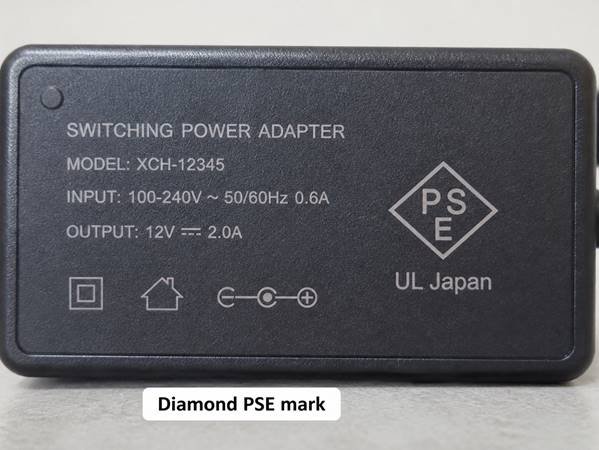
• Check the mark shape: Civilian mains-connected chargers within the legal scope of DC power supply devices should usually have a diamond-shaped PSE mark; if it is circular, further verification of its specific legal classification is required.
• Check parameter information: The rated input voltage should include 100V, and the rated frequency should be consistent with the intended sales or use region; if sold nationwide in Japan, it should usually support 100V, 50/60Hz.
• Check legal markings: The label must have legal information such as the name or abbreviation of the evaluation body, the notification business operator (Japanese responsible subject), and rated values. Be alert if any items are missing.
• Check marking quality: The marking should be located in a visible place and applied in a non-fading method. If the marking is found to be blurry, peeling, or missing, it should be regarded as a compliance risk, and further verification of the notification subject, model, conformity certificate, and registered inspection body information should be conducted; you cannot conclude that the product is counterfeit just based on the result of wiping or scraping by hand.
Layer 2: Verification of Supply Chain Compliance Documents
After checking the label, ask the supplier for compliance documents to verify:
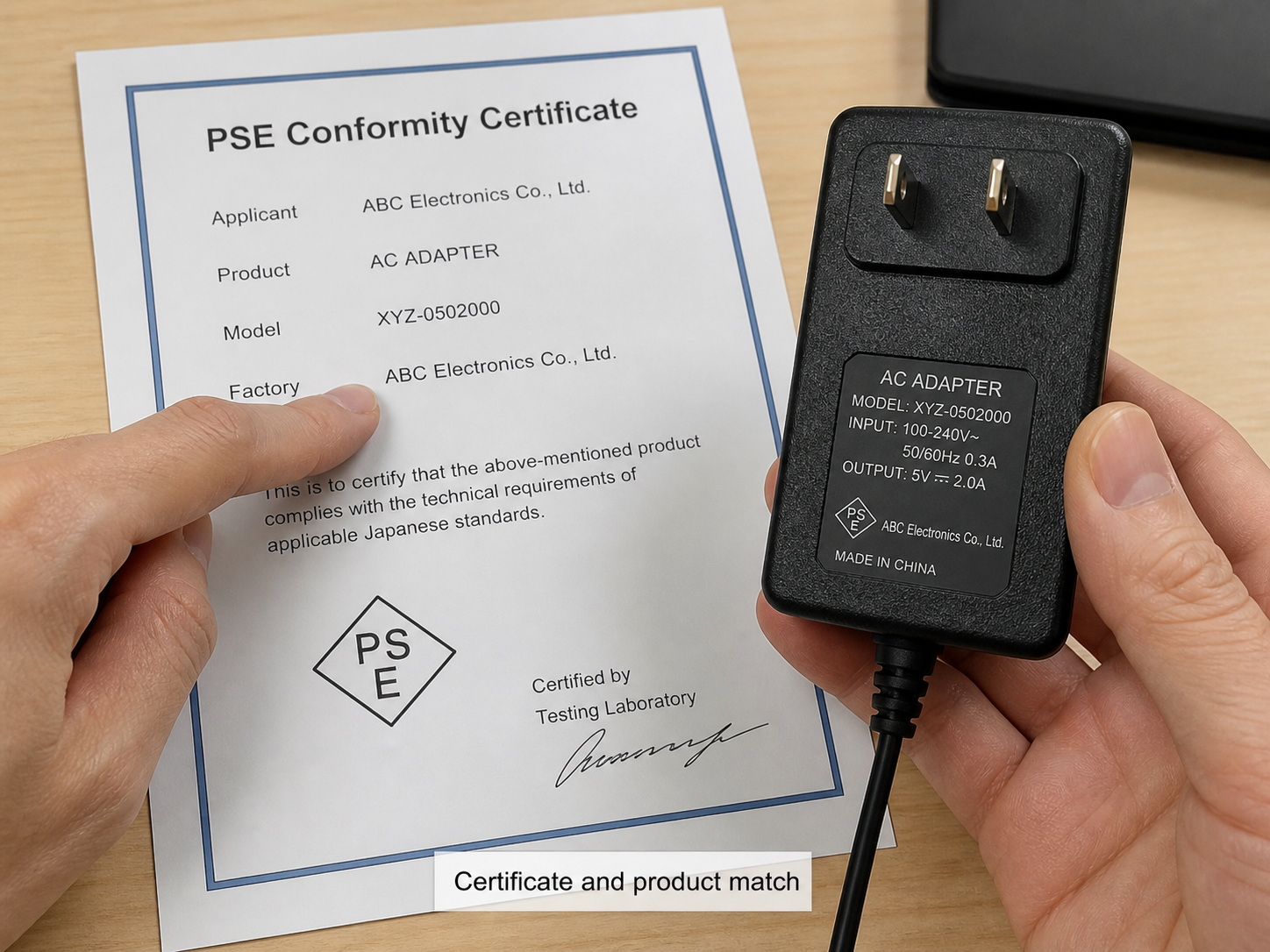
• Diamond-shaped PSE: Check the certificate issued by the evaluation body to confirm that the model range and applicable factory are consistent with the product you received.
• Circular PSE: The core is the technical documents and product inspection records retained by the notification business operator. Circular PSE does not require the third-party conformity certificate applicable to specified electrical appliances. If someone only provides a “third-party certificate” to replace complete compliance documents, further verification is also required.
• Set products: The compliance documents of the adapter itself must be checked separately. The certification of the main device cannot replace the PSE of the adapter.
Layer 3: Verification of Notification Business Operator Information
One layer up, you can query the subject notification information of the notification business operator marked on the product through METI’s public channels, and check whether the responsible subject marked on the product is consistent with the officially filed information. If it cannot be found on the public platform or the information is inconsistent, it should be regarded as high risk, and the notification business operator should be required to explain and provide notification materials, and verify with the competent Bureau of Economy, Trade and Industry if necessary; due to factors such as the scope of public disclosure and system response time, you cannot directly determine illegality or forgery just because it is not retrieved.
Layer 4: Official Confirmation from the Issuing Body/Brand
If you are still unsure, you can conduct the most authoritative verification: For diamond-shaped PSE, you can directly contact the issuing registered assessment body to verify the validity and coverage of the certificate; when necessary, you can also contact the brand owner or importer to verify the compliance status of the product. This step has the highest accuracy and is suitable for verification of large-value purchases and high-risk products.
Common Characteristics of PSE Fraud
We have sorted out several of the most common fraud characteristics. You should be highly alert when encountering these situations:
• Using circular PSE to impersonate diamond-shaped PSE, making profit from the price difference by reducing compliance costs;
• Forging or misusing the PSE mark, notification business operator information, or the name and abbreviation of the registered inspection body; if the supplier provides a conformity certificate or test materials, you should also check whether the number, model range, and factory information in them are consistent;
• Only the outer packaging has the PSE mark, and the product body has no relevant marking at all;
• Label parameters are blurry, responsible subject information is missing, or the corresponding subject cannot be found at all.
VII. Establishment and Management of PSE Certification Database
If you are a seller or brand owner operating on Japanese sites, with dozens or hundreds of adapter models in hand, it is easy to get messy just storing certificates in folders. You may not know when a certificate expires or which model is not within the certification scope. At this time, you need to build a simple PSE certification database to manage compliance risks.
Core Goals of Building a Database
Building a database is not for show. The core is to solve three practical problems: First, centrally manage all certification materials, so that they can be quickly found when needed, and verify the compliance status of products on sale; second, track the expiration date of conformity certificates, notification matters and change notification status, production inspection records, and product changes, to prevent product delisting caused by compliance failure; third, support unified management of multiple models and multiple suppliers, so that materials will not be lost or the rhythm disrupted due to personnel changes.
Notification itself is not a matter that is renewed at fixed intervals, but when the content of the notification changes, a change notification must be processed in a timely manner. Therefore, the database should not simply manage the “notification expiration date” as a fixed renewal item.
Core Fields Required for the Database
You don’t need a too complicated system. Even with an Excel spreadsheet, as long as it includes these types of core fields, it can meet basic management needs:
• Basic Information: Brand, manufacturer, factory address, product model, rated parameters, port configuration, used to correspond to specific products.
• Compliance Classification Information: Basis for DENAN legal classification, technical requirement version, PSE type (diamond/circular), keep the original classification judgment to avoid random changes later.
• Certification and Notification Information: Evaluation body, certificate coverage scope, report number, notification status, issuance date, certificate expiration date, production inspection records, and change notification status, used to track compliance status.
• Product Materials: Label photos, packaging photos, list of key safety components, change conclusions. All product-related materials are stored together for easy verification.
• Management Information: Change impact level, risk status, corresponding sales SKU, sampling inspection and complaint records, to facilitate docking between operation and compliance departments and quickly identify risks.
Daily Management Rules for the Database
After building the database, you also need to know how to manage it, otherwise it is just a pile of useless dead data. Daily management must follow four rules:
First, Model Consistency Management: Diamond-shaped PSE products shall be managed according to the product name, type classification, factory, and coverage scope stated in the conformity certificate; when a variant is to be included in an existing conformity certificate, it shall be confirmed with the registered inspection body. Circular PSE products shall be managed by the notification business operator based on the notification type classification, confirmation of compliance with technical standards, and product inspection records. Internal files can be managed jointly, but must be able to clearly trace the compliance basis of each model.
Second, Change Control: If there are changes to key components, power, structure, or production factory, a compliance impact assessment must be conducted first. For diamond-shaped PSE products, if the change may affect the conformity certificate or compliance with technical standards, you should confirm with the registered inspection body whether supplementary or re-conformity inspection is required; for circular PSE products, the notification business operator shall reconfirm compliance with technical standards and keep inspection records. When notification matters change, a change notification must also be processed in a timely manner.
Third, Regular Maintenance: Track the legal validity period of the conformity certificate; process change notifications in a timely manner for changes in notification matters; keep product inspection records for the legal period; if the registered inspection body or the contract has other production management and supervision arrangements, track them according to their specific requirements. Check the information of products on sale and the database once a quarter to ensure that no out-of-scope products are sold.
Fourth, Risk Classification: Mark each model with a risk status, such as “normal sales”, “pending verification”, “change under evaluation”, “suspended sales”, so that you can see at a glance which products have risks and handle them first.
VIII. Common Misconceptions and Pitfall Avoidance Points
After talking so much, let’s sort out the 6 most common pitfalls people fall into. Avoiding these can solve 80% of PSE compliance problems.
Misconception 1: Having a PSE Mark Means True Compliance
The PSE mark can be printed privately. Having a mark does not mean it is truly compliant. It must be cross-verified with compliance documents, responsible subject, and issuing body information. A mark without fulfilling the obligations of evaluation and notification has no compliance effect at all, and it is a violation if found out.
Misconception 2: Low-Power/Low-Voltage Adapters Can Be Self-Exempted from PSE
You must never self-determine that a product can be exempted from PSE just because it has low power or low output voltage. Whether PSE is required is judged according to the legal category definition. Power differences may affect test items and classification, but they must never be used as a basis for self-exemption or self-downgrading.
Misconception 3: One PSE Certification Can Cover All Models in the Same Series
The coverage scope of PSE is subject to the model series confirmed by the body. It does not mean that all models in the same series can be automatically covered. Even if only the appearance color or SKU is different, as long as there is a difference in safety structure, or it has not been confirmed by the body, it cannot be included in the certification scope without authorization.
Misconception 4: New Products Such as Fast Chargers/GaN Are Not Regulated by Old Rules
The core of PSE regulation is “whether the product is an AC-DC power supply device”, which has nothing to do with what charging protocol or technical solution is used. No matter how new technologies such as PD, PPS, and GaN are, as long as the product falls within the regulated scope, it must meet safety regulatory requirements. There is no such thing as “new technologies are not regulated by old rules”.
Misconception 5: Adapters and Matching Power Cords Do Not Need Correlated Verification
For detachable AC power cords, you cannot simply think that “as long as the adapter is certified, the cord doesn’t matter”. Whether they need separate notification and marking should be distinguished by whether they are sold separately, whether they are universal, and whether they are bundled non-universal accessories. Even if they meet the conditions and do not need separate notification and marking, they must still comply with applicable technical standards when used as components or accessories.
In addition, adapters with different plug versions must not directly use the PSE mark or conformity certificate for the Japanese market without confirmation. The plug structure, rated value, type classification, factory, and coverage scope of the conformity certificate should be checked; whether the notification business operator is the same depends on the manufacturing or import business subject, not on which country version the plug belongs to.
Misconception 6: Changing Suppliers/Modifying Enclosures Does Not Affect Certification
Many people think that “since the appearance model hasn’t changed, changing suppliers or modifying the enclosure has no impact”, which is completely wrong. Changes to key components, structure, and materials may affect the safety compliance of the product. Even if the appearance model remains unchanged, as long as the internal design is different from the original evaluation sample, it may be non-compliant.
The correct approach is to conduct a compliance impact assessment before the change. For diamond-shaped PSE products, if the change may affect the coverage of the conformity certificate or compliance with technical standards, you should confirm with the registered inspection body whether supplementary or re-conformity inspection is required; for circular PSE products, the notification business operator shall reconfirm compliance with technical standards and keep inspection records. If changes involve legal notification matters, a change notification must be processed in a timely manner before updating certification documents and the database.
IX. Basic Checklists for Different Roles
Finally, we have compiled a minimal checklist for readers in different roles. You don’t need to memorize the full text, just follow it to cover basic compliance requirements.
Ordinary Consumers (Buying Japanese-Version Chargers)
• Check the product body: Common mains-connected chargers within the regulated scope should have a clear diamond-shaped PSE mark; the rated input voltage should include 100V, and the frequency should be consistent with the intended use region. If used nationwide in Japan, it should usually support 50/60Hz;
• Check compliance documents: You can request and verify the notification business operator, model, and conformity materials from the merchant;
• Verification of doubts: If you have questions, you can contact the brand, importer, or issuing body for confirmation;
• Avoid low-price traps: Do not buy low-priced chargers with no marks, blurry parameters, or unknown sources, as they have high safety risks.
E-Commerce Sellers (Before Listing on Japanese Sites)
• Check consistency: The model and PSE information on the physical product, detail page, and packaging must be completely consistent;
• Keep documents: Retain a full set of compliance documents, purchase records, and batch information for official inspection;
• No vague publicity: Do not use vague statements such as “PSE certification in progress” or “factory has done certification” to replace formal compliance certificates;
• Check scope: Confirm that the model and factory covered by the certificate are completely consistent with the products on sale, and do not sell out of scope.
Small Brands/New Sellers (Applying for PSE for the First Time)
• Determine the responsible subject first: Determine the notification subject in advance based on the transaction and import mode. Overseas operators that sell directly to Japanese consumers can consider the specified importer path and appoint a domestic manager in Japan as required;
• Classify first then test: First confirm the product classification and PSE type, then arrange corresponding testing to avoid wasting money on wrong test items;
• Pre-design labels: Incorporate PSE label requirements into the product development stage. Do not change labels just before shipment, which wastes costs;
• Evaluate models in advance: Conduct coverage evaluation for different models in the same series in advance, which can save a lot of repeated certification costs.
Summary
At this point, the core content of PSE certification for power adapters is finished. No matter what your identity is, after reading this article, you can master several practical abilities: you can judge whether common power adapters need Japanese PSE through the three-step method; you can distinguish the applicable scenarios of diamond-shaped and circular PSE, and know that civilian mains-connected adapters within the legal scope of DC power supply devices should usually be prioritized for diamond-shaped preparation; you can initially judge the authenticity of PSE certification through the four-layer cross-verification method; you can avoid the 6 most common types of compliance misconceptions; you can complete basic compliance checks according to your role; if you are a seller or brand owner, you can also build a basic PSE certification database framework for power adapters.
PSE compliance may seem complicated, but its core logic is actually very simple: do a good job of safety verification in accordance with legal requirements, declare truthfully, and be responsible for consumers’ electrical safety. As long as you do the basic work solidly, you don’t have to be afraid of compliance risks.