
Almost all sellers of cross-border charging products have encountered the situation where a supplier confidently claims “our products are certified” and then sends a PDF right after. Many new sellers think that with this document, they can pass platform reviews and clear customs smoothly, only realizing the truth when their listings are deleted, payments are frozen, or goods are detained: either the document is fake, or the genuine document does not cover the products you are selling at all. Today we will thoroughly explain all issues related to fake certifications — from how to identify them, what risks they carry, to how to verify them, and what to do when something goes wrong, covering all practical content from beginner to advanced levels.
Basic Understanding: First Figure Out What Fake Certification Is
First, a most basic warning for everyone: fake certification documents must never be used. Even genuine certification documents, if they do not cover the products you currently sell, the target market, or the sales entity, cannot serve as the compliance basis for the product, and may lead to review failure, delisting, or regulatory disposition; however, their legal nature and consequences are not necessarily equivalent to forged or altered certification documents, which may also trigger additional liability for fraud, forgery, or counterfeit marks.
Many people understand “certification” as just a stamped PDF, but in fact, compliance documents are a complete set of materials, and the functions of different documents vary vastly. This can be easily understood using the logic of school exams:
• **Regulations/Standards**: Equivalent to the exam syllabus, these are mandatory requirements that products must comply with, and are not proof documents in themselves;
• **Test Report**: Equivalent to the “exam score report” of the submitted sample, it reflects the tested sample and its test conditions, and cannot automatically prove that the entire series or all mass-produced products can be legally sold;
• **Third-party Certification/Mark**: Equivalent to a graduation certificate issued by an authoritative institution, it has third-party endorsement, but has a clear scope of coverage; one certificate cannot be used universally for all products;
• **Declaration of Conformity (DoC)**: Equivalent to a “guarantee letter” issued by the enterprise itself, promising that the product complies with the regulations of the target market, but must be supported by complete technical documentation, which must be archived for future inspection;
• **Technical Documentation**: Equivalent to a full set of files from product design, bill of materials to test reports, which must be provided in full when inspected by regulatory authorities;
• **Authorization Letter**: Equivalent to written permission from another party allowing you to use its certification or brand, with clear product, market, and time scopes; a random document is not automatically valid.
The models, configurations, and manufactured products that a certification or assessment document can cover shall be subject to the model range, rated values, key structures, applicable conditions, and change control requirements specified in it.
Remember a core principle: what product you sell, which market you sell it to, and what role you play in the sales chain (brand owner/importer/seller) — these three factors jointly determine which compliance documents you need to prepare. There is no universal “one certificate for all markets”.
Basic Compliance Requirements for Charging Products in Major Markets
For the European, American, and Japanese markets that most sellers operate in, the compliance requirements for charging products vary, so don’t mix them up:
• **European Union**: CE is a compliance mark, not a single certificate. For many low-voltage charging products, CE compliance can be self-declared by the enterprise, and only specific categories require participation of a Notified Body (NB). Don’t think that a CE mark without an NB number is fake;
• **United States**: The FCC mainly regulates radio frequency equipment and its electromagnetic emissions. Products with wireless functions usually involve certification; charging products without wireless functions should not be automatically excluded from FCC requirements either. Products containing digital circuits or switching power supplies may be subject to Part 15 rules for unintentional radiators, and it should be confirmed according to specific product classification whether SDoC, certification, or exemption applies;
• **Japan**: PSE is an electrical safety requirement, divided into two categories — specified electrical appliances require conformity assessment by an authorized third-party body (CAB); non-specified electrical appliances usually do not require a registered CAB for conformity assessment, but manufacturers or importers must still complete business notification, confirm compliance with technical requirements, implement and retain self-inspection records, and affix the corresponding PSE mark after meeting statutory conditions. Sellers who only act as sellers should also confirm product markings. For example, common wall-mounted fast chargers mostly belong to specified electrical appliances, while ordinary low-voltage USB cables may not be within the scope of PSE control, which should be judged based on product parameters.
5 Common Forms of Fake Certification for Charging Products
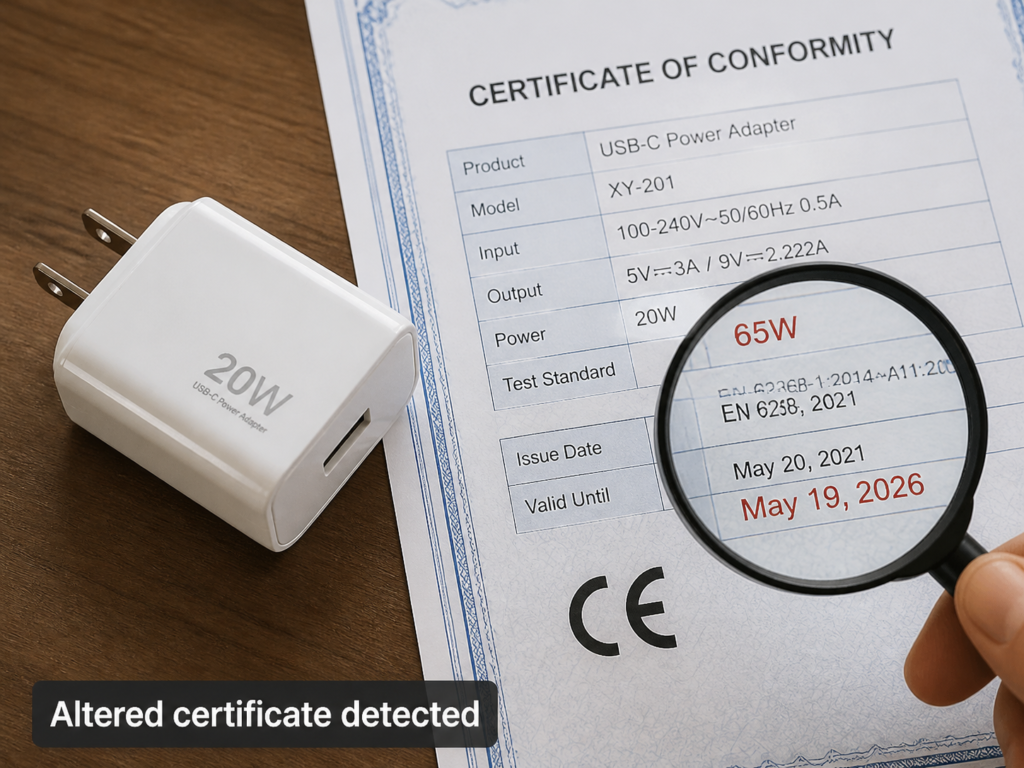
Many people can’t tell if a document is real or fake when they get it. In fact, fake certifications for charging products are nothing more than 5 common forms. Be more vigilant when you encounter them:
The first is **complete forgery**: the certificate number, issuing authority, and official seal are all fake. There is no record at all when checked in the official database, making this the most egregious form of fraud;
The second is **alteration/tampering**: using Photoshop to modify key information such as model, power, and validity period on a genuine document. For example, changing a 20W charger certificate to 65W, or extending the expiration date to several years later. This type of fake certificate is the most deceptive;
The third is **misappropriation/borrowing**: using documents of other models or other brands from the same factory as a substitute. For example, if you sell 30W chargers, the supplier gives you documents for an 18W product with the same appearance from the same factory, saying “it’s universal for the same series” — this is a typical case of misappropriation;
The fourth is **invalid qualification**: either the supplier passes off third-party test reports or self-made “CE certificates” as the basis for CE compliance; if applicable regulations require the participation of a Notified Body, it should also be verified whether the Notified Body is notified within the scope of the corresponding regulations, products, and assessment procedures; or some third-party certificates have expired or been revoked, but the supplier is still using them;
The fifth is **document mismatch**: for example, using a third-party test report as a market access certificate, or using US FCC documents to clear customs in the EU. The document itself may be genuine, but it is used in the wrong scenario, which may lead to review failure or product non-compliance.
3 Easily Confused Boundary Concepts
Here we also need to clarify three common cognitive boundaries to avoid going to extremes when making judgments:
First, **fake certification ≠ expired genuine certification**: Fake certification is forged at its root, and has never been genuine; while an expired genuine certification was once legally valid, but can no longer be used now due to reasons such as expiration or revocation. The two have different natures, but both may be invalid documents in actual sales, posing review or regulatory risks.
Second, **fake certification ≠ unintentional information error**: If you accidentally fill in wrong listing parameters or miss pages when submitting documents, resulting in review failure, this is an unintentional information error and does not count as subjective fraud; but if you intentionally modify document information or forge an official seal, it is outright fake certification.
Third, **genuine documents ≠ product compliance**: Even if the certification document is genuine, it does not mean that all mass-produced products are automatically compliant. The test report reflects the tested sample and test conditions; which models, configurations, and manufactured products a certification or assessment document can cover depends on the scope, rated values, key structures, applicable conditions, and change control requirements specified in the document. If the copper core is secretly replaced, the power supply scheme is changed, or the internal structure is modified during mass production, the actual product may still be non-compliant and may be penalized.
Why Is Certification for Charging Products Subject to Such Strict Inspection?
Compliance reviews for charging products are much stricter than for ordinary categories, mainly for three reasons:
First, charging products are a high-risk electrical category. Inferior products are very prone to overheating, fire, and electric leakage problems, which directly threaten consumers’ personal safety, so regulators and platforms naturally keep a close eye on them;
Second, both platforms and regulatory authorities do not want to bear the risk of joint liability after consumers are injured, so they raise the compliance threshold in advance;
Third, for buyers, compliance documents are an important basis for judging supply chain capabilities and reducing after-sales disputes. Regular buyers will require to see certifications, which is also a natural choice of the market.
Core Risks: Multiple Consequences of Using Fake Certifications
After finishing the basic understanding, you may still have a fluke mentality: it’s just a document, how bad can it be? Next, we will talk about the multiple risks brought by using fake certifications, ranging from listing delisting to criminal liability, each of which is a tangible loss.
First, it should be noted that there is no unified standard for the penalty intensity of fake certification. The specific penalty depends on platform rules, regulations of the destination country, the circumstances of the violation, and whether rectification is carried out in a timely manner. It cannot be generalized, but the types of risks are clear.
Direct Penalties from Cross-border Platforms: The Most Common Immediate Risk
For most cross-border sellers, the first thing they encounter is platform penalties. In mild cases, the listing of the involved product will be delisted, the platform will give a time limit to supplement genuine compliance documents, or restrict listing editing; in serious cases, the listing will be directly deleted, and all previously accumulated reviews and rankings will be cleared.
In more serious cases, the platform will freeze the payment for corresponding orders, deduct store performance scores, reduce natural traffic weight, and even prohibit participation in major promotion events such as Black Friday and Cyber Monday, directly affecting sales. If there are repeated frauds, or if a safety accident is caused by a fake certified product, the store may be directly expelled, and even the operating entity and brand will be blacklisted by the platform, making it impossible to settle in again.
Overseas Customs and Regulatory Penalties: Cross-border Exclusive Risks
If fake certification is found during the customs clearance stage, the most direct consequence is cargo detention — either the goods are returned, or they are directly destroyed by customs, and all freight and cargo costs are wasted.
In addition to cargo detention, local regulatory authorities may also impose administrative fines, sales restrictions, rectification, or other measures, depending on the laws of the destination, the authority of the competent authority, whether the product has safety risks, the specific rules violated, and the circumstances of the case. It is not appropriate to preset a unified fine range or a permanent sales ban conclusion.
What’s more troublesome are corrective measures or recalls: if the product has already entered the market, regulatory authorities may require measures due to product safety risks or violations of applicable safety rules. Take the US CPSC (Consumer Product Safety Commission) as an example, whether to require a recall or other corrective measures depends on its assessment of major product hazards, risk of serious injury, or violation of applicable safety rules. The mere existence of fake certification documents does not automatically mean a nationwide recall.
Product Safety and User Risks: Core Hidden Risks for Charging Products
For charging products, fake certification often means that the product itself fails to meet safety standards, which is the most hidden and dangerous risk.
Chargers and charging cables that have not undergone formal safety testing are very prone to overheating, fire, and electric leakage problems. The higher the power, the greater the risk — for example, a 65W fast charger, if the insulating materials do not meet standards, is very likely to break down and short circuit during charging, causing a fire.
Even if no one is injured, inferior chargers without overvoltage and overcurrent protection can easily damage users’ electronic devices such as mobile phones and laptops, and ultimately the seller has to bear the compensation liability.
There are also batch quality problems: if the copper core wire gauge of ordinary charging cables does not meet standards, they are either easy to break or have falsely marked charging power; if the parameters of high-power fast charging cables are insufficient, not only will they not charge fast, but they will also heat up due to overcurrent, further amplifying safety hazards.
Financial and Goodwill Losses: Invisible Long-term Costs
The losses caused by fake certification are far more than visible expenses such as cargo detention and fines.
Direct economic losses include storage fees for detained goods, return freight, consumer refunds and compensation, fines, and the opportunity cost of unsellable products, which often add up to several times the value of the goods.
What is even harder to recover is brand reputation: negative reviews and complaints caused by inferior products will lower store ratings, reduce natural traffic, and make it difficult to increase sales volume when launching new products in the future. If exposed by consumers on social media platforms, the brand’s reputation will be directly ruined.
In the long run, the black history of fake certification will also affect cooperation and financing: distributors may dare not cooperate; whether product liability insurance will pay claims also depends on policy exclusions, the duty of truthful disclosure, and the specific facts of the accident; if you want to seek financing, it may also be difficult to pass the compliance due diligence level.
Legal Liability Risks: Serious Cases May Involve Criminal Law
If fake certified products cause serious personal injury or property loss, it is not as simple as just paying a fine.
First is **civil compensation**: consumers can sue for compensation for medical expenses, property losses, etc. Whether to bear liability, the scope and amount of compensation shall be determined based on the laws of the destination country, the role of the entity, subjective fault, and the facts of damage.
In particularly serious cases, it may also involve **criminal risks**: for example, forging government documents, forging third-party certification documents, or counterfeiting certification marks may involve different legal liabilities respectively; whether acts such as passing off inferior products as good ones or fraudulent sales are subject to criminal liability shall also be determined according to local laws and specific circumstances.
Many new sellers have a misconception: “The document was given by the supplier, I don’t know about it, so if there’s a penalty, it should be on the supplier.” This is a very dangerous idea. As a seller, you cannot only rely on the supplier’s oral guarantee; you should fulfill the obligations of verification, archiving, and sales suspension required by the market and platform where you operate. As for whether and what kind of liability to bear, it shall also be determined according to your role in the sales, import, or manufacturing chain and applicable laws. Compensation disputes between you and the supplier do not affect the handling of product compliance issues by the platform or regulatory authorities.
Three-Layer Verification Process: Practical Methods from Beginner to Semi-proficient
Since fake certification has such great risks, is there a way to identify it in advance? Of course there is. This three-layer verification process of “authenticity – applicability – mass production consistency” can help you systematically identify common risks.
Before starting the verification, three prerequisites must be clarified first, otherwise the check will be in vain:
First is **product form**: what do you sell? Chargers, cables, power adapters, or wireless charging products? Different products are subject to different regulations and require different documents;
Second is **target market**: do you sell to the EU, the US, or Japan? The compliance requirements of different countries/regions vary vastly;
Third is **your own role**: are you a brand owner, importer, platform seller, or distributor? Different roles have different legal liabilities and require different documents to be retained.
First Layer: Document Authenticity Verification
This is the most basic step. Basic verification can first check the issuer, document number, model, date, signature or mark, and query path; the time required and the proportion of problems that can be found depend on the document type, database availability, and verification depth.
The core of verification is: Is this document issued by a legitimate institution? Is the current status of the document valid? Are there applicable supervision, revocation, or change requirements?
Specifically, it is divided into two steps:
First, check the basic information first: whether the name of the issuing authority is formal, whether the document number exists, whether the issuance date and document status are reasonable, whether the official seal and signature are clear and natural, and whether there are obvious PS traces, such as inconsistent fonts, blurred edges, or distorted color of the official seal.
Second, prioritize using the verification channels provided by the issuer. For UL, relevant certification information can be queried through Product iQ and the status can be confirmed with UL; for EU Notified Bodies, their notification scope should be checked through NANDO, and their documents should be verified with the specific body. If it is an institution that does not have public query access, you can directly send an email to the issuing authority for verification.
Here we specially remind two situations that are prone to misjudgment. You cannot conclude that a certificate is fake based on only one point:
• **No NB number next to CE does not mean it is a fake certificate**: Not all CE certifications require the participation of a Notified Body. Only products that EU regulations explicitly require NB involvement need to be marked with an NB number. If the CE of ordinary low-voltage charging products is self-declared by the enterprise, there is no NB number.
• **Inconsistent UL number format does not mean it is a fake certificate**: There are many types of UL certification, and the numbering rules for complete machine and component certifications are different. You cannot judge authenticity based solely on the number format or length, but should search through multiple dimensions such as product model and certificate holder.
You cannot conclude fraud just because there is no public search result, nor can you take these two situations as exhaustive judgment criteria. In addition to query results, judgment can also be made based on evidence such as written confirmation from the issuer, signature verification, authorization chain, mark use authorization, revocation or suspension status, and original records.
Second Layer: Document Applicability Verification (Semi-proficient, Avoid 90% of Pitfalls)
Many people think that if the certificate is genuine, everything is fine. In fact, many compliance pitfalls occur in “genuine documents but not applicable” — the document itself is genuine, but it does not cover the product, market, or entity you are selling at all. When a genuine document does not cover the current product, market, or responsible entity, it cannot be used as the compliance basis for the product, and may lead to review failure, delisting, or regulatory disposition; however, its legal nature and consequences are not necessarily equivalent to forged or altered certification documents.
The core of this step of verification is: Can this genuine document cover the product you currently want to sell, the target market, and your sales entity?
It is mainly checked from four dimensions:
First is **market applicability**: Which market’s compliance requirements does this document correspond to? For example, if you sell to the EU, you need documents that comply with EU regulations. US FCC documents are definitely useless and cannot be mixed across markets.
Second is **product parameter applicability**: Check whether the sold product belongs to the model, configuration, rated value range, and applicable conditions clearly listed in the document. When the model, power, interface, plug, cable, or key components change, you should not assume that it is still covered; change assessment should be carried out based on the document’s restrictive conditions and applicable regulations, and if necessary, confirm with the issuer or laboratory and supplement testing or update the document. For example, if the document says it is a 20W USB-A charger, and you sell a 65W USB-C charger, even if the appearance is exactly the same, you cannot unilaterally assume that it is still within the coverage scope.
Third is **entity applicability**: Are the certificate holder, manufacturer, and brand owner of the document consistent with the entity you declared? If not, is there a legal authorization letter? For example, if you are a distributor and use the brand owner’s certificate, you must have a legal authorization issued by the brand owner, otherwise it may constitute misappropriation.
Fourth is **change assessment**: If the product is redesigned, the factory is changed, or key components are replaced, such as power ICs or wire core materials, you must assess whether it is still within the coverage of the original certification or assessment document; if it is out of scope or affects conformity, you may need to supplement testing, update documents, or stop sales.
For high-selling USB-C cables, there are several special verification points that should not be missed:
First, distinguish the function type: is it for charging only, data transmission, or supports video output? Cables with different functions are subject to different test standards. You cannot pass off a cable that only passed the charging test as a data cable.
Then are the core parameters: rated current, cable length, wire gauge, insulating material, terminal type — all of these must be consistent with the model range, rated values, and applicable conditions specified in the document. For example, a document covering 20V 5A cables does not mean that a cable of any different specification is automatically covered; whether changes such as 20V 3A are still within the scope shall be subject to the document’s restrictive conditions and change assessment results.
There is also the E-Marker chip: many suppliers use “with E-Marker” as a selling point, and even say that all USB-C cables must have an E-Marker to be compliant, but that is not the case — for passive USB-C cables that only support USB 2.0 and have a rated current of 3A, electronic marking can be optional; cables with a rated current exceeding 3A (usually 5A), as well as high-speed full-featured USB-C cables such as USB 3.2 and USB4, usually require electronic marking. Whether it is required should also be confirmed according to the cable category, data rate, power capability, and applicable version specifications.
Third Layer: Mass Production Consistency Verification (Mandatory for High-risk Products)
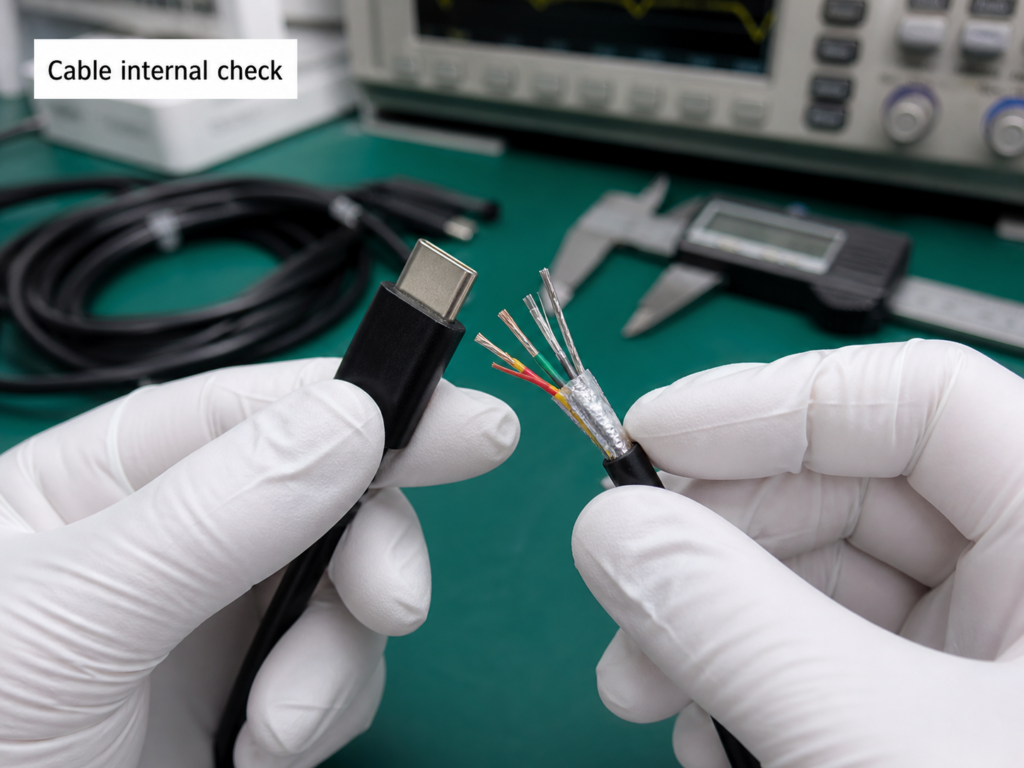
Even if the document is genuine and applicable, you still have to confirm: Is the actual mass-produced goods you sell still within the document coverage scope and technical documentation control scope? Many suppliers use good materials when submitting samples for testing, but cut corners during mass production. In this case, even if the certificate is genuine, the product may still be non-compliant.
The core of this step of verification is: Compared with the tested sample or approved document, are the changes in key parameters, structure, and core components of the actually sold mass-produced goods still within the document coverage scope and technical documentation control scope?
There are two verification methods:
The first is sampling check: take several samples from the mass-produced goods, and compare them with the key parameters, structure, and core component list marked in the certification document, such as the power supply scheme of the charger, the wire gauge and copper core material of the cable, to confirm whether the changes are still within the scope allowed by the document.
The second is third-party retesting: if it is a high-risk product, it is best to directly send it to a qualified third-party laboratory to retest core safety indicators, such as temperature rise, insulation performance, actual power, overcurrent protection function, etc. These are the places where cutting corners is most likely to cause problems.
For products such as high-power power supplies and USB-C cables with high-speed data or high-current capabilities, sampling inspection or retesting should be strengthened based on target market regulations, certification schemes, and supply chain change risks. These products have high power or functional requirements, and the impact may be greater if something goes wrong. Don’t skimp on this testing fee.
The judgment rule is: when a mass-produced product has changes related to the tested sample or approved document, it shall be assessed whether the change is still within the document coverage scope and technical documentation control scope; if it is out of scope or affects conformity, supplementary testing, document update, or sales suspension shall be carried out.
Several Common Questions During Verification
Many people encounter uncertain situations when doing verification for the first time. Here are unified answers:
First, **unable to find the number ≠ it must be a fake certificate**. The databases of some institutions update relatively slowly, especially for newly issued certificates, which may take one or two weeks to be queryable. In this case, you can directly send an email to the issuing authority for verification, and do not directly judge it as fake.
Second, **having an authorization letter ≠ you can use the certificate casually**. Be sure to carefully read the scope of the authorization letter: Does it include the product model you want to sell? Does it include the target sales market? Does it include the scenarios you want to use, such as platform listing and customs clearance? If it exceeds the authorization scope, even having an authorization letter is useless.
Third, **same factory and same appearance ≠ certification is automatically universal**. Many suppliers will say “these two models are from the same factory and same series, with the same appearance, so the certification is universal”. Don’t just believe that — when the internal materials, power, interface, etc. of the product change, you should not unilaterally assume that it is still covered. You should check the model range, restrictive conditions, key structure definition, and change assessment results specified in the document.
Emergency Loss Mitigation Steps After Discovering Fake Certification
In case you have already obtained suspicious certification documents, or even find that they may be fake after they have been listed for sale, don’t panic. Follow the steps below to minimize losses.
Stop Losses Immediately First
The first thing to do is not to quarrel with the supplier, but to stop the losses first:
First, immediately delist all involved products, suspend using this suspicious document to submit for platform review or customs clearance, and don’t let more products flow into the market;
Second, keep all relevant records: certification documents, communication records with the supplier, purchase contracts, product batch information — these are all evidence for subsequent accountability;
Third, clearly count the inventory status of the involved products: how many have not been shipped, how many are in transit, how many are in overseas warehouses, and how many have been sold — you should have a clear idea of these.
Verify the Severity of the Problem
After stopping losses, the next step is to figure out how serious the problem is:
First, require the supplier to provide the complete original certification, complete authorization chain, and official query path. Don’t let them fool you with blurry PDFs anymore;
Then, verify by yourself or entrust a third-party compliance agency to confirm what type of problem it is: is it a completely forged fake certificate, or a misappropriated certificate of another model, or parameter mismatch? Different problems have different severity levels and different handling methods;
Finally, assess the safety risk of the product: if it is a high-risk product such as a high-power charger or fast charging cable, prioritize checking for safety hazards. Don’t wait until an accident occurs to deal with it, it will be too late by then.
Four-Step Handling by Scenario (Sales Are Absolutely Prohibited Before Compliance Is Confirmed)
Before confirming that the product is fully compliant, you must never continue to sell with a fluke mentality. Handle it according to the following four steps:
First, **isolate and suspend sales** of all involved batches of products, whether they are in domestic warehouses, in transit, or in overseas warehouses. They must be isolated first to avoid flowing into consumers’ hands;
Second, first figure out what the compliance obligations are in the corresponding destination country regulations and platform rules, and then combine the severity of the problem to judge what the approximate consequences will be;
Third, find professional compliance personnel or accredited laboratories to assess the feasibility of rectification: for example, can supplementary testing, rework, labeling, and document supplementation meet compliance requirements? If yes, what is the cost?
Fourth, **handle by category** based on the assessment results:
• Domestic inventory not yet shipped: if certification can be supplemented, ship after supplementing the certification; if not, directly return the goods to the supplier or cancel the order, don’t hold them in your hands;
• Goods in transit or in overseas warehouses: if rectification is possible, such as changing packaging or supplementary labeling, sell after rectification; if rectification is not possible, return or destroy them, don’t force sales;
• Sold products: if there are safety risks, you must actively contact consumers for refunds or recalls. Don’t wait until complaints are filed with the platform or regulatory authorities, as the penalties will be heavier then;
• Listings under platform review: actively withdraw suspicious certification documents, submit genuine compliance materials for appeal, and strive for lenient treatment.
Subsequent Accountability and Rectification
After handling the immediate matters, you also need to do a good job of follow-up:
First, pursue the supplier’s liability for fraud compensation in accordance with the purchase contract. If the contract has clear fraud compensation clauses, follow the contract directly; if not, try to collect evidence for negotiation or lawsuit;
Then, sort out the compliance documents of all on-sale SKUs, and comprehensively check whether there are other fake certificates or non-compliance situations. Don’t only handle the one that had the problem;
Finally, optimize the supplier audit and compliance control processes. For example, in the future, when selecting suppliers, check certifications first, clearly add fraud liability clauses in the contract, and verify goods before warehousing after delivery, to avoid stepping into the same pit again.
Pre-emptive Pitfall Avoidance: Compliance Processes for Procurement and Platform Entry
In fact, the pit of fake certification can be completely avoided before procurement and listing, without waiting for something to go wrong to stop losses.
Certification Control at the Procurement End
To avoid fake certification from the source, the procurement link is key:
First is the **product selection stage**: prioritize suppliers who can provide formal and verifiable compliance documents. Abnormally low prices can be used as a risk signal that the verification intensity needs to be increased, but product compliance cannot be judged based on price; it should be judged based on verifiable compliance materials, product coverage scope, consistency between samples and mass production, and necessary test results.
Then is the **contract stage**, be sure to write down the key clauses clearly, don’t just rely on verbal agreements:
• Clarify the applicable target market, covered SKU scope, and traceable batch requirements to avoid suppliers fooling you with certificates from other markets;
• Clearly agree on the list of documents that the supplier needs to deliver, such as certificates, test reports, DoC, authorization chain, etc., don’t let them only give a PDF at that time;
• Require the supplier to notify in advance if the product is redesigned, the factory is changed, or key components are replaced, and must not make secret changes;
• Agree that the buyer has the right to sampling inspection, how to handle failed retests, and who bears the recall costs;
• Clarify the use authorization of certification marks, the document archiving period, and the refund and compensation liability for fraud. It is best to agree on high liquidated damages to increase the supplier’s fraud cost.
Next is **trial order verification**: when placing a small-batch trial order, first verify the authenticity and applicability of the documents, and pay the full amount after there are no problems; at the same time, check whether the parameters of the sample are consistent with those in the documents, don’t only look at the documents without checking the goods.
Finally is **change confirmation**: as long as the supplier says the product has been redesigned, the factory has been changed, or key components have been replaced, you must ask them to re-provide certification documents, verify the coverage scope, and continue to purchase goods after there are no problems.
Key Points for Platform Entry and Listing Compliance
In addition to the procurement end, you also need to check strictly when listing on the platform:
First, before listing, be sure to verify SKUs according to the coverage scope of compliance documents. If the same SKU has versions with different power, different plugs, and different wire gauges, you should confirm separately whether they are covered by the document, and cannot use one certificate for all mixed together.
Then, all compliance documents must be kept with original vouchers. Whether they are PDFs or paper documents, they must be archived by category so that they can be taken out immediately when the platform conducts random inspections, don’t be unable to find them when the time comes.
There is also **document status review**: the valid status, supervision conditions, and change requirements of each document should be checked one by one. Some third-party certificates may have a validity period or annual review; but the CE mark itself does not have a unified expiration date, and the EU DoC and technical documentation should be reviewed and updated when the product, applicable regulations, or relevant entity information changes.
For high-risk products, audits should be tightened: for example, high-power power supplies and USB-C cables with high-speed data or high-current capabilities, sampling inspection or retesting should be strengthened according to target market regulations, certification schemes, and supply chain change risks. Don’t find it troublesome.
Internal Compliance Management
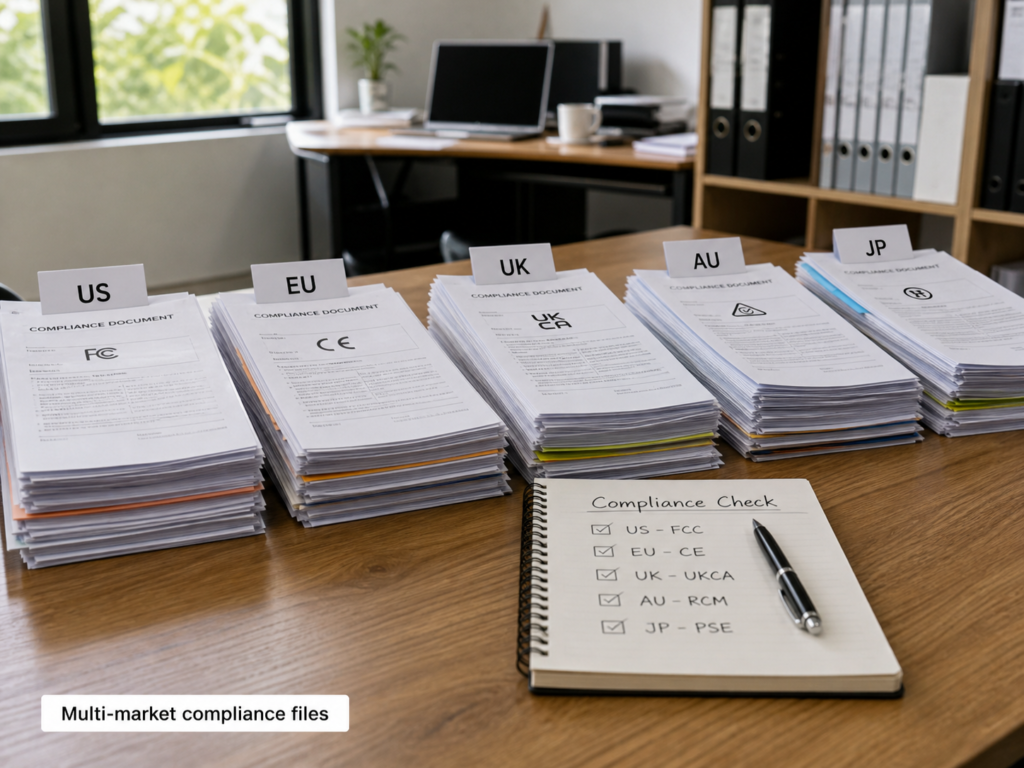
If you have a relatively large number of SKUs, it is best to establish a set of internal compliance management processes:
For example, establish a SKU certification ledger, and clearly record the product version, target market, responsible entity, document number, coverage scope, validity period or status requirements corresponding to each SKU, which is clear at a glance and will not be confused.
Then set different audit intensities according to product risk levels: high-power chargers > ordinary chargers > fast charging cables > ordinary charging cables. The higher the risk of the product, the stricter the audit and the more verification links.
In addition, compliance documents should be prepared separately for different target markets. Never have the fluke mentality of “one set of documents is universal worldwide”. The regulations of each market are different, and mixing them will cause problems sooner or later.
6 Certification Cognitive Misconceptions That New Sellers Are Most Likely to Fall Into
Finally, we have sorted out 6 certification misconceptions that 90% of new sellers will fall into. See if you have fallen for any of them:
1. **Misconception 1: Having a PDF file means genuine compliance**
Truth: Compliance documents are truly effective only after passing the three-layer verification of authenticity, applicability, and mass production consistency. Just having a stamped PDF doesn’t prove anything.
2. **Misconception 2: Products of the same series/same appearance can share certification**
Truth: The coverage scope of certification depends on the model, configuration, rated values, key structures, and applicable conditions specified in the document. When power, interface, internal materials, etc. change, you should not assume that it is still covered. The same appearance does not mean that certification can be shared.
3. **Misconception 3: There’s no problem borrowing someone else’s genuine certificate**
Truth: Without legal authorization and if the product is not within the coverage scope, even genuine documents cannot be used as the compliance basis for the current product, which may lead to review failure, delisting, or regulatory disposition; however, their legal nature and consequences are not necessarily equivalent to forged or altered certification documents.
4. **Misconception 4: No one checks low-power charging cables/accessories**
Truth: Don’t think that no one cares about low-power products. If cable parameters do not meet standards, they may also cause safety accidents such as overheating and fire. As long as there are consumer complaints or regulatory random inspections, you will be held accountable just the same. Don’t have a fluke mentality.
5. **Misconception 5: Certification is the supplier’s business, sellers don’t need to care**
Truth: Sellers cannot only rely on the supplier’s oral guarantee; they should fulfill the obligations of verification, archiving, and sales suspension required by the market and platform where they operate. Even if you can claim compensation from the supplier later, the loss of traffic and ranking caused by store penalties and listing deletions is difficult to fully compensate for.
6. **Misconception 6: Deleting the listing when something goes wrong eliminates the risk**
Truth: Even if you delete the listing, the records of sold orders, platform backend records, inventory products, and investigation records of regulatory authorities are still there, and you may still be held accountable. When something goes wrong, you should take the initiative to rectify it, don’t think that deleting the listing will end everything.
Core Summary
The content about fake certification is almost finished here. After reading this article, you should be able to master these practical skills:
First, you can identify 5 common forms of fake certification, and distinguish the boundaries between fake certification, expired genuine certification, and genuine documents but non-compliant products;
Second, you can clearly explain the 5 types of core risks of fake certification — platform penalties, regulatory accountability, safety hazards, financial and goodwill losses, and legal liability, with a clear understanding of the consequences;
Third, you can use the three-layer process of “authenticity – applicability – mass production consistency” to verify the validity of compliance documents for charging products, which can be used from beginner to advanced levels;
Fourth, you know the emergency loss mitigation steps after discovering fake certification, as well as the pre-emptive pitfall avoidance processes before procurement and listing, which can minimize risks in advance;
Fifth, you can avoid the 6 most common certification cognitive misconceptions for new sellers, and save a lot of detours.
Compliance of charging products seems complicated, but as long as you follow the process step by step and don’t have a fluke mentality, it’s actually not that difficult. After all, compliance is the long-term foundation for doing cross-border business.