
Many people who are new to cross-border wholesale and e-commerce are easily confused by the wide variety of certification terms when they first purchase electronic products such as charging cables and chargers in bulk: CE, UL, KC, FCC… Which ones are mandatory? Why can some goods clear customs but be removed from platforms? Is it really reliable if a supplier says “certificates are complete”?
This article will thoroughly explain the certification issues for bulk import of electronic products, from introductory logic to practical operation methods. It focuses on the most commonly purchased charging cables, USB/USB-C data cables, chargers, power adapters, and interface connectors, to help you avoid the pitfalls of cargo detention, listing removal, and fines.
Core Conclusions First
Let me give you three core conclusions first, to help you quickly build a cognitive framework and avoid detours:
First, **there is no globally universal certification**. It must be comprehensively judged based on the three dimensions of “product type + target market + sales channel”. Do not believe in “one certificate for the whole world”.
Second, compliance is not only in the form of third-party certification issuance. It also includes enterprise self-declaration, test reports, local registration/product labels, etc. Different requirements have different legal effects and uses.
Third, **the requirements of platforms and retailers are usually stricter than the basic customs access requirements**—being able to clear customs does not mean you can sell legally, let alone list on platforms. The two types of requirements need to be checked separately.
You can quickly find the corresponding content in the following directions: if you want to check key points by the products you sell, see “Sorting out Compliance Key Points by Product Type”; if you want to check requirements by target market, see “Compliance Requirements for Common Markets”; if you want to know how to verify suppliers’ certificates, see “Procurement Certification Verification Methods”; if you want to follow the steps through the entire process, see “Full Process Compliance Operation Steps for Bulk Import”; if you want to avoid pitfalls and calculate costs, see “Pitfall Avoidance and Cost Decision Guide”.
Sorting out Compliance Key Points by Product Type
Now that we understand the core logic, let’s break down the core compliance focus points one by one for the most commonly purchased types of charging products. You can directly correspond to your own products:
Passive Ordinary Charging Cables/Data Cables (No Chip)
These are what we often call “ordinary charging cables”, which only have pure copper conductors inside and no electronic chips, such as the common USB-A to USB-C ordinary charging cables.
The compliance focus of such products is mainly on environmental protection (such as RoHS restriction of hazardous substances), material flame retardancy, and label compliance. Usually, mandatory electrical safety and Electromagnetic Compatibility (EMC) certifications are not required—of course, the specific requirements shall be subject to the regulations of the destination, and there may be slight differences in different countries.
Active Data Cables with Chips
For example, USB-C full-featured cables with E-Marker chips (supporting fast charging, data transmission, video output) and Apple Lightning data cables all fall into this category. Because they contain electronic chips, they are products with electronic functions.
At the level of statutory compliance, it is necessary to judge whether EMC requirements need to be met according to the power supply structure of the product and the regulations of the destination. In addition, the commonly heard USB-IF certification and MFi certification belong to **ecosystem rule requirements, not statutory mandatory**: for example, you only need to obtain USB-IF certification if you want to use the official USB logo and claim official PD fast charging compatibility; you only need to meet MFi requirements if you want to produce Lightning accessories and use Apple-related trademarks. Not all cables with chips are required to have them.
Chargers/Power Adapters (Active Wall-Plug Type)
These are what we often call charging heads and power adapters, with AC plugs, which convert alternating current to direct current. They are active electronic products and also the category with the most compliance requirements.
There are three core focus points: electrical safety (preventing electric shock and fire), Electromagnetic Compatibility (EMC), and energy efficiency (energy saving requirements). For multi-port chargers, special attention should be paid: the test must cover the maximum total power, maximum single-port output, and combined working conditions of multi-port simultaneous output, and cannot only test a single port.
Charging Products with Additional Functions
If a charging product has additional functions, the compliance requirements will also increase correspondingly:
• Those with wireless charging, Bluetooth, or Wi-Fi functions: need to additionally meet radio frequency (RF)/spectrum compliance requirements, because they involve wireless signal transmission.
• Those with lithium batteries (such as power banks, power banks with built-in cables): need to meet both product safety requirements and lithium battery dangerous goods transportation rules. The UN 38.3 test summary and the declaration, packaging, marking and labeling materials required by the carrier shall be obtained and provided as needed; the specific documents and operations shall be determined according to the battery configuration, rated energy, transportation method and carrier rules, and the whole product safety report cannot be used to replace transportation compliance evidence.
Impact of Plugs and Voltage on Compliance
Many people ignore this point: the compliance documents corresponding to different national plug specifications (US standard, EU standard, UK standard, AU standard, etc.) are not universal. For example, if you have obtained CE certification for a charger with an EU standard plug, it cannot be directly applied to the same model of charger with a UK standard plug, and separate matching tests are required.
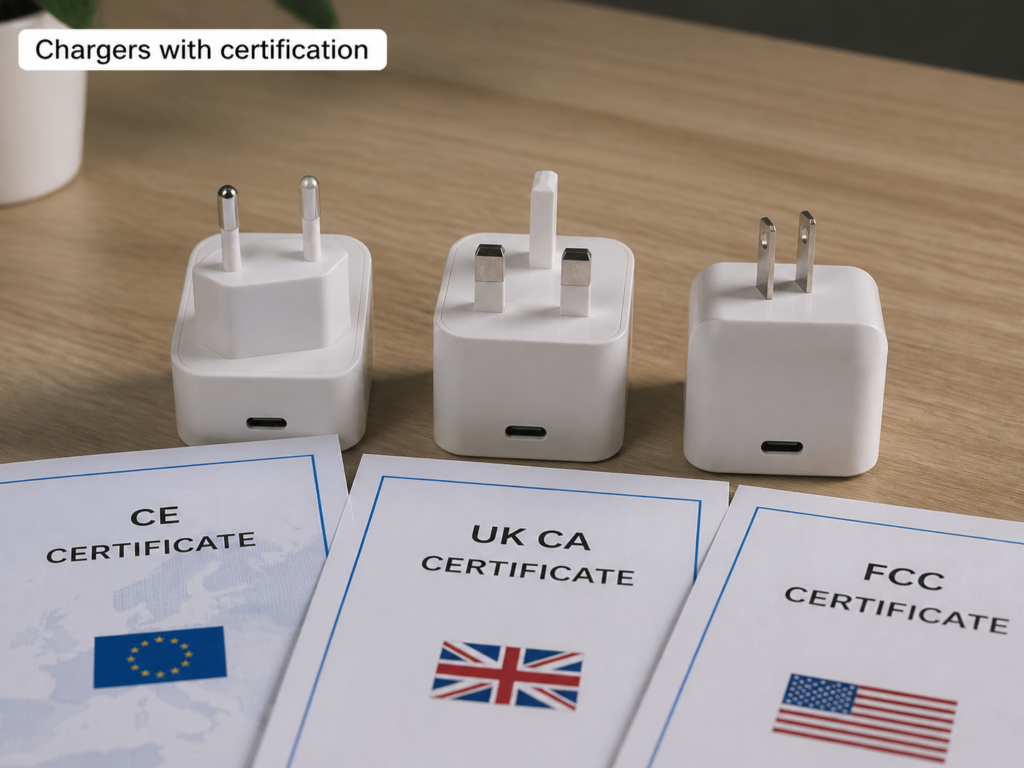
In addition, the input voltage range of the product (such as 100-240V wide voltage) will affect the test conditions and nameplate labeling. When doing certification, it must be based on the actual product parameters, and cannot be written arbitrarily.
Relationship Between HS Code and Certification
The HS code is a code used by customs to classify products, calculate tariffs, and initially screen regulatory requirements. Many people think that the HS code can determine what certifications are needed, but that is not correct.
The HS code can only be used as a preliminary reference and cannot alone determine certification requirements—products under the same HS code may be subject to different regulations due to different power and functions. In practice, it is recommended to find a freight forwarder or compliance consultant for pre-classification in advance to avoid missing compliance requirements.
Non-statutory Access Requirements
In addition to legally mandatory certifications, there are some requirements that are not statutory, but if you want to sell through specific channels or make specific claims, you must meet them. Many people easily confuse these with statutory requirements.
General Additional Requirements for Cross-border E-commerce Platforms
Almost all mainstream cross-border e-commerce platforms have higher compliance requirements than the basic customs access requirements. For example, Amazon in the US requires chargers to have NRTL certification, but customs clearance only requires FCC SDoC.
Common platform review requirements include: the certificate number can be queried through official channels, proof of consistency between the brand and the certificate holder, actual photos of the product nameplate, etc. Special attention should be paid: platform review requirements are not equal to national statutory certification requirements, and you need to separately check the rules of the corresponding category, and cannot only prepare according to customs clearance requirements.
Interface Ecosystem and Trademark Use Requirements
Such requirements are industry ecosystem rules, not statutory mandatory. They are only required when you want to use the corresponding trademarks or make related claims:
• USB-IF certification: If you want to use the official USB logo, PD registered trademark, or claim official compatibility, you must obtain it, and cannot make false compatibility claims.
• MFi certification: If you produce Lightning accessories and use Apple-related trademarks, you need to meet MFi requirements; USB-C accessories should be confirmed according to the latest MFi scope, and not all USB-C accessories require MFi.
• Fast charging protocol certification: For example, Qualcomm QC, MediaTek PE and other fast charging protocols, if you want to use the corresponding trademark and claim support for the protocol, you need to obtain the corresponding certification.
Supplementary Performance and Safety Tests
Such tests are used to improve product competitiveness and are not mandatory access requirements:
• UL94 flame retardant rating: It is the flame retardant classification of materials/components. The shells and cable sheaths of high-power products usually undergo higher-level flame retardant tests as a selling point.
• IP protection rating: Water and dust resistance test based on IEC 60529 standard, commonly used for outdoor products.
• Supplementary energy efficiency: Statutory energy efficiency is the access threshold, while voluntary energy-saving labels such as Energy Star are marketing selling points and not mandatory.
Supplier System Requirements
For example, ISO 9001 quality management system certification is a threshold for large customers and brand owners to select suppliers. It is a requirement for the factory’s management system, not a mandatory certification for the product itself. Do not confuse it with product certification.
Full Process Compliance Operation Steps for Bulk Import
After finishing all the knowledge points, let’s string together the entire compliance process for bulk import. You can follow the steps step by step to avoid omissions.
Step 1: Before Placing an Order, Establish a Compliance Requirement List
Before placing an order, you must sort out the requirements clearly, and do not pay in a confused manner:
• Fill in product information: product category, model, power, interface, plug specification, whether with wireless/battery, HS code prediction.
• Fill in sales information: target country/warehousing location, sales channel, purchase quantity.
• List certification requirements clearly: divide into three categories: statutory access, platform requirements, and customer requirements, to avoid missing items or doing unnecessary certifications.
Step 2: Sample Review Stage, Verify the Matching Degree Between Documents and Physical Products
After getting the samples, don’t just look at the appearance. First check compliance:
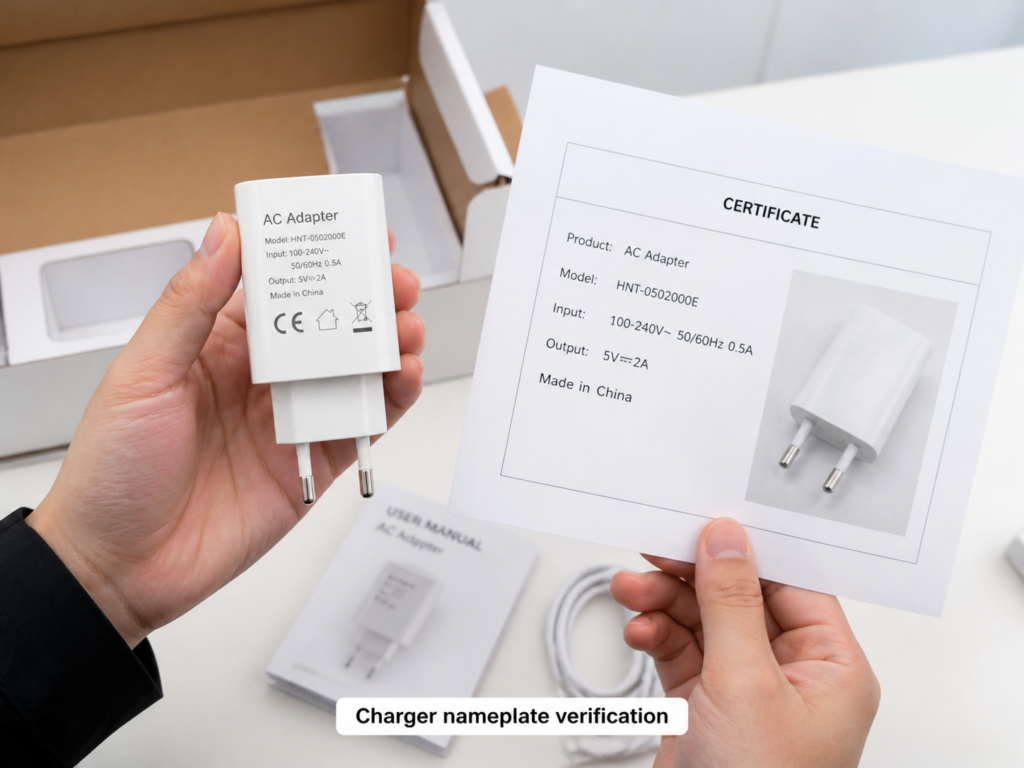
• Document review: According to the verification methods mentioned above, check the authenticity and matching degree of all certification documents.
• Sample check: Check whether the nameplate parameters, plugs, packaging, and manuals of the samples are consistent with the descriptions in the documents, meeting the three-consistency standard.
• For high-risk products, such as high-power chargers above 65W, it is recommended to arrange a third-party institution for sampling verification, and do not just rely on the documents provided by the supplier.
Step 3: Sign a Contract to Lock in Compliance Responsibilities
Be sure to sign a formal purchase contract and clearly state the compliance responsibilities to avoid disputes later:
• Clarify the applicable market, certification requirements, and language and content requirements of labels.
• Agree that any change to the core parameters of the product must be notified in writing in advance, otherwise the supplier shall bear full responsibility.
• Clarify the division of responsibilities for rework, compensation, recall, and supplementary document submission of unqualified products.
Step 4: Before Shipment, Label and Packaging Inspection
After the bulk goods are ready and before shipment, be sure to conduct an inspection:
• According to the three-consistency standard, check all identification information of the product, packaging, and manual.
• For products with batteries, check whether the shipping labels, packaging methods, and declaration materials meet the transportation requirements.
• Inapplicable certification marks must never be printed. If found, immediately ask the supplier to rectify.
Step 5: Customs Clearance and Listing, Prepare Materials as Required
• Customs clearance materials: Prepare according to the requirements of the importer/freight forwarder, combined with the HS code and regulatory catalog, including declaration documents, DoC, certification copies, etc.
• Platform listing materials: Submit according to the platform category requirements, such as certificate query links, brand authorization letters, etc.
• Document archiving: All documents are archived by product model and batch. The retention period shall be set separately according to the target market and applicable regulations, and the longest mandatory period among them shall prevail; for example, technical documentation and EU DoC subject to EU harmonized regulations shall generally be kept for 10 years after the product is placed on the market. Procurement, batch and sales traceability records shall also be kept in accordance with local product safety, tax and platform rules.
Step 6: Subsequent Maintenance, Regularly Review Validity
Compliance is not a one-time thing. It needs to be reviewed regularly:
• For new batches, factory changes, and product modifications, the validity of the certification must be re-examined.
• When the regulations and standards of the destination country are updated, it is necessary to confirm in time whether the existing certificates are still compliant, to avoid violations due to changes in regulations.
Pitfall Avoidance and Cost Decision Guide
The last part is about what everyone cares most about: how to avoid pitfalls and save money, to help you meet compliance requirements at the lowest cost.
5 Decision Misconceptions That Easily Cause Direct Losses
These five pitfalls have been stepped on by many people, and each one may lead to direct economic losses. Be sure to avoid them:
1. **”If customs clearance is granted, you can sell with confidence”**: Wrong. Customs clearance is only passing the customs level. Market supervision spot checks and platform reviews may result in listing removal, fines, and recalls due to non-compliance. Platform and market requirements are often stricter than customs.
2. **”Small batches/samples can go through gray customs clearance”**: Wrong. Commercial bulk import evading declaration or regulatory requirements has extremely high risks, which may lead to detention, return shipment, confiscation, administrative penalties, as well as credit management or tightened subsequent supervision; the specific consequences depend on the illegal act, the determination of the competent authority and legal procedures. Never lose a lot because of a small gain.
3. **”Changing packaging/Logo does not affect certification at all”**: Wrong. If you change the brand, the responsible entity, or the way the certification mark is used, you may need supplementary authorization or recordation, and cannot change it arbitrarily.
4. **”Battery documents can be replaced by the whole product report”**: Wrong. The transportation safety and product safety of lithium batteries are two completely different sets of requirements. Products with lithium batteries shall meet product safety and dangerous goods transportation rules respectively, and prepare UN 38.3 test summary, declaration, packaging, marking and labeling materials according to battery configuration, rated energy, transportation method and carrier rules. The whole product safety report cannot be used to replace transportation compliance evidence.
5. **”The more certifications, the better”**: Wrong. It is enough to only do the certifications required by the target market’s statutory requirements + sales channel requirements, to avoid increasing costs without purpose. For example, when only selling to the EU, UL certification usually cannot replace the applicable conformity assessment required for CE, and may not be required by law or channels; but it may still have commercial value for design verification, customer requirements or other market planning. You should first meet the applicable EU regulations, and then decide whether to add UL-related tests or certifications according to actual needs.
Certification Selection Logic for Different Procurement Scenarios
The optimal certification plan is different for different procurement scenarios. You can choose according to your own situation:
• **Small-batch trial order**: Prioritize suppliers that already have compliance documents for the target market, so you don’t need to do certification separately, reducing upfront costs.
• **Customized products**: If you only change the outer carton and packaging text, you don’t need to redo the certification; if you change the core parameters, functions, or structure, a written assessment shall be conducted by the certificate holder, certification body or compliance responsible party, and supplementary testing, change, re-certification or document update shall be determined according to the assessment conclusion. You cannot self-determine that it must be redone or can be continued to use.
• **Multi-market sales**: You can evaluate using the CB scheme as the test basis, and then convert to certifications of each target country, to reduce possible duplicate testing costs; but first confirm the acceptance of the target country, national differences, supplementary tests, factory inspections and local application requirements, and cannot default that CB reports can directly replace local certifications.
• **Platform sales**: First check the compliance requirements of the platform category, then supplement certifications. Do not only prepare according to the minimum requirements of customs, otherwise you will not be able to list.
Certification Cost and Cycle Planning
Many people ask “How much does a certification cost? How long does it take?” In fact, there is no unified quotation and cycle, which all depend on the product situation. Here I will explain the cost composition and influencing factors clearly, to facilitate your inquiry and planning:
Common Cost Composition
• Testing related: sample fee, testing fee, rectification and retesting fee if the product is unqualified.
• Certification/registration related: certificate registration fee, factory audit fee for some certifications, annual maintenance fee for some.
• Supporting services related: label/manual translation and revision fee, local responsible person service fee, platform re-review fee.
Core Factors Affecting the Cycle
Product complexity, whether there are existing test reports, laboratory scheduling, number of rectifications, institutional approval efficiency.
Information to Provide for Quotation
When making an inquiry, be sure to provide all this information, otherwise the price quoted by the institution will be inaccurate: product type, complete rated parameters, target market, sales channel, existing report status, purchase quantity.
All quotations shall be subject to the written quotation of the institution. Do not believe verbal quotations, and do not choose unregulated institutions for cheap prices, which will result in greater losses if you get fake certificates in the end.
Response Process for Certification Rejection/Spot Check Failure
In case you encounter certification rejection or failed spot checks, don’t panic. Follow the steps below to minimize losses:
1. **Step 1: Immediately stop losses**: Immediately stop selling products of the same batch, suspend shipment, to avoid more products flowing into the market and expanding losses.
2. **Step 2: Preserve evidence**: Preserve the inventory of the involved batches and all compliance documents, isolate the inventory, and never continue to sell after privately changing marks, otherwise the penalty will be heavier.
3. **Step 3: Verify the cause**: First figure out where the problem is, whether it is inconsistent model/parameters, non-compliant labels, or fake, expired, or subject-inconsistent certificates. Only by finding the root cause can targeted rectification be carried out.
4. **Step 4: Formulate a rectification plan**:
• If it is a problem with labels or materials: rectify the labels in time, supplement materials, and resubmit for review.
• If it is a fake certificate, borrowed certificate, or mismatched certificate: immediately replace with a compliant supplier, or re-apply for certification.
5. **Step 5: Submit rectification confirmation**: Submit the rectification plan to the platform or competent department, and after obtaining written confirmation, resume sales or shipment. Never secretly modify and sell on your own.
Checklist and Frequently Asked Questions
For the convenience of self-inspection, I have sorted out a three-stage SKU compliance checklist. You can print it out and check each SKU according to this:
| Stage | Check Items |
| Before placing an order | 1. Clarify the country of import/sales/warehousing and sales channel<br>2. Clarify product type and core parameters<br>3. List all compliance checklists required by statutory + channel requirements<br>4. Obtain complete certification documents provided by the supplier (not just the cover)<br>5. Check that the certificate model, parameters, validity period, and scope of application match the product |
| Before shipment | 1. The physical nameplate parameters are completely consistent with the certification documents<br>2. The information of the product, packaging, and manual is consistent (three-consistency standard)<br>3. Products with wireless/battery have corresponding supplementary documents<br>4. All certification documents are archived and saved by SKU and batch |
| After listing | 1. Product claims are consistent with the certification scope (no false propaganda)<br>2. Retain complete compliance documents to respond to regulatory spot checks<br>3. Regularly track updates to regulations in the destination country |
Frequently Asked Questions
Finally, let’s answer a few of the most commonly asked questions to help you find answers quickly:
1. **Is UL certification mandatory for chargers imported into the US?**
There is no mandatory UL certification at the statutory level, but e-commerce platforms and large retailers usually require NRTL safety certification. UL is one of the NRTL institutions, and you can also choose certifications from other NRTL institutions such as ETL and cTUVus. If you sell on Amazon US, NRTL certification is basically required.
2. **Do charging cables exported to the EU need CE?**
It depends on the type of charging cable: passive ordinary low-voltage charging cables usually do not fall under the LVD Low Voltage Directive; whether cables with electronic modules fall under directives such as EMC shall be judged according to whether the product is within the applicable scope, whether it may generate electromagnetic disturbance or its performance may be affected by electromagnetic disturbance, and whether there are exclusion scenarios. It cannot be automatically determined just because it has an E-Marker chip. Requirements such as RoHS and WEEE still need to be met, and the final judgment shall be combined with product parameters and regulations.
3. **Can CE certificates be used in the US?**
No. CE is only valid in the EU and mutual recognition areas. The US has its own compliance requirements such as FCC and NRTL, and the two cannot replace each other.
4. **How to verify that the charger’s certification certificate is real?**
First, confirm that the issuing institution is officially recognized by the target market, then go to the institution’s official website to enter the certificate number to query, and check that the certification status, applicable standards and their version update requirements, certification scope, model series or derivative model descriptions, and certificate holder information are consistent with the actual product.
5. **Is EMC certification mandatory for USB-C cables with chips?**
Not necessarily. It depends on the regulations of the target market and the actual characteristics of the product. Taking the EU as an example, it shall be judged whether the product falls within the scope of the EMC Directive, whether it may generate electromagnetic disturbance or its performance may be affected by electromagnetic disturbance, and whether there are applicable exclusion scenarios; a conclusion cannot be automatically drawn just because it has an electronic module or E-Marker chip. Ordinary passive cables usually do not need it, and the specific judgment shall still be combined with product functions and local regulatory requirements.
Final Summary
The certification for bulk import of electronic products is essentially “specific issues are analyzed specifically”—there is no universal certificate, nor is there a universal answer. The core is to grasp the three core variables: product type, target market, and sales channel.
After reading this article, you should be able to: judge the statutory + necessary compliance documents according to the product, market, and channel, distinguish different compliance tools without being confused by concepts, verify the authenticity of supplier certificates and identify fake and borrowed certificates, select cost-effective certification plans according to procurement scenarios, complete the full-process compliance operation from order placement to listing, and avoid common risks of cargo detention, listing removal, and fines.
Compliance is never “spending more money to buy certificates”, but planning in advance, carefully verifying, and doing the work in front, so as to avoid large losses later.